Every successful interview starts with knowing what to expect. In this blog, we’ll take you through the top Flexography Printing interview questions, breaking them down with expert tips to help you deliver impactful answers. Step into your next interview fully prepared and ready to succeed.
Questions Asked in Flexography Printing Interview
Q 1. Explain the difference between conventional and UV flexographic inks.
The primary difference between conventional and UV flexographic inks lies in their curing mechanism. Conventional inks, also known as solvent-based or water-based inks, rely on oxidation or evaporation of the solvent to dry. This process can be slow and requires significant drying time, often involving ovens or extensive air circulation. UV inks, on the other hand, cure instantly upon exposure to ultraviolet light. This rapid curing allows for faster production speeds and eliminates the need for extensive drying infrastructure.
Think of it like this: conventional inks are like paint – they dry slowly through the loss of a liquid component. UV inks are like glue that instantly hardens when exposed to a special light.
Practically, this means that UV inks are ideal for high-speed printing and applications requiring immediate handling, while conventional inks are suitable for applications where faster drying isn’t a critical concern and cost might be a bigger factor (UV equipment is a more significant capital investment).
Q 2. Describe the process of anilox roller selection for a specific printing job.
Anilox roller selection is crucial for consistent ink transfer and print quality. It’s a multi-faceted process that starts with understanding the job specifications. We need to know the substrate (e.g., paper, film, corrugated board), ink type (conventional, UV, water-based), desired print quality (halftone screen, solid areas), and the required ink coverage (%).
- Substrate analysis: Different substrates require different ink transfer rates. Porous substrates like paper need more ink, while non-porous substrates such as films need less.
- Ink type: UV inks, being thicker, often require a slightly lower line count than solvent based inks.
- Print quality: Fine detail requires a high line-count anilox roller with a smaller cell volume to achieve the required resolution. Solid areas benefit from lower line counts with larger cell volume to ensure smooth coverage.
- Ink coverage: This dictates the BCM (Billion Cubic Microns) rating of the roller. A higher ink coverage requires a higher BCM rating.
Once we understand the job, we can use our experience and available anilox charts to identify the most appropriate line count and BCM. For example, for fine halftone printing on a film substrate using a conventional ink, we’d choose a high line-count anilox with a relatively low BCM. However, for a high-coverage solid on a corrugated board using UV ink, we’d choose a lower line-count roller with a higher BCM. Ultimately, testing and fine-tuning are essential to get the perfect result.
Q 3. How do you troubleshoot common flexographic printing problems like slurring or mottle?
Slurring and mottle are two common flexographic print defects. Slurring refers to a blurred or smeared image, while mottle is characterized by uneven ink distribution, leading to a speckled appearance.
- Slurring: This is often caused by excessive ink viscosity, improper impression pressure, or worn printing plates. To troubleshoot, we start by checking the ink viscosity. If it’s too high, we dilute it. Next, we examine the impression pressure; it might be too high, causing the ink to spread. Finally, we inspect the printing plate for damage or wear.
- Mottle: Mottle can stem from several sources, including improper anilox roller cleaning, insufficient ink transfer, or variations in the anilox cell geometry. The first step is to meticulously clean the anilox roller. Then we check the impression pressure, which may be too low. If the problem persists, a microscopic examination of the anilox roller’s surface may be needed. It’s also essential to ensure the ink is consistently mixed and being properly transferred from the ink pan.
In practice, it involves a systematic approach: check the ink, the pressure, the plate, and then consider the anilox roller itself. Often, it’s a combination of factors that need adjustment to eliminate these defects.
Q 4. What are the key factors affecting print register in flexography?
Print register, the accurate alignment of multiple colors or print elements, is critical in flexography. Several factors influence its accuracy:
- Press mechanics: Precise press registration mechanisms are essential. Wear and tear in the press components can lead to misalignment. Regular maintenance and calibration of the press are crucial.
- Plate mounting: Incorrect plate mounting can result in poor register. Plates must be precisely positioned and securely attached to the printing cylinders. The use of high-quality mounting tapes is important.
- Substrate handling: Uneven tension or slippage of the substrate during printing can distort the printed image and compromise register. This calls for appropriate adjustments to the web tension settings.
- Web path: The path the substrate takes through the press should be smooth and consistent. Changes in the web path cause misregistration.
- Environmental factors: Temperature and humidity variations can affect the substrate’s dimensions, indirectly influencing register.
A good example of a register issue is when a multi-color label isn’t perfectly aligned; one color might be slightly offset from another. This directly affects the quality of the final printed product.
Q 5. Explain the importance of maintaining proper ink viscosity.
Maintaining proper ink viscosity is essential for consistent print quality and efficient production. Viscosity, the thickness of the ink, directly impacts ink transfer and print characteristics.
- Ink transfer: Too high viscosity leads to poor ink transfer, resulting in light prints or skips, whereas too low viscosity leads to excessive ink transfer, causing slurring or excessive dot gain.
- Print consistency: Consistent viscosity ensures uniform ink coverage and color across the entire print run. Fluctuations in viscosity lead to variations in color density and overall print quality.
- Press performance: Incorrect viscosity can strain the press components, leading to malfunctions or reduced efficiency.
Imagine trying to paint with paint that is too thick or too thin – the results would be inconsistent. Similarly, the proper viscosity ensures the ink is applied uniformly and prints reliably across the entire run.
Q 6. Describe your experience with different types of flexographic printing plates.
My experience encompasses various flexographic plate types, each with its strengths and limitations:
- Photopolymer plates: These are the most common type, offering good quality, relatively low cost, and decent durability. I’ve extensively used them for various applications, from simple packaging to high-quality labels.
- Digital plates: These plates are created using digital imaging technology, offering high precision, fast turnaround times, and reduced waste compared to photopolymer plates. These have proven invaluable for short runs and customized jobs.
- Ceramic plates: Known for their exceptional durability and longevity, they are ideal for high-volume production where long run lengths are involved. They require specialized equipment and expertise for processing.
The choice of plate material depends on the job’s requirements. For instance, digital plates are excellent for short runs and variable data printing, while photopolymer plates are versatile and cost-effective for medium runs, and ceramic plates excel in high-volume printing where longevity is key.
Q 7. How do you ensure consistent color reproduction across multiple runs?
Consistent color reproduction across multiple runs is achieved through a combination of precise color management practices:
- Accurate color profiling: Color profiles of the press, inks, and substrates must be created and consistently utilized across different print runs. This ensures accurate color conversion from the digital design to the final printed output.
- Standardized ink formulation: Using the same ink batches from the same supplier, or carefully matching batches from multiple sources, helps maintain consistency. This minimizes variations due to formulation differences.
- Regular press calibration: Regular press maintenance and calibration ensure consistent ink transfer and registration.
- Consistent substrate: Using the same type and batch of substrate minimizes variation due to differences in the material’s characteristics.
- Color measurement and control: Utilizing color measurement devices such as spectrophotometers enables objective color measurement, facilitating adjustments to maintain consistent color across runs. This allows for color correction based on precise data and minimizes subjective decisions.
Imagine baking a cake – you’d want the same ingredients, the same oven temperature, and the same baking time to achieve consistent results. Similarly, consistent color reproduction requires consistency in all the contributing factors.
Q 8. What are the different types of drying systems used in flexographic printing?
Drying systems in flexographic printing are crucial for ensuring the ink sets properly and prevents smearing or offsetting. The choice of system depends heavily on the ink type, substrate, and production speed. Common types include:
- Hot Air Drying: This is the most prevalent method, utilizing heated air blown across the printed web. The temperature and airflow are carefully controlled to achieve optimal drying without damaging the substrate. For instance, a high-speed production line might use multiple banks of hot air dryers to ensure rapid and complete drying of inks.
- Infrared (IR) Drying: IR dryers use infrared radiation to directly heat the ink, promoting rapid evaporation of solvents. This method is particularly effective for high-speed printing and certain ink formulations, like UV inks, that require intense heat. IR drying often complements hot air drying in a hybrid system for superior results.
- UV (Ultraviolet) Curing: UV curing uses UV lamps to instantly polymerize UV inks, eliminating the need for drying time. It’s a highly efficient system, perfect for applications requiring immediate further processing, such as lamination or converting. However, it requires specialized UV inks and lamps, which adds to the initial investment.
- Hybrid Systems: Many modern flexo presses incorporate hybrid drying systems, combining hot air, IR, and sometimes even UV curing for maximum flexibility and efficiency. This allows for adapting the drying process to different inks and substrates, maximizing output quality and speed.
Selecting the right drying system is a critical decision impacting production speed, print quality, and overall efficiency. A thorough understanding of the inks and substrates being used is essential for optimizing the drying process.
Q 9. Explain the concept of line screen ruling and its impact on print quality.
Line screen ruling refers to the number of lines per inch (lpi) or lines per centimeter (lpc) used to create the halftone dots that make up a printed image. Think of it like a grid overlaid on the image; the finer the grid (higher lpi), the more detail the image can capture. This directly impacts print quality.
A higher lpi (e.g., 175 lpi or higher) results in smoother gradations, finer detail, and a sharper overall image. However, it demands higher printing precision and can be more susceptible to dot gain (the spreading of ink dots during printing). High-lpi screens are ideal for high-quality images with fine details, such as photographic reproductions.
A lower lpi (e.g., 60-133 lpi) is used for applications where fine detail is less critical. It allows for a more robust printing process, tolerating minor inconsistencies in print pressure. Lower-lpi screens are often employed for solid color areas or simpler graphic designs. Using a lower lpi screen for detailed images results in a muddy or less crisp appearance.
Choosing the right line screen ruling involves balancing image quality requirements with the capabilities of the press and inks. Factors like substrate absorbency and ink viscosity play a significant role in determining the optimal lpi for any given job.
Q 10. How do you measure and control web tension during the printing process?
Maintaining consistent web tension is crucial for preventing defects such as wrinkles, breaks, and registration problems. It’s controlled through a combination of mechanical and electronic systems.
Measurement: Web tension is measured using tension transducers strategically placed along the press. These transducers provide real-time feedback on the tension level. Some common measurement techniques include:
- Load Cell Measurement: This measures the force applied to the web.
- Dancer Roll System: A dancer roll, a freely rotating roll, responds to variations in web tension. Its position indicates the tension level.
Control: Web tension is controlled through several mechanisms, often working together:
- Air Brakes: Air brakes regulate the speed of the unwind and rewind rolls, directly affecting tension.
- Tension Control Systems (TCS): Sophisticated TCS systems use electronic feedback from the tension transducers to automatically adjust the brake tension and maintain the desired web tension level.
- Web Guiding Systems: These systems help maintain the web’s path, further contributing to tension control by minimizing lateral shifts and preventing unwanted stresses.
Experience in accurately setting and monitoring web tension is gained through continuous monitoring, adjustments, and troubleshooting. Consistent tension control is a cornerstone of quality printing and minimizes material waste.
Q 11. What is your experience with different types of substrates used in flexography?
My experience encompasses a wide range of substrates commonly used in flexographic printing. This includes:
- Paper: From lightweight papers for labels to heavier-weight paperboard for cartons, paper substrates require careful consideration of ink absorption and surface treatment to ensure optimal print quality and adhesion.
- Films: Various plastic films, including polyethylene (PE), polypropylene (PP), and polyester (PET), are frequently used for flexible packaging. The choice depends on the product’s requirements regarding barrier properties, printability, and heat resistance. Each film type requires specific ink and press settings.
- Foils: Metallic foils offer a premium look and feel but require specialized printing techniques due to their non-porous nature. I have experience optimizing ink transfer and adhesion for various foil types.
- Laminates: Multi-layer structures combining paper, film, and foil often require careful control of the printing process to prevent ink migration and delamination. This is where precise control of web tension, drying, and ink selection is paramount.
- Corrugated Board: Printing on corrugated board demands inks with high opacity and adhesion properties, as well as proper press settings to accommodate the substrate’s texture.
Understanding the characteristics of each substrate is crucial for selecting the appropriate inks, press settings, and drying system. It’s not merely about choosing the correct materials but ensuring that they are compatible and result in a high-quality print.
Q 12. How do you manage waste and ensure sustainable practices in flexographic printing?
Sustainable practices are increasingly important in flexographic printing. We focus on minimizing waste and maximizing resource efficiency in several ways:
- Ink Reduction Techniques: Employing techniques like Enhanced Screen Printing, where dots are designed for higher density and reduced ink usage, can significantly decrease ink consumption.
- Wastewater Treatment: Proper handling and treatment of wastewater generated during cleaning and production, often involving filtration and recycling, are essential for environmental responsibility. Compliance with relevant environmental regulations is non-negotiable.
- Solvent Management: Careful management of solvents, including minimizing usage, using low-VOC (Volatile Organic Compound) inks, and recovering or recycling solvents wherever possible, is vital for reducing air pollution.
- Substrate Selection: Choosing sustainably sourced substrates, such as recycled paper or bio-based films, contributes significantly to environmental sustainability.
- Energy Efficiency: Optimizing press parameters to minimize energy usage during drying and other processes is a key focus. This includes regular maintenance to ensure optimal energy efficiency.
- Waste Segregation and Recycling: Implementing a system for segregating and recycling waste materials, such as ink containers, plates, and substrate scraps, is crucial for reducing landfill waste.
Implementing these practices not only reduces environmental impact but also contributes to cost savings through efficient resource utilization. It’s a continuous improvement process, constantly looking for innovative ways to minimize our environmental footprint.
Q 13. Describe your experience with pre-press processes in flexography.
My pre-press experience involves a thorough understanding of the steps leading to the actual printing process. This begins with:
- File Preparation and Review: Ensuring that the artwork files are in the correct format and resolution for high-quality flexo printing. This involves checking color profiles, trapping, and overall image integrity.
- Plate Making: I have experience working with various plate-making technologies, including digital platemaking and laser-ablation techniques. This involves selecting the appropriate plates for the substrate and print job, ensuring consistent dot shape and size across the plate.
- Color Management: Accurate color management is critical. This involves working with color profiles to ensure consistent color reproduction across different stages of the process, from design to final print.
- Proofing: Reviewing proofs and making adjustments as necessary to ensure accuracy before proceeding to full-scale printing. Both soft proofing (digital) and hard proofing (physical prints) are involved.
- Plate Mounting and Inspection: Properly mounting plates on the printing cylinders to ensure accurate registration and print quality. Thorough inspection is essential to identify any defects.
Efficiency and accuracy in pre-press are vital to minimizing errors and ensuring a successful printing run. A streamlined process and good communication with the design team are crucial.
Q 14. How do you interpret a flexographic printing press specification sheet?
A flexographic printing press specification sheet provides a comprehensive overview of the press’s capabilities and features. Interpreting this document is essential for determining if a press is suitable for a given printing application.
Key aspects I look for include:
- Print Width: The maximum width of the substrate that the press can handle.
- Number of Colors: The maximum number of printing units the press has.
- Maximum Print Speed: The fastest speed at which the press can operate, expressed in meters per minute.
- Impression Cylinder Diameter: The diameter of the impression cylinders affects the print pressure and quality.
- Web Path Length: The total distance the web travels through the press, relevant for drying considerations.
- Drying System Specifications: Details on the type and capacity of the drying system (hot air, IR, UV). This helps determine the suitability of the press for different ink types and substrates.
- Automation Features: Information on automation features, such as automatic register control, web tension control, and plate changing systems. These features can greatly impact efficiency and consistency.
By thoroughly reviewing these specifications, we can assess the press’s suitability for a project, considering factors such as print quality, speed, substrate, ink types, and budget. Comparing several specification sheets enables informed decision-making when choosing a press for a specific production need.
Q 15. Explain the importance of proper cleaning and maintenance of flexographic printing equipment.
Proper cleaning and maintenance of flexographic printing equipment is paramount for consistent print quality, minimizing downtime, and extending the lifespan of the press. Think of it like regularly servicing your car – neglecting it leads to breakdowns and expensive repairs.
Anilox Roll Cleaning: Regular cleaning of anilox rolls is critical. We use specialized cleaning solutions and brushes to remove ink and debris, ensuring consistent ink transfer. Failing to do so leads to clogged cells, resulting in uneven ink coverage and poor print quality. I’ve personally seen instances where improper cleaning led to a full anilox roll replacement, a costly mistake that could have been avoided.
Impression Cylinder Care: The impression cylinder needs regular inspection for wear and tear. Scratches or damage can lead to poor print quality and plate damage. We check for imperfections and polish the cylinder as needed. A poorly maintained impression cylinder can cause inconsistent pressure, leading to uneven print density.
Plate Cylinder Cleaning: After each print run, the plate cylinder must be thoroughly cleaned to remove residual ink. We use appropriate solvents and cleaning techniques to avoid damaging the plates. Leaving ink residue can affect the next print job and lead to plate contamination.
Doctor Blade Replacement: Doctor blades, which remove excess ink from the anilox roll, wear down over time. Regular inspection and timely replacement are vital. A worn doctor blade can cause ink streaks and poor print quality. I once experienced a significant production delay due to a worn doctor blade causing inconsistent ink coverage on a large-scale project. It taught me the importance of preventative maintenance.
Career Expert Tips:
- Ace those interviews! Prepare effectively by reviewing the Top 50 Most Common Interview Questions on ResumeGemini.
- Navigate your job search with confidence! Explore a wide range of Career Tips on ResumeGemini. Learn about common challenges and recommendations to overcome them.
- Craft the perfect resume! Master the Art of Resume Writing with ResumeGemini’s guide. Showcase your unique qualifications and achievements effectively.
- Don’t miss out on holiday savings! Build your dream resume with ResumeGemini’s ATS optimized templates.
Q 16. How do you identify and resolve problems related to plate mounting and registration?
Plate mounting and registration are crucial for accurate and aligned printing. Improper registration leads to misaligned images, unacceptable in most commercial print jobs. Identifying and resolving issues requires a systematic approach.
Visual Inspection: A thorough visual inspection of the mounted plate is the first step. We look for any misalignment or imperfections in the plate itself or how it’s mounted on the cylinder. This often reveals obvious problems.
Test Prints: Small test prints are run to assess registration. If misalignment is detected, we measure the discrepancy. For example, if the colors are off by 0.2mm, we know how much adjustment is needed.
Adjusting Mounting: Based on the test print results, we carefully adjust the plate mounting using shims or other adjustment mechanisms. Precision and patience are essential here.
Plate Re-Mounting: In severe cases, the plate may need to be removed and remounted, paying extra attention to the positioning and securing of the plate.
For example, I once encountered a registration problem caused by a slightly warped plate. After carefully measuring the warp, we corrected the mounting, ensuring perfect alignment. The key is to be methodical and persistent.
Q 17. Describe your experience with different types of flexographic printing presses.
My experience encompasses various types of flexographic printing presses, ranging from central impression presses to surface printing presses and more modern CI flexo presses.
Central Impression (CI) Presses: These presses offer high-speed printing with excellent print quality, ideal for high-volume jobs. I’ve worked extensively with these, particularly on packaging applications like flexible films and labels.
Surface Printing Presses: These are simpler and often used for smaller jobs or short runs. They are cost-effective but typically run at lower speeds compared to CI presses. I’ve used these for smaller client projects or for testing and proofing.
Narrow Web Presses: I have experience operating narrow web flexographic presses often used for label and tag printing. These demand precision and are usually suited for detailed work.
Wide Web Presses: I am familiar with wide-web presses used in applications like corrugated board printing and large-format flexible packaging. These require a deeper understanding of web handling and ink distribution across wider print widths.
Each press type has its nuances in terms of operation, maintenance, and the specific challenges associated with it. My experience working with a wide range of press types has provided a broad skill set and helps me adapt to diverse printing scenarios.
Q 18. What are the key safety procedures you follow while operating a flexographic printing press?
Safety is paramount in a flexographic printing environment. We adhere to strict safety protocols at all times. Think of it as a checklist we run through before, during, and after every operation.
Lockout/Tagout Procedures: Before any maintenance or cleaning, we perform a proper lockout/tagout procedure to prevent accidental activation of the press. This is non-negotiable.
Personal Protective Equipment (PPE): We always wear appropriate PPE, including safety glasses, gloves, and hearing protection. The solvents used in cleaning can be hazardous, and the press itself is a powerful machine.
Emergency Stop Procedures: All operators are trained on the location and use of emergency stop buttons. Knowing where these are and how to use them effectively is vital.
Machine Guards: We ensure all machine guards are in place and functioning correctly to prevent accidental contact with moving parts. We inspect them regularly for wear and tear.
Solvent Handling: Appropriate handling and disposal of solvents are followed strictly to avoid environmental contamination and health risks. Proper ventilation is also crucial.
Ignoring any of these steps can lead to serious injury or damage. My training emphasizes safe practices and I am committed to maintaining a secure work environment.
Q 19. How do you monitor and control print quality throughout the printing process?
Monitoring and controlling print quality is an ongoing process throughout the printing run, not just at the end. It’s like baking a cake—you check it regularly to ensure it’s coming along as planned.
Initial Setup and Test Prints: Before the main run, we conduct thorough setup and run test prints to check ink density, registration, and overall print quality. This allows us to adjust parameters before the full run begins.
Regular Monitoring: Throughout the run, we regularly inspect printed sheets for consistency in color, registration, and print defects. We use densitometers and other instruments to objectively measure the results.
Ink Adjustments: Based on the monitoring, adjustments to ink flow, viscosity, and other parameters are made to maintain consistency. Slight adjustments might be needed throughout a long run to maintain quality.
Waste Management: We closely track waste sheets to identify and resolve problems that lead to poor quality prints. Waste analysis points us towards potential problems in the process.
Documentation: We meticulously record all adjustments and measurements to ensure traceability and maintain quality control throughout the production process.
For example, if I notice a gradual decrease in ink density over time, I would investigate the cause, which could be a slow ink supply or an issue with the anilox roll. Addressing this quickly prevents a large number of defective products.
Q 20. Explain your understanding of color management in flexography.
Color management in flexography is critical to achieving accurate and consistent color reproduction across different print runs and substrates. It’s about ensuring the printed colors match the desired colors.
Color Space: Understanding color spaces like CMYK and their limitations in flexo printing is essential. Flexo inks are not as vibrant as those used in other processes, so color conversions must account for this.
Proofing: Accurate proofing is vital, using techniques like soft proofing and hard proofing to match colors precisely. We use spectrophotometers to measure and compare the color values.
Ink Selection: The choice of inks significantly impacts color accuracy. We select inks carefully considering the substrate and desired color gamut. Different inks have varying characteristics.
Calibration and Profiling: Press calibration and profiling are crucial for consistent color reproduction. Regular calibration ensures that the press is running correctly and producing predictable results.
Substrate Considerations: The substrate itself will affect how the ink lays and dries, impacting the final color. We consider the substrate’s absorbency and color characteristics when managing color.
I have personally been involved in projects where precise color matching was paramount, such as printing food packaging where accurate color reproduction is crucial for brand recognition and consumer appeal. In one instance, we carefully profiled the press and worked closely with the client’s color specifications to ensure perfect color accuracy.
Q 21. How do you troubleshoot problems related to ink transfer and dot gain?
Troubleshooting ink transfer and dot gain issues requires a systematic approach. Ink transfer refers to how well ink is transferred from the plate to the substrate. Dot gain refers to the increase in the size of a printed dot during the printing process. Both impact print quality significantly.
Ink Viscosity: Incorrect ink viscosity is a common cause of poor ink transfer. We measure the viscosity regularly and adjust it as needed to ensure proper flow. Too thick, and the ink won’t transfer properly. Too thin, and it will lead to poor coverage.
Anilox Roll Condition: A worn or damaged anilox roll can lead to both ink transfer and dot gain issues. Regular cleaning and maintenance of the anilox roll are vital.
Impression Pressure: Excessive impression pressure can lead to increased dot gain, while insufficient pressure can result in poor ink transfer. The correct impression pressure depends on many factors such as the substrate, ink, and plates.
Plate Condition: Damaged or worn plates contribute to poor ink transfer and inconsistent dot gain. We regularly inspect plates for any defects.
Substrate Properties: The substrate’s absorbency and surface characteristics can affect ink transfer and dot gain. We choose the appropriate substrate and printing parameters accordingly.
For example, if I encounter excessive dot gain, I will first check the impression pressure. If it’s too high, reducing it will often resolve the problem. If ink transfer is an issue, I’ll investigate the viscosity and anilox condition. Troubleshooting often involves a process of elimination.
Q 22. Describe your experience with different types of flexographic printing inks.
My experience encompasses a wide range of flexographic inks, each chosen based on the specific substrate, print application, and desired end result. I’m proficient with water-based inks, which are environmentally friendly and ideal for food packaging; UV-curable inks, known for their vibrant colors and quick drying time, perfect for high-speed production; and solvent-based inks, offering excellent adhesion to challenging substrates like films and plastics. I also have experience with hybrid inks, combining the best aspects of multiple ink types. For instance, I’ve successfully managed projects requiring a combination of water-based inks for food-safe applications with UV-curable inks for vibrant accent colors. Selecting the right ink is critical; a mismatch can lead to poor print quality, substrate damage, and even regulatory issues.
- Water-based inks: Eco-friendly, lower odor, suitable for food contact materials.
- UV-curable inks: Vibrant colors, quick drying, high gloss, ideal for high-speed printing.
- Solvent-based inks: Excellent adhesion to various substrates, durable, but require careful handling due to VOCs (Volatile Organic Compounds).
Q 23. How do you handle customer complaints related to print quality?
Addressing customer complaints about print quality is a systematic process. First, I thoroughly review the complaint, gathering all necessary information including the specific defect, the affected area, and any relevant background information. Next, I conduct a thorough investigation, analyzing the print samples, inspecting the printing plates, reviewing press settings, and examining the substrate. Common causes might include issues with the printing plates, ink viscosity, press pressure, or substrate inconsistencies.
Once the root cause is identified, I collaborate with the customer to find a mutually acceptable solution. This may involve reprinting, adjusting the printing parameters, or exploring alternative substrates or inks. Transparent communication and a proactive approach are crucial in resolving such issues. For example, in one case a customer complained about banding on their packaging. Through my investigation, I found that an issue with the anilox roll caused inconsistent ink distribution. A quick replacement of the roll solved the problem and maintained the customer’s satisfaction.
Q 24. What are the different types of print defects and their causes in flexography?
Flexographic printing can encounter several defects. These defects usually stem from problems in the plate, press, or ink. Here are a few common examples:
- Hickeys: Small, solid dots or specks on the print caused by dust, debris, or foreign matter on the printing plate or substrate.
- Mottle: Uneven ink distribution across the print resulting in a mottled or blotchy appearance. This can be caused by improper ink viscosity, anilox roll wear, or improper press settings.
- Halftone dots: problems in the screen, including incorrect dot size, shape, or gain. Improper dot size or shape result from problems during platemaking.
- Streaks or banding: Parallel lines running across the print due to inconsistent ink transfer, often caused by anilox roll problems, ink viscosity issues, or faulty doctor blade.
- Register Problems: Inaccurate alignment of multiple colors resulting in misaligned images or text. These problems can result from mechanical issues in the press or plate mis-registration.
- Slurring: Blurred or fuzzy image details, often caused by excessive pressure or insufficient drying.
Understanding the root cause is critical for implementing corrective actions. A detailed analysis often involves examining the complete process, from plate preparation to final printing.
Q 25. How do you optimize the printing process to minimize waste and maximize efficiency?
Optimizing the flexographic printing process for minimal waste and maximum efficiency involves a multi-faceted approach. This begins with meticulous pre-press planning and platemaking. Using high-quality plates with precise designs minimizes plate defects and reduces the likelihood of reprints. Efficient job scheduling and press setup are also critical; implementing lean manufacturing principles helps eliminate idle time and material waste.
Precise ink management ensures consistent ink transfer and reduces ink waste. Regular maintenance and calibration of the printing press are essential to minimize downtime and prevent defects. Employing advanced technologies, like automated register control systems and inline inspection systems, improves accuracy and reduces waste through early detection of defects. Close monitoring of press parameters, such as speed, pressure, and ink viscosity, ensures the process operates within optimal ranges. Data analysis of past print runs help identify and rectify areas for improvement.
Q 26. Describe your experience with quality control procedures in flexography.
My experience with quality control procedures in flexography is extensive. It starts with a robust quality management system, usually ISO-certified, ensuring all aspects are tightly controlled. This system encompasses several key elements. First, incoming material inspection verifies that the substrates and inks meet the required specifications. Second, rigorous quality checks are performed at each stage of the printing process – pre-press checks for plate quality, in-process monitoring of color accuracy and registration, and final print inspection for any defects. Statistical process control (SPC) is employed to monitor process variability and identify potential problems proactively.
We use various tools and methods for quality control, including densitometers for measuring ink density, spectrophotometers for precise color measurement, and automated inspection systems for high-throughput analysis. Regular calibrations of all equipment ensure accuracy and consistency. Documentation is meticulously maintained, providing a complete audit trail of the printing process. A strong focus on continuous improvement drives us to regularly review and refine our quality control procedures.
Q 27. How do you stay updated with the latest trends and technologies in flexographic printing?
Staying current in flexographic printing requires a multi-pronged strategy. I actively participate in industry conferences and trade shows, such as those organized by FTA (Flexographic Technical Association), to learn about new technologies and best practices. I also subscribe to industry publications and regularly read relevant journals. I maintain a network of contacts within the industry to exchange ideas and insights, attend webinars, and actively seek out training opportunities on new equipment and software. For example, I recently completed a training course on advanced color management techniques for flexography. This continuous learning ensures I’m aware of and ready to implement cutting-edge solutions.
Q 28. What are your salary expectations for this role?
My salary expectations for this role are in the range of [Insert Salary Range] annually, commensurate with my experience and skills, and based on the responsibilities of this position within the company’s overall compensation structure. I am flexible and open to discussion about this aspect depending on the complete compensation package and benefits offered.
Key Topics to Learn for Your Flexography Printing Interview
- Plate Making & Mounting: Understand the process from digital file to mounted plate, including different plate types (photopolymer, digital), exposure techniques, and troubleshooting common mounting issues.
- Press Operation & Maintenance: Demonstrate knowledge of press components (anilox rolls, impression cylinders, doctor blades), ink transfer mechanisms, and routine maintenance procedures to ensure optimal print quality and press uptime. Be prepared to discuss troubleshooting scenarios like ink spitting or print defects.
- Ink & Substrate Knowledge: Discuss various ink types (UV, water-based, solvent-based), their properties, and how they interact with different substrates (paper, film, flexible packaging). Be able to explain considerations for ink selection based on the application.
- Color Management & Quality Control: Explain the importance of accurate color reproduction and the role of color management software and devices (spectrophotometers, densitometers). Describe quality control methods used to maintain consistent print quality throughout the run.
- Pre-press Considerations: Discuss file preparation, including resolution, color spaces (CMYK, spot colors), trapping, and the impact of these elements on the final print result. Understand the role of proofing in ensuring print accuracy.
- Safety & Environmental Regulations: Demonstrate awareness of safety protocols in a printing environment, including handling of chemicals and waste disposal, and compliance with relevant environmental regulations.
- Automation & Process Optimization: Discuss your familiarity with automated press controls and technologies used to optimize print speed, efficiency, and waste reduction. Be ready to discuss lean manufacturing principles and their application in flexographic printing.
Next Steps
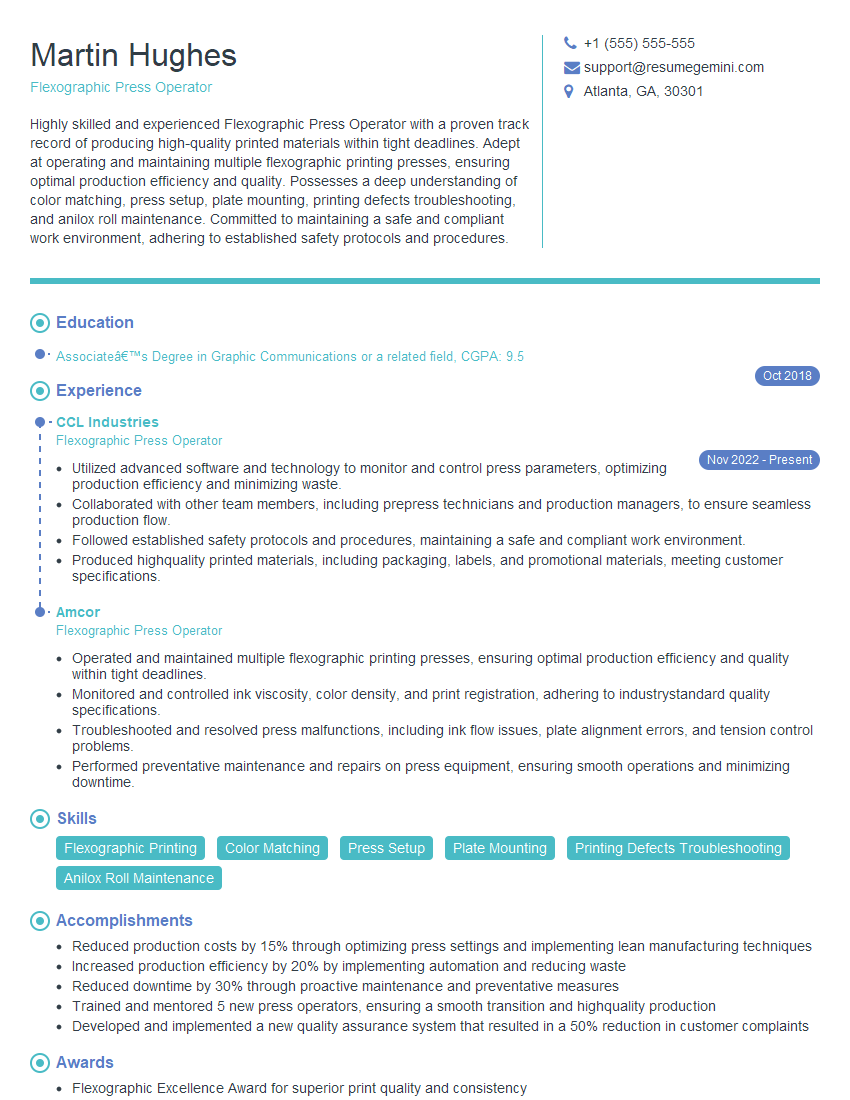
Mastering flexographic printing opens doors to exciting career opportunities in a dynamic industry. To maximize your job prospects, crafting a strong, ATS-friendly resume is crucial. ResumeGemini can help you build a professional resume that highlights your skills and experience effectively. They offer examples of resumes tailored to the Flexography Printing industry to help you showcase your qualifications. Invest time in crafting a compelling resume—it’s your first impression on potential employers.

Explore more articles
Users Rating of Our Blogs
Share Your Experience
We value your feedback! Please rate our content and share your thoughts (optional).
What Readers Say About Our Blog
Very informative content, great job.
good