The thought of an interview can be nerve-wracking, but the right preparation can make all the difference. Explore this comprehensive guide to Flood Control and Management interview questions and gain the confidence you need to showcase your abilities and secure the role.
Questions Asked in Flood Control and Management Interview
Q 1. Explain the difference between flood prevention and flood mitigation.
Flood prevention aims to eliminate the possibility of a flood occurring altogether, while flood mitigation focuses on reducing the negative impacts of flooding that may still occur. Think of it this way: prevention is like installing a strong, impenetrable dam to stop water completely, whereas mitigation is like building reinforced walls around your house to lessen the damage if the river overflows.
Prevention strategies often involve long-term structural solutions and land-use planning that reduces the risk of flooding. Examples include constructing dams and reservoirs to control water flow, implementing strict building codes in floodplains, and restoring wetlands to absorb excess water. These measures aim to prevent the flood from happening in the first place.
Mitigation strategies, on the other hand, focus on minimizing the damage caused by a flood once it occurs. This could involve building levees to divert floodwaters, creating early warning systems to give residents time to evacuate, developing flood insurance programs, and implementing improved drainage systems. The goal isn’t to stop the flood, but to lessen its impact.
Q 2. Describe common flood control infrastructure and their applications.
Common flood control infrastructure includes a range of structures and systems designed to manage and control floodwaters. Their applications vary depending on the specific geographic location and flood risk.
- Levees (or Embankments): Earthen or concrete walls built along rivers or coastlines to contain floodwaters. These are effective in protecting developed areas, but can lead to increased flooding downstream if not properly managed.
- Dams and Reservoirs: Dams create artificial lakes (reservoirs) that store excess water during periods of high rainfall, releasing it gradually downstream. This helps regulate water flow and reduce the risk of downstream flooding. However, dams can have significant environmental impacts and require careful planning and management.
- Floodwalls: Similar to levees, but typically made of concrete, floodwalls are often used in urban areas to protect buildings and infrastructure. They provide greater protection than levees in specific localized areas.
- Retention Ponds: These are designed to temporarily store stormwater runoff, reducing the amount of water that flows into rivers and streams during heavy rainfall. They act as natural sponges, slowly releasing the water once the storm subsides.
- Channel Improvements: This involves widening, deepening, or straightening river channels to increase their capacity to carry floodwater. However, it can have ecological consequences, like altering river habitats.
- Pumping Stations: Used to remove excess water from low-lying areas, these are particularly useful in urban settings where drainage can be a challenge. They are crucial for preventing urban flooding.
Q 3. What are the key factors considered in designing a levee system?
Designing a levee system requires careful consideration of numerous factors to ensure its effectiveness and safety. Overlooking any of these can lead to catastrophic failures. Key considerations include:
- Hydraulic analysis: Precise calculations are necessary to determine the required levee height and capacity based on historical flood data, projected future rainfall scenarios, and anticipated water levels.
- Geotechnical investigations: The soil properties of the levee’s foundation and the surrounding area must be carefully evaluated to ensure stability and prevent seepage or erosion. The soil’s ability to support the weight of the levee and withstand water pressure is critical.
- Environmental considerations: The impact of the levee on the surrounding ecosystem must be assessed. Changes to water flow, sediment transport, and wildlife habitats need careful mitigation.
- Construction materials and methods: The choice of materials and construction techniques must be appropriate for the local conditions and should provide long-term durability and stability. Quality control is paramount.
- Maintenance and monitoring: A comprehensive maintenance program is essential to prevent erosion, seepage, and other issues that can compromise the levee’s integrity. Regular inspections and monitoring using instrumentation are crucial.
- Freeboard: A critical safety factor, freeboard is the extra height above the design flood level that provides a margin of safety to account for uncertainties in flood predictions and potential wave action.
Q 4. How do you assess the flood risk of a particular area?
Assessing flood risk involves a multi-step process that integrates various data sources and analytical techniques. The goal is to determine the likelihood and potential consequences of flooding in a specific area.
- Data Collection: Gather historical rainfall and river flow data, topographical information (elevation, slope), soil types, land use maps, and information on existing infrastructure (levees, drainage systems).
- Flood Modeling: Employ hydrological and hydraulic models to simulate flood events under different rainfall scenarios and predict water levels and extents. This often involves sophisticated software.
- Vulnerability Assessment: Identify assets at risk within the floodplains, including buildings, infrastructure, population density, and critical facilities (hospitals, schools). Consider potential economic and social impacts.
- Risk Mapping: Combine the flood model results with the vulnerability assessment to create maps showing different flood risk zones. These maps visualize the probability and potential consequences of flooding in each area.
- Risk Assessment: Quantify the flood risk by combining the probability of a flood occurring with the potential consequences. This often involves calculating the annual expected damage or loss of life.
For example, an area with a history of frequent flooding, high population density, and critical infrastructure located in a low-lying area would be assessed as having a high flood risk.
Q 5. What are the limitations of using flood prediction models?
While flood prediction models are invaluable tools, they have limitations that need to be acknowledged:
- Data Uncertainty: Models rely on historical data, which may not accurately represent future climate patterns or extreme events. Inaccurate or incomplete data can lead to significant errors in predictions.
- Model Simplifications: Models often simplify complex hydrological processes, which can lead to inaccuracies. Factors like rainfall intensity variability, infiltration rates, and channel roughness are often simplified.
- Uncertainty in Future Climate Change: Predicting future flood risk requires accounting for the potential impacts of climate change, such as increased rainfall intensity and sea-level rise. These factors are difficult to predict accurately.
- Computational Limitations: High-resolution modeling of large areas can be computationally expensive and time-consuming. This may limit the detail and accuracy of the predictions.
- Lack of real-time data: Models may not always be able to incorporate real-time data, such as current rainfall measurements, which could affect their accuracy during an ongoing flood event.
It’s essential to remember that flood prediction models provide probabilities, not certainties. Results should always be interpreted with caution and used in conjunction with other information and expert judgment.
Q 6. Explain the role of GIS in flood risk mapping and analysis.
Geographic Information Systems (GIS) play a crucial role in flood risk mapping and analysis by providing a powerful platform for integrating, analyzing, and visualizing spatial data. It facilitates a more comprehensive and efficient assessment.
- Data Integration: GIS integrates diverse data sets such as elevation models (DEMs), rainfall data, land use maps, soil types, and infrastructure information, all spatially referenced to a common coordinate system. This allows for a holistic view of flood risk factors.
- Floodplain Delineation: GIS is used to delineate floodplains by processing elevation data and hydrological model outputs. This helps identify areas that are susceptible to flooding.
- Vulnerability Mapping: GIS allows the overlay of floodplains with information on population density, critical infrastructure, and other vulnerable assets to create vulnerability maps. These highlight areas with high potential for damage and loss.
- Risk Assessment and Modeling: GIS facilitates the integration of flood probabilities and vulnerability information to create risk maps that represent the potential consequences of flooding in different areas.
- Scenario Planning and Communication: GIS enables the creation of various flood scenarios based on different rainfall events or sea-level rise scenarios. This helps in planning mitigation measures and effectively communicating the flood risks to stakeholders.
GIS provides a visual and readily understandable way to communicate complex flood risk information to decision-makers, emergency responders, and the public.
Q 7. Describe various methods for flood water diversion.
Flood water diversion methods aim to channel excess water away from vulnerable areas. Several approaches exist, each with its own advantages and disadvantages.
- Diversion Channels: Constructing new channels or modifying existing ones to divert floodwaters away from populated areas or critical infrastructure. This can be expensive and may have environmental impacts.
- Floodways: Designated areas that are intentionally allowed to flood to relieve pressure on other areas. They often require careful planning and land-use restrictions to ensure safety and minimize damage.
- Retention Basins: Artificial reservoirs or basins designed to temporarily store floodwaters, allowing them to gradually drain or be pumped out. They provide a degree of flood control and can also serve as recreational areas.
- Spillways: Controlled structures built into dams or levees to safely release excess water during flood events. They are essential for managing the water levels in reservoirs and preventing dam failures.
- Pumping Systems: Used to remove water from low-lying areas or divert it to other locations. This method is particularly useful in urban areas where drainage is limited.
The choice of diversion method depends on several factors including the magnitude and frequency of floods, the topography of the area, environmental considerations, and cost effectiveness.
Q 8. How do you determine the appropriate size and capacity of a drainage system?
Determining the appropriate size and capacity of a drainage system involves a multifaceted approach, combining hydrological analysis with engineering design principles. It’s like designing a pipe system for a house – you need to know how much water will flow through it during a heavy rain.
Firstly, we conduct hydrological studies to estimate the design rainfall intensity and frequency. This involves analyzing historical rainfall data and using statistical methods to predict the maximum rainfall expected within a given return period (e.g., a 100-year flood). Tools like the Rational Method or more sophisticated hydrological models are employed.
Next, we use hydraulic modeling techniques to simulate the flow of water through the drainage system. This helps determine the required size of pipes, channels, and other drainage structures to convey the estimated runoff without causing flooding. We consider factors such as pipe slope, roughness, and the presence of any obstructions.
Finally, we incorporate safety factors and consider future growth and development to ensure the system’s long-term effectiveness and resilience. For example, a growing suburban area will require a larger drainage system than one that’s already developed.
An example would be designing a drainage system for a new housing development. We’d first determine the catchment area, then use rainfall data and hydrological modeling to estimate peak runoff. We would then design a system of pipes, culverts, and possibly retention ponds to handle this flow, ensuring the system can manage even the most extreme rainfall events within the specified return period.
Q 9. What are the benefits and drawbacks of using detention basins for flood control?
Detention basins are excellent tools in flood management, acting as temporary storage for stormwater runoff, reducing peak flow rates downstream. Think of them as temporary reservoirs for rainwater.
- Benefits: Reduced downstream flooding, improved water quality through sedimentation, potential for groundwater recharge, and creation of recreational areas.
- Drawbacks: They require significant land area, can be expensive to construct and maintain, potential for mosquito breeding, and possible issues with sediment accumulation and clogging.
For instance, a detention basin located upstream of a residential area can significantly reduce the risk of basement flooding during heavy rainfall. However, the land cost for such a basin must be weighed against the benefits.
Q 10. Discuss the importance of real-time flood monitoring and forecasting.
Real-time flood monitoring and forecasting are critical for effective flood management. Imagine a weather forecast, but specifically for floods.
Monitoring involves deploying sensors to measure river levels, rainfall intensity, soil moisture, and other relevant parameters. This data is then transmitted to a central system for analysis. Forecasting uses this data, combined with hydrological models and weather predictions, to predict the timing, magnitude, and extent of potential flooding.
This information is crucial for issuing timely warnings to the public, enabling proactive evacuation efforts, and facilitating effective emergency response. It allows for better resource allocation and reduces the impact of flood events on communities and infrastructure.
For example, a real-time flood monitoring system in a river basin can provide early warnings of impending floods, allowing residents in downstream areas to prepare and evacuate if necessary, minimizing loss of life and property.
Q 11. Explain the concept of hydraulic modeling and its application in flood management.
Hydraulic modeling uses mathematical equations and computer software to simulate the movement of water in rivers, channels, and drainage systems. Think of it as a virtual laboratory for water flow.
It allows us to analyze the impact of various scenarios, such as rainfall events, dam failures, or levee breaches, on water levels and flow velocities. We use specialized software that incorporates the physical characteristics of the water bodies and surrounding terrain.
Applications in flood management include designing flood control structures (levees, dams, retention basins), assessing flood risk, and evaluating the effectiveness of existing flood mitigation measures. By simulating different scenarios, we can optimize the design of flood control infrastructure and develop effective flood management plans.
For example, we can use hydraulic modeling to evaluate the effectiveness of a proposed levee in reducing flood risk to a community by simulating a range of flood events and observing the changes in water levels with and without the levee.
Q 12. How do you incorporate climate change impacts into flood risk assessments?
Climate change significantly impacts flood risk by altering rainfall patterns, increasing the frequency and intensity of extreme rainfall events, and rising sea levels. We must consider these factors in our assessments.
Incorporating climate change into flood risk assessments involves using climate projections (e.g., from the IPCC) to estimate future changes in rainfall, sea levels, and other relevant variables. These projections are then used as inputs to hydrological and hydraulic models to assess the future flood risk under different climate scenarios.
This helps us understand the potential increase in flood risk, which allows for the design of more resilient infrastructure and the development of adaptive flood management strategies. For example, we might design flood defenses that accommodate higher sea levels or increased rainfall intensity predicted for future decades.
Q 13. What are the key regulations and standards related to flood control?
Regulations and standards related to flood control vary depending on the location and jurisdiction. However, common themes include building codes that address flood-prone areas, environmental regulations regarding stormwater management, and national guidelines for flood plain management.
For example, many regions have regulations requiring buildings in flood plains to be elevated or built with flood-resistant materials. Environmental regulations may mandate the implementation of best management practices (BMPs) for stormwater management to reduce runoff volumes and improve water quality.
Compliance with these regulations is crucial to ensure public safety and protect the environment. Failure to comply can result in fines and legal actions. Familiarity with local, regional and national guidelines is vital for any professional in this field.
Q 14. Describe your experience with flood emergency response plans.
My experience with flood emergency response plans involves developing, reviewing, and implementing plans for various communities and organizations. This includes collaborating with emergency management agencies, public works departments, and other stakeholders.
The plans typically outline procedures for pre-flood preparation, emergency response actions, post-flood recovery, and communication strategies. I’ve been involved in exercises designed to test the effectiveness of these plans, identify vulnerabilities, and refine procedures.
A key aspect is establishing clear communication channels to ensure that information flows efficiently during emergencies. For example, one project involved developing a system for automated flood warnings using real-time data feeds and public alerts. This work requires a thorough understanding of potential hazards and the ability to coordinate responses effectively under pressure.
Q 15. Explain the role of public awareness and education in flood risk reduction.
Public awareness and education are cornerstones of effective flood risk reduction. They empower individuals and communities to understand their vulnerability, take proactive measures to protect themselves and their property, and cooperate effectively with flood management initiatives. Without this understanding, even the most sophisticated engineering solutions will fall short.
Effective programs educate people about flood hazards in their specific areas, including historical flood events, flood plain mapping, and the likely impacts of future floods. This includes practical advice on things like: creating a household emergency plan, purchasing flood insurance, and understanding building codes and regulations. Public awareness campaigns, often using engaging multimedia tools, can effectively communicate complex information.
For example, a community might host workshops to teach residents how to prepare for a flood, demonstrating sandbagging techniques and explaining the importance of elevating electrical equipment. Another example is the use of interactive online maps to show individuals their risk of flooding based on their address. These initiatives shift the burden of flood preparedness from solely relying on government intervention to shared responsibility.
Career Expert Tips:
- Ace those interviews! Prepare effectively by reviewing the Top 50 Most Common Interview Questions on ResumeGemini.
- Navigate your job search with confidence! Explore a wide range of Career Tips on ResumeGemini. Learn about common challenges and recommendations to overcome them.
- Craft the perfect resume! Master the Art of Resume Writing with ResumeGemini’s guide. Showcase your unique qualifications and achievements effectively.
- Don’t miss out on holiday savings! Build your dream resume with ResumeGemini’s ATS optimized templates.
Q 16. How do you manage conflicts between different stakeholders during flood management projects?
Managing conflicts between stakeholders—including residents, businesses, environmental groups, and government agencies—in flood management is crucial. These conflicts often arise from differing priorities, perceptions of risk, and economic interests. A proactive, collaborative approach is essential for successful project implementation.
A structured approach involves establishing a clear communication strategy from the outset. This includes transparently sharing project plans, conducting regular stakeholder meetings, and actively soliciting feedback. Employing participatory methods, such as workshops and focus groups, ensures that diverse perspectives are considered and incorporated into the decision-making process. Mediation or arbitration may be necessary to resolve significant disagreements.
For instance, during a levee improvement project, a compromise might involve building a levee slightly further from residential areas to minimize disruption but potentially increasing costs. Or, the project might incorporate environmental mitigation measures to appease conservation groups, potentially delaying but ultimately enhancing project acceptance.
Ultimately, effective conflict management relies on fostering trust, emphasizing mutual understanding, and seeking win-win solutions.
Q 17. What are the economic impacts of flooding, and how can they be minimized?
Flooding inflicts devastating economic damage, impacting individuals, businesses, and governments. Direct costs include property damage, infrastructure repair, and cleanup. Indirect costs encompass lost business revenue, disruption to supply chains, displacement of residents, and increased healthcare expenses. The scale of economic impact varies widely, depending on flood magnitude, location, and preparedness measures.
Minimizing these impacts requires a multi-pronged approach. Firstly, investing in robust flood protection infrastructure like levees, dams, and improved drainage systems can significantly reduce the frequency and severity of floods. Secondly, enacting and enforcing building codes that restrict development in high-risk flood zones, coupled with incentives for flood-proofing existing structures, reduces property damage. Thirdly, comprehensive flood insurance programs help individuals recover financially from losses. Finally, improved flood forecasting and warning systems enable timely evacuations and mitigation measures, minimizing property damage and loss of life.
For example, the devastating floods in Houston, Texas in 2017 demonstrated the immense economic impact of inadequate flood protection measures and development in flood-prone areas. Conversely, cities with robust flood mitigation strategies often experience lower economic losses during flood events.
Q 18. Describe different types of flood insurance and their coverage.
Flood insurance policies vary in coverage and availability depending on location, risk factors, and the insurer. Generally, flood insurance falls into two main categories:
- National Flood Insurance Program (NFIP): In the United States, the NFIP is a federally subsidized program offering flood insurance to homeowners and renters in participating communities. Coverage options include building and contents coverage, with varying limits depending on the insured’s needs.
- Private Flood Insurance: Private insurers offer flood insurance policies as an alternative or supplement to the NFIP. These policies can sometimes offer more flexible coverage options or higher limits, but premiums may be higher, and availability can be more restricted in high-risk areas.
Specific coverage details will vary between policies, but typically building coverage is for damage to the structure, while contents coverage is for possessions inside. It’s crucial to carefully review policy terms and conditions to understand what is and isn’t covered before purchasing.
For example, a policy might not cover damage from ground water, or it might have a deductible that needs to be met before coverage kicks in. It’s recommended to compare multiple policies and understand the implications of various coverage limits.
Q 19. How do you ensure the sustainability of flood control measures?
Ensuring the sustainability of flood control measures requires a holistic and long-term perspective that incorporates environmental, economic, and social considerations. This means designing and implementing solutions that are resilient to future changes in climate, population, and land use patterns.
Key aspects of sustainable flood control include:
- Adaptive Management: Regularly monitoring and evaluating the effectiveness of flood control measures, adapting strategies as needed to respond to changing conditions.
- Integrated Water Resource Management: Considering flood control in conjunction with other water management objectives, like water supply and environmental protection.
- Nature-Based Solutions: Utilizing natural processes, such as wetlands restoration and floodplain reconnection, to reduce flood risk while providing ecological benefits.
- Community Engagement: Involving local communities in planning, implementation, and maintenance of flood control projects.
For example, instead of solely relying on concrete levees, a sustainable approach might integrate natural flood defenses like restored wetlands upstream to reduce the flood peak before it reaches built-up areas. This approach provides flood protection while enhancing biodiversity and improving water quality.
Q 20. What are the ethical considerations in flood management decision-making?
Ethical considerations are paramount in flood management decision-making. Decisions made impact individuals, communities, and the environment; prioritizing fairness, transparency, and justice is crucial. Key ethical aspects include:
- Equitable Protection: Ensuring that flood protection measures benefit all members of the community, regardless of socioeconomic status or geographic location.
- Transparency and Accountability: Openly communicating risk information and decision-making processes to foster trust and accountability among stakeholders.
- Environmental Sustainability: Considering the environmental impacts of flood management projects and minimizing negative consequences.
- Intergenerational Equity: Making decisions that consider the needs of future generations and protect resources for their benefit.
For instance, building a levee that protects affluent neighborhoods at the expense of poorer ones is ethically questionable. A just approach would prioritize equitable protection for all communities at risk.
Q 21. Explain the concept of a flood frequency analysis.
Flood frequency analysis is a statistical method used to estimate the probability of a flood of a given magnitude occurring within a specific timeframe. It analyzes historical flood data to determine the recurrence interval (return period) of different flood levels. This information is vital for planning flood control measures and setting flood insurance rates.
The process typically involves:
- Data Collection: Gathering historical streamflow data from gauging stations or other sources.
- Data Analysis: Using statistical methods, such as the Log-Pearson Type III distribution, to analyze the data and estimate the probability of different flood magnitudes.
- Frequency Curve Development: Creating a frequency curve that plots the relationship between flood magnitude and recurrence interval.
For example, a 100-year flood has a 1% chance of occurring in any given year. This doesn’t mean it will only happen once every 100 years, but rather that there’s a 1% probability of a flood of that magnitude or greater occurring in any given year. This type of analysis helps in setting design standards for infrastructure to withstand various flood levels, considering the associated risks and costs.
Q 22. Describe your experience with different hydrological modeling software.
My experience with hydrological modeling software spans several leading packages. I’m proficient in using HEC-RAS (Hydrologic Engineering Center’s River Analysis System) for modeling unsteady flow in rivers and streams, including flood inundation mapping. This involves defining the river geometry, setting boundary conditions (inflows and water levels), and running simulations to predict water surface elevations and flow velocities under different scenarios. I also have extensive experience with MIKE FLOOD, a powerful software suite particularly useful for integrated catchment modeling, combining rainfall-runoff modeling with hydrodynamic simulation. Further, I’ve worked with simpler models like SWMM (Storm Water Management Model) for urban drainage systems, crucial for analyzing the impact of urban development on flooding. Finally, I’m familiar with using GIS software like ArcGIS to integrate spatial data with hydrological models, improving model accuracy and visualization of results.
For instance, in a recent project involving a coastal community, we used HEC-RAS to model the impact of a potential storm surge combined with river flooding. The results identified critical areas needing immediate mitigation measures, like levee upgrades or the implementation of early warning systems. In another project involving an urban area, we utilized SWMM to assess the capacity of the drainage network and identify bottlenecks causing localized flooding. This led to recommendations for improvements to the drainage infrastructure and better stormwater management practices.
Q 23. How do you evaluate the effectiveness of implemented flood control measures?
Evaluating the effectiveness of flood control measures requires a multi-faceted approach. We begin by comparing pre- and post-implementation hydrological data, such as river discharge, water levels, and flood extent. This involves analyzing historical data alongside data collected after the measures were put in place. For example, if we’ve constructed a new levee, we would compare the extent of flooding in the protected area before and after its completion. A significant reduction in the flooded area indicates effectiveness.
Beyond quantitative data, we also assess the qualitative impacts. This includes surveys of affected communities, documenting reduced property damage, fewer disruptions to daily life, and improvements to overall community safety. Cost-benefit analysis is also crucial, weighing the investment in flood control measures against the avoided economic losses from flooding. Finally, we regularly monitor the implemented measures for structural integrity and ongoing effectiveness. Regular maintenance and inspections are vital for long-term efficacy.
Q 24. Explain your approach to managing flood control projects within budget constraints.
Managing flood control projects within budget constraints requires meticulous planning and prioritization from the outset. We employ a phased approach, starting with a comprehensive feasibility study to identify the most cost-effective solutions. This involves carefully evaluating different options and their potential benefits. Then, we develop a detailed project budget that considers all aspects of the project, from design and construction to monitoring and maintenance.
Value engineering is key. This involves critically examining every aspect of the design to identify ways to reduce costs without compromising functionality or safety. For example, we might explore alternative materials or construction techniques. Prioritization is crucial; we focus on the most impactful and urgent interventions first. We also emphasize transparent communication with stakeholders, keeping them informed about budget limitations and ensuring collaborative decision-making throughout the project lifecycle. For example, in a recent project, we prioritized improving drainage in the most vulnerable areas, a more cost-effective solution compared to building an extensive new flood wall.
Q 25. What are the challenges associated with flood control in urban areas?
Flood control in urban areas presents unique challenges. The high density of buildings and infrastructure limits the space available for flood mitigation measures, such as detention basins or floodways. Urban landscapes are highly impervious, leading to rapid runoff and increased flood peaks. Existing drainage systems may be inadequate to handle increased rainfall intensities associated with climate change. Furthermore, the complex interactions between different infrastructure systems (roads, utilities, buildings) increase the complexity and cost of flood mitigation. The presence of underground infrastructure poses additional challenges during construction.
For example, in older urban areas, inadequate drainage systems and aging infrastructure often exacerbate flood risks. Efficiently managing stormwater in dense urban settings requires integrated approaches, combining green infrastructure (like rain gardens and permeable pavements) with grey infrastructure (like upgraded drainage pipes and pumping stations). Effective communication and collaboration with various stakeholders, including residents, businesses, and utility companies, are also essential.
Q 26. Describe your experience with analyzing rainfall data and its application to flood forecasting.
Analyzing rainfall data is fundamental to flood forecasting. I have extensive experience using various statistical methods to analyze historical rainfall records, identifying patterns, trends, and extreme events. This includes analyzing rainfall intensity, duration, and frequency using techniques like frequency analysis (e.g., using Gumbel or Log-Pearson Type III distributions) to estimate the probability of extreme rainfall events. I then use this information to calibrate and validate hydrological models, ensuring they accurately reflect the rainfall-runoff processes in a specific catchment area.
For instance, in a recent project, we analyzed 50 years of rainfall data to determine the design rainfall for a new stormwater management system. We used frequency analysis to estimate the 100-year return period rainfall, which is crucial for designing infrastructure capable of withstanding extreme events. Real-time rainfall data from weather radar and rain gauges are crucial for short-term flood forecasting, allowing for timely warnings and emergency response measures. This often involves using sophisticated forecasting models that integrate rainfall data with hydrological models.
Q 27. How do you use data to inform decisions related to flood risk management?
Data plays a central role in informing decisions related to flood risk management. We use data to assess vulnerability and risk, identify high-risk areas, and evaluate the effectiveness of mitigation measures. This includes not only hydrological data (rainfall, river flow) but also socio-economic data (population density, property values) and topographic data (elevation, land use). Geographic Information Systems (GIS) are instrumental in integrating and visualizing these diverse datasets.
For example, we might use GIS to create flood risk maps that overlay flood inundation areas with population density and property values, allowing us to prioritize mitigation efforts in the most vulnerable areas. Data analysis also helps inform decisions about land-use planning, ensuring that development avoids high-risk zones. Real-time data from sensors and monitoring systems enable early warning systems, enhancing community preparedness and reducing the impact of floods.
Q 28. Explain the importance of collaboration and communication in flood management.
Collaboration and communication are paramount to successful flood management. Flood risk is not confined to geographical boundaries; it demands a collaborative approach involving multiple stakeholders. This includes government agencies, research institutions, communities, businesses, and emergency services. Effective communication involves sharing data, disseminating risk information, and coordinating response efforts. Open communication channels ensure everyone understands their roles and responsibilities, fostering a sense of shared responsibility and reducing the risk of misunderstandings during emergencies.
For instance, effective communication is vital during emergency response. Real-time information sharing among emergency services, local authorities, and communities is essential for evacuations, rescue efforts, and resource allocation. A participatory approach, involving communities in the development and implementation of flood management plans, ensures that measures are both effective and acceptable to the affected population. This builds trust and strengthens community resilience in the face of flood risks.
Key Topics to Learn for Flood Control and Management Interview
- Hydrological Modeling: Understanding rainfall-runoff processes, using hydrological models (e.g., HEC-HMS, MIKE FLOOD), and interpreting model outputs to predict flood events.
- Hydraulic Modeling: Analyzing water flow in rivers and channels using software like HEC-RAS, assessing flood inundation areas, and designing hydraulic structures.
- Floodplain Management: Understanding flood hazard mapping, developing flood risk assessments, and implementing strategies for land-use planning and floodplain zoning.
- Flood Control Structures: Knowledge of dams, levees, reservoirs, and other flood control infrastructure; their design, operation, and limitations.
- Non-Structural Measures: Understanding the role of early warning systems, public awareness campaigns, evacuation plans, and insurance programs in flood risk reduction.
- Climate Change Impacts: Assessing the influence of climate change on flood frequency and magnitude, and adapting flood management strategies accordingly.
- Sustainable Flood Management: Integrating ecological considerations into flood management practices, promoting nature-based solutions (e.g., wetlands restoration), and ensuring environmental sustainability.
- Project Management & Collaboration: Understanding project lifecycle, stakeholder engagement, communication strategies and teamwork within multidisciplinary teams.
- Data Analysis and Interpretation: Proficiency in analyzing hydrological and hydraulic data, interpreting statistical results, and presenting findings effectively.
- Risk Assessment and Mitigation: Applying quantitative and qualitative methods to assess flood risks, developing mitigation strategies, and evaluating their effectiveness.
Next Steps
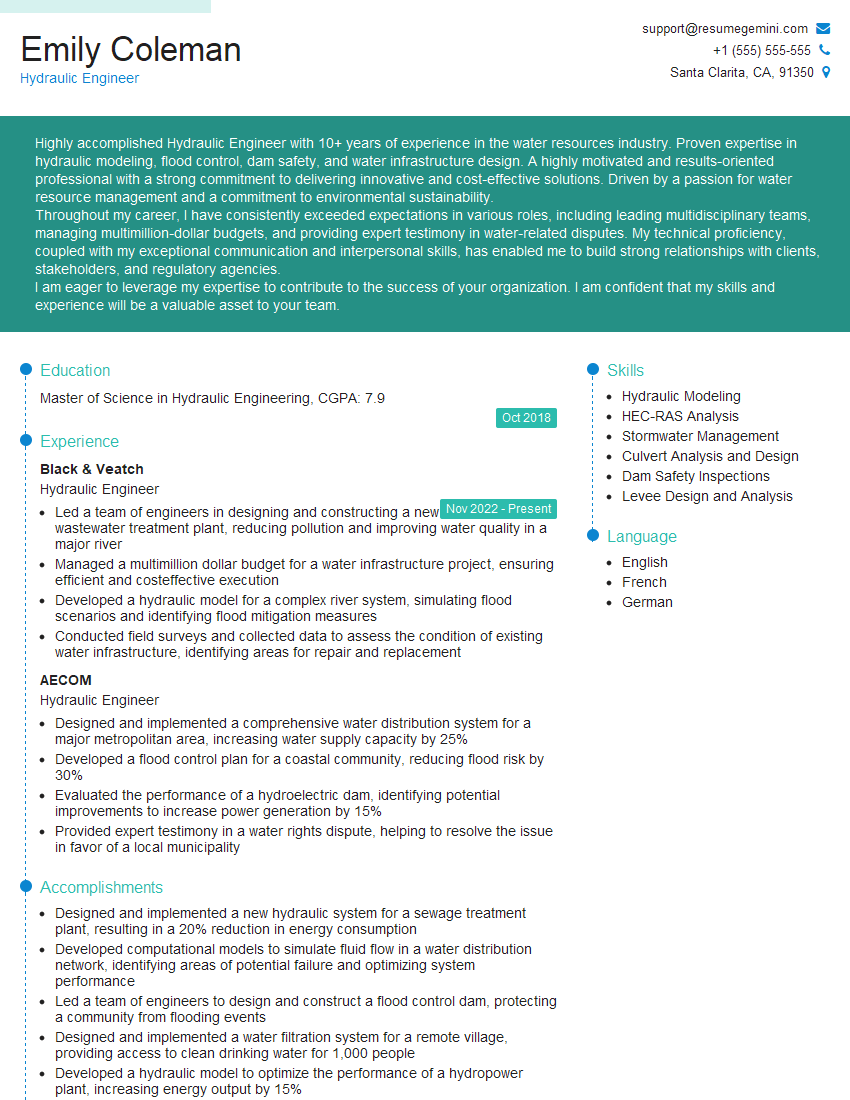
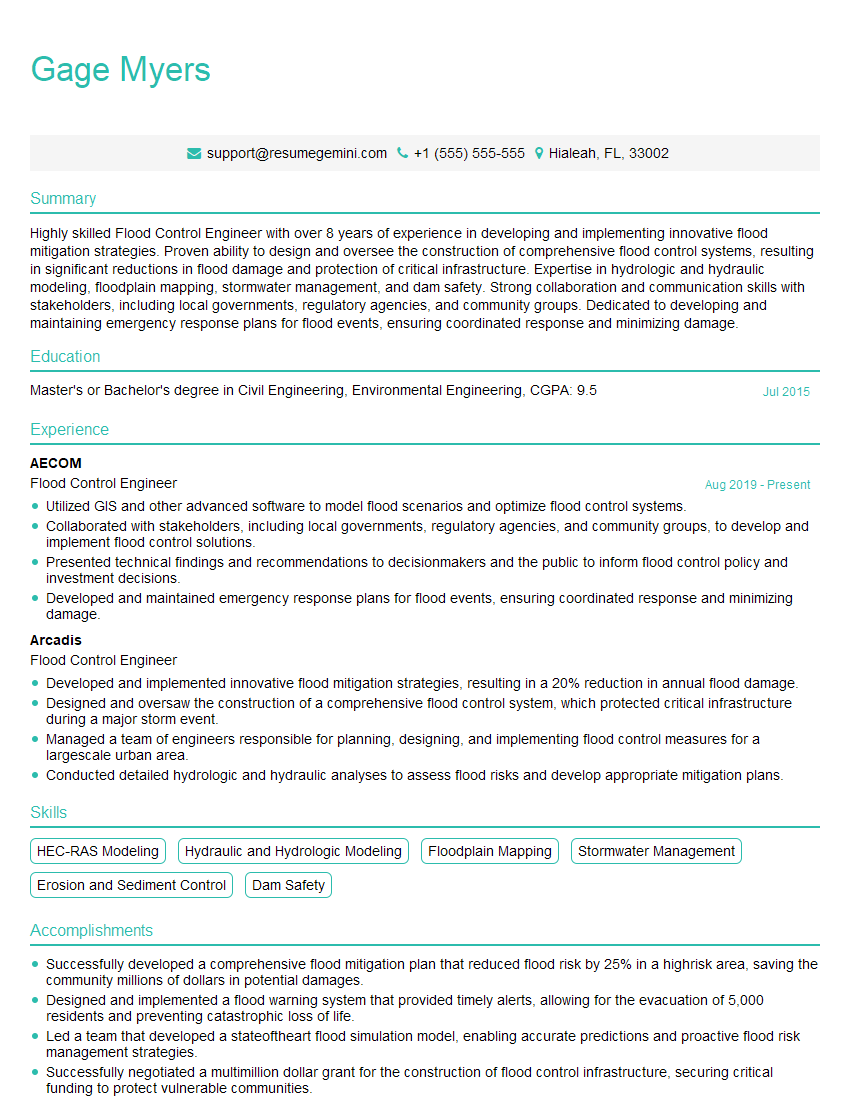
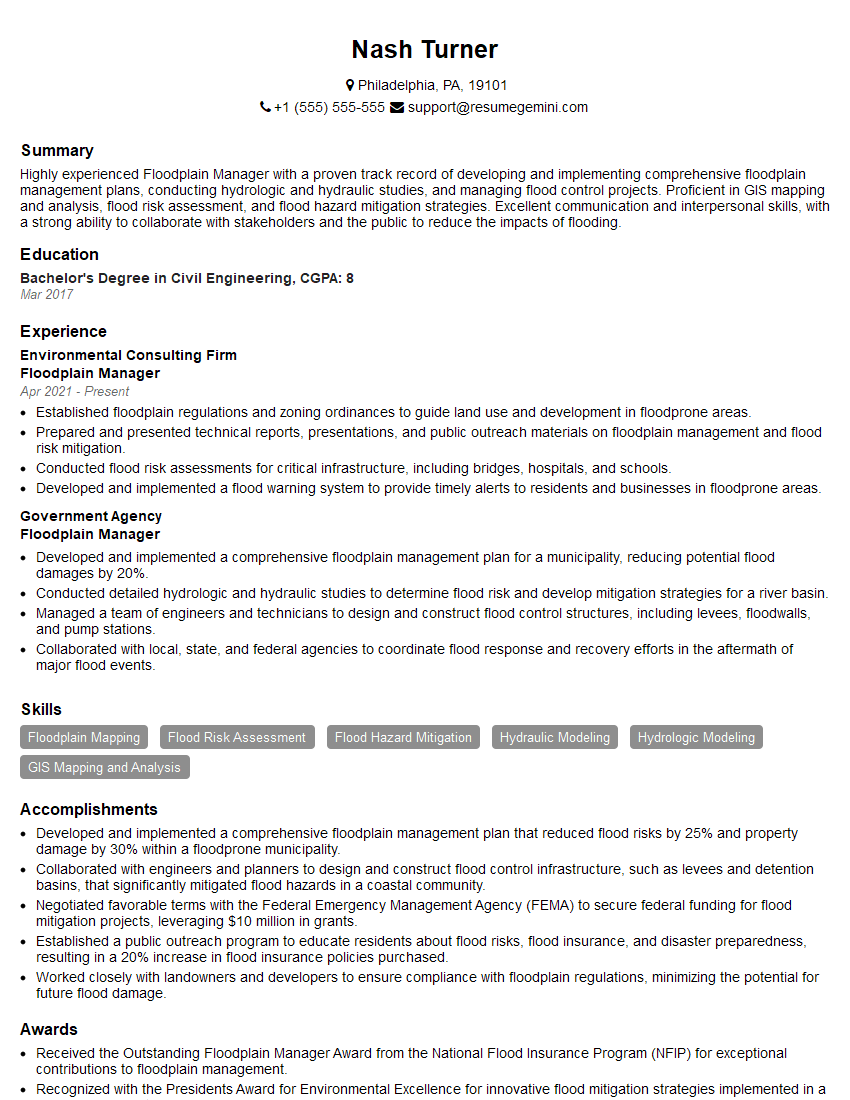
Mastering Flood Control and Management opens doors to a rewarding career with significant societal impact. Your expertise in mitigating flood risks is highly valuable to communities and organizations worldwide. To enhance your job prospects, it’s crucial to create a compelling and ATS-friendly resume that showcases your skills and experience effectively. We strongly encourage you to use ResumeGemini to build a professional resume that highlights your qualifications. ResumeGemini provides an intuitive platform and offers examples of resumes tailored to the Flood Control and Management field, helping you present your candidacy in the best possible light.

Explore more articles
Users Rating of Our Blogs
Share Your Experience
We value your feedback! Please rate our content and share your thoughts (optional).
What Readers Say About Our Blog
Very informative content, great job.
good