Preparation is the key to success in any interview. In this post, we’ll explore crucial Camera Acting interview questions and equip you with strategies to craft impactful answers. Whether you’re a beginner or a pro, these tips will elevate your preparation.
Questions Asked in Camera Acting Interview
Q 1. Describe your experience working with different camera angles and distances.
Working with different camera angles and distances is fundamental to camera acting. The camera’s perspective drastically alters how the audience perceives your performance. A close-up shot (ECU), for instance, reveals minute facial expressions, demanding a more subtle and nuanced performance. Conversely, a wide shot (WS) necessitates a bolder, more expansive physicality to ensure your presence is felt across the frame. I’ve extensively worked with everything from extreme close-ups focusing on a single eye, conveying intense emotion, to long shots where the character’s relationship to the environment becomes a key element of their portrayal.
- Extreme Close-Up (ECU): Requires subtle facial expressions and controlled body language.
- Close-Up (CU): Focuses on emotions and facial expressions, allowing for more intricate acting.
- Medium Shot (MS): Shows the character from the waist up, balancing facial expression and body language.
- Wide Shot (WS): Shows the character within their environment, emphasizing relationships and setting.
In one project, I played a character gradually losing their mind. In ECU shots, I used micro-expressions – subtle twitching of a lip, a fleeting look of fear – to communicate internal turmoil. In WS scenes depicting them alone in a vast, empty house, my physical movements became larger, more erratic, reflecting their disorientation and isolation.
Q 2. How do you adjust your performance based on the camera’s perspective?
Adjusting my performance to the camera’s perspective is a crucial aspect of my approach. It’s not simply about being bigger or smaller; it’s about understanding what the camera is highlighting and shaping my performance to complement that. A close-up demands internal focus, a nuanced delivery, and precise control over facial expressions. In contrast, a wide shot might need a broader physicality, more gestures, and a stronger vocal projection to maintain presence.
For example, during an emotionally charged scene, a CU on my face might allow me to convey vulnerability with a slight tremble in my voice and the subtle glistening of tears. That same vulnerability, in a WS where my body is also visible, may need to be translated through slumped shoulders, trembling hands, and a quieter, more fragile vocal delivery.
I constantly consider the camera’s position and the intended emotional impact on the viewer. I strive to create a performance that is both truthful and cinematic, aware of how each angle enhances the story.
Q 3. Explain your approach to delivering lines naturally for the camera.
Delivering lines naturally for the camera involves several techniques. First, I emphasize understanding the subtext and the character’s emotional arc. I aim for authenticity by grounding the dialogue in the character’s motivations, their relationships with other characters, and the overall story arc. Simply reciting words is insufficient; I must inhabit the character and make the lines believable.
I often employ techniques like ‘active listening’ – fully engaging with my scene partner, even if they are not physically present – to create a spontaneous, authentic reaction. I might also use physicality and subtext to enhance the dialogue’s emotional impact. For instance, a simple shift in weight or a fleeting glance can add layers of meaning to a seemingly simple line.
Repetition and careful observation of the director’s feedback are vital. I focus on finding truthful moments of connection, even in the most challenging or repetitive takes. The goal isn’t perfection but emotional honesty.
Q 4. How do you maintain energy and engagement throughout long filming days?
Maintaining energy and engagement during long filming days requires a multifaceted approach. Physical and mental preparation are key. I start with ample sleep, a healthy diet, and regular exercise to maintain both physical stamina and mental clarity. Hydration is crucial, and I also incorporate mindfulness techniques like meditation to stay grounded.
On set, I stay focused on the creative aspects of the work. I utilize the downtime between takes to mentally rehearse or engage in conversations with the crew to remain energized and connected to the project. I also actively maintain a positive attitude, fostering a collaborative atmosphere that keeps the entire team motivated. Finally, I leverage humor and positive self-talk to combat fatigue and maintain enthusiasm.
Q 5. How do you handle unexpected technical difficulties during filming?
Unexpected technical difficulties are an inevitable part of filmmaking. My approach involves remaining calm and flexible. I focus on problem-solving collaboratively with the crew, offering suggestions or adapting my performance based on the limitations or adjustments needed. For instance, if a light malfunctions, I might subtly adjust my position to compensate, or if a sound issue occurs, I will try to communicate non-verbally until the problem is rectified.
A crucial aspect of handling technical issues is maintaining focus and professionalism. Panicking or showing frustration is unproductive. Instead, I channel my energy into adapting to the circumstances, ensuring the scene’s integrity is preserved to the best of my ability.
Q 6. Describe your process for memorizing lines and staying focused on-camera.
Memorizing lines and staying focused on-camera involves a combination of techniques. I start by thoroughly understanding the script’s context and my character’s motivations. This provides a strong foundation for line memorization. I use various methods, including repeated readings aloud, mnemonic devices (associating lines with personal experiences or images), and working with the script’s subtext.
On set, I employ mental rehearsal techniques and visualization to stay focused. I’ll often run through the scene in my head, focusing on the emotional beats and the physical actions. This helps me to stay present and responsive to the scene’s demands. I also actively engage with my scene partners and maintain a clear line of sight with the camera to help maintain focus and connection.
Q 7. How do you build rapport and connection with the camera?
Building rapport and connection with the camera is often described as ‘talking to the audience,’ even though no one is physically present. I achieve this through a combination of techniques. Firstly, I visualize a specific person or group of people I’m addressing – someone I’m confiding in, informing, or trying to persuade. This creates a sense of intimacy and authenticity.
Secondly, I consciously connect with the camera’s lens, making eye contact as naturally as possible (this varies depending on the shot and directing choices). It’s about finding the point where direct eye contact feels genuine and avoids appearing forced. Finally, it’s crucial to understand that the camera is a conduit to the audience. My performance is a direct communication to those watching, which deeply impacts the way I approach my acting.
Q 8. How do you utilize blocking and physicality to enhance your on-screen performance?
Blocking, the planned movement of actors on set, and physicality, the use of the body to convey emotion and character, are fundamental to compelling on-screen performances. They’re not just about looking good; they’re about telling the story.
For instance, a character experiencing grief might move slowly, their shoulders slumped, perhaps clutching a memento. This physicality speaks volumes without dialogue. Blocking complements this by strategically placing the actor within the frame. Perhaps a low-angle shot emphasizes their vulnerability, or a close-up highlights their facial expression. In a scene of conflict, sharper, more deliberate movements and aggressive blocking (positioning the actors closer together, facing off) heighten the tension.
I work closely with the director to plan blocking, experimenting with different positions and movements to find what best serves the narrative and the character’s emotional arc. This process is often iterative – we might rehearse a scene with one blocking scheme and then try another to see what feels more authentic and impactful.
Q 9. What strategies do you employ to manage nerves and perform confidently on-camera?
Nerves are a natural part of performing, but managing them is crucial for delivering a strong performance. My strategy focuses on preparation and mindset. Thorough rehearsal builds confidence – the more familiar I am with the script and my character’s motivations, the less anxious I feel on set.
Before a take, I employ breathing exercises to calm my nervous system and center myself. I also visualize a successful performance, focusing on the positive aspects. Connecting with the other actors builds camaraderie and creates a supportive environment, reducing performance anxiety. On the technical side, I ensure I understand the camera angles and the director’s vision, which gives me control over the situation and further reduces my apprehension.
Q 10. How do you work effectively with a director and other crew members?
Effective collaboration is essential for successful filmmaking. My approach involves active listening and clear communication. I always attend rehearsals prepared, having already thought through the scene and my character’s intentions. I view the director as a collaborative partner; I actively seek their feedback and suggestions during rehearsals and on set, and I’m open to experimenting with different approaches.
With crew members, I maintain professionalism and respect, understanding their roles and responsibilities. This includes being mindful of the time constraints of a shoot and communicating any needs or concerns promptly and respectfully. I’ve always found that a strong, communicative relationship with the entire crew contributes to a better overall product. It fosters a supportive environment and ensures everybody feels heard and valued.
Q 11. What techniques do you use to project your voice clearly and naturally for the camera?
Projecting my voice clearly and naturally on camera requires technique and awareness. First, I ensure correct posture – standing tall helps with breath control and resonance. I focus on breathing from my diaphragm, allowing a fuller and more resonant sound. I also pay attention to articulation, enunciating words clearly and avoiding mumbled speech.
Understanding microphone placement is key. The closer the microphone, the less powerful my projection needs to be, preventing distortion and maintaining a natural quality. I practice different vocal tones and inflections to ensure my voice effectively communicates the character’s emotions and personality without being overly theatrical or unnatural. Regular vocal exercises help me maintain good vocal health and projection control.
Q 12. How do you interpret and execute nuanced emotional expressions for the camera?
Nuanced emotional expression is at the heart of compelling acting. My approach involves deep character analysis; I need to understand the character’s backstory, motivations, and relationships to authentically portray their feelings. I work with the script, not just focusing on the words but identifying the subtext and underlying emotions.
I might use specific techniques like method acting, drawing on personal experiences to understand the emotional states I need to portray. However, I strive for truthful expression rather than pure imitation. Careful observation of human behavior, from studying people in real-life scenarios to watching films and plays, informs my understanding of subtle emotional cues. I practice in front of the mirror, paying attention to micro-expressions—the small facial movements that convey emotion subtly. The goal is to express emotion convincingly without overacting.
Q 13. Describe your experience using different acting styles and techniques on-camera.
My experience encompasses various acting styles and techniques. I’ve worked with directors who favor naturalistic performances, demanding subtlety and realism, while others prefer a more theatrical approach that emphasizes heightened emotion and expression. I am comfortable with both styles.
Method acting has been instrumental in developing deep emotional connections with my characters. However, I also incorporate elements of Meisner technique which focuses on reacting truthfully to the scene and other actors. I find that the most effective approach is to be versatile, adjusting my techniques based on the demands of each role and the director’s vision. I’ve found that a blend of techniques often leads to the most compelling and nuanced performances.
Q 14. How do you adapt your performance to diverse genres (comedy, drama, etc.)?
Adapting to different genres requires a shift in approach. Comedy demands timing and a sharp understanding of physical and verbal humor; the objective is to highlight the funny elements without undermining the character’s emotional core. Drama necessitates a deep understanding of subtext and the characters’ internal conflicts, demanding a more restrained and nuanced performance.
For example, in comedy, a slightly exaggerated physical reaction can enhance the humor, whereas in a dramatic scene, the same reaction would be inappropriate and disruptive to the mood. The key is to maintain a strong sense of character consistency, irrespective of the genre. The character’s personality, even within a humorous situation, should remain true to their defined traits. Successful adaptation involves understanding the genre conventions while staying true to the essence of the character.
Q 15. How do you handle feedback and criticism during the filming process?
Feedback is crucial for growth in camera acting. I approach it as a collaborative process, valuing constructive criticism as an opportunity to refine my performance. I actively listen to the director, cinematographer, and other crew members, asking clarifying questions to fully understand their notes. For instance, if I receive feedback about my pacing being too slow in a scene, I’ll analyze the scene’s purpose and try different techniques like varying my vocal tone or adding subtle physical gestures to maintain audience engagement without rushing the dialogue. I also keep a detailed log of feedback received, noting the specific points and how I can apply them in future takes and projects. This allows for continuous improvement and a more efficient workflow. I don’t take criticism personally; instead, I see it as a guide to achieving a more compelling and impactful performance.
Career Expert Tips:
- Ace those interviews! Prepare effectively by reviewing the Top 50 Most Common Interview Questions on ResumeGemini.
- Navigate your job search with confidence! Explore a wide range of Career Tips on ResumeGemini. Learn about common challenges and recommendations to overcome them.
- Craft the perfect resume! Master the Art of Resume Writing with ResumeGemini’s guide. Showcase your unique qualifications and achievements effectively.
- Don’t miss out on holiday savings! Build your dream resume with ResumeGemini’s ATS optimized templates.
Q 16. Describe your experience working with different camera types and formats.
My experience spans various camera types and formats, from the classic 35mm film to modern high-resolution digital cameras like RED and Arri Alexa. Working with film requires a different approach than digital – a heightened awareness of each take’s preciousness, a sharper focus on performance continuity because of potential limitations in reshoots. Digital, on the other hand, affords more freedom for experimentation and immediate review. I’ve adapted to the varying sensitivities and color palettes of different cameras, understanding how lighting, lenses, and camera angles affect the final image and adjust my performance accordingly. For example, the shallower depth of field in larger format sensors requires precise eye-line and physical positioning to maintain focus and ensure the intended message is delivered effectively. I find this adaptability essential to collaborating effectively with various cinematographers and directors who have different stylistic preferences and technical limitations.
Q 17. What are your strengths and weaknesses as a camera actor?
My strengths lie in my ability to quickly understand and embody a character’s emotional arc, particularly in nuanced and subtle performances. I’m also adept at working under pressure and maintaining focus in challenging filming environments. For instance, I excelled in a recent project where we had limited time and resources, demanding quick adaptation and on-the-spot adjustments to meet the director’s vision. However, a weakness I’m consciously working on is transitioning instantly between vastly different emotional states. While I can portray complex emotions convincingly, sometimes switching between them rapidly requires extra rehearsal to achieve a natural and believable portrayal. I actively seek out roles that challenge me to grow in this area and use coaching and self-reflection to improve.
Q 18. What are your salary expectations for this role?
My salary expectations are commensurate with my experience and the specifics of this role, including the project’s scope, duration, and my responsibilities. I’m open to discussing a competitive compensation package that reflects the value I bring to the production. I’m more focused on a collaborative and creatively rewarding environment than simply on a specific salary figure, though a fair and market-appropriate compensation is, of course, essential.
Q 19. Describe a time you had to improvise on-camera.
During a commercial shoot for a tech company, the director unexpectedly asked me to improvise a response to a line that was cut due to time constraints. The scene involved a character receiving good news and reacting excitedly. Instead of a scripted response, I chose to spontaneously express my joy through a series of nonverbal cues – a gasp of surprise followed by a wide, genuine smile, punctuated by excited movements. The director loved the unanticipated authenticity and chose to keep the improvised version, demonstrating the value of spontaneity and quick thinking in camera acting. It’s moments like these that highlight the importance of being fully prepared yet open to embracing unexpected opportunities for authentic performance.
Q 20. Explain your understanding of the importance of eye line in camera acting.
Eye line is paramount in camera acting because it dictates the character’s focus and guides the audience’s attention. Precise eye line creates a sense of realism and pulls viewers into the scene’s emotional core. For instance, if a character is speaking to someone off-camera, their eye line should convincingly land on the imaginary person’s position, creating a sense of connection even when that person is not physically present. A poorly executed eye line can disrupt the scene’s continuity and make the character appear detached or unconvincing. It’s crucial for building rapport with the unseen character and effectively conveying the emotion of the interaction.
Q 21. How familiar are you with using various camera angles for storytelling?
I’m very familiar with various camera angles and their narrative functions. I understand how high angles can make a character seem vulnerable or insignificant, while low angles can portray dominance or power. Over-the-shoulder shots can create intimacy, while extreme close-ups focus on micro-expressions to convey intense emotions. My understanding extends to the use of different shots in sequences, like establishing shots followed by closer shots to progressively reveal the emotional context. I actively collaborate with the director and cinematographer to ensure that my performance harmonizes with their chosen angles and contributes to the overall storytelling effectiveness of the scene. For example, I can adjust my physicality and expressions subtly to complement the intended impact of a close-up versus a wide shot, ensuring a consistent and compelling narrative throughout.
Q 22. What are some common mistakes beginner camera actors make, and how do you avoid them?
Beginner camera actors often fall into several traps. One common mistake is overacting. The camera picks up even the slightest nuance, so big, theatrical gestures are unnecessary and often distracting. They also tend to forget about the subtle power of stillness; holding a pose or expression for just a beat can be far more impactful than frantic movement. Another frequent problem is neglecting the eyes. The camera focuses heavily on the eyes, and they need to convey emotion and believability. Beginners sometimes forget to engage their eyes or let them wander, which can make the performance feel disconnected. Finally, many beginners aren’t fully present in the moment. They may be thinking about their lines or performance rather than truly reacting to their scene partner or the situation.
To avoid these issues, practice restraint. Record yourself and analyze your performance, paying attention to subtle facial expressions and body language. Focus on active listening and reacting authentically. Work on building a strong connection with your scene partner, and remember that less is often more in front of the camera. Utilize exercises focusing on eye contact and mindful presence. Practice your lines until they’re second nature so you’re free to focus on your emotional delivery and connection with the scene.
Q 23. How do you ensure your performance remains authentic and engaging?
Authenticity and engagement on camera hinge on several key elements. Firstly, it requires honest emotional connection. This means truly experiencing the emotions of the character rather than just mimicking them. I achieve this by deeply understanding the character’s backstory, motivations, and relationships. It also means being fully present in each moment, reacting truthfully to what’s happening in the scene. Preparation is crucial; I spend time researching the script, building the character’s world, and exploring their emotional arc.
Secondly, creating a believable connection with the other actors on screen is essential for an engaging performance. It means actively listening, responding, and reacting genuinely to what my scene partner is doing. Lastly, understanding camera techniques and working closely with the director is critical. Understanding camera angles and how they impact the performance allows me to make informed choices about my physicality and emotional expression.
Q 24. What is your process for preparing for a camera acting audition?
My audition preparation is a multi-stage process. It begins with a thorough understanding of the script. I analyze the character’s arc, their motivations, and their relationships with other characters. I focus not only on my own lines but also on the overall context of the scene and the story. Then I research the project to better understand the tone and style. Is it a comedy? A drama? What are the overall themes? Once I understand the context, I begin working on character development. I may create a backstory, explore potential physicalities, and develop vocal inflections. I practice the lines diligently, but I never lose sight of the emotional core of the performance. Finally, I rehearse the scene in front of a camera, recording myself and then analyzing what works and what doesn’t, refining my performance based on this self-assessment.
Q 25. How do you stay updated on industry trends and best practices for camera acting?
Staying updated in this dynamic industry involves a multi-pronged approach. I regularly attend workshops and masterclasses focusing on camera techniques, acting styles, and industry trends. These workshops allow me to learn from established professionals, explore new acting methodologies, and connect with other actors and industry professionals. I also follow industry publications, both online and print, to stay abreast of emerging trends and developments. Watching films and television shows, critically analyzing the performances and production values, is another way I continually learn. Finally, networking with fellow actors and directors provides invaluable insight into the current landscape and gives me the opportunity to learn about new projects and opportunities.
Q 26. Describe your experience using various lighting techniques to enhance your performance.
Lighting is a crucial aspect of camera acting, directly impacting mood and emotional impact. I’ve had experience working with various lighting styles, from the soft, diffused light that creates a romantic or intimate atmosphere to the harsh, dramatic lighting used to highlight conflict or tension. High-key lighting, which utilizes bright, even illumination, creates a positive and upbeat mood, perfect for comedies or light-hearted scenes. Conversely, low-key lighting, with its heavy shadows and contrasts, sets a darker and more mysterious tone, ideal for thrillers or dramatic scenes. Understanding these techniques allows me to adjust my performance accordingly. For example, if the lighting is soft and diffused, my performance might be more subtle and intimate. If the lighting is harsh and dramatic, my performance may be more intense and emotionally charged. The interplay between the light and my performance becomes a crucial element for creating a unified, compelling visual experience.
Q 27. How do you maintain consistency in your performance across multiple takes?
Maintaining consistency across multiple takes requires meticulous preparation and mindful execution. Prior to each take, I ground myself by revisiting the emotional core of the scene and reconnecting with my character’s objectives. I don’t rely on memorization alone. Instead, I focus on understanding the underlying emotions and motivations of the character, allowing me to react authentically to the situation presented in each take. This ensures that the emotional truth remains consistent despite potential variations in timing or camera angles. Moreover, I maintain open communication with the director, constantly seeking feedback to understand if my performance is aligning with their vision. This feedback loop is crucial for identifying any inconsistencies and making necessary adjustments throughout the shoot.
Q 28. What is your preferred method of receiving direction and feedback on-camera?
I prefer receiving direction and feedback in a clear, concise, and constructive manner. I find that specific and actionable feedback, rather than general criticism, is most helpful. For instance, instead of saying ‘That wasn’t convincing,’ a more useful comment would be ‘Try conveying more vulnerability in your eyes when you deliver that line.’ I appreciate directors who explain the reasoning behind their notes, which helps me understand their vision and adjust accordingly. Direct, honest communication is key; I value a collaborative relationship with the director, where I can ask questions and explore different approaches to meet their expectations. A calm and supportive atmosphere is also beneficial, as it allows for open communication and experimentation without feeling pressured or judged.
Key Topics to Learn for Your Camera Acting Interview
- Subtopic: Understanding the nuances of performance for the camera versus the stage. This includes considerations of scale, subtlety, and timing.
- Practical Application: Analyzing your own past performances, identifying strengths and areas for improvement in relation to camera work. Consider how choices impact the viewer’s experience on screen.
- Subtopic: Mastering the art of the close-up. This involves understanding facial expression, eye-line, and subtle physical cues.
- Practical Application: Practicing specific exercises designed to develop control over facial expressions and body language within a close-up setting. Consider working with a mirror or recording yourself.
- Subtopic: Working with directors and understanding the collaborative nature of filmmaking. This includes active listening, taking direction, and contributing creatively.
- Practical Application: Reflecting on past collaborations (if any) and how you successfully integrated director feedback into your performance. If you lack formal experience, outline how you would approach this process.
- Subtopic: Maintaining emotional consistency and believability across multiple takes and potential editing choices. This involves understanding the rhythm and pacing of a scene.
- Practical Application: Develop strategies for maintaining focus and emotional control over extended periods of shooting, addressing the challenges of multiple takes.
- Additional Subtopics: Audition techniques for camera acting, improvisation for screen, understanding screen acting styles, and analyzing successful screen performances.
Next Steps
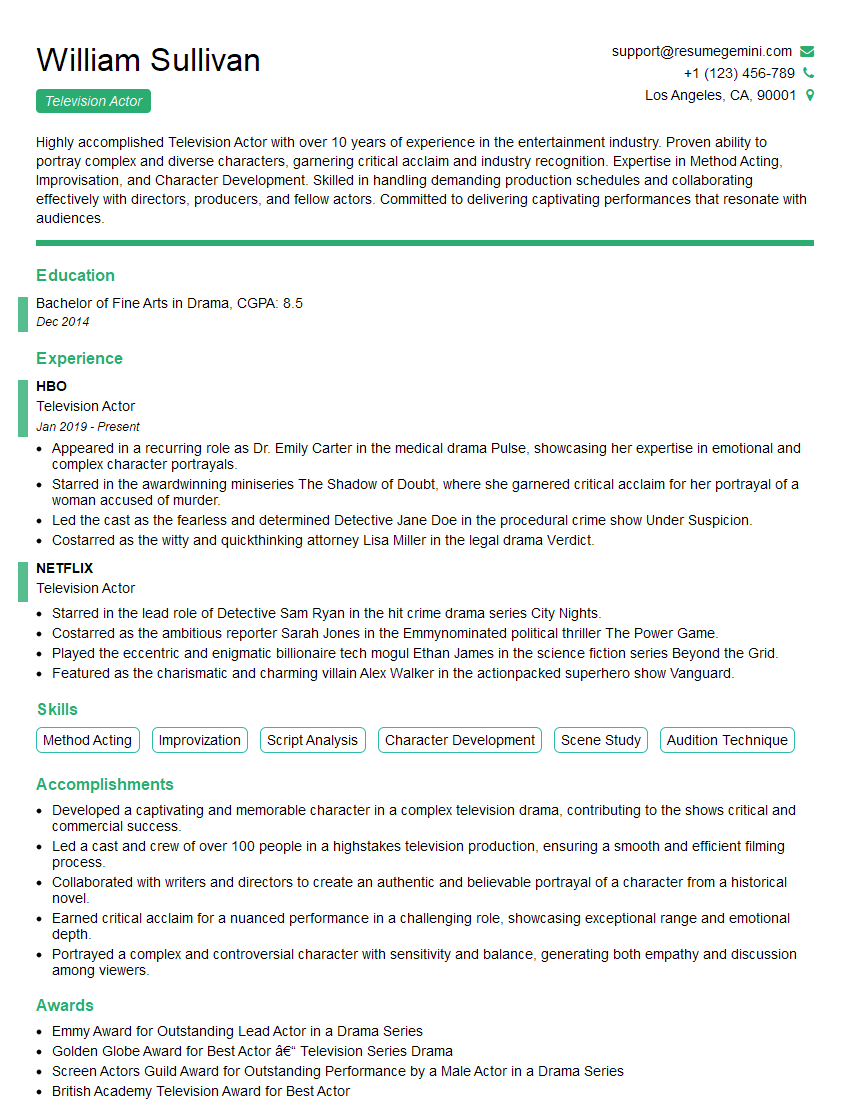
Mastering camera acting is crucial for career advancement in the dynamic world of film and television. It opens doors to a diverse range of roles and collaborative opportunities. To increase your chances of landing your dream role, it’s vital to present yourself professionally, starting with your resume. Creating an ATS-friendly resume significantly improves your chances of getting noticed by casting directors and recruiters. We strongly recommend using ResumeGemini, a trusted resource for building professional and effective resumes. Examples of resumes tailored specifically for Camera Acting roles are available to help you create a compelling application that showcases your skills and experience.
Explore more articles
Users Rating of Our Blogs
Share Your Experience
We value your feedback! Please rate our content and share your thoughts (optional).
What Readers Say About Our Blog
Very informative content, great job.
good