Unlock your full potential by mastering the most common Floral Color Theory interview questions. This blog offers a deep dive into the critical topics, ensuring you’re not only prepared to answer but to excel. With these insights, you’ll approach your interview with clarity and confidence.
Questions Asked in Floral Color Theory Interview
Q 1. Explain the color wheel and its relevance to floral design.
The color wheel is a visual representation of the relationships between colors. In floral design, it’s an indispensable tool for understanding how colors interact and create specific effects. It’s typically arranged with primary colors (red, yellow, blue) at equidistant points, with secondary colors (green, orange, purple) created by mixing adjacent primaries, and tertiary colors formed by mixing a primary and an adjacent secondary. Understanding this arrangement is fundamental to creating visually appealing and harmonious floral arrangements.
For example, imagine you’re designing a bouquet. The color wheel helps you choose colors that complement each other, creating a balanced and aesthetically pleasing arrangement. You might choose analogous colors (those sitting next to each other on the wheel) for a subtle, harmonious look, or complementary colors (opposite each other) for a vibrant, high-contrast effect.
Q 2. Describe the difference between warm and cool color palettes in floral arrangements.
Warm colors, such as reds, oranges, and yellows, evoke feelings of energy, warmth, and excitement. In floral design, warm-colored arrangements tend to feel lively and vibrant, often associated with celebrations or sunny occasions. Think of a bold sunflower bouquet – instantly cheerful and energetic!
Cool colors, such as blues, greens, and purples, create a more calming, serene atmosphere. They can convey feelings of peace, tranquility, and sophistication. A predominantly blue and white arrangement might feel elegant and sophisticated, perfect for a wedding or formal event.
The key difference lies in their psychological impact and the overall mood they create. Warm palettes are exciting and attention-grabbing, while cool palettes are soothing and calming. The choice between them greatly depends on the desired atmosphere and the occasion.
Q 3. How do you create a harmonious color scheme using analogous colors in floral design?
Analogous color schemes utilize colors that are adjacent to each other on the color wheel. This creates a harmonious and visually pleasing effect because the colors share similar undertones, creating a sense of unity. To create such a scheme, simply select three to five colors that are next to each other. For example, you could choose shades of blue, blue-green, and green for a tranquil and serene arrangement.
For a practical application, imagine designing a wedding bouquet. You might choose a light blue hydrangea, a teal lisianthus, and a sage green eucalyptus. The subtle variations in shade create a cohesive and sophisticated feel, without being overwhelming. The key is to vary the shades and tints within the analogous range to prevent monotony; introducing various textures can also enhance this effect.
Q 4. Explain the use of complementary colors in floral arrangements, including potential challenges.
Complementary colors are those that are opposite each other on the color wheel. Using them in floral arrangements creates high contrast and visual excitement. For instance, pairing orange and blue, or red and green, creates a bold and striking effect. However, a potential challenge is achieving balance. Too much of either color can overpower the arrangement, leading to a jarring or unbalanced aesthetic.
To overcome this, consider using one complementary color as the dominant hue and the other as an accent. For example, you could create an arrangement with predominantly orange flowers and then strategically incorporate small pops of blue to create contrast without overwhelming the design. Another approach is to use variations of the complementary colors—for example, muted oranges and soft blues – to create a more subtle, sophisticated balance.
Q 5. How do you use the color wheel to create a visually striking contrast in a floral piece?
Creating visual contrast with the color wheel involves selecting colors that are far apart. This could be using complementary colors (as discussed above), or even triadic colors (three colors equally spaced on the wheel). The aim is to create a striking visual impact, drawing the eye to different parts of the arrangement.
For a striking contrast, think of using a vibrant red rose as the centerpiece and accenting it with cool, contrasting greens and deep purples. The bright red immediately grabs attention, while the cooler colors provide a backdrop and highlight the red’s intensity. Remember that the level of contrast can be adjusted by selecting lighter or darker shades of the chosen colors. A bold contrast might be appropriate for a modern arrangement, while a more subdued approach might be better suited to a classic style.
Q 6. What are the psychological effects of different colors in floral design?
Color psychology plays a significant role in floral design. Different colors evoke different emotions and associations. For example:
- Red: Passion, energy, excitement
- Orange: Enthusiasm, creativity, warmth
- Yellow: Joy, optimism, happiness
- Green: Nature, peace, serenity
- Blue: Calmness, tranquility, trust
- Purple: Royalty, luxury, mystery
Understanding these associations allows designers to create arrangements that align with the desired mood or message. A funeral arrangement might utilize subdued purples and whites, whereas a birthday arrangement might incorporate vibrant yellows and oranges.
Q 7. How do you choose a color palette that complements a specific event or theme?
Choosing a color palette that complements a specific event or theme requires understanding the event’s atmosphere and symbolism. Consider these steps:
- Identify the theme: Is it a rustic wedding, a corporate event, or a vibrant birthday party?
- Research color associations: What colors typically represent the theme? (e.g., pastels for a baby shower, deep reds for a Valentine’s Day event)
- Select a base color palette: Choose 2-3 main colors based on your research and the desired mood. Consider using the color wheel to select harmonious or contrasting colors.
- Incorporate accents: Add accent colors to enhance the overall effect. These could be metallics, neutrals, or other colors that complement the main palette.
- Test and refine: Create a small sample arrangement or a digital mockup to visualize the final effect. Make adjustments as needed to achieve the desired look and feel.
For example, a tropical-themed wedding might utilize bright oranges, pinks, and greens, reflecting the vibrant colors of tropical flowers and foliage.
Q 8. Explain the concept of color temperature and its impact on floral arrangements.
Color temperature refers to the warmth or coolness of a color, ranging from warm (reds, oranges, yellows) to cool (blues, greens, purples). Think of it like the difference between the warmth of a sunset and the coolness of a winter sky. In floral arrangements, color temperature significantly impacts the overall mood and feeling. Warm colors create a vibrant, energetic atmosphere, perfect for celebratory occasions. Cool colors, conversely, evoke a sense of calm and tranquility, ideal for more subdued settings.
For example, a bouquet dominated by warm-toned roses and sunflowers will feel cheerful and uplifting, while one featuring cool-toned hydrangeas and delphiniums will project a serene and sophisticated vibe. A skillful florist understands how to balance warm and cool tones to create the desired effect; perhaps using warm oranges as accents against a backdrop of cool blues.
Q 9. Describe how light affects the perceived color of flowers.
Light is crucial in how we perceive flower colors. The type and intensity of light dramatically alter color appearance. Natural daylight, particularly indirect sunlight, often reveals the truest color of flowers. However, artificial lighting can significantly shift the perceived hue. Incandescent lighting tends to enhance warm tones, while fluorescent lighting can wash out colors and make them appear cooler or duller.
Consider a vibrant red rose. Under direct sunlight, its redness will be intense and saturated. Under dim, incandescent lighting, that same red might appear more orange and less intense. Therefore, when designing floral arrangements, it’s essential to consider where the arrangement will be displayed and the type of lighting it will receive. For example, a bouquet designed for a dimly lit evening event might need stronger, more saturated colors to prevent it from looking muted.
Q 10. How would you create a monochromatic floral arrangement and what are its advantages?
A monochromatic floral arrangement uses different shades, tints, and tones of a single color. Imagine a stunning arrangement using only various shades of purple – from deep violet to light lavender. The advantage of this approach is its inherent elegance and cohesiveness. It creates a sophisticated and harmonious look that is visually pleasing and easy on the eye.
To create one, I’d begin by selecting a base color, such as a deep burgundy. Then, I’d incorporate lighter shades of burgundy, perhaps some pinkish-burgundy blooms, and add foliage with hints of purple tones. This creates depth and avoids monotony, even though the overall palette is limited. You could also introduce textural variety through different types of flowers, to make the arrangement visually interesting. The result is a beautifully unified and calming arrangement.
Q 11. Explain how you would use triadic color harmonies in a floral design.
Triadic color harmony involves using three colors equally spaced on the color wheel. Think of a classic triad: red, yellow, and blue. In floral design, this can create a vibrant and energetic arrangement. For example, I might use yellow sunflowers as the primary element, bright red gerbera daisies as a secondary accent, and blue delphiniums to provide a calming contrast.
The key is to balance the intensity of each color. You might use a more muted shade of one color to create equilibrium, preventing any single color from overwhelming the arrangement. Another approach is to play with textures. The rough texture of sunflowers could complement the smooth petals of gerbera daisies, and feathery delphiniums would add another visual layer.
Q 12. How can you use color to create depth and dimension in a floral arrangement?
Color plays a significant role in creating depth and dimension in floral arrangements. Darker colors recede, creating the illusion of depth, while lighter colors advance, bringing them closer to the viewer. This principle is critical in creating a sense of three-dimensionality and visual interest.
For instance, placing darker-colored flowers towards the back of the arrangement and progressively lighter colors towards the front creates a sense of perspective and depth. You can also use this technique strategically; a darker background can make lighter-colored flowers pop, creating a focal point.
Q 13. How do you select colors that will photograph well?
Selecting colors that photograph well requires considering how colors interact with camera sensors and lighting conditions. Avoid colors that are very pale or washed out, as these can appear flat in photos. Similarly, colors that are too similar in tone might blend together. Think about the background against which your floral arrangements will be photographed; this will affect the contrast and overall impact of the colors.
Strong, saturated colors generally photograph best. Think of jewel-toned hues—rich purples, deep blues, and vibrant reds. A balanced color palette, using variations of tone and hue, also ensures that the arrangement doesn’t look too flat and uninspired. It’s crucial to experiment with lighting and composition to ensure the final result is stunning.
Q 14. Describe your process for selecting flowers and foliage based on color and texture.
My flower and foliage selection process is a careful dance between color and texture. I start by considering the overall mood or theme of the arrangement. Then, I select a primary color palette, keeping in mind color harmonies and the impact of color temperature. This palette guides my selection of blooms.
Next, I consider texture. I’ll pair smooth, delicate petals with rough, textured foliage to create visual interest. For example, I might combine the smooth petals of roses with the prickly texture of eucalyptus leaves, or pair soft, velvety poppies with the spiky foliage of ferns. The interplay of color and texture is essential in creating a dynamic and visually engaging floral arrangement. The final step involves checking the longevity of the flowers I’ve selected, ensuring the arrangement will remain beautiful for its intended lifespan.
Q 15. Explain how different flower types affect the overall color palette of an arrangement.
Different flower types significantly impact the overall color palette of an arrangement. Think of it like painting with a limited set of brushes – each flower offers a unique texture and color intensity that contributes to the final effect. For example, the delicate pastel shades of a hydrangea will create a softer, more romantic feel compared to the bold, saturated hues of a gerbera daisy. Similarly, the subtle variations in color within a single flower type, like the gradient shades of a tulip, can add depth and complexity. We need to carefully consider both the individual flower’s color and its texture, as a velvety rose will have a different impact than a light, airy baby’s breath, even if they share a similar color.
Roses, with their wide array of colors and forms, can anchor a palette. Their rich tones can be balanced by lighter, airy flowers like Queen Anne’s Lace for contrast and textural variation. Using multiple types of flowers allows for playing with color intensity and saturation. For instance, combining deep red roses with pale pink peonies creates a visually harmonious blend that’s both elegant and dynamic.
Career Expert Tips:
- Ace those interviews! Prepare effectively by reviewing the Top 50 Most Common Interview Questions on ResumeGemini.
- Navigate your job search with confidence! Explore a wide range of Career Tips on ResumeGemini. Learn about common challenges and recommendations to overcome them.
- Craft the perfect resume! Master the Art of Resume Writing with ResumeGemini’s guide. Showcase your unique qualifications and achievements effectively.
- Don’t miss out on holiday savings! Build your dream resume with ResumeGemini’s ATS optimized templates.
Q 16. How do you balance strong colors with softer hues in a floral design?
Balancing strong colors with softer hues is crucial for creating a visually appealing and harmonious floral design. It’s all about creating a sense of equilibrium. Think of it as a musical composition – you need both strong beats and softer melodies to make it engaging. Strong colors like crimson or deep purple act as focal points, drawing the eye, while softer hues like pastel pinks or creams provide a calming counterpoint, preventing the arrangement from feeling overwhelming. This balance can be achieved through several techniques:
- Proportion: Use a smaller quantity of strong colors strategically placed amongst a larger quantity of softer hues.
- Placement: Position strong colors towards the center or at strategic points to draw the eye, while letting softer colors fill the gaps.
- Color Wheel: Utilize the color wheel to select complementary or analogous colors. For example, pairing a vibrant orange with a soft blue creates a visually appealing contrast while maintaining harmony.
For example, in a bridal bouquet, you might use a few deep red roses as focal points, surrounded by a cascade of ivory and blush-toned roses and delicate greenery. This combination avoids visual overload and delivers elegance.
Q 17. What are some common mistakes to avoid when using color in floral arrangements?
Avoiding common color mistakes is essential for successful floral design. Some frequent pitfalls include:
- Overusing one color: A monochromatic arrangement can be stunning if done well, but overdoing it can lead to a monotonous and visually unappealing result. Variety is key!
- Ignoring color temperature: Warm and cool colors affect the overall mood. Mixing too many warm colors together can feel overwhelming, while too many cool colors might feel sterile. Balancing both is essential.
- Ignoring color harmony: Using colors that clash drastically can create visual discord. Referencing the color wheel ensures harmony.
- Neglecting the background: The backdrop against which the arrangement is displayed significantly impacts its overall perception. A vibrant background might overwhelm a delicate arrangement, while a neutral background could enhance it.
- Lack of focal points: Without defined focal points, arrangements can appear messy and lack direction. Strategic use of color helps guide the eye.
For instance, using only shades of red without any contrasting cooler tones could create a rather heavy and unbalanced design. Always consider the overall impact of color temperature and balance.
Q 18. Explain how you maintain color consistency in large-scale floral installations.
Maintaining color consistency in large-scale floral installations requires meticulous planning and execution. Imagine arranging flowers for a large wedding – any inconsistency would be easily noticed! Here’s how to achieve this:
- Source Flowers Carefully: Utilize reputable suppliers who can guarantee consistent color batches. Order in bulk but verify the consistency before finalizing the order.
- Color Charts & Samples: Create detailed color charts specifying exact flower types and shades. Provide these to the team assembling the installation. Physical samples from the supplier should also be kept as reference.
- Quality Control: Employ a rigorous quality control process where team members check the flowers for color accuracy before incorporating them into the installation. This is especially crucial when working with a large team.
- Staging & Lighting: Consider how the lighting affects the perceived color of flowers. Ensure consistent lighting throughout the installation area to avoid discrepancies in color appearance.
- Flower Aging: Be aware that flower color can change as they age. Choose flowers at the peak of their bloom for optimal color consistency throughout the event.
For example, in a large wedding installation, we created a detailed chart with specific flower varieties and color codes (e.g., Pantone matching) for each section, ensuring everyone used the exact same shades of pink and white throughout the ceremony and reception spaces.
Q 19. Discuss how seasonal changes influence your color choices.
Seasonal changes dramatically influence my color choices. Think of the vibrant oranges and reds of autumn versus the soft pastels of spring. Each season naturally lends itself to specific color palettes.
- Spring: Soft pastels like peach, light pink, lavender, and light greens, reflecting the freshness and renewal of the season. I might incorporate tulips, hyacinths, and daffodils.
- Summer: Bright, vibrant colors like sunshine yellow, coral, and fuchsia, reflecting the warmth and energy. Sunflowers, zinnias, and gerbera daisies are frequently used.
- Autumn: Rich jewel tones such as burgundy, deep orange, gold, and rust, mirroring the changing leaves. Dahlias, chrysanthemums, and ornamental grasses feature prominently.
- Winter: Cool tones like white, silver, deep blue, and ivory, symbolizing purity and calmness. White roses, poinsettias, and amaryllis are frequently used.
Seasonal availability also dictates color choices. While I might envision a specific color palette, the actual availability of flowers during the specific season significantly influences my final selections. Adaptability is vital!
Q 20. How do you adapt color palettes to different client preferences?
Adapting color palettes to different client preferences is a crucial aspect of my work. Every client has unique taste and vision. My approach involves a collaborative process:
- Client Consultation: I start by having a thorough discussion with the client, understanding their style, preferences, and any specific color requests. Inspiration boards, mood boards, and even clothing swatches can be useful tools.
- Style Exploration: Based on the client’s input, I present a range of color palette options, keeping in mind the event’s theme, location, and overall atmosphere.
- Color Psychology: I incorporate knowledge of color psychology to suggest palettes that evoke the desired mood – e.g., calming blues for a spa-like ambiance or vibrant reds for an energetic party.
- Presentation and Refinement: I present my suggestions through digital mockups and physical samples, enabling clients to visualize the proposed palettes. I’m always open to feedback and adjustments.
- Compromise and Creativity: Sometimes, we need to compromise to reach a perfect balance between the client’s vision and my professional expertise. Creativity lies in finding solutions that fulfill both needs.
For example, a client might request a ‘rustic’ wedding, which I might translate into earth tones with pops of lavender. A corporate event might require a more sophisticated palette of navy, silver, and white.
Q 21. Describe a time you had to solve a color-related problem in a floral design project.
During a large corporate gala, the initial color scheme called for deep purples and golds, which looked stunning on paper. However, the event space had very low lighting. When the flowers arrived, the deep purples appeared almost black under the dim lights, losing their impact. The golds, though still visible, lacked the brilliance intended.
To solve this, I quickly made adjustments. I swapped out some of the deep purple flowers with lighter shades of lilac and mauve. These still incorporated the purple family but were far more vibrant under the lighting conditions. I also supplemented the golds with more shimmery accents like crystals and gold-toned ribbons to enhance their visibility. This ensured the arrangements still felt luxurious and elegant while appearing as intended in the low-light setting.
The on-the-spot adjustment required creativity, quick thinking, and a good understanding of how lighting impacts color perception. The final result retained the intended elegance and luxury of the event without sacrificing the impact of the color palette.
Q 22. What are some advanced color techniques you employ in your floral arrangements?
Advanced color techniques in floral design go beyond basic color wheel knowledge. They involve understanding nuanced color harmonies, manipulating color temperature, and utilizing unique color effects. For example, I frequently employ split complementary color schemes, which are more dynamic than strict complementary schemes. Instead of using colors directly opposite each other on the wheel (like blue and orange), I’ll use a blue and the two colors adjacent to its complement, orange – perhaps orange and yellow-orange. This provides visual interest without the harsh contrast of direct complements.
Another technique I utilize is color gradation. This involves subtly shifting from one color to another, creating a smooth transition. Imagine a bouquet progressing from deep burgundy roses to lighter pink lilies, then finally to near-white carnations. This creates a sophisticated and visually appealing depth. I also experiment with monochromatic schemes, using different shades and tints of a single color, to achieve elegant unity. Finally, the strategic use of color accents, incorporating a small amount of a contrasting color to ‘pop’ against a primarily muted palette, adds dramatic focus. This could be a single deep purple dahlia in an arrangement dominated by pastel shades.
Q 23. How do you stay updated on current floral color trends?
Staying updated on floral color trends is crucial. I actively engage with several methods to stay ahead of the curve. I religiously follow influential floral designers on social media platforms like Instagram and Pinterest, analyzing their work and identifying emerging trends. Attending industry trade shows and workshops allows me to network with peers and observe the latest innovations firsthand. Subscription to design magazines and online publications keeps me abreast of global color palettes and design direction. Additionally, I regularly review Pantone’s color reports, as they offer insights into broader color trends influencing fashion and design, which often trickle down to floral arrangements. Finally, I pay close attention to seasonal blooms; nature itself is a great source of color inspiration!
Q 24. Explain the impact of cultural significance on color choices in floral design.
Cultural significance profoundly impacts floral color choices. For instance, white is often associated with purity and innocence in Western cultures, frequently used in weddings. However, in some Asian cultures, white is associated with mourning. Red symbolizes passion and love in many cultures, but in some, it represents luck or prosperity. Understanding these cultural nuances is vital for creating arrangements appropriate for specific occasions and audiences. For a Japanese wedding, avoiding white might be prudent, while focusing on softer pastels or incorporating traditional Japanese flowers like cherry blossoms would show cultural sensitivity and respect. When designing for a client of a different cultural background, I always engage in open communication to understand their preferences and avoid any unintentional misinterpretations of color symbolism.
Q 25. How do you consider the environmental impact when selecting flower colors and materials?
Environmental considerations heavily influence my flower selection. I prioritize locally sourced, sustainably grown flowers whenever possible, reducing the carbon footprint associated with long-distance transportation. This means working with local growers and choosing flowers in season to avoid the environmental impact of importing blooms. I also avoid using excessive packaging materials and opt for recyclable or biodegradable alternatives. Furthermore, I educate my clients on the importance of supporting sustainable practices, encouraging them to choose locally sourced flowers. When selecting colors, I try to avoid highly processed and artificially dyed blooms, instead embracing the natural palette offered by seasonal flowers. For example, instead of forcing certain colors out of season, I’ll work with the beautiful hues available at the time, showcasing the natural beauty of the season.
Q 26. Explain the principles of color mixing and their relevance to floral design.
Color mixing is fundamental to floral design. Understanding the additive and subtractive color models is crucial. The additive model applies to light (as in computer screens), where red, green, and blue (RGB) combine to create other colors. The subtractive model applies to pigments (like paints and flower petals), where cyan, magenta, and yellow (CMY), alongside black (K), combine to create other colors. This means that mixing colors in floral design relies on the subtractive model. For example, mixing red and white carnations may yield pink, but mixing various flowers with different pigment concentrations will result in a variety of pink shades, depending on the ratios and concentrations of pigments involved. Understanding this helps to predict the resulting color when combining various flowers in an arrangement, allowing for precise color control.
Q 27. How do you use color to convey specific emotions or moods in your work?
Color is a powerful tool for evoking emotions. Warm colors like reds, oranges, and yellows generally convey energy, excitement, and passion. Think of a vibrant bouquet of sunflowers and gerbera daisies—it radiates warmth and joy. Cool colors like blues, greens, and purples tend to evoke calmness, serenity, and tranquility. A serene arrangement of hydrangeas and lavender might be perfect for a relaxing spa setting. The strategic use of color temperature (warm vs. cool) allows me to control the overall mood of the arrangement. For a romantic setting, I might incorporate soft pinks and peaches alongside deep burgundy accents. For a somber occasion, muted blues, purples and greys would be appropriate.
Q 28. Describe how you utilize color to create a focal point in a floral arrangement.
Creating a focal point through color involves strategic contrast and emphasis. The most straightforward approach is using a color contrast: a visually striking flower in a contrasting color placed in the center or at a visually dominant position within the arrangement. For instance, a bright orange poppy in an arrangement of mostly soft pastel-colored blooms immediately draws the eye. Another method involves using a color saturation technique. A deeply saturated color (a very rich and intense color) will naturally stand out against more muted tones. A dark red rose amongst lighter pinks and whites will serve as a prominent focal point. You can also use color temperature strategically. A warm colored flower (like a red or orange) placed amongst mostly cool colored flowers (blues and purples) will create a dramatic focal point due to the difference in temperature. Finally, you can use color placement: simply putting the most vibrant colored flower at the highest or most visible point within the arrangement.
Key Topics to Learn for Your Floral Color Theory Interview
- Color Harmonies: Understanding analogous, complementary, split-complementary, triadic, and tetradic color schemes and their application in floral arrangements.
- Color Psychology in Floral Design: Knowing how different colors evoke emotions and how to utilize this knowledge to create specific moods and atmospheres (e.g., using calming blues for a tranquil setting, vibrant reds for energy).
- Color Wheel Mastery: Demonstrate a strong understanding of the color wheel and its practical use in choosing complementary and contrasting colors for impactful designs.
- Seasonal Color Palettes: Discuss the typical color palettes associated with different seasons and how to select appropriate colors for seasonal floral arrangements.
- Color Temperature and its Impact: Explain the difference between warm and cool colors and their effect on the overall design, considering the interplay of light and shadow.
- Advanced Color Techniques: Discuss techniques such as using tints, shades, and tones to create subtle variations and depth within floral arrangements.
- Color and Flower Variety: Explain the relationship between color choices and the selection of flower types, considering texture, form, and overall aesthetic impact.
- Practical Application: Be prepared to discuss your approach to solving color-related challenges in floral design, such as resolving color clashes or creating balanced and harmonious compositions.
- Client Consultation and Color Selection: Discuss strategies for effectively communicating color choices and preferences with clients, taking into account their personal style and event theme.
Next Steps
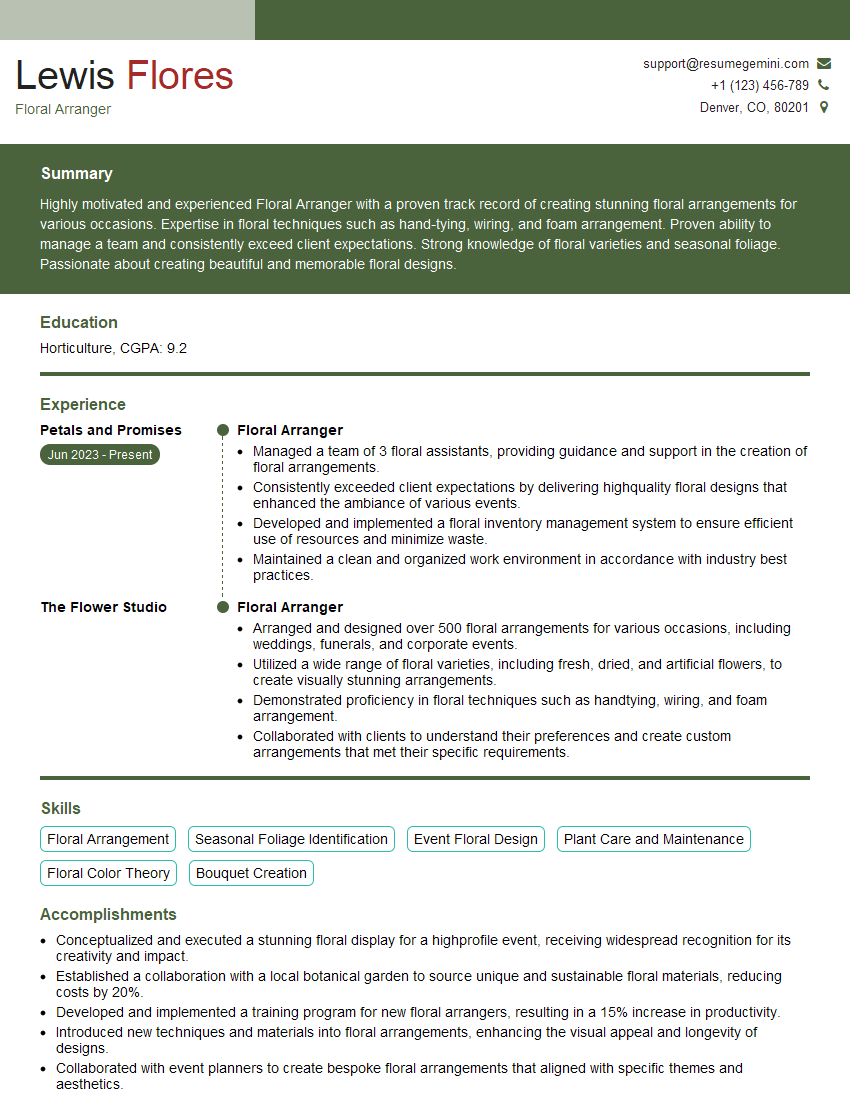
Mastering Floral Color Theory is crucial for career advancement in the floral design industry. A strong understanding of these principles will set you apart from other candidates and demonstrate your expertise to potential employers. To significantly enhance your job prospects, creating an ATS-friendly resume is paramount. ResumeGemini is a trusted resource for building professional and effective resumes that capture the attention of recruiters. ResumeGemini offers examples of resumes tailored to Floral Color Theory professionals, providing valuable templates and guidance to ensure your resume stands out.
Explore more articles
Users Rating of Our Blogs
Share Your Experience
We value your feedback! Please rate our content and share your thoughts (optional).
What Readers Say About Our Blog
Very informative content, great job.
good