Preparation is the key to success in any interview. In this post, we’ll explore crucial Folding and Stitching interview questions and equip you with strategies to craft impactful answers. Whether you’re a beginner or a pro, these tips will elevate your preparation.
Questions Asked in Folding and Stitching Interview
Q 1. What types of stitching techniques are you proficient in?
My stitching proficiency spans a wide range of techniques, encompassing both hand and machine stitching. In hand stitching, I’m adept at techniques like running stitch, backstitch, blind stitch, whip stitch, and various decorative stitches. Machine stitching includes straight stitching, zig-zag stitching, overlocking (serging), blind hemming, and decorative stitches using various machine feet. I’m also experienced in specialized techniques like topstitching for a clean finish and appliqué for embellishment. Think of it like having a diverse toolbox – each stitch has its own purpose and strength, allowing me to choose the best approach for any given fabric and garment construction.
- Running Stitch: A basic stitch for basting or gathering.
- Backstitch: A strong stitch for seams that need durability.
- Blind Stitch: Used for nearly invisible hems.
- Overlocking (Serging): Finishes raw edges to prevent fraying and adds a professional look.
Q 2. Explain the different types of seams used in garment construction.
Seams are the foundation of garment construction, and the choice depends heavily on fabric type, garment style, and desired aesthetic. Some common seam types include:
- French Seam: Encloses all raw edges, creating a very clean, durable, and professional finish, ideal for sheer fabrics or garments where the inside is visible.
- Seam Allowance: This is not strictly a seam type but is crucial; it is the amount of fabric beyond the stitching line which can vary based on the garment design and fabric type. A standard seam allowance is often 5/8 inch.
- Plain Seam: The simplest seam type; two fabric pieces are stitched together and pressed open, appropriate for most fabrics.
- Flat-felled Seam: Extremely durable and used often in denim, this seam has one seam allowance folded over and stitched down, enclosing the raw edge.
- Overlocked Seam: Achieved with a serger, it simultaneously stitches and finishes the raw edges, preventing fraying; common for knit fabrics.
The selection of seam type directly impacts the garment’s quality, durability, and appearance. For instance, a French seam is perfect for a silk blouse, while a flat-felled seam would be better suited for sturdy jeans. Choosing the correct seam type based on the intended use and fabric is key.
Q 3. Describe your experience with various folding techniques for different fabrics.
Folding techniques vary significantly depending on the fabric’s drape, weight, and texture. For example, delicate fabrics like silk require careful, gentle handling and precise folding to avoid creasing or stretching. Heavy fabrics like denim may require more force and less concern for delicate folding. I’m experienced in:
- Bias Folding: Cutting fabric on the bias (at a 45-degree angle to the grain) creates a more supple drape, useful for curved or fitted garments.
- Straight Grain Folding: The most common method for most fabrics, ensures pattern matching and helps achieve a better fit.
- Matching Notches and Pattern Pieces: Precise folding is vital for accurately aligning pattern pieces, particularly in complex garments.
- Folding for Specific Garments: Techniques vary based on the style of garment- for example, pleats require precise, repeated folding.
I adapt my folding techniques to the specific needs of the fabric and garment, ensuring accuracy and efficiency.
Q 4. How do you ensure consistent folding and stitching quality?
Maintaining consistent quality in folding and stitching requires attention to detail and a systematic approach. I use a variety of methods:
- Consistent Seam Allowances: I always measure precisely when cutting and sewing to ensure even seam allowances.
- Proper Pressing: Pressing after each sewing step helps maintain the shape of the garment and avoid distortion.
- Careful Pinning and Clipping: Accurately pinning and clipping curves helps prevent puckering or stretching.
- Regular Machine Maintenance: A well-maintained sewing machine is essential for consistent stitches and prevents skipped stitches or thread breakage.
- Quality Control Checks: Throughout the process, I carefully check for any inconsistencies, and correct as necessary.
Consistency is paramount and achieved through diligent preparation and regular quality checks.
Q 5. What are some common quality control issues encountered in folding and stitching?
Common quality control issues include:
- Uneven Seam Allowances: Leading to an inconsistent garment fit and unprofessional finish.
- Puckering or Stretching: Caused by improper fabric handling, pinning, or stitching.
- Skipped Stitches or Thread Breakage: Often due to machine malfunction or improper tension settings.
- Inconsistent Stitching Length: Makes the stitching look sloppy and unprofessional.
- Incorrect Pattern Matching: Results in a garment that lacks symmetry or alignment.
Addressing these issues requires meticulous attention to detail during each stage of the process.
Q 6. How do you troubleshoot sewing machine malfunctions?
Troubleshooting sewing machine malfunctions requires a methodical approach. I typically follow these steps:
- Identify the Problem: Pinpoint the specific issue – is the machine skipping stitches, is the thread breaking, or is it making unusual noises?
- Check the Obvious: Make sure the needle is inserted correctly, the bobbin is properly wound and placed, and the thread is correctly threaded.
- Check Tension: Adjust the upper and lower tension settings; this is often a source of problems.
- Clean the Machine: Dust and lint can interfere with the machine’s operation; clean with a brush and compressed air.
- Check the Needle: A bent or damaged needle can cause various problems; replace it.
- Refer to Manual: Consult the sewing machine’s manual for specific troubleshooting guides.
If the issue persists after these steps, I would seek professional help or consult repair manuals.
Q 7. Describe your experience with different types of sewing machines.
My experience encompasses various sewing machines, from basic mechanical models to advanced computerized machines. I’m proficient with:
- Mechanical Sewing Machines: These offer a basic understanding of sewing mechanics, focusing on manual control over stitch length and tension.
- Computerized Sewing Machines: These provide advanced features such as programmable stitches, automatic needle threading, and built-in embroidery capabilities. I am familiar with machines from various brands and am able to effectively utilize their features.
- Industrial Sewing Machines: While not used in my day-to-day work, I have some experience with industrial machines, understanding their strengths for heavy-duty tasks and high-volume production.
- Sergers (Overlock Machines): I’m experienced in using sergers for finishing seams and creating professional-looking edges.
Understanding the capabilities and limitations of each type allows me to select the appropriate machine for the task at hand.
Q 8. How do you maintain your sewing machines to ensure optimal performance?
Maintaining sewing machines is crucial for consistent, high-quality work. Think of it like regularly servicing a car – preventative maintenance is key. My routine involves several key steps:
- Regular Cleaning: After each use, I remove lint and dust from the bobbin case, feed dogs, and presser foot area using a small brush or compressed air. This prevents build-up that can cause jams and malfunctions. Think of it like cleaning out the crumbs from your toaster – it keeps it running smoothly!
- Lubrication: I lubricate moving parts like the needle bar, bobbin race, and hook with high-quality sewing machine oil, following the manufacturer’s recommendations. This reduces friction and wear, extending the life of the machine.
- Needle Changes: I replace needles regularly, even if they don’t appear damaged. Bent or dull needles can lead to skipped stitches, broken threads, and even damage to the fabric. It’s like changing a dull knife – a sharp needle makes all the difference.
- Tension Adjustment: I regularly check and adjust the upper and lower thread tension to ensure even stitch formation. This involves testing on scrap fabric and making minor adjustments as needed. It’s like fine-tuning a musical instrument for perfect harmony.
- Professional Servicing: I schedule annual professional servicing for a thorough cleaning, lubrication, and inspection by a qualified technician. This addresses any potential issues before they become major problems. This is like getting a yearly checkup for your car.
Q 9. What safety precautions do you observe when operating sewing machines?
Safety is paramount when working with sewing machines. My safety precautions include:
- Machine Maintenance: Regular cleaning and maintenance prevent unexpected malfunctions that could cause injuries.
- Proper Setup: Ensuring the machine is stable on a flat surface, and the power cord is in good condition prevents accidents from a tipping machine or electrical shock.
- Finger Guards: I always use finger guards or guides when working with needles, especially when sewing curves or tight seams. This protects my fingers from accidental punctures.
- Clear Workspace: I maintain a clean and organized workspace, free from clutter to avoid tripping hazards and ensure easy access to all necessary materials.
- Sharp Objects: I handle needles and pins carefully, and I use pincushions or magnetic needle keepers to prevent accidental pricks.
- Appropriate Attire: I avoid loose clothing or jewelry that could get caught in the machine. I always make sure my hair is tied back.
- Never Leave Machine Running Unattended: This is crucial to prevent accidents and maintain quality control.
Q 10. How do you manage your time and prioritize tasks in a fast-paced production environment?
In a fast-paced environment, effective time management is crucial. I use a combination of techniques:
- Prioritization: I prioritize tasks based on deadlines and urgency, using methods like the Eisenhower Matrix (urgent/important). This ensures that the most critical tasks are completed first.
- Batching: I group similar tasks together, such as cutting all fabrics for a specific order at once, to streamline my workflow. This minimizes context switching and improves efficiency.
- Time Blocking: I allocate specific time blocks for different tasks, which helps maintain focus and track progress. For example, I may dedicate two hours to cutting, and then two hours to stitching.
- Break Planning: I incorporate short breaks throughout the day to prevent burnout and maintain concentration. Regular short breaks can be more effective than one long break.
- Production Tracking: I use a system (physical or digital) to track progress towards production targets. This allows me to adjust my approach if I fall behind schedule.
Q 11. How do you handle tight deadlines and high-volume production?
Meeting tight deadlines and high-volume production requires a strategic approach:
- Efficient Workflow: Streamlining processes, like using assembly lines or parallel processing, where possible, helps manage large volumes.
- Teamwork: In team environments, efficient communication and task delegation are essential to meet tight deadlines. This is crucial for coordination of efforts.
- Prioritization and Delegation: This allows for focusing on the most critical aspects to ensure timely completion.
- Overtime Planning: If absolutely necessary, I plan for extra time and flexibility to accommodate unforeseen delays. This can involve adjustments to scheduling and prioritizing urgent tasks.
- Quality Control Checkpoints: Regular quality checks during the production process can address issues early, preventing major delays caused by rework.
Q 12. Describe your experience working with different fabric types and their specific needs.
Experience with diverse fabric types is essential in folding and stitching. Each fabric presents unique challenges and requires specific techniques:
- Lightweight Fabrics (silk, chiffon): These require delicate handling to prevent damage. I use sharp needles, fine thread, and gentle pressing techniques.
- Medium-Weight Fabrics (cotton, linen): These are relatively easy to work with, offering a good balance between ease of handling and durability.
- Heavyweight Fabrics (denim, canvas): These demand robust needles, strong thread, and potentially specialized machine settings to ensure clean stitches and prevent needle breakage.
- Stretch Fabrics (lycra, jersey): These require special needles (ballpoint or stretch needles) and a zigzag stitch to accommodate their elasticity. Incorrect stitching can lead to puckering or distortion.
- Woven vs. Knit Fabrics: Understanding the structural differences is crucial; woven fabrics fray easily, requiring precise cutting and seam finishing, whereas knit fabrics tend to stretch and require appropriate needle and stitch selection.
I always pre-test settings on scrap fabric before starting the main project to avoid mistakes and optimize results.
Q 13. How do you adapt your folding and stitching techniques to accommodate different fabric weights and textures?
Adapting techniques to different fabric weights and textures is a core skill. The key is understanding how different fabrics react to pressure and manipulation:
- Needle Selection: Heavier fabrics require stronger needles, while lighter fabrics need finer needles to prevent damage.
- Stitch Length: Shorter stitches are generally preferred for lighter fabrics to maintain strength and prevent puckering, while longer stitches might be appropriate for heavier materials to achieve faster stitching speeds.
- Pressing Techniques: Heavier fabrics might need more aggressive pressing, while lighter fabrics require more gentle approaches to avoid distortion.
- Seam Allowances: Seam allowances should be adjusted based on fabric weight and type. Heavier fabrics often have wider seam allowances to maintain durability.
- Stitch Type: Different stitch types are better suited for various fabrics and desired aesthetic outcomes. A zigzag stitch is appropriate for stretch fabrics to reduce strain and prevent tearing, whereas a straight stitch might be used for heavier materials.
Q 14. Explain your understanding of pattern reading and interpretation.
Pattern reading and interpretation is fundamental to successful garment construction. It’s like deciphering a map to build a structure. My approach involves:
- Understanding Symbols: I am fluent in understanding the standard symbols and abbreviations used on sewing patterns, which represent seam allowances, cutting lines, and other crucial instructions.
- Layout and Cutting: I accurately lay out pattern pieces on the fabric according to grain lines and other instructions to ensure the final garment’s fit and shape.
- Seam Allowances: I always carefully note and add seam allowances to the pattern pieces before cutting, ensuring correct dimensions. This detail is often critical.
- Notches and Markings: I pay close attention to notches and markings on the pattern pieces; they are crucial for aligning seams accurately. These are small, but important cues.
- Pattern Adjustments: I can adapt patterns and make adjustments as needed based on individual measurements or design preferences, applying techniques like grading or slashing and spreading. This may require creative problem-solving.
Q 15. How familiar are you with industrial sewing machine maintenance?
Industrial sewing machine maintenance is crucial for efficient and high-quality production. My experience encompasses preventative maintenance, troubleshooting, and minor repairs. This includes regular lubrication of moving parts like the bobbin case and needle bar, cleaning lint and debris from the hook assembly and feed dogs, and checking the tension of the belts and motor. I’m familiar with various machine types, from single-needle to multi-needle machines and overlockers, and understand the specific maintenance needs of each. For instance, I know how crucial it is to regularly replace the needle on a high-speed machine to prevent skipped stitches and breakage, a costly downtime event. I also understand the importance of keeping detailed maintenance logs to track service intervals and identify potential issues before they escalate.
Career Expert Tips:
- Ace those interviews! Prepare effectively by reviewing the Top 50 Most Common Interview Questions on ResumeGemini.
- Navigate your job search with confidence! Explore a wide range of Career Tips on ResumeGemini. Learn about common challenges and recommendations to overcome them.
- Craft the perfect resume! Master the Art of Resume Writing with ResumeGemini’s guide. Showcase your unique qualifications and achievements effectively.
- Don’t miss out on holiday savings! Build your dream resume with ResumeGemini’s ATS optimized templates.
Q 16. What is your experience with different types of needles and threads?
My experience with needles and threads is extensive. I’m adept at selecting the appropriate needle size and type based on the fabric weight and type. For example, I’d use a fine needle for delicate silks and a heavier needle for denim. I understand the differences between ballpoint needles (for knits), sharp needles (for woven fabrics), and stretch needles (for lycra and other stretch fabrics). Regarding threads, I’m familiar with various fiber types – cotton, polyester, nylon, silk – and their properties. I know how to match thread weight and type to the needle and fabric for optimal stitching. Choosing the correct thread is not only about aesthetics; it significantly influences stitch quality and durability. For example, using a heavy thread with a fine needle on a light fabric will lead to puckering, while a weak thread with a heavy needle on a thick fabric will result in breakage. I regularly experiment with different thread types and brands to determine their suitability for diverse projects, ensuring a professional finish every time.
Q 17. How do you identify and correct stitching errors?
Identifying and correcting stitching errors requires a keen eye and understanding of sewing machine mechanics. Common errors include skipped stitches, broken threads, uneven stitch length, and puckering. Skipped stitches often indicate a dull needle, incorrect tension, or lint buildup. Broken threads can be caused by faulty needles, incorrect thread tension, or knots in the thread. Uneven stitch length points to issues with the machine’s feed dogs or stitch length regulator. Puckering often arises from using the wrong needle type or incorrect tension for the fabric. To correct these errors, I systematically check:
- Needle condition and replacement (if necessary)
- Thread tension adjustments
- Bobbin winding and placement
- Feed dog alignment
- Stitch length setting
I troubleshoot methodically, starting with the simplest solutions (like re-threading or checking the bobbin) before moving to more complex adjustments. I always document the error and its solution to prevent recurrence. My experience allows me to rapidly identify the root cause and implement the most efficient solution.
Q 18. How do you ensure the accuracy and precision of your work?
Accuracy and precision are paramount in my work. I achieve this through meticulous preparation, careful execution, and consistent quality checks. Before starting a project, I thoroughly review the pattern, measure the fabric accurately, and pre-treat it accordingly. While stitching, I maintain consistent speed and pressure to ensure even stitches. I use marking tools, like tailor’s chalk or disappearing ink pens, to precisely place seams and other design elements. I regularly check my work against the pattern to ensure accuracy and correct any deviations promptly. I employ measuring tools like rulers and tape measures frequently during the entire process. Furthermore, I use templates and jigs where applicable for repetitive tasks, guaranteeing uniformity and consistency throughout the garment or item.
Q 19. Describe your experience with quality control processes.
My experience with quality control is extensive and includes both self-inspection and team collaboration. I always perform a thorough self-inspection after completing each step of a project, checking for any flaws like inconsistent stitches, inaccurate seams, or fabric defects. This includes inspecting for proper sizing and fabric alignment. I am familiar with industry-standard quality control processes, including the use of checklists and quality control reports to document findings. In team settings, I participate in collaborative quality control reviews, providing constructive feedback to colleagues and offering assistance to improve product quality. I’m familiar with identifying and addressing deviations from quality standards. My goal is always to deliver a finished product that meets or exceeds expectations, reflecting a commitment to quality in every stage of the process.
Q 20. What is your experience using different types of pressing equipment?
I have extensive experience using various pressing equipment, including irons (both dry and steam), pressing cloths, sleeve boards, seam rolls, and pressing ham. Understanding the properties of different fabrics is essential for choosing the right equipment and techniques. For instance, delicate fabrics require a lower heat setting and a pressing cloth to prevent scorching, while heavier fabrics may tolerate higher temperatures and direct pressing. I know how to use a pressing ham to shape curved areas like collars and darts. The seam roll is vital for creating crisp, even seams. Using the right tool and technique for each fabric type and project element is critical to achieve the professional finish expected. I regularly maintain the equipment, ensuring clean surfaces and proper functionality for optimal results.
Q 21. How do you maintain a clean and organized workspace?
Maintaining a clean and organized workspace is paramount for efficiency and safety. My workspace is organized logically, with frequently used tools readily accessible. I keep my sewing machine clean and free from lint and debris. I use designated storage containers for different types of needles, threads, and notions. I regularly clean up fabric scraps and other materials, ensuring a safe and clutter-free environment. Regular cleaning of the work surface and equipment prevents accidents and ensures the long-term efficiency of my tools and workspace. A clean and organized space contributes to a more focused and efficient workflow, ultimately improving the quality and speed of my work.
Q 22. Explain your experience in using templates and jigs in folding and stitching.
Templates and jigs are indispensable tools in ensuring consistency and precision in folding and stitching. Templates, typically made from sturdy materials like cardboard or plastic, provide a pattern for consistent folds and cuts. Jigs, on the other hand, are more complex fixtures that guide the fabric through various stages of the process, ensuring accurate placement and alignment. My experience encompasses using a wide range of templates and jigs, from simple paper patterns for basic folds to sophisticated, multi-part jigs for intricate garment construction. For example, when working on a project with numerous identical pockets, a jig would ensure each pocket was precisely positioned and sized, preventing inconsistencies. Similarly, templates aid in creating uniformly sized and shaped pieces, especially useful when mass-producing items.
I’ve found that the efficiency gained from using well-designed templates and jigs significantly outweighs the initial investment in their creation or purchase. This is especially true in production environments where consistency and speed are paramount. For example, in a recent project involving the creation of hundreds of identical book covers, using pre-cut templates and a folding jig significantly sped up production and resulted in a perfectly uniform final product.
Q 23. What is your preferred method for handling bulk fabric?
My preferred method for handling bulk fabric involves a combination of organizational techniques and efficient material handling practices. First, I ensure the fabric is properly inspected for any defects before beginning the process. Then, I utilize a system of careful layering and stacking, often using dividers or separators to prevent tangling or wrinkling. This maintains the integrity of the fabric and helps prevent damage or miscuts. Depending on the fabric type and project, I might also use specialized rolling or folding techniques to minimize space and maintain fabric order. For very large quantities, I often work in smaller, manageable batches to improve overall workflow and maintain quality.
Imagine handling a large roll of delicate silk versus a large roll of sturdy canvas – the approach differs significantly. For the silk, gentle rolling and careful handling are crucial, while with the canvas, a more robust stacking method is suitable. Adaptability and understanding of various fabric types are essential when handling bulk materials.
Q 24. How do you handle fabric imperfections or irregularities during the folding and stitching process?
Fabric imperfections are a reality, and dealing with them efficiently is a key skill. My approach involves careful pre-inspection of the fabric to identify irregularities such as holes, stains, or variations in texture. During the folding and stitching process, I strategically place these imperfections in areas that are less visible in the final product, or where they won’t significantly impact functionality. For example, a small imperfection might be hidden under a flap or seam. If the defect is significant and cannot be easily concealed, I’ll often mark it and consult with the client or supervisor before proceeding to determine the best course of action; this might include rejecting the flawed section of fabric or adjusting the design to accommodate it.
For instance, I once encountered a significant discoloration in a batch of cotton fabric intended for a series of tote bags. By carefully planning the placement of the panels on the bag, I managed to conceal the imperfection without compromising the aesthetic appeal of the finished product. Problem-solving and creativity are crucial in such situations.
Q 25. How do you ensure the longevity and durability of the finished product?
Ensuring longevity and durability requires attention to detail throughout the entire process. This starts with selecting high-quality materials that are appropriate for the intended use and environmental conditions. Next, precise stitching is crucial, using appropriate stitch types and tension for the fabric. Reinforcing stress points, such as corners and seams, is also vital. In addition, using appropriate seam finishes, like serging or French seams, prevents fraying and extends the product’s lifespan. Finally, proper care instructions provided to the end-user play a crucial role in extending the product’s useful life.
For example, when creating outdoor cushions, I would use a durable, weather-resistant fabric and reinforce seams to withstand exposure to the elements. Conversely, delicate clothing would require careful selection of softer materials and finer stitchwork for optimal comfort and durability.
Q 26. What are your strengths and weaknesses regarding this type of work?
My strengths lie in my precision, attention to detail, and ability to adapt to different fabrics and techniques. I am adept at problem-solving, quickly identifying and resolving issues that arise during production. I’m also efficient and organized, able to manage large quantities of fabric and complete projects within deadlines. However, a weakness I am actively working on is delegation. In smaller team settings, I sometimes find it challenging to fully delegate tasks, preferring to maintain hands-on control of the entire process. I’m actively working on improving this aspect by learning to trust team members and effectively distribute responsibilities.
Q 27. Are you comfortable working both independently and as part of a team?
Yes, I am entirely comfortable working both independently and as part of a team. Working independently allows me to focus on precision and attention to detail, essential for quality control. However, collaborative work offers valuable opportunities for knowledge sharing and problem-solving. I thrive in team environments where communication is open and constructive. I am adept at both leading and following, adapting my approach to the specific dynamics of each team.
Q 28. Describe a time you solved a complex problem in a production setting related to folding and stitching.
During a large-scale project involving the production of hundreds of custom-designed flags, we faced a challenge with inconsistent sizing due to variations in fabric shrinkage. The initial approach was to pre-wash the fabric, but this proved time-consuming and didn’t completely solve the issue. To address this, I proposed a two-pronged solution. First, we implemented a more rigorous quality control check on the fabric pre-cutting, rejecting pieces with significant variations. Second, I developed a system of using adjustable jigs for cutting and stitching, allowing us to compensate for minor variations in the fabric after pre-washing. This involved creating small, adjustable components on the jigs to fine-tune the placement of the fabric. This improved our efficiency and ensured all final products met the size specifications, avoiding costly rework and delays.
Key Topics to Learn for Folding and Stitching Interview
- Fabric Types and Properties: Understanding different fabric types (e.g., cotton, linen, silk) and their impact on folding and stitching techniques. This includes knowledge of fabric weight, drape, and potential challenges during processing.
- Folding Techniques: Mastering various folding methods for different garment types and applications. This involves understanding efficiency, accuracy, and minimizing fabric damage.
- Stitching Techniques: Proficiency in various stitching methods (e.g., straight stitch, zigzag stitch, blind stitch) and their appropriate applications. This includes understanding stitch length, tension, and needle selection.
- Machine Operation and Maintenance: Familiarization with industrial sewing machines, including their operation, maintenance, and troubleshooting. This also involves understanding safety procedures and preventative maintenance.
- Quality Control and Inspection: Understanding quality control measures to ensure consistent and high-quality output. This involves identifying and correcting defects, and understanding industry standards.
- Problem-Solving and Troubleshooting: Ability to identify and resolve common issues encountered during folding and stitching, such as fabric jams, broken needles, or inconsistent stitching.
- Efficiency and Productivity: Understanding strategies to maximize efficiency and productivity while maintaining high quality. This might involve understanding workflow optimization and time management.
- Safety Procedures: Thorough understanding and adherence to all safety regulations and procedures related to machinery and materials handling.
Next Steps
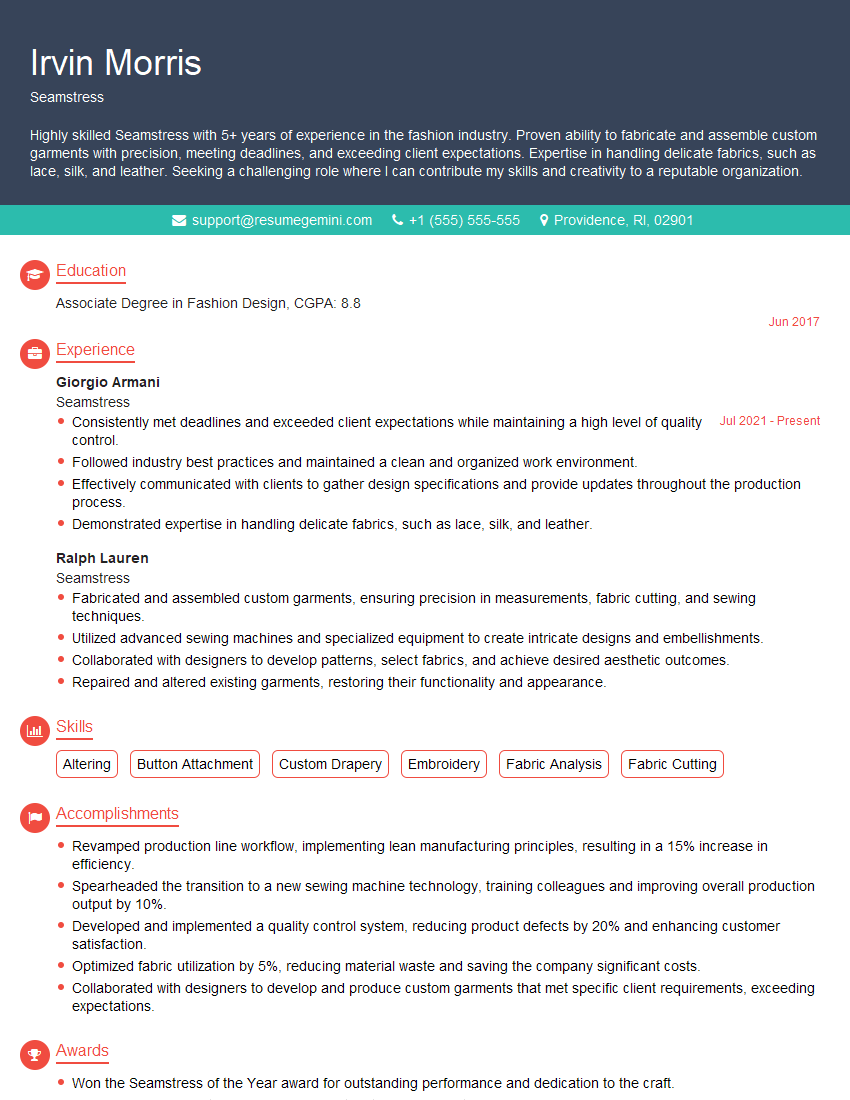
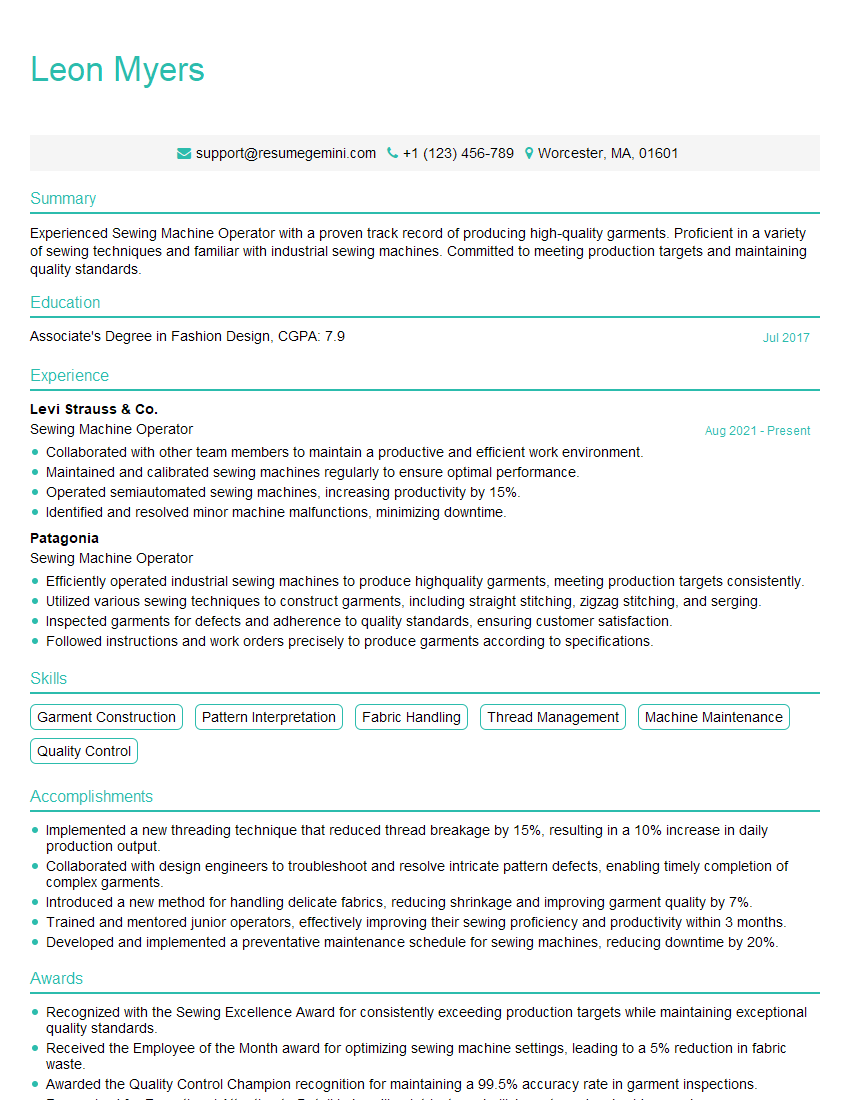
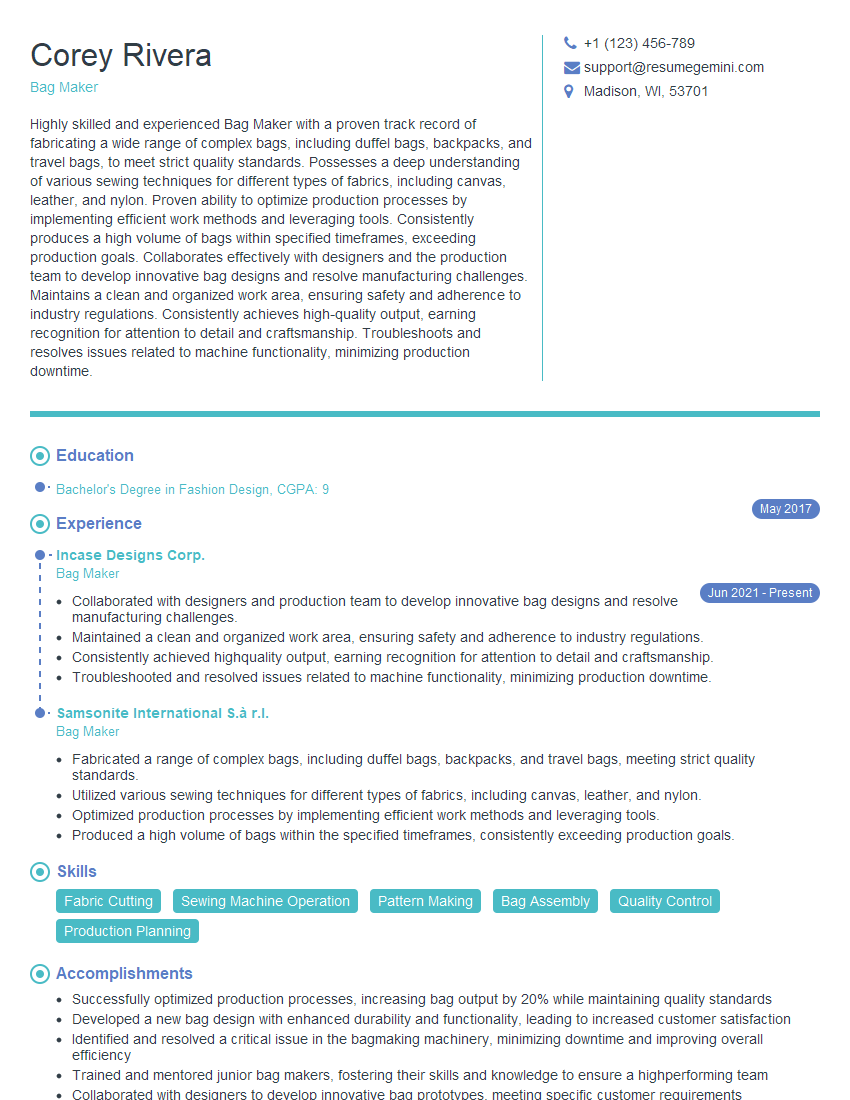
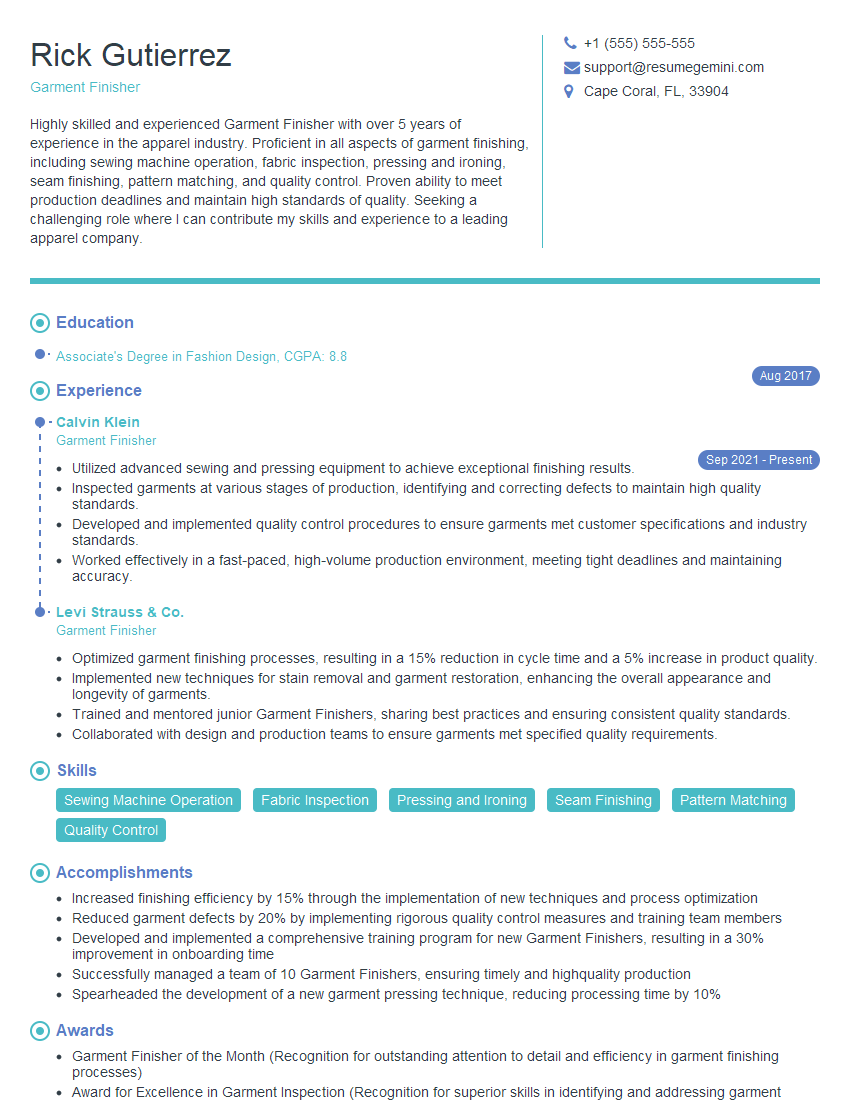
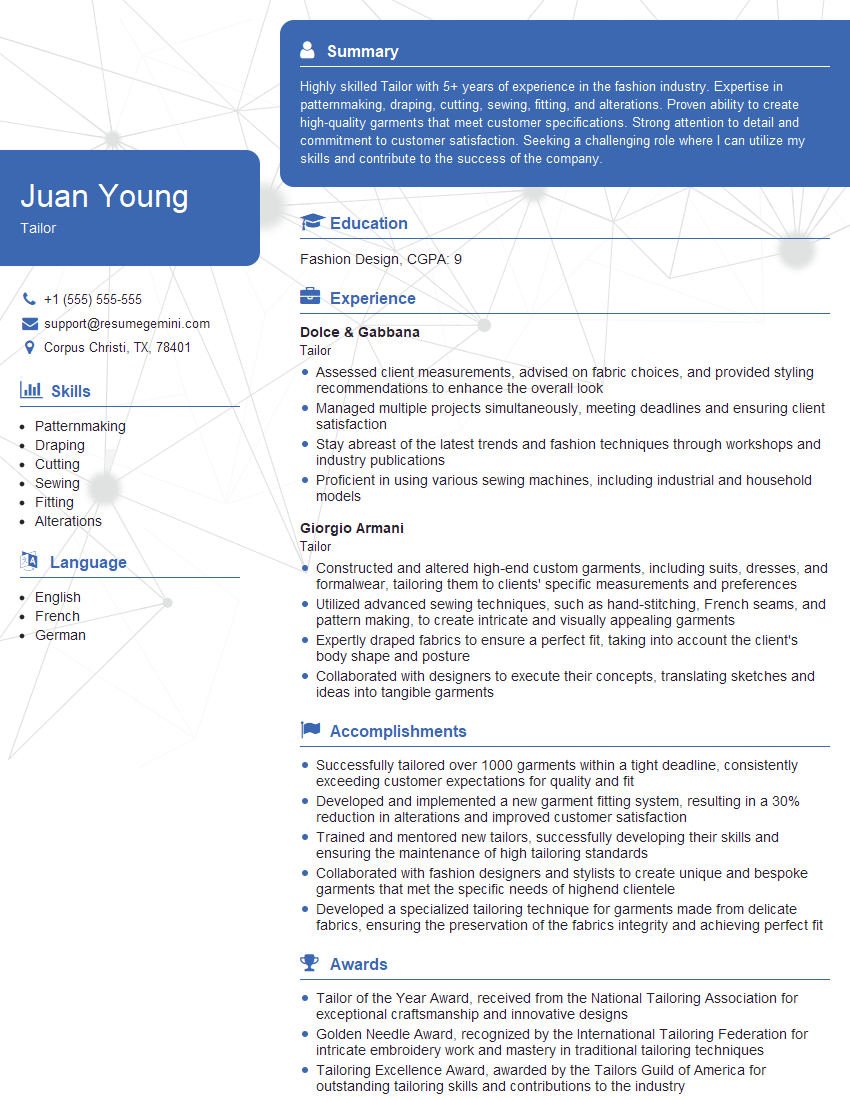
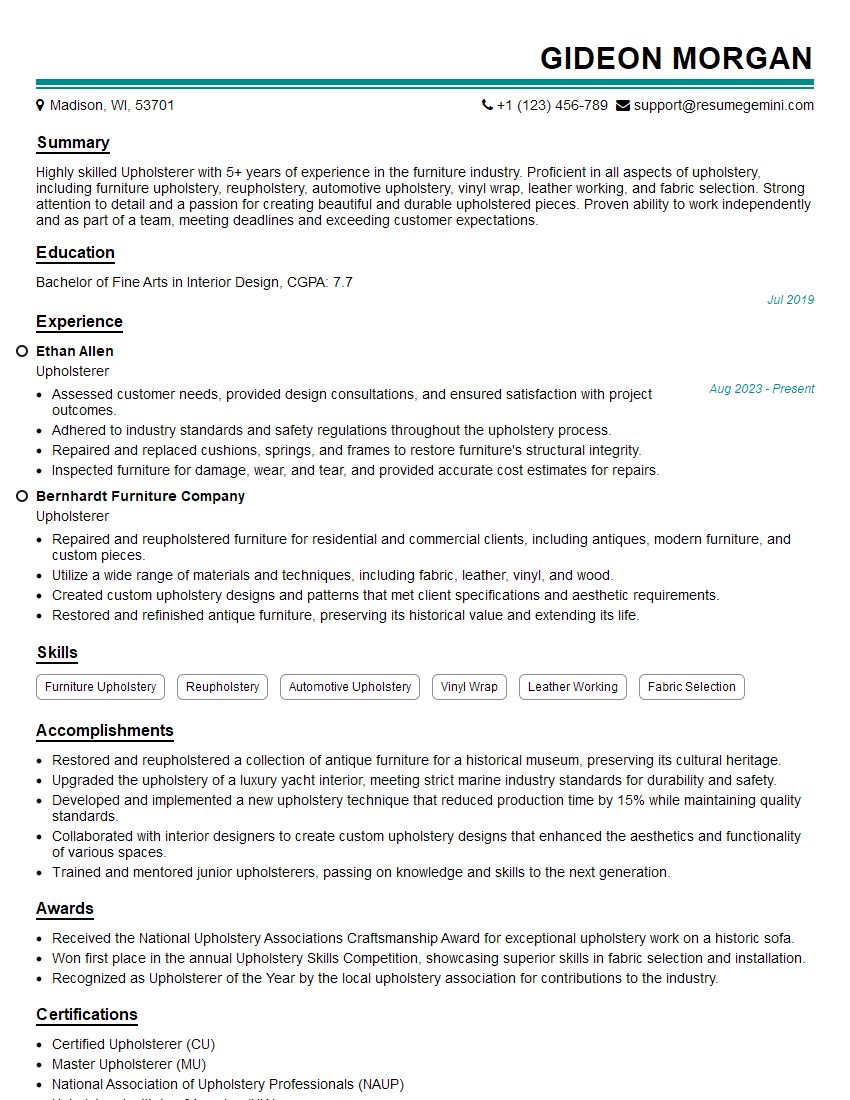
Mastering folding and stitching skills opens doors to diverse and rewarding career opportunities in the apparel and textile industries. To significantly enhance your job prospects, creating a strong, ATS-friendly resume is crucial. ResumeGemini is a trusted resource that can help you build a professional and impactful resume tailored to highlight your skills and experience. Examples of resumes tailored to the Folding and Stitching field are available to help guide you through the process. Invest time in crafting a compelling resume – it’s your first impression with potential employers.




Explore more articles
Users Rating of Our Blogs
Share Your Experience
We value your feedback! Please rate our content and share your thoughts (optional).
What Readers Say About Our Blog
Very informative content, great job.
good