The right preparation can turn an interview into an opportunity to showcase your expertise. This guide to Foley and Sound Design interview questions is your ultimate resource, providing key insights and tips to help you ace your responses and stand out as a top candidate.
Questions Asked in Foley and Sound Design Interview
Q 1. Describe your experience with different Foley recording techniques.
My Foley recording experience spans a wide range of techniques, focusing on capturing the nuances of everyday sounds to enhance cinematic realism. I’m proficient in both hard and soft Foley techniques. Hard Foley involves using larger, more impactful objects like wood, metal, and rocks. For example, to create the sound of a heavy door slamming, I might use a large piece of wood slammed against a padded surface. This requires precise control to get the right impact and resonance. Soft Foley focuses on more delicate sounds. Think of the subtle rustle of fabric, which I’d achieve using various fabrics manipulated close to a microphone. I often employ a combination of both methods, layering sounds to build depth and complexity. Another crucial technique is the use of different microphone placements and recording setups to capture the desired spatial and sonic characteristics. For example, using close miking for detailed sounds and more distant miking for ambiance, creating realistic distances in the soundscape.
Beyond the basic techniques, I also employ specialized methods such as hydrophoning (recording underwater sounds) for unique effects or using specialized tools to mimic specific mechanical sounds, such as carefully manipulated springs for realistic creaking sounds. The key is experimentation and a deep understanding of how sound behaves in different environments. For example, we can create a realistic ‘squish’ effect for footsteps on snow by applying pressure to a combination of crushed ice and other materials in a controlled environment.
Q 2. How do you approach creating realistic sound effects for specific scenarios?
Creating realistic sound effects involves a multi-step process. It begins with a deep understanding of the scene’s context—location, time of day, and the emotional tone. I meticulously analyze the visual elements, paying close attention to the source of the sound, its distance, and how it interacts with the environment. For instance, footsteps on gravel will sound different on a dry, hot day versus a rainy night. I consider the physical properties of the objects involved; the weight, material, and surface texture all impact the sound.
Next, I select the appropriate recording techniques and materials. I might source sounds from my extensive sound library or, if necessary, record new sounds. My approach is always iterative. I may start with a base sound and then layer, process and manipulate it to achieve the desired level of realism. For example, the sound of a character running through a forest requires layering the sounds of footsteps on leaves and earth, the rustling of branches and the ambient sounds of the forest itself. The final step involves meticulous sound editing and mixing. EQ, compression, reverb, and delay are all tools I employ to perfectly integrate the sound effects within the soundscape, creating a natural and believable experience.
Q 3. Explain your workflow for designing sound effects for a film or video game.
My workflow for sound design begins with a thorough review of the picture or game footage. I need to understand the story, the visual cues, and the overall emotional tone. Once I have a solid understanding of the director’s vision, I create a comprehensive sound design plan. This document outlines all the necessary sounds, their characteristics, and their placement within the timeline. Then, I start with Foley recording sessions, carefully capturing sounds and making notes on the context of each recording.
After Foley recording, I move into the sound design phase. This involves creating, editing, and processing sound effects, selecting appropriate sound libraries, and creating original sounds from scratch using synthesis techniques. The process includes layering, adjusting volume levels, and adding reverberation or delay to create realistic spatial cues. The next step involves integrating all recorded and designed sounds into the picture. I meticulously match them to the visuals, ensuring perfect synchronization and fidelity. Throughout this process, I maintain constant communication with the director or sound supervisor to maintain creative consistency and address any potential concerns.
Finally, I conduct a thorough mix and final mastering process to ensure optimal sound quality for the delivery format. This process includes a detailed review with the director or supervisor to secure final approval before the project’s completion. My workflow is highly flexible, adapting to specific project needs and constraints.
Q 4. What software and hardware are you proficient in for Foley and sound design?
My arsenal includes both hardware and software that are crucial for high-quality Foley and sound design. In terms of hardware, I rely on high-quality microphones (e.g., Neumann U 87 Ai, Schoeps CMC 6), preamps (e.g., Focusrite Scarlett, Universal Audio), and audio interfaces (e.g., RME Fireface, Apogee Symphony). I use a variety of recording devices and microphones to capture sounds depending on the context, including contact mics to pick up vibrations. I also use field recording equipment such as Zoom recorders, to capture ambient sounds in various environments.
Regarding software, I’m proficient in Pro Tools, Reaper, and Ableton Live, which are all essential Digital Audio Workstations (DAWs) for my workflow. I also utilize various plugins like iZotope RX for audio repair and restoration and Waves plugins for mixing and mastering. For sound design, I use specialized tools like Max/MSP for creating unique sounds, and various sample libraries to access a vast collection of sound effects. Finally, I am proficient in using Adobe Audition for additional editing and cleaning.
Q 5. How do you handle tight deadlines and prioritize tasks in a fast-paced post-production environment?
Working in post-production often means dealing with tight deadlines. My approach to managing time effectively involves careful planning and prioritization. It starts with a thorough understanding of the project timeline and breaking down the tasks into smaller, manageable components. I use project management tools to track progress and identify potential bottlenecks. I prioritize tasks based on their urgency and importance, focusing on those that have the most significant impact on the final product. This might involve prioritizing crucial sound effects for key scenes or focusing on completing urgent Foley recording tasks.
Furthermore, I communicate openly with the team to ensure that everyone is on the same page and that any issues are addressed promptly. I’m also comfortable delegating tasks when appropriate. Most importantly, I maintain a flexible and adaptable approach. Unexpected delays are common in post-production, and being able to quickly adjust my plan based on new information or changing circumstances is critical for success. This proactive strategy ensures the project remains on schedule and produces a high-quality end result.
Q 6. Discuss your experience with Pro Tools or other relevant DAWs.
Pro Tools is my primary DAW (Digital Audio Workstation) and a cornerstone of my workflow. I’ve been using it for over 15 years, and my proficiency extends beyond basic functionality to advanced techniques such as complex automation, MIDI editing, and efficient session management. I’m particularly adept at using Pro Tools’ powerful editing capabilities for precise manipulation of Foley recordings and sound effects. My experience extends to using Pro Tools’ automation features to create dynamic sound effects, incorporating subtle changes in volume, panning, and equalization.
I frequently leverage Pro Tools’ advanced mixing features such as utilizing advanced routing and bussing techniques to manage large projects efficiently. I’m comfortable using a range of plugins and processing tools within Pro Tools to achieve the desired sound and feel of the project. My expertise encompasses everything from preparing the project from start to finish to final exporting in various formats. My proficiency in Pro Tools and other DAWs such as Reaper and Ableton Live allows me to adapt quickly to different project requirements and ensure compatibility with various production pipelines.
Q 7. How do you maintain consistency and accuracy in sound effects throughout a project?
Maintaining consistency and accuracy in sound effects throughout a project is paramount. This starts with meticulous record-keeping during the Foley recording sessions. I carefully label and organize all recordings, noting the specific details of each sound, such as the materials used, microphone placement, and any processing applied. This detailed information allows me to easily track and match similar sounds later on. Another critical aspect is consistency in the mixing and mastering process.
I strive to maintain a consistent sonic palette throughout the project, ensuring that sound effects have a cohesive character and tone. I use reference tracks to maintain consistency in sound design and ensure that all sounds are harmoniously integrated into the project. I frequently use templates and presets for consistency when working with common sound effects. For example, maintaining a standard reverb setting or EQ curve for all footsteps will create a more uniform soundscape. Finally, regular quality control checks are implemented to catch any inconsistencies or potential errors before the final mixing and mastering phases.
Q 8. Describe your approach to sound design for different genres (e.g., horror, comedy, action).
My approach to sound design varies significantly depending on the genre. Genre dictates the emotional landscape and the overall sonic palette. For instance, in horror, I aim for a soundscape that is unsettling and suspenseful. This might involve using low-frequency rumbles, distorted sounds, and unsettling silence punctuated by sharp, unexpected noises. I’ll often utilize techniques like binaural recording to enhance the feeling of immersion and unease. Think of the creaking of an old door, amplified and manipulated to suggest something far more sinister than a simple draft.
Comedy, conversely, requires a lighter touch. I might incorporate exaggerated sound effects, slapstick elements, and whimsical music to amplify the humor. Timing is crucial here; a well-placed whoosh or comedically off-key sound effect can enhance a joke tremendously. Imagine a cartoonish ‘boing’ sound after a character trips – timing is key to its comedic impact.
Action films demand a powerful and dynamic soundscape. This might involve layering multiple sounds together—explosions, gunfire, and the whoosh of vehicles—to create a sense of chaos and excitement. Careful attention to sound perspective and placement is essential to provide a sense of realism and scale within the action sequence. The roar of a jet engine, for example, shouldn’t just be loud, but should also move in the soundscape as the jet does on-screen.
Q 9. How do you integrate Foley with pre-recorded sound effects to create a cohesive soundscape?
Integrating Foley and pre-recorded sound effects requires a nuanced understanding of both. The goal isn’t to simply layer them on top of each other, but to create a seamless and realistic soundscape. I usually start with Foley, as it provides the essential foundation of the scene. Foley often captures the subtle nuances of movement and interaction that are difficult or impossible to replicate with pre-recorded effects. For example, the subtle scuffing of shoes on pavement, the rustle of clothing, or the creak of a chair. These details, though seemingly minor, contribute significantly to a scene’s realism.
Once the Foley work is complete, I then incorporate pre-recorded sound effects. These effects can add a layer of excitement, power, or specific detail that Foley might not easily achieve. Careful mixing and EQ are essential to ensure a cohesive blend. I often employ techniques like panning and reverb to integrate sounds spatially and create a sense of depth and immersion. It’s like building a cake—the Foley forms the base, and pre-recorded sound effects are the layers that add flavor and texture.
Q 10. What are your preferred methods for creating unique and memorable sound effects?
Creating unique and memorable sound effects involves a combination of experimentation and skill. One of my favorite methods is manipulating everyday sounds. I might record the sound of a balloon popping and then process it using various audio effects, like distortion or reverb, to transform it into something entirely different—perhaps a ghostly wail or a futuristic laser blast. This approach allows for unexpected and original results. The key is to listen with a creative ear and identify the potential of seemingly mundane sounds.
Another method I use frequently is sound synthesis. Software synthesizers offer endless possibilities for creating abstract and fantastical sounds. Using wavetables, oscillators and other sound generating techniques I can construct sounds from the ground up. This approach is particularly useful for creating otherworldly or fantastical sounds that don’t exist in the real world. Lastly, combining different sound sources—like manipulating a recorded metal clang with synthesized textures—can produce unique and complex soundscapes that are difficult to replicate.
Q 11. Explain your understanding of spatial audio and its applications in sound design.
Spatial audio refers to the ability to create a three-dimensional soundscape that accurately reflects the positioning of sound sources in a scene. This goes beyond simply panning sounds left and right; it involves creating a sense of depth and height, allowing sounds to appear to originate from above, below, or even behind the listener. Imagine hearing a helicopter fly overhead – spatial audio gives the listener a sense of the helicopter’s trajectory and distance.
In sound design, spatial audio is incredibly powerful. It enhances immersion, adds realism, and can be used to guide the listener’s attention. For example, in a horror film, a whisper coming from behind the listener can be significantly more unnerving than the same whisper coming directly from the front. The application of techniques like Ambisonics or binaural recording creates immersive soundscapes that are more engaging and believable than traditional stereo sound. With ever-growing adoption in home theater systems and virtual and augmented reality applications, spatial audio is rapidly changing the landscape of sound design.
Q 12. Describe a challenging sound design project and how you overcame the obstacles.
One particularly challenging project involved creating the soundscape for a film depicting a futuristic underwater city. The biggest challenge was creating realistic and believable underwater sounds. Water dramatically absorbs and attenuates sound, and the soundscape had to reflect this. Many typical sound effects would sound out of place or unrealistic under water.
To overcome this, I used a combination of approaches. I began by recording a variety of sounds in a water tank, experimenting with different objects and techniques to capture the unique characteristics of underwater sound propagation. Then, I heavily processed and manipulated those recordings, using techniques like equalization and reverb, to achieve the desired effect. I also utilized a combination of synthesis and field recordings of underwater marine life to create a unique and immersive soundscape. The final product was far more believable, and significantly enhanced the film’s sense of realism and immersion.
Q 13. How do you collaborate effectively with other members of the sound team?
Effective collaboration is essential in sound design. I believe in open communication and transparency. I always start by clearly outlining expectations and goals with the other members of the sound team—the composer, editor, and director. Regular meetings throughout the production process are crucial to ensure that everyone is on the same page and that any issues are identified and resolved promptly. I also find it beneficial to share early drafts of my work and solicit feedback from the team at various points in the process.
Collaboration often involves compromises. I’m comfortable adapting my work based on constructive feedback from others, and I’m always open to new ideas and creative approaches. Building strong working relationships with my collaborators and valuing their contributions is essential to ensuring a positive and productive working environment. Good communication makes for a seamless and enjoyable collaborative workflow.
Q 14. What are your strategies for troubleshooting audio issues and resolving technical problems?
Troubleshooting audio issues requires a systematic approach. I typically start by isolating the problem. Is it a hardware issue, a software glitch, or a problem with the audio files themselves? Once the source of the problem is identified, I can then begin to investigate potential solutions. For hardware issues, I might check cables, connections, and power sources. Software problems often require restarting applications, updating drivers, or reinstalling software.
For audio file-related problems, I might check for clipping, noise, or other issues that could be affecting the sound quality. In this instance, I might use audio editing software to correct the problems or replace the damaged audio file. I also regularly back up my files. If a problem occurs, being able to revert to a previous version is frequently a quick and easy solution. A methodical approach, and a well-stocked troubleshooting toolkit consisting of both hardware and software solutions, is essential for dealing with the day-to-day technical challenges in sound design.
Q 15. How do you balance creativity and technical precision in your work?
Balancing creativity and technical precision in Foley and sound design is a constant dance. Think of it like sculpting: you have a creative vision (the final sound you want), but you need the technical skill (the tools and techniques) to bring it to life.
For example, I might envision a specific type of creaking door for a suspense scene. My creative goal is to evoke fear and anticipation. The technical precision comes in achieving that sound through the right microphone choice, recording techniques, and editing processes to ensure the creak is clear, realistic, and integrated seamlessly into the scene. I might experiment with different materials, like old wood or metal, to find the perfect texture. Then, I meticulously process the recording, adjusting EQ, compression, and reverb to enhance its impact within the scene’s soundscape. This meticulous process allows the creative intent to be executed flawlessly, ensuring a high-quality, engaging result.
It’s about iterative refinement – continually testing and tweaking until both artistic goals and technical standards are met.
Career Expert Tips:
- Ace those interviews! Prepare effectively by reviewing the Top 50 Most Common Interview Questions on ResumeGemini.
- Navigate your job search with confidence! Explore a wide range of Career Tips on ResumeGemini. Learn about common challenges and recommendations to overcome them.
- Craft the perfect resume! Master the Art of Resume Writing with ResumeGemini’s guide. Showcase your unique qualifications and achievements effectively.
- Don’t miss out on holiday savings! Build your dream resume with ResumeGemini’s ATS optimized templates.
Q 16. How familiar are you with sound library management and organization?
Sound library management is crucial for efficiency and quality. I utilize a metadata-rich system to organize my library. This involves detailed tagging using keywords (material, action, environment, etc.), employing a hierarchical folder structure, and utilizing a database system – often integrated with my DAW. This lets me quickly search and retrieve specific sounds.
For instance, instead of just having a folder called ‘wood’, I might have subfolders like ‘wood-creaks’, ‘wood-knocks’, ‘wood-breaking’, each further categorized by environment (indoors/outdoors), microphone type, and other relevant metadata. This ensures I can rapidly locate a specific creaking wood sound suitable for a particular scene without wasting time sifting through hundreds of files.
Regular backups and archiving are also essential to prevent data loss and ensure long-term access to my library.
Q 17. What is your experience with sound design for different media (e.g., film, television, games)?
My experience spans various media. In film, I’ve worked on everything from gritty independent dramas requiring nuanced sound design to large-scale productions with complex soundscapes. Television often demands a faster turnaround time but can involve similar techniques to film sound design. Games present unique challenges; interactivity requires creating sound effects with multiple variations and triggers to ensure realistic responses to the player’s actions, often including procedural generation techniques.
For example, in a film, I might meticulously craft the sound of footsteps on different surfaces (gravel, wood, carpet) to enhance the realism of a chase sequence. In a game, I would design multiple variations of those same footsteps, with randomization incorporated, so that the sound never feels repetitive, no matter how many times the player repeats the action. The different media demand adaptation of the fundamental skills in terms of workflow and technical requirements.
Q 18. Explain your understanding of the importance of sound design in storytelling.
Sound design is integral to storytelling. It’s not merely background noise; it’s a powerful tool that shapes the audience’s emotional response, guides their attention, and enhances the narrative. Think of the iconic shower scene in Alfred Hitchcock’s Psycho – the unsettling music and the stark sounds of the stabbing create a palpable sense of horror far beyond what visuals alone could convey.
Consider how the subtle sounds of an approaching storm build tension in a dramatic scene, or how the quiet hum of machinery in a sci-fi film establishes a sense of foreboding. Sound helps paint a vivid picture of the environment, establishes character, and underlines crucial plot points. It adds depth and layers, enriching the storytelling experience.
Q 19. Describe your knowledge of sound mixing and mastering techniques.
Sound mixing and mastering are the final stages that shape the overall sonic landscape of a project. Mixing involves balancing the levels of various sound elements (dialogue, music, sound effects) to create a clear and harmonious audio mix. This is where I ensure each element sits perfectly within the soundscape, prioritizing clarity and impact. Mastering is the final polishing stage, focusing on optimizing the overall dynamic range, loudness, and frequency balance for different playback systems. This ensures consistent audio quality across various platforms.
In mixing, I might use techniques like EQ (equalization) to carve out space for specific sounds, compression to control dynamics, and reverb to add depth and atmosphere. Mastering may involve adjusting the overall loudness, applying limiting to avoid clipping, and ensuring the audio sounds consistent across different playback environments.
Q 20. How do you ensure the quality and fidelity of your sound effects throughout the production process?
Maintaining quality and fidelity throughout production requires a methodical approach. Firstly, high-quality recording is paramount. This involves using appropriate microphones, pre-amps, and recording techniques to capture clean and detailed sound effects. Secondly, meticulous editing and processing are vital to remove unwanted noise and enhance the quality of the recorded sounds. This might involve using noise reduction tools, equalization, and other audio processing techniques.
Regular quality checks are a must. I continuously monitor the fidelity of my work using high-quality reference monitors and headphones, ensuring consistent sonic quality across different stages of production. Careful version control, using a digital audio workstation (DAW) with features such as undo/redo and project backups, is essential for preventing errors and facilitating easy revisits to earlier versions.
Q 21. What is your understanding of different microphone techniques for Foley recording?
Microphone technique is fundamental in Foley recording. The choice of microphone and its placement significantly impact the final sound. Different microphones offer different characteristics: condenser mics excel at capturing detail and subtle nuances, while dynamic mics are more robust and handle higher sound pressure levels.
For instance, a close-miking technique might be used to capture the detailed sounds of footsteps, emphasizing the texture of the shoe and the surface. A more distant technique might be employed to record the ambience of a scene, providing a broader sonic picture. The use of stereo or multiple microphones might capture the spatial characteristics of a sound, adding realism and depth. Experimentation and knowing the strengths of different microphone types are key to capturing a desirable result.
Q 22. How do you manage and organize your audio files and projects?
Organizing audio files and projects is crucial for efficiency and sanity in Foley and sound design. My approach is multifaceted and relies on a combination of meticulous file naming conventions, robust folder structures, and powerful Digital Audio Workstations (DAWs).
Firstly, I use a hierarchical folder system, typically mirroring the project’s structure. For example, a project titled “The Whispering Woods” might have folders like “TheWhisperingWoods_SFX”, “TheWhisperingWoods_Foley”, “TheWhisperingWoods_Music”, each further subdivided by scene or event. This prevents a chaotic mess of thousands of files.
File names are equally important. I utilize a consistent format such as Project_Scene_SoundType_Description.wav. For example: WhisperingWoods_Scene1_Foley_Footsteps_Grass.wav. This allows for easy searching and identification. Metadata embedded within the audio files, including keywords and descriptions, further enhances organization and searchability.
My DAW (currently Logic Pro X, but I’m proficient in Pro Tools and Ableton Live) plays a critical role. I heavily utilize its features for track grouping, color-coding, and the creation of comprehensive session notes. Furthermore, I utilize cloud storage solutions for backup and collaboration, ensuring that all project assets are safe and accessible.
Q 23. Describe your experience working with ADR (Automated Dialogue Replacement).
ADR, or Automated Dialogue Replacement, is a vital part of post-production. My experience encompasses working with actors in recording studios, remotely, and even on-set during filming. The process begins with the selection of scenes requiring ADR, often due to poor audio quality in the original recording or changes in the script.
I work closely with the director, editor, and actors to achieve the best possible results. I carefully prepare the ‘scratch track’ (the existing dialogue), syncing it with the picture. This is where precise timing and synchronization are crucial – even slight discrepancies can ruin the realism. I’ll then guide the actor through the lines, ensuring their performance matches the lip movements and the tone of the scene. Techniques like giving the actor context, playing back sections of the scene, and subtle coaching are essential to achieve natural performances.
Post-recording, I edit and process the new dialogue, adjusting levels, eliminating background noise, and smoothing out any inconsistencies in tone and performance. I also work to seamlessly integrate the ADR dialogue with the existing sound elements to avoid any obvious differences in quality or timbre.
Q 24. How do you adapt your sound design style to fit the overall vision of a project?
Adapting my sound design style to a project’s vision requires a deep understanding of the director’s artistic intent and the overall tone of the project. It’s a collaborative process. I begin by closely reviewing the script, storyboards, and any available reference material, paying attention to the mood, setting, and characters.
For example, a gritty, realistic war film will require a very different sonic palette compared to a whimsical children’s animation. In a horror film, I might focus on creating suspense through unsettling sounds and dissonant textures, while a romantic comedy might benefit from lighthearted sound effects and a warmer, more optimistic score.
I often present the director with several different approaches or ‘sound sketches’, highlighting various styles and treatments. We will discuss these and adjust until we arrive at a cohesive sound design that perfectly aligns with their vision. Communication and collaboration are key in this process.
Q 25. What are your strategies for creating believable and immersive soundscapes?
Creating believable and immersive soundscapes involves combining multiple layers of sounds, meticulously placed and processed to create depth and realism. It’s about building a world, not just adding sounds. I start with the foundational elements, such as ambient sounds, establishing the environment and atmosphere.
This might include a bustling city ambience for an urban scene, or the gentle rustle of leaves for a forest. Next, I add the mid-ground sounds, like footsteps, dialogue, and specific sound effects directly related to actions within the scene. Finally, I incorporate foreground sounds such as detailed object interactions (e.g., the creak of a door, the clinking of glasses) to add immediacy and realism.
The art lies in balancing these layers, adjusting levels, panning, and adding reverb and other spatial effects to create depth and a sense of space. Careful attention to detail is paramount; for example, matching the reverberation characteristics to the environment helps create a believable sense of place. The use of binaural recordings and spatial audio technologies can further enhance immersion.
Q 26. How do you stay up-to-date with the latest technologies and trends in Foley and sound design?
Staying current in this fast-evolving field requires a multi-pronged approach. I actively participate in online communities and forums dedicated to Foley and sound design, connecting with peers and experts around the globe. This allows me to learn about new techniques and technologies through discussions and shared experiences.
I regularly attend industry conferences, workshops, and seminars, both online and in-person. These events offer unique opportunities to learn from leading professionals, network with colleagues, and see new software and hardware in action. Furthermore, I subscribe to industry publications and follow leading sound designers and studios on social media to remain informed about new trends, innovative methodologies, and cutting-edge equipment.
Experimentation is crucial. I allocate time to experiment with new software, plugins, and recording techniques. I regularly delve into the research of audio-related scientific publications to stay abreast of advancements in psychoacoustics and perceptual audio studies which directly impact sound design principles.
Q 27. What are your salary expectations?
My salary expectations are commensurate with my experience and the specific demands of the project. I am open to discussing a competitive salary range that reflects the industry standard and my unique skills and contributions. This would also consider factors such as project size, duration, and required expertise, aiming for a mutually beneficial arrangement.
Q 28. Describe your experience with sound design for virtual reality or augmented reality applications.
My experience with sound design for VR and AR applications is growing rapidly, reflecting the industry’s increasing demand for immersive audio. The key difference lies in the need to create highly spatialized and interactive sound designs. Unlike traditional filmmaking, where the listener’s perspective is fixed, VR and AR demand 360-degree soundscapes that change dynamically based on the user’s movements and interactions.
I utilize ambisonics and binaural recording techniques to create immersive soundscapes. Understanding how sound behaves in virtual environments is crucial; I employ techniques like head-related transfer functions (HRTFs) to accurately simulate how the user’s ears perceive sounds from different locations. The interactive aspect requires creating reactive soundscapes, where sounds change in intensity, direction, and character depending on the user’s actions. For example, a footstep sound might vary depending on the surface the user is walking on.
I’m proficient in using software such as Wwise and Unreal Engine’s audio engine, which are specifically designed for creating immersive and interactive audio experiences. The focus is on creating believable and engaging soundscapes that significantly contribute to the overall immersion and believability of the VR/AR environment.
Key Topics to Learn for Foley and Sound Design Interview
- Microphone Techniques: Understanding different microphone types (e.g., condenser, dynamic), placement techniques, and polar patterns for capturing realistic Foley and sound effects.
- Sound Design Principles: Applying principles of rhythm, timbre, and dynamics to create engaging and believable soundscapes. Practical application: Analyzing existing sound design in film or games to identify effective techniques.
- Foley Recording and Editing: Mastering the process of creating Foley effects, including recording techniques, editing software proficiency (e.g., Pro Tools, Audition), and sound manipulation skills.
- Sound Libraries and Sample Manipulation: Understanding the use of sound libraries and the ability to manipulate and layer samples to achieve specific sonic goals. Practical application: Creating unique sound effects by combining and processing existing samples.
- Spatial Audio and Surround Sound: Knowledge of panning, ambisonics, and other techniques for creating immersive audio experiences. Practical application: Designing sound for VR or interactive media.
- Workflow and Collaboration: Understanding efficient workflows in a collaborative environment, including communication with directors, editors, and other sound professionals.
- Problem-solving and Troubleshooting: Demonstrating the ability to diagnose and solve technical issues related to recording, editing, and mixing sound.
- Software Proficiency: Demonstrating proficiency in relevant software (DAWs, sound editing tools, etc.) and the ability to adapt to new technologies.
- Audio Post-Production: Understanding the entire post-production audio workflow, including mixing, mastering, and delivery of final audio assets.
Next Steps
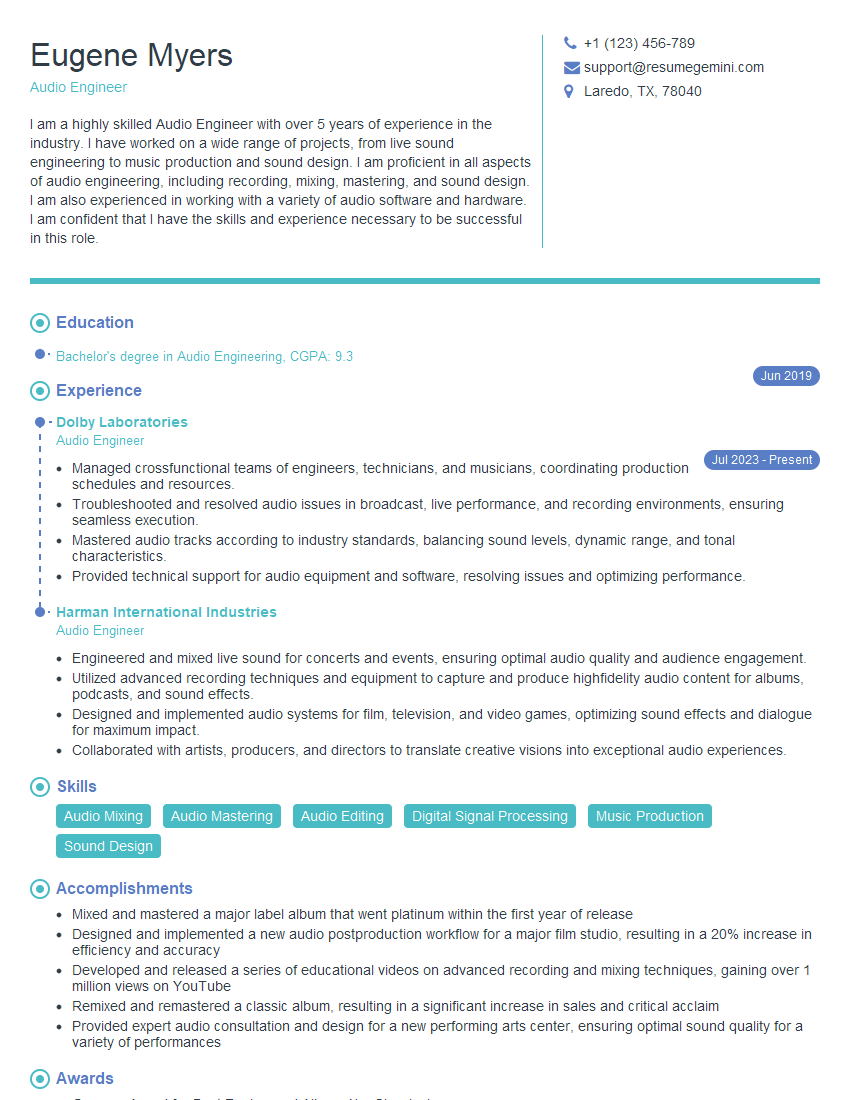
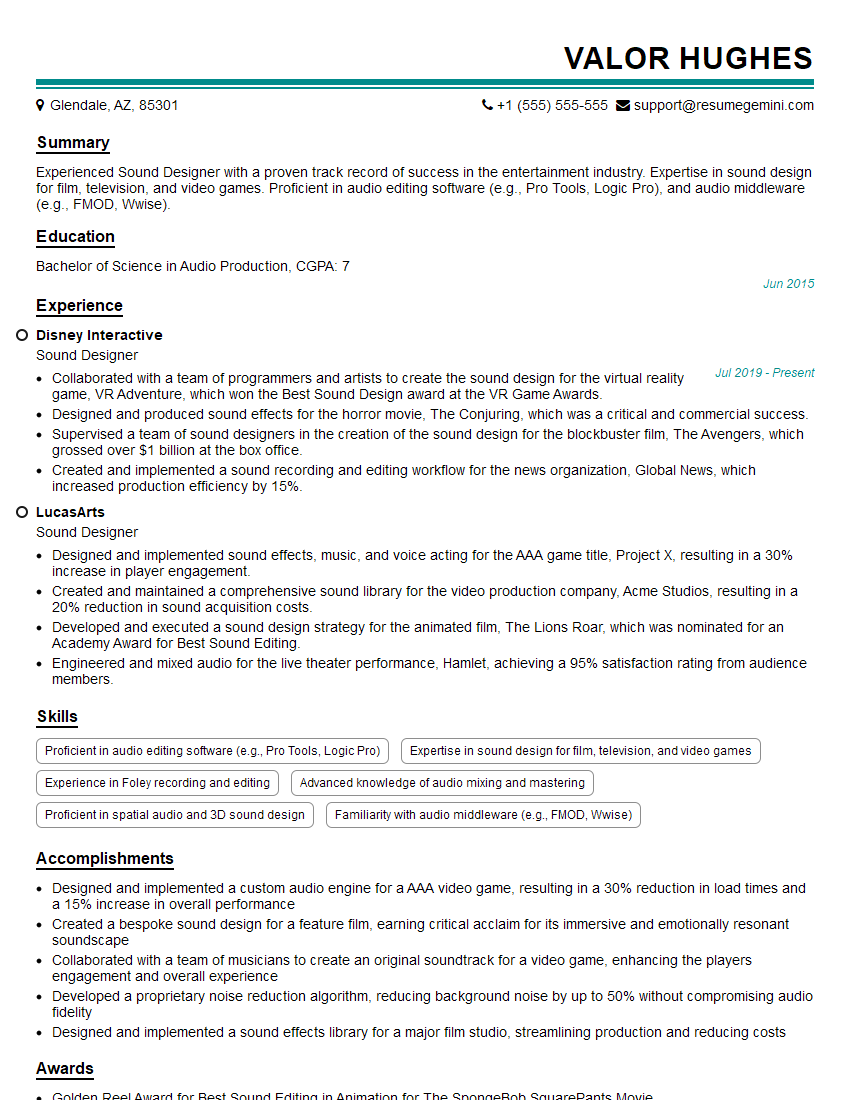
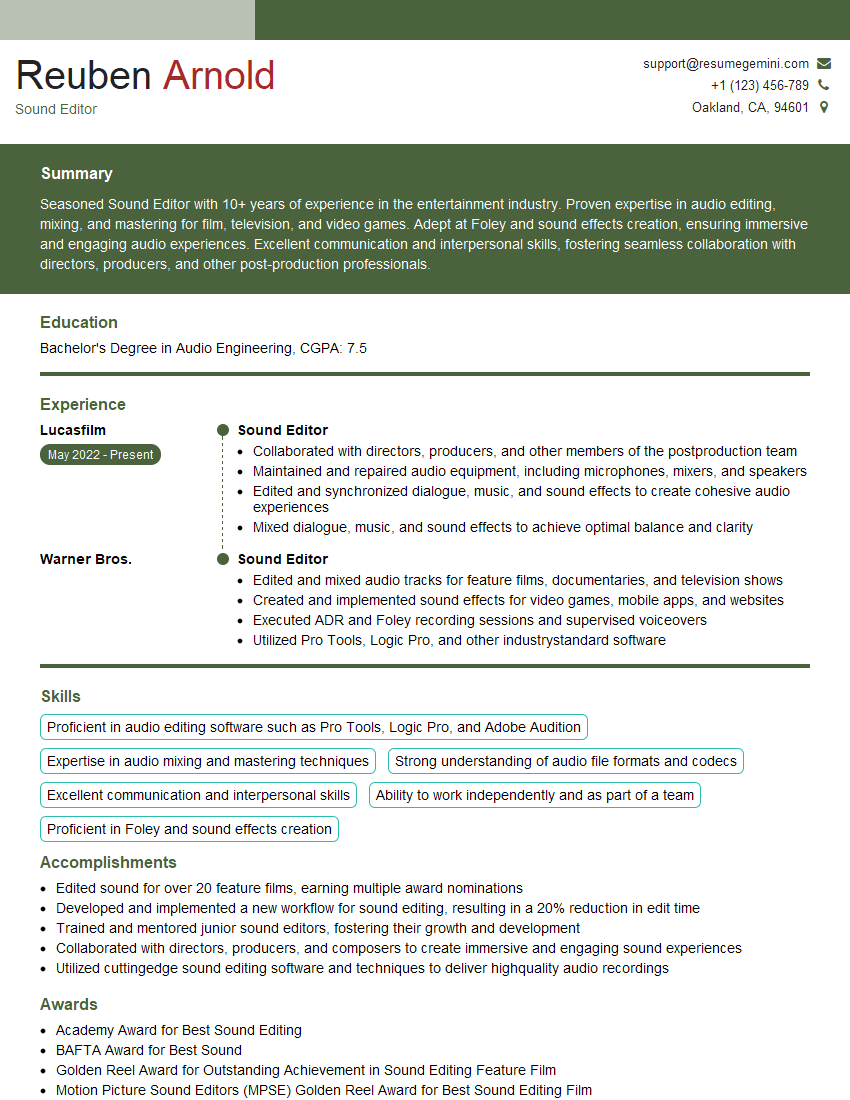
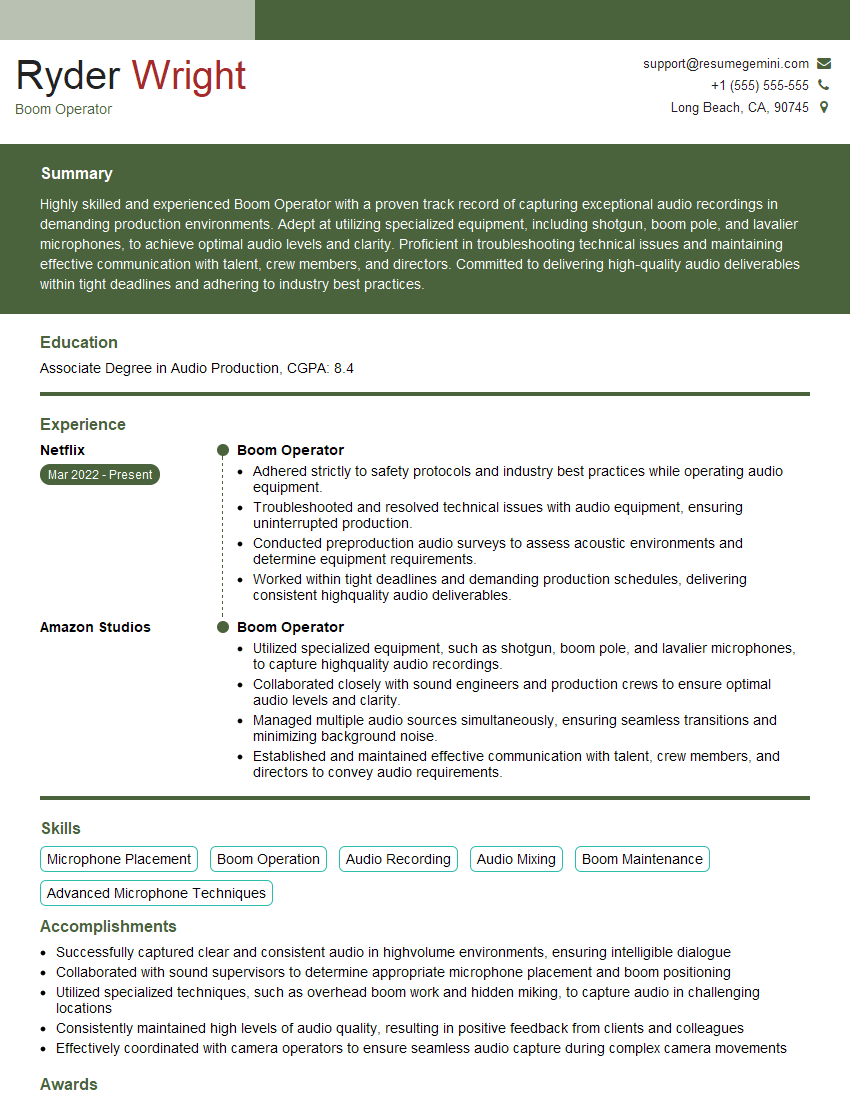
Mastering Foley and Sound Design opens doors to exciting careers in film, television, video games, and interactive media. A strong understanding of these techniques will significantly enhance your job prospects. To maximize your chances of landing your dream role, creating an ATS-friendly resume is crucial. ResumeGemini is a trusted resource that can help you build a professional and impactful resume tailored to the specific requirements of Foley and Sound Design positions. Examples of resumes tailored to this field are available to help guide your resume creation process.
Explore more articles
Users Rating of Our Blogs
Share Your Experience
We value your feedback! Please rate our content and share your thoughts (optional).
What Readers Say About Our Blog
Very informative content, great job.
good