Unlock your full potential by mastering the most common Food Sanitation and Hygiene interview questions. This blog offers a deep dive into the critical topics, ensuring you’re not only prepared to answer but to excel. With these insights, you’ll approach your interview with clarity and confidence.
Questions Asked in Food Sanitation and Hygiene Interview
Q 1. Describe the principles of HACCP.
HACCP, or Hazard Analysis and Critical Control Points, is a systematic, preventative approach to food safety. Instead of simply reacting to contamination, HACCP identifies potential hazards throughout the food production process and puts controls in place to prevent or eliminate them. Think of it as building a safety net before someone even gets close to the edge.
The seven principles of HACCP are:
- Conduct a hazard analysis: Identify biological, chemical, and physical hazards that could occur at each step of food production.
- Determine critical control points (CCPs): Pinpoint the steps where hazards can be prevented, eliminated, or reduced to safe levels. These are the crucial points where control is essential.
- Establish critical limits: Set measurable limits for each CCP. For example, a critical limit for cooking chicken might be an internal temperature of 165°F (74°C).
- Establish monitoring procedures: Define how and how often you’ll monitor CCPs to ensure critical limits are met. This might include using thermometers, visual inspections, or other methods.
- Establish corrective actions: Outline what to do if a critical limit is not met. This could involve discarding a batch of food, reprocessing it, or adjusting equipment settings.
- Establish verification procedures: Regularly check that the HACCP plan is working effectively. This might involve internal audits, staff training, or reviewing production records.
- Establish record-keeping and documentation procedures: Maintain thorough records of all aspects of the HACCP plan, including hazard analysis, CCP monitoring, corrective actions, and verification activities. This is crucial for traceability and demonstrating compliance.
For example, in a canning factory, a CCP might be the sterilization process to eliminate Clostridium botulinum spores. Failure to reach the critical limit of temperature and time during sterilization could lead to a deadly foodborne illness.
Q 2. Explain the importance of handwashing in food safety.
Handwashing is paramount in food safety. Hands are vectors for countless bacteria, viruses, and parasites that can cause foodborne illnesses. Imagine all the surfaces your hands touch throughout the day – doorknobs, phones, money – all potential sources of contamination. Then, you touch food, directly transferring those contaminants.
Proper handwashing significantly reduces the risk of transferring pathogens to food. It’s a simple yet incredibly effective preventative measure. Think of it as washing away the invisible dangers.
Effective handwashing involves:
- Using warm running water.
- Applying soap and lathering thoroughly for at least 20 seconds (think singing “Happy Birthday” twice).
- Scrubbing all surfaces, including between fingers and under nails.
- Rinsing thoroughly under running water.
- Drying with a clean towel or air dryer.
Handwashing should be performed frequently throughout the food preparation process, especially after touching raw meat, poultry, or seafood; using the restroom; handling garbage; and before and after handling food.
Q 3. What are the critical control points (CCPs) in a food production process?
Critical Control Points (CCPs) are steps in a food production process where control can prevent, eliminate, or reduce a food safety hazard to acceptable levels. These aren’t just any points; they’re the crucial steps where things could go drastically wrong if not properly managed. Identifying them is a critical part of implementing a HACCP plan.
The specific CCPs will vary depending on the food and the production process. Some common examples include:
- Temperature control during cooking: Ensuring that food reaches the proper internal temperature to kill harmful pathogens.
- Chilling and freezing: Rapid cooling of cooked food to prevent bacterial growth.
- Ingredient receiving and storage: Verifying the safety and quality of incoming ingredients and storing them appropriately to prevent spoilage and contamination.
- Cleaning and sanitation: Maintaining clean and sanitized equipment and surfaces to prevent cross-contamination.
- Packaging and labeling: Preventing contamination during packaging and ensuring proper labeling to prevent consumer confusion or misuse.
For example, in a bakery, a CCP might be the baking temperature and time, ensuring sufficient heat to eliminate any harmful bacteria in the dough. In a meat processing plant, grinding might be a CCP, as it can increase the surface area of the meat, promoting microbial growth if not handled correctly.
Q 4. How do you prevent cross-contamination in a food preparation area?
Cross-contamination occurs when harmful bacteria or other pathogens from one food source transfer to another. This often happens when raw and cooked foods come into contact. Think of it like spreading germs – you don’t want the ‘germs’ from your raw chicken spreading to your salad!
Preventing cross-contamination requires careful planning and diligent practices:
- Separate raw and cooked foods: Use separate cutting boards, utensils, and containers for raw and cooked foods. Clearly label everything to avoid mistakes.
- Clean and sanitize surfaces frequently: Wash and sanitize cutting boards, countertops, and utensils thoroughly after each use, especially after handling raw foods.
- Cook foods to safe internal temperatures: Ensure that meat, poultry, and seafood are cooked to the proper temperatures to kill harmful pathogens.
- Chill foods promptly: Refrigerate or freeze cooked foods quickly to prevent bacterial growth.
- Wash hands thoroughly: Wash hands frequently, especially after handling raw foods.
- Protect food from contamination: Cover or wrap food properly to prevent contamination from dust, insects, or other sources.
For instance, never place cooked chicken back on the same plate that held raw chicken. Always use separate cutting boards for raw vegetables and meat. These simple steps can significantly reduce the risk of cross-contamination.
Q 5. What are the common foodborne illnesses and their prevention methods?
Common foodborne illnesses are caused by various bacteria, viruses, and parasites present in contaminated food. These illnesses can range from mild discomfort to life-threatening conditions.
Some common examples include:
- Salmonella: Often found in poultry, eggs, and meat; symptoms include diarrhea, fever, and abdominal cramps.
- E. coli: Primarily found in undercooked ground beef; symptoms can range from mild diarrhea to severe kidney failure.
- Listeria monocytogenes: Found in soft cheeses, ready-to-eat meats, and unpasteurized milk; particularly dangerous for pregnant women, newborns, and people with weakened immune systems.
- Campylobacter: Often found in raw poultry; symptoms include diarrhea, fever, and abdominal cramps.
- Norovirus: A highly contagious virus that can spread through contaminated food or surfaces; symptoms include vomiting and diarrhea.
Prevention methods focus on controlling hazards at each stage of food handling:
- Cook food to safe temperatures: Use a food thermometer to ensure that meat, poultry, and seafood are cooked to the proper internal temperature.
- Wash hands thoroughly: Wash hands frequently with soap and water for at least 20 seconds.
- Refrigerate food promptly: Refrigerate perishable foods within two hours of purchase or preparation.
- Avoid cross-contamination: Use separate cutting boards and utensils for raw and cooked foods.
- Source food from reputable suppliers: Choose food from trusted sources that follow safe food handling practices.
Q 6. Explain the role of temperature control in food safety.
Temperature control is crucial in food safety, preventing the growth of harmful bacteria. Bacteria thrive in the ‘danger zone,’ which is between 40°F (4°C) and 140°F (60°C). Keeping food outside of this temperature range significantly reduces the risk of foodborne illness.
Safe temperature practices include:
- Refrigeration: Keep perishable foods at or below 40°F (4°C).
- Freezing: Freeze foods at 0°F (-18°C) or below to halt bacterial growth.
- Cooking: Cook foods to their recommended internal temperatures to kill harmful bacteria.
- Hot holding: Keep hot foods at or above 140°F (60°C).
- Rapid cooling: Cool cooked foods rapidly to prevent bacterial growth in the danger zone.
For instance, leaving cooked food at room temperature for extended periods allows bacteria to multiply rapidly, increasing the risk of illness. Similarly, improperly refrigerated food can support bacterial growth, resulting in spoilage and potential health risks. Using food thermometers and following recommended cooling times are crucial for maintaining safe temperatures.
Q 7. Describe proper cleaning and sanitizing procedures for food contact surfaces.
Proper cleaning and sanitizing are essential for preventing cross-contamination and ensuring food safety. Cleaning removes visible soil and food residues, while sanitizing kills harmful microorganisms that remain after cleaning. Think of cleaning as getting rid of the visible dirt, and sanitizing as eliminating the invisible threats.
Cleaning procedure:
- Pre-clean: Remove loose food debris from the surface using a scraper, brush, or other appropriate tool.
- Wash: Wash the surface with a detergent solution using hot water (at least 110°F/43°C).
- Rinse: Rinse the surface thoroughly with clean, hot water to remove all traces of detergent.
- Air dry: Allow the surface to air dry completely. Avoid using cloths or towels that could re-introduce contamination.
Sanitizing procedure:
After cleaning, sanitize the surface using a food-safe sanitizer, according to the manufacturer’s instructions. Common methods include using a chlorine solution, iodine solution, or quaternary ammonium compounds. Ensure the appropriate contact time for effective sanitization.
Important considerations:
- Choose appropriate cleaning agents: Select detergents and sanitizers that are safe for food contact surfaces and effective against a wide range of microorganisms.
- Follow manufacturer’s instructions: Always follow the manufacturer’s instructions for the proper use and concentration of cleaning and sanitizing agents.
- Monitor effectiveness: Regularly check the effectiveness of your cleaning and sanitizing procedures through routine inspections and testing.
For example, in a restaurant kitchen, cutting boards must be cleaned and sanitized after each use to eliminate any potential contamination from raw meats. Similarly, all food contact surfaces must be thoroughly cleaned and sanitized at the end of each day to maintain a hygienic environment.
Q 8. How do you monitor and control pest infestations in a food facility?
Pest control in a food facility is crucial for preventing contamination and ensuring food safety. A comprehensive strategy involves proactive prevention and reactive control. Think of it like this: you wouldn’t just wait for a fire to start before installing a sprinkler system; similarly, you shouldn’t wait for a pest infestation to begin implementing control measures.
- Prevention: This focuses on eliminating conditions that attract pests. Examples include:
- Regular cleaning and sanitation to remove food debris and spills.
- Proper storage of food and ingredients in sealed containers, away from walls and floors.
- Sealing cracks and crevices in walls and floors to eliminate entry points.
- Regularly inspecting incoming deliveries for pest activity.
- Using pest-proof packaging.
- Control: If pests are detected, immediate action is required. This may involve:
- Identification: Determining the type of pest is essential for targeted control.
- Monitoring: Using traps, sticky boards, and visual inspections to monitor pest activity and effectiveness of control measures.
- Integrated Pest Management (IPM): This approach emphasizes prevention and uses pesticides only when necessary and with a focus on minimizing environmental impact. It involves using a combination of methods, such as traps, baits, and professional pest control services.
- Documentation: Maintaining detailed records of pest sightings, control measures taken, and their effectiveness is crucial for traceability and regulatory compliance.
For example, imagine finding rodent droppings in a warehouse. An effective response would involve immediately identifying the location, setting up traps, contacting a pest control professional, and thoroughly cleaning and sanitizing the affected area while implementing preventive measures to stop future infestations.
Q 9. What is the difference between cleaning and sanitizing?
Cleaning and sanitizing are distinct but interconnected processes, both vital for food safety. Cleaning removes visible soil, food residues, and other debris, while sanitizing reduces the number of microorganisms to a safe level. Think of cleaning as preparing the ground and sanitizing as planting the seeds of hygiene.
- Cleaning: This involves using water, detergents, and appropriate tools (brushes, cloths, pressure washers) to physically remove dirt and grime from surfaces. Effective cleaning is the foundation of a sanitary environment.
- Sanitizing: This is a process using chemicals (e.g., chlorine solutions, quaternary ammonium compounds) or heat to kill or reduce the number of harmful bacteria, viruses, and other microorganisms. Sanitizing is the final step in ensuring a hygienically safe area.
Imagine washing dishes. Cleaning involves scrubbing them with soap and water to remove food particles. Sanitizing involves rinsing them in a hot water bath or a sanitizing solution to kill any remaining bacteria. Both steps are essential for safe dishwashing.
Q 10. What are Good Manufacturing Practices (GMPs)?
Good Manufacturing Practices (GMPs) are a set of guidelines that ensure the production of safe, high-quality food products. These practices cover all aspects of food production, from receiving raw materials to the final packaging and distribution. They are the bedrock of a safe and efficient food production facility.
- Personnel Hygiene: Maintaining cleanliness, proper handwashing, and wearing appropriate protective clothing.
- Equipment and Facilities: Proper design, construction, maintenance, and sanitation of equipment and facilities.
- Raw Materials: Sourcing safe and high-quality ingredients with proper traceability.
- Production Processes: Implementing and documenting safe and efficient production methods.
- Packaging and Labeling: Using appropriate packaging materials and providing accurate and clear labels.
- Pest Control: Implementing effective pest control measures as previously discussed.
- Product Recall System: Establishing a clear procedure for handling product recalls in case of contamination or other food safety issues.
GMPs aren’t just suggestions; they are often legally mandated. Non-compliance can lead to serious consequences, including product recalls, fines, and reputational damage. Following GMPs is crucial for building consumer trust and ensuring long-term business success.
Q 11. Explain the importance of personal hygiene in food handling.
Personal hygiene is paramount in food handling. Handlers are the primary vectors of contamination, and neglecting hygiene can lead to foodborne illnesses. Think of it as the ‘human factor’ in food safety—a crucial element that can make or break the safety of the product.
- Handwashing: Frequent and thorough handwashing with soap and water, especially after using the restroom, handling raw materials, and touching potentially contaminated surfaces.
- Protective Clothing: Wearing clean uniforms, hairnets, gloves, and other protective equipment to prevent contamination.
- Wound Care: Covering any open wounds or cuts with waterproof bandages to prevent contamination.
- Illness Reporting: Employees should report any illness symptoms that could indicate foodborne illness to their supervisor immediately, ensuring they don’t handle food while potentially infectious.
Imagine a cook preparing a salad without washing their hands after using the restroom. The potential for cross-contamination is incredibly high, leading to a significant risk of foodborne illness. Strict adherence to personal hygiene protocols is a critical safeguard against this.
Q 12. How do you handle a food safety incident?
Handling a food safety incident requires a swift, decisive, and transparent response to minimize harm and maintain consumer trust. Every minute counts! It’s a structured approach, not a chaotic scramble.
- Immediate Containment: Identify and isolate the affected product or area to prevent further contamination.
- Investigation: Conduct a thorough investigation to identify the root cause of the incident. This will often involve tracing the product’s journey from origin to the point of detection.
- Notification: Notify relevant authorities, such as regulatory agencies and potentially affected consumers, as needed.
- Corrective Actions: Implement corrective actions to prevent similar incidents from happening in the future.
- Documentation: Maintain detailed records of the incident, investigation, and corrective actions taken.
- Recall (if necessary): If the risk is significant, a product recall might be necessary. This involves a coordinated effort to retrieve and destroy contaminated products.
For instance, if salmonella contamination is detected in a batch of chicken, immediate steps must be taken to remove the affected batch from shelves, thoroughly sanitize equipment and surfaces, and notify relevant authorities. A thorough investigation would identify the source of contamination to implement appropriate corrective actions and prevent future outbreaks.
Q 13. What are the requirements of a food safety management system?
A food safety management system (FSMS) is a comprehensive framework designed to prevent, control, and monitor food safety hazards throughout the entire food chain. Think of it as a safety net for your food production process.
- Hazard Analysis and Critical Control Points (HACCP): Identifying and controlling biological, chemical, and physical hazards throughout the production process.
- Good Manufacturing Practices (GMPs): Implementing proper hygiene, sanitation, and facility maintenance.
- Supplier Management: Ensuring that suppliers adhere to appropriate food safety standards.
- Personnel Training: Providing adequate training to all employees on food safety procedures and responsibilities.
- Traceability: Maintaining accurate records to track the movement of food products throughout the production process. This allows for quick identification of the source of a problem if one arises.
- Monitoring and Verification: Regularly monitoring and verifying the effectiveness of the FSMS through internal audits and testing.
- Corrective Actions: Implementing corrective actions to address any identified food safety issues.
- Documentation: Maintaining thorough documentation of all aspects of the FSMS.
A well-implemented FSMS reduces the risk of foodborne illnesses, enhances product quality, and improves consumer confidence. It’s a continuous process of improvement and not a one-time event.
Q 14. What is the role of a food safety auditor?
A food safety auditor is an independent expert who evaluates a food facility’s compliance with food safety regulations, standards, and best practices. They act as a crucial ‘check and balance’ system, ensuring that food safety procedures are followed effectively.
- Compliance Audits: Assessing the facility’s compliance with relevant regulations and standards such as GMPs, HACCP, and any other industry-specific requirements.
- Documentation Review: Reviewing records and documentation related to food safety practices, including HACCP plans, training records, and pest control logs.
- On-site Inspections: Conducting on-site inspections of the facility to observe food handling practices and assess the condition of equipment and facilities.
- Interviewing Personnel: Interviewing employees to assess their understanding and application of food safety procedures.
- Reporting and Recommendations: Preparing a detailed audit report summarizing findings, identifying areas of compliance and non-compliance, and providing recommendations for improvement.
Auditors provide objective assessments, identifying potential vulnerabilities and suggesting improvements to reduce risks. Their findings help facilities maintain compliance, improve food safety practices, and reduce the likelihood of foodborne illnesses.
Q 15. Describe your experience with food safety audits.
Food safety audits are critical for ensuring compliance with regulations and maintaining high standards of hygiene. My experience encompasses conducting both internal and external audits, utilizing various methodologies like HACCP (Hazard Analysis and Critical Control Points) and GMP (Good Manufacturing Practices) principles. I’ve audited facilities ranging from small-scale restaurants to large-scale food processing plants, evaluating areas such as sanitation practices, employee hygiene, temperature control, pest control, and record-keeping. For instance, during an audit of a bakery, I identified a critical control point failure in their proofing process, leading to inconsistent product quality and potential safety hazards. This highlighted the need for stricter temperature monitoring and staff retraining, which we subsequently implemented. My audit reports are comprehensive, providing detailed findings, recommendations, and corrective action plans to address any deficiencies.
Career Expert Tips:
- Ace those interviews! Prepare effectively by reviewing the Top 50 Most Common Interview Questions on ResumeGemini.
- Navigate your job search with confidence! Explore a wide range of Career Tips on ResumeGemini. Learn about common challenges and recommendations to overcome them.
- Craft the perfect resume! Master the Art of Resume Writing with ResumeGemini’s guide. Showcase your unique qualifications and achievements effectively.
- Don’t miss out on holiday savings! Build your dream resume with ResumeGemini’s ATS optimized templates.
Q 16. How do you maintain accurate records in a food safety management system?
Maintaining accurate records is the cornerstone of a robust food safety management system. Think of it as a detailed diary of your food safety journey. We use a combination of digital and paper-based systems, depending on the specific requirement. For example, temperature logs are often automated using digital thermometers that record data directly into a system, providing an auditable trail. However, manual records, like cleaning checklists, are also crucial. These are meticulously completed and signed by the responsible personnel. All records are stored securely, following a strict retention policy – compliant with local regulations. We use a dedicated database to manage these records, allowing for easy retrieval and analysis. Regular checks for accuracy and completeness are conducted, ensuring the data’s integrity. Data integrity is absolutely paramount; without it, your entire food safety management system is compromised.
Q 17. What are the key elements of a food safety training program?
A comprehensive food safety training program is vital for a safe food operation. It’s not just a one-time event; it’s an ongoing process. Key elements include:
- Hazard identification and control: Training employees to identify potential hazards (biological, chemical, physical) and implement controls to mitigate them.
- Hygiene practices: Thorough handwashing techniques, proper sanitation of equipment and work surfaces, and personal protective equipment (PPE) usage.
- Allergen control: Understanding allergen sources, cross-contamination prevention, and proper labeling practices. This is especially important considering the severe reactions some individuals experience.
- Temperature control: Safe food handling temperatures, proper refrigeration, and the importance of monitoring temperatures throughout the process.
- Pest control: Identifying pest infestation signs and following protocols to eliminate and prevent them.
- Record-keeping: Understanding the importance of accurately completing and storing necessary records.
- Regulations and compliance: Training on relevant local, regional, and national food safety regulations.
Q 18. Explain your understanding of food allergen control.
Food allergen control is a critical aspect of food safety, and negligence can have severe consequences. It’s about preventing the unintentional introduction of allergens into food products. This involves a multi-pronged approach:
- Ingredient sourcing and control: Carefully selecting suppliers who can guarantee the allergen status of their ingredients and maintaining detailed records.
- Preventing cross-contamination: Implementing strict procedures to prevent allergen transfer between different food products. This includes dedicated equipment, processing areas, and thorough cleaning protocols.
- Labeling and communication: Clearly labeling products with all potential allergens as required by law and providing clear allergen information to customers.
- Staff training: Educating all staff on allergen awareness, handling procedures, and the importance of hygiene to prevent cross-contamination.
Q 19. How do you ensure the safety of water used in food processing?
Ensuring the safety of water used in food processing is paramount. It should be potable and free from any contaminants that could cause foodborne illness. We use water that meets the standards set by relevant authorities. This typically involves regular testing for parameters such as bacterial contamination, chlorine levels, and other chemical impurities. A comprehensive water treatment system, which could include filtration, chlorination, or UV disinfection, is crucial. Regular maintenance and monitoring of this system are also key to ensuring continued water quality. Any deviation from the acceptable standards triggers immediate corrective actions, ensuring the safety and quality of our products.
Q 20. What are the different types of sanitizers and their applications?
Sanitizers are crucial for eliminating microorganisms from food contact surfaces. Different sanitizers have varying applications and effectiveness:
- Chlorine-based sanitizers: These are widely used, effective against a broad range of bacteria, but can react with some food residues, potentially affecting product quality. Their effectiveness also depends on concentration and contact time.
- Iodine-based sanitizers: These are also effective but may stain surfaces and can be less effective against certain types of microorganisms.
- Quaternary ammonium compounds (Quats): These are effective and relatively non-corrosive, suitable for a range of surfaces but less effective against some spores and viruses.
- Acid-based sanitizers: These are effective against certain types of microorganisms and are often used in specific applications, such as dairy processing.
Q 21. How do you manage waste disposal to maintain sanitation?
Waste disposal is crucial for maintaining sanitation and preventing pest infestations. We adhere to strict procedures that minimize environmental impact and prevent contamination. This involves separating waste streams (e.g., organic waste, recyclable materials, hazardous waste) and using appropriate disposal methods. Organic waste might be composted, while other waste goes through regulated disposal channels. Regular cleaning and disinfection of waste disposal areas are essential to prevent the accumulation of waste and attract pests. Proper storage containers and frequent waste removal are also important. A well-managed waste disposal system is not just about hygiene; it’s also about environmental responsibility.
Q 22. What is your experience with food recall procedures?
Food recall procedures are crucial for protecting public health. My experience encompasses every stage, from initial detection of a potential hazard to the final notification and product removal. This includes conducting thorough internal investigations to pinpoint the source and scope of the contamination or defect. We utilize sophisticated traceability systems to quickly identify affected batches and distribution channels. I’ve managed recalls involving various product types, from fresh produce to processed foods, coordinating with regulatory agencies (like the FDA in the US or EFSA in Europe) to ensure compliance and transparency. The process involves clear communication with consumers, retailers, and distributors, with a focus on minimizing disruption and maintaining consumer trust. A critical aspect is documenting every step of the recall, creating a comprehensive report for future analysis and improvement of our food safety management system.
For example, during a recall of a frozen vegetable product due to suspected Listeria contamination, I led the team in tracing the implicated batch to its origin. We used our inventory management system to identify all retailers who received the affected product, contacting them immediately to arrange for retrieval. We also issued a public statement through our website and social media, advising consumers on how to safely dispose of the product and what steps to take if they felt unwell. Post-recall, we conducted a thorough root cause analysis to identify weaknesses in our sanitation protocols and implement corrective actions.
Q 23. How do you identify and address potential food safety hazards?
Identifying and addressing food safety hazards is a proactive, multi-step process. It starts with a thorough Hazard Analysis and Critical Control Points (HACCP) plan. This involves systematically identifying potential biological, chemical, and physical hazards at each stage of production, from raw material sourcing to finished product distribution. For each hazard, we determine critical control points (CCPs) – steps in the process where control is essential to prevent or eliminate the hazard. Then we establish critical limits (e.g., temperature thresholds) for each CCP and implement monitoring procedures to ensure these limits are met. Corrective actions are defined for when critical limits are exceeded. This system relies heavily on regular inspections, environmental monitoring (testing for pathogens in air and surfaces), and employee training.
For instance, imagine a bakery. A potential biological hazard is bacterial growth in cream fillings. The CCP would be the cooling process of the filled pastries. The critical limit would be a maximum temperature of 4°C (39°F) within a specified time frame. Monitoring involves regular temperature checks using calibrated thermometers. If the temperature exceeds the critical limit, corrective actions, such as discarding the affected batch, would be implemented. Regular staff training ensures proper cooling techniques and handling practices.
Q 24. Explain your understanding of food spoilage and its prevention.
Food spoilage is the deterioration of food quality, rendering it undesirable or unsafe for consumption. This can be due to microbial growth (bacteria, yeasts, molds), enzymatic activity, or chemical changes. Prevention hinges on controlling factors that promote spoilage: Temperature, moisture, and oxygen availability are key. Proper storage (refrigeration, freezing, vacuum sealing) dramatically slows down spoilage. Preservation techniques like canning, pickling, and fermentation inhibit microbial growth. Good manufacturing practices (GMPs), including strict hygiene and sanitation protocols, are also vital to minimizing contamination and extending shelf life.
Imagine milk left at room temperature. Bacteria rapidly multiply, leading to souring and off-flavors. Refrigeration lowers the temperature, slowing bacterial growth significantly. Proper pasteurization further reduces the bacterial load, extending the shelf life considerably. Similarly, maintaining low moisture content in dried goods prevents microbial growth, extending shelf life. Using modified atmosphere packaging (MAP), which reduces oxygen levels and increases carbon dioxide, can also inhibit the growth of spoilage organisms. Finally, understanding the inherent properties of different foods and adopting appropriate handling and storage methods tailored to them is crucial.
Q 25. How do you ensure compliance with local and national food safety regulations?
Ensuring compliance with food safety regulations requires a comprehensive approach. We maintain a robust food safety management system (FSMS), often based on internationally recognized standards like ISO 22000 or HACCP, tailored to our specific operations and the relevant national and local regulations (e.g., FDA Food Code in the US, EU food regulations). This includes regular internal audits to assess our compliance, conducting periodic gap analyses to identify areas for improvement, and updating our systems to reflect changes in regulations. We keep meticulous records of all our food safety procedures, including ingredient sourcing, processing parameters, and testing results. We also maintain open communication with regulatory agencies, participating in inspections and promptly addressing any identified non-compliances. This proactive approach allows us to identify potential issues before they affect consumer safety.
For example, if a new regulation regarding allergen labeling is introduced, we update our labeling procedures and training materials accordingly, ensuring that our packaging clearly displays all necessary allergen information. We conduct mock regulatory inspections internally to identify any vulnerabilities in our systems before an official inspection.
Q 26. What is your experience with microbiological testing in food?
My experience with microbiological testing in food is extensive. I’ve overseen and interpreted countless analyses to detect the presence and quantify levels of various microorganisms, including pathogens like Salmonella, Listeria, E. coli, and Staphylococcus aureus, as well as indicators of sanitation like coliforms and yeast/mold counts. This involves selecting appropriate testing methods (e.g., plate counts, PCR, ELISA) depending on the food type and potential hazards. We utilize accredited laboratories for testing to ensure reliable and valid results. The results are crucial for determining product safety, identifying sources of contamination, and monitoring the effectiveness of our sanitation programs. Understanding the limitations of each testing method and interpreting results within the context of relevant standards is essential.
For instance, if we suspect Salmonella contamination in a poultry product, we would send samples to an accredited lab for testing using methods like PCR or enrichment culture followed by plate counting. We would then use the results to decide whether to release the product, recall it, or initiate a more thorough investigation.
Q 27. Describe your experience with implementing and maintaining a food safety program.
Implementing and maintaining a food safety program involves more than just complying with regulations; it’s about building a culture of food safety within the organization. My experience includes designing, implementing, and continually improving comprehensive food safety programs using a holistic approach, covering all aspects from supplier management to consumer feedback. This involves creating detailed Standard Operating Procedures (SOPs) for all critical processes, ensuring traceability systems are in place, and developing effective monitoring and corrective action procedures. It is crucial to establish clear roles and responsibilities, ensuring that everyone understands their contributions to food safety. Regular training, audits, and management reviews are essential to maintain the program’s effectiveness and keep it adapted to evolving best practices.
In a previous role, I established a new FSMS in a food processing plant. This entailed working with cross-functional teams to develop SOPs, create a traceability system using barcodes, and establish a robust environmental monitoring program. This led to a significant reduction in customer complaints and improved efficiency and overall food safety.
Q 28. How do you manage employee training related to food safety?
Effective employee training is the cornerstone of a successful food safety program. My experience includes developing and delivering engaging and effective training programs that cater to different roles and skill levels. Training goes beyond simply conveying information; it involves creating a culture where food safety is everyone’s responsibility. Our programs use a combination of methods – classroom lectures, hands-on workshops, online modules, and interactive exercises – to cater to different learning styles. We ensure all employees are trained on proper hygiene practices, allergen awareness, safe food handling techniques, and the company’s specific food safety procedures. Regular refresher courses and competency assessments are crucial to reinforcing learning and identifying gaps in knowledge. Documenting training attendance and competency levels is essential to demonstrate compliance and for continuous improvement.
For instance, we use interactive simulations to train employees on the correct procedure for responding to a potential contamination incident. We also use scenario-based exercises to practice proper handwashing techniques and the handling of potentially contaminated equipment.
Key Topics to Learn for Your Food Sanitation and Hygiene Interview
- Hazard Analysis and Critical Control Points (HACCP): Understanding the principles of HACCP, including hazard identification, critical control point determination, and monitoring procedures. Consider practical applications in a food processing plant or restaurant setting.
- Good Manufacturing Practices (GMP) and Good Hygiene Practices (GHP): Familiarize yourself with the key elements of GMP and GHP, including personal hygiene, sanitation of equipment and facilities, and pest control. Think about how these practices translate into preventing foodborne illnesses.
- Foodborne Illnesses and Pathogens: Develop a strong understanding of common foodborne pathogens (e.g., Salmonella, E. coli, Listeria), their sources, and methods of prevention and control. Be prepared to discuss specific examples and outbreak scenarios.
- Sanitation and Cleaning Procedures: Learn about effective cleaning and sanitizing techniques for various food contact surfaces and equipment. Consider the differences between cleaning and sanitizing and the importance of proper chemical usage and disposal.
- Food Safety Regulations and Standards: Familiarize yourself with relevant food safety regulations and standards applicable to your target industry (e.g., FDA, USDA regulations). Understand the implications of non-compliance.
- Personal Protective Equipment (PPE): Discuss the importance of appropriate PPE in maintaining food safety and hygiene in various food handling environments.
- Waste Management and Disposal: Understand proper procedures for handling and disposing of food waste to prevent contamination and pest infestation.
- Temperature Control and Food Storage: Discuss the critical role of temperature control in minimizing the growth of harmful microorganisms. Be prepared to explain safe storage practices for different types of food.
Next Steps: Launch Your Food Safety Career!
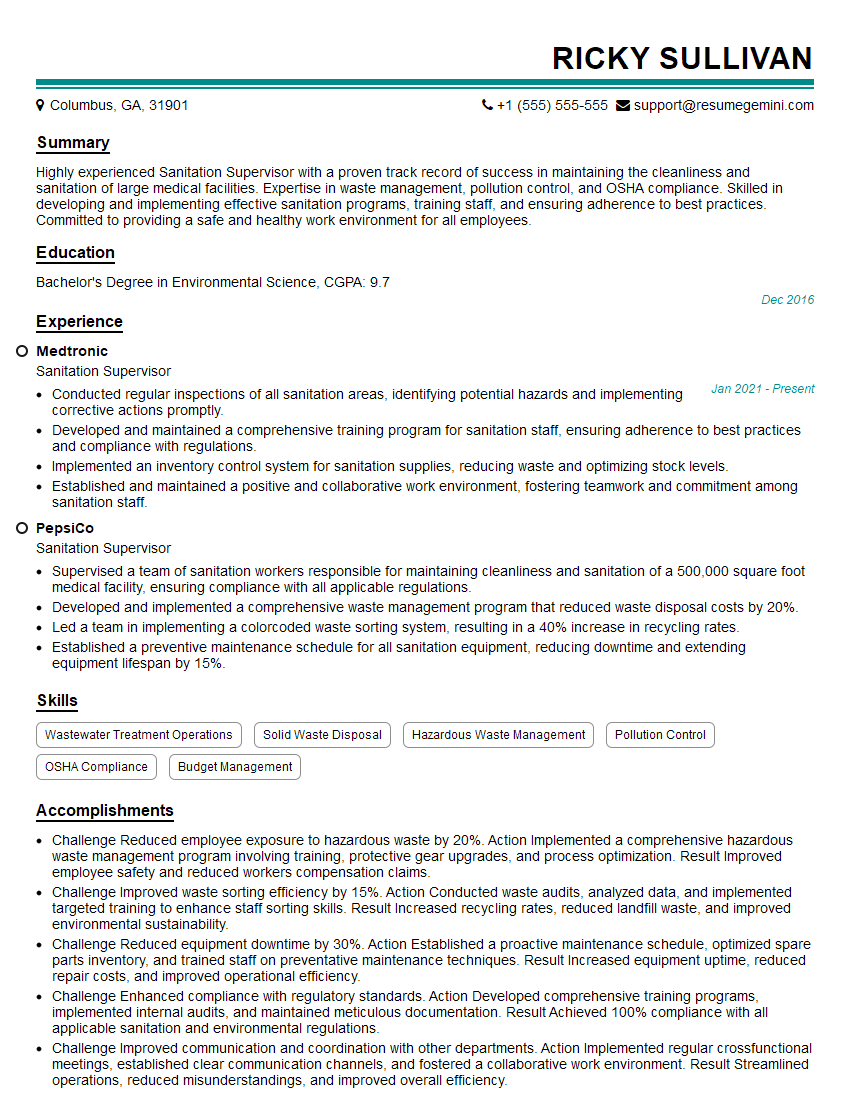
Mastering Food Sanitation and Hygiene is crucial for career advancement in the food industry. It demonstrates your commitment to safety and quality, opening doors to more challenging and rewarding roles. To maximize your job prospects, create a compelling, ATS-friendly resume that highlights your skills and experience. ResumeGemini is a trusted resource to help you build a professional resume that stands out. We offer examples of resumes tailored to the Food Sanitation and Hygiene field to guide you. Take the next step towards your dream career – build your best resume today!
Explore more articles
Users Rating of Our Blogs
Share Your Experience
We value your feedback! Please rate our content and share your thoughts (optional).
What Readers Say About Our Blog
Very informative content, great job.
good