The thought of an interview can be nerve-wracking, but the right preparation can make all the difference. Explore this comprehensive guide to Foreshortening interview questions and gain the confidence you need to showcase your abilities and secure the role.
Questions Asked in Foreshortening Interview
Q 1. Explain the principle of foreshortening.
Foreshortening is a technique used in art to represent in two dimensions the apparent visual contraction of an object that extends backward into space. Think of it as how things appear shorter when viewed at an angle, rather than straight on. It’s about accurately portraying how perspective affects the size and shape of objects receding into space on a flat surface.
Imagine looking down a long hallway; the floor and ceiling seem to converge toward a vanishing point. That visual compression is foreshortening in action. It’s not about making things smaller arbitrarily, but about representing how they’re seen by the eye.
Q 2. How does foreshortening create depth and perspective in a 2D artwork?
Foreshortening creates depth and perspective in 2D artwork by mimicking the way our eyes perceive three-dimensional space on a two-dimensional plane. By shortening the length of objects that recede into the distance, the artist creates the illusion of depth. The objects closest to the viewer appear larger and more detailed, while those further away are smaller and less defined. This gradation of size and detail gives the sense of space extending beyond the picture plane.
For instance, if you were to draw a person lying down, their legs, extending away from the viewer, would appear much shorter than they actually are in real life. This shortening creates the illusion that the legs are receding into space, giving the drawing depth.
Q 3. Describe how foreshortening affects the apparent size and shape of objects.
Foreshortening significantly impacts the apparent size and shape of objects. Objects closer to the viewer appear larger and their features are more distinct. Conversely, as objects recede into space, they appear smaller and their shapes become increasingly distorted. Lines that are parallel in reality can appear to converge, and shapes can appear compressed or elongated depending on their angle to the viewer.
Consider a drawn cylinder angled towards the viewer. The circle closest to us will appear as a full circle, while the far circle might be reduced to an ellipse, and the length of the cylinder will appear much shorter than its actual length. This distortion is key to creating a realistic representation of depth.
Q 4. What are some common mistakes artists make when using foreshortening?
Common mistakes artists make with foreshortening include:
- Inconsistent proportions: Not accurately reducing the size and shape of objects according to their distance from the viewer.
- Ignoring perspective: Failing to consider the convergence of parallel lines and the resulting distortion of shapes.
- Lack of understanding of form: Not adequately understanding the three-dimensional form of the object being foreshortened leads to inaccurate representations.
- Unnatural distortion: Over-exaggerating the foreshortening effect, leading to unrealistic and jarring results. The aim is realism, not caricature.
Practice and observation are crucial to mastering foreshortening. Careful study of anatomy and perspective principles is essential to overcome these common pitfalls.
Q 5. How does foreshortening differ in different artistic mediums (e.g., painting, sculpture, animation)?
Foreshortening applies across various artistic mediums, but its implementation differs. In painting, it’s achieved through careful manipulation of perspective and shading. In sculpture, foreshortening requires consideration of the three-dimensional form and how it interacts with the viewer’s viewpoint. Animation uses foreshortening dynamically, adjusting the shapes of characters to convey movement and depth within each frame.
For instance, in a painting of a reclining figure, the artist uses line and shading to shorten the length of the limbs receding into space. In a sculpture, the actual physical dimensions of the figure would need to be adjusted to create the foreshortened effect. In animation, the character’s limbs might appear to shorten and change shape as they move through space.
Q 6. How can you use foreshortening to enhance the narrative or emotional impact of a piece?
Foreshortening can significantly impact the narrative and emotional impact of a piece. By strategically employing foreshortening, an artist can draw the viewer’s eye to specific elements, creating focal points and emphasizing certain aspects of the composition. It can create a sense of immediacy and intimacy, or conversely, a sense of vastness and distance.
For example, foreshortening a character’s face prominently in the foreground can create a powerful sense of connection with the viewer, emphasizing their emotions. Conversely, using foreshortening to depict a vast landscape can evoke feelings of awe and wonder.
Q 7. Explain the relationship between foreshortening and vanishing points.
Foreshortening and vanishing points are intrinsically linked. Vanishing points, the points at which parallel lines appear to converge in perspective drawings, are essential for creating accurate foreshortening. The degree of foreshortening is directly related to the position of objects relative to the vanishing point. Objects closer to the vanishing point exhibit greater foreshortening.
Essentially, vanishing points define the direction and extent of perspective, which, in turn, dictates how much foreshortening is needed to create a realistic representation of three-dimensional space on a two-dimensional surface. Understanding vanishing points is crucial for accurate and convincing foreshortening.
Q 8. How do you accurately represent foreshortening in a digital environment (e.g., using software like Maya or Blender)?
Accurately representing foreshortening in digital environments like Maya or Blender hinges on understanding perspective and manipulating the object’s geometry. It’s not just about making things smaller; it’s about accurately depicting how forms change as they recede into space. Think of it like a train track – the rails appear to converge, and similarly, shapes and distances distort as they move away from the viewer.
In Maya or Blender, you’d leverage tools like:
- Perspective Viewports: Working in a perspective view is crucial. This simulates how our eyes perceive depth.
- Transform Tools (Scale, Rotate, Translate): These tools allow you to adjust the size and orientation of objects to reflect foreshortening. You might scale down elements that are further away, but more importantly, you’ll adjust their orientation to convey the depth correctly. A perfectly square object viewed from an angle would appear as a trapezoid, for instance.
- Cameras: The camera’s position and focal length greatly influence foreshortening. Experimenting with these is key to achieving the desired effect.
- Reference Images: Always use reference images – they act as a guide to ensure your interpretation of foreshortening is accurate.
Essentially, you’re building a three-dimensional model that faithfully represents the visual distortion caused by perspective. Constantly checking your work from multiple viewpoints is vital.
Q 9. Describe your process for planning and executing foreshortening in your artwork.
My process for planning and executing foreshortening begins with a thorough understanding of the subject. I start with sketches, focusing on the underlying structure and how it interacts with the viewer’s perspective. I frequently use a quick block-in to establish the primary forms and proportions before adding detail. Think of it like building with LEGOs: the basic shapes need to be accurately placed before adding the finer elements.
Next, I work from multiple reference images, comparing them with my sketches. I meticulously observe the shape distortions caused by the perspective, paying close attention to the angles and the relative sizes of the different elements. This is particularly crucial when dealing with complex forms, like human figures.
During execution, I constantly refine my understanding of the subject by revisiting my sketches and references. I might even create a small maquette – a three-dimensional model – to clarify the spatial relationships before committing to the final artwork. This process ensures a strong foundation, preventing errors from compounding as I add details.
Q 10. How can you use reference images effectively to improve your foreshortening skills?
Reference images are invaluable. They are not just for copying; they provide a visual vocabulary for understanding how foreshortening works in the real world. Don’t just look at the final image; analyse what makes the foreshortening effective.
Here’s how I use them effectively:
- Multiple Angles: Seek multiple viewpoints of the same subject. This helps develop a three-dimensional understanding beyond the limitations of a single perspective.
- Comparative Analysis: Compare your work to the reference images at every stage. Look for discrepancies in shapes and proportions. This will highlight where your understanding of foreshortening falls short.
- Deconstruction: Break down complex forms into simpler shapes. Look at the reference image and see how those basic shapes are distorted by perspective. This helps translate the complexities into simpler, manageable elements.
By actively engaging with references in this way, you train your eye to recognize and reproduce the nuances of foreshortening accurately.
Q 11. Give examples of artists who masterfully use foreshortening in their work.
Many artists have mastered foreshortening. Andrea Mantegna’s work is a prime example. His paintings, such as the ‘Dead Christ,’ showcase incredibly effective use of foreshortening, creating a powerful sense of depth and drama. The dramatic perspective pulls the viewer into the scene. Similarly, Michelangelo’s frescoes in the Sistine Chapel, especially the creation of Adam, demonstrate a mastery of foreshortening in conveying dynamic human forms.
More contemporary examples include Frank Frazetta, known for his dynamic illustrations that exploit foreshortening to create powerful compositions, and many contemporary digital painters who employ the technique with great skill in their 3D modeling and digital painting techniques.
Q 12. How does understanding anatomy impact your use of foreshortening in figure drawing?
Understanding anatomy is paramount for accurate foreshortening in figure drawing. Without it, your depiction will likely be distorted and unconvincing. Knowing the underlying structure of the human body allows you to accurately predict how muscles and bones shift and change shape under different perspectives.
For instance, understanding the structure of the rib cage helps you accurately represent how it shrinks and changes its shape when viewed from below. Understanding the planes of the body – the way the form is built upon layered planes – allows you to see how those planes distort according to perspective. This knowledge allows you to draw not just what you see, but what you *know* should be there, despite the foreshortening.
Q 13. How can you ensure consistency in foreshortening throughout a complex composition?
Maintaining consistency in foreshortening across a complex composition requires meticulous planning and a deep understanding of perspective. A vanishing point or multiple vanishing points establish a clear framework for your perspective. All elements within the composition must adhere to this framework. Inconsistent vanishing points will ruin the overall illusion of depth.
One effective strategy is to create a preliminary perspective sketch outlining the major elements and their vanishing points. This sketch acts as a guideline throughout the entire process, ensuring everything aligns correctly. Regular checks against this sketch, coupled with consistent use of measurement and comparison tools (like rulers in digital painting), are crucial for maintaining consistency.
Q 14. Discuss the challenges of foreshortening and how you overcome them.
The biggest challenges in foreshortening stem from the inherent difficulty of representing three dimensions on a two-dimensional plane. It requires a very strong understanding of spatial relationships and perspective, often defying our intuitive sense of form.
Common challenges include:
- Misjudging Proportions: Elements furthest away will appear smaller, but getting these proportions correct requires accurate understanding of the perspective.
- Distorted Forms: Shapes morph and twist depending on the angle. Accurately representing these distortions is challenging.
- Lack of Depth: Without careful consideration of perspective, the image can appear flat, even if foreshortening is attempted.
To overcome these challenges, I emphasize using strong references, multiple viewpoints, and a breakdown of complex forms into simpler shapes. Consistent checking and refining are key to arriving at a believable and convincing result.
Q 15. How do you adapt your foreshortening techniques based on the style or genre of your artwork?
Foreshortening, the technique of depicting an object or figure extending into space, adapts significantly based on artistic style. In realistic renderings, I’d meticulously measure proportions, using anatomical references or perspective grids to ensure accuracy. The level of detail would be high, aiming for a photorealistic effect. Think of the precise foreshortening in classical Renaissance paintings like Michelangelo’s Sistine Chapel ceiling – every muscle and limb is carefully rendered to convey depth and form.
However, in a cartoon style, foreshortening might be more exaggerated and simplified. I might shorten limbs more drastically for comedic effect or stylistic emphasis. Think of the dynamic poses in classic Disney animation – the characters’ proportions might be altered for visual impact, not strict anatomical accuracy. Similarly, in impressionistic works, foreshortening might be suggested through brushstrokes and color rather than precise lines, prioritizing the overall emotional impact over strict realism. The key is to understand how the chosen style dictates the level of precision and exaggeration in foreshortening.
Career Expert Tips:
- Ace those interviews! Prepare effectively by reviewing the Top 50 Most Common Interview Questions on ResumeGemini.
- Navigate your job search with confidence! Explore a wide range of Career Tips on ResumeGemini. Learn about common challenges and recommendations to overcome them.
- Craft the perfect resume! Master the Art of Resume Writing with ResumeGemini’s guide. Showcase your unique qualifications and achievements effectively.
- Don’t miss out on holiday savings! Build your dream resume with ResumeGemini’s ATS optimized templates.
Q 16. Describe a situation where you had to use foreshortening to solve a specific artistic problem.
I once faced a challenge depicting a bustling market scene, specifically focusing on a vendor reaching forward to offer goods to a customer. The angle was such that the vendor’s arm and hand extended directly towards the viewer. The initial attempts felt flat; the arm didn’t convincingly project into space. To solve this, I employed several strategies. First, I used a detailed hand reference, carefully observing the perspective distortion of the fingers and the hand’s overall shape as it extended towards the viewer. Then, I employed a combination of linear perspective – showing converging lines – to create a sense of depth, and adjusted the size and proportions of the arm and hand accordingly. Finally, I carefully adjusted the shading and highlights to further enhance the three-dimensionality and give a sense of volume and depth. The end result was an arm that dynamically broke the picture plane, significantly improving the scene’s dynamism and realism.
Q 17. How can you use foreshortening to create a sense of movement or dynamism in a piece?
Foreshortening is a powerful tool for creating movement. By strategically shortening limbs and body parts that are moving towards or away from the viewer, you can suggest speed and direction. Imagine a runner sprinting towards the viewer: their legs, closest to the viewer, appear much shorter than their legs further back. This creates a feeling of forward momentum. This effect is heightened by using motion blur or a dynamic composition – the runner might be positioned slightly off-center, with other elements in the background reinforcing their speed. The foreshortened limb also becomes an implied directional arrow, guiding the viewer’s eye through the composition. Contrast this with a static pose, where limbs would be rendered with less distortion. The difference emphasizes the sense of movement created through careful use of foreshortening.
Q 18. Explain the difference between linear perspective and foreshortening.
While both linear perspective and foreshortening contribute to the illusion of depth, they focus on different aspects. Linear perspective uses converging lines to show how objects appear smaller and closer together as they recede into the distance. It establishes a sense of overall spatial relationships within a scene. Think of railway tracks converging towards the horizon. Foreshortening, conversely, is concerned with the distortion of shapes and proportions caused by an object’s orientation in space relative to the viewer. It specifically addresses how objects appear when viewed at an angle, particularly when parts of the object are closer or further away from the viewer. Imagine an arrow pointed directly at you – the arrowhead appears much smaller than the feathers at the back, demonstrating foreshortening. Therefore, linear perspective creates a broader spatial context, while foreshortening focuses on the specific distortions within that space.
Q 19. How does foreshortening relate to the concept of visual weight in a composition?
Foreshortening directly affects visual weight. A foreshortened object, especially when placed prominently in the composition, carries more visual weight than an object rendered in a more natural, less distorted manner. This is because the eye is naturally drawn to forms that seem to project forward into space. A figure’s outstretched arm, sharply foreshortened, might command more attention than the rest of their body. This principle can be manipulated to guide the viewer’s eye or to create focal points. To balance a composition where foreshortening is used prominently, other elements should be arranged to counter this visual weight; you might place smaller, less prominent elements opposite a foreshortened figure to create a balance.
Q 20. What are some key considerations when using foreshortening in animation?
Foreshortening in animation presents unique challenges. Maintaining consistent foreshortening across multiple frames is critical for believable movement. Inconsistent application can create jarring visual effects and break the illusion of reality. Key considerations include:
- Rigging and posing: The 3D model’s skeleton (rig) must allow for realistic deformations during poses involving foreshortening.
- Frame-by-frame consistency: The foreshortening effects should smoothly transition from one frame to the next, avoiding sudden, unnatural changes in proportions.
- Perspective camera movement: The virtual camera’s position and movement must be coordinated with the character’s pose and foreshortening to maintain the illusion of space.
- Avoiding squash and stretch extremes: While squash and stretch are used in animation for comedic effect, extreme use can clash with accurate foreshortening.
Software tools such as Maya or Blender offer features to assist with perspective-correct animation, but careful planning and knowledge of foreshortening principles are crucial for achieving convincing results.
Q 21. How can you maintain accuracy and believability when using extreme foreshortening?
Extreme foreshortening requires meticulous attention to detail and accuracy to avoid appearing unnatural or distorted. Key strategies include:
- Precise measurements and references: Use accurate anatomical or object references, ensuring proportions are carefully measured and adapted to the foreshortened view.
- Understanding perspective distortion: Accurately depict the way shapes and features deform under extreme perspective. Forms closer to the viewer appear larger, while those further away shrink.
- Careful shading and highlights: Use light and shadow to emphasize the three-dimensionality of the object, even in extreme foreshortening. This helps define contours and creates a sense of volume.
- Iteration and refinement: Expect to go through several revisions. Step back from your work to assess the effects, and be prepared to adjust proportions and details until the illusion of depth and accuracy is convincing.
Creating believable extreme foreshortening demands a solid understanding of perspective, anatomy (if applicable), and a commitment to iterative refinement.
Q 22. How do you determine the appropriate level of foreshortening for a specific scene or object?
Determining the appropriate level of foreshortening depends entirely on the desired effect and the perspective of the viewer. It’s about creating a believable illusion of three-dimensional space on a two-dimensional surface. Too little foreshortening and the object appears flat and unrealistic; too much, and it can look distorted and unnatural. Think of it like a photographer choosing their lens – a wide-angle lens minimizes foreshortening, while a telephoto lens exaggerates it.
The process involves considering several factors:
- Perspective Point: The closer the object is to the viewer, the more pronounced the foreshortening needs to be. Objects further away will show less dramatic foreshortening.
- Angle of View: The angle from which the viewer observes the object dramatically affects how much foreshortening is necessary. A head-on view will have less foreshortening than a view from below or above.
- Desired Emphasis: Sometimes, artists intentionally exaggerate foreshortening to draw the eye to a specific detail or to create a dramatic effect. For example, in a portrait, a strongly foreshortened hand might emphasize its gesture.
- Context and Style: The overall style of the artwork also influences the level of foreshortening. A realistic portrayal will demand more accurate foreshortening than a stylized or abstract piece.
Ultimately, finding the right level of foreshortening is an iterative process. It often involves sketching, revising, and constantly comparing the rendering to real-world examples or reference images.
Q 23. Explain how you would use foreshortening to depict a hand reaching toward the viewer.
Depicting a hand reaching toward the viewer requires a strong understanding of how forms change with perspective. The hand closest to the viewer will appear larger and more detailed, while the parts further away will shrink and become less defined. Imagine holding your hand out to someone – the palm is larger than the fingers, but in a foreshortened view, the palm might be almost the same size, or even smaller, than the fingers.
Here’s how I’d approach it:
- Start with a basic shape: Begin with a simplified representation of the hand, perhaps a flattened oval for the palm and cylinders for the fingers.
- Identify the vanishing point: Consider where the viewer’s eye is positioned. The implied vanishing point will help determine the diminishing size and angle of the hand’s components.
- Establish perspective lines: Use light lines to guide the foreshortening, ensuring that the fingers converge toward the vanishing point, mimicking the effect of depth.
- Refine shapes and proportions: Gradually refine the shapes of the palm and fingers, adjusting sizes to create a convincing illusion of depth and perspective.
- Add details: Include details like knuckles, creases, and fingernails, but remember that details on foreshortened elements are more implied than explicitly drawn.
- Consider Lighting: Lighting is crucial for emphasizing the three-dimensionality of the hand. Properly rendered shadows can significantly enhance the foreshortening effect.
Remember to constantly observe real hands in similar positions for reference. You’ll quickly learn how the angles and proportions shift as you change your perspective.
Q 24. Describe your understanding of atmospheric perspective and how it interacts with foreshortening.
Atmospheric perspective and foreshortening are distinct but complementary techniques used to create depth and realism in a drawing or painting. Foreshortening deals with the distortion of an object’s shape due to its angle to the viewer, while atmospheric perspective uses color and value to represent the effects of the atmosphere on distant objects.
Atmospheric perspective creates a sense of distance by depicting objects further away as paler, less saturated, and less detailed. They appear hazy and bluish due to the scattering of light by the atmosphere. Foreshortening complements this by showing how the size and shape of those distant objects are also affected by their position in space.
Consider a landscape painting: The foreground elements will be sharply detailed and richly colored, exhibiting strong foreshortening if they are angled towards the viewer. As the eye moves towards the background, the mountains become paler, bluer, less defined, and less foreshortened, gradually fading into the horizon.
Combining these techniques is crucial for creating convincing depth. The gradual shift in color and detail in conjunction with the accurate application of foreshortening will powerfully reinforce the illusion of distance and space. A lack of atmospheric perspective can make accurate foreshortening seem unconvincing, and conversely, atmospheric perspective alone, without proper foreshortening, can feel flat and two-dimensional.
Q 25. How does understanding light and shadow improve your foreshortening skills?
Understanding light and shadow is paramount to achieving convincing foreshortening. It’s not just about accurately depicting the shape of the object, but about using light and shadow to define its three-dimensionality and accurately place it within the visual space. Without correct shadowing, foreshortened objects can appear flat and lifeless.
Here’s why:
- Defining Form: Shadows reveal the curves and planes of an object. In a foreshortened view, these curves and planes are distorted. Accurate shading helps to highlight these distortions and clarifies the form.
- Creating Depth: Shadows suggest where the object is positioned in relation to the light source. In a foreshortened scene, this is especially important because the perception of depth is highly reliant on shadow.
- Emphasizing Perspective: By carefully placing highlights and shadows, we can enhance the illusion of perspective and guide the viewer’s eye through the scene. This can directly affect how the foreshortening is perceived and understood.
For example, if you’re foreshortening a cylinder, the shadow will be elongated and distorted as the cylinder itself is. A correctly rendered shadow will be integral in supporting the foreshortened shape, enhancing the three-dimensional effect. Ignoring shadow would result in a flattened and unconvincing image.
Q 26. What are some resources you use to improve your understanding and application of foreshortening?
To continually improve my understanding and application of foreshortening, I utilize several resources:
- Master Drawings and Paintings: Studying the works of masters like Leonardo da Vinci, Michelangelo, and Rembrandt, particularly their studies of human anatomy and perspective, provides invaluable insight into the mastery of foreshortening. Their work shows how foreshortening can be used to enhance narrative and drama.
- Life Drawing and Observation: Practicing life drawing is crucial. It allows you to directly observe how forms change under different perspectives and lighting conditions, fostering a practical understanding of foreshortening.
- Anatomy Books: Detailed anatomical references are indispensable, particularly for accurate representations of the human figure. Understanding the underlying structure of the body greatly aids in depicting foreshortened figures realistically.
- Perspective Books and Tutorials: Numerous books and online tutorials delve into the principles of perspective and foreshortening, offering structured explanations and exercises to hone your skill.
- Online Communities and Workshops: Sharing work and critiques with other artists in online communities and participating in workshops dedicated to figure drawing and perspective drawing allows for feedback and collaborative learning.
Q 27. Describe your approach to correcting errors or inconsistencies in your foreshortening.
Correcting errors in foreshortening often involves a combination of careful observation, analysis, and iterative refinement. It’s rarely a single, quick fix.
- Identify the Problem: First, pinpoint the specific area or aspect where the foreshortening appears incorrect. Is it the size, proportion, or angle of the object that’s off?
- Analyze the Perspective: Examine the overall perspective of the scene. Is your vanishing point correctly placed? Are your perspective lines consistent? An error in the underlying perspective can directly impact the foreshortening.
- Use Reference Material: Consult photographs or real-life objects to compare your rendering against accurate representations. This helps identify discrepancies in size and proportions.
- Adjust and Refine: Make adjustments to the affected areas. This might involve altering the size of elements, modifying their angles, or refining the shading to better represent the depth and form.
- Iterative Process: Correcting foreshortening is rarely a one-step process. Continuously compare your work to references, refine your corrections, and re-evaluate your work until the foreshortening looks convincing and believable.
Remember, accuracy in foreshortening takes time and practice. Don’t be discouraged by initial errors; rather view them as learning opportunities.
Q 28. How would you teach someone else the fundamentals of foreshortening?
Teaching the fundamentals of foreshortening involves a multi-faceted approach that combines theory and practice.
- Start with Basic Perspective: Begin by laying a strong foundation in one-point, two-point, and three-point perspective. This provides the framework for understanding how forms shrink and change as they recede into space.
- Introduce the Concept of Foreshortening: Explain that foreshortening is the visual effect caused by an object’s orientation relative to the viewer. Use simple objects like cubes and cylinders to illustrate how their appearance changes based on their angle.
- Hands-on Exercises: Provide ample opportunities for practice. Start with simple objects and gradually increase complexity. This may involve drawing a cube at various angles, then moving to more complex forms.
- Emphasis on Observation: Encourage students to observe the world around them, paying attention to how objects appear when viewed from different perspectives. This means observing how things change when viewed at an angle, not only straight on.
- Use of Reference Images: Encourage using photographs or real-life objects as reference points. This provides a direct way to compare their rendering to accurate representations.
- Feedback and Iteration: Provide constructive feedback to students, helping them understand how to identify and correct errors. Encourage them to continuously refine their work, aiming to achieve accuracy and believability.
The key is to break down the concept into manageable steps and give students ample opportunity to practice and develop their skills through observation and feedback. Learning foreshortening is a process of understanding spatial relationships and translating them onto a flat surface.
Key Topics to Learn for Foreshortening Interview
- Understanding Perspective and Vanishing Points: Grasp the fundamental principles of linear perspective and how it relates to foreshortening. Practice identifying vanishing points in different scenarios.
- Applying Foreshortening Techniques in 2D and 3D: Explore how foreshortening is applied in drawing, painting, animation, and 3D modeling. Be prepared to discuss practical examples and techniques used in your chosen field.
- Representing Depth and Dimension: Discuss how foreshortening creates the illusion of depth and three-dimensionality on a two-dimensional surface. Understand the impact of different angles and viewpoints.
- Common Mistakes and How to Avoid Them: Identify common pitfalls in applying foreshortening, such as incorrect perspective or disproportionate elements. Be ready to explain strategies for accurate representation.
- Analyzing Existing Works: Practice analyzing existing artwork or designs, identifying how foreshortening techniques were used and their effectiveness in conveying depth and form.
- Problem-Solving Approaches: Be prepared to discuss how you would approach a problem involving foreshortening, whether it’s adjusting a perspective in a drawing or resolving a technical issue in a 3D model.
- Different Styles and Interpretations: Explore how different artistic styles influence the application and interpretation of foreshortening. Consider examples from various historical periods and artistic movements.
Next Steps
Mastering foreshortening significantly enhances your skills in visual communication and design, opening doors to exciting career opportunities in fields like animation, game design, architecture, and illustration. A strong grasp of these concepts demonstrates a keen eye for detail and a profound understanding of spatial relationships, highly valued by employers. To further boost your job prospects, create an ATS-friendly resume that highlights your skills effectively. ResumeGemini is a trusted resource for building professional resumes, and we provide examples of resumes tailored to Foreshortening to help you get started. Invest the time to craft a compelling resume – it’s your first impression on a potential employer!

Art Director Resume Sample

Comic Book Artist Resume Sample

Concept Artist Resume Sample
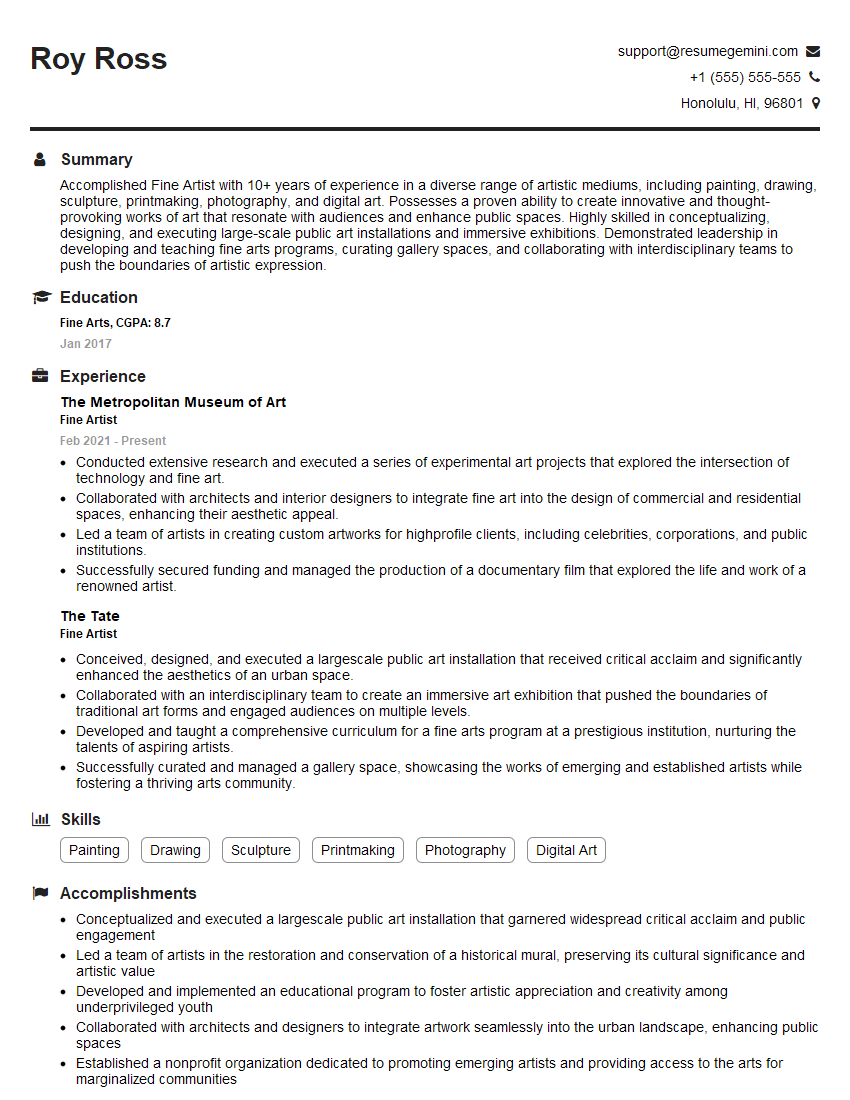
Fine Artist Resume Sample

Illustrator Resume Sample
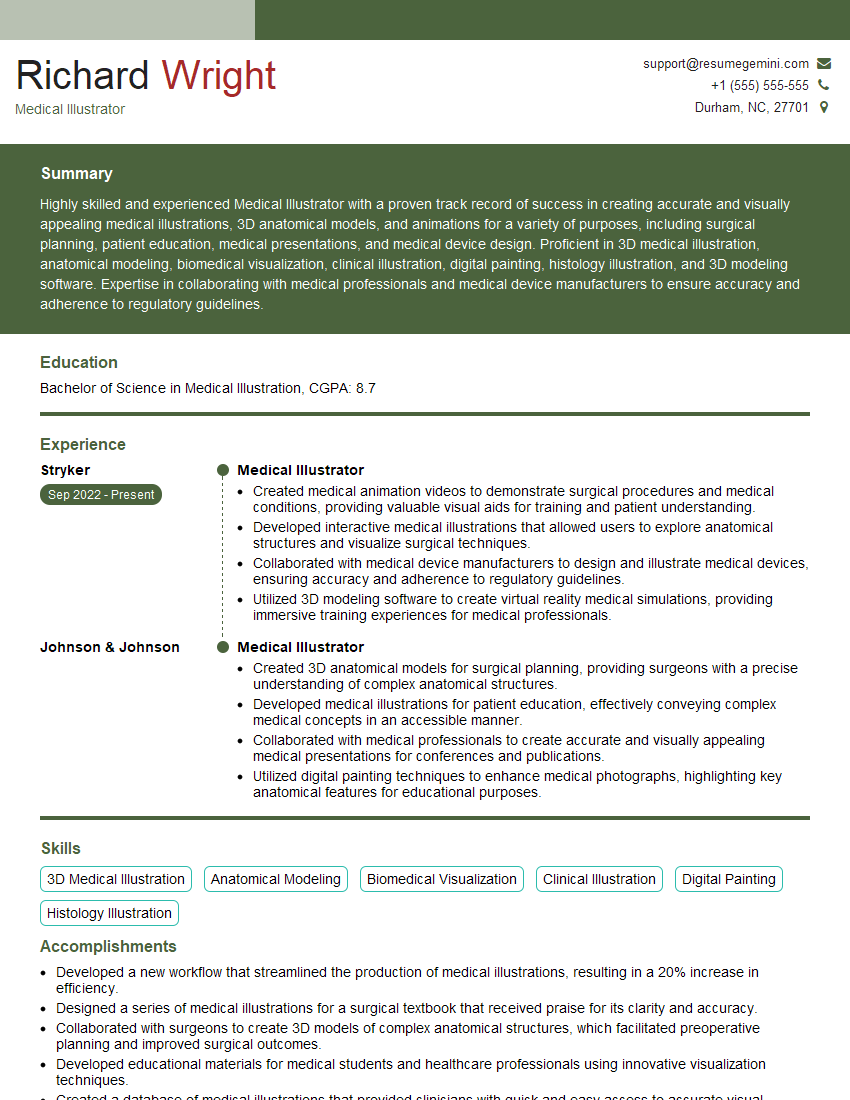
Medical Illustrator Resume Sample

Sculptor Resume Sample

Technical Artist Resume Sample

Texture Artist Resume Sample

3D Modeler Resume Sample

Animation Director Resume Sample
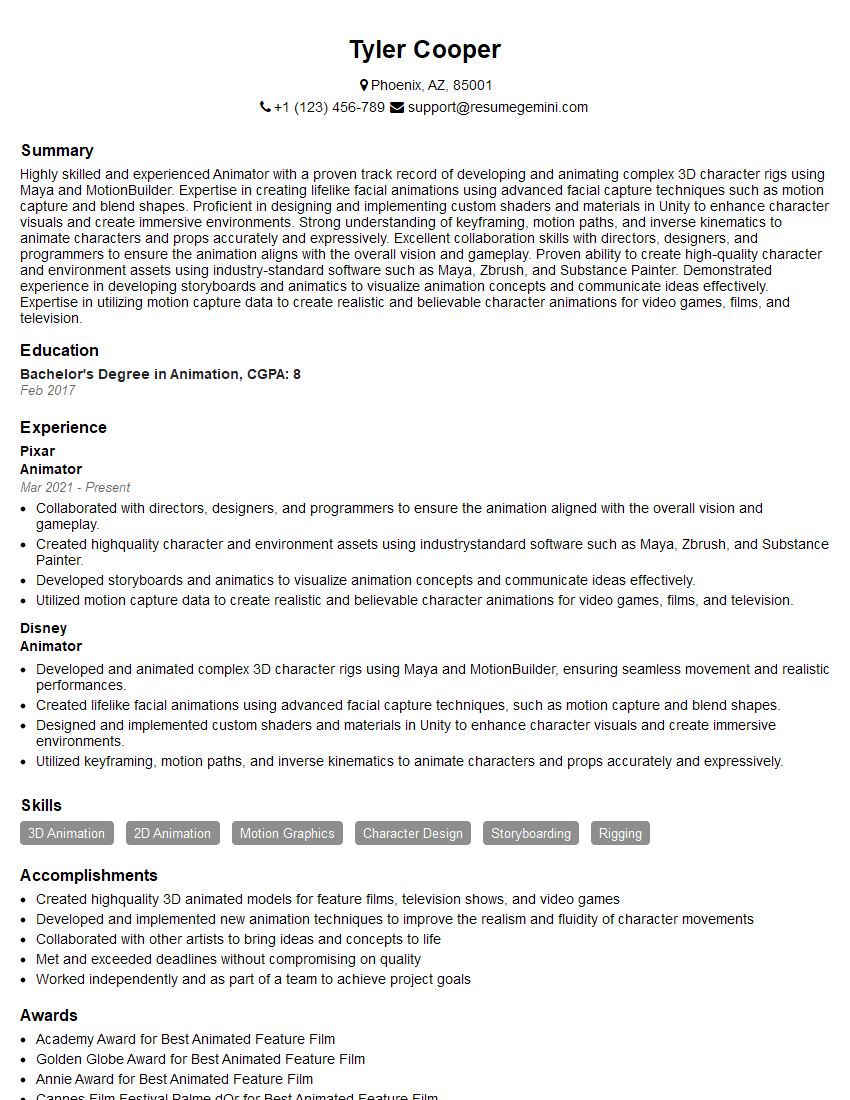
Animator Resume Sample
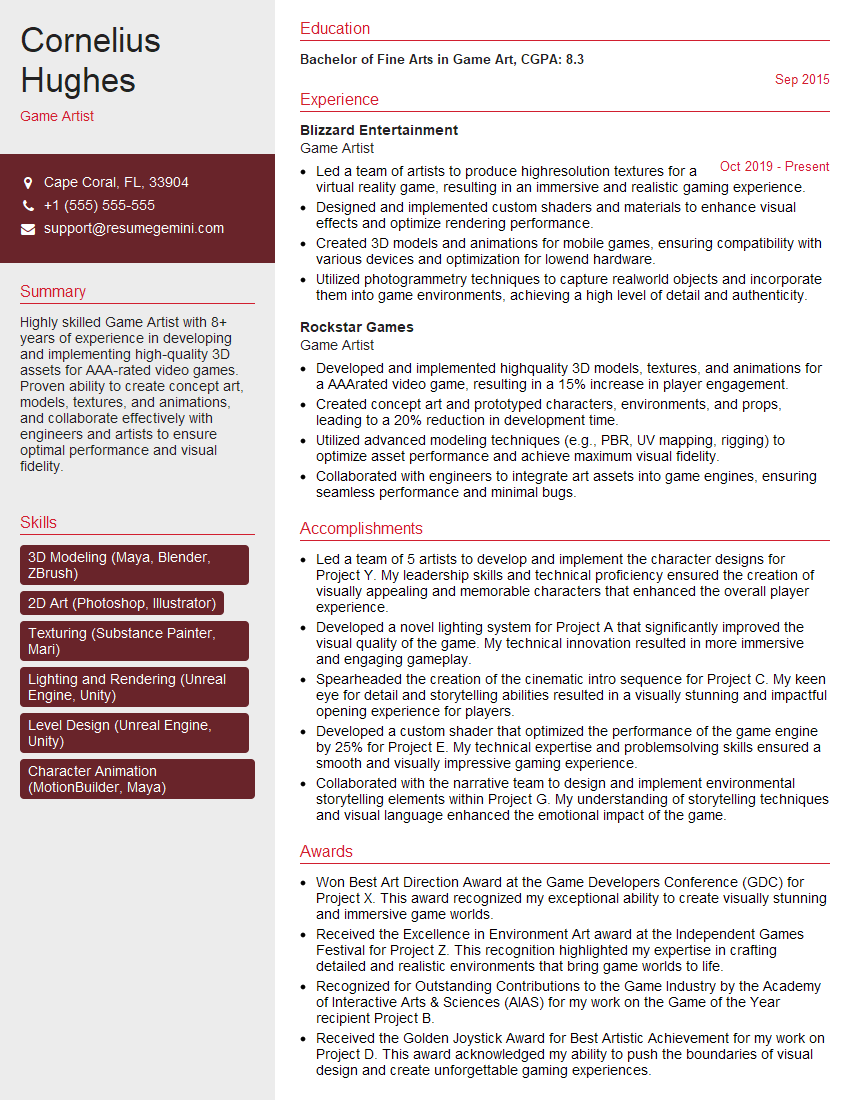
Game Artist Resume Sample

Graphic Designer Resume Sample
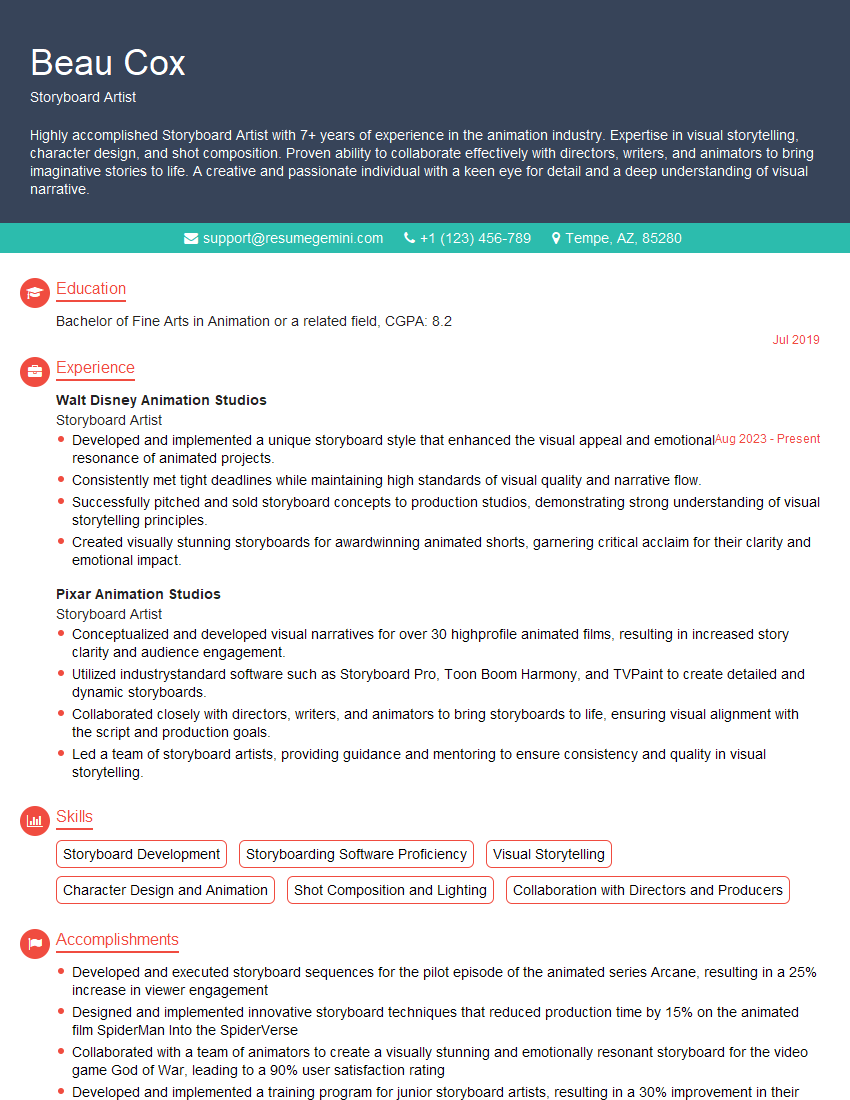
Storyboard Artist Resume Sample
Explore more articles
Users Rating of Our Blogs
Share Your Experience
We value your feedback! Please rate our content and share your thoughts (optional).
What Readers Say About Our Blog
Very informative content, great job.
good