Are you ready to stand out in your next interview? Understanding and preparing for Formulating and Compounding interview questions is a game-changer. In this blog, we’ve compiled key questions and expert advice to help you showcase your skills with confidence and precision. Let’s get started on your journey to acing the interview.
Questions Asked in Formulating and Compounding Interview
Q 1. Explain the difference between wet granulation and dry granulation.
Wet granulation and dry granulation are two distinct methods used to improve the flowability and compressibility of powders in pharmaceutical formulation, ultimately leading to better tablet formation. The core difference lies in how the granules are formed.
Wet Granulation: This method involves mixing the drug powder with a binder (like starch paste or polyvinylpyrrolidone) and a liquid to create a wet mass. This mass is then passed through a sieve or mill to create granules of a desired size. The granules are then dried and potentially milled again to achieve the final size and properties. Think of it like making a mud pie – you mix ingredients with water to create a cohesive mass, then shape it into the desired form.
Dry Granulation: This technique avoids the use of liquid binders. Instead, it uses pressure to compact the powder into larger aggregates called slugs. These slugs are then milled or crushed into smaller granules. This method is ideal for drugs that are sensitive to moisture or heat, as it avoids the need for drying. Imagine making granola bars – you press the ingredients together without added liquid to form a solid mass, then break it into smaller pieces.
- Advantages of Wet Granulation: Better homogeneity of drug distribution, improved granule properties (strength and flow).
- Disadvantages of Wet Granulation: Longer processing time, potential for degradation of heat-sensitive drugs due to drying.
- Advantages of Dry Granulation: Suitable for moisture-sensitive drugs, shorter processing time.
- Disadvantages of Dry Granulation: Potential for less uniform drug distribution, higher dust generation.
Q 2. Describe the various methods used for particle size reduction in formulation.
Particle size reduction is crucial in formulation to enhance drug dissolution, improve flowability, and ensure consistent drug delivery. Several methods exist, each with its own strengths and weaknesses.
- Milling: This is the most common technique, encompassing various types such as hammer mills, ball mills, and roller mills. Hammer mills use impact to break down particles, while ball mills employ attrition. Roller mills use compression and shearing forces. The choice of mill depends on the hardness and desired particle size of the material. For instance, a hammer mill might be used for a relatively soft material, whereas a ball mill would be better for a hard material.
- Micronization: This method utilizes air jets or other high-energy processes to create micron-sized particles, which significantly increases the surface area, often improving dissolution and bioavailability. This is frequently used for poorly soluble drugs.
- Fluid energy milling (Jet milling): This technique uses compressed air to collide particles against each other, resulting in fine particle size reduction. It is preferred for heat-sensitive materials as it involves little to no heat generation.
- Screening: While not strictly a size reduction method, screening separates particles into different size ranges and is essential for quality control and ensuring uniformity.
The selection of the appropriate particle size reduction method depends on factors like the material properties (hardness, brittleness, moisture content), the desired particle size distribution, and the overall processing cost.
Q 3. What are the key considerations when selecting excipients for a formulation?
Excipient selection is a critical aspect of formulation development. The choice of excipients greatly influences the drug product’s stability, bioavailability, and overall quality. Key considerations include:
- Compatibility: Excipients must be chemically and physically compatible with the drug substance. Incompatible excipients can lead to drug degradation or the formation of undesirable products.
- Biocompatibility: Excipients must be non-toxic and inert, ensuring they don’t elicit adverse reactions in the patient.
- Functionality: Excipients serve various purposes such as binders (to hold tablets together), diluents (to increase bulk), disintegrants (to aid in tablet breakdown), lubricants (to ease tablet ejection from the die), and preservatives (to prevent microbial growth). The selection of excipients depends on their ability to fulfill these functionalities.
- Regulatory Compliance: All excipients used must comply with the relevant regulatory guidelines and be listed in pharmacopoeias (e.g., USP, EP).
- Cost-Effectiveness: Excipients should be cost-effective, especially for large-scale manufacturing.
For example, lactose is a commonly used diluent because it is relatively inexpensive, chemically inert, and readily available. However, for lactose-intolerant patients, alternative diluents like microcrystalline cellulose would be needed.
Q 4. How do you ensure the stability of a formulation over its shelf life?
Ensuring the stability of a formulation over its shelf life is essential for maintaining its efficacy and safety. This involves understanding the factors that contribute to degradation and implementing strategies to mitigate them.
- Accelerated Stability Testing: This involves exposing the formulation to exaggerated conditions of temperature and humidity to predict its long-term stability. This allows for quick estimation of shelf-life.
- Proper Packaging: Appropriate packaging material protects the formulation from environmental factors like light, moisture, and oxygen, which can cause degradation. For example, using amber glass bottles can protect light-sensitive drugs.
- Excipient Selection: Selecting suitable excipients that act as stabilizers or antioxidants can help prevent drug degradation. Antioxidants can help prevent oxidation, and preservatives can help to prevent microbial growth.
- Formulation Optimization: Adjusting the formulation’s pH, ionic strength, or water content can influence stability. For example, adjusting pH to the drug’s optimum stability range can significantly increase shelf-life.
- Regular Stability Monitoring: Regular monitoring of the formulation’s quality attributes (e.g., potency, appearance, pH) over time is crucial to ensure that it remains stable throughout its shelf life.
Stability testing involves a combination of methods, such as chemical analysis (HPLC, UV-Vis), physical testing (particle size analysis, dissolution testing), and microbiological testing.
Q 5. What are the challenges in scaling up a formulation from lab to manufacturing?
Scaling up a formulation from the lab to manufacturing presents numerous challenges. What works well on a small scale may not translate seamlessly to a larger scale. Key challenges include:
- Mixing and Granulation: Achieving uniform mixing and granulation on a larger scale can be difficult. The mixing patterns and energy input may differ significantly, leading to variations in granule size and drug distribution.
- Drying: Drying conditions need to be carefully controlled during scale-up to avoid degradation or agglomeration. This can be more challenging at a larger scale.
- Equipment: The type of equipment used at the lab scale may not be suitable for larger-scale production. It may be necessary to use different equipment with different processing parameters.
- Reproducibility: The ability to consistently reproduce the quality of the formulation at a larger scale is crucial. This requires careful control of all processing parameters.
- Validation: Comprehensive validation studies are necessary to ensure that the manufacturing process is robust and produces a consistent product that meets quality standards.
Careful planning, thorough understanding of the formulation and process, and pilot-scale studies are crucial for successful scale-up.
Q 6. Explain the importance of pre-formulation studies.
Pre-formulation studies are critical steps undertaken before the actual formulation development. They provide essential information about the physical and chemical properties of the drug substance, enabling informed decisions regarding the formulation strategy. These studies help to avoid costly mistakes and ensure the development of a successful and stable drug product.
- Physical Properties: These include particle size, crystalline form (polymorphism), solubility, dissolution rate, and hygroscopicity (water absorption). Understanding these properties allows for the selection of appropriate excipients and formulation strategies.
- Chemical Properties: These include stability under various conditions (temperature, humidity, pH), degradation pathways, and the potential for interactions with excipients. Knowing this prevents formulation failures due to chemical incompatibility.
- Biopharmaceutical Studies: These help determine the drug’s absorption characteristics, bioavailability, and the best route of administration. This information guides decisions on formulation design.
For example, if pre-formulation studies reveal that a drug is highly susceptible to hydrolysis, the formulation will need to be designed to protect it from moisture. If the drug has poor solubility, the formulation will need to improve the drug’s dissolution rate to achieve adequate bioavailability.
Q 7. Describe different types of drug delivery systems.
Drug delivery systems are designed to control the rate, location, and manner of drug release. This enhances therapeutic efficacy and minimizes side effects. Different types exist to cater to specific needs:
- Immediate-Release Systems: These systems release the drug rapidly after administration, providing immediate therapeutic effects. This is the most common type of dosage form.
- Controlled-Release Systems: These systems regulate the release of the drug over an extended period, often reducing the frequency of dosing and improving patient compliance. Examples include sustained-release tablets, transdermal patches, and implantable systems.
- Targeted Drug Delivery Systems: These deliver the drug specifically to the target site, reducing side effects by minimizing exposure to healthy tissues. This includes systems using antibodies or nanoparticles for targeted drug delivery.
- Sustained-Release Systems: These slowly release the drug over a prolonged period, usually hours to days. They are used to maintain therapeutic drug levels for an extended time and reduce the dosing frequency.
- Liposomes: Vesicles made from lipid bilayers that encapsulate the drug and control its release. Liposomes protect the drug from degradation and can target specific tissues.
- Nanoparticles: Tiny particles that can carry and deliver drugs. Their small size allows for enhanced penetration into tissues.
- Microspheres/Microcapsules: Small spheres or capsules that contain the drug and control its release. Microspheres can be administered via injection or orally.
The choice of drug delivery system depends on factors such as the drug’s properties, the target site of action, the desired release profile, and patient-specific considerations.
Q 8. How do you handle incompatibilities between drug substances and excipients?
Incompatibilities between drug substances and excipients are a major concern in formulation development. These incompatibilities can manifest in various ways, leading to reduced efficacy, instability, toxicity, or even the formation of undesirable products. Handling these requires a systematic approach.
Strategies for Handling Incompatibilities:
- Careful Selection of Excipients: This is the first line of defense. Thoroughly researching the physicochemical properties of the drug and potential excipients is crucial. Consult established resources like the Handbook of Pharmaceutical Excipients and relevant scientific literature. For instance, if your drug is sensitive to hydrolysis, you wouldn’t use a water-based excipient.
- Compatibility Testing: Conducting various compatibility studies is vital. These include visual inspection, measuring pH changes, and analyzing for the presence of degradation products using techniques like HPLC or spectroscopic methods. For example, you might mix small amounts of the drug and excipient under different conditions (temperature, light, humidity) and monitor the mixture over time.
- Modifying Formulation Parameters: If incompatibilities arise, adjustments to the formulation can mitigate them. This might involve altering the pH, incorporating buffer systems to maintain pH stability, adding stabilizers (antioxidants, chelating agents), or changing the order of mixing ingredients. For instance, if a drug degrades in the presence of light, consider using opaque containers.
- Using Alternative Excipients: If adjustments to formulation parameters are not sufficient, consider exploring alternative excipients that demonstrate better compatibility with the drug substance. For instance, you might switch to a different type of suspending agent or binder.
- Formulation Development Strategies: Consider alternative formulation approaches, such as using microencapsulation or solid dispersions, which physically separate the drug from incompatible components. These techniques enhance the stability of the sensitive drug.
Example: Let’s say a drug is incompatible with a certain type of plasticizer in a capsule shell. One might switch to a capsule shell with a different, compatible plasticizer, or use a different drug delivery system altogether to overcome the problem.
Q 9. What are the regulatory requirements for pharmaceutical formulations?
Regulatory requirements for pharmaceutical formulations are stringent and vary across jurisdictions, primarily guided by agencies like the FDA (United States) and EMA (Europe). These regulations are aimed at ensuring product safety, quality, and efficacy. Key aspects include:
- Good Manufacturing Practices (GMP): GMP guidelines strictly govern every step of the manufacturing process, from raw material sourcing to final product packaging. These guidelines ensure consistency and quality throughout the production process.
- Pre-clinical and Clinical Trials: Extensive testing is required to demonstrate the safety and efficacy of the formulation before it can be marketed. This involves pre-clinical studies in animals and multiple phases of clinical trials in humans.
- Drug Master File (DMF): A DMF is typically submitted to regulatory agencies containing detailed information about the drug substance and the manufacturing process. This document provides transparency and allows for efficient review processes.
- Registration and Approval: Before a pharmaceutical formulation can be marketed, it needs to be registered and approved by the relevant regulatory agency. This involves submitting a comprehensive application with data from all the aforementioned stages.
- Post-Market Surveillance: Even after approval, continuous monitoring of the product’s safety and efficacy is required. This involves actively collecting data on adverse events, complaints, and changes in product quality.
- Labeling and Packaging: Regulations dictate specific requirements for labeling, which must include accurate information about the drug, its usage, warnings, and precautions. The packaging must also meet specific standards to maintain the quality and stability of the product.
Non-compliance can lead to severe consequences, including product recalls, fines, and legal action.
Q 10. Explain the concept of polymorphism and its impact on formulation.
Polymorphism refers to the ability of a substance to exist in more than one crystalline form. Different polymorphs of the same drug substance can have varying physicochemical properties, such as melting point, solubility, dissolution rate, and stability. This has a significant impact on the formulation’s overall performance.
Impact on Formulation:
- Solubility and Dissolution Rate: Different polymorphs exhibit different solubilities and dissolution rates. A polymorph with higher solubility will generally lead to faster drug dissolution and improved bioavailability.
- Stability: Some polymorphs are more stable than others, meaning they are less prone to degradation or transformation into other forms over time. This is crucial for shelf life and maintaining the efficacy of the formulation.
- Tableting and Processing: The flow properties, compressibility, and mechanical strength of the polymorph can influence the ease of processing during tableting or capsule filling. A polymorph with poor flow properties may require extra excipients to aid processing.
- Bioavailability: The bioavailability of a drug can be affected by its polymorphic form, as the dissolution rate directly influences the amount of drug that reaches the systemic circulation.
Example: Ritonavir, an antiretroviral drug, is a well-known example of polymorphism, where one polymorph exhibits much better stability and bioavailability than others. The less stable polymorph led to initial formulation challenges until the more stable form was identified and used in the final product.
Q 11. Describe various methods for evaluating the dissolution of a drug.
Evaluating the dissolution of a drug is critical to ensure its bioavailability. Several methods exist for determining the dissolution profile of a pharmaceutical formulation. These methods are standardized and often described in pharmacopeias.
- Apparatus 1 (Basket Method): A rotating basket containing the dosage form is immersed in a dissolution medium. Samples are withdrawn at predetermined time intervals, and the drug concentration is measured using appropriate analytical techniques (e.g., UV-Vis spectrophotometry, HPLC).
- Apparatus 2 (Paddle Method): A rotating paddle is used to stir the dissolution medium while the dosage form is kept at the bottom of the vessel. Samples are taken as in Apparatus 1.
- Flow-through Cell: The dissolution medium continuously flows through a cell containing the dosage form. This method is particularly useful for simulating in vivo conditions.
- USP Dissolution Apparatus 4 (Flow-Through Cell): A more advanced system with improved control over flow rate and temperature. Useful in testing extended-release formulations.
- USP Dissolution Apparatus 6 (Paddle Over Disk): This method is designed for highly viscous solutions and has increased control over the flow of fluid over the dosage form.
The choice of method depends on the specific dosage form (tablet, capsule, etc.) and its physical properties. The results obtained are often expressed as dissolution profiles, showing the percentage of drug dissolved as a function of time. These profiles can be compared and analyzed to assess the dissolution characteristics of different formulations or batches.
Q 12. What are the different types of emulsions and their characteristics?
Emulsions are thermodynamically unstable systems consisting of two immiscible liquids (e.g., oil and water), where one liquid is dispersed as droplets within the other. The type of emulsion depends on which phase is the continuous phase and which is the dispersed phase.
- Oil-in-Water (O/W) Emulsions: Oil droplets are dispersed in a continuous water phase. These emulsions are generally easier to apply to the skin and are easier to wash away. Common examples include many lotions and creams.
- Water-in-Oil (W/O) Emulsions: Water droplets are dispersed in a continuous oil phase. These emulsions often provide better skin hydration and act as occlusives to reduce water loss from the skin. Examples include some cold creams and ointments.
- Multiple Emulsions: These are complex systems with a dispersed phase containing droplets of another emulsion. For instance, a water-in-oil-in-water (W/O/W) emulsion might have water droplets dispersed in an oil phase, which is then dispersed in a continuous water phase. These formulations offer potential for sustained or targeted drug delivery.
Characteristics: The stability and characteristics of emulsions depend on factors such as the type and concentration of emulsifiers (e.g., surfactants, polymers), droplet size, viscosity, and temperature. Emulsions can be prone to problems like creaming (separation of phases due to density differences), coalescence (merging of droplets), and phase inversion (change in the continuous and dispersed phases).
Q 13. Explain the importance of rheological properties in formulation design.
Rheological properties, describing a material’s flow and deformation behavior, are paramount in formulation design. They significantly influence various aspects of a product’s performance, manufacturability, and stability.
- Product Stability: Viscosity can influence the stability of suspensions and emulsions by reducing sedimentation or creaming, thereby improving the homogeneity and shelf-life of the product.
- Ease of Application: The rheology of a topical formulation (cream, ointment, gel) impacts its spreadability and ease of application. A lotion needs to be relatively low-viscosity for easy application.
- Drug Release: In controlled-release formulations, viscosity can affect the rate of drug release by influencing the diffusion of the drug from the dosage form into the surrounding medium. Higher viscosity may slow down drug release.
- Patient Compliance: The feel and texture of the product (influenced by its rheology) can significantly affect patient acceptance and compliance. An unpleasant texture or difficulty in application can result in poor compliance.
Example: In the development of an ophthalmic solution, controlling the viscosity is critical for ensuring that the solution remains in contact with the eye surface for an adequate time to achieve therapeutic effect. A low-viscosity solution would drain out too quickly.
Q 14. How do you determine the appropriate viscosity of a formulation?
Determining the appropriate viscosity of a formulation is crucial and depends on various factors, including the type of dosage form, the intended route of administration, and the physical and chemical properties of the drug and excipients.
Methods for Determining Viscosity:
- Rheometers: These instruments directly measure the viscosity of the formulation under controlled shear conditions. Different types of rheometers (e.g., rotational, capillary) are available, each suitable for specific viscosity ranges and sample types.
- Viscometers: Simpler instruments that provide a measure of viscosity under specific conditions. Examples include Ostwald viscometers and Brookfield viscometers. These are simpler to use but may not offer the same level of detail as rheometers.
- Empirical Methods: Some formulations may use empirical methods based on experience and observations to adjust the amount of viscosity-modifying agents until a desired consistency is achieved. For instance, a formulation scientist may adjust the concentration of a thickening agent until a suitable spreadability is achieved for a topical cream.
The desired viscosity will vary greatly depending on the dosage form. For example, an injectable solution needs a very low viscosity for smooth injection, whereas an ointment or cream needs a specific viscosity to allow good spreadability and adherence to the skin.
Factors influencing viscosity choice:
- Drug Stability: Viscosity is crucial in stabilizing suspensions and emulsions by slowing down sedimentation or creaming.
- Drug Release: The viscosity can influence the rate of drug release from a formulation.
- Patient Comfort and Compliance: The viscosity of topical formulations affects patient comfort and application ease.
- Manufacturing Considerations: The viscosity must be appropriate for the manufacturing process.
Q 15. What are the different types of suspensions and their stability issues?
Suspensions are liquid dosage forms containing solid drug particles dispersed in a liquid vehicle. Their stability is crucial for maintaining drug efficacy and patient safety. Different types of suspensions exhibit unique stability challenges.
- Flocculated Suspensions: These have particles loosely aggregated into flocs. Stability issues include sedimentation (flocs settle quickly), caking (flocs compact irreversibly), and redispersibility (difficult to remix into a uniform suspension).
- Deflocculated Suspensions: Particles remain individually dispersed. Stability issues include slower sedimentation (compared to flocculated), but the risk of caking is significantly higher, leading to irreversible settling and difficulty in redispersing.
- Rheological Considerations: The viscosity of the suspending medium plays a vital role. Too low a viscosity leads to rapid sedimentation, while too high a viscosity can make pouring and administration difficult. Finding the optimal balance is key.
- Other factors: Particle size distribution, density differences between the drug and vehicle, temperature, and the presence of electrolytes also significantly affect suspension stability.
Example: A poorly formulated suspension of an antibiotic might show rapid settling, making it difficult to obtain a consistent dose each time. This can lead to treatment failure. Careful selection of suspending agents (like acacia or tragacanth) and control of particle size can improve stability significantly.
Career Expert Tips:
- Ace those interviews! Prepare effectively by reviewing the Top 50 Most Common Interview Questions on ResumeGemini.
- Navigate your job search with confidence! Explore a wide range of Career Tips on ResumeGemini. Learn about common challenges and recommendations to overcome them.
- Craft the perfect resume! Master the Art of Resume Writing with ResumeGemini’s guide. Showcase your unique qualifications and achievements effectively.
- Don’t miss out on holiday savings! Build your dream resume with ResumeGemini’s ATS optimized templates.
Q 16. Explain the methods for sterility testing of pharmaceutical formulations.
Sterility testing ensures that pharmaceutical products are free from viable microorganisms. Several methods are employed, often in combination, to provide a comprehensive assessment.
- Membrane Filtration: This method filters a sample through a sterile membrane filter, trapping microorganisms. The membrane is then placed on a suitable growth medium and incubated to detect microbial growth. It’s particularly useful for low microbial loads and is often used for parenteral products.
- Direct Inoculation: A sample is directly inoculated into a suitable growth medium. This method is simpler but may not be as sensitive as membrane filtration.
- Growth Promotion Testing: Before sterility testing, the media used should be validated to ensure that they support the growth of a wide range of microorganisms, including bacteria and fungi. Positive and negative controls should be included in every test.
Environmental Control: The testing environment is critical. Sterile conditions are paramount to prevent contamination. A laminar flow hood is essential to ensure that no airborne microbes introduce false positives. Strict aseptic techniques must be observed.
Interpretation of Results: Results are interpreted carefully. Absence of growth after incubation for a specific duration (typically 14 days) indicates sterility. However, negative results do not guarantee absolute sterility; they only indicate that no viable organisms were detected within the test’s limitations.
Q 17. How do you ensure the accurate and precise measurement of ingredients?
Accurate and precise measurement of ingredients is fundamental to the quality and consistency of pharmaceutical formulations. Several techniques ensure accuracy.
- Analytical Balances: High-precision balances are used to weigh ingredients. Regular calibration and validation are essential to ensure the balance accurately measures the desired weight. Class A weights are needed for the most accurate weighing, and the balance should be situated in a draft-free environment.
- Volumetric Measurement: Volumetric glassware (e.g., graduated cylinders, pipettes, burettes) is used for measuring liquids. Appropriate glassware should be selected based on the volume and required accuracy. Proper techniques, such as reading the meniscus accurately, are crucial.
- Automated Dispensing Systems: These systems provide increased precision and efficiency, particularly useful for large-scale production. They reduce human error and improve consistency.
Good Manufacturing Practices (GMP): GMP regulations strictly define the procedures for weighing and measuring ingredients to ensure accuracy and traceability. Records of each measurement should be documented, along with the equipment used.
Example: An error in weighing a potent active pharmaceutical ingredient (API) could have severe consequences. Using a calibrated balance and proper weighing techniques are vital to avoid such errors.
Q 18. What are the common analytical techniques used in formulation development?
Various analytical techniques are essential in formulation development to characterize the drug substance and the final formulation.
- HPLC (High-Performance Liquid Chromatography): Used for separating and quantifying components in a mixture. This is invaluable for determining the purity of the drug substance and measuring drug content in the final formulation.
- UV-Vis Spectroscopy: Measures the absorbance of light at specific wavelengths. Useful for quantifying drug content, especially if the drug has a characteristic UV absorption.
- FTIR (Fourier Transform Infrared Spectroscopy): Identifies functional groups in molecules. It’s useful for characterizing the drug substance and excipients, ensuring their identity and purity.
- DSC (Differential Scanning Calorimetry): Measures the heat flow associated with phase transitions (e.g., melting). It helps characterize the physical state of the drug substance and provides information about its thermal stability.
- Particle Size Analysis: Determines the size and distribution of particles in solid dosage forms. This is critical for suspensions and other formulations where particle size impacts bioavailability and stability.
Example: HPLC can be used to determine the purity of the active pharmaceutical ingredient, ensuring that no unwanted byproducts are present. DSC can be used to study the stability of a tablet formulation and predict its shelf life.
Q 19. Explain the concept of bioavailability and its relevance to formulation.
Bioavailability refers to the rate and extent to which an active drug ingredient or substance is absorbed from a drug product and becomes available at the site of action. It’s a critical factor in formulation development, as it directly impacts the drug’s efficacy.
Factors Affecting Bioavailability: Many factors affect bioavailability, including:
- Solubility: Poorly soluble drugs have lower bioavailability.
- Particle Size: Smaller particle size generally leads to increased solubility and absorption.
- Formulation: The type of formulation (e.g., tablet, capsule, solution) influences the rate of drug release and absorption.
- First-Pass Metabolism: The liver’s metabolism of a drug can reduce its bioavailability.
Relevance to Formulation: Formulation scientists design formulations to optimize bioavailability. Strategies include:
- Formulation of poorly soluble drugs: Using techniques such as solid dispersions or micronization to increase solubility.
- Controlled-release formulations: Designing formulations that release the drug at a controlled rate, extending its duration of action and improving compliance.
- Prodrugs: Designing prodrugs that are more readily absorbed and converted to the active drug in the body.
Example: A drug with poor bioavailability might require a formulation that increases its solubility or modifies its release rate to ensure that enough reaches the target site to produce a therapeutic effect.
Q 20. Describe different types of tablets and their manufacturing processes.
Tablets are a widely used solid dosage form, offering advantages like ease of administration, accurate dosing, and stability. Several types exist, each with unique manufacturing processes.
- Compressed Tablets: The most common type, made by compressing powdered ingredients under high pressure. Different types include:
- Plain Tablets: Simple compressed tablets containing the active ingredient and excipients.
- Sugar-coated Tablets: Compressed tablets coated with sugar to improve taste and appearance.
- Film-coated Tablets: Coated with a thin polymer film for protection, improved appearance, and controlled release.
- Multiple Compressed Tablets: Multiple layers compressed together allowing for different layers with different properties (e.g., delayed-release).
- Molded Tablets: Made by molding a wet mass of ingredients into tablet shapes. Less common for pharmaceuticals due to the issues involved in making precise dose.
Manufacturing Processes:
- Granulation: Powders are wetted and mixed with a binder to form granules, which improve flowability and compactibility.
- Mixing: The active ingredient and excipients are carefully mixed to ensure uniformity.
- Compression: Granules or powders are compressed using a tablet press.
- Coating (if applicable): Tablets are coated to improve aesthetics, protection, or release characteristics.
Example: Aspirin tablets are typically compressed tablets. Extended-release formulations might employ multiple compression or film coating to control drug release.
Q 21. What are the critical quality attributes of a pharmaceutical formulation?
Critical Quality Attributes (CQAs) are the physical, chemical, biological, or microbiological properties of a pharmaceutical formulation that should be within an acceptable range to ensure its quality, safety, and efficacy. These attributes must be carefully controlled throughout the development and manufacturing process.
- Drug Content Uniformity: The amount of drug in each dosage unit must be consistent and within an acceptable range.
- Dissolution: The rate at which the drug dissolves from the formulation. Critical for ensuring drug absorption.
- Particle Size Distribution: Affects drug solubility, bioavailability, and stability, particularly for suspensions and poorly soluble drugs.
- Stability: The ability of the formulation to maintain its quality and potency over time and under various storage conditions. Shelf life and degradation rates are key.
- Appearance: Physical appearance, including color, shape, and size, should be consistent and meet specifications.
- Microbiological Quality: For sterile formulations, freedom from microbial contamination is paramount.
Example: For an oral tablet, CQAs would include drug content uniformity, dissolution rate, hardness, friability (resistance to breakage), and appearance. Monitoring these attributes during development and production ensures that the tablets meet quality standards and deliver the expected therapeutic effect.
Q 22. How do you design a stability indicating assay for a pharmaceutical formulation?
A stability-indicating assay is a crucial analytical method designed to detect degradation products of a drug within a pharmaceutical formulation. It ensures that the assay is specific enough to measure only the active pharmaceutical ingredient (API) and not its degradation products, which can form over time due to factors like oxidation, hydrolysis, or photolysis. Designing such an assay involves several key steps.
Understanding Degradation Pathways: Initially, we need to identify potential degradation pathways of the API under various stress conditions (e.g., heat, light, humidity, oxidation). This often involves forced degradation studies, employing ICH guidelines as a framework.
Method Development: We then develop a chromatographic method (usually HPLC or UHPLC) that can effectively separate the API from its degradation products. This involves optimizing parameters such as the mobile phase composition, column type, and detection wavelength to achieve optimal resolution and sensitivity. For example, a reversed-phase HPLC method with UV detection might be suitable for many APIs. If the degradation products are structurally similar to the API, more advanced techniques like tandem mass spectrometry (MS/MS) might be needed.
Validation: The developed method must be rigorously validated to ensure accuracy, precision, linearity, specificity, limit of detection (LOD), limit of quantitation (LOQ), and robustness. This involves testing under various conditions to demonstrate the method’s reliability and consistency. For instance, we’d assess its performance across different batches of the formulation and different analysts.
Specificity Confirmation: We demonstrate specificity by showing that the method does not interfere with excipients present in the formulation. We also confirm that the method can accurately quantify the API even in the presence of its degradation products.
Example: In developing a stability-indicating assay for a specific antibiotic, we might identify hydrolysis as a major degradation pathway. We’d then design an HPLC method that uses a specific column and mobile phase to separate the intact antibiotic from its hydrolysis products. The method would then be validated according to ICH guidelines to ensure its suitability for stability studies.
Q 23. Explain the role of Good Manufacturing Practices (GMP) in formulation.
Good Manufacturing Practices (GMP) are a set of guidelines that ensure the consistent production of high-quality pharmaceutical products. In formulation, GMP plays a crucial role in ensuring the safety, efficacy, and quality of the final product. Compliance with GMP guidelines is essential for regulatory approval and maintaining patient safety.
Raw Material Control: GMP dictates rigorous testing and quality control of raw materials (API and excipients) to ensure their identity, purity, and quality.
Manufacturing Process Control: The entire manufacturing process, from weighing and mixing to filling and packaging, is documented and controlled. This ensures consistent product quality and minimizes the risk of contamination or errors.
Equipment Cleaning and Validation: Equipment used in the formulation process must be thoroughly cleaned and validated to prevent cross-contamination and ensure the absence of residues. Validation procedures must be well documented.
Personnel Training and Hygiene: GMP mandates proper training and hygiene practices for all personnel involved in the formulation process. This is vital in reducing the risk of microbial contamination and ensuring quality control.
Documentation and Record Keeping: All aspects of the formulation process must be meticulously documented, providing a complete audit trail. This includes batch records, cleaning logs, and equipment maintenance records.
Quality Control Testing: Rigorous quality control testing is performed on the final formulation to verify that it meets the required specifications. This includes tests for identity, purity, potency, and other relevant parameters.
Example: Failure to adhere to GMP might result in a batch of medication being contaminated, leading to a recall and potential harm to patients. Thorough cleaning and validation of equipment prevent cross-contamination between different formulations, and meticulous documentation ensures complete traceability of the manufacturing process.
Q 24. What is the difference between a solution and a suspension?
The key difference between a solution and a suspension lies in the particle size and distribution of the solute (drug) within the vehicle (solvent). Think of it like this: a solution is like dissolving sugar in water – it becomes invisible and uniformly distributed. A suspension is like stirring sand into water – you still see the individual particles.
Solution: In a solution, the solute is completely dissolved at a molecular or ionic level in the solvent, forming a homogenous mixture. The particle size is less than 1 nm (nanometer). The drug is fully dissolved and invisible to the naked eye. Examples include many oral liquids and injectables.
Suspension: In a suspension, the solute is dispersed as insoluble particles in the solvent. The particle size is typically greater than 1 µm (micrometer). These particles will settle over time and need to be shaken before use. Examples include many oral antibiotics and topical medications.
Key differences summarized:
- Particle size: Solutions have very small particles (less than 1nm), suspensions have larger particles (greater than 1µm).
- Homogeneity: Solutions are homogenous, suspensions are heterogeneous.
- Stability: Solutions are usually more stable than suspensions (less prone to settling).
- Clarity: Solutions are transparent, suspensions are opaque or cloudy.
Q 25. Describe the various methods used for characterizing the solid-state properties of drugs.
Characterizing the solid-state properties of drugs is critical for formulation development as they significantly impact the drug’s dissolution, bioavailability, and stability. Several techniques are employed:
Microscopy: Techniques like optical microscopy, scanning electron microscopy (SEM), and transmission electron microscopy (TEM) provide visual information about the drug’s crystal morphology, particle size distribution, and surface area.
Powder X-ray Diffraction (PXRD): PXRD is used to identify the crystalline form of the drug and assess its crystallinity. Different crystalline forms (polymorphs) of a drug can exhibit different physicochemical properties.
Differential Scanning Calorimetry (DSC): DSC measures the heat flow associated with phase transitions, providing information about melting points, glass transition temperatures, and enthalpy of fusion, which are crucial for understanding the drug’s thermal stability and behavior.
Thermogravimetric Analysis (TGA): TGA measures the weight loss of a sample as a function of temperature, which helps in determining the moisture content, volatile impurities, and thermal stability of the drug.
Particle Size and Surface Area Analysis: Techniques such as laser diffraction and gas adsorption (BET) are used to determine the particle size distribution and surface area of the drug, which influence dissolution and bioavailability.
Solid-State Nuclear Magnetic Resonance (ssNMR): ssNMR provides information about the molecular structure, dynamics, and interactions within the solid state, allowing us to understand polymorphic behavior and interactions with excipients.
Example: If a drug exists in different polymorphs, DSC and PXRD are used to determine the most stable and suitable polymorph for formulation. Microscopy techniques allow visual inspection of particle morphology, helping optimize manufacturing processes to achieve the desired particle size distribution.
Q 26. How do you choose an appropriate packaging material for a pharmaceutical formulation?
Choosing the right packaging material is critical to maintaining the quality and stability of a pharmaceutical formulation. The selection depends on several factors:
Drug Properties: The drug’s sensitivity to light, moisture, oxygen, and temperature dictates the necessary barrier properties of the packaging material. For example, a photosensitive drug needs opaque packaging.
Formulation Type: The physical form of the formulation (solid, liquid, semi-solid) also influences packaging choice. For instance, a liquid formulation might require a tamper-evident seal to prevent leakage.
Storage Conditions: The recommended storage conditions (temperature, humidity) will determine the material’s ability to withstand those conditions without compromising the drug’s quality.
Regulatory Requirements: Regulatory agencies mandate specific packaging requirements related to child-resistance, tamper-evidence, and labeling.
Cost and Availability: The economic viability and availability of packaging materials must also be considered.
Example: A lyophilized (freeze-dried) injectable formulation might require a glass vial sealed with a rubber stopper and an aluminum crimp seal to maintain sterility and protect the drug from moisture and oxygen. An oral solid dosage form might be packaged in blister packs to provide protection from moisture and light and to improve patient compliance.
Q 27. Explain the importance of understanding the physicochemical properties of drug substances in formulation development.
Understanding the physicochemical properties of drug substances is paramount in formulation development. These properties directly influence the drug’s behavior during manufacturing, storage, and administration, and ultimately impact its efficacy and safety.
Solubility: Solubility dictates the drug’s dissolution rate, which is crucial for bioavailability. Insoluble drugs may require special formulation strategies such as micronization or the use of solubilizing agents.
Partition Coefficient (LogP): LogP influences the drug’s distribution between different body compartments. It is crucial for designing formulations that optimize drug absorption.
pKa: pKa governs the drug’s ionization state, affecting its solubility, permeability, and absorption. Understanding the pKa is crucial for designing formulations that optimize drug absorption and stability.
Crystallinity/Amorphous State: The crystalline or amorphous state of the drug affects its dissolution rate, stability, and bioavailability. Amorphous forms usually dissolve faster but are often less stable.
Chemical Stability: The drug’s susceptibility to degradation under various conditions (heat, light, moisture, oxidation) dictates the choice of excipients, packaging materials, and storage conditions.
Hygroscopicity: The drug’s tendency to absorb moisture from the atmosphere can affect its stability and processing characteristics. It is considered when selecting appropriate packaging and excipients.
Example: A poorly soluble drug might require the use of solid dispersions or lipid-based formulations to enhance its dissolution and absorption. A drug susceptible to oxidation might need to be formulated under inert conditions and packaged in airtight containers.
Q 28. Describe your experience with designing and implementing Quality by Design (QbD) principles in formulation development.
Quality by Design (QbD) is a systematic approach to formulation development that aims to build quality into the product from the outset. My experience with QbD involves a structured process of understanding the critical quality attributes (CQAs) of the product and the critical process parameters (CPPs) that influence them. This involves:
Defining CQAs: Identifying the key properties of the drug product that must be controlled to ensure its quality, safety, and efficacy. Examples include dissolution rate, content uniformity, and particle size distribution.
Identifying CPPs: Identifying the process parameters that significantly influence the CQAs. Examples include mixing time, granulation pressure, and drying temperature.
Risk Assessment: Performing a thorough risk assessment to identify potential risks associated with the formulation process and develop strategies for mitigation.
Design Space: Establishing a design space, which is a region of the process parameters that provides assurance that the product will consistently meet its quality specifications. This is typically based on experimental data, modeling, and simulations.
Process Analytical Technology (PAT): Using PAT tools, such as in-line spectroscopic methods, to monitor and control the formulation process in real time, ensuring product quality and consistency.
Continuous Improvement: Continuously monitoring and evaluating the formulation process to identify areas for improvement and maintain product quality.
Example: In developing a tablet formulation, we might identify dissolution rate as a key CQA. Through experimental design, we’d identify parameters like granulation pressure and binder concentration as CPPs that significantly impact dissolution. We’d then use design of experiments (DoE) to establish a design space ensuring consistent dissolution rate. In-line NIR spectroscopy could be used to monitor blend uniformity during the manufacturing process.
Key Topics to Learn for Formulating and Compounding Interview
- Pharmaceutical Calculations: Mastering dosage forms, concentration calculations, and dilutions is fundamental. Understand the theoretical basis and be prepared to solve practical problems related to these calculations.
- Compounding Techniques: Familiarize yourself with various compounding methods (e.g., trituration, levigation, geometric dilution) and their applications in preparing different dosage forms. Be ready to discuss the advantages and limitations of each technique.
- Quality Control in Compounding: Understand the importance of accurate measurements, proper handling of ingredients, and quality assurance procedures to ensure the safety and efficacy of compounded preparations. Discuss relevant regulations and best practices.
- Dosage Forms and Their Properties: Gain a thorough understanding of different dosage forms (e.g., capsules, tablets, ointments, creams) and their physical and chemical properties. Be prepared to discuss the selection of appropriate dosage forms based on the drug’s properties and patient needs.
- Stability and Compatibility of Ingredients: Learn about factors affecting the stability and compatibility of pharmaceutical ingredients. Be able to identify potential incompatibilities and suggest strategies for resolving them. Consider both physical and chemical interactions.
- USP <797> and <800> Compliance: Understand the significance of USP guidelines for compounding sterile and hazardous preparations and how these standards ensure patient safety. Discuss practical implications for aseptic technique and safety procedures.
- Regulatory Aspects of Compounding: Familiarize yourself with relevant regulations and guidelines governing pharmaceutical compounding. This includes understanding the legal responsibilities involved in the compounding process.
- Problem-Solving and Troubleshooting: Develop your ability to troubleshoot common problems encountered during the compounding process. Be prepared to describe your approach to identifying the cause of a problem and implementing a solution.
Next Steps
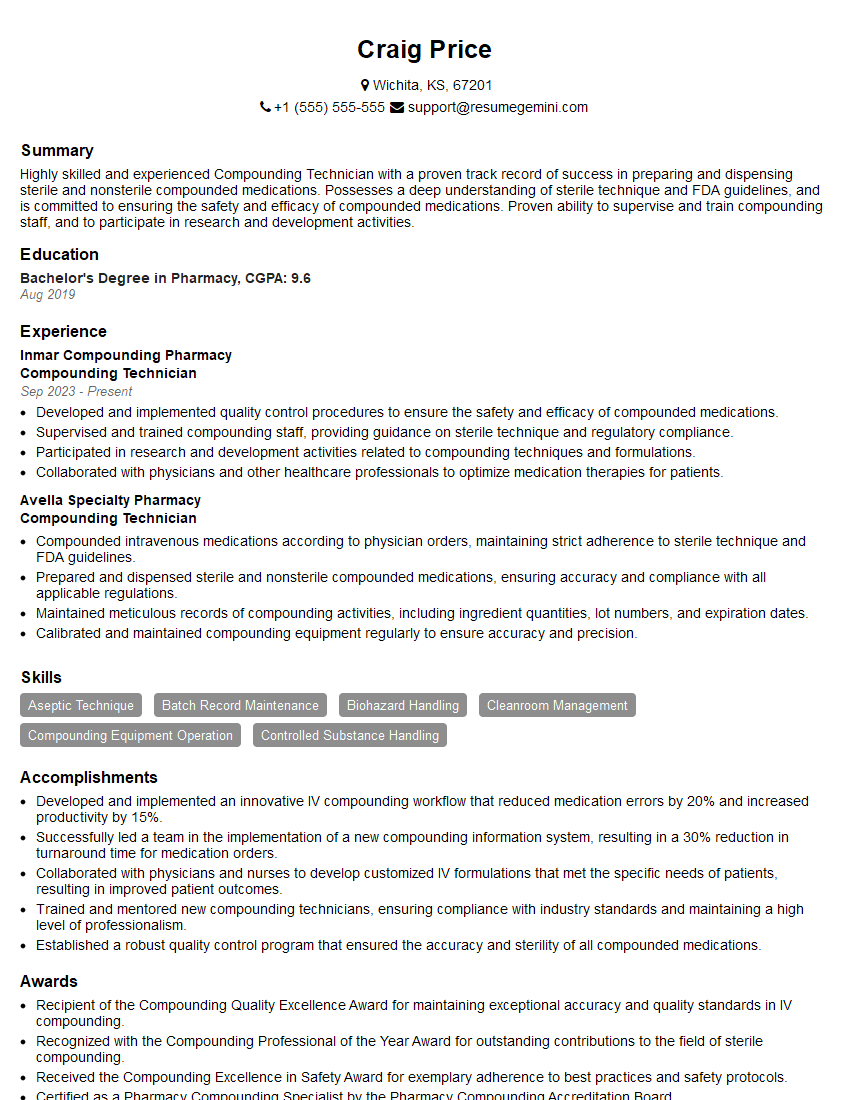
Mastering Formulating and Compounding is crucial for career advancement in the pharmaceutical industry, opening doors to specialized roles and increased earning potential. A well-crafted resume is your key to unlocking these opportunities. Creating an ATS-friendly resume is essential for getting your application noticed. ResumeGemini is a trusted resource to help you build a professional and impactful resume that highlights your skills and experience effectively. Examples of resumes tailored to Formulating and Compounding are available to guide you.
Explore more articles
Users Rating of Our Blogs
Share Your Experience
We value your feedback! Please rate our content and share your thoughts (optional).
What Readers Say About Our Blog
Very informative content, great job.
good