Are you ready to stand out in your next interview? Understanding and preparing for Frame Preparation interview questions is a game-changer. In this blog, we’ve compiled key questions and expert advice to help you showcase your skills with confidence and precision. Let’s get started on your journey to acing the interview.
Questions Asked in Frame Preparation Interview
Q 1. Explain the different types of frame materials you’ve worked with.
Frame materials greatly influence a piece’s presentation and longevity. I’ve worked extensively with various materials, each with its own strengths and weaknesses.
- Wood: This is a classic and popular choice, offering a wide range of styles, colors, and finishes. From sleek, modern hardwoods like walnut or maple to rustic, distressed pine, wood allows for customization and a luxurious feel. For example, I recently framed a delicate watercolor using a warm, cherry wood frame that beautifully complemented the artwork’s palette.
- Metal: Metal frames, including aluminum, steel, and even reclaimed materials, provide a contemporary and often minimalist aesthetic. They are durable and lightweight, making them suitable for larger pieces or those needing extra protection. I’ve used aluminum frames for photographic prints, as their clean lines prevented visual distractions from the image itself.
- Plastic/Resin: These are cost-effective and lightweight options, often used for mass-produced prints or posters. While less visually appealing than wood or metal, they offer excellent protection and are resistant to moisture. For instance, I frequently choose resin frames for children’s artwork, prioritizing durability over high aesthetics.
- Composite Materials: These are blends of different materials, like wood and polymer, to create a frame with increased strength and stability, often at a lower cost than solid wood. I’ve found these are particularly suitable for larger, heavier pieces.
Q 2. Describe your experience with matting and its purpose in framing.
Matting serves several crucial purposes beyond just aesthetics. The mat board acts as a buffer between the artwork and the glass, preventing direct contact that could lead to damage or discoloration. It also helps to create visual separation and draw the viewer’s eye to the artwork.
The color and width of the mat can significantly impact the overall presentation. A wider mat can create a sense of grandeur, while a narrower mat can make the artwork appear more intimate. The color of the mat should complement or contrast with the artwork, enhancing its colors or creating a striking visual effect. For example, a white mat can make vibrant colors pop, while a darker mat can add drama and sophistication.
Different mat boards are available with varying levels of pH neutrality (acid-free) and lignin content; this is crucial to prevent the artwork from being damaged by the mat over time. Acid-free mats are essential for preserving archival materials.
Q 3. How do you ensure the proper alignment of artwork within a frame?
Precise alignment is paramount. I use a combination of techniques to ensure the artwork is perfectly centered within the frame. First, I carefully measure the artwork and the frame opening. Then, I use a combination of straight edges and a T-square to create accurate guidelines on the backing board. I often use archival-quality tape, such as acid-free linen tape to secure the art to the backing board, ensuring it doesn’t shift. Before mounting the artwork, I often do a test fit within the frame to verify accurate placement. If the artwork is delicate, I use additional care, perhaps working on a soft surface and using conservation-grade materials to avoid damage.
Q 4. What are the common methods for securing artwork to a backing board?
The method for securing artwork to a backing board depends heavily on the artwork’s type and fragility. Here are some common methods:
- Acid-free hinges: These are small, folded pieces of archival-quality paper used to attach the artwork to the backing board at the top corners. This is ideal for delicate pieces as it creates a minimal point of contact, allowing for easy removal if needed.
- Archival-quality tape: Used sparingly, this tape can provide support to particularly lightweight or fragile artwork. Acid-free linen tape is my preferred choice for its strength and minimal adhesive residue.
- Point mounting: This involves using small, archival-quality squares of mounting material to lift and support delicate artwork at specific points. This helps to reduce stress on the artwork and prevent damage.
- Dry mounting: This method uses heat-activated adhesive tissue to permanently bond the artwork to the backing board. This is generally reserved for more robust materials and is less appropriate for archival purposes.
Q 5. Explain your process for measuring and cutting mats.
Precise matting is essential for a professional finish. My process typically involves:
- Measuring: I carefully measure the artwork and determine the desired window opening for the mat. I use a ruler and/or a digital caliper to ensure absolute accuracy. Window size depends on both aesthetic considerations and the artwork’s size and aspect ratio.
- Layout: I plan the mat’s dimensions, often using a pencil to mark the cutting lines lightly on the mat board to prevent mistakes. This step involves calculating the mat’s total size to accommodate the artwork and desired border space.
- Cutting: I use a high-quality mat cutter, ensuring the blade is sharp to achieve clean, precise cuts. A self-healing mat is essential to provide protection for the underlying board and for the blade itself.
- Beveling: After cutting, I often bevel the edges of the mat to create a professional, finished look. A bevel cutter is essential for this task. This step provides additional visual appeal.
Q 6. Describe your experience with various glazing options and their applications.
Glazing choices heavily influence the artwork’s protection and visual presentation. I frequently use:
- Regular glass: This is the most economical option but offers less protection against UV damage and reflection. It’s suitable for less valuable artwork or where cost is a major factor.
- UV-filtering glass: This is an important choice for artworks sensitive to light. It helps to significantly reduce the harmful UV rays, slowing down fading and degradation. This is my go-to choice for the majority of fine art pieces.
- Conservation-grade acrylic: This lightweight material offers superior protection against UV damage, breakage, and scratches compared to glass, making it ideal for highly valuable or fragile artwork. It’s often more expensive but provides significantly better protection and is worth the investment for many high-value pieces.
- Museum glass: This high-end option offers superior clarity, minimal reflection, and excellent UV protection. It is often quite expensive and typically reserved for museum-quality artwork.
Q 7. How do you handle fragile or delicate artwork during framing?
Handling fragile artwork requires meticulous care and attention to detail. My approach involves:
- Support and cushioning: I use soft, acid-free materials such as acid-free foam board or archival tissue paper to cushion and support the artwork during handling and transportation.
- Gentle handling: I always wear clean cotton gloves to avoid transferring oils or dirt to the artwork. I avoid applying any undue pressure during handling and positioning.
- Appropriate tools: I use specialized tools designed for conservation purposes, such as acid-free hinges and archival tape, avoiding any materials that could damage the artwork.
- Proper storage: Before and after framing, I store fragile artwork in acid-free sleeves or in archival boxes in a climate-controlled environment to prevent damage.
- Consultation: For especially valuable or fragile pieces, I may consult with a conservator to determine the best framing and handling techniques to ensure the artwork’s long-term preservation.
Q 8. What safety precautions do you take when using tools and machinery?
Safety is paramount in frame preparation. My approach is threefold: Preparation, Procedure, and Protection.
- Preparation: Before I even touch a tool, I inspect it for damage – loose parts, frayed cords, etc. Work surfaces are kept clear and free of obstructions. I always wear appropriate personal protective equipment (PPE), including safety glasses, a dust mask (especially when working with wood dust), and hearing protection when using power tools.
- Procedure: I follow the manufacturer’s instructions for all tools and machinery meticulously. I never rush the process. For example, when using a miter saw, I ensure the workpiece is securely clamped before making a cut. I also regularly maintain my tools, keeping blades sharp and machinery lubricated to prevent kickback or malfunction.
- Protection: Beyond PPE, I’m mindful of my workspace environment. I use push sticks to feed material into machinery, avoiding hand contact with blades. I keep flammable materials away from heat sources and properly dispose of all waste materials according to safety regulations. If working with particularly hazardous materials like certain glues or solvents, I ensure adequate ventilation.
For example, once, I was working with a particularly stubborn piece of oak that kept binding in my table saw. Instead of forcing it, I stopped, reassessed the situation, and used a push stick to feed the wood slowly and safely, preventing a potential injury.
Q 9. Describe your experience with different frame joinery techniques.
I’m proficient in a variety of frame joinery techniques, each chosen based on the project’s demands and aesthetic goals.
- Miter Joints: A classic and strong joint, particularly suitable for simple frames. Achieving a precise 45-degree miter is crucial for a clean, seamless finish. I use a high-quality miter saw and ensure accurate measurement to minimize gaps.
- Rabbet and Dado Joints: Offer increased strength and stability, especially for larger or heavier frames. A dado is a groove cut into one piece, while a rabbet is a shoulder-like cut; the two fit together precisely and can be further reinforced with glue and dowels.
- Spline Joints: These add strength and visual appeal, especially in more decorative frames. A thin spline (a piece of wood or other material) is glued into a groove cut into the two pieces being joined, creating a strong and attractive connection.
- Tongue and Groove Joints: These are similar to spline joints, but the tongue and groove are integral to the pieces being joined, creating an interlocking fit.
Selecting the right technique often depends on factors like the type of wood, frame size, and the desired look. For instance, I might opt for a miter joint for a delicate picture frame but use a rabbet and dado joint for a large, heavy mirror frame.
Q 10. How do you determine the appropriate frame size and style for a piece of artwork?
Determining the right frame size and style is a balance of aesthetics and functionality.
- Artwork Dimensions: The frame should complement the artwork without overpowering it. Generally, there’s a visual balance to be considered; a rule of thumb is to leave a consistent margin around the art piece. The exact amount depends on the art, but it’s often between 1.5 – 3 inches.
- Artwork Style: The style of the frame should ideally complement the artwork’s style and period. A modern minimalist painting likely wouldn’t pair well with an ornate gilded frame. Consider the colors, textures, and overall mood of the piece.
- Room Decor: The intended location also plays a role. A frame that fits well in a traditional living room might be too heavy for a modern minimalist setting. The frame should integrate seamlessly into its environment.
- Material Considerations: The material of the frame (wood, metal, etc.) should also be suitable for the artwork and the overall aesthetic.
For example, a vibrant, colorful abstract painting might be best framed with a simple, sleek black frame to let the colors shine, while a delicate watercolor would be more suited to a lighter colored, narrower frame.
Q 11. Explain your understanding of conservation framing principles.
Conservation framing prioritizes the long-term preservation of the artwork. It involves using archival-quality materials that won’t damage the artwork over time.
- Acid-Free Materials: All materials, including the mat board, backing board, and framing wood, must be acid-free to prevent discoloration and deterioration. I always use museum-quality materials to ensure this.
- UV Protection: UV-protective glazing (discussed further below) is crucial to prevent fading caused by light exposure.
- Proper Spacing: The artwork needs adequate spacing within the frame to allow for air circulation and prevent physical contact with the glazing, which can cause damage from friction or adhesion.
- Secure Mounting: The artwork must be secured safely without damaging the artwork itself. This often involves using acid-free hinges or other appropriate mounting methods.
A critical consideration is that conservation framing aims to avoid anything that may cause harm or damage to the artwork over time, emphasizing longevity and preserving its integrity.
Q 12. How do you deal with damaged or irregular-shaped artwork during framing?
Dealing with damaged or irregular artwork requires careful planning and specialized techniques.
- Assessment: First, I assess the damage to determine the best approach. This involves identifying the type of damage (tears, creases, stains) and its severity.
- Stabilization: For damaged artwork, I may need to perform conservation treatments to stabilize the artwork before framing. This might involve repairing tears, flattening creases, or cleaning stains using appropriate conservation methods.
- Custom Matting: Custom-cut matting can be used to mask minor imperfections or irregular shapes. The matting can be designed to emphasize the artwork’s positive features and de-emphasize damaged or irregular areas.
- Float Mounting: For particularly delicate or irregularly shaped pieces, float mounting might be the best approach. This technique keeps the artwork slightly separated from the backing board, allowing for movement and minimizing stress.
For example, I once framed a watercolor painting with a tear. I carefully repaired the tear using archival-quality tissue paper and adhesive, then created a custom mat to subtly hide the repair and accentuate the remaining artwork.
Q 13. Describe your experience with UV-protective glazing.
UV-protective glazing is essential for preserving artwork by blocking harmful ultraviolet (UV) rays from sunlight, which cause fading and discoloration.
- Types of Glazing: There are various types, including acrylic (a good cost-effective option), and museum glass (more expensive, but offers superior clarity and UV protection).
- UV Protection Rating: The UV protection rating is usually expressed as a percentage; 99% UV protection is ideal for optimal preservation. I always specify this during selection to guarantee the level of protection needed.
- Clarity and Reflection: While UV protection is key, I also consider the clarity and reflectivity of the glazing. High-quality glazing minimizes reflections and ensures the artwork’s colors are accurately represented.
Choosing the right glazing depends on budget and the artwork’s value. While acrylic is a practical choice for many pieces, museum glass is preferred for highly valuable artwork requiring the best possible protection.
Q 14. What is your process for cleaning and preparing frames for assembly?
Cleaning and preparing frames for assembly is a crucial step ensuring a professional finish.
- Dust Removal: I start by thoroughly removing dust and debris using a soft brush or compressed air. This prevents any dirt from becoming embedded in the joints or affecting the finish.
- Surface Cleaning: Depending on the frame material, I might use a suitable cleaner (wood cleaner for wooden frames, mild soap and water for metal frames). I always test the cleaner on an inconspicuous area first to ensure it doesn’t damage the finish.
- Repair and Refinishing: If necessary, I make any necessary repairs to the frame (e.g., filling minor cracks or scratches) before assembly. Sometimes light sanding and refinishing are needed to ensure a uniform finish.
- Inspect Joints: Before assembly, I ensure all joints are clean and ready for glue. Any remaining dust can affect the bond strength.
Thorough cleaning is crucial. A speck of dust in the joint can result in a visibly imperfect frame. This process guarantees a professional and clean result.
Q 15. How do you ensure the long-term preservation of framed artwork?
Long-term preservation of framed artwork hinges on meticulous attention to detail during the framing process and careful environmental control thereafter. It’s a holistic approach, not just a single step.
Material Selection: Using archival-quality materials is paramount. This includes acid-free matting, backing boards, and framing materials. Acidic materials release gases that can damage the artwork over time, causing discoloration and brittleness. I always opt for museum-grade materials to ensure longevity.
Proper Mounting: The artwork itself needs to be mounted correctly. For delicate pieces, I’d use conservation-grade hinges, avoiding direct adhesive contact with the artwork. For more robust pieces, appropriate hinging or floating techniques are employed, depending on the artwork’s characteristics. Over-tightening can damage the piece.
UV Protection: UV light is a major culprit in artwork degradation. Using UV-protective glazing (like museum glass) is crucial to filter out harmful rays. This extends the life of the artwork by preventing fading and discoloration.
Environmental Control: Once framed, the artwork’s environment plays a significant role. Maintaining a stable temperature and humidity level is key. Fluctuations can cause expansion and contraction of materials, leading to damage. Ideally, the artwork should be kept away from direct sunlight and heat sources.
For example, I recently framed a valuable watercolor painting. I used acid-free rag board for the mat, conservation-grade hinges for mounting, and museum glass for protection. The client was thrilled with the result, and I’m confident the artwork will remain in pristine condition for decades.
Career Expert Tips:
- Ace those interviews! Prepare effectively by reviewing the Top 50 Most Common Interview Questions on ResumeGemini.
- Navigate your job search with confidence! Explore a wide range of Career Tips on ResumeGemini. Learn about common challenges and recommendations to overcome them.
- Craft the perfect resume! Master the Art of Resume Writing with ResumeGemini’s guide. Showcase your unique qualifications and achievements effectively.
- Don’t miss out on holiday savings! Build your dream resume with ResumeGemini’s ATS optimized templates.
Q 16. Explain your experience with using various adhesives and their properties.
My experience with adhesives spans various types, each suited for specific applications in frame preparation. Choosing the right adhesive is crucial; the wrong one can irrevocably damage the artwork.
PVA (Polyvinyl Acetate): A water-based adhesive that’s commonly used for mounting prints and lightweight artwork onto mat boards. It’s reversible, making it ideal for conservation work. I prefer using archival-quality PVA to ensure long-term stability.
Hot Melt Adhesive: Used for quick assembly, mainly in the construction of frames. It’s important to use a low-temperature hot melt glue gun to avoid heat damage to the frame materials. It provides a strong bond, but isn’t ideal for artworks as it’s not easily reversible.
Pressure-Sensitive Adhesives: These come in various forms, like double-sided tape, and are used for mounting smaller pieces or for temporary installations. It’s crucial to select archival-quality pressure-sensitive adhesives that won’t leave residue or damage the artwork.
Each adhesive has unique properties, and selecting the right one depends on the material being joined, the level of permanence needed, and the artwork’s sensitivity. I always test adhesives on a scrap piece of similar material before applying them to the actual artwork to avoid any unforeseen reactions.
Q 17. Describe your proficiency with hand tools commonly used in frame preparation.
Proficiency with hand tools is fundamental in frame preparation. Precision and control are vital for achieving high-quality results. My toolkit includes a variety of essential hand tools:
Chisels and Mallet: For precise cuts and shaping of wooden frames, especially when customizing or repairing.
Hand Saw: For accurate cutting of wooden molding and other materials.
Clamps: Essential for holding pieces securely during gluing and assembly.
Measuring Tools: Accurate measuring tools, like rulers and squares, ensure precision in cutting and assembling frames.
Utility Knife: For precise cutting of mat boards and other materials.
Over the years, I’ve honed my skills in using these tools safely and effectively, enabling me to create frames that are both aesthetically pleasing and structurally sound. I always prioritize safety by using the right tools for the job and maintaining them regularly. A sharp chisel, for instance, is safer and produces cleaner cuts than a dull one.
Q 18. What are your experience with power tools used for frame construction?
Power tools significantly increase efficiency, particularly in larger-scale frame construction projects. I’m experienced with several power tools, always emphasizing safety protocols:
Miter Saw: Essential for making accurate, clean cuts of molding at precise angles. Consistent angles are crucial for a well-fitted frame.
Router: Used for shaping molding profiles or creating decorative elements on frames. Requires careful handling to avoid accidents.
Drill Press: For creating precise holes for hardware, ensuring proper alignment and a clean finish. A drill press ensures consistent depth and prevents wood splitting.
Before using any power tool on a client’s material, I always practice on a similar scrap piece to ensure correct settings and a flawless result on the actual project. Safety is paramount; I always use appropriate safety equipment like eye protection and hearing protection.
Q 19. How do you manage your time and prioritize tasks in a busy frame shop?
Time management in a busy frame shop requires a structured approach. I utilize several strategies:
Prioritization: I prioritize tasks based on urgency and deadlines. Rush orders are tackled first, followed by projects with upcoming deadlines. This ensures that clients receive their finished work on time.
Task Scheduling: I use a digital calendar to schedule tasks throughout the day and week. This allows me to manage my workflow effectively and avoid bottlenecks. Breaking down large projects into smaller, manageable tasks helps to track progress and maintain momentum.
Batching Similar Tasks: Grouping similar tasks together, like cutting all the mat boards at once, improves efficiency. This minimizes the time spent switching between different tools and materials.
Delegation: When appropriate, I delegate tasks to other team members to maximize overall productivity.
Think of it like conducting an orchestra: each instrument (task) needs to play its part at the right time for a harmonious outcome (completed projects on time).
Q 20. Explain your problem-solving approach when encountering challenges during framing.
Problem-solving is a crucial aspect of frame preparation. Challenges arise frequently, and my approach is systematic:
Identify the Problem: Clearly define the issue. Is it a measurement error? A damaged piece of molding? A faulty adhesive bond?
Analyze the Cause: Determine the root cause of the problem. This might involve examining the tools, materials, or the process itself.
Develop Solutions: Brainstorm potential solutions. This often involves considering alternative materials, techniques, or tools.
Implement and Test: Try the chosen solution and evaluate its effectiveness. Sometimes, a solution might need to be refined or adjusted.
Document Lessons Learned: Record the problem, the solution, and any lessons learned to avoid similar issues in the future.
For instance, I once encountered a warped piece of molding. Instead of discarding it, I carefully analyzed the warp and used clamps and moisture to carefully correct the issue before proceeding with the frame construction.
Q 21. Describe your experience with working on large-scale framing projects.
I have extensive experience with large-scale framing projects, such as museum exhibits or large-format artwork installations. These projects require meticulous planning, coordination, and often involve a team.
Project Planning: Careful planning is essential. This includes detailed measurements, material sourcing, and a clear timeline.
Teamwork: Large projects necessitate collaboration with other professionals, like installers, conservators, or other framers. Effective communication and coordination are key.
Specialized Equipment: Large-scale projects often require specialized equipment, such as large format cutting tools or heavy-duty lifting equipment.
Safety Procedures: Safety is paramount, especially with the handling of large and heavy materials. Strict safety protocols are implemented and followed throughout the process.
A recent large project involved framing a series of oversized canvases for a gallery exhibition. Careful planning, precise cutting with a large format miter saw, and collaborative teamwork ensured a successful and timely completion of the project, leaving the client exceptionally pleased.
Q 22. How do you maintain quality control throughout the framing process?
Maintaining quality control in frame preparation is paramount. It’s a multi-step process starting even before the frame is built. We begin with meticulous material selection – ensuring the wood is free of defects, the mat board is acid-free to prevent artwork damage, and the glass is of museum quality if required. During construction, precise measurements and cuts are crucial. I use high-precision tools and regularly check my work against the initial design. Finally, a rigorous quality check at the end ensures the frame is square, the joints are secure, and the finish is flawless. Any deviation from our high standards prompts immediate correction. For example, if a slight imperfection is detected in the wood grain after the frame is assembled but before finishing, I’d carefully sand and refinish that area to ensure a consistent, high-quality final product. This systematic approach minimizes errors and ensures customer satisfaction.
Q 23. How do you handle customer inquiries and address concerns about frame preparation?
Handling customer inquiries requires patience, attentiveness, and clear communication. I always listen carefully to understand their concerns, whether it’s about the frame design, the materials used, or the timeline. If there’s a problem, I work collaboratively with the customer to find a solution – perhaps suggesting alternative materials or adjusting the design to meet their needs and budget. Transparency is key; if a delay occurs, I keep the customer informed proactively. For instance, if a custom frame requires a specific type of wood that is currently unavailable, I would inform the client, offer alternative solutions, and provide an accurate estimate of any potential delay. Building rapport and trust with the customer is essential to ensuring their experience is positive.
Q 24. Describe your experience working in a team environment within a frame shop.
I thrive in team environments. In my previous role, I worked closely with designers, other framers, and customer service representatives. Effective communication and collaboration are crucial. We regularly held team meetings to discuss projects, troubleshoot issues, and share best practices. For example, when working on a large, complex project requiring multiple framers, I would contribute my expertise in specific areas like intricate joinery or specialized finishing techniques, ensuring the project stays on schedule and meets the high standards set by our shop. This collaborative spirit fosters a positive atmosphere and delivers exceptional results. We often shared tips and tricks – one colleague taught me a clever technique for mitering delicate frames, significantly improving my efficiency and precision.
Q 25. What software or technology are you proficient in using for frame design or estimation?
I’m proficient in several software programs used in frame design and estimation. I have extensive experience with Framing Pro, a software that allows for accurate measurements, material costing, and design visualization. I also utilize AutoCAD for more complex designs requiring precise technical drawings. These programs allow for quick prototyping and efficient quoting, reducing the possibility of errors and ensuring the client has a clear understanding of the final product. The ability to generate professional-looking mock-ups is crucial for getting client approval and avoiding costly revisions later in the process.
Q 26. How do you stay updated on the latest trends and techniques in frame preparation?
Staying updated on industry trends is a continuous process. I regularly attend workshops and seminars, subscribe to trade publications such as FrameWorks Magazine, and actively participate in online framing communities. Exploring new materials, techniques, and design styles keeps my skills sharp and ensures I can offer customers the latest and most innovative options. Participating in industry conferences allows me to network with other professionals and learn about cutting-edge techniques and emerging technologies.
Q 27. Explain your understanding of different types of wood used in framing.
Understanding wood types is vital for selecting the right material for a frame. Different woods offer varying properties – some are stronger, some are more aesthetically pleasing, and some are better suited for specific finishes. For example, oak is known for its strength and durability, making it ideal for larger, heavier pieces. Maple offers a smooth, fine grain and accepts stain beautifully, while walnut is prized for its rich, dark color and elegant appearance. Pine is more economical but less durable, making it suitable for less demanding applications. I carefully consider the client’s artwork, its size and weight, and their budget when selecting the appropriate wood.
Q 28. Describe your process for selecting appropriate hardware and fittings for a frame.
Selecting appropriate hardware and fittings is as crucial as choosing the wood. The hardware must be strong enough to securely hold the artwork and complement the frame’s style. I consider factors like the frame’s size, weight, and the type of artwork being framed. For example, a delicate watercolor would require lightweight, low-profile hardware, while a heavy canvas might need stronger, more robust fittings. The finish of the hardware should also complement the frame’s finish, creating a cohesive and visually appealing final product. I often present the client with options, explaining the pros and cons of each choice, to ensure they are fully involved in the decision-making process. This attention to detail results in a finished product that is not only beautiful but also durable and functional.
Key Topics to Learn for Frame Preparation Interview
- Understanding Frame Construction: Explore the different types of frames, materials used, and their respective strengths and weaknesses. Consider the impact of frame design on overall stability and aesthetics.
- Measurements and Calculations: Master accurate measurement techniques for various frame types and sizes. Practice calculating necessary materials and understanding tolerances for precise fitting.
- Joint Construction and Techniques: Learn about different methods of joining frame components, including miter joints, butt joints, and dovetail joints. Understand the tools and techniques required for each.
- Material Selection and Properties: Develop a strong understanding of various framing materials (wood, metal, composite) and their properties. Learn how to select the appropriate material for specific applications and environmental conditions.
- Finishing Techniques: Familiarize yourself with various finishing techniques, including sanding, staining, painting, and sealing. Understand the importance of proper surface preparation for a high-quality finish.
- Troubleshooting and Problem-Solving: Practice identifying and resolving common problems encountered during frame preparation, such as misalignment, warping, and material defects. Develop strategies for effective quality control.
- Health and Safety Regulations: Understand and adhere to relevant health and safety regulations related to woodworking machinery and handling of materials.
- Production Efficiency and Workflow: Explore methods to optimize workflow and improve efficiency in frame preparation, focusing on time management and resource allocation.
Next Steps
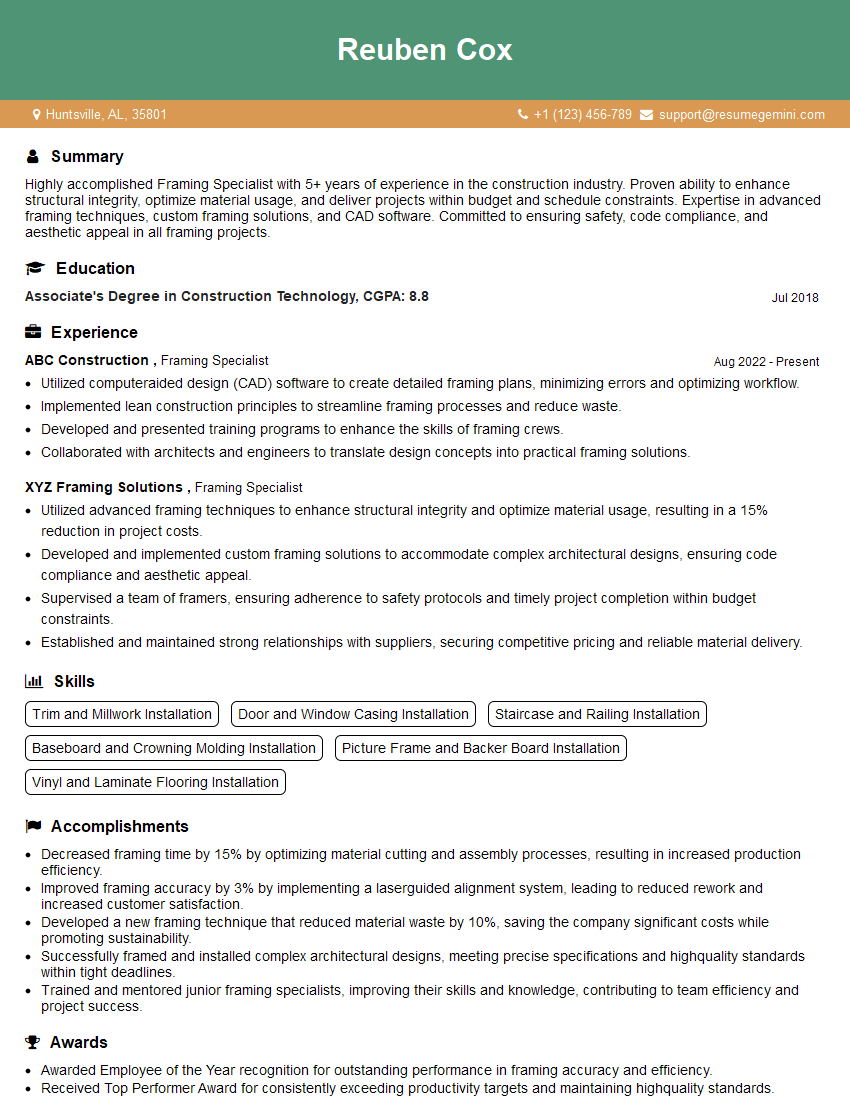
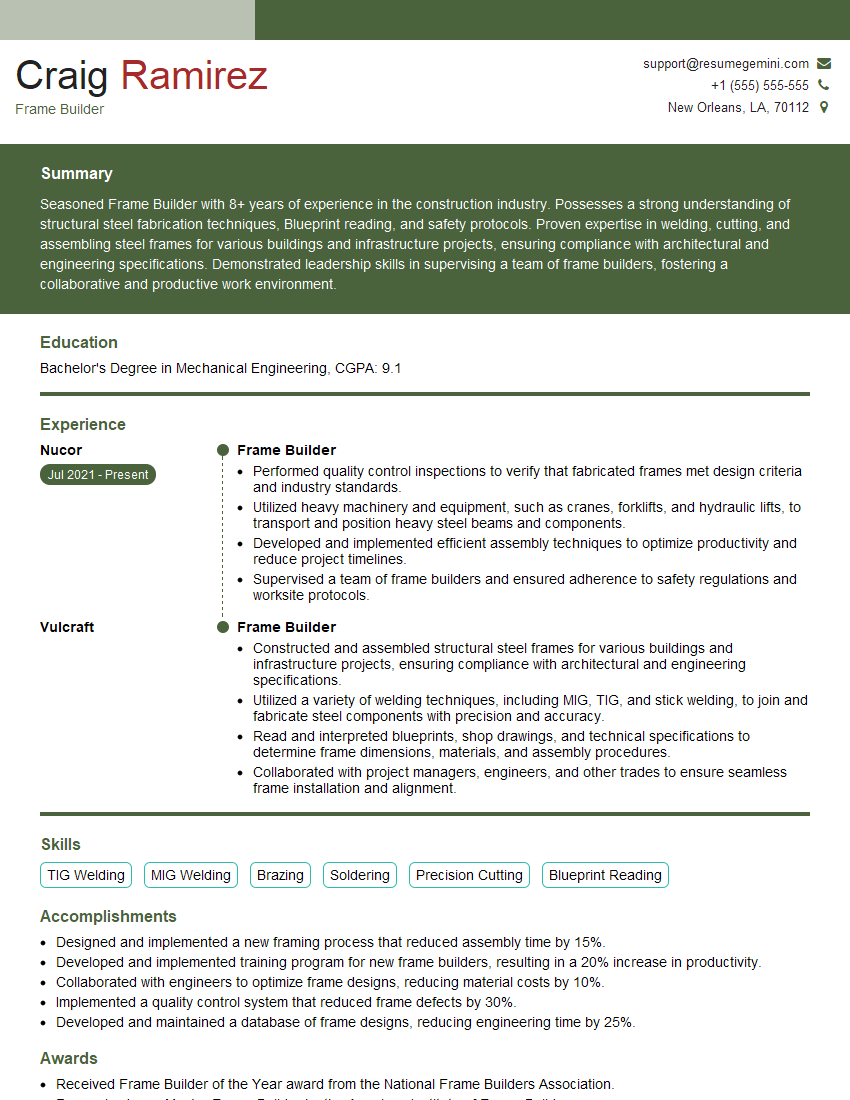
Mastering Frame Preparation is crucial for advancing your career in the field, opening doors to more specialized roles and higher earning potential. A well-crafted resume is your key to unlocking these opportunities. An ATS-friendly resume ensures your qualifications are effectively communicated to hiring managers and Applicant Tracking Systems. To significantly enhance your resume and increase your chances of securing an interview, leverage the power of ResumeGemini. ResumeGemini provides a user-friendly platform to create professional resumes, and we have examples specifically tailored to Frame Preparation available to help guide you.
Explore more articles
Users Rating of Our Blogs
Share Your Experience
We value your feedback! Please rate our content and share your thoughts (optional).
What Readers Say About Our Blog
Very informative content, great job.
good