Every successful interview starts with knowing what to expect. In this blog, we’ll take you through the top Fuel Cell Characterization interview questions, breaking them down with expert tips to help you deliver impactful answers. Step into your next interview fully prepared and ready to succeed.
Questions Asked in Fuel Cell Characterization Interview
Q 1. Explain the principles behind electrochemical impedance spectroscopy (EIS) and its application in fuel cell characterization.
Electrochemical Impedance Spectroscopy (EIS) is a powerful technique used to characterize the electrochemical processes within a fuel cell. It works by applying a small AC voltage perturbation to the fuel cell and measuring the resulting current response. This response is then analyzed in the frequency domain to determine the various resistive and capacitive elements within the fuel cell, representing different electrochemical processes.
Imagine it like gently tapping on a complex system and listening to its vibrations to understand its internal structure. Different frequencies reveal different aspects. Low frequencies reveal slower processes like mass transport, while higher frequencies reveal faster processes like charge transfer. The data is presented as a Nyquist plot (complex impedance plane plot) or a Bode plot (logarithmic plots of impedance magnitude and phase versus frequency). By fitting an equivalent circuit model to the experimental data, we can quantify parameters such as the charge transfer resistance (related to activation losses), the electrolyte resistance (related to ohmic losses), and the Warburg impedance (related to mass transport losses).
In fuel cell characterization, EIS helps identify the sources of performance limitations and monitor degradation over time. For instance, an increase in charge transfer resistance indicates catalyst degradation, while an increase in electrolyte resistance might signal membrane degradation or flooding.
Q 2. Describe different methods for measuring fuel cell performance, including polarization curves and power density curves.
Several methods are used to measure fuel cell performance, ultimately aiming to understand the relationship between current density (or power output) and cell voltage. The two most common are polarization curves and power density curves.
Polarization Curves: These curves plot the cell voltage (V) against the current density (I/A). They provide a comprehensive view of the voltage losses within the fuel cell across its operating range. Obtaining a polarization curve involves running the cell at different current densities and recording the corresponding voltage. Each point represents a steady-state condition.
Power Density Curves: These curves plot the power density (P/A = V*I/A) against the current density (I/A). They represent the power output per unit area of the fuel cell. The maximum power density is a crucial performance indicator, highlighting the optimal operating point of the cell.
Other techniques, less frequently used for routine characterization but equally important, include electrochemical surface area measurements and gas diffusion layer characterization. These approaches provide a deeper understanding of the underlying mechanisms impacting fuel cell performance.
Q 3. How do you analyze a polarization curve to determine the different losses in a fuel cell (activation, ohmic, concentration)?
Analyzing a polarization curve helps us understand the various losses occurring in a fuel cell. These losses are typically categorized into three main types: activation, ohmic, and concentration losses.
To determine these losses, we look at the shape of the polarization curve. The curve often exhibits three distinct regions:
Activation Polarization Region (High Voltage, Low Current Density): In this region, the voltage drop is steep. It results from the sluggish kinetics of the electrochemical reactions at the catalyst surface (activation overpotential). This loss can be reduced with improved catalyst materials.
Ohmic Polarization Region (Linear Region): This region is characterized by a linear drop in voltage with increasing current density. It represents the voltage loss due to the resistance of the cell components, including the electrolyte membrane, electrodes, and contact resistances (ohmic overpotential). The slope of this region is essentially the internal resistance of the cell.
Concentration Polarization Region (Steep Voltage Drop at High Current Densities): In this region, the voltage drops sharply due to limitations in the transport of reactants (fuel and oxidant) to the active sites and removal of products from the active sites. This signifies limitations in mass transport (concentration overpotential) within the cell.
By carefully analyzing the curve and using appropriate mathematical models (e.g., Tafel equation for the activation polarization), we can separate these losses and quantify their contributions to the overall cell voltage.
Q 4. What are the common degradation mechanisms in fuel cells, and how can they be characterized?
Fuel cells undergo various degradation mechanisms that limit their lifespan and performance. These mechanisms are complex and often intertwined.
Catalyst Degradation: This is a significant degradation mechanism involving the loss of active sites or changes in their activity, caused by particle aggregation, dissolution, or poisoning. Techniques such as transmission electron microscopy (TEM) and X-ray diffraction (XRD) are used to monitor catalyst particle size and structure.
Membrane Degradation: Degradation of the proton exchange membrane (PEM) leads to reduced proton conductivity and increased permeability to gases. Methods like water uptake measurements and gas permeability measurements can quantify membrane degradation.
Electrode Degradation: This involves changes in the electrode structure and properties, often related to corrosion, flooding, or carbon support corrosion. Techniques such as scanning electron microscopy (SEM) and electrochemical impedance spectroscopy (EIS) are useful here.
Other Degradation Mechanisms: These include chemical attack of cell components, mechanical stress on the cell, and contamination.
The characterization methods used are highly dependent on the specific degradation mechanism and often require a combination of techniques. Accelerated stress tests, such as high humidity or high temperature cycling, are also employed to quickly assess the degradation rate.
Q 5. Explain the difference between proton exchange membrane (PEM) fuel cells and solid oxide fuel cells (SOFCs).
PEM fuel cells and SOFCs are two major types of fuel cells that differ significantly in their operating temperatures and the materials used. The core differences are summarized as follows:
Operating Temperature: PEM fuel cells operate at relatively low temperatures (typically below 100°C), while SOFCs operate at high temperatures (typically between 600°C and 1000°C).
Electrolyte: PEM fuel cells use a polymer electrolyte membrane (typically Nafion) that conducts protons. SOFCs use a solid oxide ceramic electrolyte that conducts oxide ions.
Electrodes: PEM fuel cells typically use platinum-based catalysts, while SOFCs typically use mixed oxide electrodes (e.g., nickel/yttria-stabilized zirconia).
Advantages and Disadvantages: PEM fuel cells offer faster startup times and higher power densities at low temperatures but often suffer from catalyst degradation. SOFCs, while exhibiting better fuel flexibility and higher efficiency at high temperatures, require longer start-up times and deal with material compatibility issues at such elevated temperatures.
In essence, the choice between PEM and SOFC depends heavily on the application, considering factors such as operating temperature, efficiency, cost, and durability requirements.
Q 6. How do you measure the hydrogen crossover in a PEM fuel cell?
Hydrogen crossover in a PEM fuel cell refers to the diffusion of hydrogen gas from the anode to the cathode through the PEM. This is undesirable because it reduces the cell’s efficiency and can lead to cathode catalyst poisoning. Measuring this crossover typically involves several methods.
Open Circuit Voltage (OCV) Measurement: Measuring the OCV under conditions where the fuel cell is not producing current can reveal hydrogen crossover. A lower OCV than expected suggests the presence of hydrogen at the cathode reducing the potential difference.
Gas Chromatography (GC): A more accurate method, GC can directly analyze the gases present at the cathode to determine the amount of hydrogen that has crossed over.
Electrochemical Methods: Specialized electrochemical techniques can indirectly assess the crossover by monitoring the current generated at the cathode when only hydrogen is present at the anode.
The choice of method depends on the desired accuracy and available resources. Open-circuit voltage measurements provide a quick estimate, while gas chromatography offers a more precise and direct quantification of the hydrogen crossover.
Q 7. Describe the techniques used to characterize the catalyst layer in a fuel cell.
The catalyst layer is crucial for the fuel cell’s performance. Characterizing it requires techniques that probe its physical and electrochemical properties. Common techniques include:
Transmission Electron Microscopy (TEM): TEM provides high-resolution images of the catalyst layer, allowing the observation of catalyst particle size, distribution, and morphology. This helps to assess the effectiveness of the catalyst dispersion and understand any potential degradation processes such as agglomeration.
X-ray Diffraction (XRD): XRD determines the crystalline structure and phase composition of the catalyst particles, helping to identify any phase changes or impurities.
Scanning Electron Microscopy (SEM): SEM provides lower resolution images compared to TEM, but is useful for analyzing the overall structure of the catalyst layer and its interaction with the support materials.
Electrochemical Techniques: These include cyclic voltammetry (CV), which measures the electrochemical surface area of the catalyst, and EIS, which helps to determine the charge transfer resistance of the catalyst layer.
The choice of technique often depends on the specific aspects of the catalyst layer that need to be characterized. A combination of methods is often employed to obtain a complete picture.
Q 8. How do you determine the active surface area of a fuel cell catalyst?
Determining the active surface area (ASA) of a fuel cell catalyst is crucial for understanding its performance. A higher ASA generally translates to more catalytic sites available for the electrochemical reactions, leading to improved fuel cell efficiency. We primarily use electrochemical techniques to measure ASA. The most common method is cyclic voltammetry (CV) using an underpotential deposition (UPD) of a metal monolayer, often copper or lead on platinum.
In a typical CV experiment, we cycle the potential of the catalyst electrode in an electrolyte containing the UPD metal ions. The charge associated with the oxidation of the deposited monolayer is directly proportional to the electrochemically active surface area. We can calculate the ASA using the following formula: ASA = Q / (n * F * Γ) where Q is the charge passed (Coulombs), n is the number of electrons transferred per adsorbed atom, F is Faraday’s constant, and Γ is the surface concentration of the UPD metal monolayer (moles/cm²).
Another method involves using CO stripping voltammetry. Here, we adsorb CO on the platinum catalyst and then oxidize it using a potential sweep. The charge associated with the CO oxidation is proportional to the Pt surface area.
The choice of method depends on the catalyst material and the specific information needed. For instance, CO stripping is useful for Pt-based catalysts, while UPD is more versatile.
Q 9. What are the challenges associated with characterizing fuel cell performance under different operating conditions (temperature, pressure, humidity)?
Characterizing fuel cell performance under varying operating conditions is essential for optimizing design and predicting real-world behavior. Challenges arise because changes in temperature, pressure, and humidity significantly impact various fuel cell processes. For example, increased temperature can enhance reaction kinetics but also lead to increased water evaporation and catalyst degradation.
Temperature variations affect reaction rates (Arrhenius equation), water management (vapor pressure), and membrane conductivity. Pressure changes impact gas solubility and diffusion, altering reactant supply to the catalyst layer. Humidity variations directly influence membrane hydration, impacting ionic conductivity. An insufficiently hydrated membrane exhibits high resistance, while over-hydration can lead to flooding, hindering gas diffusion.
These challenges are tackled through meticulous experimental design and sophisticated data analysis. This often requires controlled environmental chambers capable of precisely regulating temperature, pressure, and humidity. Detailed characterization necessitates a comprehensive understanding of mass transport, electrochemical kinetics, and the interplay of various fuel cell components under diverse operating conditions.
Q 10. Explain the importance of gas diffusion layers (GDLs) and how their properties affect fuel cell performance.
Gas Diffusion Layers (GDLs) are porous structures that play a vital role in fuel cell performance. They act as a bridge, facilitating the transport of reactant gases (H2 and O2) to the catalyst layer and removing reaction products (H2O).
Properties affecting performance include:
- Porosity: High porosity ensures efficient gas diffusion. However, excessively high porosity may compromise mechanical strength.
- Thickness: Optimum thickness balances gas transport efficiency with mechanical stability. Too thick a GDL increases diffusion resistance.
- Hydrophobicity: The hydrophobic nature of the GDL helps remove water from the catalyst layer, preventing flooding. Hydrophobicity is usually imparted through PTFE treatment.
- In-plane conductivity: Efficient electron conduction within the GDL is necessary for uniform current distribution across the catalyst layer.
- Through-plane conductivity: This determines the electron transport from the catalyst layer to the bipolar plate. A low through-plane conductivity leads to ohmic losses.
Poor GDL properties can lead to several issues, including mass transport limitations, flooding of the catalyst layer, and increased ohmic resistance, ultimately reducing fuel cell performance and efficiency. In summary, the GDL is not just a passive structural component; its properties must be meticulously controlled to achieve optimal fuel cell operation.
Q 11. How do you characterize the water management in a PEM fuel cell?
Water management is critical for PEMFC performance, as the membrane needs to be sufficiently hydrated for optimal proton conductivity but not so much as to flood the catalyst layers. Characterizing water management involves several techniques:
- Electrochemical Impedance Spectroscopy (EIS): EIS can be used to monitor membrane hydration by analyzing changes in the impedance spectra as a function of humidity and current density. Increased membrane resistance indicates insufficient hydration.
- Gas flow analysis: Measuring the water content in the outlet gas streams provides an indication of water production and transport within the fuel cell.
- Direct observation: Techniques like microscopy (optical or scanning electron microscopy) allow direct visualization of water distribution and accumulation within the fuel cell, especially in the catalyst layers and GDL.
- Current-Voltage curves at different humidities: By comparing polarization curves at different humidity levels, we can assess the impact of water content on cell performance. A decrease in performance at lower humidities suggests inadequate hydration.
Advanced techniques, including neutron imaging, provide a three-dimensional visualization of water distribution within the operating cell, offering valuable insights into water management under dynamic conditions.
Q 12. Describe the methods used to analyze the durability and lifetime of fuel cells.
Characterizing fuel cell durability and lifetime requires subjecting the cell to accelerated stress tests that mimic long-term operation. These tests accelerate degradation mechanisms, allowing for quicker assessments of lifetime.
Common methods include:
- Potential cycling: Repeated potential cycling between two limits accelerates degradation by inducing mechanical stresses and chemical changes on the catalyst surface.
- Start-stop cycling: Repeated start-stop cycles mimic real-world operation and highlight degradation related to rapid changes in operating conditions.
- Constant current/voltage operation: Operating the fuel cell at a constant current or voltage for extended durations reveals degradation over time.
- Load cycling: Variable load cycling simulates dynamic operation conditions and highlights degradation associated with power fluctuations.
Post-test characterization techniques such as microscopy, X-ray diffraction (XRD), and X-ray photoelectron spectroscopy (XPS) are essential for analyzing the morphological and chemical changes in the cell components after stress testing. Data from these analyses helps to pinpoint the major degradation mechanisms affecting long-term performance. The results from these experiments are then used to develop models that predict the fuel cell’s lifespan under various operating conditions.
Q 13. What is the significance of using different reference electrodes in fuel cell characterization?
Different reference electrodes are used in fuel cell characterization to establish a stable and well-defined potential reference point. The choice of reference electrode significantly impacts the accuracy and interpretability of the electrochemical measurements. It’s crucial to select a reference electrode that remains stable and consistent across the experimental conditions.
Common choices include:
- Reversibly Hydrogen Electrode (RHE): This electrode is often considered the most appropriate for fuel cell studies because its potential is directly related to the hydrogen partial pressure and is independent of pH. It is the most common standard for fuel cell studies.
- Saturated Calomel Electrode (SCE): This is a simple and readily available reference electrode, but its potential is pH dependent and less suitable for higher temperature applications.
- Ag/AgCl electrode: Relatively easy to use but the potential is also pH dependent. Its applications are limited by the temperature.
The selection depends on the experimental conditions (temperature, electrolyte, etc.). Using an inappropriate reference electrode can lead to inaccurate potential measurements and misinterpretation of the electrochemical data. Using the correct electrode is critical for achieving reliable and comparable results across different studies.
Q 14. How do you interpret cyclic voltammetry (CV) data from a fuel cell electrode?
Cyclic voltammetry (CV) provides valuable insights into the electrochemical behavior of a fuel cell electrode. The CV curve displays the current response as a function of applied potential as the potential is scanned back and forth between two limits.
Interpreting CV data involves identifying key features:
- Hydrogen adsorption/desorption region: In Pt-based catalysts, the peaks in the low potential region (typically 0.05–0.4 V vs. RHE) represent hydrogen adsorption and desorption processes on the Pt surface. The integrated charge under these peaks is proportional to the electrochemically active surface area (ECSA).
- Oxygen reduction region: The current at potentials above 0.6 V vs. RHE represents the oxygen reduction reaction (ORR). The onset potential and current density provide information about the catalytic activity towards oxygen reduction.
- Redox peaks: Peaks corresponding to oxidation and reduction of certain metal oxides or other electroactive species can also be observed, providing information about their electrochemical behavior and the overall electrocatalytic process.
- Double-layer charging: The non-faradaic current observed at potentials where no major faradaic reactions occur reflects the double-layer capacitance. The slope of the current at those potentials is approximately proportional to the surface area of the electrode.
By analyzing these features, we can assess the electrocatalytic activity, surface area, and the overall electrochemical behavior of the fuel cell electrode. A well-defined CV curve, with sharp peaks, suggests a high surface area and good catalytic activity. Broad or ill-defined peaks suggest poor electrocatalytic properties or surface poisoning.
Q 15. Explain the concept of fuel cell stack modeling and its applications.
Fuel cell stack modeling involves creating mathematical representations of a fuel cell stack’s behavior to predict its performance under various operating conditions. Think of it like a virtual twin of your physical fuel cell. This allows researchers and engineers to optimize design parameters, explore different operating strategies, and troubleshoot problems without the need for extensive and expensive experimental testing.
Applications are diverse. For instance, we can use modeling to predict the impact of temperature changes on voltage output, optimize the flow of reactants (hydrogen and oxygen), or study the effects of different membrane materials on overall efficiency. In the design phase, modeling helps determine the optimal number of cells in a stack for a given power output, ensuring size and weight are minimized for applications like electric vehicles. Furthermore, it assists in predicting the long-term degradation of the fuel cell, which is critical for determining its lifespan and maintenance schedules. For example, I once used a model to identify an unexpected pressure drop in a specific section of a fuel cell stack that couldn’t be easily detected experimentally. The model helped pinpoint a design flaw, ultimately leading to a more robust and efficient design.
Career Expert Tips:
- Ace those interviews! Prepare effectively by reviewing the Top 50 Most Common Interview Questions on ResumeGemini.
- Navigate your job search with confidence! Explore a wide range of Career Tips on ResumeGemini. Learn about common challenges and recommendations to overcome them.
- Craft the perfect resume! Master the Art of Resume Writing with ResumeGemini’s guide. Showcase your unique qualifications and achievements effectively.
- Don’t miss out on holiday savings! Build your dream resume with ResumeGemini’s ATS optimized templates.
Q 16. What are the key performance indicators (KPIs) used to evaluate fuel cell performance?
Key Performance Indicators (KPIs) for fuel cells center around efficiency, power density, and durability.
- Voltage (V): The electrical potential difference between the anode and cathode. Lower voltage than expected indicates issues with reactant flow or internal resistances.
- Current Density (A/cm²): The current produced per unit area of the electrode. This directly relates to power output.
- Power Density (W/cm²): The product of voltage and current density, representing the power output per unit area. Higher power density is crucial for compact applications.
- Efficiency (%): The ratio of electrical energy produced to the energy content of the fuel consumed. This measures how well the fuel cell converts chemical energy to electricity.
- Durability/Stability: Measured by the rate of voltage degradation over time, often under specific operating conditions. This indicates the longevity of the fuel cell.
Understanding these KPIs provides a comprehensive assessment of a fuel cell’s performance, revealing areas needing improvement.
Q 17. How do you handle experimental errors and uncertainties in fuel cell characterization?
Experimental errors and uncertainties are inherent in fuel cell characterization. We mitigate them through a multi-pronged approach.
- Careful experimental design: This includes using well-calibrated instruments, controlling environmental variables (temperature, humidity, pressure), and employing statistically sound experimental designs to minimize random errors.
- Multiple measurements and statistical analysis: Repeating measurements and employing statistical methods (e.g., calculating mean, standard deviation, and confidence intervals) helps quantify uncertainties and identify outliers.
- Error propagation analysis: We acknowledge that errors in individual measurements propagate through calculations. Error bars on graphs visually represent this uncertainty.
- Calibration and verification: Regular calibration of equipment ensures accuracy, while comparing results with established standards or literature values validates our measurements. For example, checking the hydrogen flow rate with a secondary flow meter minimizes measurement uncertainties.
By systematically addressing these aspects, we enhance the reliability and validity of our characterization results.
Q 18. Describe different techniques for characterizing the microstructure of fuel cell components.
Several techniques reveal the microstructure of fuel cell components, crucial for understanding performance and degradation mechanisms.
- Scanning Electron Microscopy (SEM): Provides high-resolution images of the surface morphology and cross-section of materials like electrodes and membranes, revealing pore size distributions, particle size, and catalyst dispersion.
- Transmission Electron Microscopy (TEM): Offers even higher resolution imaging, allowing visualization of the nanoscale structure of catalysts, providing insights into their activity and durability.
- X-ray Diffraction (XRD): Identifies the crystalline phases present in the materials, crucial for understanding the composition and structure of the catalyst and support materials.
- Energy-Dispersive X-ray Spectroscopy (EDS): Provides elemental mapping, revealing the distribution of elements within the material, crucial for understanding catalyst composition and uniformity.
- Focused Ion Beam (FIB): Allows for precise milling and site-specific cross-sectioning for high-resolution imaging in SEM or TEM, offering detailed information about interfaces.
The choice of technique depends on the specific information needed, with many research projects employing a combination of these for comprehensive characterization.
Q 19. What software and tools are commonly used for data acquisition and analysis in fuel cell characterization?
Data acquisition and analysis in fuel cell characterization rely on specialized software and tools.
- Data acquisition systems: These systems automate the collection of data from various sensors, including voltage, current, temperature, pressure, and flow rate. Examples include LabVIEW and DasyLab.
- Electrochemical impedance spectroscopy (EIS) software: Software packages like ZView and Nova are essential for analyzing EIS data to understand the impedance of different components within the fuel cell.
- Image analysis software: Software like ImageJ is used to quantify the microstructure features obtained from SEM or TEM images.
- Statistical software: Packages like R or MATLAB facilitate statistical analysis and error propagation calculations.
These tools are integral to handling large datasets, processing the data effectively and performing in-depth analysis to obtain meaningful results.
Q 20. How would you troubleshoot a fuel cell that is not performing optimally?
Troubleshooting a poorly performing fuel cell involves a systematic approach.
- Review operating parameters: Check for deviations from optimal operating conditions, such as temperature, pressure, and reactant flow rates. Unexpected pressure drops can easily point toward leaks, for example.
- Analyze voltage-current curves (polarization curves): These curves reveal performance limitations. A significant drop in voltage at low current densities suggests high internal resistance, while a sharp drop at high currents may indicate mass transport limitations.
- Perform Electrochemical Impedance Spectroscopy (EIS): EIS helps pinpoint the source of high internal resistance, identifying issues within the membrane, electrodes, or current collectors.
- Inspect fuel cell components: Visual inspection may reveal physical damage, contamination, or flooding. Microstructural analysis can further pinpoint the cause of performance degradation.
- Check for leaks: Leaks in the system will drastically affect performance. A simple pressure test can identify leaks in the system.
This systematic investigation, combining experimental measurements with analytical tools, identifies the root cause of the problem, allowing for effective remediation.
Q 21. Explain your experience with various fuel cell testing protocols and standards.
My experience encompasses various fuel cell testing protocols and standards, including ISO, ASTM, and DOE standards. I’m familiar with protocols for evaluating performance, durability, and long-term degradation. This includes designing and executing tests following standardized procedures, such as protocol for measuring power density and efficiency under varying conditions. I’ve also participated in the development of in-house testing procedures to address specific research questions. For example, in one project, we customized a protocol to assess the performance of fuel cells under high-humidity conditions, crucial for certain applications. A strong understanding of these standards is vital for ensuring the reliability, reproducibility, and comparability of fuel cell testing data.
Q 22. How do you ensure the reproducibility and accuracy of fuel cell measurements?
Reproducibility and accuracy in fuel cell measurements are paramount for reliable data and meaningful comparisons. This involves meticulous attention to detail throughout the entire experimental process, from cell fabrication to data acquisition and analysis.
- Standardized Procedures: We strictly adhere to established protocols for cell preparation, including precise control over membrane electrode assembly (MEA) fabrication, catalyst loading, and gas flow rates. Any deviation is meticulously documented.
- Calibration and Instrumentation: Regular calibration of all instruments – including mass flow controllers, potentiostats, and gas analyzers – is crucial. We use traceable standards and maintain detailed calibration logs. For example, we calibrate our potentiostat using a known resistor and verify the accuracy of our gas analyzers with certified gas mixtures.
- Environmental Control: Environmental factors like temperature and humidity can significantly influence fuel cell performance. We maintain a stable and controlled environment within our testing chamber, and all environmental parameters are monitored and recorded.
- Data Acquisition and Analysis: We employ robust data acquisition systems and utilize appropriate statistical methods to analyze the results. This includes identifying and mitigating outliers, performing error analysis, and reporting uncertainties. We might, for instance, use linear regression with error bars to represent polarization curves.
- Blind Testing (where applicable): In some cases, particularly when evaluating new materials or designs, blind testing is used to minimize bias. This ensures the objectivity of the results.
By implementing these measures, we can confidently ensure the reproducibility and accuracy of our fuel cell measurements, enabling reliable comparisons across different experiments and facilitating the development of improved fuel cell technologies.
Q 23. Discuss your experience with different types of fuel cells (e.g., PEMFC, SOFC, DMFC).
My experience encompasses a broad range of fuel cell types, including Proton Exchange Membrane Fuel Cells (PEMFCs), Solid Oxide Fuel Cells (SOFCs), and Direct Methanol Fuel Cells (DMFCs). Each type presents unique challenges and opportunities.
- PEMFCs: I’ve extensively worked with PEMFCs, focusing on their characterization under various operating conditions and the impact of different catalyst materials on their performance. A recent project involved optimizing the water management in PEMFC stacks to improve efficiency and durability.
- SOFCs: My SOFC experience involves high-temperature testing and characterization. I’ve contributed to studies exploring the long-term stability and degradation mechanisms of SOFCs, particularly focusing on the impact of thermal cycling and redox cycling on performance. The intricacies of high-temperature operation and the need for specialized instrumentation are a key part of SOFC characterization.
- DMFCs: I’ve investigated the methanol crossover effect in DMFCs and its influence on cell performance. This involved employing electrochemical impedance spectroscopy (EIS) and advanced modeling techniques to understand the underlying transport phenomena. The challenge here lies in minimizing methanol crossover while maximizing power output.
This diverse experience allows me to approach fuel cell characterization with a holistic perspective, appreciating the strengths and limitations of each technology.
Q 24. Describe the challenges and opportunities in the field of fuel cell characterization.
The field of fuel cell characterization faces numerous challenges, but also presents exciting opportunities.
- Challenges:
- Accelerated Degradation Testing: Developing accurate and reliable accelerated stress tests to predict the long-term durability of fuel cells remains a significant hurdle.
- In-situ Diagnostics: Observing and quantifying the complex processes occurring within a fuel cell during operation is challenging. This requires sophisticated in-situ techniques.
- Standardization: The lack of standardized test protocols can make comparing results from different research groups difficult.
- Opportunities:
- Advanced Characterization Techniques: Techniques like neutron imaging, X-ray tomography, and advanced spectroscopy provide insights into fuel cell operation at a level previously impossible.
- Data-driven Modeling: Integrating experimental data with sophisticated models allows for a more predictive understanding of fuel cell performance and durability.
- Artificial Intelligence (AI): AI can accelerate the analysis of large datasets, automate experimental design, and improve the predictive capabilities of fuel cell models.
Addressing these challenges and exploiting these opportunities is key to advancing fuel cell technology and bringing it closer to widespread adoption.
Q 25. Explain how advanced characterization techniques like in-situ techniques enhance our understanding of fuel cell processes.
In-situ characterization techniques offer a significant advantage over ex-situ methods by allowing real-time observation of fuel cell processes under actual operating conditions. This provides a far more comprehensive understanding of the complex interactions within the fuel cell.
- Electrochemical Impedance Spectroscopy (EIS): EIS provides information about the various electrochemical processes within the fuel cell, such as charge transfer, mass transport, and ohmic resistance, as a function of frequency. By analyzing the impedance spectra, we can identify performance bottlenecks and understand the effects of operating parameters.
- Operando Spectroscopy (e.g., X-ray Absorption Spectroscopy – XAS): These techniques allow us to probe the electronic and structural changes in the catalyst during operation. For example, XAS can reveal changes in the oxidation state and coordination environment of catalyst nanoparticles, shedding light on their activity and durability.
- Neutron Imaging: Neutron imaging enables non-destructive visualization of water distribution within the fuel cell, which is crucial for understanding water management. This can reveal issues like flooding or drying that impact performance.
By combining several in-situ techniques, we can build a more complete picture of the complex interplay between the different components and processes within a fuel cell, ultimately leading to improved designs and enhanced performance.
Q 26. How do you interpret and report your findings from fuel cell characterization experiments?
Interpreting and reporting findings from fuel cell characterization experiments requires a rigorous and systematic approach.
- Data Analysis: The raw data is processed and analyzed using appropriate statistical tools, including error analysis and uncertainty quantification. This usually involves creating polarization curves, power density curves, and impedance spectra.
- Visualization: Key findings are presented using clear and concise graphs and tables, highlighting trends and patterns. For instance, polarization curves clearly show the impact of different operating parameters on the cell voltage.
- Discussion: The results are discussed in the context of the existing literature, highlighting the significance of the findings and relating them to the underlying physical and chemical processes. We carefully explain discrepancies and limitations of our methodology.
- Reporting: The results are presented in a structured and standardized format, including detailed experimental methods, data tables, figures, and a clear and concise summary of the conclusions and their implications. This may include peer-reviewed publications, conference presentations, or internal reports.
Transparency and reproducibility are crucial aspects of reporting. We ensure that all experimental details, data processing methods, and uncertainties are clearly documented so that other researchers can reproduce our results and build upon our work. We aim to present our findings in a way that is accessible to a broad audience, even those outside our immediate field.
Q 27. Describe your experience with working in a laboratory environment and following safety protocols.
I have extensive experience working in a laboratory environment, adhering strictly to all safety protocols. Safety is my utmost priority.
- Handling Hazardous Materials: I’m proficient in the safe handling of corrosive chemicals, flammable gases (like hydrogen), and high-voltage equipment. I always follow established safety procedures, wear appropriate personal protective equipment (PPE), and work under the supervision of qualified personnel when necessary.
- Emergency Procedures: I’m familiar with emergency procedures, including the proper use of safety showers, eyewash stations, and fire extinguishers. I’ve completed relevant safety training and certifications.
- Equipment Maintenance: I understand the importance of proper equipment maintenance to prevent accidents and ensure accurate measurements. I regularly inspect equipment for any signs of damage or malfunction and report any issues immediately.
- Waste Disposal: I am knowledgeable about the proper disposal of hazardous waste, adhering to all environmental regulations. I am careful to properly label and handle all waste materials according to established procedures.
My commitment to safety extends beyond individual precautions. I proactively participate in safety discussions and contribute to the creation of a safe and productive working environment for my colleagues.
Q 28. What are your future goals and aspirations in the field of fuel cell technology?
My future goals center around pushing the boundaries of fuel cell technology and contributing to a sustainable energy future.
- Advanced Materials Development: I aim to contribute to the development and characterization of novel catalyst materials, membranes, and other components to enhance fuel cell performance, durability, and cost-effectiveness. This involves exploring new material systems and synthesizing tailored nanostructures for optimal catalytic activity.
- In-situ Characterization Advancement: I’m eager to explore and implement advanced in-situ and operando characterization techniques to gain deeper insights into fuel cell degradation mechanisms and optimize operation parameters. This includes developing novel experimental setups and adapting advanced spectroscopic techniques.
- Data-Driven Modeling & AI Integration: I want to integrate AI and machine learning into the design and optimization of fuel cells. This involves developing robust predictive models that accurately simulate fuel cell performance and guide the development of new materials and designs.
- Commercialization of Fuel Cell Technology: Ultimately, I aspire to contribute to the successful commercialization of fuel cell technologies, enabling their widespread adoption in various applications, such as transportation and stationary power generation.
I believe that fuel cells offer a promising pathway towards a decarbonized energy system, and I am passionate about contributing to its realization.
Key Topics to Learn for Fuel Cell Characterization Interview
- Electrochemical Fundamentals: Understanding electrochemical kinetics, electrode processes (e.g., oxygen reduction reaction, hydrogen oxidation reaction), and Nernst equation application in fuel cell analysis.
- Polarization Curves and Analysis: Interpreting polarization curves to identify activation, ohmic, and concentration losses. Practical application involves diagnosing performance limitations and suggesting improvements.
- Electrochemical Impedance Spectroscopy (EIS): Understanding the principles of EIS and its application in characterizing fuel cell components. This includes analyzing Nyquist and Bode plots to determine resistances and capacitances.
- Fuel Cell Materials: Knowledge of different catalyst materials (e.g., platinum, platinum alloys), membrane electrode assemblies (MEAs), and their impact on fuel cell performance and durability. Practical application involves material selection and optimization strategies.
- Gas Chromatography (GC) and Mass Spectrometry (MS): Understanding the application of these techniques in analyzing fuel cell effluent streams to determine gas composition and identify potential issues.
- Durability and Degradation Mechanisms: Analyzing degradation mechanisms such as catalyst poisoning, membrane degradation, and flooding, and their impact on long-term performance. Problem-solving approaches involve mitigating these issues through material selection and operating parameter optimization.
- Data Analysis and Modeling: Proficiency in analyzing experimental data, developing mathematical models to represent fuel cell behavior, and validating models against experimental results.
- Fuel Cell Types and Applications: Familiarity with different fuel cell types (PEMFC, SOFC, etc.) and their applications in various sectors (e.g., transportation, stationary power generation).
Next Steps
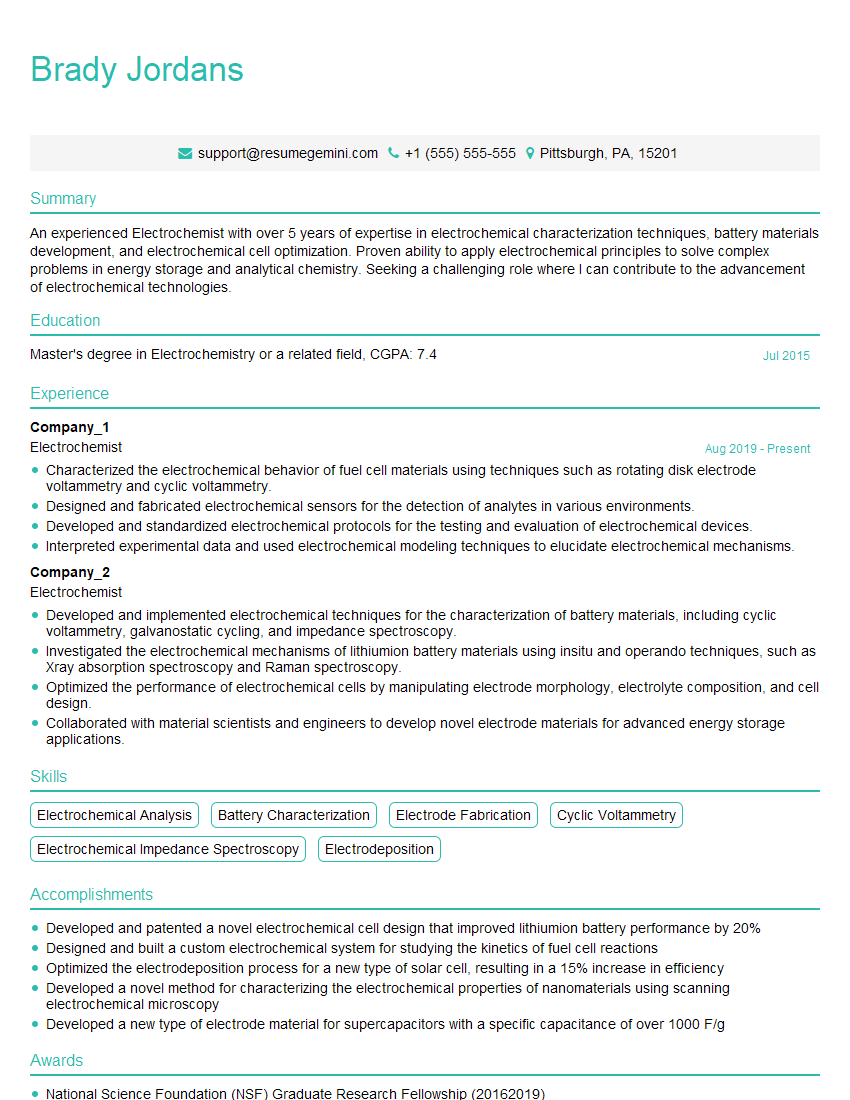
Mastering Fuel Cell Characterization is crucial for a successful and rewarding career in this rapidly growing field. A strong understanding of these concepts opens doors to exciting opportunities in research, development, and engineering. To maximize your job prospects, create an ATS-friendly resume that highlights your skills and experience effectively. ResumeGemini is a trusted resource for building professional resumes that stand out. Leverage their expertise to craft a compelling narrative that showcases your qualifications. Examples of resumes tailored to Fuel Cell Characterization are available to help you get started.



Explore more articles
Users Rating of Our Blogs
Share Your Experience
We value your feedback! Please rate our content and share your thoughts (optional).
What Readers Say About Our Blog
Very informative content, great job.
good