Interviews are more than just a Q&A session—they’re a chance to prove your worth. This blog dives into essential Furniture Polishing interview questions and expert tips to help you align your answers with what hiring managers are looking for. Start preparing to shine!
Questions Asked in Furniture Polishing Interview
Q 1. What types of wood finishes are you familiar with?
I’m familiar with a wide range of wood finishes, each offering unique aesthetic and protective qualities. These include:
- Shellac: A natural resin finish, prized for its warm glow and buildable layers. It’s relatively easy to repair, making it a favorite for antique restoration. Think of the rich, lustrous finish on a finely crafted Victorian chair.
- Lacquer: A fast-drying, hard finish available in various sheens. It’s durable and resistant to scratches, but can be more challenging to repair than shellac. Modern furniture often utilizes lacquer for its protective properties and ease of application.
- Varnish: A durable protective coating made from resins dissolved in a solvent. Varnish offers excellent protection against moisture and wear, often found on outdoor furniture or heavily used pieces. The range of finishes from glossy to satin makes it versatile.
- Polyurethane: A synthetic finish known for its exceptional durability and water resistance. It’s common in contemporary furniture and offers a wide variety of sheen options. A durable finish like this is vital for high-traffic areas like dining tables.
- Oil finishes (e.g., linseed oil, tung oil): These penetrate the wood, enhancing its natural beauty and providing a protective layer. They offer a more natural, less glossy finish and are easy to maintain with occasional reapplication. These are great for pieces where you want to see the natural grain of the wood.
Q 2. Describe your experience with French polishing.
French polishing is a time-honored technique that yields an incredibly smooth, high-gloss finish. It involves applying multiple thin layers of shellac using a pad and rubbing the surface continuously to achieve a flawless, glass-like sheen. My experience encompasses working on everything from delicate antique bureaus to larger pieces of furniture. The process requires patience and a steady hand; it’s like painting with a tiny, perfectly controlled brush. I’ve had to troubleshoot issues like orange peel (uneven application) and build up of shellac, using appropriate solvents to correct the issue while maintaining the integrity of the piece. I particularly enjoy the challenge of restoring highly damaged pieces using French polishing, bringing them back to their original glory.
Q 3. How do you prepare a surface for polishing?
Surface preparation is crucial for a successful polish. It’s like preparing a canvas before painting. The steps generally include:
- Cleaning: Thoroughly cleaning the surface with a suitable cleaner, removing dust, dirt, grease, and old wax. I often use a combination of gentle soap and water, followed by a thorough rinse and drying.
- Repairing: Addressing any imperfections like scratches, dents, or cracks. This may involve filling with wood filler, wood glue, or other appropriate materials depending on the severity of the damage.
- Sanding: Carefully sanding the surface, progressing through progressively finer grits of sandpaper (e.g., 120, 180, 220, 320 grit) to create a smooth, even surface. This step should be done meticulously to avoid uneven sanding and ensure the final finish is flawlessly smooth.
- Dusting: Removing all sanding dust using a tack cloth or soft brush. Any remaining dust will show up in the final finish, resulting in imperfections.
Q 4. What are the different types of abrasives used in furniture polishing?
Abrasives are essential for smoothing and preparing surfaces before polishing. I use a variety of abrasives, chosen based on the specific wood and the desired finish:
- Sandpaper: Available in various grits, from coarse to fine. Coarse grit is used for initial smoothing, while finer grits are used for final refinement. I often use a sanding block for even pressure.
- Steel wool: Provides a finer level of abrasion than sandpaper, ideal for final smoothing and cleaning before polishing. Different grades of steel wool exist for varying degrees of abrasiveness.
- Abrasive pads: These are useful for achieving a specific level of smoothness or for working in tight corners or on intricately carved details. These can be abrasive felt or other specialized pads.
- Pumice powder and rottenstone: These fine abrasives are used in the final stages of polishing to achieve an ultra-smooth surface before applying the final finish.
Q 5. Explain the process of removing old varnish or lacquer.
Removing old varnish or lacquer requires careful consideration to avoid damaging the underlying wood. My approach often involves:
- Testing: Testing the effectiveness of various removal methods in an inconspicuous area. Different finishes react differently to different solvents or methods.
- Chemical Strippers: Using a chemical stripper following the manufacturer’s instructions carefully. This often involves applying the stripper, allowing it to work, and then scraping off the softened finish. I always ensure adequate ventilation and wear appropriate safety gear.
- Mechanical Removal: In some cases, I use careful scraping with a plastic scraper or sanding with low-grit sandpaper. This is a more labor-intensive method, but it’s less aggressive than chemical strippers and is ideal for delicate pieces. This approach needs patience and a light touch to avoid damaging the surface.
- Heat Gun (with caution): A heat gun can soften varnish or lacquer, making it easier to scrape away. However, this method requires extreme caution to avoid burning or scorching the wood. This is best employed with experience and careful monitoring.
After removal, thorough cleaning and sanding are necessary to prepare the surface for refinishing.
Q 6. How do you identify different types of wood?
Identifying different types of wood involves a combination of visual inspection and sometimes, more advanced techniques. Key characteristics to look for include:
- Grain pattern: The arrangement of wood fibers, which varies significantly between species. Straight grain is common in many hardwoods like maple, whereas curly or figured grain patterns are characteristic of species like maple burl or quilted maple.
- Color and tone: Wood color ranges widely from light (e.g., ash) to dark (e.g., ebony). The presence of heartwood and sapwood can also affect color. Even slight variations in color can indicate the type of wood.
- Texture: Some woods are smooth (e.g., cherry), while others are more coarse (e.g., oak). The feel of the wood can offer clues to its identity.
- Odor: Some woods have distinctive smells; for example, cedar has a strong, pleasant aroma.
- Density and Hardness: More dense woods tend to be harder. Testing this can be informative but requires experience and appropriate tools.
In more complex cases, advanced testing techniques like microscopic examination may be necessary.
Q 7. What safety precautions do you take when using polishing chemicals?
Safety is paramount in furniture polishing. When handling polishing chemicals, I always take the following precautions:
- Ventilation: Working in a well-ventilated area or using a respirator to avoid inhaling fumes from solvents and strippers.
- Eye Protection: Always wearing safety glasses or goggles to protect my eyes from splashes or dust.
- Gloves: Using appropriate gloves to protect my hands from chemicals.
- Proper Storage: Storing chemicals in their original containers, in a cool, dry place, away from ignition sources.
- Disposal: Disposing of chemicals and waste materials responsibly according to local regulations.
- Fire Safety: Keeping fire extinguishers readily available, especially when using flammable materials.
- Read Labels: Carefully reading and following the instructions and safety warnings on all product labels.
I also prioritize proper waste disposal. It is a matter of environmental responsibility, and keeping solvents contained and properly disposed of is a non-negotiable safety precaution. My work ethic involves safety protocols as an integral part of my job.
Q 8. What are the common problems encountered during furniture polishing, and how do you address them?
Common problems in furniture polishing often stem from surface imperfections, incorrect product application, or environmental factors. For example, water rings, scratches, and dullness are frequent issues. Addressing these requires a systematic approach.
- Water Rings: These are usually caused by moisture. I start by gently cleaning the area with a slightly damp (not soaking wet!) cloth, then applying a furniture polish designed for water ring removal. Sometimes, a very fine steel wool (0000 grade) is needed, followed by polishing to restore the sheen. It’s crucial to test any product in an inconspicuous area first.
- Scratches: Minor scratches can be buffed out with a polishing compound and a soft cloth. Deeper scratches may require filling with wood filler matched to the furniture’s color, followed by sanding and polishing. For very deep scratches, professional wood repair may be necessary.
- Dullness: A dull finish often means the furniture needs cleaning and polishing. I use appropriate cleaners based on the finish type (e.g., lacquer, shellac, varnish). Following a thorough cleaning, a high-quality furniture polish will restore the shine.
- Sticky or Tacky Finish: This often indicates a build-up of old polish or wax. Gentle cleaning with a suitable solvent (again, testing in an inconspicuous area first!) followed by re-polishing is usually the solution. Excessive polishing can itself lead to a sticky feel, so moderation is key.
Remember, proper preparation is essential. Always clean the surface thoroughly before applying any polish or treatment.
Q 9. Describe your experience with color matching and stain application.
Color matching and stain application require a keen eye for detail and a methodical approach. I’ve worked on numerous projects, ranging from antique restorations to modern pieces, demanding precise color matching. My process involves:
- Assessment: First, I carefully examine the existing finish to determine its type (e.g., stain, paint, varnish) and color. I use color charts and sometimes even take color samples to a paint store for analysis.
- Testing: Before applying any stain, I always perform test applications on an inconspicuous area. This allows me to evaluate the color and ensure a perfect match. Several thin coats are better than one thick coat to avoid blotchiness.
- Application: I use various application methods depending on the project’s requirements: brushes, rags, or sprayers. For intricate details, a small brush is used. For larger surfaces, I may use a rag or sprayer. Always maintain even strokes for a uniform finish.
- Blending: If the stain needs to blend into existing finish, I use blending techniques, carefully feathering the edges to avoid visible lines.
For example, I once restored an antique secretary desk where a small section had been damaged. Matching the century-old stain required meticulous testing and careful application of multiple thin coats of stain to achieve a seamless blend.
Q 10. How do you handle scratches and minor damage during the polishing process?
Handling scratches and minor damage is a crucial aspect of furniture polishing. My approach varies depending on the severity of the damage.
- Minor Scratches: These can often be removed with fine steel wool (0000 grade) and polishing compound. The process involves gently rubbing the scratch in the direction of the grain using light pressure. The compound helps fill in the scratch and restore the surface’s sheen. It’s always vital to test in an inconspicuous area first.
- Deeper Scratches: Deeper scratches might require wood filler. I select a filler that closely matches the wood’s color, carefully filling the scratch. Once dry, I sand the area smooth with progressively finer grits of sandpaper, ensuring a seamless blend with the surrounding surface before polishing.
- Gouges or Chips: For larger damage, I may need to employ more involved techniques such as wood repair. This may involve carefully inlaying matching wood, followed by sanding, staining, and finishing to match the surrounding wood.
In all cases, patience and precision are key. It’s better to take your time and work carefully to avoid compounding the problem.
Q 11. Explain your experience with different polishing techniques (e.g., hand polishing, machine polishing).
I’m proficient in both hand and machine polishing techniques. Each method has its advantages and limitations.
- Hand Polishing: This offers more control and allows for attention to detail, especially on intricate carvings or curved surfaces. It’s a more traditional approach that can deliver excellent results but requires more time and physical effort. I commonly use this for delicate antique pieces.
- Machine Polishing: Machine polishing, using buffers or orbital sanders with appropriate pads, can be much faster for large, flat surfaces. However, it requires more care to avoid burning through the finish or creating swirl marks. The right pad, speed, and pressure are crucial for successful machine polishing.
The choice between hand and machine polishing depends on the piece’s size, shape, and the desired finish. Often, a combination of both methods yields the best results. For instance, I might use a machine polisher for large flat areas and then hand polish the details.
Q 12. What are the best practices for maintaining the finish of polished furniture?
Maintaining the finish of polished furniture involves regular cleaning and protection. Think of it like caring for your skin – regular maintenance prevents damage.
- Regular Dusting: Dust regularly using a soft cloth or a microfiber duster. Avoid using harsh chemicals or abrasive cleaners.
- Occasional Cleaning: Use a specialized furniture cleaner appropriate for the type of finish. Always test in an inconspicuous area first. Avoid using excessive moisture.
- UV Protection: Direct sunlight can fade and damage the finish. Keep furniture away from direct sunlight, or use UV-blocking curtains or window film.
- Use Coasters and Placemats: Protect surfaces from moisture rings and scratches by using coasters and placemats.
- Avoid Abrasive Materials: Do not use abrasive cleaners, steel wool (except for the very fine 0000 grade in specific situations), or harsh chemicals.
- Periodic Repolishing: Every few years, consider applying a fresh coat of furniture polish to restore the sheen and provide added protection.
By following these best practices, you can significantly extend the life and beauty of your polished furniture.
Q 13. How do you determine the appropriate level of sheen for a piece of furniture?
Determining the appropriate level of sheen depends on several factors, including the furniture’s style, age, and the client’s preference. The goal is to achieve a finish that complements the piece.
- Style and Age: Antique furniture often benefits from a more subdued, low-sheen finish to maintain its historical character. Modern pieces might be better suited to a higher gloss.
- Client Preference: Ultimately, the client’s preference is paramount. I discuss various sheen options (e.g., matte, satin, semi-gloss, high-gloss) and show examples to help them make an informed decision.
- Wood Type: Some wood types naturally lend themselves to certain levels of sheen. For example, highly figured wood might be better showcased with a higher gloss, while simpler woods might look better with a satin finish.
I often use test areas to demonstrate the different sheens before committing to the final finish. This ensures the client is completely happy with the outcome.
Q 14. What types of sealants or protective coatings are you familiar with?
I’m familiar with a wide range of sealants and protective coatings, each suited for different purposes and finish types.
- Varnish: A durable and versatile coating that comes in various sheens. It protects against scratches and moisture.
- Shellac: A natural resin-based finish that offers a warm, elegant look. It’s more delicate than varnish and requires more care.
- Lacquer: A quick-drying finish that offers good durability and is often used for high-gloss finishes.
- Polyurethane: A very durable, water-resistant finish, often used for floors and outdoor furniture. It comes in various sheens and offers excellent protection but may yellow over time.
- Wax: Wax provides a protective layer and enhances the sheen, but offers less protection than varnish or lacquer. It needs to be reapplied regularly.
The choice of sealant depends on the furniture’s type, use, and the desired level of protection and sheen. I always discuss the pros and cons of each option with my clients before proceeding.
Q 15. What is your experience with working with antique or delicate furniture?
Working with antique and delicate furniture requires a meticulous and nuanced approach. It’s not just about polishing; it’s about preservation. My experience spans over 15 years, encompassing a wide range of materials and construction techniques, from intricate marquetry to delicate veneers. I understand the importance of using appropriate techniques and products that won’t damage the existing finish or underlying structure. For example, I recently restored a Victorian writing desk with inlaid mother-of-pearl. The process involved careful cleaning with specialist solutions, followed by the application of a wax polish in thin layers, allowing each layer to dry completely before applying the next to avoid build-up and cloudiness. This painstaking approach ensures the piece retains its historical integrity and beauty. I always prioritize careful assessment of the piece before starting any work to identify any underlying damage or weaknesses.
Career Expert Tips:
- Ace those interviews! Prepare effectively by reviewing the Top 50 Most Common Interview Questions on ResumeGemini.
- Navigate your job search with confidence! Explore a wide range of Career Tips on ResumeGemini. Learn about common challenges and recommendations to overcome them.
- Craft the perfect resume! Master the Art of Resume Writing with ResumeGemini’s guide. Showcase your unique qualifications and achievements effectively.
- Don’t miss out on holiday savings! Build your dream resume with ResumeGemini’s ATS optimized templates.
Q 16. Describe your experience with spray finishing techniques.
Spray finishing allows for a consistent, even application of lacquer or varnish, crucial for achieving a high-quality, professional finish, especially on larger pieces. My expertise includes the use of various spray equipment, from HVLP (High Volume Low Pressure) systems to airless sprayers, each chosen based on the specific project and finish requirements. The key is precision and control. I’m proficient in adjusting spray pressure and nozzle size to optimize atomization, minimizing overspray and ensuring a smooth, flawless finish. For example, when spraying a high-gloss lacquer on a dining table, the careful management of spray distance and overlap is crucial to avoid runs, sags, or uneven build-up. Proper ventilation and personal protective equipment are always prioritized for safety.
Q 17. How do you choose the right polishing compound for a particular finish?
Selecting the right polishing compound is critical for achieving the desired finish and protecting the furniture. My approach begins with identifying the existing finish – is it lacquer, shellac, varnish, or wax? The type of finish dictates the appropriate compound. For example, a French polishing compound would be entirely inappropriate for a piece finished in modern polyurethane lacquer. I also consider the condition of the piece – heavy scratches or minor blemishes require different levels of abrasiveness. I carefully test the compound on a small, inconspicuous area before applying it to the entire piece. Often, I’ll start with a fine abrasive, progressing to finer compounds to ensure a polished finish without damaging the underlying surface. The goal is to restore the piece’s original beauty whilst maintaining its structural integrity and character.
Q 18. How do you maintain your tools and equipment?
Maintaining my tools and equipment is paramount to ensuring consistent, high-quality results and extending their lifespan. After each project, I meticulously clean all tools and equipment, removing any residue of polishing compounds or finishes. Spray equipment requires thorough cleaning and rinsing to prevent clogging and ensure proper functioning. I store my brushes and applicators in appropriate solvents or cleaners, and sharp tools are kept in protective sheaths or cases. Regular sharpening and maintenance of hand tools, like scrapers and chisels, are performed as needed, ensuring a clean, precise cut. This proactive approach to maintenance saves time and resources in the long run, avoiding costly repairs or replacements.
Q 19. Describe your experience with working from blueprints or specifications.
I have extensive experience working from blueprints and specifications, often necessary when undertaking restoration or reproduction projects. This involves careful analysis of the drawings to understand the overall design, construction details, and materials used. I use these specifications as a guide, understanding that sometimes adjustments may be necessary depending on the condition of the original or availability of materials. For example, when restoring an antique chair with broken spindles, I might refer to historical records or photographs alongside the provided blueprints to ensure accuracy in recreating the missing components. My attention to detail ensures the final product accurately reflects the design intent while considering practicality and functionality. The ability to interpret and translate design specifications into practical actions is crucial to deliver quality work.
Q 20. How do you manage your time effectively when working on multiple projects?
Managing multiple projects effectively requires a structured and organized approach. I use project management tools to create timelines, set deadlines, and track progress. This includes prioritizing tasks based on urgency and importance, allocating sufficient time for each project, and coordinating resources effectively. Regular review and adjustment of the schedule, anticipating potential delays, ensures efficient workflow and timely completion of all projects. Communication with clients is crucial – keeping them updated on progress, potential issues, and anticipated completion dates builds trust and manages expectations. Effective time management minimizes stress and maximizes productivity, resulting in satisfied clients and quality workmanship.
Q 21. How do you handle customer expectations and feedback?
Managing customer expectations and feedback is a crucial aspect of my work. Open and honest communication from the outset is key – discussing the project scope, timelines, potential challenges, and costs ensures everyone is on the same page. Regular updates, including photos and videos of the progress, keep clients informed and involved. I actively encourage feedback throughout the process, addressing any concerns promptly and professionally. Positive feedback is valued and incorporated into future projects, while constructive criticism is used to refine my techniques and processes. My aim is to exceed expectations, delivering a final product that not only meets but exceeds the client’s vision, fostering lasting client relationships.
Q 22. What is your experience with different types of furniture (e.g., solid wood, veneer, particleboard)?
My experience encompasses a wide range of furniture types, each requiring a unique approach to polishing. Solid wood, like oak or mahogany, offers the most rewarding results, but also presents challenges with grain variations and potential wood movement. I’ve worked extensively with various solid wood pieces, from antique dressers to modern dining tables, mastering techniques for highlighting the natural beauty of the wood. Veneer furniture requires a much gentler touch, as the veneer layer is thin and easily damaged. My expertise includes understanding how to repair minor veneer lifting and ensure a seamless finish. Particleboard, while less glamorous, also requires careful handling. The porous nature of particleboard means achieving a smooth, even finish requires specific primers and techniques. I’ve worked on particleboard furniture to improve its appearance and durability, applying techniques to minimize the visible seams and imperfections. Each material necessitates careful consideration of the polishing methods to avoid damage and achieve a professional finish.
Q 23. Explain your knowledge of different types of wood stains and their properties.
Wood stains are crucial for enhancing the color and grain of wood. I’m proficient with various types, including oil-based, water-based, and gel stains. Oil-based stains penetrate deeply, providing rich color and enhancing the wood’s natural grain. However, they require more time to dry and can be more difficult to clean up. Water-based stains are easier to clean and dry faster, making them ideal for quick projects. They tend to provide a more even color, but may not penetrate as deeply. Gel stains are thicker and stay put better on vertical surfaces, perfect for intricate detailing. They are also good for filling in minor imperfections. The choice depends on the project’s specific requirements and the desired outcome. For example, a rich, dark finish on an antique piece might call for an oil-based stain, while a modern piece might benefit from a quicker-drying water-based stain.
Q 24. How do you deal with challenging wood grains or imperfections?
Challenging wood grains or imperfections require patience and a nuanced approach. Tight grain patterns can be difficult to stain evenly; I often use multiple thin coats to ensure even color penetration, and I carefully sand between coats to achieve a smooth finish. Open grain woods like oak require special consideration; filling the grain with a wood filler before staining prevents uneven color absorption. Imperfections such as knots or cracks require targeted solutions. Small imperfections can often be addressed by careful sanding and filling, followed by careful staining. Larger imperfections may require more involved repairs such as wood patching or epoxy fillers. The key is always to prepare the surface correctly before any application of stain or finish. One technique I utilize is to use a wood conditioner before staining, which allows for more even absorption and avoids blotchiness.
Q 25. What is your experience with repairing minor damages like chips or gouges?
Repairing minor damages like chips or gouges is a common part of furniture restoration. My process begins with carefully cleaning the damaged area. For small chips, I often use wood filler matched to the wood species, carefully applying and smoothing the filler to be flush with the surrounding surface. For deeper gouges, I might use epoxy to fill the void and then carefully sand it down. Once the repair is dry, I lightly sand the area to blend it seamlessly with the surrounding wood. Finally, I re-stain and finish the area to match the rest of the piece. This involves carefully blending the new finish with the existing finish to prevent visible patching. Each repair is unique and calls for a combination of techniques to ensure the repair is virtually invisible.
Q 26. Describe your experience with different types of shellac.
Shellac is a natural resin-based finish known for its durability and beauty. I’m experienced with various types, including dewaxed and bleached shellac. Dewaxed shellac is a more common choice, as the wax can interfere with subsequent layers of finish. Bleached shellac is used to create a lighter, more transparent finish. The level of purity impacts the clarity and quality of the shellac, and the application techniques vary depending on the desired finish. Thin coats are key to avoiding runs and ensuring a smooth surface. Shellac’s quick drying time allows for quick build-up of multiple layers for a protective and glossy finish. I often use shellac as a sealer before applying other finishes to achieve optimal results. The shellac acts as a barrier, preventing the absorption of subsequent coats and creating an even surface.
Q 27. What are the advantages and disadvantages of using different types of finishes?
Different finishes offer unique advantages and disadvantages. Lacquer dries quickly and is very durable, making it ideal for high-traffic areas. However, it can be more difficult to repair if damaged. Polyurethane is also durable and water-resistant, but it can yellow over time. Oil finishes, such as tung oil or linseed oil, penetrate the wood, enhancing its natural beauty and offering a warm, soft glow. However, they are less durable and require more maintenance. Shellac is a durable, beautiful finish but can be more sensitive to moisture. The best choice depends on the furniture’s intended use, the desired aesthetic, and the level of maintenance the owner is willing to commit to. For instance, a high-traffic dining table might benefit from a tough polyurethane finish, while a delicate antique might be best suited to a more traditional shellac finish.
Key Topics to Learn for Your Furniture Polishing Interview
- Wood Identification and Properties: Understanding different wood types (hardwoods, softwoods), their grain patterns, and how they react to various polishing techniques is crucial. This includes knowing which techniques are suitable for different wood types.
- Surface Preparation Techniques: Mastering sanding techniques (including grit selection), cleaning methods, and the proper use of fillers and wood repair compounds is vital for a flawless finish. Be prepared to discuss practical scenarios where these skills were essential.
- Finishing Techniques and Products: Develop a thorough understanding of various finishes (lacquer, varnish, shellac, oils, waxes), their application methods, drying times, and maintenance requirements. Consider the pros and cons of each finish type and how to achieve different sheen levels.
- Color Matching and Staining: Learn about color theory and its application to furniture. Practice blending stains to achieve desired colors and understand techniques to address color inconsistencies in older pieces.
- Health and Safety: Demonstrate knowledge of safe handling practices for chemicals (solvents, stains, finishes), personal protective equipment (PPE), and proper ventilation techniques in your workspace. This is crucial for your safety and professionalism.
- Troubleshooting and Problem-Solving: Be ready to discuss how you would handle common problems such as scratches, dents, water rings, or uneven finishes. Detail your approach to diagnosing and resolving these issues.
- Tools and Equipment: Familiarity with various tools (sanders, brushes, sprayers, polishing cloths) and their proper use and maintenance is essential. Discuss different types of equipment and when to utilize each.
Next Steps
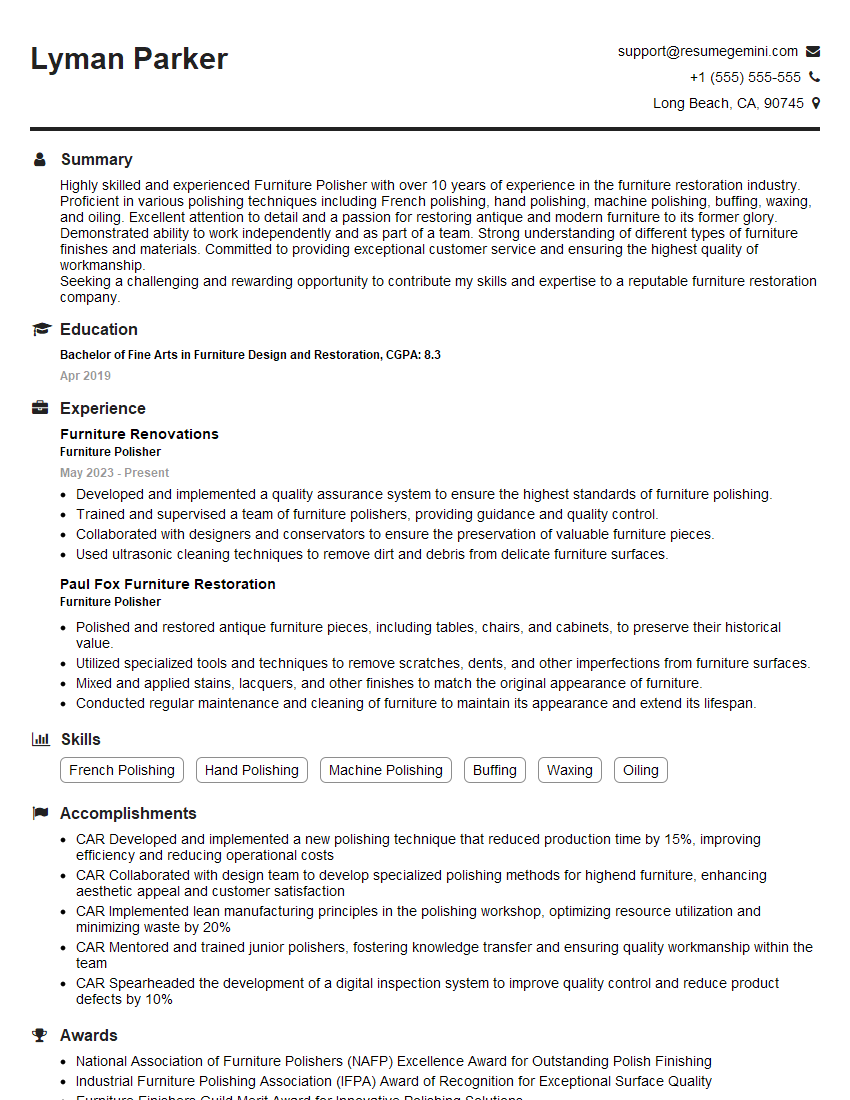
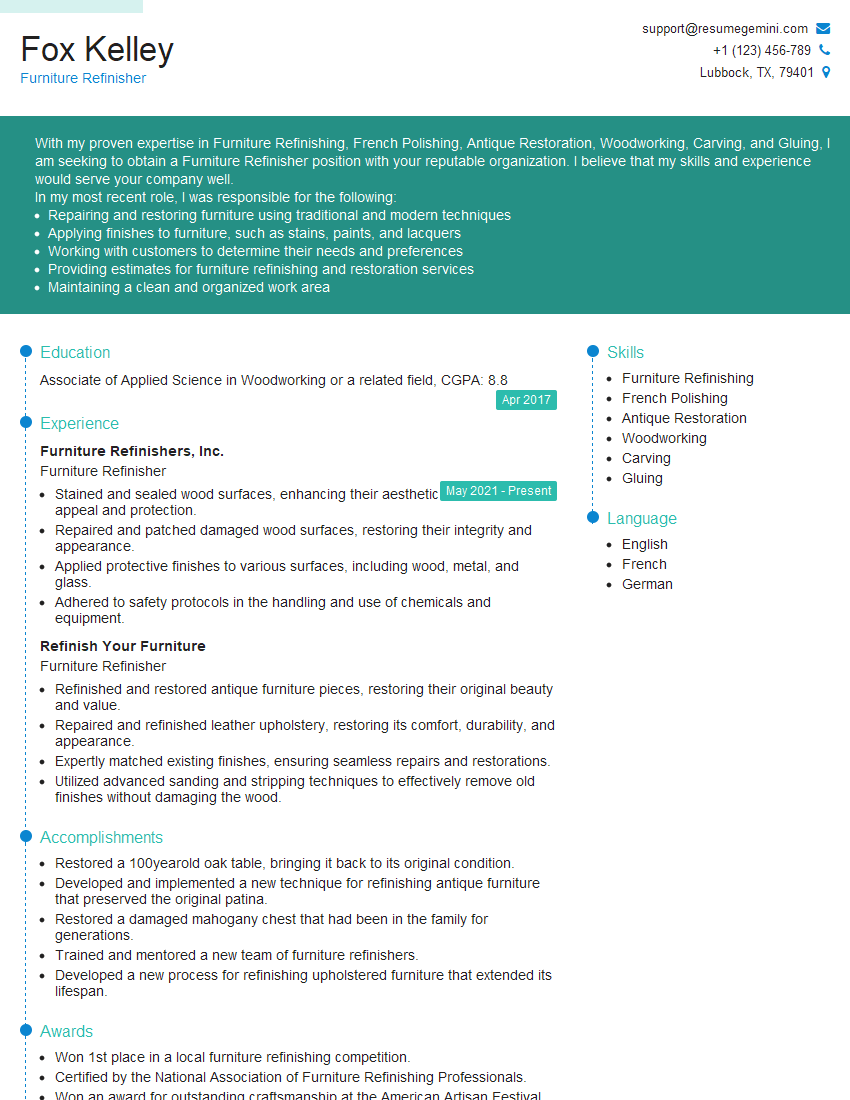
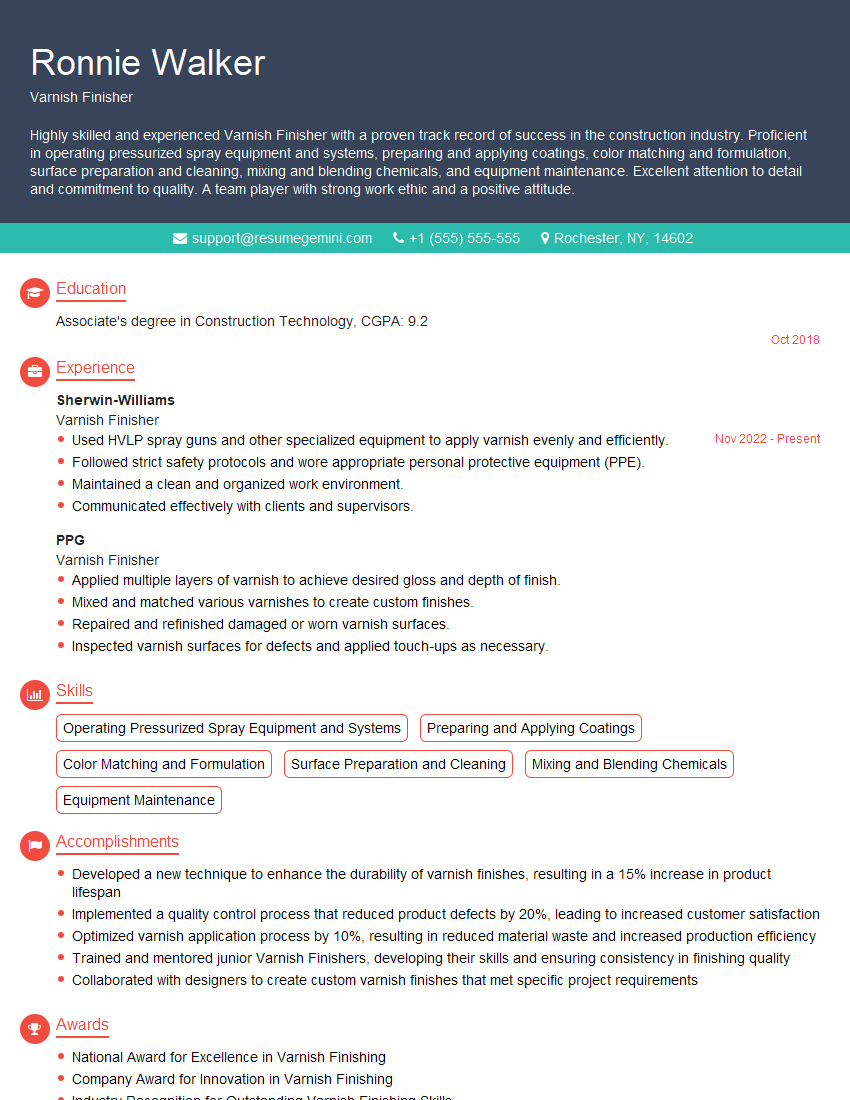
Mastering furniture polishing opens doors to a rewarding career with excellent growth potential. Whether you’re seeking entry-level positions or aiming for specialized roles, a strong understanding of the techniques discussed above will set you apart. To maximize your job prospects, invest time in creating an ATS-friendly resume that highlights your skills and experience effectively. ResumeGemini is a trusted resource that can help you build a professional and impactful resume. They even provide examples tailored to the furniture polishing industry to give you a head start. Take the next step in your career journey – craft a compelling resume and land your dream job.
Explore more articles
Users Rating of Our Blogs
Share Your Experience
We value your feedback! Please rate our content and share your thoughts (optional).
What Readers Say About Our Blog
Very informative content, great job.
good