Unlock your full potential by mastering the most common Garment Assembly and Construction interview questions. This blog offers a deep dive into the critical topics, ensuring you’re not only prepared to answer but to excel. With these insights, you’ll approach your interview with clarity and confidence.
Questions Asked in Garment Assembly and Construction Interview
Q 1. Explain the different types of sewing machine stitches and their applications.
Sewing machine stitches are the foundation of garment construction, each serving a specific purpose. The choice of stitch depends heavily on the fabric type, garment style, and desired durability. Here are some common types:
- Straight Stitch: The most basic stitch, ideal for seams requiring strength and neatness. Think of the side seams on a pair of trousers.
- Zigzag Stitch: Used for overlocking raw edges to prevent fraying, and for decorative purposes. This is commonly used on the neckline of a t-shirt to finish the edge.
- Overlock Stitch (Serger Stitch): A specialized stitch created by a serger machine, this stitch cuts, sews, and finishes the raw edge simultaneously. It is extremely efficient for production environments and enhances durability. A great example is the seams on athletic wear.
- Blind Hem Stitch: Creates an almost invisible hem, particularly useful for delicate fabrics like silk. You’ll often find this on dress pants or skirts.
- Buttonhole Stitch: Creates neat and functional buttonholes. Essential for shirts, jackets, and many other garments.
The selection of the correct stitch is crucial for both aesthetic appeal and garment longevity. Incorrect stitch selection can lead to seam failure, fraying, and overall poor quality.
Q 2. Describe your experience with various sewing machine maintenance procedures.
Regular maintenance is key to the longevity and efficiency of sewing machines. My experience includes:
- Cleaning and Lubrication: Regularly cleaning the bobbin case, feed dogs, and other moving parts with a brush and compressed air, followed by lubricating with specialized sewing machine oil, prevents friction and ensures smooth operation. Neglecting this can lead to skipped stitches or machine jams.
- Needle Changes: Changing needles frequently, especially when working with different fabric types, is crucial. A bent or dull needle can cause skipped stitches, broken threads, and even damage to the fabric.
- Tension Adjustment: Regularly checking and adjusting the upper and lower tension is vital for consistent stitch formation. Improper tension results in puckering or loose stitches.
- Bobbin Winding: Properly winding the bobbin ensures smooth sewing. Incorrectly wound bobbins can lead to tangles and jams.
- Troubleshooting Minor Issues: I’m adept at identifying and rectifying minor issues, such as thread breakage or inconsistent stitch length, preventing larger problems down the line.
Proactive maintenance not only extends the machine’s lifespan but also significantly improves efficiency and minimizes downtime in a production environment.
Q 3. How do you identify and resolve common sewing machine malfunctions?
Diagnosing sewing machine malfunctions requires a systematic approach. I typically follow these steps:
- Identify the Symptom: Precisely describe the problem; is it skipped stitches, inconsistent stitch length, thread breakage, or something else?
- Inspect the Machine: Check the needle for bends or damage, the thread for tangles or knots, the bobbin case for proper placement and winding, and the tension settings.
- Test with Different Threads and Needles: Sometimes the issue is simply a faulty needle or thread.
- Check for Obstructions: Remove any lint or debris from the machine’s moving parts.
- Consult Manuals and Online Resources: Many common problems have documented solutions.
- Seek Professional Help (if needed): If the problem persists after trying basic troubleshooting, seeking help from a qualified technician is necessary.
For example, if a machine is skipping stitches, I’d systematically check the needle, tension, bobbin winding, and finally consider a problem with the machine’s internal mechanisms. My experience allows for rapid identification and resolution of most common problems.
Q 4. What are the key quality control checks you perform during garment assembly?
Quality control is paramount in garment assembly. My checks include:
- Seam Strength and Evenness: Ensuring seams are securely stitched and consistently spaced.
- Fabric Alignment: Verifying that fabric pieces are precisely aligned before stitching to avoid distortions.
- Stitch Quality: Examining stitches for consistency, avoiding skipped stitches, loose threads, or broken threads.
- Finishing Details: Checking for proper finishing techniques, such as neat overlocking or hemming.
- Measurements and Fit: Confirming the garment conforms to specifications and fits properly. (This is often done at multiple stages of construction).
- Fabric Inspection: Checking for defects in the fabric itself, such as holes, stains, or inconsistencies.
These checks are performed at various stages of the production process, enabling early detection and correction of flaws, leading to a superior final product.
Q 5. Explain your experience with different types of fabrics and their sewing characteristics.
My experience spans a wide range of fabrics, each with unique sewing characteristics.
- Lightweight Fabrics (silk, chiffon): Require delicate handling, fine needles, and slower stitch speeds to prevent damage. Special care is needed to prevent puckering.
- Medium-Weight Fabrics (cotton, linen): Relatively easy to sew, but attention to needle size and stitch length is essential for a professional finish.
- Heavyweight Fabrics (denim, canvas): Often require heavier needles, stronger threads, and potentially a more robust machine to handle the thickness.
- Stretch Fabrics (Lycra, spandex): Need specialized needles and stitches to accommodate their elasticity without causing damage or breakage.
- Knit Fabrics: More delicate than woven fabrics, requiring special attention to avoid snagging or distortion.
Understanding these differences is crucial for selecting the appropriate needle, thread, stitch type, and sewing techniques to achieve the best results.
Q 6. How do you ensure consistent stitching quality throughout a production run?
Maintaining consistent stitching quality throughout a production run requires meticulous attention to detail and a proactive approach.
- Regular Machine Maintenance: As discussed earlier, cleaning, lubricating, and adjusting the machine regularly prevents inconsistencies.
- Consistent Thread and Needle Use: Using the same type and quality of thread and needle throughout the production run prevents variations in stitch quality.
- Tension Calibration: Regularly checking and adjusting tension settings ensures uniform stitching.
- Operator Training: Properly trained operators are crucial to maintain consistency in technique and stitch quality.
- Regular Quality Checks: Frequent checks of the finished garments ensure any deviations from the standard are identified promptly. This is where the quality control checks mentioned previously come into play.
By implementing these strategies, I ensure the high quality of finished products is maintained throughout the entire production run, thus minimizing defects and rework.
Q 7. Describe your experience with different garment construction techniques.
My experience with garment construction techniques is extensive, covering a range of methods and styles:
- Flat-Felled Seams: A very durable seam commonly used in high-quality garments, ideal for areas requiring strength and neatness.
- French Seams: Used for lightweight fabrics, creating a clean and professional finish with enclosed raw edges.
- Hong Kong Seams: Provide a clean, professional finish by binding the seam allowance with bias binding.
- Bound Seams: Used in many applications, often with decorative bias tape.
- Set-in Sleeves: A classic method of attaching sleeves to a garment.
- Raglan Sleeves: Sleeves that extend to the neckline for a more comfortable and less structured fit.
- Various Collar Attachments: Including stand collars, shirt collars, and shawl collars, each requiring specific techniques.
- Pocket Construction: Many different techniques for different pocket styles.
The technique used depends on the specific design, fabric type, and desired aesthetic.
Q 8. How familiar are you with pattern reading and interpretation?
Pattern reading and interpretation are fundamental to garment construction. It’s like reading a map before embarking on a journey; the pattern dictates the final product. My familiarity extends to understanding various pattern markings, such as notches, grainlines, seam allowances, and dart placements. I can confidently interpret both simple and complex patterns, including those with multiple pieces and intricate details. For example, I can easily differentiate between a princess seam pattern and a set-in sleeve pattern and understand the construction techniques specific to each. I’m proficient in adjusting patterns for different sizes and body types, ensuring a proper fit. This involves understanding grading techniques and making necessary alterations to achieve the desired silhouette.
Q 9. Explain your process for identifying and correcting defects in a finished garment.
Identifying and correcting defects in a finished garment requires a systematic approach. I begin with a thorough visual inspection, checking for inconsistencies in stitching, fabric flaws, incorrect seam allowances, or mismatched patterns. Then, I systematically examine each component: seams, hems, collars, cuffs, pockets, etc. I use a checklist to ensure I don’t miss any details. For example, uneven stitching might indicate a problem with the machine tension or the operator’s technique. A pulled seam reveals insufficient reinforcement or stress points. I document all defects with notes and photos for reference. Correction methods depend on the severity and type of defect. Minor flaws, like a loose thread, can be easily fixed with hand stitching. More significant issues may necessitate unpicking and resewing sections. If a substantial fault arises from a pattern error, the pattern itself will be reviewed and adjusted for future production. I meticulously check the corrected areas for quality assurance before the garment is considered complete. This whole process is crucial for maintaining quality standards and client satisfaction.
Q 10. How do you prioritize tasks and manage time effectively during garment assembly?
Efficient task prioritization and time management are crucial in garment assembly. I employ several strategies. First, I break down large projects into smaller, manageable tasks. This allows for better tracking of progress and easier identification of potential bottlenecks. Secondly, I use time-blocking techniques, allocating specific time slots for each task. This helps maintain focus and prevent distractions. For instance, I might dedicate one hour to cutting fabric, another to assembling the sleeves, and so on. Thirdly, I leverage technology to streamline workflows. I utilize spreadsheets or project management software to track deadlines and allocate resources effectively. Prioritization considers factors such as urgency, complexity, and dependencies between tasks. Urgent orders or complex garments with tight deadlines get precedence. Maintaining a clean and organized workspace is also essential for efficiency. This minimizes wasted time spent searching for materials or tools. Ultimately, a well-organized approach guarantees timely completion of projects while maintaining high quality standards.
Q 11. Describe your experience working with different types of sewing patterns.
My experience encompasses a wide range of sewing patterns, including those for various garments such as dresses, blouses, trousers, coats, and jackets. I’ve worked with both sloper patterns (basic blocks) and commercially produced patterns from various brands. I’m comfortable with different pattern formats—printed paper patterns, digital patterns, and even hand-drawn patterns. Each pattern type requires a specific approach: paper patterns often require careful cutting and assembly, while digital patterns can be adapted and scaled easily with software. I understand how to interpret different pattern notations and symbols across various design styles – from classic tailoring patterns to modern contemporary designs. This diverse experience allows me to adapt quickly to new pattern formats and design intricacies. Working with complex patterns, such as those requiring advanced techniques like draping or pattern manipulation, allows me to showcase my creativity and advanced technical skills.
Q 12. How do you handle discrepancies between the pattern and the actual fabric?
Discrepancies between a pattern and the actual fabric are common, and handling them requires a keen eye for detail and problem-solving skills. These discrepancies can stem from fabric shrinkage, differences in fabric drape, or even minor pattern errors. My first step involves carefully assessing the nature of the discrepancy. If the fabric is significantly different in terms of drape or stretch from what the pattern anticipated, I might need to make adjustments to the pattern itself, possibly through techniques like ease adjustments or grading. For example, if a woven fabric lacks the stretch of the pattern’s intended knit, I may need to add seam allowances to ensure sufficient ease. Fabric shrinkage requires pre-shrinking the fabric before cutting, or accounting for expected shrinkage during pattern adjustments. Minor discrepancies can often be resolved by careful cutting and placement of pattern pieces, ensuring correct grain alignment. In some cases, it may be necessary to create a muslin (test garment) to verify pattern adjustments before cutting into the final fabric. This iterative process of pattern adjustment and testing ensures a high-quality final garment, even when faced with fabric-related challenges.
Q 13. Explain your experience with industrial sewing equipment.
I possess extensive experience with a variety of industrial sewing equipment, including, but not limited to, single-needle and double-needle lockstitch machines, overlock machines (sergers), coverstitch machines, and buttonhole sewing machines. My proficiency extends beyond basic operation to include machine maintenance and troubleshooting. I can adjust stitch length, tension, and pressure feet to accommodate different fabrics and stitching techniques. For instance, I know how to adjust the tension on a serger to prevent skipped stitches when working with delicate fabrics like chiffon or heavier fabrics like denim. I’m also familiar with different types of needles and presser feet and understand how each affects the outcome of the stitching. Furthermore, I can identify and rectify common machine malfunctions—from simple threading issues to more complex mechanical problems, such as replacing needles or adjusting timing belts. This expertise enables me to maintain the sewing machines’ optimal performance, reducing downtime and improving overall productivity.
Q 14. What safety precautions do you take while operating industrial sewing machines?
Safety is paramount when working with industrial sewing machines. Before operating any machine, I always ensure it’s properly maintained and functioning correctly. This includes checking the machine for loose parts, frayed cords, and proper grounding. I meticulously inspect the needles and replace them regularly to prevent breakage. I always use the appropriate needle size and type for the fabric. While operating the machine, I never leave my hands close to the needle area, even when the machine is stopped. I maintain a clean and organized workspace, removing any obstructions that could cause trips or falls. I use proper lifting techniques when handling heavy fabrics or materials. I always keep my fingers clear of moving parts. Protecting my eyes is also a priority, and I often use safety glasses to protect against flying debris. Following these safety precautions helps ensure a safe and productive working environment.
Q 15. How do you handle production delays or unexpected issues?
Production delays are inevitable in garment assembly, but proactive management minimizes their impact. My approach involves a three-pronged strategy: identification, mitigation, and communication.
Identification begins with a thorough understanding of the production schedule and potential bottlenecks. This includes regular monitoring of material availability, machine functionality, and worker productivity. Early warning signs, like slower-than-expected output from a specific workstation, are immediately addressed.
Mitigation involves implementing corrective actions. This might include adjusting the work schedule, reallocating resources (personnel or machinery), or sourcing alternative materials. For example, if a fabric shipment is delayed, I’d explore using a readily available substitute with minimal impact on the final product’s quality. If a machine malfunctions, I would prioritize its repair while rerouting tasks to other available machines.
Communication is crucial throughout the process. I keep all relevant stakeholders – management, production team, and clients – informed of any delays or issues. Transparent communication prevents misunderstandings and fosters collaborative problem-solving. For instance, if a delay is unavoidable, I will proactively inform the client and propose alternative solutions to meet their deadlines as closely as possible. This could include prioritizing urgent orders or offering partial shipments.
Career Expert Tips:
- Ace those interviews! Prepare effectively by reviewing the Top 50 Most Common Interview Questions on ResumeGemini.
- Navigate your job search with confidence! Explore a wide range of Career Tips on ResumeGemini. Learn about common challenges and recommendations to overcome them.
- Craft the perfect resume! Master the Art of Resume Writing with ResumeGemini’s guide. Showcase your unique qualifications and achievements effectively.
- Don’t miss out on holiday savings! Build your dream resume with ResumeGemini’s ATS optimized templates.
Q 16. Describe your experience with different types of garment closures (zippers, buttons, snaps).
I have extensive experience with a wide array of garment closures, each presenting unique challenges and requiring specific techniques.
- Zippers: I’m proficient in installing various zipper types—centre-front, invisible, separating, and non-separating—and understand the nuances of working with different zipper tapes and slider mechanisms. I can troubleshoot common issues like zipper binding or inconsistent closure. For example, I know how to properly set the zipper tape using a special foot on the sewing machine to ensure a clean and neat finish.
- Buttons: My experience covers various button types (plastic, metal, shank), attachment methods (sewing, shanks, button machines), and buttonhole construction (hand-stitched, machine-stitched). Accurate button placement is critical, and I employ techniques to maintain consistency and ensure durability. I’m also familiar with reinforcing button areas to prevent tearing.
- Snaps: I’m experienced with different snap types (ball-and-socket, prong) and understand their respective attachment methods. Proper snap placement is vital for smooth, reliable closures, and I utilize precision tools to guarantee consistent alignment.
Beyond the technical aspects, I prioritize selecting closures appropriate for the garment’s fabric weight, style, and intended use. This ensures both functionality and aesthetics.
Q 17. How do you ensure the accuracy of measurements during garment assembly?
Accuracy in measurements is paramount in garment assembly. It’s the foundation of a well-fitting and aesthetically pleasing garment. My approach emphasizes a multi-stage process.
- Accurate Pattern Making: I start by ensuring the base pattern is precise and graded correctly to accommodate different sizes. This involves using accurate measurements from the initial design specifications and leveraging pattern-making software for advanced precision.
- Precise Cutting: I use sharp cutting tools and precise cutting techniques to minimize fabric distortion and ensure that the cut pieces match the pattern exactly. I use a cutting mat and a rotary cutter to achieve clean, straight cuts.
- Regular Checks: I conduct frequent measurements throughout the assembly process, confirming that each step adheres to the pattern’s specifications. This includes checking seam allowances, placements of pockets or other details. I regularly utilize measuring tapes, rulers, and other measuring tools to ensure accuracy.
- Quality Control Checks: A final garment fit check is done before finishing to ensure there are no discrepancies and all measurements align with the specification.
By combining these steps, I minimize errors and guarantee consistent quality throughout the production process.
Q 18. What are the different methods used to finish seams in garment construction?
Seam finishing is crucial for durability, appearance, and preventing fraying. Several methods are employed, each suitable for different fabrics and garment types.
- Serging/Overlocking: This method uses a serger machine to enclose raw edges, providing a neat and durable finish. It’s especially effective for woven fabrics.
- Zigzag Stitching: A common method using a standard sewing machine to create a zigzag stitch along the raw edge, preventing fraying. The width and length of the stitch can be adjusted depending on the fabric type.
- Pinking Shears: These shears create a serrated edge, reducing fraying. It’s a simpler, faster method but less durable compared to serging or zigzag stitching.
- Binding: A fabric strip is folded and stitched over the raw edge, creating a clean and decorative finish. This is often used on garment hems or edges that will be visible.
- French Seams: This method encases the raw edges within the seam itself, resulting in a very clean and professional finish. It’s particularly suitable for delicate fabrics or garments where a high-end finish is required.
The choice of seam finish depends on factors such as fabric type, garment style, and desired aesthetic. For example, a delicate silk garment may require a French seam, while a sturdy denim jacket might use serging.
Q 19. How familiar are you with various pressing and finishing techniques?
Pressing and finishing techniques are integral to achieving a professional finish. My experience includes a variety of techniques, tailored to the fabric and garment style.
- Pressing: I understand different pressing methods, including using a variety of irons, steam irons, and pressing cloths to prevent scorching or shine. Different fabrics require different levels of moisture and temperature; I know how to adjust accordingly.
- Blocking: This technique shapes and flattens garments, ensuring proper drape and fit, particularly vital for knitwear and tailored garments.
- Seam Pressing: I use specific techniques to press seams open, to one side, or encasing raw edges, depending on the construction requirements. Correct seam pressing prevents puckering and ensures a clean and crisp finish.
- Pleat and Dart Pressing: These specialized techniques require precise manipulation to create sharp, well-defined pleats and darts.
- Finishing Details: This includes edge finishing (like hemming), collar and cuff pressing, and other details that enhance the garment’s overall appearance.
I understand the importance of using the correct pressing equipment and appropriate temperatures for each fabric type to achieve the desired finish without damaging the garment.
Q 20. Explain your experience working with different types of interfacing.
Interfacing is crucial for providing structure and support to garments. I’m familiar with various types, each offering distinct properties.
- Woven Interfacing: Provides crispness and structure, often used in collars, cuffs, and lapels. The choice of weave and weight depends on the garment’s fabric and desired stiffness.
- Non-Woven Interfacing: Offers more flexibility and drape, commonly used in less structured garments. Different non-woven types (fusible, sew-in) offer varying degrees of support.
- Knit Interfacing: Provides stretch and flexibility, suitable for knit garments. It’s crucial to select an interfacing with appropriate stretch to match the garment fabric.
- Fusible Interfacing: Bonds to the fabric using heat and pressure, providing a clean, seamless finish. This is quick and efficient, but incorrect application can cause wrinkling or damage.
- Sew-in Interfacing: Stitched to the garment fabric, offering greater durability and stability, particularly in areas subjected to stress.
Selecting the correct interfacing is crucial for achieving the intended garment structure and drape. For instance, a lightweight fusible interfacing would be appropriate for a delicate blouse, while a heavier sew-in interfacing might be necessary for a structured jacket.
Q 21. Describe your experience with quality control procedures in garment production.
Quality control is an ongoing process, not just a final check. My approach integrates quality checks throughout the entire production cycle.
- Incoming Material Inspection: I verify that received materials meet quality standards, checking for defects in fabric, zippers, buttons, or other components.
- In-Process Inspections: Regular checks during each stage of production—cutting, sewing, pressing—identify and rectify any errors early on, preventing costly rework or waste.
- Final Garment Inspection: A thorough inspection of each completed garment, checking for inconsistencies in stitching, pressing, and overall appearance. This also includes checking for proper measurements, closure functionality, and overall quality.
- Sampling and Prototyping: Creating samples and prototypes allows for early identification of potential problems before mass production.
- Documentation and Reporting: Maintaining detailed records of quality checks, defects, and corrective actions. This data is invaluable for process improvement and preventing recurring problems.
Employing these procedures minimizes defects, upholds consistent quality, and ultimately enhances customer satisfaction.
Q 22. How familiar are you with industry standards and best practices for garment construction?
I’m intimately familiar with industry standards and best practices in garment construction, including those set by organizations like the American Apparel & Footwear Association (AAFA) and global certifications like OEKO-TEX. My understanding encompasses everything from pattern making and grading to stitching techniques, quality control, and ethical manufacturing practices. I’m proficient in various sewing methods, understanding the strengths and weaknesses of different stitch types for various fabric weights and applications. I also have a deep understanding of the importance of adhering to safety regulations in the workplace.
- Sewing Standards: I’m adept at identifying and correcting stitching inconsistencies, ensuring consistent seam allowance, and understanding the impact of different needle sizes and thread types on fabric.
- Quality Control: I’m skilled in implementing quality control checks at each stage of production, identifying and resolving defects promptly to maintain high standards.
- Ethical Manufacturing: I’m well-versed in fair labor practices and sustainable manufacturing, always prioritizing worker safety and environmental responsibility.
Q 23. Explain your experience with different types of fabric cutting techniques.
My experience with fabric cutting techniques is extensive, encompassing both manual and automated methods. I’m proficient in using various tools, from manual cutting shears and rotary cutters to computer-aided design (CAD) systems and automated cutting machines. The choice of technique depends heavily on the fabric type, the complexity of the pattern, and the production volume.
- Manual Cutting: This involves using shears or rotary cutters for smaller production runs or intricate designs, requiring precision and attention to detail. I’m highly skilled at ensuring accurate cuts to minimize waste.
- Automated Cutting: For large-scale production, I’m experienced in using automated cutting machines that are programmed using CAD patterns. This method significantly improves efficiency and accuracy, minimizing fabric waste.
- Spread Planning: I’m adept at optimizing fabric spread planning to minimize material waste and maximize yield, regardless of the cutting method.
For example, delicate fabrics like silk require very sharp shears and a gentle hand to avoid damage. Conversely, heavier fabrics like denim benefit from the speed and accuracy of automated cutting machines.
Q 24. How do you manage inventory and ensure sufficient supplies of materials?
Effective inventory management is crucial for smooth production. My approach involves a multi-faceted system combining accurate forecasting, regular stock checks, and efficient ordering processes. This ensures that we have sufficient materials on hand to meet production demands without unnecessary stockpiling.
- Demand Forecasting: I analyze historical data and upcoming orders to predict future material needs, accounting for seasonal variations and potential fluctuations.
- Regular Stock Audits: I conduct regular physical inventory checks to ensure accuracy of records and identify any discrepancies or potential shortages.
- Just-in-Time Inventory: Where feasible, I implement a just-in-time inventory system to minimize storage costs and reduce the risk of material obsolescence.
- Supplier Relationships: I maintain strong relationships with reliable suppliers to ensure timely delivery and quality control.
For instance, I’ve implemented a system using barcodes to track fabric and notions, integrating it with our production schedule for better inventory visibility.
Q 25. How do you communicate effectively with colleagues and supervisors?
Clear and respectful communication is paramount in a collaborative environment. I strive to communicate effectively using various methods – verbal, written, and visual – tailored to the audience and the situation. I actively listen to others, seek clarification when needed, and provide constructive feedback.
- Team Meetings: I actively participate in team meetings, sharing updates and contributing to problem-solving.
- Written Communication: I use email, reports, and documentation to ensure clear and concise communication.
- Visual Aids: Where applicable, I use diagrams, charts, and other visual tools to enhance understanding.
- Active Listening: I listen attentively to colleagues and supervisors, asking clarifying questions to fully grasp their needs and concerns.
A recent example involved resolving a discrepancy in a pattern by visually demonstrating the error using a sample garment and collaboratively finding a solution with the design team.
Q 26. Describe a time you had to solve a complex problem during garment assembly.
During a high-volume order, we faced a significant challenge when a large batch of fabric arrived with a subtle but consistent flaw – uneven dyeing. This risked delaying the entire production run.
My solution involved a multi-step approach:
- Assessment: I immediately contacted the supplier to discuss the issue, documented the defect with photographs and samples, and assessed the extent of the problem.
- Problem Solving: I collaborated with the cutting and sewing teams to identify fabric areas least affected by the flaw and strategically planned the layout of patterns to minimize the visibility of the defect.
- Communication: I kept the supervisor updated on the progress and potential impact of the problem. We discussed alternative solutions, such as potentially using a different, albeit more expensive, fabric.
- Implementation: We successfully implemented the adjusted cutting and sewing plans. We successfully completed the order with minimal loss.
This experience highlighted the importance of quick thinking, effective communication, and problem-solving skills under pressure.
Q 27. How do you adapt to changes in production schedules or requirements?
Adaptability is essential in garment production. I’m proficient in adapting to changes in production schedules and requirements by prioritizing tasks effectively and utilizing available resources optimally.
- Prioritization: I effectively prioritize tasks based on urgency and importance, using tools such as Kanban boards or similar systems to manage workflow.
- Resource Allocation: I efficiently allocate available resources – materials, equipment, and personnel – to meet changing demands.
- Communication: I maintain open communication with colleagues and supervisors about any changes and potential impacts.
- Problem-solving: I proactively identify and address potential bottlenecks or roadblocks resulting from schedule changes.
For example, when an urgent rush order came in, I quickly reassessed our production schedule, reallocated resources, and communicated the changes to the team to ensure timely completion of both orders without compromising quality.
Q 28. What are your long-term career goals within the garment industry?
My long-term career goals within the garment industry involve progressing into a leadership role, potentially as a production manager or a senior quality control specialist. I’m eager to leverage my expertise in garment construction and my leadership skills to contribute to a company’s growth and success. I aim to refine my skills in lean manufacturing techniques and sustainable practices to create a more efficient and ethically responsible production environment.
Specifically, I’d like to contribute to the implementation of innovative technologies in garment manufacturing while maintaining a focus on quality and craftsmanship.
Key Topics to Learn for Garment Assembly and Construction Interview
- Pattern Making and Grading: Understanding pattern construction, grading techniques for different sizes, and adapting patterns for various styles. Practical application includes efficiently creating accurate patterns and grading them to meet production needs.
- Sewing Techniques: Mastering various stitches, seam finishes, and their applications in different garment constructions. This includes understanding the impact of stitch selection on durability and aesthetics.
- Fabric Knowledge: Identifying different fabric types, their properties (drape, weight, stretch), and suitability for specific garments. Practical application: selecting appropriate fabrics for pattern designs and construction methods.
- Construction Methods: Understanding various garment construction methods (e.g., set-in sleeves, raglan sleeves, princess seams) and their advantages/disadvantages. Problem-solving includes adapting methods based on fabric type and design.
- Quality Control and Inspection: Identifying and rectifying common construction defects, ensuring quality standards are met, and understanding industry best practices for quality control procedures.
- Industrial Sewing Machines: Familiarity with different types of industrial sewing machines, their maintenance, and troubleshooting common issues. Practical application includes efficient machine operation and timely repair identification.
- Production Processes and Efficiency: Understanding the flow of garment production, optimizing workflows, and contributing to efficient assembly line operations.
Next Steps
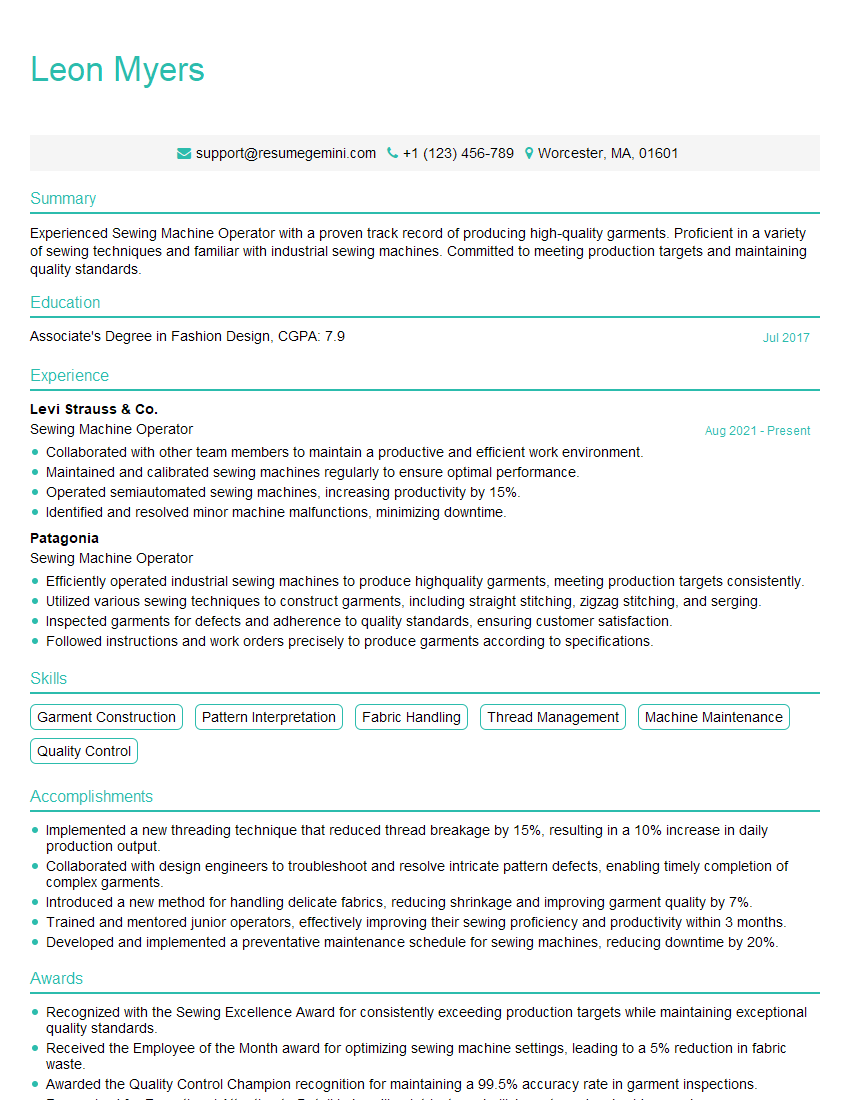
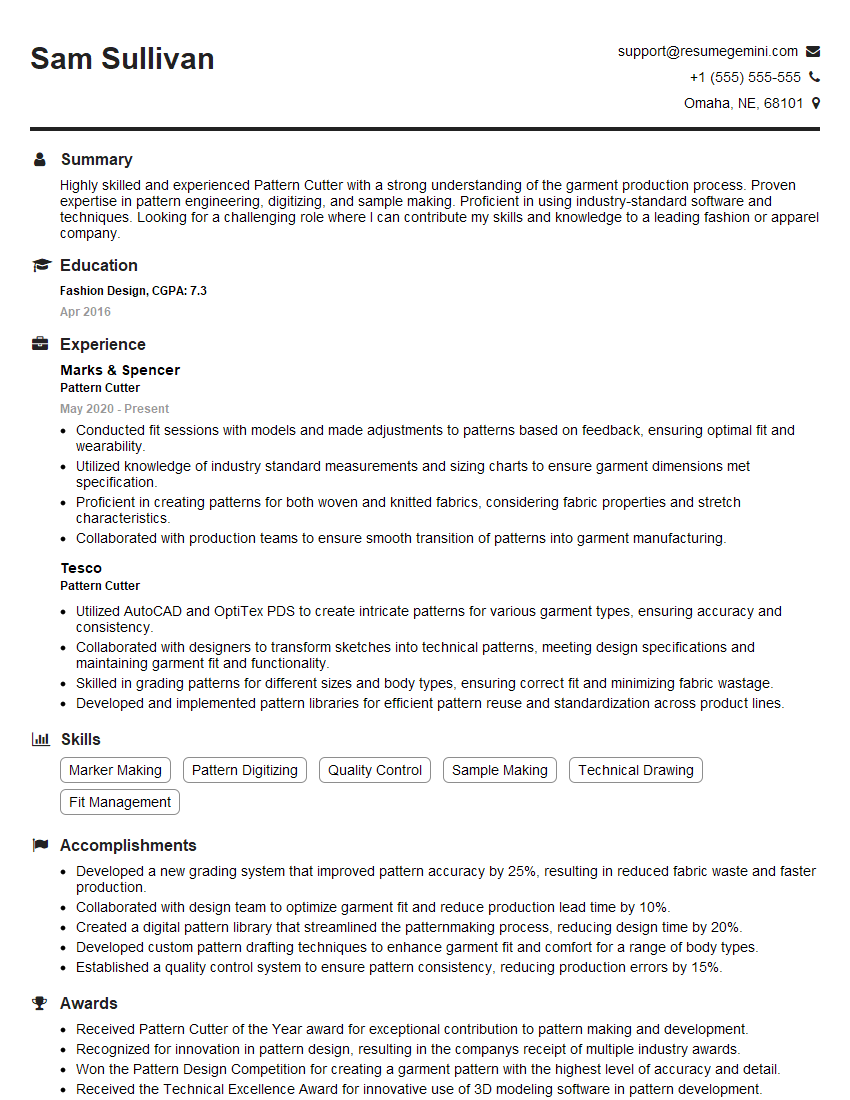
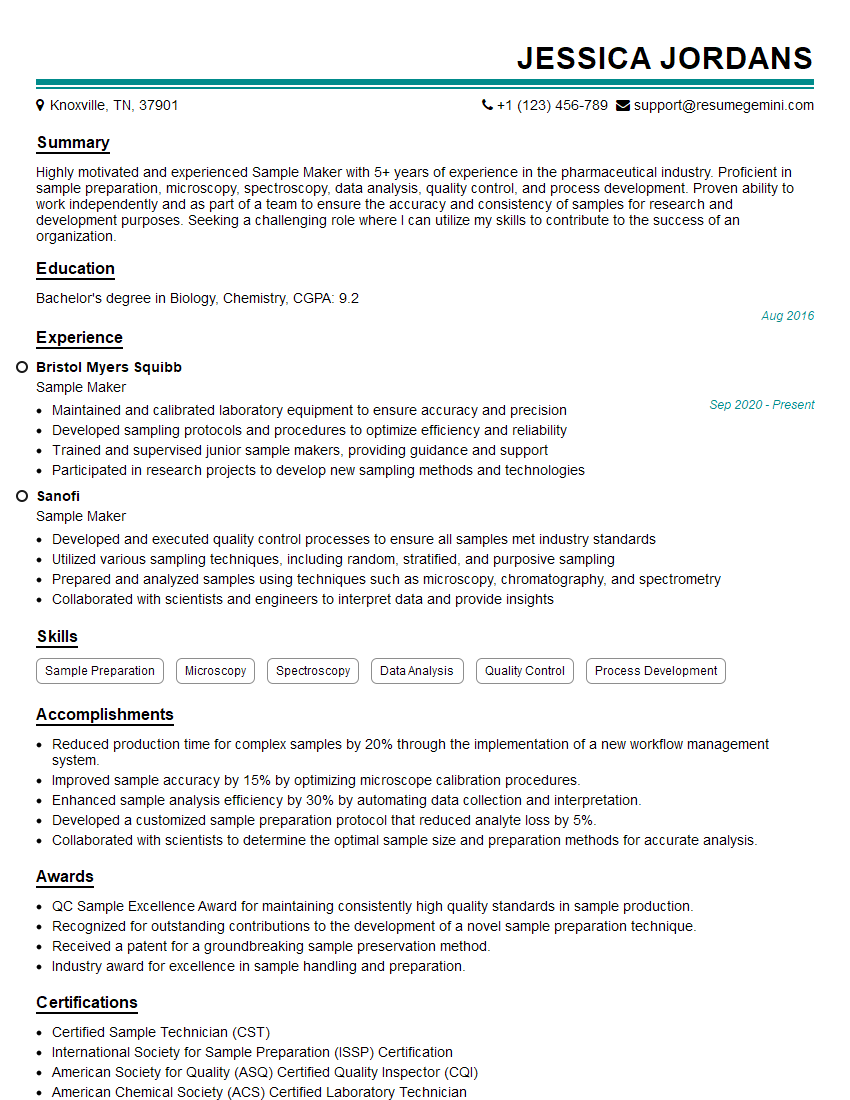
Mastering Garment Assembly and Construction opens doors to exciting career opportunities with significant growth potential within the fashion and apparel industry. Building a strong foundation in these skills demonstrates your value to potential employers. To maximize your job prospects, creating an ATS-friendly resume is crucial. ResumeGemini is a trusted resource that can help you build a professional resume that highlights your skills and experience effectively. Examples of resumes tailored to Garment Assembly and Construction are available to guide you in crafting a compelling application. Take the next step toward your dream career today!



Explore more articles
Users Rating of Our Blogs
Share Your Experience
We value your feedback! Please rate our content and share your thoughts (optional).
What Readers Say About Our Blog
Very informative content, great job.
good