Interviews are opportunities to demonstrate your expertise, and this guide is here to help you shine. Explore the essential Garment Measurements interview questions that employers frequently ask, paired with strategies for crafting responses that set you apart from the competition.
Questions Asked in Garment Measurements Interview
Q 1. Explain the difference between standard and individual garment measurements.
Standard garment measurements represent average body dimensions for a specific size and gender, typically found in size charts. These are pre-defined and used for mass production. Individual garment measurements, on the other hand, are taken directly from a specific person’s body to create a custom-fit garment. Think of it like this: standard measurements are like a one-size-fits-most approach, while individual measurements are like a tailor-made suit.
For example, a standard size medium men’s shirt might have a chest measurement of 40 inches. However, an individual’s actual chest measurement could be 38 or 42 inches, necessitating individual measurements for a perfect fit. This difference highlights the importance of understanding the context – mass production versus bespoke tailoring – when selecting the appropriate measurement method.
Q 2. How do you ensure accurate measurements on different body types?
Ensuring accurate measurements across diverse body types requires a systematic approach. It begins with a clear understanding of anthropometry – the study of human body measurements. I always start by explaining the process clearly to the individual, putting them at ease. I use a flexible tape measure and take multiple measurements at each point, averaging the results to minimize errors. For example, when measuring the waist, I ensure the tape is parallel to the floor and snug but not constricting. Different body types require adjustments. For individuals with a larger bust, I’ll ensure the tape measure is positioned correctly to avoid adding extra inches. Similarly, I adjust the techniques for pregnant individuals or those with physical limitations. Detailed notes on posture and any peculiarities are crucial for consistency.
Q 3. Describe your experience with various measurement tools (e.g., tape measure, measuring gauge).
My experience spans various measurement tools, each with its own advantages. The standard tape measure remains my primary tool; its flexibility is crucial for accurate body measurements. I use a fabric tape measure rather than a metal one as it conforms better to the curves of the body. I’ve also used measuring gauges, particularly useful for checking the consistency of finished garments. These are particularly helpful in quality control when we’re examining mass-produced garments for dimensional accuracy. Digital calipers offer precision for smaller components. The choice of tool depends entirely on the task – whether it’s taking body measurements for a bespoke garment or verifying the dimensions of a finished product in a factory setting. It’s essential that every tool is regularly calibrated for accuracy.
Q 4. What are the key measurements required for a men’s shirt pattern?
Key measurements for a men’s shirt pattern include:
- Neck circumference: Measured around the base of the neck.
- Chest circumference: Measured around the fullest part of the chest, keeping the tape measure level.
- Sleeve length: Measured from the shoulder point to the wrist bone.
- Shoulder width: Measured across the back from one shoulder point to the other.
- Back length: Measured from the base of the neck to the waistline.
- Waist circumference: Measured around the natural waistline.
- Shirt length: Desired length of the shirt.
These measurements, along with others like bicep circumference and wrist circumference, provide a complete picture for accurate pattern creation. It’s crucial to note that the accuracy of these measurements directly impacts the fit and comfort of the finished shirt.
Q 5. How do you handle inconsistencies in measurements taken by different technicians?
Inconsistencies in measurements taken by different technicians are addressed through training, standardization, and quality control. Firstly, I ensure all technicians receive thorough training on proper measurement techniques, emphasizing consistent posture and placement of the measuring tape. We establish a standardized measurement protocol, which includes detailed instructions and visual aids. This document acts as a reference for all team members, minimizing variations. Regular calibration of measuring instruments is another vital aspect. Finally, a quality control system, involving double-checking measurements and statistical analysis, helps identify and address any systematic errors or individual inconsistencies. If discrepancies remain, I conduct further training or retraining as needed.
Q 6. What is grading in garment measurements, and how is it done?
Grading in garment measurements refers to the systematic process of adjusting a base pattern to create a range of sizes. It involves scaling the pattern pieces proportionally to create larger or smaller sizes. This is done to ensure the garment maintains its design and proportions across the size range. Grading can be done manually, using rulers and other tools, or using CAD software. Manual grading requires careful attention to detail, and experienced graders must possess a good understanding of garment construction. CAD software automates the process, offering speed and precision. However, manual checking for any errors or adjustments might be necessary, and an understanding of how to use the software is key.
For example, to grade a size small shirt pattern to a size medium, you’d increase the chest, waist, and sleeve measurements according to pre-defined grading rules. The amount of increase is dependent on the specific brand’s or designer’s grading standards and typically determined using grading rules or percentage increases.
Q 7. Describe your experience using CAD software for pattern making and measurement.
My experience with CAD software for pattern making and measurement is extensive. I’m proficient in several industry-standard software packages, which allow for precise digital pattern creation and grading. These programs significantly streamline the process, automating tasks such as grading and marker making. The software allows for 3D modeling, enabling visualization of the garment before production, leading to better fit predictions and reduced prototyping. Further, digital pattern pieces minimize potential errors associated with manual pattern cutting and also allow easy storage and retrieval of designs. For example, in a recent project, we used CAD software to design a new line of women’s dresses with complex draping. The software’s 3D simulation feature enabled us to fine-tune the design and adjust the pattern before even cutting the fabric, considerably saving time and resources.
Q 8. Explain the importance of accurate measurement in garment production.
Accurate measurement is the cornerstone of successful garment production. Think of it like baking a cake – if your measurements are off, your final product will be flawed. In garment manufacturing, inaccurate measurements lead to ill-fitting garments, increased material waste, production delays, and ultimately, unhappy customers. Accurate measurements ensure the garment fits the intended target audience correctly, reducing returns and improving brand reputation.
For example, a 1cm error in sleeve length might seem insignificant, but across hundreds or thousands of garments, this small discrepancy translates to significant material waste and potential customer dissatisfaction.
Q 9. How do you identify and correct measurement errors in existing patterns?
Identifying and correcting errors in existing patterns requires a systematic approach. First, I would compare the pattern measurements to a set of standardized body measurements representative of the target size. Discrepancies highlight areas needing adjustment. I would then analyze the fit on a sample garment, carefully noting areas of tightness or looseness. This involves using tools like measuring tapes and rulers to precisely measure the garment, comparing these measurements with the pattern measurements and the standard body measurements. Common adjustments include tweaking seam allowances, grading (adjusting measurements for different sizes), or re-drafting sections of the pattern.
For instance, if the sleeve cap is too tight on the sample garment, I’d adjust the pattern by increasing the sleeve cap height and easing the curve. To quantify the adjustments, I use detailed measurement notes, which helps track changes and document revisions. A visual fit assessment on a sample, using pins and marking to note areas of adjustment, completes the process.
Q 10. What are the common challenges in taking garment measurements, and how do you overcome them?
Taking garment measurements presents several challenges. Inconsistent measuring techniques among different technicians is a major issue. For example, the way a tape measure is held or the pressure applied can slightly alter the reading. Another challenge is the variation in body shapes and postures. A person’s posture while measurements are taken can drastically impact accuracy, so it’s crucial that measurements are taken consistently and properly.
To overcome these, I implement standardized measurement procedures, training all technicians using visual aids and hands-on practice to ensure everyone employs the same techniques. Utilizing standardized tools, like flexible measuring tapes, reduces discrepancies. I also train technicians to instruct the person being measured on proper posture and to take multiple measurements to average out minor inconsistencies. Detailed checklists and photographic guides are essential to maintain consistency.
Q 11. Explain your understanding of tolerance levels in garment measurements.
Tolerance levels in garment measurements represent the acceptable range of variation from the ideal measurement. It’s practically impossible to achieve absolute precision in mass production; therefore, tolerance accounts for minor variations. These tolerances depend heavily on the garment type, fabric, and the acceptable fit range. For instance, a tight-fitting garment will have smaller tolerances than a loose-fitting one. Tolerances are usually expressed as plus or minus a specific value (e.g., ± 0.5cm).
Setting appropriate tolerances is crucial for efficient production and avoiding unnecessary rejects. Overly strict tolerances might lead to higher rejection rates and increased costs, while overly lenient tolerances could result in inconsistent sizing and unsatisfactory fit. Finding the right balance is a critical aspect of the process.
Q 12. How do you ensure consistency in measurements across different production runs?
Consistency across production runs is ensured through several measures. First, strict adherence to standardized measurement procedures and training are paramount. Every technician follows a precisely defined method, using calibrated tools. Second, regular calibration and maintenance of measuring equipment is crucial. Regular checks prevent tool wear from affecting accuracy. Third, I use digital measurement systems and data logging to improve accuracy and track measurements electronically. This allows for easier comparison between batches and quicker identification of any deviations. Control charts are essential to track the measurements over time, allowing for quick detection of trends and adjustments to manufacturing processes if needed.
Implementing quality control checks at various stages of production – including during pattern cutting and garment construction – helps catch and correct inconsistencies early in the process, minimizing waste and ensuring uniform sizing across different production batches.
Q 13. What is your experience with different measurement systems (e.g., metric, imperial)?
I’m proficient in both metric (centimeters and millimeters) and imperial (inches) measurement systems. My experience includes converting between the two systems as needed, and I understand the importance of using the correct system based on client requirements, production standards, and the available equipment. I’ve worked on projects requiring both systems, demonstrating my adaptability and accuracy regardless of the system used. Accuracy in conversion is critical, ensuring that design specifications remain consistent across different systems. Any discrepancies stemming from conversion errors can lead to ill-fitting garments, hence the importance of meticulousness.
For instance, a seemingly small conversion error, especially with complex garments, could result in a significant difference in the final product, leading to wasted material and rework.
Q 14. Describe your process for creating a size chart from collected measurements.
Creating a size chart from collected measurements involves several steps. First, the data needs to be organized and analyzed. This usually involves inputting the measurements into a spreadsheet or database. This step helps identify patterns and potential outliers. Next, I calculate the mean (average) measurement for each size and body area, and then determine the standard deviation. The standard deviation gives an indication of the variability within each size group and helps in establishing appropriate tolerance levels for the size ranges. Based on the mean and standard deviation, I define size ranges for each body measurement (e.g., chest, waist, hip, etc.).
Finally, I construct the size chart, which clearly outlines the measurement ranges for each size (e.g., XS, S, M, L, XL, etc.), typically accompanied by a corresponding visual representation of body area measurements. The chart is then thoroughly reviewed and adjusted as needed to reflect the actual data and acceptable tolerances. This ensures the chart accurately represents the target demographic and serves as a reference for all subsequent production runs.
Q 15. How do you incorporate customer feedback on fit into the measurement process?
Customer feedback is paramount in refining the fit of garments. We actively solicit feedback through various channels, including post-production surveys, online reviews, and focus groups. This feedback, detailing specific areas of discomfort or dissatisfaction (e.g., ‘sleeves too tight,’ ‘waistband too high’), is meticulously analyzed. We categorize these comments, identifying recurring themes and patterns. For instance, if multiple customers complain about a tight sleeve, we might re-evaluate the sleeve circumference measurement in our patterns, potentially adding ease or adjusting the armhole depth. We use this data to inform adjustments in our measurement templates and production processes, ultimately creating better-fitting garments.
For example, if we consistently receive feedback that a particular dress size runs small, we’ll analyze the measurements of that size, comparing them to industry standards and customer body measurements. We might increase the chest, waist, and hip measurements by a specific increment to improve the fit. This iterative process ensures our measurement standards are consistently refined for better customer satisfaction.
Career Expert Tips:
- Ace those interviews! Prepare effectively by reviewing the Top 50 Most Common Interview Questions on ResumeGemini.
- Navigate your job search with confidence! Explore a wide range of Career Tips on ResumeGemini. Learn about common challenges and recommendations to overcome them.
- Craft the perfect resume! Master the Art of Resume Writing with ResumeGemini’s guide. Showcase your unique qualifications and achievements effectively.
- Don’t miss out on holiday savings! Build your dream resume with ResumeGemini’s ATS optimized templates.
Q 16. What is your experience working with different fabric types and their effect on measurements?
Different fabrics dramatically impact garment measurements. The drape, stretch, and shrinkage properties of a fabric necessitate adjustments to the base pattern measurements. For example, a tightly woven fabric like linen will require less ease than a drapey fabric like rayon. Linen tends to hold its shape, so a smaller ease allowance will suffice, while rayon’s tendency to drape requires more ease to avoid a clingy fit. Similarly, stretchy fabrics, like jersey knits, need significantly different measurements than non-stretch wovens like cotton twill. We conduct fabric testing to determine the exact properties, then adjust our measurements accordingly. This might involve using a ‘control sample’ – a test garment made in the selected fabric to confirm the fit and make necessary adjustments before mass production.
For instance, if working with a fabric that has significant shrinkage tendencies after washing, we would pre-shrink the fabric before creating the pattern pieces, increasing the measurements accordingly to compensate for the loss in size. This ensures the final garment fits correctly even after washing.
Q 17. How do you handle complex garment constructions during the measurement process?
Complex garment constructions, such as those with darts, princess seams, or intricate draping, require a more nuanced approach to measurement. We use a combination of flat pattern measurements, draping techniques, and 3D scanning to ensure accuracy. For garments with darts, we’ll consider the intended shape and how the darts will affect the final fit. We might take additional measurements around the dart points to ensure they align correctly with the body’s natural curves. For princess seams, we’ll need precise measurements around the bust, waist, and hips, ensuring the seams follow the body’s contour smoothly. Similarly, for draped garments, we’ll rely more on the draping process to inform the measurements and incorporate adjustments as needed to achieve the desired silhouette. Accurate grading (scaling measurements for different sizes) becomes crucial for maintaining the design’s integrity across the size range.
A practical example involves a fitted blazer with princess seams. We wouldn’t rely solely on standard chest, waist, and hip measurements. We’d incorporate additional measurements like high bust, underbust, and waist back width to capture the garment’s shape and ensure a comfortable and flattering fit. We might also utilize a full body scan to visualize how the garment drapes on different body types and make adjustments to the pattern accordingly.
Q 18. Explain your understanding of ease and its importance in garment measurements.
Ease is the extra fabric added to a garment’s measurements to allow for comfort and movement. It’s the difference between the body measurements and the garment’s finished measurements. There are different types of ease: design ease (for style and drape), functional ease (for comfort and movement), and fitting ease (to account for variations in body shape). Understanding ease is critical because insufficient ease results in a tight, uncomfortable garment, while excessive ease leads to a baggy, ill-fitting one. The amount of ease needed depends on the garment type, fabric, and intended fit (e.g., slim fit, relaxed fit).
For a tailored shirt, a moderate amount of ease would be used to allow for comfortable arm movement and a flattering silhouette. Conversely, a loose-fitting dress might have significant ease to create a relaxed, flowing style. Determining the appropriate ease for each garment involves considering both the body measurements and the intended aesthetic.
Q 19. Describe your experience with fit sessions and how you use measurement data to improve fit.
Fit sessions are crucial for fine-tuning garment measurements and identifying areas for improvement. We conduct fit sessions with representative body types, using muslin mock-ups (prototype garments made from inexpensive fabric). The muslin is fitted on the model, and detailed measurements are taken, noting any areas of tightness, looseness, or pulling. These measurements are compared to the original measurements, and adjustments are made to the pattern. We use digital tools, such as 3D body scanning and computer-aided design (CAD), to streamline this process. The data from the fit sessions, combined with our digital tools, facilitates adjustments to seam lines, dart placement, and other aspects of the pattern to achieve the perfect fit.
For example, if the muslin reveals the sleeves are too tight at the biceps, we would increase the bicep circumference measurement on the pattern. If the waistline sits too high, adjustments are made to shift the waistline seam. We iterate this process until the fit is optimal, meticulously documenting each change and its impact on the overall fit. This iterative approach minimizes costly mistakes in mass production.
Q 20. How do you document and archive garment measurements for future reference?
We maintain a comprehensive digital archive of all garment measurements using a dedicated database management system. This system allows us to store detailed information, including: body measurements for each fit model, pattern measurements for each size, final garment measurements after production, and customer feedback related to fit. This ensures that we can easily access and analyze data for future projects. The system allows for searching and filtering of data based on various parameters (e.g., garment type, fabric, size), making it easier to identify trends and patterns across different garments.
Additionally, we utilize version control for our patterns, enabling us to track changes made over time and revert to previous versions if necessary. This meticulous record-keeping is invaluable for troubleshooting issues, replicating successful designs, and ensuring consistent sizing across different production runs.
Q 21. How familiar are you with industry-standard measurement specifications?
I am highly familiar with industry-standard measurement specifications, including those from organizations like the ASTM International (formerly known as the American Society for Testing and Materials) and various national and international standards bodies. I understand the importance of consistent and standardized measurements for effective communication and collaboration within the apparel industry. My experience encompasses the use of various measurement systems and their conversion factors to ensure accuracy. I’m adept at using different measurement tools, like tape measures, rulers, and body scanners, and interpreting measurement charts and specifications accurately.
This familiarity is crucial for creating patterns that can be reliably graded (scaled) for different sizes, ensuring consistency between samples, prototypes, and mass-produced garments. It also allows for seamless collaboration with manufacturers and suppliers globally, avoiding misunderstandings and ensuring the finished garment meets the desired specifications.
Q 22. What techniques do you use to improve the speed and accuracy of measurement taking?
Improving the speed and accuracy of garment measurement taking involves a combination of efficient techniques and meticulous attention to detail. It’s like being a skilled surgeon – precise and swift.
Standardized Procedures: Implementing a consistent measurement process, using the same tools and techniques every time, dramatically reduces errors. This means using a measuring tape of consistent quality, always measuring at the same points on the body, and documenting everything in a standardized format.
Proper Body Positioning: Ensuring the subject maintains a consistent posture minimizes variations in measurements. For example, instructing the subject to stand tall, relax their shoulders, and breathe normally before each measurement significantly impacts accuracy.
Technological Aids: Employing digital measuring tools, such as laser measuring devices or 3D body scanners, can significantly increase both speed and accuracy. These tools provide instantaneous and precise readings, minimizing manual errors.
Team Training: Regular training for the measurement team ensures everyone follows the same procedures and uses the same techniques. This consistency creates reliable and reproducible measurements across different individuals.
Regular Calibration: Periodically calibrating measuring instruments, especially tape measures, ensures their accuracy. A miscalibrated tape measure can lead to significant errors that compound throughout the production process.
Q 23. Explain your experience with different measurement methods (e.g., direct, indirect).
My experience encompasses both direct and indirect measurement methods. Direct measurement involves taking measurements directly on the body, while indirect methods utilize existing data, patterns or avatars. Each method has its strengths and weaknesses.
Direct Measurement: This is the most common method, especially for custom garments. I’m proficient in using various techniques, from basic body measurements (bust, waist, hip, etc.) to more specialized measurements for specific garment styles. Accuracy heavily relies on proper technique and the measurer’s experience. This approach allows for excellent fit personalization.
Indirect Measurement: This often involves using pre-existing data or 3D body scans. I have experience working with body scanning technologies to capture detailed body shapes, creating digital avatars for pattern making. This significantly speeds up the measurement process and can improve consistency. However, it requires specialized equipment and expertise in software manipulation.
I select the appropriate method based on project requirements, balancing accuracy, speed, and available resources. For example, custom-tailored suits would necessitate direct measurement, while mass production might leverage indirect methods for efficiency.
Q 24. How would you handle a situation where measurements are not consistent with the design specifications?
Inconsistencies between measurements and design specifications require immediate attention to avoid production delays and defects. My approach involves a systematic investigation and corrective action.
Verification: I would first verify the measurements. Were the measurements taken correctly and recorded accurately? A simple mistake in recording or a misinterpretation of the design specification is a common source of error. I’d re-measure if necessary, ensuring all procedures are being followed.
Specification Review: A thorough review of the design specifications is crucial. Are the specifications clear, complete, and realistic? Often inconsistencies stem from ambiguous specifications or unrealistic expectations. Communication with the design team is vital here.
Root Cause Analysis: If the problem persists, a root cause analysis is necessary. Are the inconsistencies in specific areas, suggesting an issue with the pattern or the measurement technique? This stage helps identify systematic problems in either the design or the measurement process.
Corrective Action: Based on the root cause analysis, appropriate corrective actions are implemented. This might involve adjusting the pattern, revising the design specification, retraining the measurement team, or recalibrating measuring instruments.
Documentation: All findings, including measurement data, identified inconsistencies, root causes, and corrective actions, are meticulously documented. This record helps in future problem-solving and continuous improvement.
Q 25. What is your experience with quality control procedures related to garment measurements?
Quality control for garment measurements is integral to producing high-quality garments. My experience encompasses various QC procedures, emphasizing both statistical process control and visual inspection.
Statistical Process Control (SPC): I’m familiar with using control charts and other statistical tools to monitor measurement variations and identify trends. This approach allows for early detection of potential issues, preventing widespread defects.
Sampling Techniques: I understand the importance of sampling techniques to assess the overall quality of measurements without needing to measure every garment. Systematic random sampling is often employed to ensure representative data.
Tolerance Ranges: I use tolerance ranges, or allowable variations in measurements, to define acceptable limits. Measurements falling outside these ranges are flagged for further investigation.
Visual Inspection: While statistical methods are crucial, visual inspection of the garments themselves helps identify issues not captured by numerical measurements. This involves checking for consistency of fit and overall quality.
Feedback Loops: I actively promote a feedback loop system, allowing the measurement team to provide input on potential issues or challenges, enhancing the quality control process.
Q 26. How do you communicate measurement data to different stakeholders (e.g., designers, manufacturers)?
Effective communication of measurement data is crucial for seamless collaboration. I utilize different methods to convey this information to various stakeholders.
Designers: I communicate using detailed measurement sheets, often incorporating visual aids such as diagrams or sketches. Clear labeling and units are essential. I also provide feedback on the feasibility of design specifications based on measurement data.
Manufacturers: I transmit measurement data electronically, using standardized formats like spreadsheets or specialized software. Clear communication of tolerances and acceptable variations is key to avoiding misunderstandings.
Technicians: Collaboration with pattern makers and technicians requires detailed and accurate measurements, often annotated with specific instructions on construction details.
In all cases, clarity, consistency, and accuracy are paramount. I strive to present the information in a format that is easily understandable and usable by each stakeholder.
Q 27. Describe a time when you had to solve a problem related to inaccurate garment measurements.
In a previous project, we experienced significant discrepancies in sleeve length during the production of a women’s blouse. The initial measurements were consistent, but the finished garments had inconsistently sized sleeves. It was like baking a cake – the recipe was correct, but the oven temperature wasn’t consistent.
My investigation revealed a problem with the sewing machine’s needle positioning, causing inconsistent seam allowances. This minor mechanical issue compounded across multiple garments. We corrected the issue by recalibrating the sewing machines, retraining the operators, and implementing stricter quality control checks on sleeve length during the production process. This resulted in a significant improvement in consistency and eliminated the problem.
Q 28. What are your strategies for minimizing measurement errors during the production process?
Minimizing measurement errors during production involves a multi-pronged approach, focusing on both preventative measures and ongoing monitoring.
Consistent Tools and Techniques: Using standardized measuring tools and employing consistent measurement techniques are fundamental. Every team member should be trained on the same methods.
Quality Control Checks at Each Stage: Implementing quality control checks at various stages of production ensures that errors are caught early. This includes checking measurements at the cutting stage, during assembly, and in the final inspection.
Regular Equipment Maintenance: Maintaining and regularly calibrating measuring equipment (tape measures, body scanners etc.) ensures accurate readings throughout the process.
Clear Communication: Open communication between designers, pattern makers, and production staff reduces misinterpretations and minimizes errors arising from unclear instructions.
Continuous Improvement: Regularly reviewing the measurement process and implementing improvements based on data and feedback is essential for long-term accuracy. This might involve adjusting procedures, retraining staff, or investing in new technologies.
Key Topics to Learn for Garment Measurements Interview
- Body Measurement Basics: Understanding standard body measurements (e.g., bust, waist, hip, inseam) and their accurate taking.
- Measurement Tools & Techniques: Proper use of measuring tapes, understanding different measurement methods (e.g., lying down vs. standing), and ensuring consistent accuracy.
- Standard Size Charts & Conversions: Familiarity with various sizing systems (e.g., US, UK, EU) and their conversions, interpreting size charts for different garments.
- Pattern Making & Garment Construction: How measurements inform pattern design and the impact of accurate measurements on garment fit and construction.
- Fitting & Alterations: Identifying and addressing fit issues based on measurements, understanding common alterations and adjustment techniques.
- Advanced Measurement Techniques: Exploring specialized measurements for specific garments (e.g., sleeve length, shoulder width) and understanding the nuances of each.
- Data Analysis & Interpretation: Analyzing measurement data to identify trends, inconsistencies, and potential problems in garment production.
- Technological Applications: Familiarity with digital measurement tools and software used in the industry (mentioning general concepts without specific software names).
Next Steps
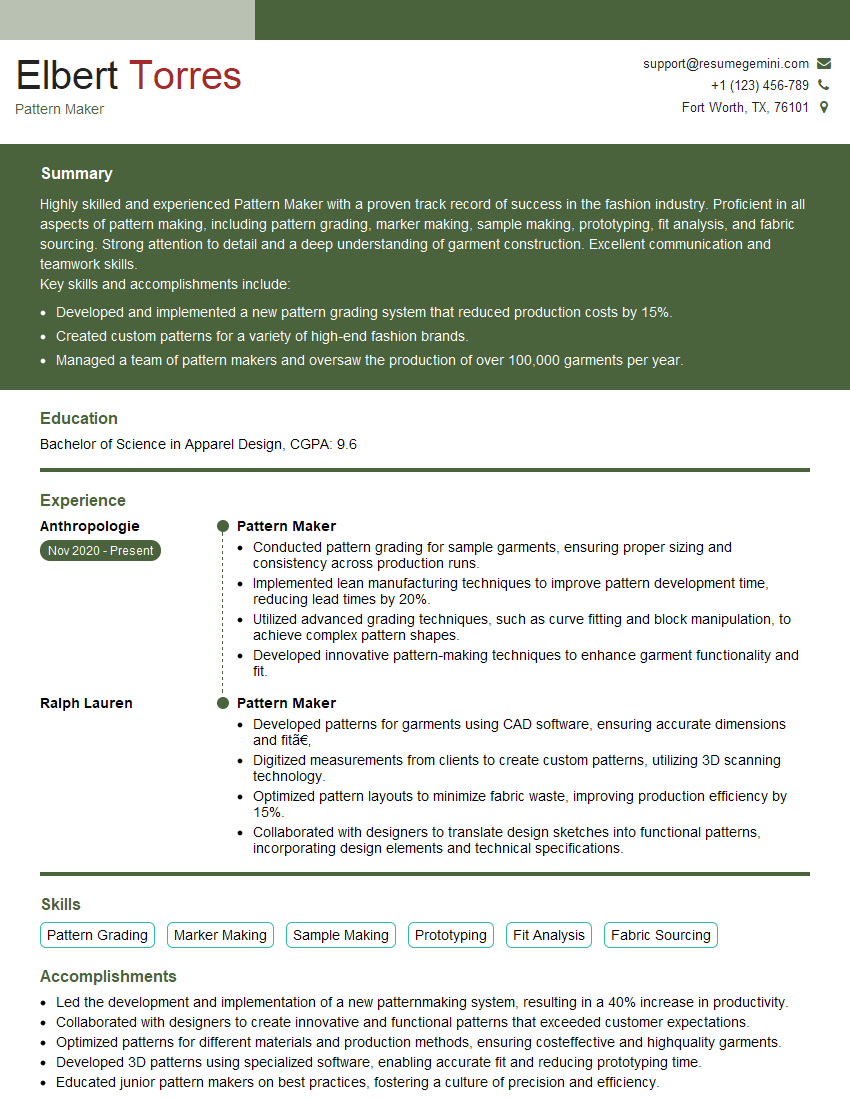
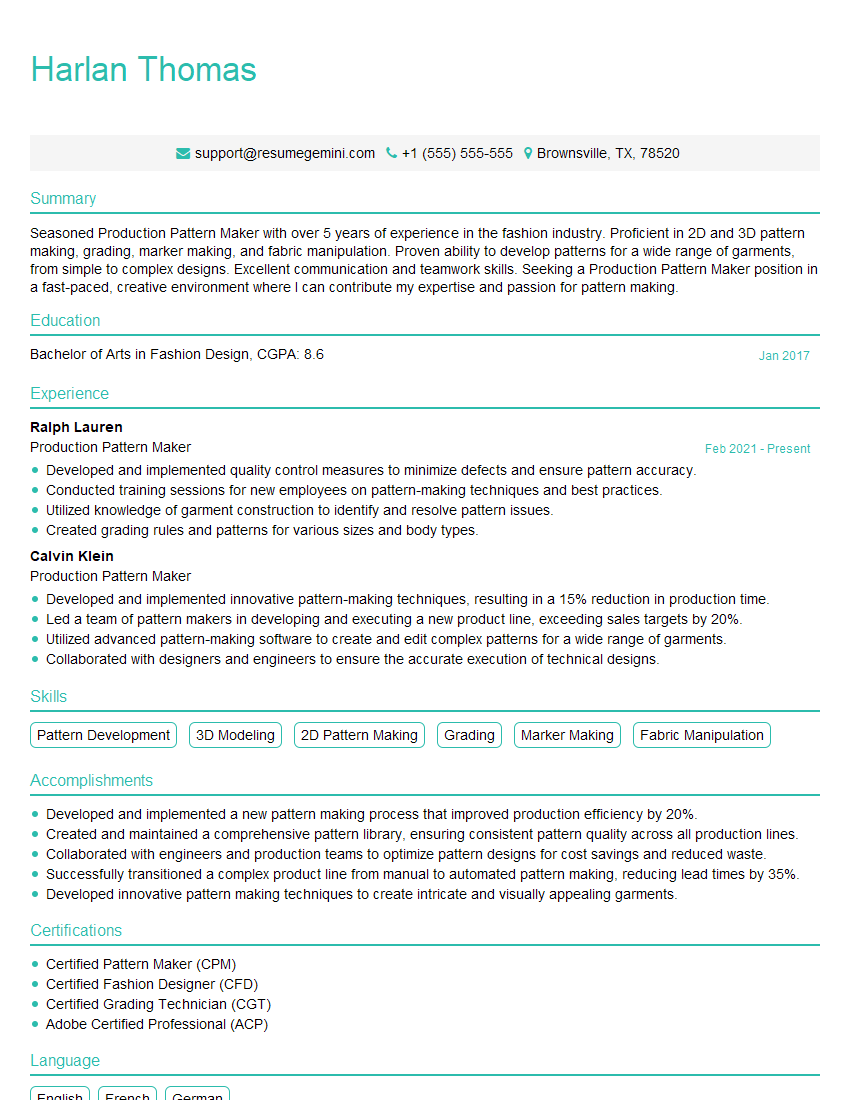
Mastering garment measurements is crucial for success in the fashion industry, opening doors to diverse roles and career advancement opportunities. A strong understanding of these concepts demonstrates precision, attention to detail, and problem-solving skills – highly valued attributes in this field. To maximize your job prospects, create an ATS-friendly resume that highlights your skills and experience effectively. ResumeGemini is a trusted resource that can help you build a professional and impactful resume. We offer examples of resumes tailored to Garment Measurements to guide you in showcasing your expertise.



Explore more articles
Users Rating of Our Blogs
Share Your Experience
We value your feedback! Please rate our content and share your thoughts (optional).
What Readers Say About Our Blog
Very informative content, great job.
good