Interviews are opportunities to demonstrate your expertise, and this guide is here to help you shine. Explore the essential Geographic Information Systems (GIS) Knowledge interview questions that employers frequently ask, paired with strategies for crafting responses that set you apart from the competition.
Questions Asked in Geographic Information Systems (GIS) Knowledge Interview
Q 1. Explain the difference between vector and raster data.
Vector and raster data are two fundamental ways of representing geographic information in a GIS. Think of it like drawing a map: vector data is like using precise lines and points to draw features, while raster data is like using a grid of colored pixels to create an image.
- Vector Data: Represents geographic features as points, lines, and polygons. Each feature has precise coordinates and can store attributes (e.g., a point representing a well might store its depth and water quality). Vector data is ideal for representing discrete objects with clearly defined boundaries, such as roads, buildings, or rivers. It’s typically smaller in file size and allows for more accurate measurements.
- Raster Data: Represents geographic information as a grid of cells or pixels, each with a value representing a specific attribute. This is like a digital photograph of the Earth’s surface. Each pixel’s value could represent elevation, temperature, or land cover type. Raster data is excellent for representing continuous phenomena such as elevation, temperature, or satellite imagery. While typically larger in file size, they show spatial variation effectively.
Example: A vector map might show individual buildings as polygons, while a raster image could show the same area as a satellite image with various shades representing different building materials or land use.
Q 2. Describe your experience with different GIS software packages (e.g., ArcGIS, QGIS).
I have extensive experience with both ArcGIS and QGIS, having used them for diverse projects spanning various scales and applications. In ArcGIS, I’m proficient in utilizing ArcMap, ArcGIS Pro, and its various extensions like Spatial Analyst and Geostatistical Analyst for tasks ranging from geoprocessing and spatial analysis to data visualization and cartography. I’ve leveraged ArcGIS’s robust geodatabase capabilities for managing and analyzing large datasets.
My QGIS experience includes data management, processing using the Processing Toolbox, creating custom scripts using Python, and generating high-quality maps. I appreciate QGIS’s open-source nature and its extensive plugin library, which provides flexibility and customizability. For instance, I’ve used QGIS plugins for specific tasks like raster analysis and hydrological modeling that weren’t readily available in ArcGIS. The choice between ArcGIS and QGIS usually depends on the project’s budget, the availability of specific extensions or plugins, and the data’s volume and complexity.
I’ve also had the opportunity to work with other GIS software, including ERDAS Imagine for image processing and Google Earth Engine for big data analysis, allowing me a broad understanding of GIS software capabilities.
Q 3. How do you handle spatial data errors and inconsistencies?
Handling spatial data errors and inconsistencies is crucial for ensuring the accuracy and reliability of GIS analysis. This involves a multi-step approach:
- Data Validation: This initial step uses tools and techniques to identify errors such as topological inconsistencies (e.g., overlapping polygons), attribute errors (e.g., missing or incorrect values), or positional inaccuracies. Both visual inspection and automated checks are employed.
- Data Cleaning: Once errors are identified, they need to be corrected. This might involve editing the geometry of features, updating attribute tables, or using data cleaning tools to resolve discrepancies. The complexity of the cleaning will depend on the nature and scale of the errors.
- Data Transformation: For issues arising from inconsistencies between different datasets (e.g., varying coordinate systems, different projection), transformations are essential. Tools within GIS software allow for reprojection and coordinate system conversions.
- Error Propagation Assessment: Recognizing that errors can propagate through analysis, an assessment of their potential impacts is important. Techniques like error modeling can help quantify this uncertainty.
For example, I once encountered a dataset with overlapping polygons representing land parcels. I used ArcGIS’s topology tools to identify and fix these overlaps, ensuring that the analysis based on this corrected dataset was accurate and reliable.
Q 4. What are the common file formats used in GIS?
GIS uses a variety of file formats, each suited for different data types and applications.
- Shapefile (.shp): A widely used vector format storing point, line, and polygon geometries along with attribute data. It’s not a single file but rather a collection of files (.shp, .shx, .dbf, etc.).
- Geodatabase (.gdb): ArcGIS’s native format; a powerful and efficient way to store and manage both vector and raster data within a single database. It can handle complex data relationships and offers advanced data management capabilities.
- GeoJSON (.geojson): A text-based, open standard format for representing geographic data. It’s increasingly popular due to its web compatibility.
- GeoTIFF (.tif, .tiff): A widely used raster format that supports georeferencing and metadata, storing raster data with location information.
- Raster formats (other): Various formats exist such as ERDAS IMAGINE (.img), MrSID (.sid), and many more specialized formats.
The choice of file format often depends on the GIS software used, the data’s complexity, and the intended application.
Q 5. Explain the concept of georeferencing.
Georeferencing is the process of assigning geographic coordinates (latitude and longitude) to points on an image or map that doesn’t already have them. It’s essentially the act of linking a map or image to a known coordinate system. This allows you to overlay and analyze the image or map with other geospatial data.
Think of it like adding location information to a photograph. If you just have a picture, you don’t know where it was taken. Georeferencing is the act of finding that location. This is typically done by identifying control points – points with known coordinates – on the image and corresponding points on a reference map. The software then uses these control points to transform the image coordinates into a geographic coordinate system.
This process is crucial for integrating scanned maps, aerial photos, or satellite images into a GIS, ensuring their spatial alignment with other geographic data.
Q 6. What is spatial analysis and how is it applied in GIS?
Spatial analysis is the process of manipulating, analyzing, and visualizing geographic data to understand spatial patterns, relationships, and processes. It involves a wide range of techniques used to answer questions about ‘where’ things are, ‘how’ they are distributed, ‘why’ they are located in certain areas, and ‘what’ might happen in the future.
In a GIS environment, spatial analysis is performed using various tools and functions. Common examples include:
- Buffering: Creating zones around features (e.g., creating a buffer around a river to identify the flood plain).
- Overlay analysis: Combining multiple layers to identify areas that meet specific criteria (e.g., finding areas suitable for development that meet criteria for proximity to roads, water availability, and suitable soil conditions).
- Network analysis: Analyzing networks such as roads or pipelines to find the shortest routes or optimal flow patterns.
- Proximity analysis: Determining the distances and proximity between features (e.g., finding the nearest hospitals to a residential area).
Real-world Application: Spatial analysis can be used to predict the spread of wildfires, optimize delivery routes, plan urban development, assess environmental risks, or identify disease hotspots.
Q 7. Describe your experience with spatial interpolation techniques.
Spatial interpolation is a technique used to estimate values at unsampled locations based on known values at sampled locations. Imagine you have temperature readings from a few weather stations; interpolation helps estimate temperatures at locations between those stations. This is crucial because we rarely have data for every single point on Earth.
I have experience using several interpolation methods, including:
- Inverse Distance Weighting (IDW): A simple method that estimates values based on the inverse of the distance to known points. Closer points have a greater influence.
- Kriging: A more sophisticated geostatistical method that considers spatial autocorrelation (the correlation between values at different locations) and generates an estimate with associated uncertainty.
- Spline interpolation: Creates a smooth surface that passes through or near known points. It’s suitable for creating smooth surfaces like elevation models.
The choice of method depends on the data’s characteristics and the desired level of accuracy. For instance, Kriging is often preferred when spatial autocorrelation is significant, while IDW might be sufficient for simpler applications. I’ve used these techniques in projects such as creating continuous elevation surfaces from point elevation data and predicting pollutant concentrations based on scattered measurement points.
Q 8. How do you perform data projection and coordinate transformations?
Data projection and coordinate transformation are fundamental processes in GIS. Essentially, we’re converting data from one coordinate system to another. This is crucial because the Earth’s spherical surface cannot be accurately represented on a flat map without distortion. We use different projections to minimize specific types of distortion depending on the application. The process usually involves two steps:
- Defining the source and target coordinate systems: This includes specifying the datum (a reference surface approximating the Earth’s shape), projection type (e.g., UTM, Mercator, Albers), and units (e.g., meters, feet).
- Applying the transformation: This is done using GIS software. The software uses mathematical formulas to recalculate the coordinates of each point in the dataset, transforming them from the source to the target coordinate system. Software like ArcGIS Pro or QGIS offer robust tools to manage this.
For example, imagine you have a dataset of GPS coordinates (latitude and longitude, typically in WGS 84 datum) that you need to overlay on a map projected using UTM. You would use a coordinate transformation tool to project the GPS data into the UTM system before overlaying it. Failure to do this would result in inaccurate spatial relationships.
Sometimes, the transformation is not a simple projection but involves a datum transformation as well, since different datums represent the Earth’s shape differently. Tools handle this automatically, but understanding the implications is crucial for accurate results. Incorrect transformations can lead to significant errors in spatial analysis and distance calculations.
Q 9. Explain the difference between map projections and coordinate systems.
While often used interchangeably, map projections and coordinate systems are distinct concepts. Think of it like this: a coordinate system provides a way to locate points on a 3D surface (the Earth), while a map projection is a method for representing that 3D surface on a 2D plane (a map).
- Coordinate System: A mathematical framework defining the location of points on the Earth’s surface using coordinates (e.g., latitude and longitude, or Easting and Northing). It includes a datum, which specifies the reference ellipsoid (an approximation of the Earth’s shape), and units.
- Map Projection: A mathematical transformation that projects the 3D surface of the Earth onto a 2D plane. Because this is inherently a distortion process, different projections minimize different types of distortion (e.g., area, shape, distance). Examples include Mercator, UTM, Albers Equal-Area.
For instance, the WGS 84 coordinate system uses latitude and longitude to define locations globally, but displaying those coordinates directly on a flat map won’t be accurate. To display those locations on a map, we need to use a map projection (like the Mercator projection) which will inherently distort the shape and area of landmasses. Choosing the right projection is critical; a map projected for navigation might not be suitable for area calculations.
Q 10. What are the different types of spatial relationships?
Spatial relationships describe how geographic features relate to one another in space. Understanding these relationships is crucial for spatial analysis and querying. They can be broadly categorized as:
- Topological Relationships: These describe spatial relationships that are preserved even after geometric transformations (e.g., rotation, scaling). Examples include:
- Contains: Feature A contains Feature B.
- Intersects: Feature A intersects Feature B.
- Touches: Feature A touches Feature B at a boundary.
- Adjacent: Features share a common boundary.
- Metric Relationships: These describe spatial relationships based on geometric measurements, and are influenced by changes in scale or orientation. Examples include:
- Distance: The linear distance between two features.
- Area: The size of a polygon feature.
- Direction: The compass direction from one feature to another.
Imagine a map of roads and buildings. Topological relationships help us understand connectivity (e.g., which roads intersect), while metric relationships help us determine distances (e.g., the distance between two buildings) or proximity to features (e.g., buildings within 100 meters of a river).
Understanding these relationships is key to performing queries and analyses such as network analysis (finding the shortest route between two points), proximity analysis (identifying features within a certain distance), or overlay analysis (combining layers to identify overlapping areas).
Q 11. Describe your experience with database management in a GIS environment.
My experience with database management in a GIS environment is extensive. I’m proficient in managing both spatial and attribute data using various database management systems (DBMS). I’ve worked with relational databases like PostgreSQL/PostGIS, spatial databases like Oracle Spatial, and file geodatabases (in ArcGIS). My work routinely involves:
- Database design: Creating efficient and robust database schemas that accommodate both spatial and attribute data. This involves carefully considering data types, indexes, and relationships to optimize query performance.
- Data import and export: Efficiently importing data from various sources (e.g., shapefiles, CSV, databases) into a GIS environment. Similarly, exporting data in various formats for use in other applications.
- Data manipulation and querying: Using SQL and GIS-specific functions to query, update, and manipulate spatial and attribute data. This includes performing complex spatial queries (e.g., finding features within a certain distance).
- Data integrity: Implementing measures to ensure data consistency and accuracy within the database, including data validation rules and constraints.
For instance, in a recent project, I designed a PostgreSQL/PostGIS database to manage land parcel information, including spatial data (parcel boundaries) and attribute data (owner information, property value). The design incorporated spatial indexes to accelerate spatial queries, and data validation rules were implemented to ensure data consistency.
Q 12. How do you ensure data quality and accuracy in GIS projects?
Ensuring data quality and accuracy is paramount in GIS projects. Inaccurate data leads to flawed analyses and decision-making. My approach involves a multi-faceted strategy:
- Data Source Evaluation: Critically assessing the reliability and accuracy of data sources before incorporating them into the project. This includes considering the source’s methodology, data resolution, and potential biases.
- Data Cleaning and Preprocessing: Identifying and correcting errors, inconsistencies, and outliers in the data before analysis. This often involves using tools for spatial data editing and attribute data manipulation.
- Data Validation and Verification: Implementing validation rules and checks to ensure data integrity. This may involve field checking or comparing data against other reliable sources.
- Metadata Management: Maintaining comprehensive metadata describing the data’s origin, processing steps, and limitations, to ensure transparency and reproducibility.
- Quality Control (QC) Checks: Regularly performing QC checks during and after data processing to detect and address errors. This can involve visual inspection of maps, statistical analysis, and using GIS tools to identify anomalies.
For example, when working with aerial imagery, I would use tools to check for geometric distortions, and I’d incorporate ground control points to georeference the imagery accurately. Similarly, for attribute data, I would perform data validation checks to ensure consistency and identify potential errors.
Q 13. What is your experience with remote sensing data?
I have extensive experience working with remote sensing data, including satellite imagery and aerial photography. My experience encompasses:
- Image Preprocessing: Performing tasks such as geometric correction, atmospheric correction, and orthorectification to prepare imagery for analysis.
- Image Classification: Using supervised and unsupervised classification techniques to extract thematic information from imagery (e.g., land cover classification, change detection).
- Image Analysis: Using various techniques to extract information from imagery, such as NDVI calculation (Normalized Difference Vegetation Index) for vegetation health analysis or object-based image analysis.
- Data Integration: Combining remote sensing data with other GIS data layers for integrated analysis and modeling.
- Software Proficiency: Proficient in using software like ERDAS Imagine, ENVI, and ArcGIS for processing and analyzing remote sensing data.
In a past project, I used Landsat imagery to monitor deforestation in a rainforest region. I performed image classification to identify forest and non-forest areas, and then used change detection techniques to identify areas of forest loss over time. This involved careful pre-processing steps to ensure the accuracy of the results.
Q 14. How do you create and manage geodatabases?
Geodatabases are the fundamental data storage structures in many GIS workflows. My experience includes creating and managing them effectively:
- Design: Designing geodatabases to accommodate specific project requirements, considering data structure, data types, and relationships between datasets. This involves creating feature classes, tables, and establishing appropriate relationships.
- Implementation: Implementing geodatabases using various platforms like ArcGIS Enterprise or file geodatabases. This involves using geodatabase management tools to create and configure the database.
- Data Management: Effectively managing data within the geodatabase, including data import, update, and versioning. Versioning is crucial for collaborative projects to track changes and manage concurrent edits.
- Data Optimization: Implementing strategies to optimize geodatabase performance, such as creating indexes and using appropriate data types. This can significantly improve query speeds and overall efficiency.
- Backup and Recovery: Implementing robust backup and recovery strategies to protect the geodatabase from data loss or corruption.
For example, in a large-scale urban planning project, I designed a geodatabase to store diverse datasets – from road networks and land use to utility infrastructure. I implemented a versioning system to support concurrent editing by multiple team members and maintain data integrity throughout the project lifecycle.
Q 15. Explain your understanding of topology in GIS.
Topology in GIS refers to the spatial relationships between geographic features. It’s not just about where features are located (their coordinates), but also how they connect and relate to each other. Think of it like a sophisticated map of how things are connected, going beyond simple proximity. For example, topology defines whether two polygons share a boundary, if lines intersect, or if points are contained within polygons. This information is crucial for various GIS operations.
- Connectivity: Topology ensures that lines correctly connect to form networks (like roads or rivers). Without it, a line might appear broken, even if the data is continuous.
- Adjacency: It establishes which features are neighbors. This is important for tasks such as identifying contiguous land parcels or calculating buffer zones.
- Containment: Topology shows whether points fall within polygons (e.g., a point representing a house inside a polygon representing a neighborhood).
Imagine trying to calculate the shortest route between two locations using a road network. Topology ensures the GIS software understands which roads connect to which, allowing accurate route calculation. Without a topologically correct dataset, the software might fail to find a valid route, or calculate an incorrect one.
Career Expert Tips:
- Ace those interviews! Prepare effectively by reviewing the Top 50 Most Common Interview Questions on ResumeGemini.
- Navigate your job search with confidence! Explore a wide range of Career Tips on ResumeGemini. Learn about common challenges and recommendations to overcome them.
- Craft the perfect resume! Master the Art of Resume Writing with ResumeGemini’s guide. Showcase your unique qualifications and achievements effectively.
- Don’t miss out on holiday savings! Build your dream resume with ResumeGemini’s ATS optimized templates.
Q 16. What are your skills in cartography and map design?
My cartography and map design skills encompass the entire map-making process, from data collection and preparation to the final product’s visual presentation. I’m proficient in various map projection techniques, selecting the appropriate projection based on the area of interest and purpose of the map. For example, a Mercator projection is suitable for navigation, while Albers equal-area projection is better for representing area accurately. Beyond projections, I’m adept at:
- Symbology: Choosing effective visual symbols (points, lines, polygons) and colors to clearly convey information.
- Layout and Design: Creating visually appealing and informative maps with clear legends, titles, and scale bars.
- Cartographic Generalization: Simplifying complex features for optimal representation at different scales. For example, condensing numerous small roads into a single line representing a general road network.
- Software Proficiency: I’m experienced in using ArcGIS Pro, QGIS, and other GIS software packages for map creation and manipulation.
In a recent project, I created a thematic map illustrating the distribution of poverty levels across a city. By carefully selecting color ramps and symbology, I was able to effectively highlight areas with high poverty concentration, guiding policy decisions for resource allocation.
Q 17. Describe your experience with spatial statistics.
My experience in spatial statistics involves using statistical methods to analyze geographically referenced data. I’m familiar with techniques such as:
- Spatial autocorrelation: Assessing the degree to which nearby locations exhibit similar values. For example, identifying spatial clustering of disease outbreaks.
- Geographically Weighted Regression (GWR): Accounting for spatial non-stationarity by allowing regression coefficients to vary across space. This is beneficial for scenarios where relationships between variables change geographically.
- Point pattern analysis: Analyzing the spatial distribution of points, such as determining if points are randomly distributed, clustered, or dispersed. For example, analyzing the spatial pattern of crime incidents to identify hotspots.
- Spatial interpolation: Estimating values at unsampled locations based on the values at nearby sampled locations. For example, creating a surface representing rainfall intensity based on limited rainfall gauge data.
In one project, I used spatial autocorrelation to identify areas with high concentrations of air pollution, informing the placement of air quality monitoring stations. Understanding spatial statistics enables making data-driven, location-specific decisions.
Q 18. How do you handle large datasets in GIS?
Handling large datasets in GIS requires employing strategies to efficiently manage and process information. The key is to avoid loading the entire dataset into memory at once. My approach involves:
- Data Subsetting: Working with smaller portions of the data at a time, focusing on the area of interest.
- Spatial Indexing: Using spatial indexes (like R-trees or quadtrees) to quickly locate features based on their spatial location.
- Database Management Systems (DBMS): Utilizing geospatial databases such as PostGIS or Oracle Spatial to efficiently store, manage, and query large spatial datasets.
- Data Compression: Employing compression techniques to reduce the storage space required and improve data transfer times.
- Parallel Processing: Leveraging multi-core processors and distributed computing environments to distribute processing tasks across multiple cores or machines, significantly speeding up the analysis of large datasets.
For instance, when analyzing a large dataset of land cover for an entire country, I might divide the dataset into smaller regions for analysis, using parallel processing techniques to analyze each region concurrently.
Q 19. What is your experience with GPS data and its integration with GIS?
My experience with GPS data and its integration with GIS is extensive. I understand the various GPS data formats (e.g., GPX, KML) and techniques for importing and processing this data. This includes:
- Data Cleaning: Identifying and correcting errors and inconsistencies in GPS data, such as outliers and gaps in tracking. This often involves filtering and smoothing techniques.
- Georeferencing: Assigning geographic coordinates to GPS data so that it can be correctly displayed and analyzed in a GIS.
- GPS Error Analysis: Understanding and accounting for the inherent errors in GPS data, which can result from atmospheric conditions and signal interference.
- Integration with other GIS data: Combining GPS data with other spatial layers to perform analysis, such as overlaying GPS tracks of animal movement on a habitat map.
In one project, I used GPS data from a fleet of delivery trucks to optimize delivery routes. By integrating the GPS tracks with street network data, I was able to identify areas with congestion and propose more efficient routes, reducing delivery times and fuel consumption.
Q 20. Describe a challenging GIS project you worked on and how you overcame the challenges.
One particularly challenging GIS project involved creating a flood risk assessment model for a coastal region. The challenge stemmed from the vast amount of diverse data, including elevation models, rainfall data, sea level rise projections, and historical flood records, often in different formats and coordinate systems. Furthermore, the region had complex topography and intricate drainage patterns.
To overcome these challenges, I employed a systematic approach:
- Data Integration and Preprocessing: I spent significant time cleaning, transforming, and integrating the data using a variety of GIS tools. This included georeferencing, data projection, and format conversion.
- Hydrological Modeling: I utilized hydrological modeling software to simulate water flow across the landscape, considering the terrain and drainage networks. This involved calibrating the model using historical flood data.
- Flood Inundation Mapping: Based on the hydrological model’s output, I created flood inundation maps illustrating areas at risk of flooding under different flood scenarios.
- Uncertainty Analysis: To account for uncertainty in the input data and model parameters, I conducted sensitivity analysis and uncertainty propagation to provide more robust and reliable flood risk estimates.
The final product was a comprehensive flood risk assessment map that helped local authorities develop effective flood mitigation strategies, demonstrating the power of integrated GIS techniques to solve complex real-world problems.
Q 21. What are your skills in Python scripting for GIS?
My Python scripting skills for GIS are strong. I’m proficient in using libraries like geopandas, shapely, rasterio, and arcpy to automate GIS tasks and perform advanced spatial analysis. This includes:
- Data Processing and Manipulation: Automating tasks such as data cleaning, conversion, and projection.
- Spatial Analysis: Performing complex spatial analyses such as overlay analysis, network analysis, and spatial interpolation.
- Map Automation: Creating automated map generation workflows to produce consistent and reproducible maps.
- Geoprocessing: Automating geoprocessing tasks within ArcGIS using the
arcpylibrary.
For example, I’ve developed a Python script that automatically processes satellite imagery, extracts relevant features, and classifies land cover types, significantly reducing the time and effort required for manual interpretation. A code snippet illustrating basic shapefile manipulation with geopandas is:
import geopandas as gpd
gdf = gpd.read_file('shapefile.shp')
print(gdf.head())
This is a very basic example. My scripts often involve more complex operations and incorporate error handling and efficient data management.
Q 22. Explain your understanding of spatial indexing and its benefits.
Spatial indexing is a crucial technique in GIS that significantly speeds up spatial queries. Think of it like creating an index in a book – instead of searching page by page, you use the index to quickly locate a specific topic. Similarly, spatial indexing structures organize spatial data (points, lines, polygons) to allow for efficient searching and retrieval of features based on their location.
Common spatial indexing methods include R-trees, Quadtrees, and Grid Indexes. R-trees, for example, organize spatial objects into hierarchical tree structures, bounding boxes representing clusters of objects. This allows for quicker elimination of irrelevant areas during a search.
Benefits:
- Improved Query Performance: Significantly reduces the time it takes to retrieve data based on location, especially with large datasets.
- Enhanced Efficiency: Enables faster processing of spatial operations, such as overlay analysis and proximity searches.
- Scalability: Allows efficient handling of growing datasets without a corresponding increase in processing time.
Example: Imagine searching for all fire hydrants within a 500-meter radius of a given location. Without spatial indexing, the system would have to compare the distance of every hydrant in the database. With spatial indexing, the system can quickly identify the potential candidates within the approximate region defined by the index and only then perform the precise distance calculation.
Q 23. What is your experience with cloud-based GIS platforms?
I have extensive experience with cloud-based GIS platforms, primarily using Amazon Web Services (AWS) with its offerings like Amazon S3 for data storage, and ArcGIS Online. I’ve utilized these platforms for large-scale projects, managing and processing terabytes of geospatial data. My experience includes data management, implementing and optimizing geoprocessing workflows, and deploying web-based GIS applications.
One specific example involved processing satellite imagery for a land-use change analysis project covering a large region. Using cloud-based services allowed for parallel processing, reducing the overall analysis time from weeks to days. This greatly improved efficiency and reduced the computational burden on local resources. Furthermore, I am familiar with the security and scalability benefits that cloud platforms offer, managing access control and resource allocation appropriately.
Q 24. How familiar are you with open-source GIS software?
I’m highly proficient in several open-source GIS software packages, most notably QGIS and PostGIS. QGIS provides a robust desktop environment for data visualization, analysis, and management, while PostGIS extends PostgreSQL to handle spatial data types, enabling powerful spatial database operations.
In a recent project, we used QGIS to process and analyze elevation data, creating contour lines and slope maps. The open-source nature of QGIS allowed for collaboration and customization. Meanwhile, PostGIS powered the back-end spatial database, enabling complex spatial queries on millions of features quickly and efficiently. My experience extends to scripting and automation using Python within these environments to streamline workflows.
Q 25. Describe your experience working with different types of spatial queries.
My experience with spatial queries encompasses a wide range of techniques, including:
- Buffer Analysis: Determining areas within a specific distance of a feature (e.g., finding houses within 1km of a school).
- Spatial Joins: Combining data from different layers based on spatial relationships (e.g., associating properties with their census tracts).
- Overlay Analysis: Combining multiple layers to identify areas of overlap or difference (e.g., intersecting land use with floodplains).
- Nearest Neighbor Search: Identifying the closest feature to a given point (e.g., finding the nearest hospital to an accident).
- Spatial Selection: Selecting features based on their location or attributes (e.g., identifying all buildings in a specific zone).
I’m proficient in using SQL (with PostGIS extensions) and various GIS software tools to perform these queries efficiently. I am also skilled in optimizing query performance by using appropriate spatial indexes and selecting the most effective query strategies.
Q 26. Explain your understanding of LiDAR data and its applications.
LiDAR (Light Detection and Ranging) is a remote sensing technology that measures distance to a target by illuminating the target with pulsed laser light and measuring the reflected pulses. This produces highly accurate three-dimensional data representing the Earth’s surface.
Applications:
- Elevation Modeling: Creating detailed Digital Elevation Models (DEMs) for various applications such as hydrological modeling, terrain analysis, and visualization.
- Forestry: Measuring tree heights and canopy density for forest inventory and management.
- Urban Planning: Creating highly accurate 3D models of urban areas for infrastructure planning and development.
- Archaeology: Detecting buried features and structures that are not visible on the surface.
- Disaster Response: Assessing damage after natural disasters such as floods or earthquakes.
My experience involves processing and analyzing LiDAR point clouds using software such as ArcGIS Pro and specialized LiDAR processing tools. I’m familiar with data cleaning techniques, classification methods, and the creation of various LiDAR-derived products.
Q 27. How do you ensure data security and privacy in a GIS environment?
Data security and privacy are paramount in GIS. My approach involves a multi-layered strategy:
- Access Control: Implementing robust access control mechanisms to restrict data access based on roles and permissions. This could include using role-based access control (RBAC) within the GIS software or integrating with enterprise security systems.
- Data Encryption: Encrypting sensitive data both at rest and in transit using appropriate encryption algorithms and protocols. This protects data from unauthorized access, even if a breach occurs.
- Data Anonymization and Generalization: Techniques such as data aggregation and generalization can help protect individual privacy by reducing the level of detail in the data while maintaining its utility for analysis.
- Regular Audits and Monitoring: Conducting regular security audits and monitoring system logs to detect and respond to potential security threats.
- Compliance: Adhering to relevant data privacy regulations and standards, such as GDPR or CCPA.
For example, when working with sensitive location data, I would employ techniques such as replacing exact coordinates with generalized locations or using differential privacy methods to reduce the risk of re-identification.
Q 28. What are your future aspirations regarding GIS technology?
My future aspirations involve deepening my expertise in the intersection of GIS and emerging technologies. I’m particularly interested in exploring the potential of AI and machine learning for automating geospatial tasks, such as feature extraction from imagery, predictive modeling for urban growth, and real-time spatial analysis for disaster response. I also hope to contribute to the development and implementation of open-source GIS tools and frameworks, making advanced spatial technologies accessible to a broader community.
Specifically, I am keen to learn more about the application of deep learning techniques for object detection in high-resolution satellite imagery, aiming to automate the mapping of infrastructure and land cover. I also anticipate the increasing importance of spatio-temporal data analysis, requiring a deeper understanding of time series modeling and analysis within a GIS context.
Key Topics to Learn for Geographic Information Systems (GIS) Knowledge Interview
- Spatial Data Models: Understanding vector and raster data, their strengths and weaknesses, and when to apply each.
- Data Acquisition and Processing: Familiarize yourself with various data sources (e.g., GPS, LiDAR, satellite imagery), data cleaning techniques, and geoprocessing workflows.
- Geographic Coordinate Systems and Projections: Mastering concepts like datum, ellipsoid, and map projections, and their impact on spatial analysis.
- Spatial Analysis Techniques: Develop proficiency in techniques such as overlay analysis, buffering, network analysis, and spatial statistics. Be prepared to discuss practical applications.
- GIS Software Proficiency: Showcase your expertise in commonly used GIS software (e.g., ArcGIS, QGIS). Highlight specific functionalities and projects you’ve completed.
- Cartography and Visualization: Demonstrate your ability to create clear, effective, and visually appealing maps that communicate spatial information effectively.
- Database Management Systems (DBMS) in GIS: Understanding the role of databases in storing and managing spatial data, including relational database concepts.
- Remote Sensing Principles: For advanced roles, understanding fundamental remote sensing concepts and image processing techniques is crucial.
- Problem-Solving and Analytical Skills: Be prepared to discuss how you approach complex spatial problems and use GIS tools to find solutions. Showcase your analytical thinking.
- Ethical Considerations in GIS: Understand the ethical implications of spatial data use and privacy concerns.
Next Steps
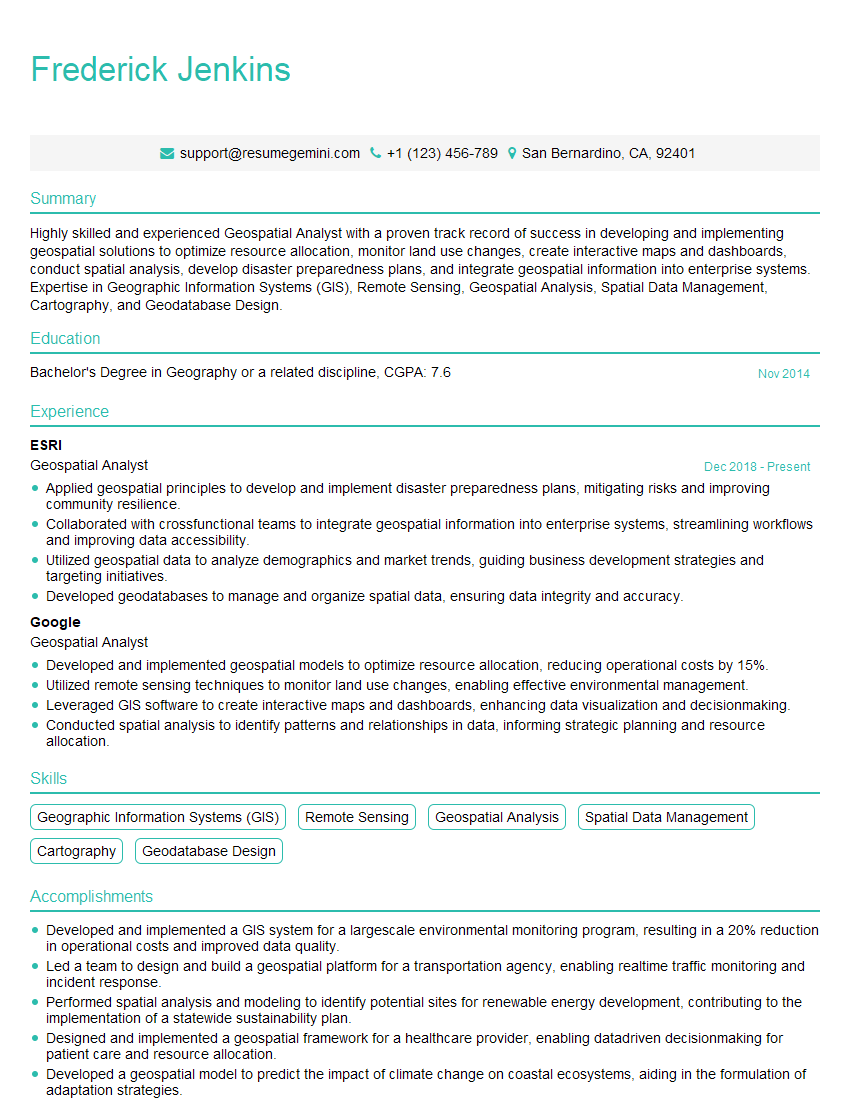
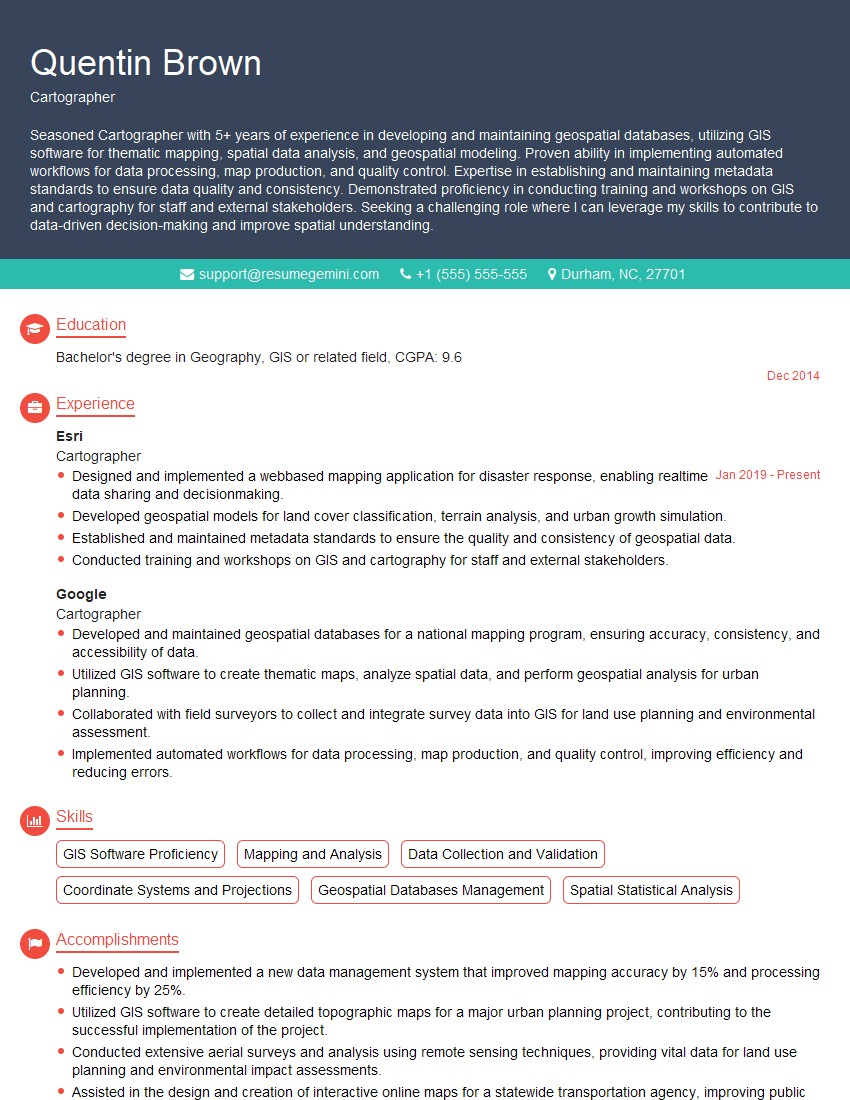
Mastering Geographic Information Systems (GIS) knowledge is essential for career advancement in this rapidly growing field. A strong understanding of these concepts will open doors to exciting opportunities and higher earning potential. To maximize your job prospects, it’s crucial to present your skills effectively. Creating an ATS-friendly resume is key to getting your application noticed. We highly recommend using ResumeGemini to build a professional and impactful resume. ResumeGemini provides examples of resumes tailored to Geographic Information Systems (GIS) Knowledge, helping you showcase your skills and experience in the best possible light.
Explore more articles
Users Rating of Our Blogs
Share Your Experience
We value your feedback! Please rate our content and share your thoughts (optional).
What Readers Say About Our Blog
Very informative content, great job.
good