Are you ready to stand out in your next interview? Understanding and preparing for Geophysical Prospecting interview questions is a game-changer. In this blog, we’ve compiled key questions and expert advice to help you showcase your skills with confidence and precision. Let’s get started on your journey to acing the interview.
Questions Asked in Geophysical Prospecting Interview
Q 1. Explain the difference between reflection and refraction seismic methods.
Both reflection and refraction seismic methods utilize seismic waves to image subsurface structures, but they differ in how they interpret the wave behavior. Reflection seismology focuses on the reflected waves that bounce back from subsurface interfaces (boundaries between layers with different acoustic impedance). Think of it like shining a flashlight into a pool – you see the reflection off the water’s surface. Refraction seismology, conversely, measures the refracted waves that bend as they pass through different layers. Imagine a stick partially submerged in water – the light bends at the water’s surface.
In practice, reflection methods are far more common for hydrocarbon exploration because they provide higher resolution images of subsurface structures. Refraction methods are often used for shallower investigations, such as determining the depth to bedrock or mapping near-surface geological features, as they are more effective in detecting the layers which the waves pass through.
In short: Reflection surveys ‘see’ the interfaces; refraction surveys ‘see’ the layers themselves.
Q 2. Describe the principle of operation of a gravity meter.
A gravity meter measures subtle variations in the Earth’s gravitational field. These variations arise from differences in the density of subsurface rocks. Denser rocks exert a stronger gravitational pull than less dense rocks. The instrument essentially measures the acceleration due to gravity at a specific location.
A common type is the spring-based gravity meter, which uses a spring to support a mass. Changes in gravity cause the spring to stretch or compress, and this displacement is precisely measured. Another type uses a pendulum. Modern instruments use very sensitive accelerometers and sophisticated corrections to account for various environmental factors such as the Earth’s tides and the instrument’s own drift.
By carefully measuring the gravity at numerous locations across a survey area, geophysicists can create a gravity map. Anomalies (variations from the expected regional gravity) can indicate the presence of dense ore bodies, buried geological structures, or variations in sedimentary layers. For example, a positive gravity anomaly might indicate a dense salt dome, while a negative anomaly could suggest a lighter sedimentary basin.
Q 3. What are the different types of seismic waves and how are they used in exploration?
Seismic waves are elastic waves that propagate through the Earth. Several types are important in exploration:
- P-waves (Primary waves): These are compressional waves, meaning the particles in the rock vibrate parallel to the direction of wave propagation. They are the fastest seismic waves and the first to arrive at a geophone. Think of a slinky being pushed and pulled – the compression and rarefaction travels along the slinky.
- S-waves (Secondary waves): These are shear waves, where particles vibrate perpendicular to the direction of wave propagation. They travel slower than P-waves and cannot propagate through liquids. Imagine shaking a rope up and down – the wave travels along the rope, but the rope itself moves perpendicular to the wave direction.
- Surface waves: These waves travel along the Earth’s surface. Examples include Rayleigh waves (rolling motion) and Love waves (horizontal shear). They are generally slower than P and S-waves but often have larger amplitudes.
In exploration, P-waves are primarily used because of their higher speed and ability to travel through all materials. S-waves are also used to aid in distinguishing between different rock types. Surface waves are sometimes used, but they can often cause problems when interpreting reflection surveys.
Q 4. How do you correct for static shifts in seismic data?
Static shifts in seismic data refer to time shifts in seismic traces that are not related to subsurface geology. They are caused by variations in the near-surface elevation, weathering layer thickness, and seismic velocity near the surface. This can result in an inaccurate image of the subsurface because the shifts introduce inconsistency in arrival times of the reflection events.
Correcting for static shifts is crucial for accurate seismic imaging. Several methods are used:
- Elevation static corrections: Account for differences in elevation between geophones and shot points.
- Refraction statics corrections: Refraction surveys are often used to model near-surface velocity variations and apply corrections based on this information.
- Well velocity surveys: Use sonic logs from boreholes to determine velocity in near-surface layers.
- Surface-consistent processing: This method identifies and applies corrections based on consistent patterns in the static shifts across different shot and receiver gathers.
Often a combination of these methods is needed for optimal results. The goal is to create a seismic section where reflections are aligned correctly in time, resulting in a sharper and more accurate image of the subsurface.
Q 5. Explain the concept of velocity analysis in seismic processing.
Velocity analysis is a critical step in seismic processing. It involves determining the velocity of seismic waves as they travel through the subsurface. This information is essential for correcting for the time it takes for waves to travel through different layers and to correctly stack and image the seismic reflections.
The process typically involves creating a velocity spectrum or semblance panel where different velocity values are tested to determine which best aligns the reflections from different offsets (distances between shot and receiver). This technique is often done using what is known as Common Midpoint (CMP) gathers. Common methods are Constant Velocity stacks, NMO (Normal Moveout) corrections, followed by further analysis to generate a velocity model.
An accurate velocity model is crucial for generating a high-quality seismic image. Errors in velocity analysis can lead to distorted images and misinterpretations of subsurface structures. For example, an incorrect velocity model might lead to the misidentification of a fault or a reservoir boundary.
Q 6. Describe the various types of well logs and their applications.
Well logs are measurements of various physical properties of rocks taken in boreholes. They provide crucial data for subsurface characterization and reservoir evaluation.
- Gamma ray logs: Measure natural radioactivity, helping identify lithology and distinguish between shale (high radioactivity) and sandstone or limestone (low radioactivity).
- Neutron logs: Measure the hydrogen index of rocks, providing information on porosity and fluid content. Hydrogen rich materials appear more porous and/or fluid filled.
- Density logs: Measure bulk density of formations, which helps determine porosity and lithology.
- Sonic logs: Measure the time it takes for a sound wave to travel through the formation, providing information on rock velocity, porosity, and lithology.
- Resistivity logs: Measure the electrical resistance of the formation, helping identify fluid type (oil, gas, or water) within pores.
These logs are essential for various applications, including reservoir characterization, formation evaluation, well completion design, and geological modeling. For example, combining porosity and resistivity logs helps estimate hydrocarbon saturation in a reservoir rock.
Q 7. How do you interpret gamma ray logs to identify lithology?
Gamma ray logs measure the natural radioactivity of formations. Shales typically have higher radioactivity than sandstones or limestones because they contain clay minerals that are rich in radioactive isotopes like potassium, thorium, and uranium. Sandstones and limestones generally have lower radioactivity.
Therefore, a high gamma ray log reading indicates the presence of shale, while a low reading suggests sandstone or limestone. By analyzing the variations in gamma ray log values, we can identify the boundaries between different lithological units. The high gamma ray reading, or shale ‘kick’ in a well log, often indicates a change in lithology.
It’s important to note that other factors can influence gamma ray readings, so it’s essential to use gamma ray logs in conjunction with other well logs (such as neutron and density logs) for a more comprehensive understanding of the subsurface lithology.
Q 8. What are the common challenges in processing and interpreting seismic data from complex geological settings?
Processing and interpreting seismic data from complex geological settings presents numerous challenges. These complexities often arise from variations in rock properties, structural features, and the presence of noise. Imagine trying to understand a very busy, overlapping conversation – that’s similar to the difficulty of interpreting seismic reflections from a complex subsurface.
- Multiple reflections and reverberations: Seismic waves bounce multiple times between different layers, creating interfering reflections that obscure the primary reflections we are interested in. This is especially prevalent in areas with strong contrasts in acoustic impedance, like salt domes or layered sedimentary basins.
- Diffraction effects: Sharp changes in subsurface geology, such as faults or edges of bodies of rock with differing properties, cause seismic waves to diffract, creating complex wave patterns that can obscure the primary reflections.
- Attenuation: Seismic energy is absorbed and scattered as it travels through the subsurface, reducing its amplitude and resolution, particularly at depth. This makes identifying weaker reflections more challenging.
- Velocity variations: Inhomogeneous subsurface structures lead to variations in seismic wave velocities, causing distortions in the seismic image. This can lead to inaccuracies in depth conversion and structural interpretation.
- Noise: Various sources of noise, including surface waves, ambient vibrations, and electronic noise, can contaminate seismic data, making it harder to identify genuine reflections.
Addressing these challenges requires advanced processing techniques, including multiple attenuation, deconvolution, migration, and velocity modeling. Careful interpretation, integrating other data sources such as well logs and geological maps, and employing robust uncertainty assessments are also crucial for reliable subsurface imaging and reservoir characterization.
Q 9. Explain the concept of impedance inversion and its use in reservoir characterization.
Impedance inversion is a technique used to estimate the acoustic impedance of subsurface layers from seismic reflection data. Acoustic impedance is the product of rock density and seismic velocity (Z = ρv). Think of it as a measure of how much a rock resists the passage of seismic waves.
Seismic reflection data shows changes in acoustic impedance. Impedance inversion aims to quantify these changes. This is crucial in reservoir characterization because variations in impedance often reflect changes in lithology (rock type) and fluid content (e.g., presence of hydrocarbons). High impedance values may indicate the presence of hard rock or hydrocarbons, while low impedance may suggest softer rocks or water-saturated formations.
There are various types of impedance inversion techniques, including model-based inversion, which relies on pre-defined rock physics models; and stochastic inversion, which considers the uncertainty in the seismic data and the rock properties. The output of impedance inversion is a quantitative measure of impedance as a function of depth, offering valuable insights into reservoir properties, such as porosity, permeability, and hydrocarbon saturation. This is used to create detailed reservoir models for production planning and optimization. For example, a high impedance zone with specific seismic characteristics could be identified as a potential hydrocarbon reservoir.
Q 10. How do you identify and mitigate noise in seismic data?
Noise in seismic data can originate from various sources, including ambient noise (e.g., wind, traffic), instrumental noise (e.g., electronic glitches), and geological noise (e.g., surface waves). Imagine trying to hear a quiet whisper in a crowded room; that’s the challenge of extracting the desired signal from a noisy seismic dataset.
Identifying and mitigating noise requires a multi-pronged approach:
- Data-acquisition strategies: Careful planning during data acquisition, including the use of appropriate instrumentation and optimized survey parameters, is critical in minimizing noise. For instance, using geophones in a shallow borehole reduces ground roll effects.
- Processing techniques: Various processing techniques, including filtering (e.g., band-pass filtering to remove unwanted frequency components), noise attenuation techniques (e.g., f-k filtering to remove coherent noise), and predictive deconvolution, are used to suppress noise and enhance the signal-to-noise ratio. Each technique requires understanding the type of noise present and choosing the most appropriate method.
- Data analysis: Careful visual inspection of the seismic data is necessary to identify remaining noise and artefacts and select appropriate mitigation methods. We might use techniques such as editing or muting to remove obvious noise spikes.
The effectiveness of noise mitigation depends heavily on the nature and severity of the noise present. Often, multiple noise-reduction techniques are combined to achieve optimal results.
Q 11. Describe different types of seismic acquisition geometries.
Seismic acquisition geometries refer to the spatial arrangement of sources and receivers used to acquire seismic data. Different geometries are selected based on the geological setting and the desired resolution and imaging capabilities. They’re like choosing the right camera angle and lens to capture the best picture of the subsurface.
- 2D seismic surveys: Involves a linear array of sources and receivers along a single profile. Relatively inexpensive but provides only a limited view of the subsurface.
- 3D seismic surveys: Uses a 2D grid of sources and receivers to obtain a 3D volume of seismic data. Provides a significantly more complete image of the subsurface structure and properties and is often the preferred method for complex geological settings. 3D surveys are more expensive and require significant computational resources for processing.
- 4D seismic surveys: Acquires multiple 3D seismic surveys over time to monitor changes in the subsurface, such as pressure changes related to hydrocarbon production. This is typically more expensive than 3D surveys.
- Other geometries: Other geometries like wide-azimuth surveys (WAZ) and ocean bottom cable (OBC) surveys are also utilized to improve subsurface imaging resolution.
Choosing the appropriate geometry is a crucial step in seismic exploration as it directly impacts the quality and resolution of the final seismic image.
Q 12. What are the limitations of using gravity and magnetic methods for hydrocarbon exploration?
Gravity and magnetic methods, while valuable in geophysical prospecting, have limitations when it comes to direct hydrocarbon exploration. These methods measure variations in the Earth’s gravitational and magnetic fields caused by variations in subsurface density and magnetic susceptibility, respectively. Think of them as taking an indirect photograph of the subsurface.
Limitations include:
- Limited resolution: Gravity and magnetic methods have relatively low resolution compared to seismic methods. They can delineate large-scale geological structures but struggle to detect small hydrocarbon reservoirs.
- Ambiguity in interpretation: The gravity and magnetic anomalies caused by hydrocarbons are often subtle and can be masked by anomalies from other geological features with contrasting densities and magnetic susceptibilities (e.g., dense igneous rocks). This ambiguity necessitates the integration with other geophysical methods, like seismic and electromagnetic methods, for a more reliable interpretation.
- Depth of investigation: The depth of investigation is limited. Gravity and magnetic methods are primarily sensitive to shallow to medium-depth structures. Deep, subtle hydrocarbon traps might not be detectable by these methods alone.
Therefore, while gravity and magnetic methods provide valuable regional context and help identify potential geological structures, they are usually not used on their own for direct hydrocarbon exploration. They are often used in early-stage exploration to identify promising areas for more detailed surveys employing higher-resolution methods.
Q 13. Explain the principle of electromagnetic methods used in geophysical prospecting.
Electromagnetic (EM) methods in geophysical prospecting rely on measuring the response of the subsurface to electromagnetic fields. Imagine sending electromagnetic waves into the ground and then analyzing the returning signals. Different subsurface materials respond differently to these waves.
The principle involves generating an electromagnetic field, either using a controlled source (e.g., transmitting loop or dipole) or relying on naturally occurring sources, and measuring the resulting electromagnetic fields at the surface or in boreholes. The measured electromagnetic fields contain information about the electrical conductivity and permittivity of the subsurface. These properties are related to the lithology (rock type), porosity, fluid saturation, and other geological parameters.
Various EM methods exist, including:
- Controlled-source electromagnetic (CSEM): Utilizes controlled sources to generate electromagnetic fields, often employed in marine environments for hydrocarbon exploration.
- Magnetotelluric (MT): Uses naturally occurring electromagnetic fields, mainly for deeper exploration.
- Transient electromagnetic (TEM): Measures the decaying electromagnetic field after the source is switched off.
The interpretation of EM data involves analyzing the measured fields to estimate the electrical conductivity distribution in the subsurface, which can help in identifying potential hydrocarbon reservoirs or other subsurface targets.
Q 14. How do you interpret resistivity logs?
Resistivity logs are used to measure the electrical resistivity of subsurface formations. The resistivity is a measure of how easily electric current flows through the rock. High resistivity usually indicates less conductive rocks, often associated with hydrocarbon-bearing formations. Low resistivity usually means more conductive rocks, such as water-saturated formations.
Interpreting resistivity logs involves analyzing the resistivity values as a function of depth. This is done by comparing the measured resistivity values to known rock properties and using various interpretation techniques, such as:
- Identifying lithological boundaries: Changes in resistivity often mark the boundaries between different lithological units. These boundaries are easily identified by changes in the log curves.
- Estimating porosity: Porosity is often correlated with resistivity, with higher porosity usually associated with lower resistivity (unless the pore fluids are highly resistive). Using empirical relationships between porosity and resistivity, the porosity of the formations can be estimated.
- Determining fluid saturation: The resistivity of a rock is sensitive to the type and saturation of pore fluids. By analyzing resistivity logs in combination with other logs (e.g., porosity logs), the fluid saturation in a formation (e.g., water or hydrocarbon saturation) can be estimated.
- Identifying hydrocarbon reservoirs: High resistivity values coupled with low porosity can suggest the presence of hydrocarbons because hydrocarbon-saturated rocks typically exhibit higher resistivity compared to water-saturated rocks with the same porosity.
Careful interpretation of resistivity logs, often in conjunction with other well logs, is essential for accurate reservoir characterization and hydrocarbon exploration.
Q 15. What are the common software packages used in geophysical data processing and interpretation?
The geophysical industry boasts a suite of powerful software packages for data processing and interpretation. The specific choice often depends on the type of data (seismic, gravity, magnetic, etc.), the scale of the project, and the company’s established workflows. However, some industry-standard packages include:
- Seismic Unix (SU): An open-source package offering a wide range of seismic processing tools. It’s highly versatile but requires a strong programming background. Think of it as the ‘Swiss Army knife’ of seismic processing.
- Petrel (Schlumberger): A commercial, integrated platform that handles seismic interpretation, reservoir modeling, and other geoscience workflows. It’s known for its user-friendly interface and powerful visualization capabilities, making it ideal for collaborative projects.
- Kingdom (IHS Markit): Another commercial software package focusing on seismic interpretation and reservoir characterization. It offers advanced visualization and interpretation tools, often preferred for its strengths in structural interpretation.
- OpendTect (dGB Earth Sciences): This commercial software package provides a powerful and flexible environment for seismic interpretation, particularly well-suited for complex geological settings and unconventional reservoirs.
- GeoFrame (Landmark): A comprehensive suite of software for seismic and well log processing and interpretation within an integrated workflow.
Many companies also utilize custom-built software or in-house tools to streamline their specific workflows and integrate data from various sources.
Career Expert Tips:
- Ace those interviews! Prepare effectively by reviewing the Top 50 Most Common Interview Questions on ResumeGemini.
- Navigate your job search with confidence! Explore a wide range of Career Tips on ResumeGemini. Learn about common challenges and recommendations to overcome them.
- Craft the perfect resume! Master the Art of Resume Writing with ResumeGemini’s guide. Showcase your unique qualifications and achievements effectively.
- Don’t miss out on holiday savings! Build your dream resume with ResumeGemini’s ATS optimized templates.
Q 16. Describe your experience with depth conversion and velocity modeling.
Depth conversion is a crucial step in seismic imaging, transforming the two-way travel time (TWT) of seismic reflections into their depths below the surface. This relies heavily on accurate velocity modeling, which involves constructing a 3D representation of the subsurface velocity structure. My experience spans several projects where I’ve utilized both conventional and advanced techniques.
For instance, in one project involving a complex subsalt imaging challenge, we used a combination of velocity analysis techniques – including semblance and tomography – to build a detailed velocity model. We started with a simple velocity model based on well logs and then iteratively refined it by comparing the migrated image with the velocity model using techniques like residual moveout analysis. This iterative process ensured that the final depth-converted image was geologically consistent and accurate. We also incorporated well-tie constraints to ensure the velocity model respected the known velocity information from well logs. The success of this process hinged on both the quality of the initial velocity model and the careful iterative refinement. In another project, we used full waveform inversion (FWI) which, although computationally expensive, yielded a high-resolution velocity model crucial for improved imaging of complex structures.
Q 17. Explain the concept of AVO analysis (Amplitude Versus Offset).
AVO analysis, or Amplitude Versus Offset analysis, examines how the amplitude of seismic reflections changes with the offset (distance) between the source and receiver. This change in amplitude is sensitive to the acoustic impedance contrast between layers and is used to predict lithology and fluid content. Imagine throwing a ball at a wall – a harder wall will reflect the ball with a stronger amplitude. Similarly, seismic waves reflect differently depending on the properties of the subsurface layers.
The key is that different rock properties (e.g., porosity, fluid saturation) lead to different AVO responses. For example, a gas-filled reservoir might show a characteristic AVO response – a decrease in reflection amplitude with increasing offset – which is significantly different than the response of a water-filled reservoir. By analyzing these amplitude variations, we can infer the presence of hydrocarbons and estimate their properties. AVO analysis involves advanced techniques like pre-stack inversion which transforms AVO data into acoustic impedance, a direct indicator of rock properties.
Q 18. How do you handle uncertainties and ambiguities in geophysical interpretations?
Geophysical interpretations are inherently uncertain due to the indirect nature of the data. Seismic data, for instance, is a complex convolution of subsurface properties. We address this using several strategies:
- Multiple Interpretations: We encourage multiple interpreters to independently analyze the data, comparing results to identify areas of consensus and ambiguity. This helps reduce bias and highlight potential uncertainties.
- Quantitative Uncertainty Analysis: We use statistical methods to quantify uncertainties associated with model parameters, e.g., using Monte Carlo simulations to propagate uncertainties in velocity models through the depth conversion process.
- Integration of Multiple Data Types: Combining seismic data with other geophysical data (gravity, magnetic, electromagnetic) and geological information helps constrain interpretations and reduce ambiguity. The more data we integrate, the better our understanding of the subsurface.
- Sensitivity Analysis: We assess the sensitivity of the interpretation to changes in input parameters or assumptions. This helps identify which factors contribute most to the uncertainty.
- Clearly Communicate Uncertainties: Finally, our reports clearly articulate the level of confidence in the interpretation and highlight the areas of greatest uncertainty. Transparency is key.
Q 19. Explain your understanding of different types of seismic attributes and their applications.
Seismic attributes are quantitative measures derived from seismic data that enhance our understanding of subsurface features. They’re like different lenses through which we can view the same seismic data, each revealing different aspects of the subsurface.
- Amplitude Attributes: These describe the strength of reflections (e.g., instantaneous amplitude, peak amplitude). Strong amplitudes can indicate the presence of gas or other strong reflectors.
- Frequency Attributes: These relate to the frequency content of reflections (e.g., dominant frequency, spectral decomposition). Lower frequencies often correspond to deeper or less consolidated formations.
- Geometric Attributes: These describe the geometry of reflections (e.g., curvature, dip). These are essential for structural interpretation and fault detection.
- Simultaneous Attributes: These combine multiple attributes to provide a more integrated view. They are more efficient in capturing complex relationships.
For example, in a reservoir characterization project, we used instantaneous amplitude to identify potential hydrocarbon zones, and then used curvature attributes to delineate faults and delineate potential reservoir compartments. The application of seismic attributes is highly dependent on the geological context and the specific exploration objectives.
Q 20. Describe your experience with pre-stack depth migration.
Pre-stack depth migration (PSDM) is a powerful seismic imaging technique that processes seismic data before it is stacked (combined) to create a depth image of the subsurface. This is unlike post-stack migration, which migrates data after stacking. This is a computationally intensive process but offers significantly improved imaging of complex structures, particularly in areas with steep dips or complex velocity variations.
My experience with PSDM includes projects where it was crucial for accurate imaging beneath complex salt bodies or in areas with significant structural deformation. The key advantage of PSDM is that it accounts for the variation in seismic wave travel times caused by lateral changes in velocity before stacking. This leads to more accurate positioning of subsurface reflectors and a better overall image quality, particularly for sub-salt imaging. We use advanced algorithms, often requiring high-performance computing clusters, to handle the vast amounts of data involved in PSDM. We also need very accurate velocity models to achieve reliable results.
Q 21. How do you integrate geophysical data with geological information for reservoir modeling?
Integrating geophysical data with geological information is fundamental to building accurate reservoir models. It’s not just about merging data; it’s about creating a consistent and geologically plausible representation of the subsurface. This iterative process often involves many steps.
We typically start with a geological framework (e.g., based on well logs and outcrop studies) to constrain the interpretation of the geophysical data, especially seismic. We then use seismic attributes and seismic inversion to estimate reservoir properties such as porosity and permeability. Well log data provide crucial ground truth information used for calibration and validation. Geological data like fault maps, stratigraphic interpretations and facies information is incorporated within a 3D modelling platform to improve the geological realism of the model. By integrating these different data types, we build a reservoir model that’s consistent across various scales, reflecting both the large-scale geological structure and the fine-scale reservoir heterogeneity. Discrepancies between data sets often indicate areas requiring further investigation or refinement of our interpretation.
Q 22. What is your experience with 3D seismic data visualization and interpretation?
My experience with 3D seismic data visualization and interpretation is extensive. I’m proficient in using industry-standard software packages like Petrel, Kingdom, and SeisSpace to process, interpret, and visualize large 3D seismic datasets. This involves not only loading and viewing the data in various ways (slices, volumes, attributes) but also applying advanced interpretation techniques.
For instance, I’ve worked on projects where we used horizon tracking to map geological formations, fault interpretation to understand structural complexities, and amplitude analysis to identify potential hydrocarbon reservoirs. We often integrate seismic data with well logs and geological models to build a comprehensive subsurface understanding. A recent project involved using advanced visualization techniques to identify subtle stratigraphic features that were crucial in refining the geological model and improving drilling success rates. Specifically, we employed coherence and curvature attributes to highlight subtle faults and fractures which were not immediately apparent on standard seismic sections.
I’m also experienced in using pre-stack depth migration (PSDM) data for improved imaging in complex geological settings. The ability to visualize and interpret PSDM data is crucial in areas with significant structural deformation, where conventional migration techniques can lead to inaccuracies. Finally, I’m comfortable working with different seismic data formats and ensuring compatibility between various software platforms.
Q 23. Explain your understanding of different rock physics models.
Rock physics models are essential for bridging the gap between seismic data and reservoir properties. They describe the relationship between rock properties (like porosity, permeability, and saturation) and seismic attributes (like velocity and impedance). Understanding these relationships is crucial for accurate reservoir characterization and hydrocarbon prediction.
Several models exist, each with its own assumptions and applications. For example, the Gassmann equation is a classic model that relates P-wave velocity to porosity, fluid saturation, and rock matrix properties. It’s widely used but assumes a homogeneous and isotropic rock. More complex models, like the Biot-Gassmann equations, account for fluid viscosity and pore shape, making them more suitable for heterogeneous and anisotropic formations.
Furthermore, I have experience with empirical rock physics models, which are based on laboratory measurements and statistical relationships. These models are often tailored to specific geological settings and can provide more accurate predictions for a given reservoir. Selecting the appropriate model depends heavily on the available data and the complexity of the reservoir. For instance, in a carbonate reservoir with significant fracturing, a model incorporating fracture properties would be necessary. My work involves carefully evaluating the suitability of different models and using them to build reliable reservoir models.
Q 24. What are the environmental considerations in geophysical surveys?
Environmental considerations are paramount in geophysical surveys. Minimizing the environmental impact of our operations is not just ethical, it’s often a legal requirement. This involves careful planning and execution at every stage of the survey.
For land surveys, this might include avoiding sensitive habitats, minimizing ground disturbance, restoring land after the survey, and managing waste responsibly. For marine surveys, concerns include the potential impact on marine life, particularly through the use of airguns (noise pollution) and the risk of seabed disturbance from other equipment. Mitigation strategies might include using lower-energy sources, implementing marine mammal monitoring programs, and choosing appropriate survey techniques to minimize environmental harm.
I have experience working with environmental impact assessments (EIAs) and ensuring compliance with all relevant regulations. This involves understanding the specific environmental concerns of a project location, identifying potential risks, and developing appropriate mitigation plans. A recent project in a sensitive wetland area necessitated careful planning of the seismic line locations, the use of low-impact equipment, and a rigorous post-survey environmental monitoring program.
Q 25. Describe your experience with quality control and quality assurance procedures in geophysical projects.
Quality control (QC) and quality assurance (QA) are integral to ensuring the reliability and accuracy of geophysical data. I have extensive experience implementing and overseeing both QC and QA procedures throughout all phases of geophysical projects, from data acquisition to final interpretation.
QC procedures involve regularly checking the data during acquisition and processing to identify and correct errors or anomalies. This might involve inspecting seismic sections for noise, checking navigation data for accuracy, or reviewing processing parameters to ensure optimal results. QA procedures, on the other hand, involve a more systematic approach to verifying the overall quality of the data and the processes used to acquire and process it. This might involve comparing results against independent checks, reviewing processing workflows for consistency, and conducting audits to ensure compliance with industry standards.
For example, in a recent project, we used automated QC checks during seismic data processing to flag potential anomalies. This early detection allowed us to investigate and correct problems, avoiding costly mistakes later in the workflow. I believe a proactive approach to QC and QA is essential to ensure the high quality of the final product and the success of any geophysical project.
Q 26. How do you manage large geophysical datasets efficiently?
Managing large geophysical datasets efficiently requires a multi-pronged approach, combining robust data management techniques, powerful computing resources, and efficient data processing and visualization strategies.
Firstly, a well-organized data structure is crucial. This involves using a hierarchical file system with clear naming conventions and metadata. This ensures easy access and retrieval of data. Secondly, using cloud-based storage and data management tools can significantly improve accessibility and scalability. These tools enable parallel processing and collaboration among multiple teams, allowing for rapid data analysis.
Thirdly, employing advanced processing techniques like parallel processing and efficient algorithms is vital. In practice, this might mean utilizing high-performance computing (HPC) clusters to speed up computationally intensive tasks. Finally, advanced visualization tools are essential to effectively explore and interpret large datasets, enabling quicker identification of key features and patterns.
Q 27. Explain your experience working with different geophysical contractors and service companies.
Throughout my career, I’ve collaborated with a wide range of geophysical contractors and service companies, including both large multinational corporations and smaller specialized firms. This has provided me with diverse experiences in various geophysical techniques and project scales.
Working with these different companies has exposed me to a variety of approaches to data acquisition, processing, and interpretation. It has enhanced my understanding of different industry standards and best practices. For example, I’ve worked with companies specializing in marine seismic acquisition, others focused on land seismic, and others with expertise in electromagnetic methods. This breadth of experience has made me a more versatile and adaptable geophysicist.
I find that effective communication and collaboration are essential when working with external contractors. This involves clearly defining project scope, expectations, and timelines, and maintaining open communication channels throughout the project lifecycle to address challenges and ensure smooth collaboration.
Q 28. What are your future career goals in the field of geophysical prospecting?
My future career goals center on leveraging my expertise in geophysical prospecting to contribute to advancements in energy exploration and resource management. I’m particularly interested in pushing the boundaries of 3D and 4D seismic interpretation, specifically by applying machine learning and artificial intelligence techniques to automate and improve data analysis.
I also aim to expand my knowledge of emerging geophysical technologies and integrate them into innovative solutions for subsurface imaging and reservoir characterization. Furthermore, I aspire to take on leadership roles within the geophysical community, mentoring younger professionals and sharing my experience to further the field’s development. My ultimate goal is to contribute meaningfully to the responsible and sustainable exploration and development of natural resources.
Key Topics to Learn for Geophysical Prospecting Interview
- Seismic Methods: Understanding reflection, refraction, and their applications in hydrocarbon exploration, including data acquisition, processing, and interpretation. Practical application: Analyzing seismic sections to identify subsurface structures and potential reservoir formations.
- Gravity and Magnetic Methods: Theoretical concepts behind gravity and magnetic anomalies, their sources, and interpretation techniques. Practical application: Using gravity and magnetic data to delineate subsurface geological structures like salt domes or basement features.
- Electromagnetic Methods: Principles of electromagnetic induction and its use in various applications, such as mineral exploration and groundwater studies. Practical application: Interpreting electromagnetic data to identify conductive or resistive zones within the subsurface.
- Well Logging: Understanding different types of well logs (e.g., resistivity, porosity, gamma ray) and their interpretation to characterize reservoir properties. Practical application: Integrating well log data with seismic and other geophysical data for a comprehensive subsurface model.
- Data Processing and Interpretation: Proficiency in seismic processing workflows, including noise attenuation, deconvolution, and migration. Understanding techniques for interpreting geophysical data and integrating them with geological information. Practical application: Problem-solving scenarios involving noisy data sets and ambiguous interpretations.
- Geophysical Inversion: Understanding the principles and techniques of geophysical inversion for creating subsurface models from geophysical data. Practical application: Evaluating the uncertainties and limitations associated with different inversion methods.
- Reservoir Characterization: Integrating geophysical data with petrophysical and geological data to characterize reservoir properties such as porosity, permeability, and fluid saturation. Practical application: Using geophysical data to predict reservoir performance and optimize production strategies.
Next Steps
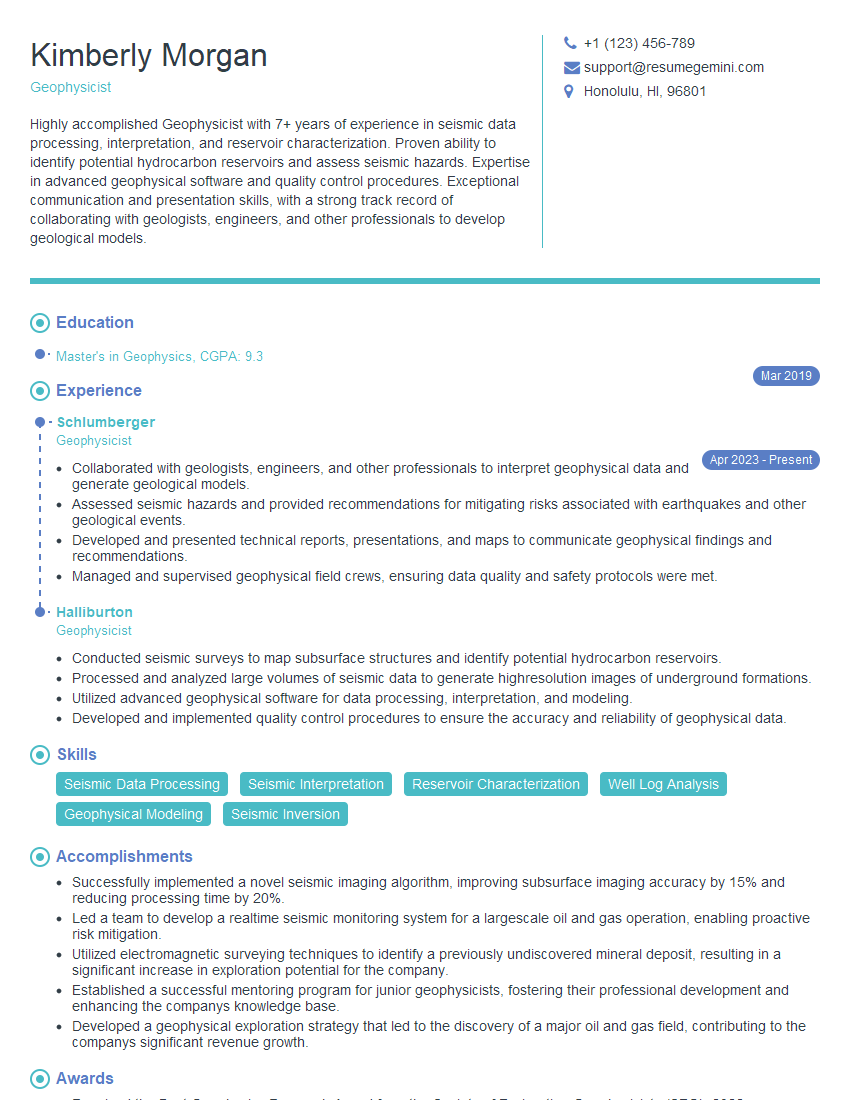
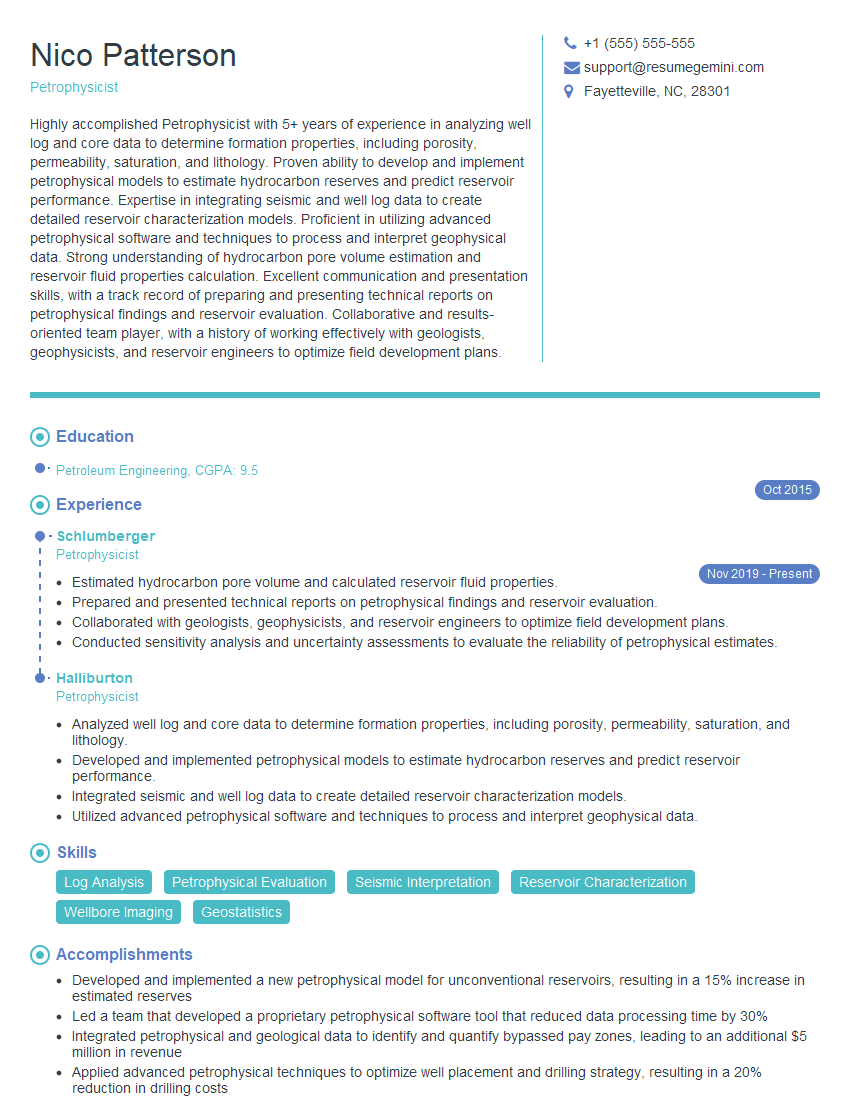
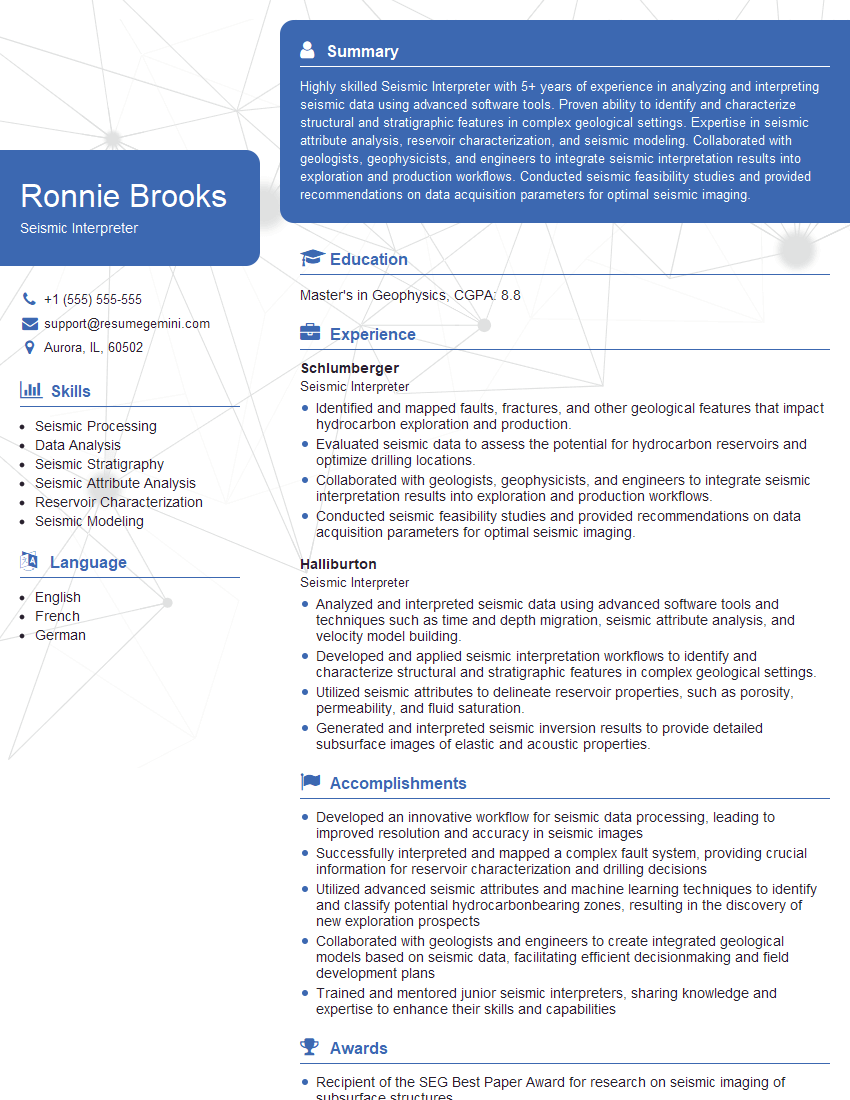
Mastering Geophysical Prospecting opens doors to exciting and challenging careers in the energy and resource sectors. A strong understanding of these fundamental principles is crucial for success. To significantly enhance your job prospects, crafting an ATS-friendly resume is essential. ResumeGemini is a trusted resource to help you build a professional and impactful resume that stands out. ResumeGemini provides examples of resumes tailored specifically to Geophysical Prospecting, giving you a head start in showcasing your skills and experience effectively.

Explore more articles
Users Rating of Our Blogs
Share Your Experience
We value your feedback! Please rate our content and share your thoughts (optional).
What Readers Say About Our Blog
Very informative content, great job.
good