The thought of an interview can be nerve-wracking, but the right preparation can make all the difference. Explore this comprehensive guide to Grade Control and Slope Measurement interview questions and gain the confidence you need to showcase your abilities and secure the role.
Questions Asked in Grade Control and Slope Measurement Interview
Q 1. Explain the different methods used for grade control.
Grade control, in construction, ensures that the earthworks meet the designed elevations and slopes. Several methods achieve this, each with its strengths and limitations. These methods often work in concert.
Conventional Leveling: This is the most fundamental method, employing a level and leveling rod to establish benchmarks and determine elevations. It’s simple and reliable for smaller projects but can be time-consuming and less efficient for large-scale projects.
Total Station Surveying: Total stations measure distances, angles, and elevations with high accuracy. They are ideal for complex projects and provide rapid data collection, aiding in precise grade control and stakeout. For instance, when constructing a highway, a total station is used to accurately establish the precise location and elevation of each point along the grade.
GPS (Global Positioning System) Surveying: GPS uses satellites to determine precise coordinates (latitude, longitude, and elevation). While highly efficient for large areas, GPS accuracy can be affected by atmospheric conditions and multipath errors. We use differential GPS (DGPS) or Real Time Kinematic (RTK) GPS to minimize these errors and achieve centimeter-level accuracy. A great example is using RTK GPS for setting out the foundation of a large building, ensuring perfect alignment and grade.
3D Modeling and Machine Control: This advanced method integrates 3D models with GPS or total station data to guide earthmoving machinery. This real-time feedback system improves efficiency and accuracy, minimizing rework and material waste. Imagine using 3D machine control on a massive earthworks project like a dam – the ability to precisely control the bulldozer’s actions in real-time ensures perfect slope control and grade accuracy.
Q 2. Describe your experience with various surveying instruments (e.g., total station, GPS, level).
My experience spans several years and encompasses proficient use of total stations, GPS systems (including RTK and DGPS), and automatic levels. I’m adept at handling both the data acquisition and processing aspects. I’ve utilized Leica and Trimble equipment extensively.
With total stations, I’m skilled in setting up, performing instrument calibrations, and performing both horizontal and vertical control surveys. My GPS experience covers the full spectrum, from pre-processing and post-processing raw data to creating high-accuracy surfaces. I have specific experience in resolving multipath errors and atmospheric effects. With automatic levels, I’m comfortable with traditional leveling techniques, including the establishment and maintenance of benchmarks.
I’ve used these instruments on a variety of projects, including highway construction, building foundations, and large-scale earthmoving operations. In each case, the choice of instrument depended on the project’s specific requirements, the accuracy needed, and the terrain’s complexity.
Q 3. How do you ensure accurate slope measurement in challenging terrain?
Challenging terrain requires meticulous planning and appropriate instrumentation. I typically employ a combination of techniques to ensure accurate slope measurement.
Detailed Topographic Survey: Before any work begins, a thorough topographic survey using a total station or GPS, with dense point cloud acquisition, provides a detailed representation of the existing terrain. This allows for accurate slope calculations and the planning of earthmoving activities.
Breaklines and Control Points: In complex terrain, I strategically place breaklines (points where the slope changes significantly) and control points to guide the survey process and ensure that the slope measurements are accurate and representative of the actual ground conditions.
Multiple Instrument Setups: In areas with limited sightlines, multiple instrument setups and overlapping measurements are used to eliminate errors caused by long distances or obstructed views. This ensures comprehensive coverage and increases the accuracy of slope measurements.
RTK GPS or Total Station with Prisms: These instruments are used for precise point positioning in challenging locations, such as steep slopes or densely vegetated areas. The use of prisms with a total station enhances accuracy and reach.
By combining these methods, I can accurately determine slope gradients and ensure that the final grade meets the design specifications even in difficult terrain. This often involves extensive field checks and quality control measures.
Q 4. What are the common sources of error in grade control and how do you mitigate them?
Errors in grade control can stem from various sources, necessitating careful mitigation strategies.
Instrument Errors: Improper calibration of instruments (levels, total stations, GPS receivers) is a major source of error. Regular calibration and maintenance are crucial. For example, a misaligned level can result in significant elevation errors.
Human Errors: Mistakes in reading instruments, recording data, and performing calculations are commonplace. Double-checking measurements, employing quality control procedures, and using robust data management systems are vital.
Environmental Factors: Temperature variations, atmospheric refraction (affecting GPS accuracy), and wind can introduce errors. Using appropriate corrections and accounting for these conditions is essential for accurate results.
Ground Conditions: Unstable ground, shifting soil, and vegetation can affect measurements. Careful planning, proper ground preparation, and the use of appropriate surveying techniques are necessary to reduce these influences.
Mitigation involves rigorous quality control procedures, including independent checks, redundant measurements, and thorough data analysis. Employing experienced personnel, using appropriate instrument technology, and implementing robust data management systems are all critical for reducing errors.
Q 5. Explain the importance of benchmark establishment in grade control.
Benchmarks are fundamental to grade control. They are points of known elevation that serve as reference points for all subsequent leveling and elevation measurements. Think of them as the anchors of your entire grade control system.
Establishing benchmarks ensures that all measurements are referenced to a stable and reliable datum. This allows for the consistent and accurate determination of elevations across the entire project site. Without benchmarks, any errors or inconsistencies in elevation will propagate throughout the project, leading to significant problems. For example, if a roadway is constructed without a reliable benchmark system, the resulting grades might be inconsistent and unsafe.
Benchmarks are usually established using precise leveling techniques and are often permanently marked on stable features to ensure their long-term stability and accessibility.
Q 6. How do you interpret and utilize construction drawings related to grading?
Interpreting construction drawings related to grading requires a deep understanding of surveying and engineering principles.
I start by identifying key elements such as:
Existing Ground Elevations (Contour Lines): These lines represent points of equal elevation on the existing terrain. They are crucial for understanding the site’s topography.
Proposed Grade Elevations: These indicate the final design elevations after grading is complete.
Cut and Fill Areas: Drawings typically delineate areas requiring earth removal (cut) and areas needing earth addition (fill).
Slope Angles: These specify the desired slopes for various parts of the project (e.g., road embankments, retaining walls).
Benchmarks and Control Points: Drawings will show the locations of established benchmarks and control points which form the basis of the grading process.
Using this information, I create a detailed understanding of the project’s grading requirements, preparing the way for accurate fieldwork and earthwork calculations.
Q 7. Describe your experience with using 3D modeling software for earthwork calculations.
I have extensive experience using 3D modeling software like Civil 3D and AutoCAD Civil 3D for earthwork calculations. This software allows me to create detailed digital terrain models (DTMs) from survey data.
These DTMs enable accurate calculations of volumes (cut and fill quantities), the generation of detailed grading plans, and the simulation of various grading scenarios. This facilitates efficient project planning and optimizes earthmoving operations. For example, on a large-scale land development project, using 3D modeling significantly reduced the amount of material that needed to be moved, leading to considerable cost savings.
Furthermore, 3D modeling allows for visualization and analysis of the final graded surface, helping identify potential issues and making informed design modifications before construction begins. This is particularly valuable in complex projects with intricate grading requirements.
Q 8. How do you handle discrepancies between design plans and field conditions during grade control?
Discrepancies between design plans and field conditions are inevitable in grade control. My approach involves a systematic process of identification, analysis, and resolution. First, I meticulously compare the design plans with the actual field conditions using surveying equipment like total stations or GPS receivers. Any differences are carefully documented, including their location, magnitude, and potential causes (e.g., unforeseen subsurface conditions, errors in the design, or settlement). Next, I analyze the discrepancies to determine their significance. Minor discrepancies might be acceptable within tolerance limits, while major discrepancies necessitate a reassessment of the design or adjustment of the construction methodology. This may involve consultations with engineers and other stakeholders to find the best solution, which could range from minor adjustments to the earthworks to complete redesigning a section. Finally, I implement the agreed-upon solution, updating the construction plans and ensuring all personnel are informed of the changes. For example, if unexpected bedrock is encountered where fill was planned, we would adjust the design, potentially increasing the cost and timeline but ensuring the project’s structural integrity.
Q 9. Explain your understanding of different types of earthworks (cut, fill, borrow).
Earthworks encompass the movement of earth materials during construction. There are three primary types:
- Cut: Excavation of earth from a higher elevation to a lower elevation. Imagine digging a trench for a foundation – that’s a cut. This removes material from the site.
- Fill: Placing earth material to raise a lower elevation to a desired level. Think of building up a road embankment; that requires fill. This adds material to the site.
- Borrow: Acquiring earth material from an off-site location to supplement the on-site material when there isn’t enough for the required fill. This is often needed for large projects where on-site material is insufficient.
Understanding these distinctions is crucial for accurate earthwork quantity calculations and efficient resource management. For instance, the location of borrow pits needs careful planning to minimize transportation costs and environmental impact.
Q 10. How do you calculate earthwork volumes?
Earthwork volumes are calculated using various methods, depending on the complexity of the terrain. The most common methods include:
- Cross-section method: This involves taking measurements at regular intervals along the length of the earthwork, creating cross-sections of the ground. The area of each cross-section is calculated, and these areas are used to estimate the volume using numerical integration techniques (like the trapezoidal rule or Simpson’s rule). This is accurate for relatively uniform slopes.
- Volume from survey data: Modern surveying techniques using total stations and GPS provide 3D point cloud data. This data can be directly input into software packages to generate highly accurate volume calculations. This method is more efficient and precise, especially for complex projects.
- Mass haul diagrams: These diagrams visually represent the balance between cut and fill volumes along the length of a project. They are useful for optimizing earthmoving operations and minimizing transportation distances.
The choice of method depends on the project’s scale, complexity, and the available resources. For example, a small project might utilize the cross-section method, while a large highway project might necessitate the use of 3D point cloud data processed using specialized software.
Q 11. What are the safety procedures you follow during slope measurement and grade control work?
Safety is paramount in slope measurement and grade control work. My safety procedures adhere strictly to site-specific safety plans and relevant regulations. These include:
- Risk Assessment: Before any work begins, a thorough risk assessment is conducted to identify potential hazards such as unstable slopes, equipment malfunctions, and environmental conditions (e.g., extreme weather).
- Personal Protective Equipment (PPE): All personnel wear appropriate PPE, including hard hats, safety glasses, high-visibility clothing, and safety boots.
- Site Supervision: Experienced personnel supervise all activities, ensuring workers follow safety procedures and use equipment correctly.
- Safe Work Practices: We maintain safe distances from excavation edges, use proper signaling procedures for equipment operation, and ensure the stability of slopes, using appropriate shoring or other methods as needed.
- Emergency Response Plan: A clear emergency response plan is in place and all team members are trained in emergency procedures.
Regular safety inspections and toolbox talks further reinforce safe work practices and address potential hazards proactively.
Q 12. Describe your experience with using different types of leveling equipment.
I have extensive experience with various leveling equipment, including:
- Automatic Levels: These are highly precise and efficient for establishing level lines and benchmarks over long distances. I’m proficient in their setup, operation, and data recording.
- Total Stations: These instruments combine the functions of a theodolite and an EDM (electronic distance meter) to accurately measure both horizontal and vertical distances and angles. I regularly use them for precise topographic surveys and stakeout.
- GPS/GNSS Receivers: I have experience using both RTK (Real-Time Kinematic) and post-processed GPS systems for high-accuracy positioning and surveying. This is particularly useful for large-scale projects and precise measurements across longer distances.
- Digital Levels: These combine the precision of traditional levels with automated data recording and processing, improving efficiency and reducing human error.
My proficiency extends beyond basic operation; I understand the principles of instrument calibration, error analysis, and the limitations of each technology. For instance, I know to consider atmospheric refraction when using long-range EDM instruments.
Q 13. Explain your knowledge of different types of surveying datums.
Surveying datums are reference surfaces used to define the heights or elevations of points on the Earth’s surface. Several types exist:
- Geodetic Datums: These are based on a mathematical model of the Earth’s shape and orientation, such as WGS84 (World Geodetic System 1984) – a global datum widely used in GPS applications. They provide a consistent reference frame across large areas.
- Orthometric Datums: These datums define the height of a point above mean sea level (MSL). A common example is the North American Vertical Datum of 1988 (NAVD88). They are essential for engineering applications requiring accurate elevations relative to sea level.
- Local Datums: These are defined for specific regions and are often based on local benchmarks and measurements. They can be useful for smaller-scale projects but may not be compatible with other datums.
Understanding the difference and implications of different datums is critical. Using incorrect datums can lead to significant errors in design and construction. Choosing the appropriate datum depends on the project’s scope and the required accuracy. For instance, a large-scale national project would use a geodetic datum like WGS84, while a local construction project might use a local datum referenced to local benchmarks.
Q 14. How do you manage data collected during grade control and slope measurement?
Data management is a crucial aspect of grade control and slope measurement. My approach involves a multi-step process:
- Data Acquisition: Data is acquired using appropriate surveying equipment and methods, ensuring accuracy and consistency. Metadata (information about the data) is meticulously recorded, including date, time, instrument used, and personnel involved.
- Data Processing: Raw data undergoes processing using specialized software. This involves coordinate transformations, error analysis, and volume calculations. Quality control checks are implemented at every step to ensure data integrity.
- Data Storage: Processed data is securely stored in a structured format (e.g., databases, cloud storage) and properly backed up. A robust file naming convention is implemented for easy retrieval and reference.
- Data Sharing and Reporting: Data is shared with relevant stakeholders, often through digital platforms and reports, presenting results in clear and concise formats, including tables, graphs, and maps. These reports often include error analyses and quality control summaries.
This systematic approach ensures data accuracy, accessibility, and traceability, allowing for efficient project management and informed decision-making. Using software capable of integrating data from multiple sources and providing visualization tools helps in identifying potential issues and managing projects efficiently.
Q 15. How familiar are you with using coordinate systems (e.g., UTM, State Plane)?
I’m highly proficient in using various coordinate systems, including UTM (Universal Transverse Mercator) and State Plane Coordinate Systems. Understanding these systems is fundamental to accurate grade control and slope measurement. UTM is a global system ideal for large-scale projects, while State Plane systems are designed for specific regions, often providing higher accuracy within those areas. I regularly utilize these systems in my work, transforming coordinates between different datums as needed and ensuring the consistency of data across different surveying instruments and software.
For example, in a recent highway project, we used UTM coordinates for initial site mapping using LiDAR data. Then, we transitioned to a local State Plane system for more precise grade staking and construction layout, as the project was confined to a specific state. This approach minimized coordinate transformation errors and improved overall accuracy.
Career Expert Tips:
- Ace those interviews! Prepare effectively by reviewing the Top 50 Most Common Interview Questions on ResumeGemini.
- Navigate your job search with confidence! Explore a wide range of Career Tips on ResumeGemini. Learn about common challenges and recommendations to overcome them.
- Craft the perfect resume! Master the Art of Resume Writing with ResumeGemini’s guide. Showcase your unique qualifications and achievements effectively.
- Don’t miss out on holiday savings! Build your dream resume with ResumeGemini’s ATS optimized templates.
Q 16. Explain the concept of grade staking.
Grade staking is the process of precisely marking the ground to indicate the desired elevation for various elements of a construction project. Think of it like creating a three-dimensional blueprint on the ground. This ensures that foundations, roads, and other structures are built to the correct levels, meeting specifications and ensuring proper drainage and functionality. It involves setting stakes at specific points along a project’s alignment, each marked with its designed elevation. These elevations are calculated from a design model, often incorporating slope parameters and vertical curves.
For instance, in building a road, grade staking would pinpoint the exact location and elevation of the road’s centerline and edges. Contractors then use these points to guide excavation and paving, ensuring the road has the correct slope and alignment.
Q 17. Describe your experience with quality control procedures in grade control.
Quality control in grade control is paramount. My experience involves a multi-pronged approach: Regular instrument calibration is crucial, checking levels, total stations, and GPS equipment frequently against known benchmarks. I implement rigorous data checks, comparing field measurements against design plans, identifying and resolving discrepancies promptly. Independent verification of critical points and random checks are performed to ensure consistent accuracy across the project. Detailed documentation of all measurements, procedures, and QC checks is maintained for traceability and accountability.
For instance, I might independently check 10% of the stakes set by the construction crew using a separate instrument to verify their accuracy before paving starts. Any significant discrepancies would initiate a thorough investigation to identify and correct the source of the error.
Q 18. How do you communicate effectively with contractors and other stakeholders regarding grade control issues?
Effective communication is vital. I prioritize clear and concise communication, both written and verbal. I use plain language, avoiding technical jargon unless absolutely necessary, and always provide visual aids like plans and diagrams to explain complex concepts. Regular meetings with contractors, engineers, and other stakeholders are essential, ensuring everyone understands the current status and any potential issues. Open dialogue and proactive problem-solving are key to maintaining positive relationships and ensuring project success.
For instance, if a grade discrepancy is detected, I would immediately inform the contractor, providing them with the precise location and magnitude of the error, along with a proposed solution. I might even create a sketch to show the exact spot and how to correct it, ensuring mutual understanding and a collaborative approach to resolving the issue.
Q 19. Describe a situation where you encountered a significant challenge in grade control and how you resolved it.
On a large-scale earthmoving project, unexpected subsurface conditions (uncharted bedrock) significantly affected the planned grades. The initial design was based on assumed soil conditions, leading to substantial deviations from the intended grades. To resolve this, we employed a combination of methods. We used a combination of laser scanning and GPS surveying to generate a high-resolution digital terrain model accurately reflecting the existing topography. This new model informed revised design adjustments, incorporating the unforeseen bedrock, and allowing the project to continue on time with minimal disruption, though with revised cost estimates that were justified and approved.
Q 20. What is your experience with laser scanning technology for surveying?
I have extensive experience using laser scanning technology, particularly in generating accurate and detailed topographic surveys. Laser scanning provides high-density point clouds representing the terrain, which can then be processed to create accurate digital elevation models (DEMs). These DEMs are invaluable for planning, design, and construction, providing a far more detailed and accurate representation of the ground than traditional methods. The technology’s speed and efficiency make it ideal for large, complex projects where traditional surveying would be time-consuming.
For instance, we used laser scanning to map a complex terrain before starting a large pipeline project. This allowed us to build a precise 3D model, identifying potential challenges like steep slopes or unstable ground that might have been missed with traditional surveying. This improved planning and reduced risks.
Q 21. How do you ensure the accuracy of your measurements using GPS technology?
Ensuring GPS accuracy requires a multi-faceted approach. First, using high-precision GPS receivers with Real-Time Kinematic (RTK) capabilities is crucial. These receivers receive corrections from a base station or network, significantly improving accuracy to sub-centimeter levels. Regular calibration and maintenance of the equipment are essential. I also employ several techniques like checking against known control points, performing multiple measurements at each location, and analyzing the data for outliers or anomalies. Understanding the effects of atmospheric conditions and multipath errors is also crucial, and taking appropriate measures to mitigate them helps enhance accuracy.
For example, during a construction layout, I would always check my GPS measurements against existing survey markers to verify their accuracy. I’d perform several measurements at each point, noting the precision and repeatability. If significant discrepancies arise, I would investigate possible causes, such as atmospheric interference or equipment malfunction.
Q 22. Explain your understanding of slope stability and its implications for construction.
Slope stability refers to the ability of a soil or rock mass to remain in its natural or engineered position without undergoing undesirable movement. In construction, especially in earthworks, ensuring slope stability is paramount to prevent failures like landslides or slumps that can cause significant damage, delays, and even casualties. A stable slope maintains its integrity under various stresses like rainfall, seismic activity, and the weight of overlying materials. Understanding factors like soil type, shear strength, groundwater conditions, and the angle of repose is crucial for designing and constructing stable slopes. For example, a steep, unsupported cut slope in loose sandy soil is far less stable than a gently sloping embankment built with compacted clay and proper drainage measures.
The implications for construction are significant. Instability leads to project delays, cost overruns, potential legal issues, and safety risks. Therefore, rigorous geotechnical investigations, including slope stability analyses, are essential during the planning phase to determine the appropriate slope angles, support systems (like retaining walls or rock bolts), and drainage solutions needed to maintain stability throughout the project lifecycle. Failure to address slope stability can have catastrophic consequences.
Q 23. How do you interpret and apply tolerance limits for grade and slope?
Tolerance limits for grade and slope define acceptable deviations from the design specifications. These limits are crucial for ensuring the accuracy of construction and the overall functionality of the project. Interpreting tolerance limits requires a precise understanding of the project drawings and specifications, the accuracy of the surveying equipment, and the potential impact of minor deviations on the overall performance. For example, a highway curve might have a grade tolerance of ±0.5%, meaning the actual grade can vary within 0.5% above or below the design grade. Exceeding this tolerance might impact drainage or vehicle handling.
Applying these limits involves meticulous on-site measurements and regular quality control checks. We use surveying instruments like total stations and GPS receivers to ensure the constructed grades and slopes conform to the allowed tolerances. If deviations are detected outside the acceptable limits, corrective actions are taken, which might involve re-grading, compaction adjustments, or even redesign in extreme cases. It is crucial to document every measurement and correction, ensuring traceability and transparency throughout the process. Accurate application of tolerance limits minimizes rework and maintains the integrity of the overall structure.
Q 24. What software and tools are you proficient in using for grade control and slope measurement?
My proficiency in grade control and slope measurement software and tools is extensive. I’m adept at using industry-standard software like AutoCAD Civil 3D, Bentley MXROAD, and Leica GeoMos. These tools allow for the creation and analysis of digital terrain models (DTMs), generation of design profiles, and calculation of earthworks volumes. They also provide precise tools for setting out, measuring grades, and managing construction tolerances. In addition, I’m skilled in operating and interpreting data from various surveying instruments including total stations, GPS receivers, and laser scanners. My experience encompasses using both robotic total stations and GPS systems for highly accurate real-time positioning and measurement during construction. I can also process and analyze data from these instruments efficiently to ensure that work is within specified tolerances.
Q 25. Describe your understanding of different types of slope failures and how they are mitigated.
Several types of slope failures can occur, each with unique characteristics and mitigation strategies.
- Rotational Slides: These involve the sliding of a mass of soil or rock along a curved surface. They often occur in cohesive soils and are influenced by factors like groundwater pressure and the angle of the slope. Mitigation involves terracing, installing retaining walls, or improving drainage.
- Translational Slides: In this type, the mass moves along a relatively planar surface. These are common in weaker soils or rock layers with distinct discontinuities. Mitigation involves improving the shear strength of the soil, using rock bolts, or constructing retaining structures.
- Falls: This is the detachment of individual blocks of rock or soil from a steep slope. Factors like weathering and fracturing contribute to rock falls. Mitigation includes rock scaling, rock bolts, and protective barriers.
- Flows: These are rapid movements of soil or debris that typically occur in saturated conditions. Mitigation involves improved drainage, terracing, and the installation of sediment basins.
- Complex Failures: These involve a combination of different failure mechanisms.
Q 26. How do you ensure the compliance of your work with relevant codes and regulations?
Compliance with relevant codes and regulations is a critical aspect of my work. I adhere strictly to local, regional, and national building codes, geotechnical engineering standards, and occupational safety regulations. Before starting any project, I review the relevant regulations and incorporate them into my design and construction methodologies. I ensure that all surveying and measurement procedures meet the required accuracy standards. Regular quality control checks are performed to maintain compliance and identify any potential issues early. This includes maintaining detailed records of all measurements, inspections, and corrective actions. I also collaborate closely with regulatory bodies and other stakeholders to ensure that all aspects of my work meet or exceed the legal and safety requirements. This proactive approach ensures the safety and longevity of the projects I’m involved with, while minimizing the risks of legal or safety issues.
Q 27. Describe your experience with working on large-scale infrastructure projects involving significant earthworks.
I have extensive experience working on large-scale infrastructure projects involving significant earthworks. For example, I was involved in the construction of a new highway section where I was responsible for the design and implementation of grade control and slope stability measures along several kilometers of cut and fill sections. This involved complex slope analysis using specialized software, incorporating drainage solutions, and managing the earthmoving operations to ensure optimal stability and compliance with the stringent design specifications and regulatory requirements. Another significant project was a large dam construction, where my role focused on ensuring the stability of the dam embankment during construction and after completion. This involved close monitoring of groundwater levels, instrumental monitoring of slope movements, and careful consideration of seismic stability. These experiences have instilled in me a deep appreciation for the importance of meticulous planning, precise execution, and rigorous quality control in managing earthworks on such substantial projects.
Key Topics to Learn for Grade Control and Slope Measurement Interview
- Understanding Grades and Slopes: Defining grade and slope, converting between percentage, ratio, and degree measurements, and interpreting grade stakes.
- Methods of Slope Measurement: Mastering various techniques including using levels, total stations, and inclinometers; understanding the limitations and applications of each method.
- Grade Control in Construction: Applying grade control principles to earthworks, road construction, and other relevant projects; understanding the importance of accuracy and precision.
- Practical Applications: Working with cross sections, longitudinal profiles, and calculating earthwork volumes; understanding cut and fill calculations and their impact on project budgets and timelines.
- Error Analysis and Mitigation: Identifying potential sources of error in grade control and slope measurement; understanding methods for error correction and prevention.
- Software and Technology: Familiarity with relevant software used for grade control and slope measurement (e.g., CAD software, surveying software); understanding data processing and analysis techniques.
- Safety Procedures: Understanding and adhering to safety protocols related to surveying equipment and field operations.
- Problem-solving and Decision-making: Demonstrating the ability to troubleshoot issues on-site and make informed decisions in challenging situations.
Next Steps
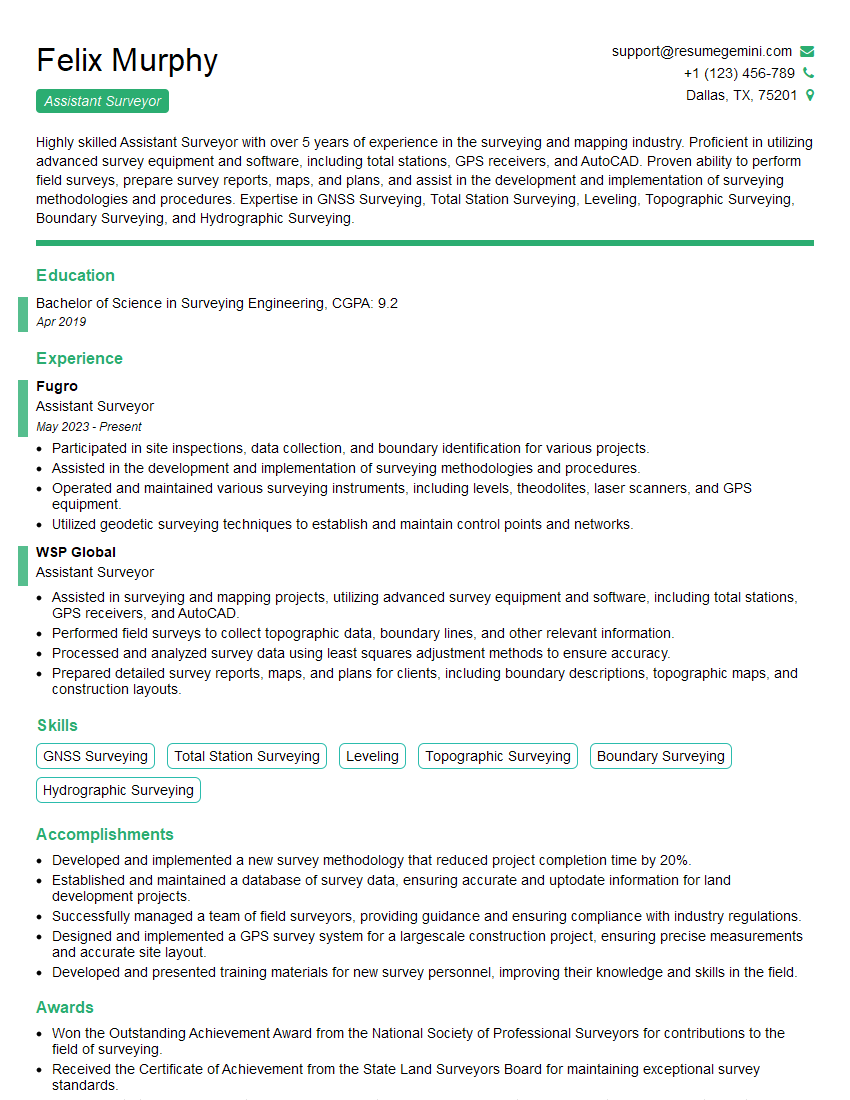
Mastering Grade Control and Slope Measurement is crucial for career advancement in construction, engineering, and surveying. A strong understanding of these concepts demonstrates technical proficiency and problem-solving skills highly valued by employers. To significantly improve your job prospects, invest time in creating an ATS-friendly resume that highlights your skills and experience effectively. ResumeGemini is a trusted resource to help you build a professional and impactful resume. We provide examples of resumes tailored to Grade Control and Slope Measurement to guide you through this process. Take advantage of these resources to showcase your qualifications and land your dream job!





Explore more articles
Users Rating of Our Blogs
Share Your Experience
We value your feedback! Please rate our content and share your thoughts (optional).
What Readers Say About Our Blog
Very informative content, great job.
good