Interviews are opportunities to demonstrate your expertise, and this guide is here to help you shine. Explore the essential SIGINT/EW Equipment Operations interview questions that employers frequently ask, paired with strategies for crafting responses that set you apart from the competition.
Questions Asked in SIGINT/EW Equipment Operations Interview
Q 1. Explain the difference between SIGINT and EW.
SIGINT (Signals Intelligence) and EW (Electronic Warfare) are closely related but distinct disciplines within the broader field of electronic intelligence. Think of it like this: SIGINT is about listening, while EW is about talking and jamming.
SIGINT focuses on passively collecting and analyzing electromagnetic emissions to extract intelligence. This involves intercepting and decoding various signals, such as communications, radar, and navigation signals, to understand the intentions and capabilities of adversaries. For example, intercepting a terrorist group’s radio chatter provides valuable SIGINT.
EW, on the other hand, is an active process. It involves using electromagnetic energy to gain a tactical advantage. This includes electronic attack (jamming enemy signals), electronic protection (protecting friendly signals from jamming), and electronic support (detecting and analyzing enemy electronic emissions). Imagine a military using jamming technology to disrupt an enemy’s radar system; that’s EW in action.
In essence, SIGINT provides the intelligence, while EW provides the ability to manipulate the electromagnetic environment to support that intelligence gathering or influence adversary operations.
Q 2. Describe your experience with various SIGINT/EW platforms.
Throughout my career, I’ve had extensive experience with a variety of SIGINT/EW platforms. This includes working with both legacy systems and cutting-edge technologies. For example, I’ve operated and maintained sophisticated direction-finding systems capable of pinpointing the location of radio emitters with high precision. This often involved analyzing complex data streams to filter out noise and accurately identify signals of interest.
I’ve also worked extensively with sophisticated signal intercept and analysis systems, able to demodulate and decode a wide range of communication signals, from analog voice transmissions to modern digital encrypted communications. This required a deep understanding of digital signal processing and cryptographic techniques.
My experience also extends to EW platforms. I’ve been involved in the operation and maintenance of electronic jamming systems, which involved planning jamming strategies, understanding the technical limitations of the equipment, and monitoring the effectiveness of jamming operations. In addition, I have experience with electronic support measures (ESM), analyzing detected signals to identify potential threats in a dynamic environment.
Each system has unique operational procedures, data handling protocols, and maintenance requirements, emphasizing my ability to quickly adapt to new technology and situations.
Q 3. What are the common challenges in SIGINT/EW equipment operation?
Operating SIGINT/EW equipment presents several significant challenges. One major hurdle is the complex signal environment. We’re dealing with a cacophony of signals from various sources, making it difficult to isolate and identify the signals of interest. This requires advanced signal processing techniques and sophisticated filtering methods.
Another challenge is maintaining operational security (OPSEC). The very nature of SIGINT/EW operations makes us a potential target. We must constantly be aware of potential adversaries attempting to detect, locate, and disrupt our operations.
Technological advancements by adversaries require continuous adaptation and training to keep up with the latest signal processing techniques, encryption algorithms, and jamming methods. This necessitates ongoing professional development and training.
Finally, the physical environment can significantly impact equipment operation. Harsh weather conditions, electromagnetic interference, and physical limitations can all affect performance and reliability.
Q 4. How do you ensure the security and integrity of SIGINT/EW data?
Ensuring the security and integrity of SIGINT/EW data is paramount. This involves a multi-layered approach. Firstly, physical security measures are crucial. Equipment is housed in secure facilities with access control, and physical tamper-evident seals are used.
Secondly, data encryption is essential. All intercepted data is encrypted both during transmission and while at rest. We use strong encryption algorithms, regularly updated to counter emerging threats.
Thirdly, data handling protocols are strictly enforced. Access to sensitive information is strictly controlled through role-based access control and regular security audits. A chain of custody is meticulously maintained for all collected data. Only authorized personnel can access the data, and all accesses are logged and monitored.
Finally, regular security assessments and penetration testing are conducted to identify and address vulnerabilities proactively. This helps maintain the confidentiality, integrity, and availability of the data and systems.
Q 5. Explain your troubleshooting process for malfunctioning SIGINT/EW equipment.
My troubleshooting process follows a systematic approach. It begins with observation and data collection. I carefully analyze any error messages or abnormal behavior, recording all relevant information. This includes signal strength, frequency, error codes, and environmental factors.
Next, I conduct initial checks. This might involve verifying power supply, cable connections, and software configuration. I use diagnostic tools to check for hardware faults and software glitches.
If the issue persists, I move on to systematic isolation. I systematically test different components to pinpoint the faulty element. This often requires detailed knowledge of the system’s architecture and functionality.
Once the problem is identified, I proceed with repair or replacement. Depending on the nature of the fault, this could involve replacing a faulty component, updating software, or seeking assistance from specialized engineers. Thorough documentation is maintained throughout the process.
Finally, I conduct verification testing to confirm that the issue has been resolved and the system is operating as expected. Post-troubleshooting reports are created, and lessons learned are documented to prevent future recurrence.
Q 6. Describe your experience with signal processing techniques.
I have extensive experience with various signal processing techniques critical to SIGINT/EW operations. This includes digital filtering to remove noise and isolate signals of interest, signal demodulation to extract information from modulated signals, and frequency analysis to identify and characterize signals based on their frequency content.
My experience also extends to time-frequency analysis techniques, such as short-time Fourier transforms (STFT), to analyze signals whose frequency content changes over time. I have utilized these techniques extensively in the analysis of complex signals, such as those emitted from advanced radar systems. I’m also proficient in using advanced techniques like wavelet transforms for analyzing non-stationary signals and identifying subtle signal characteristics.
Further, I am familiar with the use of machine learning and AI algorithms for automatic signal classification and anomaly detection. These algorithms can significantly improve the efficiency and effectiveness of signal analysis, especially when dealing with large volumes of data.
The application of these techniques depends on the specific intelligence requirements and the characteristics of the intercepted signals.
Q 7. How familiar are you with different types of antennas and their applications in SIGINT/EW?
My understanding of antennas is comprehensive and directly relates to my experience in SIGINT/EW. I am familiar with a wide array of antenna types and their applications, from simple dipole antennas to complex phased arrays. The choice of antenna significantly impacts the effectiveness of SIGINT/EW systems.
For example, dipole antennas are simple and effective for intercepting a wide range of frequencies, while Yagi antennas provide high gain in a specific direction, useful for focusing on a particular signal source. Phased array antennas offer advanced capabilities, allowing for electronic beam steering and tracking of multiple targets simultaneously, providing an significant advantage in a dynamic environment.
The selection of an appropriate antenna depends on factors such as the frequency of interest, the desired gain, the directionality required, and the physical constraints of the deployment environment. A deep understanding of these factors is crucial for effective SIGINT/EW operations. For example, in a covert operation, a low-profile antenna is preferred, even if it means a reduction in signal strength.
Beyond these fundamental antenna types, I am also familiar with specialized antennas such as helical antennas for circular polarization and horn antennas for high-gain, directional reception. Understanding the strengths and limitations of each antenna type is essential in configuring optimal signal interception and emission systems.
Q 8. What is your experience with data analysis and interpretation in SIGINT/EW?
My experience with data analysis and interpretation in SIGINT/EW is extensive, encompassing the entire lifecycle from raw data acquisition to actionable intelligence. I’m proficient in using various signal processing techniques to extract meaningful information from complex datasets. This includes identifying patterns, anomalies, and trends in intercepted communications and electronic emissions. For example, I’ve worked on projects involving the analysis of radar signals to determine the type and location of emitters, and the decryption of encrypted communications to reveal the content of intercepted messages. My analysis often involves using specialized software tools to visualize and analyze large datasets, coupled with manual interpretation using my understanding of the signals’ context and characteristics.
A recent project involved analyzing a large volume of intercepted radio traffic. By employing advanced signal processing techniques and correlating the data with geographical information, we were able to pinpoint the location of a clandestine communication network and subsequently disrupt their operations. This process included identifying specific modulation schemes, decoding the data, and ultimately constructing a visual representation of the network’s activity. This demanded not just technical skills but also a deep understanding of the operational environment and the likely intentions of the actors involved.
Q 9. How do you maintain situational awareness during SIGINT/EW operations?
Maintaining situational awareness in SIGINT/EW operations is crucial for effective decision-making and operational success. It involves a multifaceted approach leveraging multiple sources of information and constant monitoring of the operational environment. This includes real-time analysis of intercepted signals, integration of intelligence from other sources (HUMINT, OSINT, etc.), and close collaboration with other teams.
Imagine a scenario where we’re monitoring a specific frequency band. Real-time analysis of the signal strength, modulation type, and content provides immediate clues about potential threats or changes in the operational environment. If we detect a surge in activity on a normally quiet channel, that triggers immediate action: further investigation, correlation with other intelligence, and possibly the deployment of countermeasures. We use sophisticated software systems with visual dashboards and alerting mechanisms to provide a consolidated picture of the situation. Regular briefings with other teams ensure a shared understanding of the evolving landscape, allowing for coordinated responses.
Q 10. What are the ethical considerations in SIGINT/EW operations?
Ethical considerations in SIGINT/EW operations are paramount. We operate under strict legal and ethical guidelines that prioritize respecting privacy rights and adhering to international laws. This means carefully assessing the legality and ethical implications of every operation before proceeding. We must ensure that our actions are strictly targeted, proportionate, and necessary for the purpose at hand. Any collection and use of data must be justified and aligned with legal mandates.
For instance, when intercepting communications, we must ensure we only target individuals or entities that are legally authorized for surveillance. We are also obligated to safeguard collected data and prevent unauthorized access or disclosure. Regular training and ethical reviews are integral to maintaining the highest standards of conduct. We continuously evaluate our operational procedures to ensure compliance with evolving legal frameworks and ethical standards.
Q 11. Describe your experience with EW jamming and deception techniques.
My experience with EW jamming and deception techniques is extensive. I’ve been involved in the design, implementation, and testing of various jamming systems and deception strategies. This includes the use of noise jamming to disrupt communications, deceptive jamming to mislead adversaries, and sophisticated spoofing techniques to manipulate electronic systems. I understand the technical complexities involved in selecting appropriate jamming techniques based on the threat and the desired effect.
For example, I’ve worked on projects involving the development of smart jamming systems that adapt to changing threat environments. These systems employ advanced signal processing techniques to identify and target specific signals while minimizing collateral effects. Successful deception often requires a deep understanding of the adversary’s systems and their operational procedures; we design our strategies accordingly.
Q 12. How do you handle high-pressure situations during SIGINT/EW operations?
Handling high-pressure situations in SIGINT/EW operations requires a combination of technical expertise, calm decision-making, and teamwork. We rely on thorough training and established procedures to maintain composure and efficiency under stress. We utilize checklists and standardized operational procedures to ensure all steps are taken systematically. Regular simulations and exercises prepare us for various scenarios, improving our team’s coordination and problem-solving skills under pressure.
One particular scenario involved an unexpected surge in hostile activity. Following our established protocols, we calmly switched to our backup systems, prioritized critical tasks, and relayed the information to the relevant teams. Our training and experience helped us avoid panic and ensure effective response, ultimately neutralizing the threat.
Q 13. Explain your understanding of frequency hopping and spread spectrum techniques.
Frequency hopping and spread spectrum are crucial techniques for enhancing the security and resilience of communication systems. Frequency hopping involves rapidly changing the transmission frequency according to a predefined pattern, making it difficult for adversaries to intercept or jam the signal continuously. Spread spectrum techniques, on the other hand, spread the signal’s energy over a wider bandwidth, making it more resistant to jamming and interference. Both techniques provide enhanced security against eavesdropping and jamming.
Consider a military communication system. Using frequency hopping, the signal jumps across different frequencies, making it incredibly difficult for an adversary to continuously track and intercept the communication. Spread spectrum further enhances this by spreading the signal across a wide bandwidth, making it less susceptible to narrowband jamming attempts. These techniques are integral to ensuring secure and reliable communication in challenging environments.
Q 14. What is your experience with SIGINT/EW software and tools?
My experience with SIGINT/EW software and tools is broad and in-depth. I’m proficient in using various signal processing, data analysis, and visualization tools. This includes specialized software for signal interception, decoding, and analysis, as well as geographic information systems (GIS) for mapping and visualizing data. I have experience with both commercial and proprietary software packages. I’m also comfortable working with programming languages like Python and MATLAB for custom data analysis and visualization.
For instance, I routinely use specialized software packages for analyzing intercepted radio signals, including algorithms for modulation recognition, signal demodulation, and data extraction. I also use GIS software to map the location of identified emitters, visualize signal propagation patterns, and coordinate with other teams in real-time. This integrated approach allows us to build a comprehensive understanding of the operational environment and make informed decisions.
Q 15. Describe your experience with data encryption and decryption techniques.
Data encryption and decryption are fundamental to securing communications in SIGINT/EW. Encryption transforms readable data (plaintext) into an unreadable format (ciphertext), while decryption reverses this process. My experience spans various techniques, from symmetric algorithms like AES (Advanced Encryption Standard) – where the same key is used for both encryption and decryption – to asymmetric algorithms like RSA (Rivest-Shamir-Adleman), using separate public and private keys.
In practical terms, I’ve worked extensively with AES-256 for securing data at rest and in transit within our systems. For key management, we utilize robust hardware security modules (HSMs) to protect the cryptographic keys themselves. I’ve also had experience with implementing and troubleshooting public key infrastructure (PKI) for secure communication between different components of our SIGINT/EW network. Understanding the vulnerabilities of each algorithm and choosing the appropriate one based on the sensitivity of the data and the operational environment is crucial. For instance, AES-256 offers a high level of security for most applications, but in highly sensitive situations, we may employ more robust multi-layered encryption strategies.
Career Expert Tips:
- Ace those interviews! Prepare effectively by reviewing the Top 50 Most Common Interview Questions on ResumeGemini.
- Navigate your job search with confidence! Explore a wide range of Career Tips on ResumeGemini. Learn about common challenges and recommendations to overcome them.
- Craft the perfect resume! Master the Art of Resume Writing with ResumeGemini’s guide. Showcase your unique qualifications and achievements effectively.
- Don’t miss out on holiday savings! Build your dream resume with ResumeGemini’s ATS optimized templates.
Q 16. How do you identify and mitigate threats to SIGINT/EW systems?
Identifying and mitigating threats to SIGINT/EW systems requires a multi-faceted approach. We employ a layered security model, incorporating physical security, network security, and application security. Threats can range from physical breaches and insider threats to sophisticated cyberattacks and electronic warfare jamming.
- Physical Security: This involves securing our equipment sites, preventing unauthorized access, and implementing robust environmental controls.
- Network Security: Intrusion detection and prevention systems (IDS/IPS) monitor network traffic for malicious activity. Firewalls control network access, and virtual private networks (VPNs) secure remote access. Regular security audits and penetration testing identify vulnerabilities.
- Application Security: Secure coding practices, regular software updates, and vulnerability scanning are crucial. Data loss prevention (DLP) measures prevent sensitive data from leaving the controlled environment.
- Electronic Warfare (EW) Mitigation: We use techniques like frequency hopping, spread spectrum communication, and jamming countermeasures to protect our communications from jamming and interception. This includes active and passive detection of potential jamming sources.
For example, during a recent operation, we detected an anomalous increase in network traffic originating from a specific workstation. Our IDS/IPS alerted us, prompting a thorough investigation. We discovered a sophisticated malware infection. Swift action, including isolating the workstation and deploying updated anti-malware software, prevented further compromise. Regular security training and awareness programs for personnel are essential to combat insider threats.
Q 17. Explain your experience with network security in SIGINT/EW environments.
Network security in SIGINT/EW environments is paramount, demanding robust measures to protect sensitive data and ensure operational integrity. My experience includes designing, implementing, and maintaining secure networks using a layered security approach. This includes:
- Firewall Management: Configuring and managing firewalls to control network access and prevent unauthorized connections.
- Intrusion Detection/Prevention Systems (IDS/IPS): Implementing and monitoring IDS/IPS to detect and mitigate malicious activity.
- Virtual Private Networks (VPNs): Establishing secure VPN connections for remote access to sensitive systems.
- Network Segmentation: Dividing the network into smaller, isolated segments to limit the impact of security breaches.
- Data Loss Prevention (DLP): Implementing DLP measures to prevent sensitive data from leaving the controlled environment.
I’ve worked with various network technologies, including both wired and wireless networks, implementing security protocols like IPsec and TLS to encrypt data in transit. We utilize strong authentication mechanisms, including multi-factor authentication, to prevent unauthorized access to our systems. For example, we recently implemented a zero-trust security model, requiring strong authentication and authorization for every network access request, regardless of location.
Q 18. Describe your understanding of radio frequency (RF) principles.
My understanding of radio frequency (RF) principles is comprehensive, encompassing the entire spectrum from propagation characteristics to antenna design and signal processing. I understand the relationship between frequency, wavelength, and power, as well as the effects of atmospheric conditions on signal propagation. I’m familiar with various modulation techniques, including amplitude modulation (AM), frequency modulation (FM), phase modulation (PM), and digital modulation schemes like QAM (Quadrature Amplitude Modulation) and OFDM (Orthogonal Frequency-Division Multiplexing).
This understanding is crucial for effectively operating and maintaining SIGINT/EW equipment. For example, knowing the propagation characteristics of different frequencies allows us to optimize antenna placement for optimal signal reception or transmission. Understanding modulation techniques enables us to demodulate intercepted signals and extract the intelligence contained within. In one instance, we were able to successfully intercept a low-power communication signal by understanding the specific modulation scheme used and employing the appropriate demodulation technique. My expertise also extends to RF interference mitigation techniques, essential for minimizing interference and maintaining operational effectiveness.
Q 19. What is your experience with COMINT and its applications?
COMINT (Communications Intelligence) involves the interception and analysis of communications to extract intelligence. My experience with COMINT covers various aspects, from signal acquisition and processing to traffic analysis and intelligence reporting. I’m proficient in using specialized software and hardware to intercept, decode, and analyze different types of communications, including voice, data, and imagery.
For example, I’ve worked on projects involving the interception and analysis of encrypted communications, using advanced signal processing techniques to identify and exploit vulnerabilities in encryption algorithms. I’ve also performed traffic analysis to identify patterns and anomalies in communication networks, providing valuable insights into organizational structures and operational capabilities. The applications of COMINT are wide-ranging, from identifying potential threats and tracking terrorist activities to supporting military operations and diplomatic efforts. The ethical implications are always at the forefront of our operations; we strictly adhere to all relevant laws and regulations regarding data collection and analysis.
Q 20. How do you collaborate with other teams during SIGINT/EW operations?
Collaboration is essential in SIGINT/EW operations. My experience includes working closely with various teams, including analysts, engineers, and operators, to achieve common objectives. We use collaborative tools and platforms to share information, coordinate activities, and ensure efficient workflow. Effective communication is vital, and I’m adept at clearly articulating technical information to both technical and non-technical audiences.
For instance, in a recent operation, we collaborated closely with a signals intelligence analysis team to correlate intercepted communications with other intelligence sources, creating a comprehensive picture of the target’s activities. This required seamless information sharing and a clear understanding of each team’s role and responsibilities. We utilized secure collaboration platforms to share sensitive data, ensuring data integrity and confidentiality. Clear, concise communication ensured our efforts were aligned and we successfully completed our objectives. This collaborative approach consistently delivers better results compared to individual efforts.
Q 21. Explain your experience with reporting and documentation in SIGINT/EW.
Reporting and documentation in SIGINT/EW are critical for ensuring accountability, maintaining operational history, and providing valuable intelligence to decision-makers. My experience includes generating detailed reports that accurately reflect the findings of our operations. These reports follow strict formatting and classification guidelines to protect sensitive information. I’m proficient in using specialized software tools to generate, manage, and archive reports.
Documentation is equally important. We maintain comprehensive records of equipment configuration, operational procedures, and analysis methodologies. This documentation ensures that our operations are repeatable and auditable. In one project, meticulous documentation allowed us to quickly recreate a complex analysis process after a system failure, minimizing disruption to our intelligence gathering. This commitment to thorough and accurate reporting and documentation contributes to efficient operations and provides high-quality intelligence to our stakeholders.
Q 22. How do you stay current with the latest advancements in SIGINT/EW technology?
Staying current in the rapidly evolving field of SIGINT/EW requires a multi-pronged approach. It’s not enough to rely solely on formal training; continuous learning is crucial.
Professional Publications and Journals: I regularly read publications like IEEE Transactions on Aerospace and Electronic Systems and other specialized journals to keep abreast of the latest research and technological advancements. This provides in-depth technical knowledge on new algorithms, receiver designs, and signal processing techniques.
Conferences and Workshops: Attending industry conferences like MILCOM and attending specialized workshops provides opportunities to network with peers, learn from leading experts, and discover emerging trends. Hearing presentations and engaging in discussions allows me to see practical applications of new technologies and understand their limitations.
Online Courses and Webinars: Online platforms offer valuable resources, including specialized courses on advanced signal processing, modern EW techniques, and emerging threats. I actively participate in these to broaden my expertise and learn about new software tools.
Vendor Engagement: Maintaining relationships with equipment manufacturers and attending their briefings allows me to understand the capabilities of the latest commercial and military systems. This includes understanding the nuances of their software and how it interacts with other systems.
Open-Source Intelligence (OSINT): Carefully examining publicly available information, research papers, and even patent filings can unveil trends and developments that may not be readily apparent through other means.
Q 23. Describe a time you had to deal with a complex technical problem in SIGINT/EW.
During a large-scale military exercise, we experienced unexpected interference on our primary SIGINT receiver, significantly degrading the quality of intercepted communications. The interference was sporadic, making it difficult to pinpoint the source. It wasn’t simply noise; the interference pattern was complex, suggesting a sophisticated jamming technique.
Our initial troubleshooting involved checking for obvious issues like faulty cables and receiver settings, but these proved fruitless. We then implemented a more systematic approach:
Spectrum Analysis: We used a spectrum analyzer to carefully examine the frequency bands where the interference was most prevalent. This revealed the interference was spread across multiple frequencies, suggesting a sophisticated sweeping technique.
Signal Characterization: We used advanced signal processing techniques to characterize the interference. We determined it was a type of spread-spectrum jamming, making it particularly challenging to filter out without also affecting the desired signals.
Adaptive Filtering: We implemented an adaptive filtering algorithm to dynamically adjust to the changing interference pattern. This wasn’t a simple, off-the-shelf solution; we had to develop custom algorithms and fine-tune parameters based on the specific characteristics of the interference.
Collaboration: We collaborated with the communications team to understand the frequency bands used by friendly forces, allowing us to refine our filtering to minimize impact on our intelligence gathering capabilities.
Through this multi-faceted approach, we successfully mitigated the interference, recovering a significant portion of the intercepted communications. This experience highlighted the importance of thorough troubleshooting, adaptive signal processing techniques, and effective teamwork in solving complex SIGINT challenges.
Q 24. How familiar are you with various modulation techniques?
I am very familiar with various modulation techniques, which are fundamental to SIGINT/EW. Understanding modulation allows us to identify the type of communication, its characteristics, and its potential vulnerability to jamming or deception. My knowledge encompasses both analog and digital modulation schemes.
Analog Modulation: I’m proficient in identifying and analyzing AM (Amplitude Modulation), FM (Frequency Modulation), and PM (Phase Modulation) signals. This includes recognizing variations like DSB-SC (Double Sideband Suppressed Carrier), SSB (Single Sideband), and various types of FM, such as narrowband and wideband.
Digital Modulation: This is a critical area for modern SIGINT. I’m experienced in identifying and demodulating various digital modulation schemes like ASK (Amplitude Shift Keying), FSK (Frequency Shift Keying), PSK (Phase Shift Keying) – including BPSK, QPSK, and higher-order PSK variations – and QAM (Quadrature Amplitude Modulation). I am also knowledgeable about advanced modulation techniques used in modern communication systems, such as OFDM (Orthogonal Frequency-Division Multiplexing).
My understanding extends beyond simple identification; I can analyze the characteristics of these modulations, including data rates, spectral efficiency, robustness to noise, and vulnerabilities to jamming.
Q 25. What is your understanding of the electromagnetic spectrum?
My understanding of the electromagnetic spectrum is comprehensive. It’s the foundation of SIGINT/EW operations. It encompasses the entire range of frequencies of electromagnetic radiation, from extremely low frequencies (ELF) to extremely high frequencies (EHF).
Each portion of the spectrum has unique characteristics affecting propagation, attenuation, and susceptibility to interference, all crucial aspects of SIGINT/EW.
Radio Frequency (RF): This is the most critical part of the spectrum for SIGINT/EW, encompassing the frequencies used for communications, radar, navigation, and other electronic systems. Different frequency bands within RF offer different advantages and disadvantages regarding propagation distance, susceptibility to atmospheric effects, and ease of interception.
Microwave and Millimeter Wave: These higher frequencies are used extensively in radar, satellite communications, and high-speed data transmission. The characteristics of these frequencies necessitate specialized equipment and techniques for detection and analysis.
Infrared (IR) and Optical: These portions of the spectrum are also relevant to certain types of SIGINT, particularly for detecting laser-based communication systems or tracking systems using infrared signatures.
Understanding the spectrum’s nuances is essential for designing effective SIGINT/EW systems and correctly interpreting intercepted signals. Knowing how different frequencies propagate, interact with the environment, and are affected by various atmospheric conditions, is paramount for successful operations.
Q 26. How do you prioritize tasks in a fast-paced SIGINT/EW environment?
Prioritization in a fast-paced SIGINT/EW environment is critical. A structured approach, combining urgency, importance, and available resources, is essential.
I utilize a combination of methods:
Urgency/Importance Matrix: I assess each task based on its urgency (immediate need) and importance (strategic impact). This helps categorize tasks into four quadrants: Do First, Schedule, Delegate, and Eliminate. This allows for the focused handling of critical tasks.
Dynamic Prioritization: In a dynamic environment, the priority of tasks can change rapidly due to new information or evolving threats. I remain flexible and adapt my priorities as needed, ensuring that I address the most pressing issues first.
Timeboxing: Allocating specific time blocks to tasks helps ensure focused work and prevents task switching, improving overall efficiency.
Collaboration: Effective communication and collaboration with my team are crucial. Sharing workload and ensuring all team members understand priorities enables efficient resource allocation and prevents bottlenecks.
Automation: When appropriate, I leverage automation tools to streamline repetitive tasks, freeing up time to focus on higher-priority, more complex issues.
This multi-faceted approach allows me to efficiently manage multiple tasks, ensuring that critical information is processed and acted upon quickly and effectively, even under pressure.
Q 27. Explain your experience with different types of receivers and their capabilities.
My experience encompasses a range of receivers, each with specific capabilities and applications within the SIGINT/EW domain.
Software Defined Radios (SDRs): These are highly versatile and reconfigurable, enabling flexibility in adapting to different frequency bands and modulation schemes. They provide excellent signal processing capabilities, facilitating advanced signal analysis and demodulation.
Narrowband Receivers: These are specialized for receiving signals within a limited frequency range. They often offer high sensitivity and selectivity, ideal for detecting weak signals in a noisy environment. They are useful for intercepting specific types of communication.
Wideband Receivers: These are capable of monitoring a wide range of frequencies simultaneously, allowing for broader surveillance. While sacrificing some sensitivity compared to narrowband receivers, their broad coverage is crucial for detecting unknown or unexpected signals.
Specialized Receivers: Certain applications require specialized receivers, like those optimized for intercepting specific types of signals, such as satellite communications or radar signals. These receivers often integrate advanced signal processing algorithms designed for their specific purpose.
My experience involves not only operating these receivers but also understanding their limitations, including their dynamic range, noise figures, and susceptibility to interference. This knowledge is crucial for optimizing their performance and ensuring the accuracy of the intercepted data.
Q 28. Describe your understanding of direction-finding techniques.
Direction-finding (DF) techniques are crucial for determining the location of a transmitting source. They involve analyzing the characteristics of a received signal to pinpoint its origin.
Several techniques are employed:
Interferometry: This method utilizes multiple antennas to measure the phase difference of a received signal. By comparing the phase difference between antennas, the direction of arrival (DOA) can be calculated. Accuracy depends on the baseline distance between the antennas.
Time Difference of Arrival (TDOA): This technique measures the difference in arrival time of a signal at multiple geographically separated receivers. The difference in arrival times can be used to triangulate the source’s location.
Angle of Arrival (AOA): This method uses a single antenna with a directional capability, such as a phased array, to determine the direction from which the signal originates. This method is particularly useful for high-frequency signals.
Passive DF Systems: These systems do not transmit any signals themselves, reducing the risk of detection. They are commonly used for intelligence gathering and monitoring.
The choice of technique depends on factors like frequency of the signal, desired accuracy, available resources, and the environment. Advanced DF systems often combine multiple techniques to improve accuracy and robustness.
Key Topics to Learn for SIGINT/EW Equipment Operations Interview
- SIGINT System Fundamentals: Understanding the theoretical basis of signal intelligence gathering, including various signal types, propagation characteristics, and interception techniques.
- EW System Principles: Grasping the core concepts of electronic warfare, encompassing jamming, deception, and electronic protection methods. Practical application includes analyzing EW system effectiveness in diverse operational environments.
- Equipment Operation & Maintenance: Demonstrate knowledge of the practical operation and maintenance procedures for various SIGINT/EW equipment. This includes troubleshooting common malfunctions and performing preventative maintenance.
- Data Analysis & Interpretation: Showcase your ability to analyze raw SIGINT/EW data, identify relevant information, and interpret findings to support operational decisions. This includes familiarity with signal processing techniques and data visualization tools.
- Cybersecurity in SIGINT/EW: Understanding the importance of cybersecurity within SIGINT/EW operations, including secure data handling, network protection, and vulnerability mitigation strategies.
- Regulatory Compliance & Ethical Considerations: Demonstrating awareness of legal and ethical implications associated with SIGINT/EW operations, including adherence to relevant regulations and international laws.
- Troubleshooting & Problem-Solving: Highlight your ability to diagnose and resolve complex technical problems related to SIGINT/EW equipment and systems using a systematic approach.
- Teamwork & Communication: Emphasize your skills in collaborating effectively within a team environment and clearly communicating technical information to both technical and non-technical audiences.
Next Steps
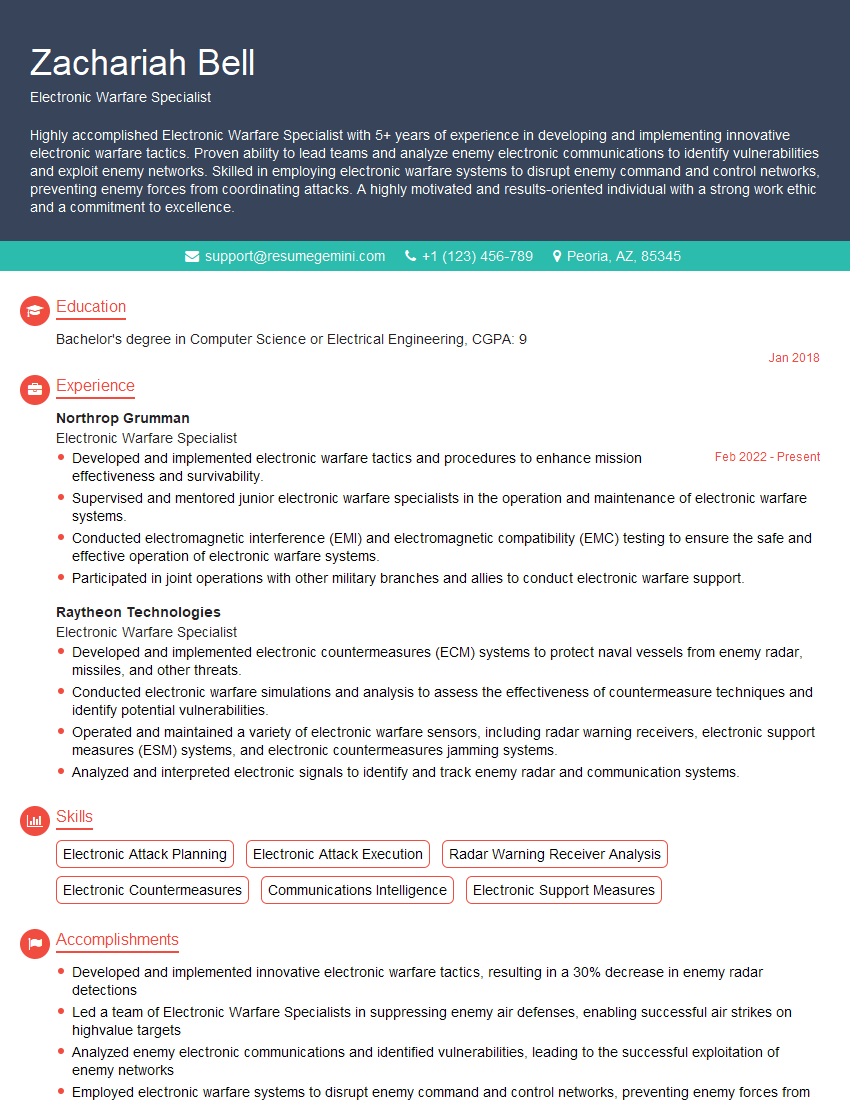
Mastering SIGINT/EW Equipment Operations opens doors to a rewarding career with significant growth potential in a dynamic and highly skilled field. To maximize your job prospects, creating a strong, ATS-friendly resume is crucial. This is where ResumeGemini can help! ResumeGemini provides a powerful platform to craft a professional and compelling resume that showcases your skills and experience effectively. We offer examples of resumes tailored specifically to SIGINT/EW Equipment Operations roles, giving you a head start in presenting yourself as the ideal candidate. Invest the time to build a resume that reflects your expertise and helps you land your dream job.
Explore more articles
Users Rating of Our Blogs
Share Your Experience
We value your feedback! Please rate our content and share your thoughts (optional).
What Readers Say About Our Blog
Very informative content, great job.
good