Interviews are more than just a Q&A session—they’re a chance to prove your worth. This blog dives into essential Ground Improvement Techniques interview questions and expert tips to help you align your answers with what hiring managers are looking for. Start preparing to shine!
Questions Asked in Ground Improvement Techniques Interview
Q 1. Explain the principles of soil stabilization.
Soil stabilization aims to improve the engineering properties of soil, making it more suitable for construction purposes. This is achieved by modifying the soil’s physical and/or chemical characteristics to increase its strength, reduce its compressibility, and enhance its durability. Think of it like baking a cake – you wouldn’t use raw flour and eggs, right? You need to combine and process the ingredients to achieve the desired texture and strength. Similarly, soil stabilization involves a treatment process to improve the soil’s ‘baking’ and achieve the desired engineering properties for a stable foundation.
Methods involve adding binders (like cement, lime, or asphalt), altering moisture content, or using other techniques like compaction or thermal treatment. For instance, adding cement to clay soil increases its strength and reduces shrinkage, making it an ideal base for a road or building foundation. The choice of method depends on the soil type, project requirements, and budget.
Q 2. Describe different types of deep foundation systems.
Deep foundation systems transfer structural loads from a building to a stronger soil stratum far below the surface. They’re essential when shallow foundations are unsuitable due to weak or compressible soil. Different types include:
- Piles: These are long, slender structural elements driven or bored into the ground. They can be made of various materials, including timber, steel, or concrete. Examples include driven piles (hammered into place), bored piles (constructed in situ), and cast-in-place piles.
- Caissons: These are large, hollow structures constructed in situ, usually for heavier loads or in challenging conditions like water-saturated soil. They can be open-ended or sealed at the bottom, and often use compressed air to keep water out.
- Piers: These are similar to piles but are generally wider and more robust, often used for bridge supports or heavy industrial structures. They can be constructed in situ or pre-cast and driven.
The selection of a deep foundation system depends on factors like the soil profile, structural load, groundwater conditions, and environmental concerns.
Q 3. What are the advantages and disadvantages of vibro-compaction?
Vibro-compaction is a ground improvement technique that uses high-frequency vibrations to densify loose, granular soils. Imagine shaking a container of sand – the particles settle and pack together more tightly. That’s the basic principle of vibro-compaction.
Advantages:
- Increased soil density and bearing capacity.
- Relatively quick and cost-effective compared to other techniques.
- Suitable for various granular soils.
- Minimizes ground disturbance.
Disadvantages:
- Ineffective in cohesive (clayey) soils.
- Potential for vibration-induced damage to nearby structures – careful planning and monitoring are necessary.
- Not suitable for extremely deep or heavily contaminated soils.
- Requires specialized equipment.
A practical application could be improving the ground beneath a road embankment in a sandy area. However, if the soil is primarily clay, vibro-compaction would be less effective.
Q 4. How is ground improvement design influenced by site investigation results?
Site investigation results are crucial for designing effective ground improvement. These investigations provide crucial data on the soil’s properties (like grain size distribution, shear strength, compressibility, and groundwater level) at various depths. This information guides the selection of the appropriate ground improvement technique and its design parameters. For example:
- Soil type: Clayey soils may require chemical stabilization, while sandy soils might benefit from vibro-compaction.
- Depth of weak soil: This determines the depth of treatment required for a given improvement method.
- Groundwater level: High groundwater levels affect the choice of technique and may require dewatering.
- Soil stratification: Different soil layers may require different treatment strategies.
Without a thorough site investigation, the ground improvement design might be inadequate, leading to potential settlement problems or structural failure in the future.
Q 5. Explain the role of ground improvement in reducing settlement.
Ground improvement plays a vital role in reducing settlement by increasing the soil’s bearing capacity and reducing its compressibility. Settlement occurs when the soil under a structure compresses under load. Imagine a sponge absorbing water – it compresses and settles. Similarly, weak soil compresses under the weight of a structure, leading to settlement. Ground improvement techniques aim to ‘stiffen’ the sponge so it compresses less.
For example, techniques like deep compaction or soil stabilization increase the soil’s shear strength and stiffness, limiting the amount of settlement. This prevents differential settlement (uneven settlement), which can cause cracks and structural damage. Effective ground improvement minimizes settlement, ensuring the structural integrity and longevity of the construction.
Q 6. Describe the process of soil grouting.
Soil grouting involves injecting a grout mixture (e.g., cement, chemical grouts, or bentonite slurries) into the soil mass to fill voids, increase strength, and reduce permeability. It’s like filling cracks in a wall to make it stronger and more waterproof. The process involves drilling boreholes, inserting grout pipes, and injecting the grout under pressure. The grout permeates the soil, filling voids and improving its properties.
Different grouting techniques exist, such as:
- Permeation grouting: This involves injecting grout into permeable soils to reduce their permeability and improve their strength. It’s often used to seal leaking dams or underground tunnels.
- Compaction grouting: This technique is used to improve the density of loose soils by injecting grout under pressure. The grout fills the voids, causing the soil particles to compact.
- Crack grouting: This is used to seal cracks and fissures in rock or soil formations, preventing seepage or leakage. It’s common in underground construction and foundation repair.
The selection of the appropriate grout type and grouting technique depends on the soil type, project requirements, and the desired outcome.
Q 7. What are the different types of ground improvement techniques?
A wide range of ground improvement techniques exists, categorized broadly as deep and shallow methods. Examples include:
- Shallow methods: These treat the soil near the surface, such as compaction (using rollers or vibratory equipment), preloading (using fill material to induce consolidation), and soil stabilization (using additives like lime, cement, or fly ash).
- Deep methods: These involve treatment at significant depths, examples including vibro-compaction, stone columns (creating reinforced soil columns), soil mixing (mixing soil with a binding agent in place), and grouting (as detailed above).
- Other techniques: These include techniques such as dynamic compaction, which uses heavy weights dropped from a height to compact the soil, and electro-osmosis, a method that uses electrical currents to reduce water content in soils.
The choice of technique depends on several factors, including soil type, project requirements, cost, environmental considerations, and access to specialized equipment. A comprehensive geotechnical investigation is always necessary to select the most appropriate and effective method.
Q 8. How do you select the appropriate ground improvement method for a given project?
Selecting the right ground improvement method is crucial for project success and involves a systematic approach. It’s not a one-size-fits-all solution; the best method depends on several interacting factors.
- Soil characteristics: The type of soil (clay, sand, silt), its density, strength, and compressibility are fundamental. For example, vibro-compaction works well with granular soils, while preloading is effective for compressible clays.
- Project requirements: What’s the intended use? A high-rise building needs a much stronger foundation than a small residential structure. The allowable settlement, required bearing capacity, and construction timeframe all play significant roles.
- Environmental factors: Groundwater levels, potential for erosion, and proximity to sensitive ecosystems are key considerations. Some methods might be unsuitable due to environmental concerns.
- Cost-benefit analysis: The cost of each method must be weighed against its effectiveness. Sometimes, a more expensive method is justifiable if it leads to long-term cost savings or avoids delays.
- Accessibility: The site’s accessibility impacts the feasibility of certain methods. For example, some techniques might require substantial space for equipment.
Imagine choosing between deep dynamic compaction and stone columns for a highway project. Deep dynamic compaction would be more suitable for a large area with uniform granular soil, while stone columns might be preferred for a localized area with soft clay.
Q 9. Explain the concept of preloading for ground improvement.
Preloading is a ground improvement technique that uses the soil’s own weight to induce consolidation and increase its strength. It’s like putting a heavy weight on a sponge to squeeze out the water – the sponge becomes firmer and stronger.
The process involves placing a surcharge load (e.g., fill material, embankments) on the ground for a specific period. This load compresses the soil, forcing water out and reducing its volume. Over time, the soil consolidates, increasing its bearing capacity and reducing settlement. The surcharge load is then removed after sufficient consolidation.
For example, imagine constructing a large warehouse on a site with soft, compressible clay. Preloading could be used to increase the bearing capacity, preventing excessive settlement and ensuring the structural integrity of the warehouse. The duration of preloading depends on factors such as soil type and thickness, as well as the desired level of consolidation.
Q 10. Describe the factors influencing the cost-effectiveness of ground improvement.
Cost-effectiveness in ground improvement is a complex interplay of various factors.
- Material costs: The cost of materials like cement, stone, or fill significantly affects the overall expense.
- Equipment costs: The type and size of equipment needed (e.g., vibratory hammers, drilling rigs) contribute to the cost.
- Labor costs: The amount of labor required for installation and supervision impacts the budget.
- Project duration: Longer project durations lead to higher costs due to increased overhead and potential delays in the construction schedule.
- Maintenance and monitoring: Costs associated with monitoring the effectiveness of the improvement and addressing any potential issues must also be considered.
- Environmental remediation: If environmental remediation is needed, it can substantially increase the project’s cost.
For instance, while deep dynamic compaction might be faster, using stone columns might be more cost-effective in the long run if the soil requires a higher degree of improvement.
Q 11. How do you assess the effectiveness of ground improvement techniques?
Assessing the effectiveness of ground improvement relies on a combination of methods to ensure the desired level of improvement has been achieved.
- Pre-improvement testing: Initial soil investigations (e.g., laboratory testing, in-situ tests) establish baseline soil properties.
- During-improvement monitoring: During installation, monitoring tools like settlement gauges, piezometers, and inclinometers track the process and confirm the efficacy of the chosen method.
- Post-improvement testing: After the improvement, tests like plate load tests, cone penetration tests, and shear strength tests verify the enhanced soil properties and bearing capacity.
- Numerical modeling: Sophisticated computer models can simulate the ground improvement process and predict the effectiveness of various methods. These models are calibrated and validated using the field data obtained from testing.
For example, after installing stone columns, plate load tests would be conducted to verify the improved bearing capacity. If the achieved bearing capacity does not meet the project requirements, remedial measures might be necessary.
Q 12. What are the environmental considerations in ground improvement?
Environmental considerations are paramount in ground improvement. We must minimize negative impacts on surrounding ecosystems and comply with environmental regulations.
- Noise pollution: Methods like dynamic compaction can generate significant noise. Mitigation strategies like noise barriers and restricted working hours might be needed.
- Dust generation: Dry methods can create significant dust. Water spraying, dust suppressants, and proper site management can mitigate this.
- Waste generation: Some methods produce waste materials that must be disposed of responsibly. Recycling or appropriate disposal methods must be implemented.
- Groundwater contamination: The use of certain chemicals or the potential for soil leaching requires careful consideration to prevent groundwater contamination.
- Habitat disruption: Ground improvement activities can disturb natural habitats. Minimizing site disturbance and implementing restoration measures are crucial.
Choosing an environmentally friendly method and implementing proper mitigation measures is not just good practice but often a regulatory requirement. For instance, a project near a sensitive wetland might benefit from using a less disruptive method, even if it’s slightly more expensive.
Q 13. Explain the use of stone columns for ground improvement.
Stone columns are a ground improvement technique involving the installation of vertical columns of compacted granular material (typically crushed stone) into soft, compressible soils. Think of them as reinforcing the ground like rebar in concrete.
These columns increase the soil’s bearing capacity and reduce settlement by transferring loads from the overlying soil to the stronger stone columns. The process typically involves drilling holes, placing the stone, and compacting it. The space between the columns acts as a load-transfer mechanism, with the soil being reinforced by the stiffer, stronger stone columns.
Stone columns are often used in areas with soft clay or peat, where the ground is not strong enough to support structures. For example, they are frequently used under foundations for buildings, roads, and railways in areas prone to consolidation settlement. The spacing and diameter of the columns are carefully designed based on soil conditions and loading requirements.
Q 14. Describe the process of dynamic compaction.
Dynamic compaction is a ground improvement method that uses repeated impact loading to densify loose, granular soils. It’s like repeatedly dropping a heavy weight on the ground to compact it.
The process involves dropping a heavy weight (typically 10-60 tons) from a significant height (typically 10-20 meters) onto the ground surface. This creates shockwaves that propagate through the soil, causing the particles to rearrange and become denser. The process is repeated across the site in a grid pattern.
Dynamic compaction is efficient for improving large areas of granular soil. It’s frequently used for embankments, landfill capping, and other large-scale projects where densification of loose fills is needed. The depth of densification depends on the weight, drop height, and the characteristics of the soil. However, it’s important to note that dynamic compaction is generally not suitable for cohesive soils or areas with sensitive structures nearby.
Q 15. What are the challenges in implementing ground improvement techniques in challenging ground conditions?
Implementing ground improvement techniques in challenging ground conditions presents numerous hurdles. These conditions, such as highly compressible clays, loose sands prone to liquefaction, or highly variable soil strata, demand careful consideration and often necessitate specialized approaches.
- Difficult Access: Working in confined spaces, steep slopes, or underwater environments can significantly increase the complexity and cost of the project. For example, improving the ground for a foundation in a densely populated urban area requires precise execution to avoid damaging nearby structures.
- Unexpected Soil Conditions: Subsurface investigations, while thorough, are not always perfectly accurate. Unforeseen soil conditions encountered during construction can lead to delays, cost overruns, and design modifications. Imagine hitting an unexpected bedrock layer during vibrocompaction – this necessitates altering the plan immediately.
- Environmental Concerns: Ground improvement methods can potentially impact the surrounding environment. For example, the use of chemicals in some techniques might contaminate groundwater, demanding stringent environmental monitoring and mitigation strategies. This could involve rigorous pre- and post-construction water quality testing.
- Technical Challenges: The selection and successful implementation of appropriate techniques for specific problematic soils necessitate specialized expertise and advanced equipment. Working with extremely soft clays, for instance, might require preloading techniques coupled with stone columns, demanding careful coordination and precise execution.
Career Expert Tips:
- Ace those interviews! Prepare effectively by reviewing the Top 50 Most Common Interview Questions on ResumeGemini.
- Navigate your job search with confidence! Explore a wide range of Career Tips on ResumeGemini. Learn about common challenges and recommendations to overcome them.
- Craft the perfect resume! Master the Art of Resume Writing with ResumeGemini’s guide. Showcase your unique qualifications and achievements effectively.
- Don’t miss out on holiday savings! Build your dream resume with ResumeGemini’s ATS optimized templates.
Q 16. How do you manage risks associated with ground improvement projects?
Risk management in ground improvement projects is crucial for ensuring project success and safety. A robust risk management plan should proactively identify, assess, and mitigate potential hazards. This plan is usually built around a structured process:
- Risk Identification: Thorough geotechnical investigations, coupled with detailed design reviews, form the basis of identifying potential risks, including soil variability, equipment failure, unforeseen ground conditions, and environmental impact.
- Risk Assessment: Each identified risk is evaluated in terms of its likelihood and potential consequences. Techniques like fault tree analysis or risk matrices can quantify the potential impact of each risk.
- Risk Mitigation: Appropriate strategies are developed to reduce the likelihood or impact of identified risks. These might include using conservative design parameters, implementing rigorous quality control measures, contingency planning for unforeseen events, or employing insurance.
- Monitoring and Control: During construction, continuous monitoring of the ground improvement works and the surrounding environment ensures that the project remains within acceptable safety limits and performance targets. Regular progress reports highlight the project’s current status and any emerging risks.
For instance, a risk of encountering unexpected boulders during deep soil mixing could be mitigated by incorporating a contingency plan that includes specialized drilling equipment and a revised construction schedule.
Q 17. Explain the importance of quality control in ground improvement.
Quality control (QC) in ground improvement is paramount to ensure that the installed ground improvement meets the design specifications and achieves the desired performance. Think of it as ensuring the foundation of a building is as strong and stable as intended. QC measures involve a multi-layered approach:
- Material Testing: Regular testing of the materials used in ground improvement, such as cement, grout, or reinforcing elements, ensures they meet required standards.
- In-situ Testing: During construction, in-situ tests (like cone penetration tests or pressuremeter tests) are performed to verify the effectiveness of the ground improvement technique and monitor the achieved soil parameters.
- Documentation: Meticulous record-keeping, including daily reports, material certificates, and test results, provides a complete audit trail throughout the project. This is crucial for future analysis and verification.
- Independent Verification: Independent verification by qualified geotechnical engineers can provide an unbiased assessment of the project’s quality and adherence to design specifications.
A lack of robust QC can result in compromised ground improvement, leading to potential structural failures and safety hazards.
Q 18. What are the common failure modes of ground improvement techniques?
Ground improvement techniques can fail in several ways, often due to inadequate design, poor construction practices, or unforeseen ground conditions. Understanding these failure modes is essential for effective risk management.
- Settlement: Excessive settlement of the improved ground can occur due to insufficient improvement depth or inadequate consolidation of the treated soil. This could cause cracking in structures built upon it.
- Shear Failure: Failure can occur due to exceeding the shear strength of the improved ground, leading to localized collapse or overall instability. This is particularly important in areas prone to seismic activity.
- Erosion: Erosion of the improved soil can occur if the treatment is not properly protected or if there is inadequate drainage. This is especially relevant in applications near water bodies.
- Loss of Integrity: The integrity of the improved ground may be compromised due to the deterioration of the improvement materials or due to changes in the surrounding soil conditions over time. For example, chemical degradation could weaken some ground improvement materials.
- Unexpected Ground Conditions: Unexpected subsurface conditions encountered during construction, such as the presence of unforeseen voids or weak layers, can significantly compromise the effectiveness of the ground improvement.
Q 19. How do you interpret geotechnical investigation reports?
Interpreting geotechnical investigation reports requires a good understanding of geotechnical principles and engineering judgment. It’s not simply reading the data; it’s understanding what the data means in the context of the project.
- Understanding the Scope: First, review the investigation’s scope to understand the methods used, the extent of the investigation, and any limitations. A limited investigation might miss crucial information.
- Soil Classification: Carefully examine the soil classification and stratification data. Understanding the different soil types and their properties (e.g., strength, compressibility) is essential for selecting appropriate ground improvement techniques.
- Engineering Properties: Analyze the engineering properties of the soil, such as shear strength, consolidation characteristics, and permeability. These parameters inform design decisions and determine the required ground improvement measures.
- Groundwater Conditions: Assess the groundwater conditions to determine their potential influence on the ground improvement works and the long-term stability of the improved ground. A high water table might necessitate specific drainage measures.
- Interpreting Test Data: Understand the meaning of various laboratory and in-situ test data (e.g., CPT, SPT, consolidation tests). This data provides valuable insights into the soil’s behavior under different loading conditions.
- Identifying Potential Issues: Identify any potential issues or uncertainties based on the presented data, such as unusual soil layers or high variability in soil properties. This will help to plan for contingencies during construction.
Q 20. Describe the role of numerical modeling in ground improvement design.
Numerical modeling plays a crucial role in ground improvement design by providing a powerful tool for simulating the behavior of the improved ground under various loading conditions. It allows engineers to optimize designs, predict performance, and assess risks before construction.
- Predicting Settlement: Models can predict settlement under various loading scenarios, enabling the optimization of the ground improvement design to meet settlement criteria.
- Assessing Stress Distribution: Numerical analysis helps evaluate the stress distribution within the improved ground and the surrounding soil, ensuring adequate strength and stability.
- Evaluating Stability: Modeling aids in evaluating the overall stability of the improved ground, especially under seismic loading or other extreme conditions.
- Optimizing Design Parameters: By running simulations with different design parameters, engineers can optimize the design, minimizing costs while maintaining adequate performance.
- Assessing Construction Methodology: Modeling helps in assessing the influence of construction methods on the performance of the ground improvement, leading to better construction planning.
Software packages like PLAXIS, ABAQUS, and finite element analysis (FEA) tools are commonly employed for this purpose. The model accuracy depends critically on the quality of input parameters, obtained through detailed geotechnical investigations.
Q 21. Explain the concept of soil reinforcement.
Soil reinforcement involves improving the engineering properties of soil by incorporating reinforcing materials, enhancing its strength, stiffness, and stability. Think of it like adding rebar to concrete – it dramatically increases its overall strength.
- Materials: Common reinforcement materials include geotextiles, geogrids, geomembranes, and steel bars or fibers. The choice depends on the specific soil conditions and the required improvement.
- Mechanisms: Reinforcement works by several mechanisms: confinement of soil, increasing tensile strength, controlling soil deformation, and improving drainage. Geogrids, for example, increase the tensile strength of the soil mass by transferring tensile stresses from the soil to the stronger geogrid material.
- Applications: Soil reinforcement is widely used in various applications, including retaining walls, embankments, pavements, and slopes. A common example is using geogrids to stabilize a steep slope preventing landslides.
- Design Considerations: Designing soil reinforcement systems requires considering the soil properties, the reinforcement material properties, the loading conditions, and the required performance criteria. The spacing and orientation of the reinforcement need to be optimized.
Successful soil reinforcement requires careful planning, design, and construction to ensure the reinforcement interacts effectively with the soil and meets design requirements.
Q 22. Describe the use of geosynthetics in ground improvement.
Geosynthetics are synthetic materials used to improve the engineering properties of soil. Think of them as advanced fabrics engineered to reinforce, separate, filter, or drain soil. They’re incredibly versatile in ground improvement projects.
Reinforcement: Geogrids and geotextiles increase the tensile strength of soil, making it more resistant to deformation and improving slope stability. Imagine a woven fabric holding together loose sand – that’s essentially what geogrids do for soil.
Separation: Geotextiles prevent mixing of different soil layers, ensuring the integrity of each layer’s function. This is crucial in layered construction, preventing contamination or weakening of the layers. For instance, they can separate a high-quality fill layer from a weaker underlying layer.
Drainage: Geotextiles and geocomposites act as drains, removing excess water from the soil. This prevents pore water pressure build-up, crucial for avoiding instability and settlement. Picture it as a sophisticated drainage system embedded within the soil.
Filtration: Geotextiles act as filters, allowing water to pass through while preventing the migration of fine soil particles. This maintains the drainage capacity and prevents clogging of the drainage system. Think of it as a sophisticated sieve embedded within the soil.
Geosynthetics are used in a wide range of applications, from road construction and railway embankments to landfill liners and retaining walls, significantly enhancing the performance and longevity of these projects.
Q 23. How do you ensure the long-term stability of ground improvement projects?
Ensuring long-term stability requires a multifaceted approach that starts even before construction begins.
Thorough Site Investigation: Detailed geotechnical investigations are crucial to understand the soil’s properties and potential challenges. This includes laboratory testing to determine parameters such as shear strength, compressibility, and permeability.
Appropriate Ground Improvement Technique Selection: Choosing the right technique – based on the site conditions and project requirements – is paramount. For example, deep mixing might be ideal for soft clays, while stone columns might be better suited for sandy soils.
Quality Control and Assurance: Rigorous quality control during construction is essential. This involves regular monitoring of construction activities and in-situ testing to confirm that the ground improvement is meeting the design specifications.
Proper Design and Construction: The design should incorporate adequate factors of safety and account for potential long-term effects, such as consolidation settlement and creep. Construction should follow the design precisely.
Post-Construction Monitoring: Monitoring the performance of the ground improvement after construction is complete is important to identify and address any unexpected issues. This might involve settlement measurements or pore water pressure monitoring.
By carefully considering these aspects, we can significantly increase the chances of achieving long-term stability and prevent costly repairs or failures down the line. It’s a bit like building a house – a strong foundation built with quality materials and careful attention to detail will last much longer.
Q 24. What are the different types of grouting materials?
Grouting materials are used to fill voids, increase strength, or improve the permeability of soil. The choice depends heavily on the specific application and soil conditions.
Cement grouts: These are commonly used and consist of cement, water, and sometimes additives to control setting time and properties. They’re versatile and suitable for a variety of applications.
Chemical grouts: These include resin-based grouts (epoxy, polyurethane) and silicate grouts. They offer higher strength and durability than cement grouts but can be more expensive. They’re often used in situations where rapid strength gain is required or where water tightness is critical.
Fly ash grouts: These utilize fly ash, a byproduct of coal combustion, as a binder. They are more environmentally friendly and can reduce the cost compared to cement grouts.
Microfine cement grouts: These use very fine cement particles, resulting in a grout with higher flowability and improved penetration into the soil. This allows for better filling of small voids and fissures.
The selection of the right grout material requires careful consideration of factors such as soil type, required strength, permeability, and environmental impact. It’s a crucial decision that significantly impacts project success.
Q 25. Describe the limitations of ground improvement techniques.
While ground improvement techniques offer numerous benefits, they also have limitations.
Cost: Ground improvement can be expensive, especially for large-scale projects. The cost will vary greatly depending on the chosen technique and site conditions.
Time constraints: Some techniques, like deep mixing, can be time-consuming, potentially delaying the overall project schedule.
Suitability limitations: Not all ground improvement techniques are suitable for all soil types. Some techniques may be ineffective or impractical for specific soil conditions.
Environmental considerations: Some techniques, especially those involving chemical grouts, may have environmental impacts. Careful planning and adherence to environmental regulations are essential.
Difficulty in predicting long-term behavior: While careful design and monitoring are crucial, it can be difficult to perfectly predict the long-term behavior of improved ground. Unexpected factors may influence performance.
Therefore, careful planning, thorough investigation, and a realistic assessment of limitations are crucial before selecting and implementing any ground improvement technique.
Q 26. How do you handle unexpected ground conditions during construction?
Unexpected ground conditions are a common challenge in construction. Handling them effectively requires a proactive and adaptable approach.
Immediate Assessment: Upon encountering unexpected conditions, the first step is to thoroughly assess the situation. This involves detailed inspection, sampling, and testing to understand the nature and extent of the unexpected ground conditions.
Re-evaluation of the design: Based on the assessment, the design may need to be revised to incorporate the new information and account for the unexpected ground conditions. This often involves discussions with geotechnical engineers and project stakeholders.
Adaptation of construction methods: The construction methods may also need to be adjusted to address the new challenges. This could involve employing alternative ground improvement techniques or modifying the existing method.
Documentation and communication: Maintaining thorough documentation of the unexpected conditions, the assessment, and the corrective actions is crucial for legal and insurance purposes. Clear communication between the project team and stakeholders is essential to ensure everyone is aware of the situation and the planned actions.
Dealing with unexpected ground conditions successfully requires a flexible mindset, strong problem-solving skills, and good communication. It’s about adapting to the situation rather than being inflexible.
Q 27. Explain the importance of communication and coordination in ground improvement projects.
Communication and coordination are absolutely critical for successful ground improvement projects. These projects often involve multiple parties with diverse expertise, including geotechnical engineers, contractors, and inspectors. Effective communication ensures everyone is on the same page and working towards the same goals.
Clear communication channels: Establishing clear communication channels, such as regular meetings, progress reports, and electronic communication tools, ensures timely information exchange. This minimizes misunderstandings and delays.
Collaborative decision-making: Important decisions should be made collaboratively, incorporating the expertise of all stakeholders. This includes addressing unexpected ground conditions, changes in the design, and resolving conflicts.
Regular monitoring and feedback: Regular monitoring of progress and providing timely feedback are crucial for identifying and resolving issues promptly. This prevents minor problems from escalating into significant setbacks.
Documentation and reporting: Thorough documentation of all aspects of the project, including design, construction, and testing, is critical. This helps maintain a clear record of activities and facilitates future reference.
Effective communication and coordination not only lead to project success but also contribute to a safer and more efficient work environment. It’s about teamwork, trust, and a shared understanding of project goals.
Q 28. Describe your experience with different ground improvement software and tools.
Throughout my career, I’ve utilized several software and tools for ground improvement analysis and design. My experience includes:
Plaxis 2D/3D: This finite element software is widely used for analyzing soil behavior and the effectiveness of ground improvement techniques. I’ve used it extensively for modeling various scenarios, such as the settlement of embankments and the stability of retaining walls.
GeoStudio: Another popular software suite that I utilize for slope stability analysis, seepage analysis, and consolidation settlement calculations. Its user-friendly interface simplifies complex geotechnical analyses.
ABAQUS: For more complex simulations involving non-linear soil behavior or sophisticated constitutive models. This high-end finite element software offers greater control over modeling details.
Specialized in-situ testing software: I’m proficient in using software that manages and interprets data from in-situ tests such as CPT, DMT, and SPT, which are crucial for assessing soil properties and design parameters.
In addition to software, I’m experienced with various field instruments and measurement tools for monitoring ground improvement projects, including settlement markers, inclinometers, and piezometers.
Key Topics to Learn for Ground Improvement Techniques Interview
- Soil Mechanics Fundamentals: Understanding soil behavior, classification, and shear strength is crucial. This forms the basis for selecting appropriate ground improvement methods.
- Compaction Techniques: Learn the principles of dynamic and static compaction, including their applications in various soil types and project scenarios. Be prepared to discuss limitations and suitability.
- Ground Reinforcement: Explore different reinforcement methods like geogrids, geotextiles, and soil nailing. Understand their mechanisms, design considerations, and applications in retaining walls, embankments, and pavements.
- Vibro-Compaction and Vibro-Replacement: Understand the principles of these techniques, their effectiveness in different soil conditions, and the limitations. Be prepared to discuss case studies.
- Deep Mixing Methods: Learn about techniques like soil cement columns and lime columns, including their design, construction, and applications for improving bearing capacity and reducing settlement.
- Grouting Techniques: Explore different grouting methods and their applications in stabilizing foundations, controlling seepage, and improving ground strength. Consider factors such as grout type and injection pressure.
- Case Studies and Practical Applications: Prepare to discuss real-world applications of ground improvement techniques. Thinking critically about the selection process based on site conditions is key.
- Problem-Solving and Design Considerations: Focus on your ability to analyze geotechnical data, identify problems, and propose solutions using appropriate ground improvement strategies. Consider factors like cost, time, and environmental impact.
- Relevant Codes and Standards: Familiarize yourself with relevant industry codes and standards related to ground improvement techniques in your region.
Next Steps
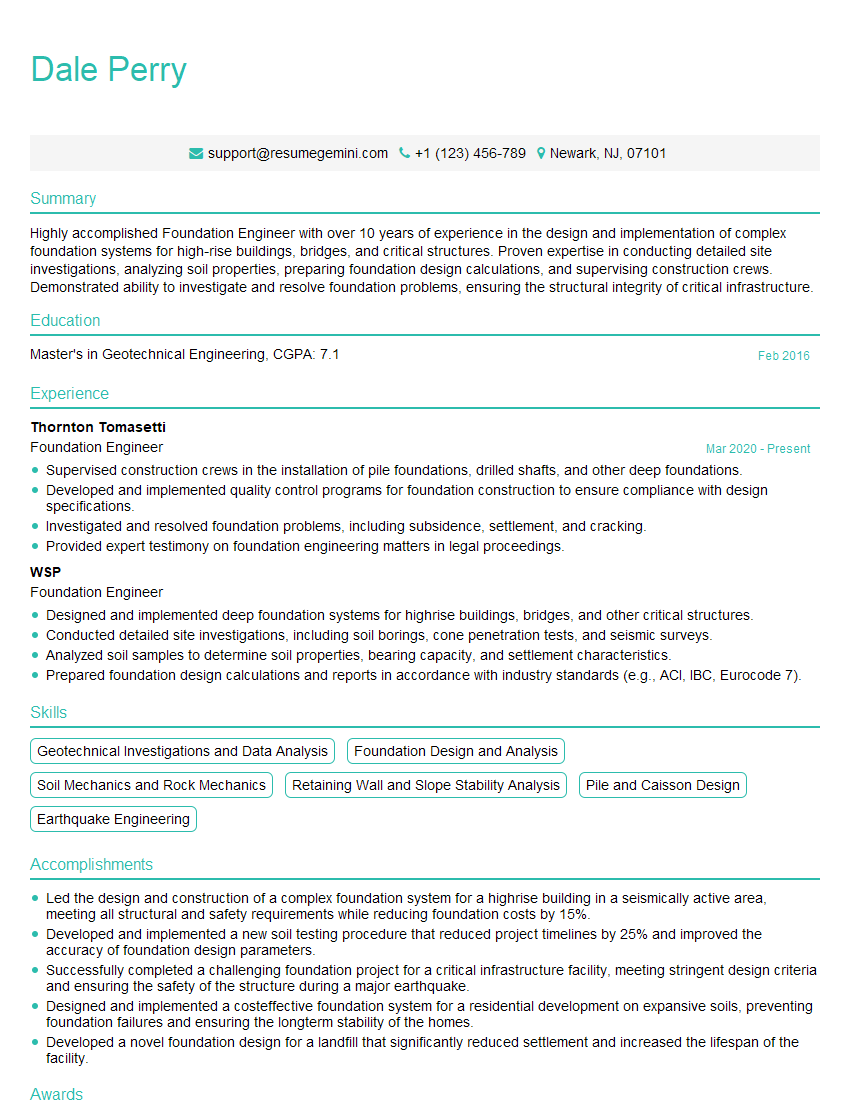
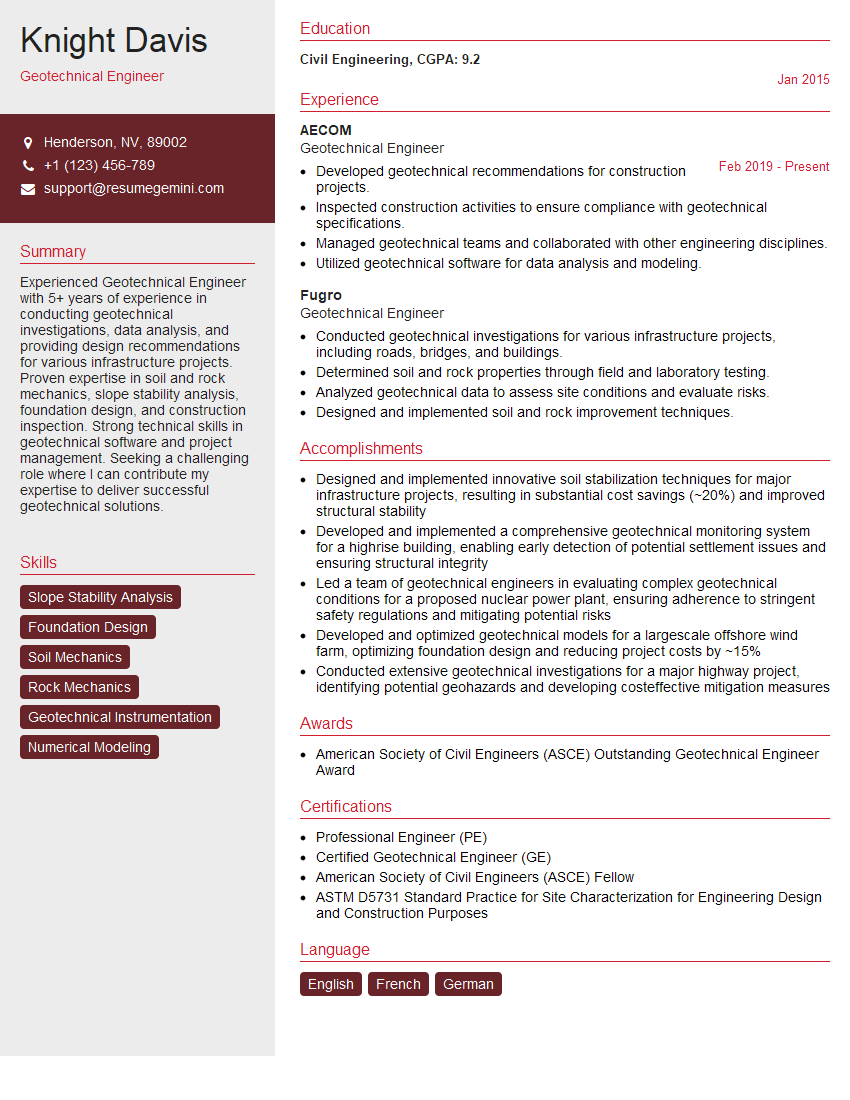
Mastering Ground Improvement Techniques opens doors to exciting career opportunities in geotechnical engineering, offering diverse projects and continuous learning. A strong resume is your key to unlocking these opportunities. Creating an ATS-friendly resume that highlights your skills and experience is essential. ResumeGemini is a trusted resource to help you build a professional and impactful resume that gets noticed. Examples of resumes tailored to Ground Improvement Techniques are available to guide you, ensuring your qualifications shine.
Explore more articles
Users Rating of Our Blogs
Share Your Experience
We value your feedback! Please rate our content and share your thoughts (optional).
What Readers Say About Our Blog
Very informative content, great job.
good