Unlock your full potential by mastering the most common Soil Investigation and Analysis interview questions. This blog offers a deep dive into the critical topics, ensuring you’re not only prepared to answer but to excel. With these insights, you’ll approach your interview with clarity and confidence.
Questions Asked in Soil Investigation and Analysis Interview
Q 1. Explain the different types of soil sampling methods and their applications.
Soil sampling methods are crucial for understanding subsurface conditions. The choice of method depends heavily on the project’s scope, soil type, and depth of investigation. Here are some common techniques:
- Hand Auger Sampling: Simple and inexpensive, ideal for shallow depths and relatively unconsolidated soils. Think of it like using a large corkscrew to extract soil samples. Limitations include the depth it can reach and difficulty in sampling hard or gravelly soils.
- Wash Boring: A hollow pipe is rotated and water is pumped down to loosen the soil, which is then brought to the surface. This method is suitable for various soil types but provides disturbed samples, making grain size analysis less precise.
- Shelby Tube Sampling: This method uses a thin-walled tube to extract relatively undisturbed samples, providing a clearer picture of soil structure. It’s excellent for consolidation and shear strength tests, but it’s limited to softer, cohesive soils. Imagine taking a core sample like taking a slice of a cake to preserve its structure.
- Rotary Drilling with Core Barrel Sampling: For deeper investigations, this method employs a rotating drill bit to extract cylindrical core samples, which are largely undisturbed. This technique can penetrate very hard or rocky formations.
- Pit Sampling: This involves manually excavating a pit to directly examine and collect samples. Useful for shallow, detailed investigations and visual inspection of soil layering.
The selection of the optimal sampling method involves considering factors such as cost, depth, soil conditions, and the required level of sample disturbance. For instance, a large infrastructure project would likely utilize a combination of methods, starting with wash boring for initial exploration and then using Shelby tube or core barrel sampling for specific testing locations.
Q 2. Describe the process of conducting a Standard Penetration Test (SPT).
The Standard Penetration Test (SPT) is an in-situ dynamic penetration test that provides valuable information on the relative density of granular soils and the consistency of cohesive soils. It’s performed in a borehole using a split-spoon sampler. Here’s the process:
- Advancement: A borehole is advanced to the desired depth using appropriate drilling techniques.
- Driving the Sampler: A split-spoon sampler, attached to a drive rod, is driven into the soil using a 63.5 kg hammer falling 76 cm. The number of blows required to drive the sampler 30 cm is recorded. This is the crucial ‘N-value’.
- Sampling: After the 30cm drive, the sampler is extracted, and the soil sample is carefully removed and analyzed.
- Data Recording: The number of blows (N-value) for each 15cm increment is meticulously recorded, along with any observations about the soil encountered, including color, moisture content, and presence of any gravel or other inclusions.
The N-value provides an indication of the soil’s relative density or consistency. Higher N-values generally correlate with denser granular soils or stiffer cohesive soils. Remember, the SPT is sensitive to various factors like hammer efficiency, borehole diameter and rod length, all of which can affect the obtained N-values and should be accounted for during interpretation.
Q 3. What are the limitations of the SPT test?
While the SPT is a widely used and relatively simple test, it does have limitations:
- Sampler Disturbance: The sampling process can disturb the soil, leading to inaccurate representation of the in-situ conditions. This is particularly true in loose sands.
- Energy Efficiency: The actual energy transferred to the sampler can vary significantly depending on the drilling equipment, rod length, and hammer efficiency. This variability affects the reliability of the N-value.
- Difficult in Cohesive Soils and Gravelly Soils: Obtaining reliable N-values in very stiff clays or gravelly soils can be challenging, potentially leading to inaccurate interpretations.
- Depth Limitation: While it can reach considerable depths, there are limitations on the practical depth depending on the drill equipment and soil conditions.
- Sensitivity to Overburden Pressure: The N-value can be influenced by the overlying soil pressure, making it hard to make direct comparisons between sites with differing overburden.
Despite these limitations, the SPT remains a valuable tool, especially when used in conjunction with other investigations, giving a reasonably reliable assessment of soil behavior.
Q 4. How do you interpret soil classification using the Unified Soil Classification System (USCS)?
The Unified Soil Classification System (USCS) is a widely used system for classifying soils based on their grain size distribution and plasticity characteristics. It utilizes a two-letter symbol system. For example, GC represents Clayey Gravel, and SP-SM might indicate silty poorly graded sand.
Interpretation involves:
- Grain Size Analysis: Determining the percentage of gravel, sand, silt, and clay in the sample using sieve analysis and hydrometer tests.
- Plasticity Chart: For fine-grained soils (silt and clay), plasticity characteristics (liquid limit and plastic limit) are determined using standard laboratory tests and plotted on a plasticity chart to classify the soil as CL (lean clay), CH (high plasticity clay), ML (silt), or MH (high plasticity silt).
- Dual Classification: Some soils may have a significant portion of both coarse-grained and fine-grained components, leading to a dual classification (e.g.,
GC-GMwould indicate a gravely clay with some silt).
The USCS provides a standardized approach, enabling geotechnical engineers to communicate soil properties and design accordingly. For instance, knowing a soil is classified as SP (poorly graded sand) influences decisions related to foundation design and earth retaining structures.
Q 5. Explain the concept of soil consolidation and its significance in geotechnical engineering.
Soil consolidation is the process by which saturated clay soils decrease in volume due to the expulsion of water under sustained loading. Imagine squeezing a sponge – the water is forced out, and the sponge becomes smaller. Similarly, the weight of buildings or other structures compresses saturated clay, causing water to be expelled.
This process is crucial in geotechnical engineering because:
- Settlement Prediction: Consolidation dictates the amount and rate of settlement a structure will undergo. Underestimating consolidation can lead to structural damage.
- Design Considerations: Engineers use consolidation theory to design foundations that can accommodate settlement without causing excessive stress or distress.
- Time-Dependent Behavior: Consolidation is a time-dependent process. The rate of settlement can take years, particularly in thick clay layers. This needs to be factored into project planning and construction sequencing.
Understanding consolidation is vital for designing safe and stable structures on clay soils. Failure to account for it can lead to significant structural issues.
Q 6. Describe different types of soil failure mechanisms.
Soil failure mechanisms describe how soil mass deforms and eventually fails under stress. Common types include:
- Shear Failure: This is the most common mode, where soil particles slide past each other along a failure plane due to shear stress exceeding the soil’s shear strength. Think of a deck of cards collapsing when pushed sideways.
- Bearing Capacity Failure: Occurs when the pressure exerted by a structure on the soil exceeds the soil’s capacity to support it, causing the foundation to settle excessively or fail completely. Imagine a building sinking into the ground.
- Slope Failure: Involves the downward movement of soil along a slope, often triggered by factors like rainfall, erosion, or seismic activity. Landslides are a prime example.
- Liquefaction: Loose saturated sandy soils can lose strength and behave like a liquid during earthquakes, causing significant settlement and damage. Imagine quicksand, where the ground loses its structural integrity.
- Creep: A slow, continuous deformation of soil under sustained stress, often observed in slopes.
Understanding these failure mechanisms is fundamental in geotechnical engineering for designing safe and stable structures.
Q 7. What are the key factors affecting shear strength of soil?
The shear strength of soil – its resistance to deformation under shear stress – is influenced by several key factors:
- Soil Type: The type of soil (clay, silt, sand, gravel) significantly impacts its shear strength. Clays, for example, can exhibit higher shear strength due to cohesive forces between particles.
- Density/Void Ratio: Denser soils (with fewer voids) generally exhibit greater shear strength than looser soils.
- Water Content: The presence of water significantly affects shear strength. In saturated sands, water pressure can reduce effective stress and decrease shear strength, potentially leading to liquefaction. Water in clay can increase the cohesion, sometimes enhancing the strength.
- Effective Stress: This is the difference between the total stress and the pore water pressure. Higher effective stress generally corresponds to higher shear strength.
- Stress History: The soil’s past loading history can impact its current shear strength. Overconsolidated soils, which have experienced higher past stresses, tend to be stronger.
- Cementation and Consolidation: The presence of natural cementation between soil particles or the consolidation due to past loading can increase the shear strength.
Understanding these factors is vital for accurate assessment of soil stability and for designing structures capable of withstanding the imposed loads without failure.
Q 8. Explain the principles of effective stress and its role in soil mechanics.
Effective stress, in soil mechanics, is the stress carried by the soil skeleton, excluding the pore water pressure. Imagine a sponge saturated with water; the effective stress is the force on the sponge itself, ignoring the water’s pressure. It’s crucial because it dictates the soil’s strength and deformation characteristics. The total stress on the soil is the sum of effective stress and pore water pressure: Total Stress = Effective Stress + Pore Water Pressure. A high pore water pressure reduces the effective stress, making the soil weaker and more susceptible to failure. For instance, during an earthquake, the sudden shaking can increase pore water pressure, leading to liquefaction – where saturated, loose soil behaves like a liquid.
Understanding effective stress is fundamental for designing foundations, retaining walls, and earth dams. By analyzing the effective stress distribution, engineers can ensure these structures remain stable and prevent failures.
Q 9. How do you determine the bearing capacity of soil?
Determining the bearing capacity of soil, which is its ability to support a load without failure, involves a combination of field investigation and laboratory testing. We consider various factors like soil type, density, moisture content, and depth of the foundation. There are several methods, including:
- Empirical Methods: These use simplified equations based on soil properties obtained from tests like the standard penetration test (SPT) and cone penetration test (CPT). For example, the Terzaghi bearing capacity equation provides an estimate based on soil shear strength parameters.
- Limit Equilibrium Methods: These methods analyze the forces acting on the soil beneath the foundation and determine the critical conditions for failure. They often involve factor of safety considerations.
- Numerical Methods: Advanced finite element analysis (FEA) can simulate the behavior of soil under load, providing a more accurate prediction of bearing capacity, especially for complex soil conditions or unusual foundation geometries.
The choice of method depends on factors like project size, complexity, and risk tolerance. For simpler projects, empirical methods might suffice, while complex projects benefit from the accuracy of numerical methods. A detailed geotechnical investigation is essential for accurate determination.
Q 10. Describe different methods for soil stabilization.
Soil stabilization aims to improve the engineering properties of soil, such as strength, compressibility, and permeability. Several methods exist, categorized broadly as:
- Mechanical Stabilization: This involves compacting the soil to increase its density and shear strength. Rollers and vibratory compactors are commonly used. This is simple, cost-effective and suitable for granular soils.
- Chemical Stabilization: This uses additives to alter the soil’s structure and properties. Common additives include lime, cement, and fly ash. Lime, for example, reacts with clay particles, improving their strength and reducing their plasticity. Cement provides a cementitious binder, increasing the soil’s strength and stiffness. This is efficient for weaker and more problematic soil types.
- Thermal Stabilization: This involves heating the soil to alter its properties, primarily used for treating contaminated soil or improving its engineering characteristics. It’s energy-intensive and requires specialized equipment.
- Biostabilization: This uses microorganisms to improve soil properties. Microbial activity can bind soil particles together, increasing strength and reducing erosion. This is environmentally friendly but often slower.
The selection of method hinges on the soil type, project requirements, and environmental concerns. For example, lime stabilization might be ideal for improving the subgrade of a road, while cement stabilization could be used for foundation support.
Q 11. Explain the importance of groundwater level in geotechnical design.
Groundwater level significantly influences geotechnical design because it affects the effective stress in the soil. A high water table reduces the effective stress, making the soil softer and weaker, thus increasing the potential for settlement and failure. The buoyancy effect of water on submerged soil also needs to be considered. It reduces the apparent weight of soil elements. For instance, a foundation built below the water table experiences an upward buoyant force that needs to be accounted for in the design.
In designing foundations, retaining walls, and excavations, accurate determination and consideration of the groundwater level are crucial. If the groundwater level fluctuates seasonally, this variability needs to be accounted for to ensure the structural stability over time. Lowering the water table through dewatering is often employed during excavation to improve soil conditions and reduce risk of instability.
Q 12. What are the common in-situ testing methods used in soil investigation?
In-situ testing provides valuable information about soil properties directly in the ground. Common methods include:
- Standard Penetration Test (SPT): A sampler is driven into the ground, and the number of blows required is recorded, indicating the soil’s relative density and strength.
- Cone Penetration Test (CPT): A cone-shaped probe is pushed into the ground, measuring the resistance encountered. It provides continuous data on soil density and strength.
- Vane Shear Test: A vane is rotated in the soil to measure its shear strength. Particularly useful for soft, cohesive soils.
- Pressuremeter Test (PMT): A cylindrical probe inflates in the soil, measuring the pressure required to expand it. This provides information about the soil’s stiffness and deformability.
- Piezometer Installation: These measure pore water pressure at specific depths, crucial for understanding effective stress and groundwater conditions.
The selection of in-situ tests depends on the project’s specific needs and soil conditions. A comprehensive testing program usually involves a combination of these methods for a more complete understanding.
Q 13. How do you interpret laboratory soil test results?
Interpreting laboratory soil test results requires careful consideration of the test methods used and the soil’s characteristics. Key parameters include:
- Grain Size Distribution: Indicates the proportion of different particle sizes (sand, silt, clay) affecting permeability and drainage. This is typically presented in a grain size distribution curve.
- Atterberg Limits: These define the consistency limits of cohesive soils (liquid limit, plastic limit, shrinkage limit), useful for classifying the soil and predicting its behavior under different moisture conditions.
- Consolidation Test: Determines the compressibility of soils under different loading conditions, crucial for predicting settlement of structures.
- Shear Strength Tests: (e.g., triaxial, direct shear) measure the soil’s resistance to failure under shear stress. Essential for designing foundations and retaining structures.
- Permeability Tests: Determine the rate at which water flows through the soil, affecting drainage and seepage analysis.
Combining the results from these various tests allows engineers to characterize the soil, predict its behavior, and design appropriate foundations or other geotechnical structures. It’s vital to interpret the results with appropriate engineering judgement and potentially use correlations with other in-situ tests for confirmation.
Q 14. Explain the concept of permeability and its determination in soils.
Soil permeability describes the ease with which water can flow through the soil. A highly permeable soil, like a well-graded sand, allows water to move quickly, while a low permeability soil, like a dense clay, resists water flow. Permeability is crucial for many geotechnical applications, including drainage design, seepage analysis, and landfill design.
Permeability is determined through laboratory tests, such as the constant head and falling head permeameters. The constant head permeameter applies a constant head of water across a soil sample and measures the flow rate. The falling head permeameter measures the rate of water level decline in a standpipe connected to a soil sample. The results are expressed as the coefficient of permeability (k), typically in units of cm/sec or m/day. Understanding permeability helps engineers predict the rate of groundwater flow, which is essential for various geotechnical designs. For example, in designing a dam, understanding the permeability of the underlying soil is critical to predicting possible seepage and ensuring the structure’s long-term stability.
Q 15. Describe the role of soil investigation in foundation design.
Soil investigation is absolutely crucial in foundation design. Think of it as the doctor’s examination before performing surgery on a building. We need to understand the soil’s characteristics to ensure the foundation can adequately support the structure’s weight and resist various loads (like wind or earthquakes) without settling, cracking, or failing. A thorough investigation helps engineers select the appropriate foundation type (shallow or deep), determine its dimensions, and specify the materials needed. For instance, if we discover weak, compressible soil, we might opt for a deep foundation like piles to transfer the load to stronger strata deeper down. Conversely, if we find strong, stable soil, a simpler and more economical shallow foundation may suffice.
Career Expert Tips:
- Ace those interviews! Prepare effectively by reviewing the Top 50 Most Common Interview Questions on ResumeGemini.
- Navigate your job search with confidence! Explore a wide range of Career Tips on ResumeGemini. Learn about common challenges and recommendations to overcome them.
- Craft the perfect resume! Master the Art of Resume Writing with ResumeGemini’s guide. Showcase your unique qualifications and achievements effectively.
- Don’t miss out on holiday savings! Build your dream resume with ResumeGemini’s ATS optimized templates.
Q 16. How do you assess the potential for soil liquefaction?
Assessing liquefaction potential involves analyzing the soil’s susceptibility to losing strength and stiffness during an earthquake. Liquefaction occurs when saturated, loose sandy or silty soils behave like a liquid under seismic shaking. We use several methods to evaluate this risk. First, we perform geotechnical site investigations to obtain soil samples and determine their grain size distribution, density, and saturation level. Then, we conduct laboratory tests like cyclic triaxial testing or simple shear testing to assess the soil’s resistance to liquefaction under earthquake-induced cyclic loading. We also utilize empirical methods like the simplified procedures outlined in geotechnical guidelines (e.g., those published by organizations like the USGS or similar national organizations) These methods typically involve calculating factors like the cyclic stress ratio (CSR) and the cyclic resistance ratio (CRR) and comparing the two. If CSR exceeds CRR, liquefaction is potentially possible.
Furthermore, we analyze historical seismic data and the site’s proximity to active faults to gauge the potential for future seismic events. Integrating these analyses gives us a comprehensive understanding of the liquefaction hazard and allows us to design mitigation strategies, such as ground improvement techniques (e.g., vibro-compaction, soil stabilization) or foundation designs that account for potential settlement.
Q 17. What are the environmental considerations in soil investigation and remediation?
Environmental considerations are paramount in soil investigation and remediation. We must minimize our impact on the surrounding environment throughout the entire process. For example, during drilling, we take precautions to avoid contaminating groundwater. This often involves using specialized drilling fluids and proper disposal methods for cuttings and waste materials. When handling contaminated soil, we adhere to strict regulations for excavation, transportation, and treatment or disposal of contaminated materials, preventing further spread of pollutants.
Remediation projects must always prioritize sustainable practices. For example, selecting in-situ remediation techniques (treating the contaminated soil in place) reduces the need for excavation and transportation, lessening the environmental footprint. The selection of remediation strategies considers the surrounding ecosystems, potentially impacted water resources, and air quality. Comprehensive environmental impact assessments (EIAs) are commonly conducted to evaluate the potential environmental consequences of various alternatives and justify environmentally responsible choices. Documentation and reporting are critical to demonstrating compliance with environmental regulations.
Q 18. Explain different types of soil erosion and their control measures.
Soil erosion is the detachment and movement of soil particles by natural forces like water, wind, or ice. Different types of erosion exist:
- Sheet erosion: A relatively uniform removal of soil from a large area, like a field after a heavy rain. Imagine a thin sheet of water washing away the topsoil.
- Rill erosion: The formation of small channels or rills due to concentrated runoff. This is often seen on sloping land after a rainfall event.
- Gully erosion: The formation of large channels or gullies. This represents a more advanced stage of erosion where the channels become significant and difficult to repair.
- Wind erosion: The removal of soil particles by wind, particularly in arid and semi-arid regions. Think of dust storms and sand dunes.
Controlling soil erosion involves various measures:
- Vegetative measures: Planting vegetation, including cover crops, trees, and shrubs, helps stabilize the soil and prevent erosion. The roots bind the soil together.
- Engineering measures: Construction of terraces, contour bunds, and check dams slows down the flow of water and reduces its erosive power. These structures trap sediment and reduce runoff.
- Conservation tillage: Minimizing soil disturbance during farming helps maintain soil structure and reduce erosion. No-till farming is a great example.
- Agroforestry: Integrating trees into agricultural landscapes helps protect soil from wind and water erosion.
The specific control measures depend on the type of erosion, the climate, and the land use.
Q 19. Describe the process of conducting a cone penetration test (CPT).
The Cone Penetration Test (CPT) is an in-situ dynamic probing method used to determine the soil’s engineering properties. A cone-shaped probe is pushed into the ground at a constant rate, and the resistance to penetration is measured. This resistance is then used to estimate soil parameters. The process is straightforward:
- Probe insertion: A cone penetrometer, which is a cone-shaped probe attached to a rod, is pushed into the ground using hydraulic pressure.
- Data acquisition: Sensors within the probe measure the cone resistance (qc), the sleeve friction (fs), and the pore water pressure (u). These measurements are continuously recorded as the probe advances.
- Data interpretation: The measured values are used to estimate soil properties such as density, shear strength, and relative density.
The CPT is a relatively quick and continuous method that provides a lot of data. A major advantage is its ability to provide information on soil layering and the location of various soil strata.
Q 20. What are the advantages and disadvantages of CPT compared to SPT?
Both the CPT and the Standard Penetration Test (SPT) are common in-situ soil testing methods, but they have distinct advantages and disadvantages:
CPT Advantages:
- Continuous data: CPT provides continuous data along the depth of penetration, providing a detailed soil profile.
- Higher resolution: Offers higher resolution and better soil stratification detail compared to the SPT.
- Less disturbance: Causes less soil disturbance than the SPT, yielding more representative soil properties.
- Faster testing: Generally faster and more efficient than the SPT.
- Direct measurement of pore water pressure: Allows for direct measurement of pore water pressure (important for liquefaction analysis).
CPT Disadvantages:
- Higher cost: Typically more expensive than SPT.
- Sensitivity to gravel: Can be less reliable in gravelly soils.
- Requires specialized equipment: Needs specialized and often expensive equipment.
SPT Advantages:
- Wider acceptance: More widely accepted and used, even in some challenging soils.
- Lower cost: Less expensive than CPT.
- Simpler equipment: Requires less sophisticated equipment.
SPT Disadvantages:
- Discontinuous data: Provides data at discrete intervals.
- Disturbs the soil: Significantly disturbs the soil during sampling.
- Subjectivity: The process includes some human subjectivity, potentially impacting results.
- Limited pore water pressure info: Pore water pressure measurement is not standard practice.
The choice between CPT and SPT depends on project-specific factors such as budget, site conditions, and the desired level of detail.
Q 21. How do you handle uncertainties and variability in soil properties during design?
Soil properties are inherently variable and uncertain. We address this by employing several strategies:
- Statistical analysis: We analyze the variability in the collected data using statistical methods, estimating the mean, standard deviation, and confidence intervals for key soil parameters.
- Probabilistic design: Instead of using single values for soil parameters, we use probabilistic models that account for the uncertainty in those values. This often involves Monte Carlo simulations to assess the reliability of the design.
- Sensitivity analysis: We conduct sensitivity analyses to determine which soil parameters have the most significant impact on the design and focus on obtaining more reliable data for these parameters.
- Conservative design practices: Adopting conservative design factors helps account for uncertainties and ensures the structural safety of the design. This often means slightly overdesigning the structure to cope with potential variations in soil conditions.
- Geotechnical risk assessment: Conducting a thorough risk assessment identifies potential risks arising from soil variability and helps prioritize the mitigation of those risks.
By incorporating these strategies, we can make informed decisions and design foundations that are both safe and economically viable while effectively dealing with uncertainties inherent in soil behavior.
Q 22. Describe your experience with different types of soil sampling equipment.
My experience encompasses a wide range of soil sampling equipment, selected based on project needs and site conditions. For undisturbed sampling, I’ve extensively used Shelby tubes, which are excellent for obtaining intact samples for laboratory testing of shear strength and consolidation properties. These are ideal for cohesive soils. For more disturbed samples, where the exact soil structure isn’t crucial, I often utilize split-spoon samplers (often part of a standard penetration test or SPT), which are effective across various soil types and provide valuable information about soil density and consistency. We also employ hand augers for shallow investigations, particularly in less consolidated materials, and larger diameter augers or rotary drilling rigs for deeper investigations and larger diameter boreholes. For special situations, like very loose sands, we might use a piston sampler to minimize sample disturbance. The choice of equipment always depends on the specific goals of the investigation, budget, and the expected soil conditions. For example, if we were investigating a site for a large building foundation, the use of Shelby tubes and SPT would likely be specified to ensure accurate determination of bearing capacity and settlement predictions. In contrast, a simpler investigation for a smaller project might only necessitate hand augers and minimal laboratory testing.
Q 23. How do you ensure the quality control and quality assurance of soil testing?
Quality control and quality assurance (QA/QC) are paramount in soil testing. We implement a rigorous system throughout the entire process, starting with sample collection. This includes detailed logging of sample locations, depths, and any observed soil conditions. Chain-of-custody documentation meticulously tracks samples from the field to the lab, ensuring sample integrity. In the laboratory, we employ standardized testing procedures following established codes, like ASTM standards. We regularly calibrate equipment and use certified reference materials to validate test results. Duplicate samples and split samples are analyzed to assess variability and precision. Blind samples are occasionally sent to independent labs for comparison, confirming the accuracy of our in-house testing. Data analysis involves statistical methods to identify outliers and trends. A comprehensive QA/QC report documents the entire process, identifying any deviations and their potential impacts on the final results. This rigorous approach ensures the reliability and credibility of our findings, which are crucial for informed engineering decisions.
Q 24. Explain your experience in interpreting geological maps and logs in soil investigations.
Interpreting geological maps and logs is fundamental to planning effective soil investigations. Geological maps provide a regional overview of soil types, geological formations, and potential subsurface features like faults or bedrock. This helps in determining the likely soil profiles at the investigation site and guides the placement of boreholes. Borehole logs, recorded during drilling, offer detailed information about soil stratigraphy (layer sequence), soil descriptions, groundwater levels, and any encountered obstructions. I use this information to identify potential areas of concern, such as weak or expansive soils, or the presence of groundwater. For instance, a geological map might reveal the presence of a clay layer in the area, prompting me to specifically target this layer during sampling to evaluate its engineering properties. Comparing borehole logs from multiple boreholes helps in constructing a three-dimensional representation of the subsurface conditions, enabling a more accurate assessment of the overall site characteristics. Integrating this information with geophysical surveys, like seismic refraction or resistivity surveys, enhances the understanding of subsurface conditions and provides a more comprehensive picture of the site.
Q 25. What software programs are you familiar with for geotechnical analysis?
I am proficient in several geotechnical analysis software programs. My experience includes using Plaxis for finite element analysis of slope stability, foundation settlements, and earth retaining structures. I’m also familiar with Rocscience software, such as Slide for slope stability analysis and RS2 for designing reinforced soil structures. For data management and visualization, I use GINT which facilitates borehole log creation, correlation, and interpretation. Excel and other spreadsheet software are utilized for data analysis and reporting. The choice of software depends on the complexity of the project and the specific analysis required. For example, Plaxis might be used for a complex foundation design involving multiple soil layers, while simpler analyses might only require spreadsheet software and basic geotechnical hand calculations.
Q 26. Describe a challenging soil investigation project you were involved in and how you overcame the challenges.
One challenging project involved investigating a site for a high-rise building in an area with highly variable soil conditions. The site comprised layers of dense clay, loose sand, and pockets of highly organic material, posing significant challenges for sampling and data interpretation. The initial boreholes revealed unexpected variations in soil properties within short distances. To overcome this, we implemented a denser grid of boreholes than initially planned to adequately characterize the site’s heterogeneity. We also integrated geophysical surveys, particularly cone penetration tests (CPT), to provide continuous measurements of soil resistance and improve our understanding of subsurface variability. We used the CPT data to refine the soil model used in our finite element analysis, allowing us to better account for the irregular soil layering and develop appropriate foundation designs to address the complex soil conditions and ensure the building’s stability. Careful documentation of the variable soil conditions and the detailed approach we used was essential for project success and client confidence.
Q 27. How do you communicate technical information effectively to non-technical audiences?
Communicating technical information effectively to non-technical audiences requires simplification and visualization. I avoid using jargon and instead use plain language, explaining technical terms in easily understandable terms. I use visual aids such as diagrams, charts, and cross-sections to illustrate complex concepts. Analogies and real-world examples help to make the information relatable. For instance, instead of saying “the soil has a low shear strength,” I might explain that “the soil is like loose sand and might not be able to support a heavy building without proper foundation design.” I tailor my communication style to the audience’s level of understanding, ensuring the message is clear and concise. The overall goal is to ensure the audience understands the key findings and recommendations, enabling them to make informed decisions.
Q 28. What are your career aspirations in the field of soil investigation and analysis?
My career aspirations involve continued growth and expertise in soil investigation and analysis. I aim to become a leading expert in challenging geotechnical projects, particularly those involving complex soil conditions and innovative solutions. I want to further develop my skills in advanced geotechnical modeling and data analysis, and contribute to research advancing our understanding of soil behavior. Ultimately, I strive to contribute to safer and more sustainable infrastructure projects by providing reliable and insightful geotechnical assessments.
Key Topics to Learn for Soil Investigation and Analysis Interview
- Soil Classification Systems: Understand the Unified Soil Classification System (USCS) and other relevant systems. Be prepared to discuss the implications of different soil classifications on engineering design.
- In-situ and Laboratory Testing: Describe various methods like Standard Penetration Test (SPT), Cone Penetration Test (CPT), and laboratory tests (e.g., shear strength, consolidation) and their applications. Be ready to explain the limitations of each method.
- Soil Mechanics Principles: Demonstrate a thorough grasp of concepts like effective stress, permeability, consolidation, shear strength, and their relevance to geotechnical engineering projects.
- Site Investigation Planning and Reporting: Explain the process of planning a soil investigation, including site reconnaissance, drilling methods, sampling techniques, and the preparation of comprehensive geotechnical reports.
- Data Analysis and Interpretation: Discuss how to analyze and interpret soil test data to determine soil properties and make engineering judgments. Be prepared to discuss potential sources of error and uncertainty.
- Ground Improvement Techniques: Familiarize yourself with various ground improvement methods (e.g., compaction, grouting, soil stabilization) and their suitability for different soil conditions and project requirements.
- Environmental Considerations: Understand the environmental aspects of soil investigation, including contamination assessment and remediation strategies.
- Software and Tools: Demonstrate familiarity with relevant geotechnical software packages used for analysis and interpretation of soil data.
Next Steps
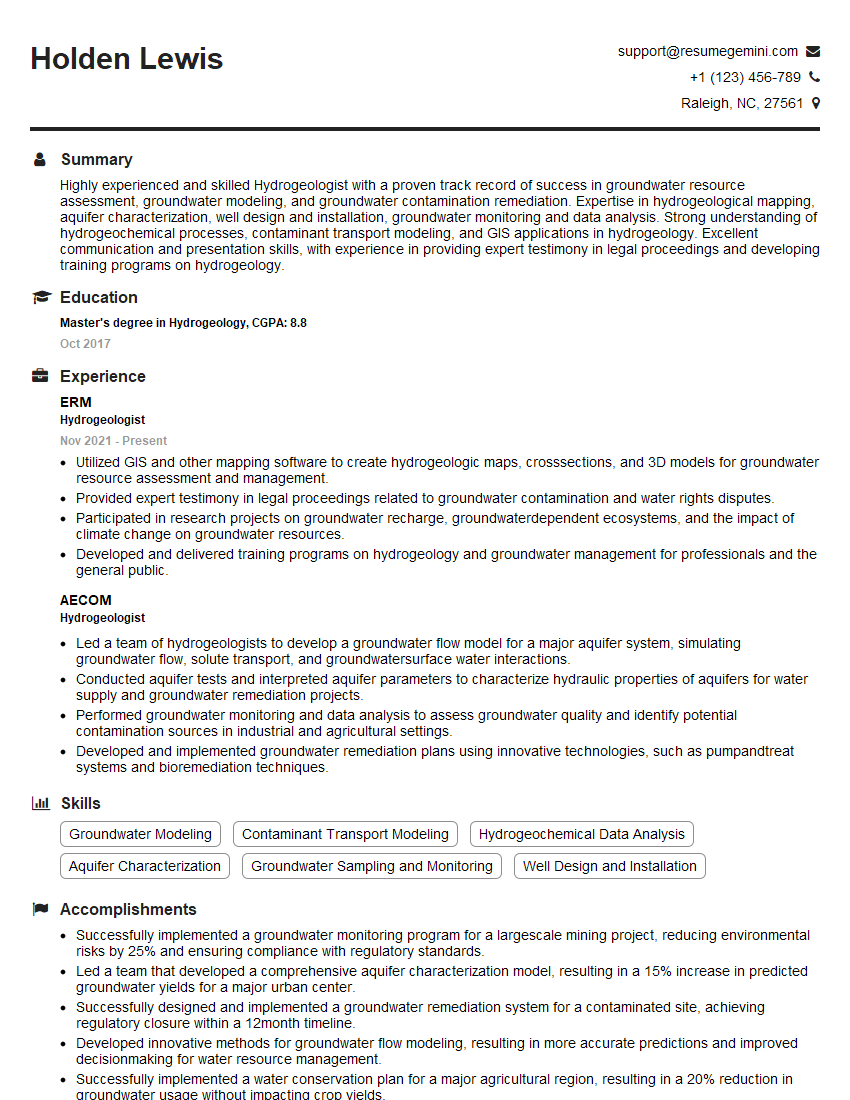
Mastering Soil Investigation and Analysis opens doors to a rewarding career in geotechnical engineering, offering diverse opportunities and significant professional growth. A strong resume is crucial for showcasing your skills and experience to potential employers. Creating an ATS-friendly resume is key to ensuring your application gets noticed. We recommend using ResumeGemini, a trusted resource for building professional and impactful resumes. ResumeGemini provides examples of resumes tailored to Soil Investigation and Analysis, helping you create a document that highlights your unique qualifications effectively. This will significantly boost your job prospects in this competitive field.





Explore more articles
Users Rating of Our Blogs
Share Your Experience
We value your feedback! Please rate our content and share your thoughts (optional).
What Readers Say About Our Blog
Very informative content, great job.
good