Unlock your full potential by mastering the most common Groundwater Vistas interview questions. This blog offers a deep dive into the critical topics, ensuring you’re not only prepared to answer but to excel. With these insights, you’ll approach your interview with clarity and confidence.
Questions Asked in Groundwater Vistas Interview
Q 1. Explain the process of creating a groundwater flow model in Groundwater Vistas.
Creating a groundwater flow model in Groundwater Vistas involves several key steps. First, you define the model domain, essentially drawing the boundaries of your area of interest. This might be a specific aquifer, a watershed, or even a larger region. Think of it like drawing a map of the underground water system you want to study. Next, you discretize the domain into a grid or mesh—essentially breaking it into smaller, manageable blocks. The finer the mesh, the more detail you capture, but the more computationally intensive the model becomes. Then, you input your data: this includes the hydraulic properties of the aquifer (like permeability and porosity), the location and characteristics of wells and other sources or sinks, and boundary conditions which define the flow interactions at the edges of your model area. Finally, you specify the model parameters (like the time step and solution method), run the model, and interpret the results, including groundwater heads, flow directions, and velocities. This process often involves iterations— refining the model based on the initial results and improving the calibration. For example, you might start with a coarser grid to test the model setup, then refine it later for a more accurate simulation.
Q 2. Describe different types of boundary conditions used in Groundwater Vistas.
Groundwater Vistas supports various boundary conditions to accurately simulate different geological scenarios. These conditions define how water flows into and out of the modeled area. Common types include:
- Constant Head: Represents a boundary where the hydraulic head (water level) remains fixed. Imagine a large lake or river that acts as a constant source or sink of water for the aquifer.
- No-Flow: Represents an impermeable boundary, like a geological formation that prevents groundwater flow across it, acting as a barrier.
- Specified Flux: Defines a known rate of water entering or leaving the model boundary. This is useful for simulating things like recharge from rainfall or groundwater extraction from wells.
- Head-Dependent Flux: This is for boundaries where the flow rate across a boundary depends on the hydraulic head difference between the aquifer and an external reservoir. For example, a river interacting with the aquifer.
- Seepage Face: A boundary where the groundwater level intersects with a surface water body. The flow rate is determined by the difference in head and the hydraulic properties of the boundary.
Choosing the appropriate boundary condition is crucial for model accuracy. Incorrect boundary conditions can lead to significant errors in the simulation results. For instance, neglecting a significant recharge area could cause underestimation of groundwater levels.
Q 3. How do you calibrate a groundwater model in Groundwater Vistas?
Calibrating a groundwater model in Groundwater Vistas is an iterative process of adjusting model parameters to match observed groundwater levels and flows. It involves comparing simulated results with real-world data, identifying discrepancies, and modifying parameters to reduce these differences. This often starts with a preliminary model run using best-guess parameter values. You then compare the simulated heads at observation wells to actual measured heads. Tools like the automatic calibration feature within Groundwater Vistas can help to automatically adjust some parameters based on the differences between simulated and observed values. This often requires manual adjustment as well; experience and understanding of the aquifer are crucial. You might need to refine hydraulic conductivity, recharge rates, or boundary conditions. Once the calibration is deemed satisfactory (usually with a good statistical fit between observed and simulated data), you can gain confidence in using the model for predictive purposes. The process is similar to tuning a car engine – making small adjustments to improve performance until you find the optimal setting.
Q 4. What are the common sources of error in groundwater modeling?
Groundwater modeling is prone to various sources of error. These can be broadly categorized into:
- Data Uncertainty: Inaccurate or incomplete data on hydraulic properties (permeability, porosity), boundary conditions, or recharge rates are common.
- Conceptual Model Errors: Incorrect representation of the aquifer system (e.g., simplified geometry, neglecting significant geological features) can lead to significant errors.
- Numerical Errors: These arise from the numerical methods used to solve the governing equations. Grid resolution, time step size, and the choice of numerical scheme all influence accuracy.
- Parameter Uncertainty: Difficulty in accurately estimating parameter values, which often have spatial variability, can significantly impact model results.
Minimizing these errors requires careful data collection and processing, thorough understanding of the aquifer system, and thoughtful selection of numerical techniques.
Q 5. How do you handle data uncertainty in Groundwater Vistas?
Handling data uncertainty in Groundwater Vistas usually involves probabilistic approaches. Instead of using single best-guess values for parameters, you might use probability distributions representing the range of plausible values for each parameter. Groundwater Vistas itself doesn’t inherently incorporate such analysis, but you can couple its simulation outputs with other statistical tools to carry out uncertainty analyses. This allows you to assess the range of possible model outcomes and quantify the uncertainty associated with your predictions. Methods like Monte Carlo simulations can generate many model runs with randomly sampled parameters from their probability distributions to evaluate this range of possibilities. This provides a more realistic and informative representation of the system compared to a deterministic model that only uses single values. The output is less a single definitive number, and more a probabilistic range and statistical analysis of the possible outcomes.
Q 6. Explain the concept of sensitivity analysis in groundwater modeling.
Sensitivity analysis in groundwater modeling determines how sensitive the model output is to changes in input parameters. It helps identify which parameters have the most significant impact on the results. This is important because it guides data collection efforts—focusing resources on parameters that have a high impact. It also assists in calibration by showing which parameters need more careful adjustment. Various methods exist, including:
- One-at-a-time analysis: Changing one parameter at a time while holding others constant to observe its effects.
- Global sensitivity analysis: Simultaneously varying multiple parameters using techniques like variance-based methods to assess their individual and combined influence.
For instance, a sensitivity analysis might reveal that hydraulic conductivity has a much greater influence on simulated groundwater levels than recharge rate, helping prioritize better estimation and measurement of hydraulic conductivity in subsequent field studies.
Q 7. What are the limitations of numerical groundwater modeling?
Despite their power, numerical groundwater models have inherent limitations:
- Simplifications: Real aquifer systems are complex, and models necessarily simplify them. Heterogeneities in the aquifer, complex flow patterns, and interaction with surface water bodies are often simplified or idealized in the model.
- Data Requirements: Accurate modeling requires substantial data, which may be expensive or impossible to obtain in some situations. Data scarcity can limit the model’s accuracy and reliability.
- Computational Demands: Complex models can be computationally intensive, requiring significant processing power and time.
- Model Uncertainty: As discussed earlier, uncertainty in input parameters and model assumptions inherently limits the accuracy and reliability of model predictions.
- Interpretation Challenges: Interpreting and communicating the results of sophisticated numerical models can be difficult, particularly to non-experts.
It’s crucial to acknowledge these limitations and use caution when interpreting model outputs. Model results should be viewed as a tool to aid understanding, not as absolute truths.
Q 8. Describe the different types of stresses that can affect groundwater flow.
Groundwater flow is governed by a variety of stresses, essentially forces that drive the movement of water underground. These can be broadly categorized as hydraulic stresses and geologic stresses.
- Hydraulic Stresses: These are related to changes in water pressure within the aquifer. Think of it like squeezing a sponge – applying pressure changes the water flow. Examples include:
- Recharge: Infiltration of rainfall or irrigation water adds water to the aquifer, increasing pressure and driving flow.
- Discharge: Water pumped from wells or natural springs removes water, lowering pressure and affecting flow patterns.
- Hydraulic gradients: These are differences in water pressure between locations within the aquifer. Water naturally flows from areas of high pressure to areas of low pressure, much like a ball rolling downhill.
- Geologic Stresses: These relate to the physical properties and structure of the aquifer itself. They affect flow indirectly by modifying hydraulic properties. Examples include:
- Earthquakes: Seismic activity can alter aquifer properties, such as permeability (how easily water flows through the rock), leading to changes in flow paths.
- Subsidence: Compaction of the aquifer due to groundwater extraction can change the flow pattern and aquifer volume.
- Sediment deposition: The accumulation of sediments can reduce aquifer permeability and restrict groundwater flow.
Understanding these stresses is crucial for accurately modeling groundwater flow and predicting the impact of human activities or natural events on water resources.
Q 9. How do you incorporate well testing data into a Groundwater Vistas model?
Incorporating well testing data into a Groundwater Vistas model is essential for calibration and validation. This involves several steps:
- Data Acquisition and Preprocessing: Gather data on pumping rates, drawdown (reduction in water level), and recovery (return to previous levels) from well tests. Ensure the data is cleaned and consistent.
- Parameter Estimation: Use the well test data (e.g., pumping tests, slug tests) to estimate aquifer parameters like transmissivity (a measure of how easily water moves horizontally), storativity (how much water an aquifer can store), and hydraulic conductivity (how easily water moves vertically). Groundwater Vistas provides tools for this, often requiring iterative analysis.
- Model Calibration: Incorporate the estimated parameters into your Groundwater Vistas model. Compare the simulated drawdown and recovery curves from the model to the observed data from well tests. Adjust parameters until a satisfactory match is achieved. This often involves an iterative process of adjusting parameters, running simulations, and comparing results.
- Sensitivity Analysis: Assess the sensitivity of model results to changes in the estimated parameters. This helps identify which parameters have the largest impact on the model’s accuracy and which ones need the most precise estimation.
Imagine it like baking a cake: the well test data is your recipe, the parameters are the ingredients, and the model calibration is adjusting the recipe to get the desired outcome (accurate simulation of groundwater flow). Accurate parameter estimation through well testing is crucial for a reliable model.
Q 10. Explain the difference between steady-state and transient groundwater flow.
The difference between steady-state and transient groundwater flow lies in how water levels and flow rates change over time.
- Steady-state flow: This occurs when the water table and flow rates do not change significantly over time. Think of it like a calm river – the water level stays relatively constant. This is a simplification, often used for situations where recharge and discharge rates are relatively stable and the system has reached equilibrium.
- Transient flow: This reflects changing conditions where water levels and flow rates fluctuate over time. This is much more common in reality. Think of a river after a heavy rainfall – the water level rises rapidly and then gradually returns to normal. Transient flow occurs when significant changes to the system (such as pumping, recharge changes, or changes in boundary conditions) occur.
In Groundwater Vistas, you would choose between steady-state or transient simulations depending on the research question and the specific characteristics of the aquifer system being modeled. Transient models are usually more complex but necessary for accurately representing dynamic systems.
Q 11. What are the key considerations for selecting appropriate model parameters?
Selecting appropriate model parameters is crucial for the accuracy and reliability of a groundwater model. The key considerations include:
- Conceptual Model: A clear understanding of the hydrogeological system is paramount. This includes defining the aquifer boundaries, identifying different layers, understanding the geological formations, and considering the spatial distribution of hydraulic conductivity and other parameters.
- Available Data: The choice of parameters is guided by the type and quantity of available data. For example, high-quality well-testing data allows for more precise parameter estimation compared to situations with limited data, where simplification might be required.
- Model Resolution: The spatial scale of the model and the level of detail required determine the parameterization. A regional-scale model will likely require simpler parameterization, while a local-scale model may necessitate a more detailed representation of heterogeneity (variations in properties). High-resolution models require more computing resources and more careful attention to data quality.
- Parameter Sensitivity: Conducting a sensitivity analysis helps determine which parameters most significantly impact the model results. This analysis guides the effort spent on accurately estimating critical parameters.
- Parameter Estimation Methods: Several methods exist for estimating model parameters, each with its strengths and weaknesses. These include manual adjustment (using trial and error), inverse modeling techniques (using optimization algorithms), and geostatistical methods (using spatial correlation). The selection of the method depends on available data, model complexity, and computational resources.
Selecting appropriate parameters is a process that involves expert judgment, technical skill and iterative refinement. It is an art as much as a science.
Q 12. How do you validate a groundwater model?
Validating a groundwater model involves comparing the model’s predictions to independent observations. It’s about confirming that the model realistically represents the real-world system. Here’s how to do it:
- Data Comparison: Compare model-simulated water levels, flow rates, or other variables with independent measurements from monitoring wells, stream gauges, or other sources of data not used for model calibration.
- Goodness-of-Fit Statistics: Use statistical measures like R-squared or root mean squared error (RMSE) to quantify the agreement between observed and simulated data. A higher R-squared and lower RMSE indicate better agreement.
- Qualitative Assessment: Examine the spatial patterns and temporal trends predicted by the model and compare them to your understanding of the hydrogeological system. Are the simulated patterns realistic?
- Predictive Capability: Evaluate the model’s ability to predict future conditions or the effects of changes in stresses. Can the model accurately simulate the effect of a proposed new well, for example?
- Peer Review: Having other experts review the model setup, methodology, and results is crucial to identify potential biases and errors.
Model validation is an ongoing process. A model is never fully ‘validated,’ but rather progressively improved through a process of comparison, adjustment, and refinement.
Q 13. Describe your experience with different types of groundwater models (e.g., MODFLOW, FEFLOW).
My experience encompasses a range of groundwater modeling software, with significant proficiency in MODFLOW and experience with FEFLOW. While the underlying principles of groundwater flow are the same, each software has its strengths and weaknesses. Here’s a comparison:
- MODFLOW (Modular Groundwater Flow): This is a widely used, highly versatile finite-difference model. Its modular structure allows for flexible incorporation of different processes, such as pumping wells, recharge, evapotranspiration and various boundary conditions. I have extensive experience developing and calibrating complex MODFLOW models using Groundwater Vistas as the user interface for model setup, visualization, and post-processing.
- FEFLOW (Finite Element Groundwater FLOW): This is a finite-element model suited for complex geometries and heterogeneous aquifers. FEFLOW excels in modeling irregular boundaries and detailed spatial variations in aquifer properties. I have used FEFLOW on projects requiring a high degree of geometric detail. The choice between MODFLOW and FEFLOW depends on the specific problem; MODFLOW is often preferred for its relative simplicity and wide community support, while FEFLOW may be better suited for complex geometries or when highly detailed simulations of flow are required.
My experience with these models gives me the flexibility to adapt to different project needs and choose the best tool for the job.
Q 14. How do you interpret model results in Groundwater Vistas?
Interpreting model results in Groundwater Vistas involves a combination of quantitative and qualitative analysis. The software provides various tools to visualize and analyze the results:
- Water Table Maps: Examine the spatial distribution of water levels to identify areas of high and low pressure, understand flow directions, and assess the impact of pumping or recharge on the aquifer.
- Flow Lines: Visualize the paths of groundwater flow, showing the movement of water through the aquifer system. This helps to understand the connectivity between different parts of the aquifer and identify potential flow paths of contaminants.
- Head Contours: Generate contour maps of hydraulic head (water pressure) to understand pressure gradients and flow directions.
- Time Series Plots: Analyze how water levels or flow rates change over time at specific locations to understand transient behavior and the impact of events like pumping or rainfall.
- Particle Tracking: Simulate the movement of particles through the aquifer to trace contaminant transport pathways or predict the travel time of water from recharge areas to discharge areas.
The key to effective interpretation is a thorough understanding of the model’s limitations, the underlying assumptions, and the uncertainties in the input parameters. It’s crucial to combine the quantitative analysis provided by the software with a qualitative understanding of the hydrogeology and to present results in a clear and concise manner.
Q 15. How do you present your groundwater modeling results to non-technical audiences?
Presenting complex groundwater modeling results to a non-technical audience requires a strategic approach focusing on clear communication and visual aids. Instead of diving into technical jargon, I begin by outlining the main objective of the modeling study in simple terms. For example, if the study aims to assess the impact of a proposed development on groundwater resources, I’d explain this goal upfront.
Then, I use visuals extensively. Charts and graphs are crucial, but I ensure they are clear, concise, and avoid overwhelming detail. A map showing groundwater levels, for instance, is much more effective than a table of numbers. I also use analogies: comparing groundwater flow to water flowing in a network of pipes helps build understanding. Finally, I focus on the ‘so what?’ – what are the implications of the model’s predictions for the community or decision-makers? This ensures relevance and impact. Storytelling is also key; weaving the results into a narrative makes the information easier to digest and remember. A summary emphasizing key findings is always crucial.
Career Expert Tips:
- Ace those interviews! Prepare effectively by reviewing the Top 50 Most Common Interview Questions on ResumeGemini.
- Navigate your job search with confidence! Explore a wide range of Career Tips on ResumeGemini. Learn about common challenges and recommendations to overcome them.
- Craft the perfect resume! Master the Art of Resume Writing with ResumeGemini’s guide. Showcase your unique qualifications and achievements effectively.
- Don’t miss out on holiday savings! Build your dream resume with ResumeGemini’s ATS optimized templates.
Q 16. Explain the concept of aquifer testing and its importance in groundwater modeling.
Aquifer testing is a crucial field technique used to determine the hydraulic properties of aquifers. These properties, such as transmissivity (how easily water moves through the aquifer) and storativity (how much water the aquifer can store), are fundamental inputs for groundwater models. It involves inducing a change in the hydraulic head (water level) of the aquifer – usually through pumping or injection – and then monitoring the response of the water levels in the surrounding observation wells.
The data from these tests are then analyzed using various methods, such as the Thiem equation or Cooper-Jacob method, to estimate the aquifer parameters. The importance of aquifer testing lies in its ability to provide site-specific data that significantly improves the accuracy and reliability of groundwater models. Without accurate hydraulic parameters, the model’s predictions can be highly unreliable. Imagine trying to predict the flow of water in a pipe without knowing its diameter – the results would be completely inaccurate! The data acquired ensures that simulations reflect real-world conditions more closely.
Q 17. What are the different types of aquifers and how do they affect groundwater flow?
Aquifers are underground geological formations that contain and transmit groundwater. They are classified into several types, primarily based on their geologic properties and the presence of confining layers.
- Confined Aquifers: These are bounded above and below by impermeable layers (aquitards or aquicludes), preventing free exchange with the atmosphere. This can lead to higher pressure and artesian conditions, where water rises above the aquifer level in wells. Groundwater flow in confined aquifers is largely controlled by the hydraulic gradient across the aquifer, and it can be quite fast.
- Unconfined Aquifers: These aquifers are open to the atmosphere and their upper boundary is the water table. Water recharge occurs directly from rainfall infiltration. Groundwater flow in unconfined aquifers is influenced by the water table gradient and is generally slower compared to confined aquifers.
- Perched Aquifers: These are small, localized aquifers that occur above the main water table due to a lens of impermeable material. They are typically of limited extent and volume.
The type of aquifer significantly affects groundwater flow. Confined aquifers often exhibit faster flow rates due to the higher pressure, while unconfined aquifers show slower, more diffuse flow patterns. Understanding aquifer type is crucial for accurate groundwater modeling as it dictates the governing equations and boundary conditions used.
Q 18. Describe your experience using GIS software in conjunction with Groundwater Vistas.
GIS software is invaluable when working with Groundwater Vistas. I routinely use GIS to create and manage spatial data for my models, such as well locations, geologic boundaries, and elevation data. GIS tools are especially beneficial for importing and preprocessing spatial data before it’s brought into the modeling environment. For instance, I use ArcGIS to digitize well locations from scanned maps, create shapefiles defining aquifer boundaries, and generate raster layers representing land use and soil type. This detailed spatial information is then imported into Groundwater Vistas to create a more accurate representation of the hydrogeologic system.
Further, I leverage GIS to visualize and analyze modeling results. After running a simulation, I often use GIS to create maps showing groundwater flow paths, contaminant plumes, or changes in groundwater levels. These visualizations help communicate model outputs effectively to both technical and non-technical audiences. They also make it easier to identify areas of particular interest or concern. It’s a true synergy. GIS enhances the spatial aspects of modeling that would be harder to manage with Groundwater Vistas alone, allowing for better visualization and analysis.
Q 19. How do you incorporate spatial variability in your groundwater models?
Incorporating spatial variability is critical for developing realistic groundwater models. Groundwater properties like hydraulic conductivity, porosity, and recharge rates are rarely uniform across an aquifer. Ignoring this variability can lead to inaccurate predictions.
I use several approaches to incorporate spatial variability in my Groundwater Vistas models. One common method is to create spatially distributed parameter fields using GIS-derived data. For example, I might use a raster layer of soil types to assign different hydraulic conductivity values to different zones within the model. Another approach is to use geostatistical techniques, such as kriging, to interpolate point measurements of aquifer properties into continuous surfaces. This allows for a smoother representation of spatial variability and accounts for uncertainty in the data. The choice of method depends on the data available and the complexity of the system. Ultimately, the goal is to capture the heterogeneity of the aquifer to achieve model realism.
Q 20. What are the challenges of modeling complex hydrogeologic systems?
Modeling complex hydrogeologic systems presents numerous challenges. One major challenge is data scarcity. Obtaining comprehensive and reliable hydrogeologic data can be expensive and time-consuming. This often leads to model uncertainty, requiring careful consideration of data limitations and appropriate parameter estimation techniques.
Another challenge is the complexity of the physical processes involved. Groundwater flow is governed by complex interactions between various factors like geology, topography, climate, and human activities. Accurately representing these processes in a model requires sophisticated techniques and careful model calibration. Furthermore, representing the temporal variability of recharge, pumping rates, and other factors adds another layer of complexity. It’s like trying to solve a vast puzzle with only some pieces. Finally, computational limitations can restrict the complexity of the models that can be realistically simulated. Balancing model accuracy with computational feasibility is crucial for achieving meaningful results.
Q 21. How do you handle discontinuities (faults, etc.) in Groundwater Vistas models?
Discontinuities like faults significantly affect groundwater flow patterns, creating zones of preferential flow or complete barriers. In Groundwater Vistas, I handle these discontinuities by explicitly representing them in the model geometry and assigning appropriate hydraulic properties. Faults can be modeled as zones with significantly reduced hydraulic conductivity, acting as barriers to flow. Alternatively, depending on their nature, they might exhibit enhanced permeability along their plane, creating preferential flow paths.
The approach depends on the available data on fault properties and their impact on groundwater flow. Geological maps, geophysical surveys, and borehole data are key sources of information. I often use GIS to delineate fault zones and integrate them into the model’s grid or mesh. Then, specific hydraulic parameters reflecting the fault’s influence on groundwater movement are assigned to those zones in the model. This ensures that the discontinuities are accurately represented, thus avoiding a potentially unrealistic simulation of groundwater behavior.
Q 22. Explain the process of creating a conceptual model for a groundwater system.
Creating a conceptual model for a groundwater system is like drawing a blueprint before building a house. It’s a crucial first step, summarizing our understanding of the subsurface. This involves defining the geological framework, the hydrogeological properties of the aquifers and confining layers, the boundaries of the system (like rivers, lakes, or impermeable bedrock), and the sources and sinks of groundwater (like recharge areas and wells). We integrate all available data, such as geological maps, well logs, geophysical surveys, and historical water level measurements, to create a simplified representation of the complex reality.
For example, in a coastal area, the conceptual model might show a freshwater lens floating on top of saltwater, with the thickness of the lens influenced by pumping rates and recharge. We would identify the boundaries of the lens, the direction of groundwater flow, and the interaction between freshwater and saltwater. The level of detail depends on the project’s scope and the data available. A simpler model might only focus on major aquifers, whereas a more complex model would include detailed stratigraphic units and heterogeneous hydraulic properties.
- Step 1: Data Compilation and Analysis: Gather and analyze all available data.
- Step 2: Conceptual Diagram: Create a simplified diagram showing the key features of the system.
- Step 3: Defining Boundaries: Determine the spatial extent of the model.
- Step 4: Identifying Hydrogeologic Units: Define aquifers, aquitards, and other relevant geological units.
- Step 5: Characterizing Hydraulic Properties: Assign values for parameters such as hydraulic conductivity, specific yield, and storage coefficient.
- Step 6: Identifying Sources and Sinks: Define recharge areas, wells, streams, and other sources and sinks.
Q 23. Describe your experience with groundwater remediation modeling.
I have extensive experience using Groundwater Vistas for groundwater remediation modeling. I’ve worked on numerous projects involving contaminant transport and remediation strategies. My work has included simulating pump-and-treat systems, natural attenuation processes, and the effectiveness of various remediation technologies. For example, on one project involving a chlorinated solvent plume, we used Groundwater Vistas to model the plume’s migration under different pumping scenarios. We evaluated the effectiveness of various well placements and pumping rates to optimize the remediation strategy, minimizing costs and maximizing contaminant removal. This involved calibrating the model against observed concentration data and performing sensitivity analyses to assess the uncertainty in model predictions. The model helped us design a more efficient remediation system compared to a less sophisticated approach.
In another project involving a landfill leachate plume, we used Groundwater Vistas to model the transport of multiple contaminants, considering their different retardation factors and degradation rates. This allowed us to predict the long-term fate and transport of the contaminants and evaluate the effectiveness of different remediation strategies.
Q 24. How do you address data gaps in your groundwater models?
Addressing data gaps is a common challenge in groundwater modeling. We employ several strategies to handle this, always acknowledging the uncertainties introduced. One approach is to use geostatistical methods to interpolate data between known measurement points. For example, kriging can be used to estimate hydraulic conductivity values in areas where no measurements are available, incorporating spatial correlation information. Another method is to use data from similar geological settings or analogous sites to inform parameter estimation. This is especially useful when dealing with regional-scale models where data are scarce.
We also utilize expert judgment to constrain model parameters, relying on the knowledge and experience of hydrogeologists. We might establish a range of plausible values for uncertain parameters and conduct sensitivity analyses to assess how these uncertainties affect model predictions. Finally, we clearly document the assumptions and uncertainties associated with the data gaps and their potential impact on the model’s results, emphasizing transparency.
Q 25. What are some best practices for managing and organizing your groundwater modeling data?
Effective data management is crucial for successful groundwater modeling. I use a structured approach involving a dedicated database, a clearly defined naming convention for files and folders, and version control. All data are meticulously documented, including metadata such as source, date, and quality assessment. This ensures data traceability and allows for easy retrieval and reuse. I frequently use spreadsheets to organize input parameters and model results. The spreadsheet itself is then linked to a dedicated project folder containing all associated raw data, processed data, model input files, and output files. This organized approach minimizes errors and facilitates collaboration among team members. Regular backups are essential to safeguard against data loss. Finally, using a consistent project structure allows for effortless transfer of models and data between different projects or teams.
Q 26. Discuss your experience with different types of solvers in Groundwater Vistas.
Groundwater Vistas offers several solvers, each suited to different model types and complexities. I have experience with the Preconditioned Conjugate Gradient (PCG) solver, which is efficient for most groundwater flow problems, and the Newton-Raphson solver for more complex, nonlinear models that include processes such as density-dependent flow or coupled processes. The choice of solver depends on factors such as model size, the complexity of the governing equations, and the desired level of accuracy. For instance, the PCG solver is faster for large models, while the Newton-Raphson solver may be necessary to obtain convergence for strongly nonlinear systems. The choice frequently involves experimentation and comparison of computational time versus accuracy. My experience also includes using the Multi-level solver for complex problems needing faster solution times.
Q 27. Describe your experience working with Groundwater Vistas’ pre- and post-processing tools.
Groundwater Vistas’ pre- and post-processing tools are indispensable for efficient modeling workflows. The pre-processing tools facilitate the creation of the model grid, assignment of boundary conditions, and input of hydrogeological properties. I frequently use the grid generation tools to create both structured and unstructured grids tailored to the specific geometry of the study area. The post-processing tools allow for visualization of model results, including groundwater flow patterns, hydraulic heads, and contaminant concentrations. I regularly use contour plots, cross-sections, and particle tracking to interpret the model output and communicate results effectively. The ability to export data to other software packages for further analysis or presentation is also very valuable. Specific tools I frequently use include the contouring options, the creation of particle tracks, and the ability to export data to GIS software for visualization in a geographic context.
Q 28. How would you approach troubleshooting a groundwater model that is not converging?
A non-converging groundwater model is a common challenge. Troubleshooting involves a systematic approach. First, I check for errors in the input data, such as inconsistencies in units, incorrect boundary conditions, or unrealistic parameter values. Next, I review the model’s numerical parameters, including the solver settings and convergence criteria. Sometimes, adjusting the solver’s tolerance or using a different solver can resolve convergence issues. If data errors are not apparent, I then perform a sensitivity analysis to identify parameters that strongly influence the solution. Addressing inconsistencies or uncertainties in these critical parameters is essential. For example, I might refine the model grid in areas with high gradients or refine parameter values based on additional data or expert judgment. Finally, in more challenging situations, I may explore simplifying the model by removing less critical features or combining layers.
It’s like troubleshooting a car that won’t start. You systematically check the battery, fuel, ignition, and other components until you find the problem. Similarly, a methodical approach in groundwater modeling is essential for successful convergence.
Key Topics to Learn for Groundwater Vistas Interview
- Hydrogeology Fundamentals: Understanding aquifer properties (porosity, permeability, transmissivity), Darcy’s Law, and groundwater flow regimes.
- Groundwater Modeling: Familiarize yourself with various modeling techniques (e.g., MODFLOW) and their applications in assessing groundwater resources and contamination.
- Well Hydraulics: Mastering concepts related to well design, development, testing, and pumping.
- Groundwater Contamination: Explore sources of contamination (e.g., industrial, agricultural), transport mechanisms, and remediation strategies.
- Data Analysis and Interpretation: Practice analyzing hydrogeological data (e.g., water level measurements, geochemical data) and interpreting results.
- Environmental Regulations: Gain familiarity with relevant environmental regulations and permitting processes related to groundwater management.
- Sustainable Groundwater Management: Understand the principles of sustainable groundwater management and the challenges of balancing water supply and environmental protection.
- Practical Application: Consider case studies involving groundwater investigations, remediation projects, or water resource management plans.
- Problem-Solving Approaches: Develop your ability to critically analyze hydrogeological problems, identify key parameters, and propose effective solutions.
Next Steps
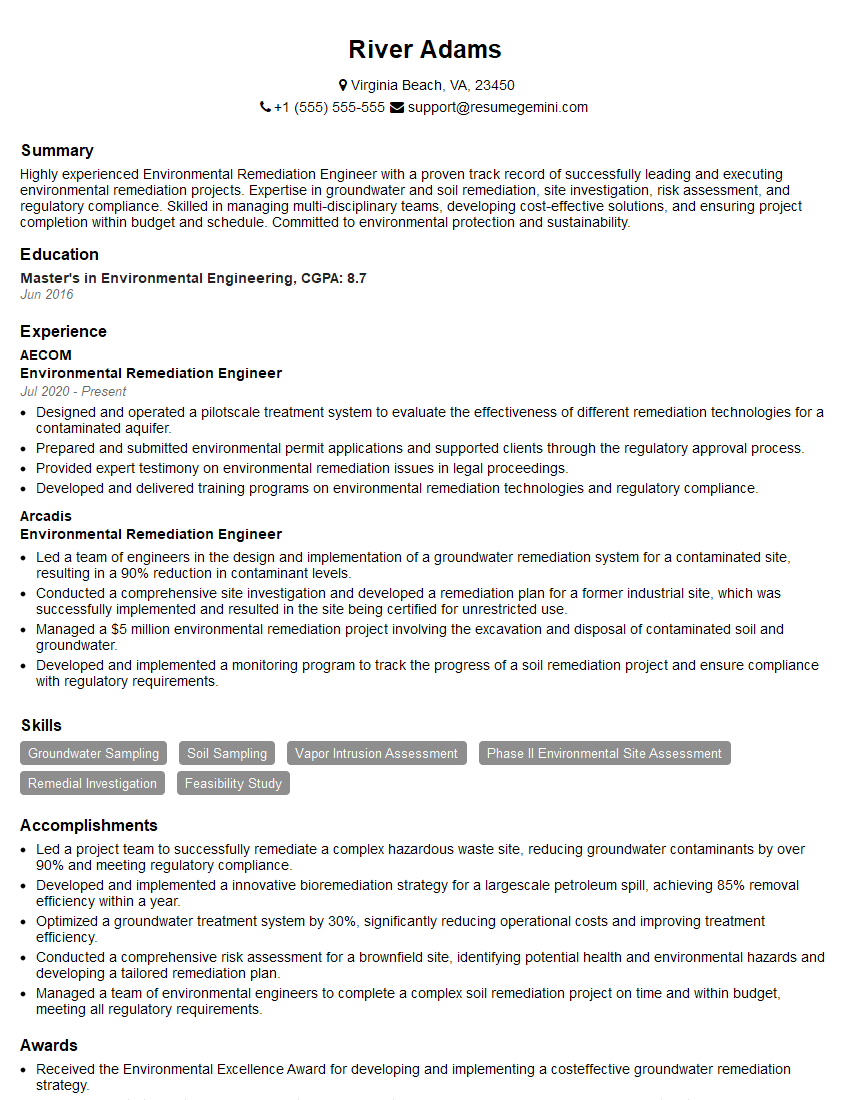
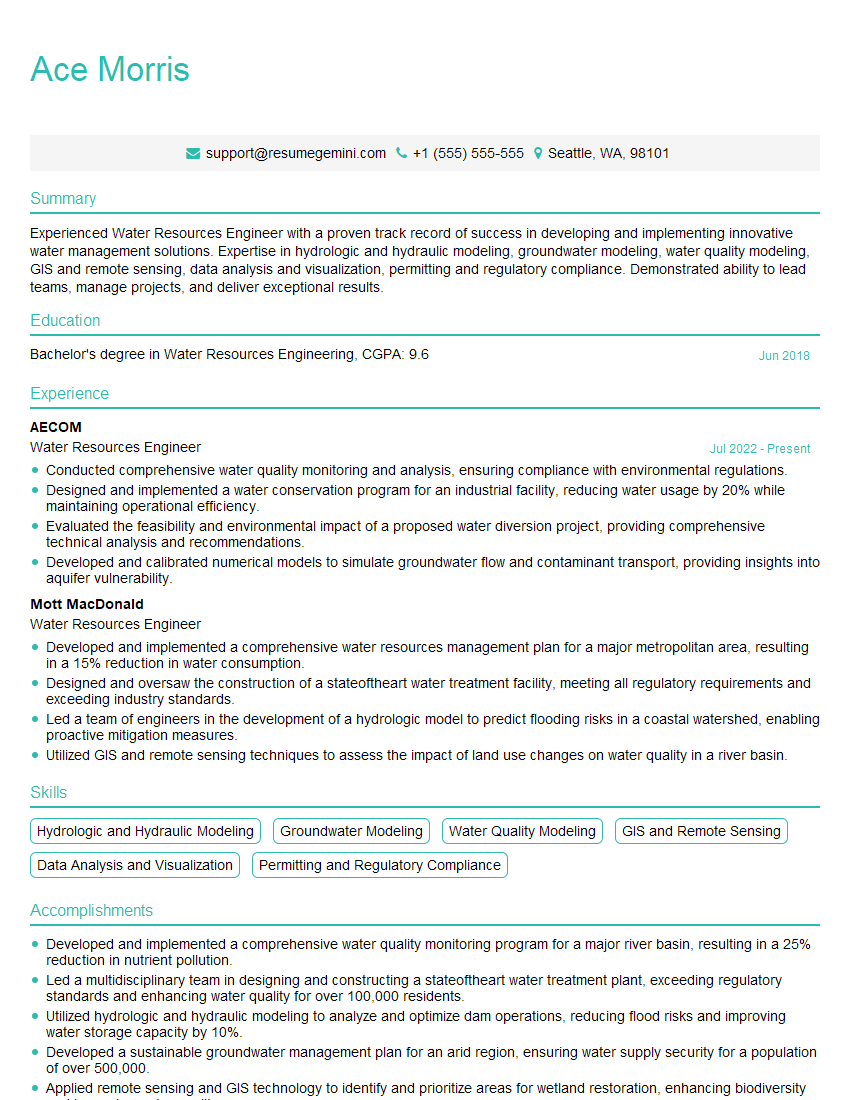
Mastering Groundwater Vistas concepts is crucial for advancing your career in environmental science, hydrology, or related fields. A strong understanding of these topics will significantly enhance your job prospects and allow you to contribute effectively to challenging projects. To increase your chances of landing your dream role, creating an ATS-friendly resume is essential. ResumeGemini is a trusted resource that can help you craft a professional and impactful resume. We provide examples of resumes tailored to Groundwater Vistas to give you a head start in showcasing your skills and experience. Take advantage of these resources and increase your interview success!

Explore more articles
Users Rating of Our Blogs
Share Your Experience
We value your feedback! Please rate our content and share your thoughts (optional).
What Readers Say About Our Blog
Very informative content, great job.
good