Cracking a skill-specific interview, like one for Guidance and Control System Maintenance, requires understanding the nuances of the role. In this blog, we present the questions you’re most likely to encounter, along with insights into how to answer them effectively. Let’s ensure you’re ready to make a strong impression.
Questions Asked in Guidance and Control System Maintenance Interview
Q 1. Explain the difference between open-loop and closed-loop control systems.
The core difference between open-loop and closed-loop control systems lies in their feedback mechanisms. An open-loop system operates without feedback; it simply executes a pre-programmed sequence of actions. Think of a toaster: you set the timer, and it toasts for that duration regardless of whether the bread is actually toasted. The outcome isn’t monitored or adjusted.
A closed-loop system, also known as a feedback control system, uses feedback to compare the actual output to the desired output (setpoint). Any difference between these two values (the error) is used to adjust the control actions, ensuring the system reaches and maintains the desired state. A cruise control system in a car is a perfect example. The system continuously monitors the vehicle’s speed and adjusts the throttle to maintain the set speed, compensating for inclines and other factors.
- Open-loop advantages: Simple design, inexpensive, usually fast.
- Open-loop disadvantages: Susceptible to disturbances, inaccurate, low precision.
- Closed-loop advantages: High accuracy, robustness to disturbances, maintains setpoint despite external factors.
- Closed-loop disadvantages: More complex design, potentially slower response, risk of instability if not properly tuned.
Q 2. Describe your experience with PID controllers. What are their limitations?
Proportional-Integral-Derivative (PID) controllers are the workhorses of many control systems. They use three terms to calculate the control signal: proportional, integral, and derivative. The proportional term responds to the current error, the integral term addresses accumulated error over time, eliminating steady-state error, and the derivative term anticipates future error based on the rate of change of the error. I’ve extensively used PID controllers in various applications, from robotic arm control to temperature regulation in industrial processes. In one project involving a robotic welding system, fine-tuning the PID parameters was crucial for achieving the necessary precision and avoiding oscillations.
Despite their ubiquity, PID controllers have limitations:
- Difficulty in tuning: Finding optimal PID gains (Kp, Ki, Kd) can be challenging and often requires iterative adjustments and trial-and-error, especially for complex systems.
- Nonlinear systems: PID controllers are fundamentally linear, struggling with systems exhibiting significant nonlinear behavior. The response may not be optimal.
- Lack of model knowledge: A thorough understanding of the system’s dynamics is often assumed but may not be available, leading to less effective control.
- Susceptibility to noise: The derivative term is particularly sensitive to sensor noise, potentially causing instability or erratic behavior.
Q 3. How do you troubleshoot a malfunctioning guidance system?
Troubleshooting a malfunctioning guidance system is a systematic process. My approach typically involves:
- Identify the symptom: What exactly is going wrong? Is the system failing to reach the target, exhibiting oscillations, or completely unresponsive?
- Isolate the problem: Is the problem related to sensors, actuators, software, or communication? I’d use diagnostic tools to isolate where the issue originates. For instance, if I suspect faulty sensor readings, a quick comparison of the sensor data with the system’s internal calculations can confirm this.
- Analyze data logs: Many guidance systems record detailed operational data. Examining these logs can reveal patterns, anomalies, and potential causes.
- Check communication links: Faulty communication between components (e.g., sensors and controller) is a common cause of failure. I would test the integrity of communication pathways.
- Verify calibration: Ensuring that all sensors and actuators are properly calibrated is critical. Recalibration of elements might resolve the problem.
- Simulate the problem: If possible, simulating the faulty behavior can help to pin down the root cause.
- Implement a fix: Once the cause is identified, I would proceed with repairing, replacing, or re-configuring the faulty component or aspect of the system. This could involve software updates, hardware replacements, or adjustments to control parameters.
- Retest and validate: After implementing a fix, the system needs to be thoroughly tested to ensure that the problem is resolved and the system is performing as expected.
Q 4. What are common causes of drift in a control system?
Drift in a control system refers to a gradual deviation from the desired setpoint over time. Several factors contribute to this:
- Sensor drift: Sensors can experience gradual changes in their output over time due to environmental conditions (temperature, pressure), aging, or component degradation. This leads to inaccurate feedback.
- Actuator wear: Actuators, such as motors or valves, can degrade over time, resulting in reduced accuracy or a shift in their operating characteristics.
- Integration errors: In PID controllers, the integral term accumulates errors. If there’s a persistent bias (e.g., due to sensor drift), the integral term can lead to a drift in the output.
- Environmental factors: External factors like temperature changes or vibrations can affect the system’s performance and contribute to drift. For example, thermal expansion or contraction can alter the mechanical properties of the system, leading to drift.
- Software bugs: Subtle bugs in the control software can cause unintended changes in the output over time, manifesting as drift.
Q 5. Explain your experience with Kalman filtering.
Kalman filtering is a powerful technique for estimating the state of a dynamic system using a series of noisy measurements. I have applied Kalman filtering in applications requiring state estimation under uncertainty, such as navigation systems and target tracking. For example, I was involved in a project where we used Kalman filtering to fuse data from an inertial measurement unit (IMU) and a GPS receiver to estimate the position and orientation of an unmanned aerial vehicle (UAV). The Kalman filter helped significantly in smoothing out noisy sensor data and producing a more accurate estimate of the UAV’s state, even when GPS signals were intermittently unavailable.
The Kalman filter works by recursively predicting the system’s state and updating the prediction with new sensor measurements. It’s particularly useful when dealing with noisy sensors and unmodeled disturbances. The filter’s effectiveness hinges on the accuracy of the system model (state transition equation) and the measurement model (how sensor readings relate to the system’s state). A crucial aspect is designing appropriate covariance matrices that represent the uncertainty in the system dynamics and sensor measurements.
Q 6. Describe your experience with sensor integration and calibration.
Sensor integration and calibration are critical aspects of building a reliable guidance and control system. My experience involves selecting the appropriate sensors based on the application’s requirements (accuracy, range, cost), integrating them into the system, and ensuring their accurate calibration. This process includes:
- Sensor selection: This step involves carefully considering the required accuracy, range, bandwidth, environmental robustness, and cost of each sensor. Tradeoffs often need to be made.
- Hardware integration: This involves physically connecting the sensors to the system, including electrical interfaces, power supplies, and signal conditioning circuits.
- Software integration: This involves developing the software to read data from the sensors, format it, and integrate it into the control algorithms.
- Calibration: This is the process of determining the relationship between the sensor’s output and the actual physical quantity being measured. Calibration procedures vary widely depending on the sensor type. Often, a combination of static and dynamic calibration techniques is employed.
- Data fusion: If multiple sensors are used, data fusion algorithms are implemented to combine the sensor readings, thereby improving the overall accuracy and robustness of the system. This might involve the use of Kalman filtering or other estimation techniques.
For instance, in a robotics project, I integrated a variety of sensors including encoders, IMUs, and laser rangefinders. Careful calibration of these sensors was crucial for achieving accurate robot motion control.
Q 7. How do you handle system failures and ensure redundancy?
Handling system failures and ensuring redundancy are paramount in safety-critical applications. My approach centers on a multi-layered strategy:
- Fault detection and isolation: Implementing mechanisms to detect and isolate failures early is crucial. This might involve watchdog timers, plausibility checks on sensor readings, or the use of fault-tolerant algorithms.
- Redundancy: Employing redundant sensors, actuators, or even entire subsystems is a common method for ensuring system reliability. This allows the system to continue operating even if one component fails. The redundant components need to be properly managed and switched over in case of failure.
- Fail-safe mechanisms: Designating fail-safe modes of operation that prioritize safety is essential. In critical applications, this could involve halting operations or switching to a degraded mode of operation that ensures a safe state.
- Error handling: The system should gracefully handle various types of errors. Error messages, logging capabilities, and recovery mechanisms should be part of the design to facilitate troubleshooting and system recovery.
- Regular maintenance and testing: Preventive maintenance, including regular testing and calibration of components, is vital for preventing failures and ensuring system reliability.
A real-world example: In an aircraft control system, redundant flight control computers and sensors are used to maintain flight stability even if one component fails. Fail-safe mechanisms ensure the aircraft can maintain a stable configuration even if significant failures occur.
Q 8. What are the different types of actuators used in guidance and control systems?
Actuators are the muscles of a guidance and control system, translating commands from the control system into physical movement. Different systems require different types of actuators, each with its own strengths and weaknesses. Common types include:
- Hydraulic Actuators: These use pressurized fluids to generate force. They offer high power-to-weight ratios, making them ideal for heavy-duty applications like large aircraft or industrial robots. However, they can be less precise and require more maintenance than other types. Imagine a giant, powerful arm – that’s often a hydraulic actuator at work.
- Pneumatic Actuators: Similar to hydraulic actuators, but they use compressed air. They are generally simpler, cleaner, and safer than hydraulic systems, but offer less power and precision. Think of the air cylinders you might see operating in factory automation.
- Electric Actuators: These use electric motors to produce movement. They are known for their precision, ease of control, and relatively low maintenance. Many modern applications favor electric actuators due to their versatility. Examples range from the tiny motors controlling the steering on your car to larger motors in robotic arms.
- Electromechanical Actuators: A hybrid combining electrical and mechanical components. This offers a blend of precision and power, often found in aerospace and high-precision industrial applications. These are sophisticated and may combine features of electric motors with gearboxes or other mechanical elements for force amplification.
The choice of actuator depends critically on the specific application requirements, considering factors such as force, speed, accuracy, power consumption, environment, and cost.
Q 9. Explain your experience with real-time operating systems (RTOS) in a GNC context.
Real-Time Operating Systems (RTOS) are crucial for Guidance, Navigation, and Control (GNC) systems because they guarantee deterministic behavior – meaning actions occur at precisely predictable times. In my experience, I’ve worked extensively with VxWorks and QNX, two prevalent RTOS in the aerospace and defense industries. These systems allow for the precise scheduling of control loops, sensor data processing, and actuator commands, all within strict timing constraints. A delay of even a few milliseconds in a GNC system could have catastrophic consequences.
For instance, in a drone application, the RTOS ensures that sensor data (e.g., GPS, IMU) is processed and used to update the control commands in a timely manner to maintain stable flight. Failure to do so could lead to instability and a crash. My work involved tasks such as optimizing RTOS scheduling algorithms to minimize latency, integrating real-time data acquisition libraries, and ensuring the overall system robustness through rigorous testing and analysis.
Q 10. What are your experiences with different communication protocols (e.g., CAN, Ethernet) in control systems?
Communication protocols are the language that different components of a control system use to talk to each other. I’ve worked with several protocols, including CAN (Controller Area Network) and Ethernet.
- CAN: This is a robust and widely used protocol, particularly in automotive and aerospace applications, known for its reliability in harsh environments. Its deterministic nature and built-in error detection make it suitable for critical control systems. I’ve used CAN extensively in projects requiring real-time communication between sensors, actuators, and the control unit, ensuring data integrity under noisy conditions.
- Ethernet: Ethernet provides higher bandwidth than CAN, making it ideal for applications needing to transmit large amounts of data, like image processing or advanced sensor data. However, its deterministic behavior is less guaranteed compared to CAN, and it requires careful network design to ensure timely data delivery for control applications. I’ve integrated Ethernet in systems where high-bandwidth communication was crucial, such as transmitting high-resolution camera data for autonomous navigation. In those cases, we employed techniques like Quality of Service (QoS) to prioritize critical control data over other network traffic.
The selection of a protocol depends on factors such as bandwidth requirements, real-time constraints, cost, and environmental considerations. Often, systems combine multiple protocols to leverage their individual strengths.
Q 11. Describe your experience with fault detection and isolation techniques.
Fault detection and isolation (FDI) is essential for ensuring the safety and reliability of GNC systems. My experience involves implementing both hardware and software-based FDI techniques.
Hardware redundancy, like having multiple sensors or actuators, is a common approach. If one unit fails, a backup is immediately available. Software FDI involves employing analytical redundancy – using multiple sensor readings and system models to cross-check data consistency and detect anomalies. For example, if the data from two independent GPS receivers diverges significantly, an FDI algorithm can flag a potential fault. I’ve also used model-based diagnostic techniques to identify the root cause of a failure by comparing the observed system behavior with a simulated model.
Techniques like parity checks, Kalman filtering, and observer-based methods are all within my expertise for implementing fault detection. The isolation phase often involves using decision trees or other logic to pinpoint the faulty component, enabling corrective actions or fail-safe mechanisms.
Q 12. How do you ensure the safety and reliability of a guidance and control system?
Safety and reliability in GNC systems are paramount. My approach involves a multi-layered strategy encompassing various aspects:
- Redundancy: Employing redundant sensors, actuators, and even processors allows the system to continue functioning even if individual components fail.
- Fault Tolerance: Designing the system to gracefully handle failures, possibly through automatic reconfiguration or fallback mechanisms.
- Formal Verification and Validation: Rigorous testing and simulation using techniques like model checking and hardware-in-the-loop testing to ensure the system behaves as expected and meets safety requirements.
- Safety Standards Compliance: Adhering to relevant safety standards (like DO-178C for airborne systems) throughout the design, development, and verification processes. This often involves producing extensive documentation and undergoing rigorous certification processes.
- Human-in-the-loop considerations: Designing systems with clear, informative displays and intuitive interfaces that allow operators to understand the system’s status and intervene if needed. This includes safety-critical displays that provide warning and alert mechanisms during unusual operational conditions.
Ultimately, safety and reliability are built-in from the very beginning of the design process, not added as an afterthought.
Q 13. What is your experience with system modeling and simulation?
System modeling and simulation are indispensable tools for designing, testing, and verifying GNC systems. I’m proficient in using tools like MATLAB/Simulink and Amesim to create accurate models of various system components, from sensors and actuators to control algorithms. These models allow me to simulate different scenarios, analyze system behavior under various conditions, and test different control strategies before physical implementation. This approach saves time and resources, enabling us to identify and fix design flaws early on.
For example, using Simulink, I’ve built detailed models of aircraft flight dynamics to test and tune autopilot algorithms before flight testing. This virtual testing allowed for the identification and correction of potential control instabilities without risking a physical aircraft. Similarly, I’ve used Amesim to model hydraulic systems, helping optimize their design for performance and efficiency.
Q 14. How do you approach debugging complex control systems?
Debugging complex control systems requires a systematic and methodical approach. My strategy typically involves:
- Isolate the Problem: Carefully examine system logs, sensor data, and actuator commands to pinpoint the area where the malfunction is occurring. This may involve analyzing data from various sources to narrow down the location of the error.
- Reproduce the Issue: Try to consistently reproduce the problem. This can be challenging in complex systems, but it is crucial for effective debugging. Understanding when and how the failure manifests is critical to isolating the cause.
- Employ Monitoring and Logging Tools: Use debugging tools and extensive logging to monitor the system’s behavior in real-time or from recorded data. This helps in understanding the sequence of events leading up to the error.
- Utilize Simulation: If possible, reproduce the issue within a simulation environment to isolate the problem without affecting the physical system. This allows for safe experimentation with different debugging approaches.
- Employ Step-by-Step Analysis: Break down the system into smaller, more manageable components and test each one individually. This ‘divide and conquer’ method is very effective in pinpointing the source of the error.
Debugging complex systems is often iterative. It requires patience, persistence, and a strong understanding of the system’s architecture and behavior. Effective communication and collaboration within a team are also crucial for tackling such challenges.
Q 15. Describe your experience with different types of sensors (e.g., IMU, GPS, encoders).
My experience with various sensors is extensive, encompassing their integration, calibration, and troubleshooting within numerous guidance and control systems. I’ve worked extensively with Inertial Measurement Units (IMUs), GPS receivers, and rotary encoders.
IMUs: I’ve used IMUs from various manufacturers, leveraging their data (accelerometer and gyroscope readings) for attitude estimation and motion tracking in applications ranging from robotics to autonomous vehicles. A key challenge is handling sensor drift and noise through Kalman filtering and other advanced signal processing techniques. For example, in one project involving a UAV, we used a complementary filter to fuse IMU data with barometric pressure readings to achieve robust altitude estimation.
GPS: GPS integration requires careful consideration of signal availability, multipath effects, and atmospheric delays. I’ve used differential GPS (DGPS) to achieve centimeter-level accuracy in high-precision applications, and I’m familiar with techniques for mitigating GPS outages using sensor fusion with IMUs. In a recent project, we implemented a robust GPS outage handling mechanism by seamlessly switching to an IMU-based navigation system until GPS signal was reacquired.
Encoders: Rotary encoders provide precise angular position and velocity measurements. I have experience integrating them into robotic manipulators and motor control systems, using their data for closed-loop control and accurate trajectory tracking. A practical application involved using encoders to precisely control the movement of a robotic arm during a welding operation, ensuring consistent weld quality.
Career Expert Tips:
- Ace those interviews! Prepare effectively by reviewing the Top 50 Most Common Interview Questions on ResumeGemini.
- Navigate your job search with confidence! Explore a wide range of Career Tips on ResumeGemini. Learn about common challenges and recommendations to overcome them.
- Craft the perfect resume! Master the Art of Resume Writing with ResumeGemini’s guide. Showcase your unique qualifications and achievements effectively.
- Don’t miss out on holiday savings! Build your dream resume with ResumeGemini’s ATS optimized templates.
Q 16. Explain your experience with control system design methodologies.
My control system design experience encompasses a wide range of methodologies, from classical control techniques to modern approaches like model predictive control (MPC). I’m proficient in using MATLAB/Simulink for system modeling, simulation, and control design.
Classical Control: I’ve designed PID controllers, lead-lag compensators, and other classical controllers for various applications. This includes tuning controllers using Ziegler-Nichols methods and other optimization techniques. For example, I successfully implemented a PID controller for a temperature control system in an industrial process, achieving stable and precise temperature regulation.
Modern Control: I have experience designing and implementing MPC controllers, particularly beneficial for systems with constraints and complex dynamics. MPC allows for optimal control strategies even in the presence of disturbances and model uncertainties. In a recent project involving autonomous driving, we used MPC to plan optimal trajectories for a vehicle, taking into account various constraints such as speed limits and obstacle avoidance.
State-Space Methods: I’m proficient in using state-space representations for system modeling and control design, including the use of Linear Quadratic Regulators (LQR) and Kalman filters for optimal state estimation and control.
Q 17. What are the advantages and disadvantages of different control algorithms?
The choice of control algorithm depends heavily on the specific application and system characteristics. Each algorithm has its strengths and weaknesses.
PID Controllers: Simple to implement and tune, but can struggle with complex dynamics and significant disturbances.
MPC: Handles constraints and complex dynamics well, but requires a good system model and can be computationally expensive.
LQR: Optimal control for linear systems, but assumes perfect state information and doesn’t directly handle constraints.
Adaptive Control: Can adapt to changing system dynamics, but more complex to design and tune.
For instance, a simple temperature control system might benefit from a PID controller due to its simplicity, whereas an autonomous vehicle navigating a complex environment would require a more sophisticated approach like MPC to handle multiple constraints and uncertainties.
Q 18. Describe your experience with data acquisition and analysis in control systems.
Data acquisition and analysis are crucial for understanding system behavior and performance. My experience involves using various tools and techniques for data logging, processing, and visualization.
Data Logging: I’ve used various data acquisition systems, including NI DAQ devices and custom-built systems, to collect sensor data, actuator commands, and other relevant information.
Data Processing: I’m proficient in using MATLAB, Python (with libraries like NumPy and Pandas), and other tools to process and analyze large datasets. This includes filtering, signal processing, and statistical analysis.
Data Visualization: I use various tools to create informative visualizations, such as plots, graphs, and animations, to communicate insights from the data analysis. This helps in identifying patterns, anomalies, and potential areas for improvement.
In one project, we used data acquisition to identify a subtle vibration in a robotic arm, which ultimately led to the discovery and correction of a minor mechanical fault, preventing a costly failure.
Q 19. How do you manage the lifecycle of a guidance and control system?
Managing the lifecycle of a GNC system is a systematic process encompassing several key phases. It’s crucial for ensuring safety, reliability, and cost-effectiveness.
Requirements Definition: Clearly defining the system’s functional and performance requirements is the foundation for successful development.
Design and Development: This phase involves selecting appropriate sensors, actuators, and control algorithms, along with detailed design and implementation.
Testing and Validation: Rigorous testing, including simulation and hardware-in-the-loop testing, is critical to verify performance and identify potential issues.
Deployment and Operation: Once validated, the system is deployed and monitored during its operational life.
Maintenance and Upgrades: Regular maintenance and software/hardware upgrades are necessary to ensure continued reliable performance and address any issues that may arise.
Decommissioning: A planned decommissioning process is important for safe and environmentally responsible disposal of the system.
This structured approach ensures a smooth and effective lifecycle, minimizing risks and maximizing the system’s operational lifespan.
Q 20. What is your experience with testing and validation of GNC systems?
Testing and validation of GNC systems are paramount for ensuring safety and reliability. My experience includes a range of testing methodologies:
Simulation: I extensively use simulation tools (e.g., MATLAB/Simulink) to test the system’s performance under various scenarios, including nominal conditions and fault conditions. This allows for early detection and correction of design flaws.
Hardware-in-the-Loop (HIL) Testing: HIL testing involves integrating the GNC system with a real-time simulator representing the physical environment. This allows for realistic testing without the risks associated with real-world testing.
Field Testing: I’ve participated in field testing of GNC systems in real-world environments. This provides valuable data on system performance in actual operating conditions.
Verification and Validation (V&V): My testing processes adhere to strict V&V procedures to ensure the system meets all specified requirements and is safe for operation. This often involves formal test plans, procedures, and documentation.
A recent project involved extensive HIL testing of an autonomous drone navigation system, simulating various challenging scenarios such as GPS outages and unexpected obstacles. This testing identified and resolved several critical issues before deployment.
Q 21. Describe your experience with predictive maintenance techniques.
Predictive maintenance aims to anticipate potential failures before they occur, minimizing downtime and maintenance costs. My experience incorporates various techniques:
Data-driven approaches: Analyzing sensor data from the GNC system to identify patterns and anomalies that may indicate impending failures. This often involves machine learning techniques to predict remaining useful life (RUL) of components.
Condition-based monitoring (CBM): Continuously monitoring the system’s health through sensor data and alerts, triggering maintenance only when necessary, instead of following a fixed schedule.
Prognostic health management (PHM): Developing sophisticated models to predict the health degradation of critical components and estimate their remaining useful life. This allows for optimized scheduling of maintenance activities.
In a past project, we implemented a CBM system for a robotic arm that reduced downtime by 30% by proactively addressing potential issues based on the analysis of motor temperature and vibration data. This predictive approach not only prevented major failures but also improved operational efficiency.
Q 22. How do you handle conflicting requirements in a control system design?
Conflicting requirements in control system design are unfortunately common. They arise when different stakeholders – such as operations, safety, and engineering teams – have differing priorities and constraints. For example, one team might prioritize speed, while another might prioritize safety, leading to conflicting demands on the system’s performance.
My approach involves a structured process to resolve these conflicts. First, I meticulously document all requirements, using a Requirements Traceability Matrix (RTM) to identify potential overlaps and contradictions. This matrix links each requirement to its source and shows its impact on other parts of the system.
Next, I facilitate a collaborative prioritization workshop with all stakeholders. We use techniques like weighted scoring or MoSCoW analysis (Must have, Should have, Could have, Won’t have) to rank requirements based on their criticality and feasibility. This ensures a transparent and agreed-upon prioritization scheme. Finally, trade-off analyses are performed. For example, if speed and safety are conflicting, we might explore different control algorithms that achieve an acceptable balance between the two, perhaps through adaptive control techniques that dynamically adjust performance based on operational conditions. Thorough simulations and testing are crucial to validate the chosen solution.
Q 23. How do you prioritize tasks when dealing with multiple system failures?
Prioritizing tasks during multiple system failures requires a systematic and rapid response. My approach is based on a risk-based prioritization model. First, I assess the severity of each failure using a pre-defined risk matrix that considers factors such as the potential for harm, system downtime, and financial impact.
For instance, a failure that could lead to a safety hazard would receive the highest priority, regardless of its complexity to resolve. This is often done using a scoring system which combines probability and impact. I’ve found this particularly useful when managing simultaneous issues like a sensor malfunction alongside a communication network outage. We assign each failure a priority based on its score.
Once prioritized, tasks are assigned to the appropriate teams, considering their expertise and availability. Clear communication is vital; this often includes regular status updates and a central dashboard to track progress. We utilize established procedures, including checklists and troubleshooting guides, to ensure consistency and efficiency during high-pressure situations. Post-incident analysis is also crucial; documenting root causes and identifying areas for improvement in our procedures is vital to prevent future issues.
Q 24. Explain your experience with control system documentation and reporting.
Documentation and reporting are paramount in guidance and control systems engineering. In my experience, I’ve utilized a variety of tools and methods, including formal technical documentation writing, developing and maintaining system diagrams, and creating detailed test reports.
For instance, I’ve used tools like MATLAB Simulink to generate documentation automatically from system models. I’ve also used enterprise-level documentation systems to track changes, maintain version control, and ensure that everyone has access to the latest information. My reports typically include detailed descriptions of test procedures, results, and analyses, with clear indications of any deviations from expected behavior or identified anomalies.
These reports are vital for stakeholders and for future maintenance and upgrades. They serve as a historical record of the system’s performance and evolution. I believe clear, concise, and well-organized documentation not only facilitates maintenance and troubleshooting but also minimizes the risk of errors and facilitates knowledge transfer amongst team members. This includes incorporating diagrams, flow charts, and clear explanations of complex concepts.
Q 25. Describe your experience with software development for embedded systems.
I have extensive experience with software development for embedded systems, particularly in the context of real-time control applications. My experience spans different programming languages, including C, C++, and some experience with real-time operating systems (RTOS) such as VxWorks and FreeRTOS.
I’m comfortable working with various development tools such as IDEs, debuggers, and simulators. For example, I’ve used Eclipse for C/C++ development and have experience in using emulators and hardware-in-the-loop (HIL) simulation for testing and debugging embedded code. A project I’m particularly proud of involved developing a low-level control algorithm for a high-precision robotic arm in C, optimizing code for performance and memory usage on a limited resource embedded system. This included careful consideration of interrupt handling and task scheduling.
I understand the importance of coding standards, testing methodologies (including unit testing, integration testing, and system testing), and version control systems like Git. My focus is always on creating robust, reliable, and maintainable code which is crucial in safety-critical applications.
Q 26. What are your strengths and weaknesses as a guidance and control systems engineer?
My strengths lie in my analytical abilities, problem-solving skills, and my ability to translate complex technical concepts into easily understandable explanations. I thrive in collaborative environments and enjoy working with cross-functional teams. I’m also adept at troubleshooting and possess a strong understanding of various control algorithms and system architectures.
One area where I can improve is delegation. In the past, I’ve sometimes taken on too much responsibility, impacting my time management. I’m actively working to improve this aspect by learning to trust team members and effectively delegate tasks, ensuring a more efficient workflow.
Another area I’m focusing on is expanding my knowledge of the latest advancements in AI/ML as they are increasingly integrated into GNC systems.
Q 27. Where do you see yourself in 5 years within the field of GNC?
In five years, I envision myself in a more senior role within the GNC field, potentially leading projects or mentoring junior engineers. I’m particularly interested in exploring the integration of advanced technologies like artificial intelligence and machine learning into control systems.
I see significant potential in using these technologies to enhance the autonomy, robustness, and adaptability of GNC systems. This could involve working on projects that develop advanced navigation algorithms, predictive maintenance strategies, or self-healing capabilities for complex systems. My goal is to contribute to the development of more intelligent, reliable, and efficient systems, pushing the boundaries of what’s possible in GNC technology.
Key Topics to Learn for Guidance and Control System Maintenance Interview
- System Architecture: Understanding the overall design and functionality of guidance and control systems, including sensors, actuators, and control algorithms. Consider exploring different system architectures and their trade-offs.
- Sensor Technology and Data Acquisition: Familiarize yourself with various sensor types (e.g., GPS, IMU, encoders) and data acquisition techniques. Be prepared to discuss signal processing and noise reduction strategies.
- Control Algorithms and Tuning: Mastering PID control, Kalman filtering, and other relevant algorithms is crucial. Practice tuning controllers for optimal performance and stability under different operating conditions.
- Fault Detection and Diagnosis: Develop a strong understanding of common system failures and troubleshooting methods. Be ready to discuss diagnostic techniques and preventative maintenance strategies.
- Software and Programming: Proficiency in relevant programming languages (e.g., C++, Python) and software tools used for system development and maintenance is essential. Discuss your experience with embedded systems programming.
- Safety and Reliability: Understand the importance of safety protocols and reliability considerations in guidance and control systems. Be prepared to discuss safety standards and certifications.
- Practical Application: Prepare examples from your experience where you’ve successfully diagnosed and resolved issues within a guidance and control system. Focus on quantifiable results and problem-solving approaches.
- Troubleshooting Techniques: Review systematic approaches to troubleshooting, including root cause analysis and preventative maintenance schedules. Be prepared to discuss your experience with specific troubleshooting methodologies.
Next Steps
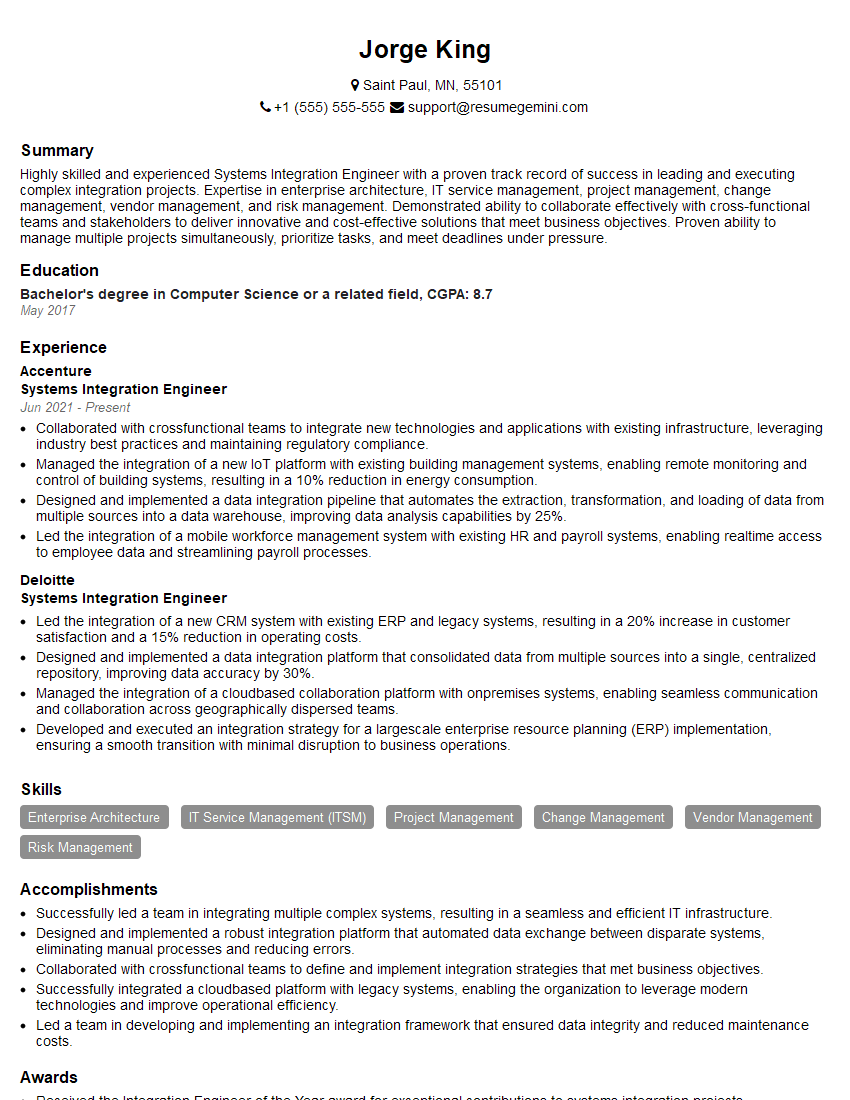
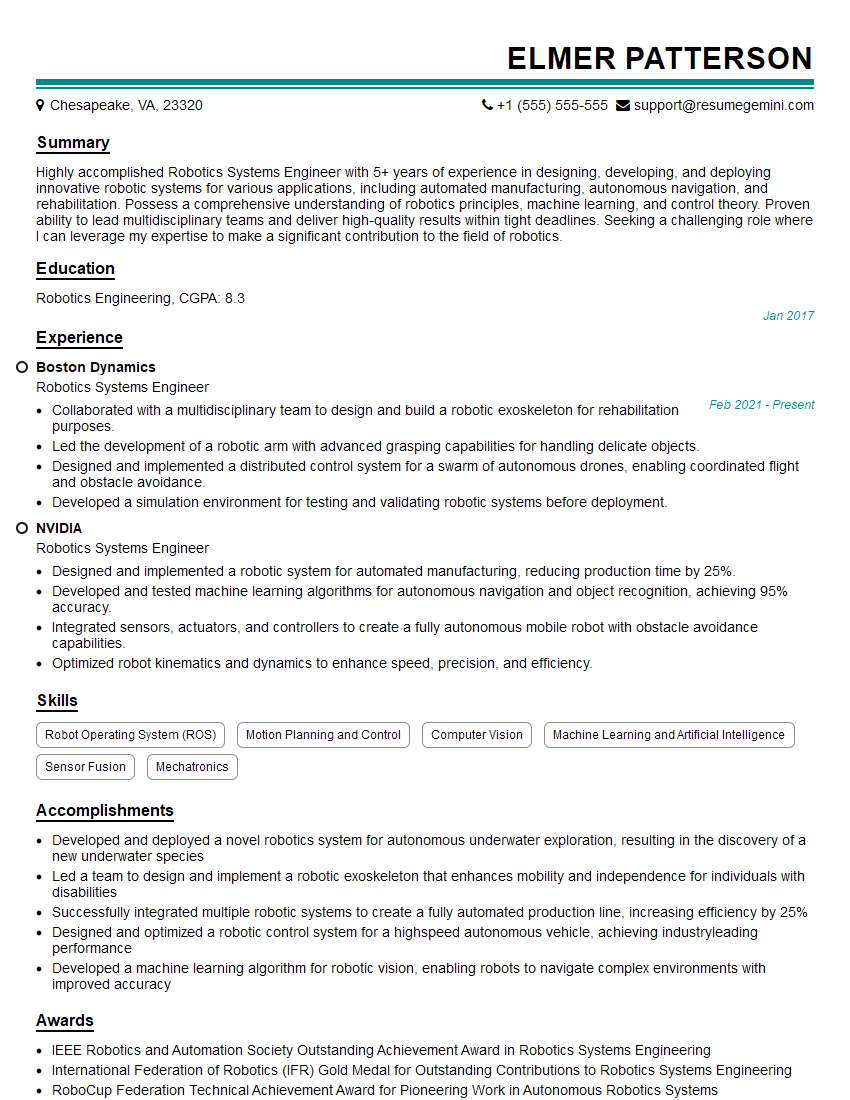
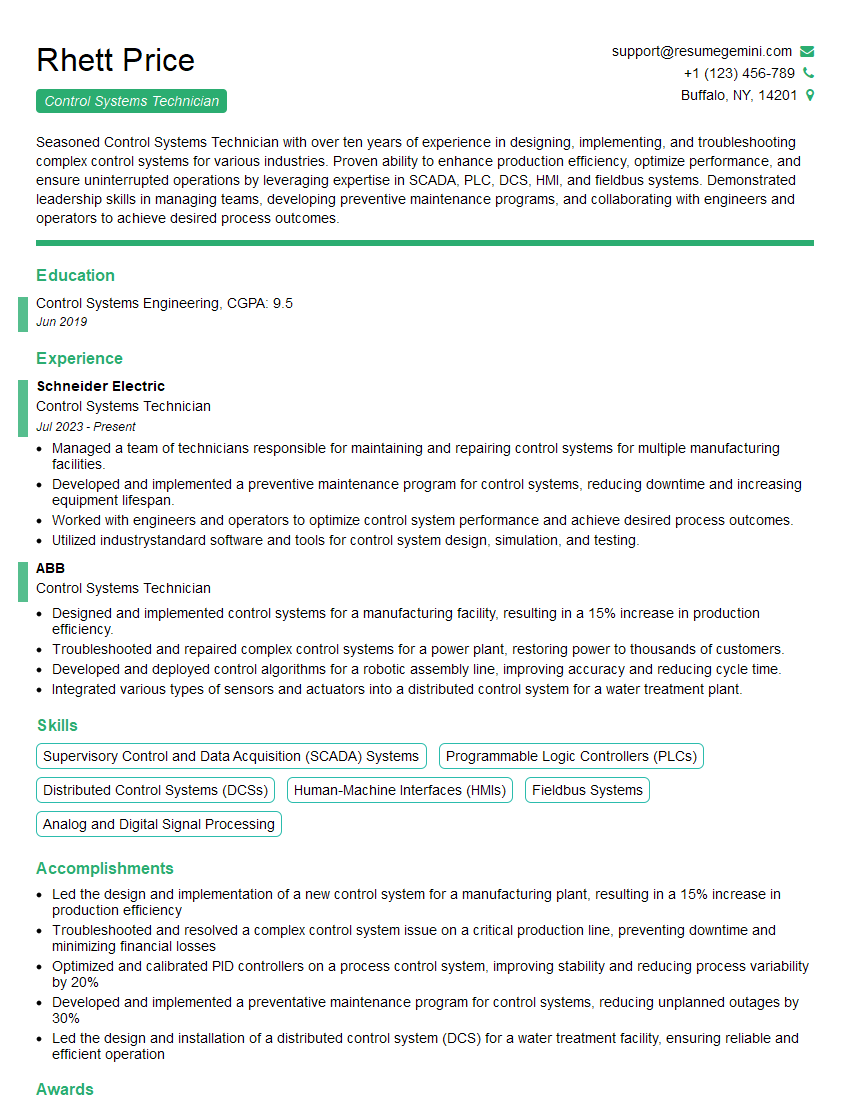
Mastering Guidance and Control System Maintenance opens doors to exciting career opportunities with significant growth potential. A strong understanding of these systems is highly valued across various industries. To maximize your job prospects, create a compelling and ATS-friendly resume that effectively showcases your skills and experience. ResumeGemini is a trusted resource that can help you build a professional resume tailored to your specific experience. We provide examples of resumes tailored to Guidance and Control System Maintenance to help you get started. Invest in crafting a strong resume—it’s your first impression and a crucial step in landing your dream job.
Explore more articles
Users Rating of Our Blogs
Share Your Experience
We value your feedback! Please rate our content and share your thoughts (optional).
What Readers Say About Our Blog
Very informative content, great job.
good