Interviews are more than just a Q&A session—they’re a chance to prove your worth. This blog dives into essential Gunnery interview questions and expert tips to help you align your answers with what hiring managers are looking for. Start preparing to shine!
Questions Asked in Gunnery Interview
Q 1. Explain the principles of projectile motion.
Projectile motion is the curved path followed by an object launched into the air, affected by gravity and air resistance. Imagine throwing a baseball – it doesn’t travel in a straight line. It arcs upwards, reaches a peak, and then descends.
Understanding projectile motion involves analyzing two independent components: horizontal and vertical. The horizontal component is constant velocity (ignoring air resistance), while the vertical component is influenced by gravity, causing acceleration downwards at approximately 9.8 m/s².
Factors such as launch angle, initial velocity, and air resistance significantly impact the projectile’s trajectory. A steeper launch angle results in a higher peak but shorter range, whereas a flatter angle provides greater range. Air resistance opposes the motion, slowing the projectile down and reducing its range.
In gunnery, understanding projectile motion is crucial for calculating the trajectory of shells to accurately hit targets. Adjustments for elevation and range are made considering launch angle, muzzle velocity, and environmental factors like wind.
Q 2. Describe the different types of artillery shells and their applications.
Artillery shells are categorized based on their function and explosive fill. Here are some examples:
- High-Explosive (HE): Designed for maximum blast and fragmentation effects against personnel and lightly armored targets. This is the most common type.
- High-Explosive Incendiary (HEI): Combines the blast and fragmentation effects of HE with an incendiary filler to ignite fires.
- Armor-Piercing (AP): Features a hard, dense core to penetrate armored vehicles and fortifications. These shells usually have a ballistic cap to improve penetration.
- Smoke: Used to create obscuring smoke screens to mask troop movements or positions. Various chemicals are used to generate different colored and density smoke.
- Illuminating (Illum): Contains a flare that illuminates a target area at night, allowing for better targeting or observation.
- White Phosphorus (WP): Produces a dense, burning cloud that is effective against personnel and creates a smoke screen. However, its use is strictly regulated due to its dangerous nature.
The selection of a particular shell depends on the target type and the desired effect. Attacking a tank would require an AP shell, whereas suppressing enemy positions might call for HE or WP.
Q 3. What are the factors affecting the accuracy of a firearm?
Accuracy in firearms is affected by a multitude of factors, both inherent to the weapon and environmental. Think of it like trying to hit a bullseye – any wobble in your aim or unexpected wind will affect the result.
- Bore condition: A worn or damaged barrel can lead to inconsistent projectile trajectory.
- Ammunition quality: Variations in cartridge dimensions, powder charge, and bullet construction can affect projectile performance.
- Sight alignment and zeroing: Improper sight adjustment means the projectile won’t hit where you aim.
- Trigger control: Jerky or inconsistent trigger pulls can introduce errors into the shot.
- Weapon stability: Proper weapon support (rest, bipod, etc.) affects accuracy.
- Environmental factors: Wind, temperature, and humidity can all affect projectile trajectory.
- Shooter skill: The most significant variable – proper technique and training improve accuracy.
In a professional setting, understanding these factors is critical for maintaining optimal accuracy and consistent results. Regular weapon maintenance, precise ammunition selection, and rigorous training are essential for achieving high levels of marksmanship.
Q 4. How does wind affect projectile trajectory?
Wind significantly impacts projectile trajectory, acting as a force that pushes the projectile off-course. Imagine throwing a ball on a windy day – the wind will push it sideways.
The effect of wind depends on its speed, direction, and the projectile’s flight time. A strong headwind will slow the projectile and decrease its range, while a tailwind will increase its range. A crosswind will deflect the projectile to the side.
Gunners must account for wind by adjusting their aim point. Wind speed and direction are typically measured using anemometers or other meteorological tools and are incorporated into fire control calculations to compensate for the deflection.
In military applications, sophisticated ballistic computers take wind data, as well as other environmental factors, into account to ensure accurate projectile delivery.
Q 5. Explain the concept of ‘zeroing’ a firearm.
Zeroing a firearm is the process of adjusting the sights to ensure the point of impact matches the point of aim at a specific range. Think of it like calibrating your weapon.
The process involves firing several shots at a target, observing the point of impact, and then adjusting the sights (either the rear sight or the scope) to bring the point of impact closer to the aiming point. This usually involves a series of iterative adjustments, shooting and adjusting until the point of impact is consistently hitting your target at that specific distance.
Zeroing is usually performed at a standard range, such as 25 meters or 100 meters, depending on the firearm and intended use. Different ranges will necessitate separate zeroing.
Proper zeroing is critical for accuracy. An improperly zeroed firearm will result in inaccurate shots, even with perfect technique.
Q 6. Describe the different types of fire control systems.
Fire control systems are the integrated systems used to accurately deliver projectiles onto a target. They vary in complexity, ranging from simple optical sights to sophisticated computer-aided systems.
- Direct Fire Control: Relies on direct observation of the target and manual adjustment of the weapon’s aim. This is typical of small arms and some light artillery.
- Indirect Fire Control: Used for longer-range engagements where the target isn’t directly visible. It involves calculating the trajectory based on the target’s location, meteorological data (wind, temperature, air pressure), and the weapon’s characteristics. Advanced systems use computers and sensors to assist with these calculations.
- Digital Fire Control Systems: These sophisticated systems incorporate sensors, computers, and advanced algorithms to automate many aspects of fire control, significantly enhancing accuracy and speed. They often incorporate radar, laser rangefinders, and GPS data.
Modern fire control systems often include features such as predictive firing solutions, which anticipate the target’s movement, and automatic target tracking.
Q 7. How does a radar system contribute to gunnery accuracy?
Radar systems significantly contribute to gunnery accuracy, particularly in indirect fire, by providing precise information about target location and movement. Think of it as providing the ‘eyes’ for the artillery.
Radar systems can track moving targets, providing real-time updates on their position and velocity. This information is fed into fire control computers to calculate the necessary adjustments for projectile trajectory, compensating for the target’s movement. This ensures that the projectile reaches the intended point of impact, even if the target is moving quickly.
Additionally, some radar systems can provide meteorological data, such as wind speed and direction, which are crucial for accurate projectile trajectory calculations. By providing accurate, real-time information, radar greatly improves the effectiveness and precision of artillery fire.
Q 8. What are the safety procedures for handling ammunition?
Ammunition handling safety is paramount. A single mistake can have devastating consequences. The core principles revolve around treating all ammunition as if it were live, regardless of its condition or perceived safety.
- Always inspect ammunition before handling: Look for any signs of damage, corrosion, or deformity. A cracked casing, for example, is a significant risk.
- Never point a firearm at anything you don’t intend to shoot: This fundamental rule applies to all firearm handling, but especially during ammunition handling where accidental discharges are more likely due to improper storage or handling of live rounds.
- Store ammunition properly: Ammunition should be stored in a cool, dry, and secure location, away from sources of heat and ignition. Keep it separate from explosives and flammables. Proper labeling and organization are vital.
- Handle ammunition with care: Avoid dropping, throwing, or striking ammunition. Use appropriate tools to load and unload firearms. Never disassemble ammunition unless you have the expertise and proper tools to do so safely.
- Follow all local, regional, and national regulations regarding ammunition storage and transport: These regulations vary significantly, and ignorance is no excuse.
- Never attempt to modify or repair ammunition yourself: This is extremely dangerous and should only be handled by qualified professionals.
Imagine you’re working on a firing range – a single careless move could result in injury or death. Adhering strictly to these procedures ensures the safety of yourself and everyone around you.
Q 9. Explain the process of calculating firing solutions.
Calculating firing solutions is a complex process that combines mathematics, physics, and meteorology. The goal is to determine the precise aiming data needed to hit a target at a given range, taking into account numerous variables.
The process generally involves these steps:
- Target Location: Determining the precise coordinates of the target (latitude, longitude, and elevation).
- Weapon Characteristics: Understanding the weapon’s ballistic properties, including muzzle velocity, boresighting, and rate of fire.
- Ammunition Characteristics: Determining the projectile’s ballistic coefficient, which influences its trajectory.
- Environmental Factors: Accounting for wind speed and direction, air density (temperature, humidity, and pressure), and the Coriolis effect (Earth’s rotation). These affect the projectile’s flight path.
- Firing Angle Calculation: Using the above data, sophisticated calculations (often performed by computer systems like Fire Control Systems) determine the optimal firing angle, elevation, and azimuth.
- Corrections: Making adjustments based on observed corrections, such as wind drift, and other real-time observations.
For example, a simple calculation might involve using a ballistic table to determine the elevation needed to hit a target at a specific range, but in real-world situations, advanced algorithms are used to perform these calculations almost instantaneously.
In essence, it is a careful balancing act where many factors must be considered to ensure accuracy.
Q 10. What are the different types of fuses used in artillery shells?
Artillery fuses are crucial for controlling when and how a shell detonates. Different mission requirements demand various fuse types. Here are some key examples:
- Point Detonating (PD): This fuse detonates upon impact. Simple and effective for surface targets.
- Delay (D): This fuse features a delay mechanism, detonating after a set time interval, allowing for penetration before explosion. Useful against fortified targets.
- Variable Time (VT): Allowing adjustable detonation times, adding flexibility to engage diverse targets.
- Proximity (or VT) Fuse: Detonates when close to the target without direct impact, maximizing damage against airborne targets.
- Airburst Fuse: Detonates at a pre-determined altitude, effective against soft targets or troops in the open.
The choice of fuse is dependent on several factors, such as target type, range, and desired effect. Choosing the wrong fuse could result in a dud or even unwanted collateral damage.
Q 11. How do you account for atmospheric conditions when firing artillery?
Atmospheric conditions significantly affect artillery projectiles’ trajectories. Ignoring them leads to inaccurate fire. Several parameters need to be factored in:
- Air Density: Temperature, pressure, and humidity determine air density. Denser air provides more resistance, altering the projectile’s trajectory. Higher temperatures usually decrease density and increase range, while high humidity generally increases density, thereby decreasing range.
- Wind: Wind speed and direction cause significant drift. Crosswinds push the projectile laterally, while headwinds and tailwinds affect its range. Detailed wind information across the entire trajectory is essential.
- Temperature: Affects air density directly and also influences the projectile’s own velocity and ballistic properties.
Modern artillery fire control systems utilize meteorological sensors to automatically measure these factors. The system then incorporates this data into the firing solution to compensate for atmospheric effects, ultimately improving accuracy. Without these corrections, the rounds may land far from the intended target.
Q 12. Describe the different types of gunsights and their purpose.
Gunsights are critical for aiming artillery pieces. Different types serve varying needs:
- Telescopic Sights: Offer magnification and improved target acquisition, often featuring crosshairs for precise aiming. Common on direct-fire weapons.
- Open Sights: Simple, consisting of a front sight and rear sight. Less precise at longer ranges.
- Panoramic Sights: Provide a wide field of view, beneficial in locating and tracking targets. Typically employed in indirect fire scenarios where the target is not directly visible from the weapon’s position.
- Digital Sights: Advanced systems employing digital technology to compute aiming solutions and display data such as range, windage, and elevation directly on the sight. They usually interface with fire control systems.
The selection depends on the type of artillery piece, the engagement scenario, and the desired level of accuracy. A telescopic sight is ideal for direct fire, while a panoramic sight is essential for indirect fire where the gunner may need a wider view to identify and track the target.
Q 13. Explain the concept of ballistic coefficient.
The ballistic coefficient (BC) is a dimensionless number representing a projectile’s ability to overcome air resistance. A higher BC indicates less air resistance, meaning the projectile will retain velocity and travel further.
It’s calculated using factors like the projectile’s shape, weight, and sectional density. A streamlined projectile will have a higher BC than a blunt one. It’s crucial for accurately predicting the trajectory.
Imagine two bullets of the same weight but different shapes: one streamlined and the other rounded. The streamlined bullet (higher BC) will travel farther due to reduced air resistance. BC is a vital parameter in ballistic calculations, directly impacting accuracy and range prediction.
Q 14. What is the difference between direct and indirect fire?
Direct and indirect fire are fundamentally different approaches in artillery:
- Direct Fire: The weapon is aimed directly at the target, similar to aiming a rifle. The line of sight from the weapon to the target is relatively unobstructed. Used for close-range engagements.
- Indirect Fire: The target is not directly visible from the gun’s position. The projectile’s trajectory is calculated to arc over obstacles and strike the target from a distance. The firing solution must consider factors like elevation, range, wind, and the Earth’s curvature.
A simple example would be a tank engaging another tank directly, that is direct fire, versus the use of a Howitzer to strike a target several miles away, which would be indirect fire. Indirect fire is far more common in artillery due to its ability to engage targets that cannot be seen directly.
Q 15. Describe the different types of weapon platforms used in gunnery.
Weapon platforms in gunnery encompass a wide range of systems designed to deliver projectiles accurately and effectively. These platforms can be broadly categorized by their mobility and the type of projectile they fire.
- Static Platforms: These are fixed installations, offering stability and often high-caliber firepower. Think of coastal defense guns or large naval artillery pieces mounted on battleships. Their advantage is immense firepower and accuracy, but they lack mobility.
- Mobile Platforms: This category includes a vast array of systems, ranging from individual soldiers with small arms to tanks, armored fighting vehicles (AFVs), and self-propelled artillery (SPA). Tanks, for instance, integrate a main gun with high mobility and armor protection, while SPAs provide mobile artillery support, sacrificing some protection for speed and range.
- Aerial Platforms: Aircraft, ranging from fighter jets with air-to-ground weaponry to bombers and attack helicopters, constitute aerial weapon platforms. These offer immense range and speed, but are susceptible to anti-aircraft fire and require specialized targeting systems.
- Naval Platforms: Beyond the aforementioned naval artillery, this includes various ship-mounted guns, missile systems, and even aircraft carriers which serve as mobile bases for aerial weapon platforms.
The choice of weapon platform depends heavily on the mission, target, and operational environment. For instance, a sniper might use a precision bolt-action rifle (a highly mobile, individual platform) while an army might deploy howitzers (mobile platforms) for long-range artillery support.
Career Expert Tips:
- Ace those interviews! Prepare effectively by reviewing the Top 50 Most Common Interview Questions on ResumeGemini.
- Navigate your job search with confidence! Explore a wide range of Career Tips on ResumeGemini. Learn about common challenges and recommendations to overcome them.
- Craft the perfect resume! Master the Art of Resume Writing with ResumeGemini’s guide. Showcase your unique qualifications and achievements effectively.
- Don’t miss out on holiday savings! Build your dream resume with ResumeGemini’s ATS optimized templates.
Q 16. What is the role of a spotter in artillery operations?
In artillery operations, the spotter plays a crucial role in ensuring accurate fire support. They are the eyes and ears on the ground, observing the effects of artillery fire and providing vital feedback to the firing unit. Think of them as the real-time quality control for the artillery barrage.
Their duties include:
- Target Acquisition: Precisely locating the target and transmitting its coordinates to the fire direction center (FDC).
- Observation of Fire: Watching the impact of the artillery shells, judging the accuracy (fall of shot) and effects of the strikes.
- Adjusting Fire: Communicating corrections to the FDC based on their observations, ensuring that subsequent rounds hit the target more accurately. This may involve adjusting range, bearing, or even the type of munition.
- Damage Assessment: Reporting on the effectiveness of the fire, including target neutralization and any collateral damage.
Effective spotters possess keen observation skills, a strong understanding of map reading and communication protocols, and the ability to remain calm and focused under pressure.
Q 17. How do you handle malfunctions in a firearm?
Handling firearm malfunctions requires a calm, systematic approach. Safety is paramount – always keep the firearm pointed in a safe direction.
The steps typically involve:
- STOP: Immediately cease firing. Ensure the muzzle is pointed in a safe direction.
- Assess: Identify the type of malfunction. Common issues include failure to feed, failure to fire, and jams. A thorough examination of the weapon and surrounding environment is vital.
- Remedy: Depending on the malfunction, various procedures may be necessary. This could involve clearing a jam using the appropriate techniques for the firearm, checking for obstructions in the magazine or chamber, or inspecting the ammunition for defects. Specific procedures are usually detailed in a weapon’s manual. Note that different firearms have different remedial processes.
- Check: After resolving the malfunction, thoroughly check the firearm’s functionality and ensure its safe operation before resuming firing (if appropriate).
- Report: Document the malfunction and any remedial actions taken. This information is critical for maintenance and future training.
Example: If a round fails to eject, it is a common jam, and clearing it will vary based on firearm. Always refer to the manufacturer’s manual for the correct procedure to prevent injury. Never attempt to force anything.
Q 18. Explain the principles of interior ballistics.
Interior ballistics focuses on the events that occur inside a firearm’s barrel from the moment the firing pin strikes the primer to the moment the projectile exits the muzzle. It’s a complex interplay of physics and chemistry.
Key principles include:
- Combustion: The primer ignites the propellant (gunpowder), creating a rapid expansion of high-pressure gas.
- Gas Pressure: This rapidly expanding gas exerts immense pressure on the base of the projectile, propelling it down the barrel.
- Projectile Motion: The projectile’s acceleration is governed by the pressure curve of the expanding gases and the firearm’s barrel design.
- Friction: Friction between the projectile and the barrel walls affects velocity and accuracy.
- Heat Transfer: Heat generated during combustion can impact the overall efficiency and potentially damage the barrel.
Understanding these principles is crucial for designing efficient and accurate firearms. Factors like propellant type, barrel length, and projectile weight influence the pressure curve, muzzle velocity, and projectile stability. Improper design or ammunition can lead to dangerous pressure surges.
Q 19. Describe the process of weapon maintenance and cleaning.
Weapon maintenance and cleaning are vital for ensuring firearm reliability, safety, and longevity. Regular cleaning prevents corrosion, removes fouling (buildup of residue), and maintains accuracy. The specific procedures vary depending on the firearm, but common steps include:
- Safety Check: Always ensure the firearm is unloaded and the chamber is empty. This is the most crucial step.
- Disassembly: Carefully disassemble the weapon according to the manufacturer’s instructions. Excessive force can damage the firearm. Use specialized tools as required.
- Cleaning: Use appropriate cleaning solvents and brushes to thoroughly remove fouling from all parts. Pay particular attention to the bore, breech, and chamber.
- Lubrication: Apply a suitable lubricant to reduce friction and prevent wear. Use appropriate gun oil.
- Reassembly: Carefully reassemble the weapon, following the manufacturer’s instructions precisely.
- Function Check: Always ensure the weapon functions correctly after cleaning and lubrication. Perform a dry fire to check function. Do not do live firing at this stage.
- Storage: Store the firearm in a safe and clean environment.
Ignoring regular cleaning and maintenance can lead to malfunctions, jams, and eventually, serious damage or injury.
Q 20. What are the common causes of misfires?
Misfires, where a firearm fails to discharge when the trigger is pulled, can stem from several issues.
- Faulty Ammunition: A damaged primer, a powder charge that is insufficient or damp, or a defective bullet can all cause misfires. This is the most common cause.
- Malfunctioning Firing Pin: A bent, broken, or improperly seated firing pin may not strike the primer with sufficient force.
- Obstructions in the Firing Mechanism: Dirt, debris, or excessive lubrication can interfere with the firing pin’s movement.
- Improper Weapon Function: Issues with the weapon’s trigger or sear mechanism can prevent the firing pin from being released.
It’s crucial to inspect both the ammunition and the firearm to determine the cause of a misfire. Never attempt to fire a weapon that has misfired multiple times without professional intervention. Always follow established safety procedures when dealing with misfires.
Q 21. How do you assess the effectiveness of gunnery exercises?
Assessing the effectiveness of gunnery exercises involves a multifaceted approach, focusing on both quantitative and qualitative measures.
Key aspects include:
- Accuracy: The percentage of rounds that hit the intended target or fall within a specified tolerance. This is frequently measured with spotting and downrange impact assessment.
- Rate of Fire: The speed at which rounds are fired, indicating the weapon system’s efficiency and crew proficiency.
- Time on Target: The duration it takes to acquire, engage, and neutralize the target. This factor is crucial in dynamic combat scenarios.
- Ammunition Consumption: The efficiency in achieving targets with minimum rounds fired.
- Damage Assessment: Analyzing the effects of the rounds on the target, including the extent of damage inflicted.
- Crew Performance: Evaluating the team’s coordination, communication, and overall effectiveness. This often involves post-exercise feedback and debriefs.
- Weapon System Reliability: Tracking the number of malfunctions and stoppages to gauge weapon performance and maintenance requirements.
Data collected from these measures is used to identify areas for improvement in training, equipment maintenance, and tactical procedures. Post-exercise debriefings and analysis play a critical role in understanding successes and shortcomings.
Q 22. Explain the importance of range safety procedures.
Range safety procedures are paramount in gunnery operations, safeguarding personnel, equipment, and the environment from the hazards associated with live fire. They are a structured system of rules, protocols, and practices designed to mitigate risks and prevent accidents. These procedures cover every aspect of a firing range, from the initial setup to the final cleanup.
A robust range safety program incorporates elements like:
- Clear communication: Establishing precise communication channels and procedures among personnel, ensuring everyone understands their roles and responsibilities.
- Designated safety officers: Appointing qualified safety officers to oversee operations and enforce regulations, promptly addressing any deviations from procedure.
- Defined firing zones and safety zones: Establishing clearly marked areas for firing and safe observation, preventing accidental exposure to projectiles.
- Ammunition handling: Implementing strict guidelines for storage, transportation, and handling of ammunition, minimizing the risk of mishaps.
- Emergency procedures: Developing and practicing emergency protocols for various scenarios, such as cease-fire orders, medical emergencies, or equipment malfunctions.
- Environmental considerations: Addressing environmental impact, including projectile dispersion, noise pollution, and the safe disposal of expended materials.
Failure to adhere to range safety procedures can lead to serious injury, death, and extensive property damage. A well-defined and diligently followed safety program is essential for the success and safety of any gunnery exercise.
Q 23. How do you ensure the safety of personnel during live-fire exercises?
Ensuring personnel safety during live-fire exercises is my top priority. It involves a multi-layered approach encompassing proactive measures and robust contingency planning. This starts with a thorough pre-exercise briefing covering all safety protocols, the designated safety zones, communication procedures, and emergency response plans.
Specific actions include:
- Pre-fire checks: Rigorous inspection of weapons and ammunition to identify and rectify potential defects before firing commences. This includes verifying ammunition type, checking for damage, and ensuring proper weapon functionality.
- Protective equipment: Ensuring all personnel wear appropriate personal protective equipment (PPE), such as hearing protection, eye protection, and body armor depending on the situation.
- Controlled environment: Maintaining a controlled and supervised environment, strictly enforcing rules regarding weapon handling and movement within the firing range.
- Emergency response teams: Having a dedicated medical team and other emergency response personnel on standby to handle any incident promptly and efficiently.
- Regular communication: Utilizing clear and concise communication channels to maintain constant situational awareness and facilitate prompt responses to unforeseen events.
- Post-exercise checks: Conducting thorough post-exercise checks to ensure no unexploded ordnance (UXO) remains, and that the firing range is safe for cleanup.
I’ve consistently utilized these measures, ensuring that my teams return from live-fire exercises without injury. One instance comes to mind where a malfunction occurred during firing; immediate activation of the cease-fire procedure, followed by systematic investigation prevented any casualties.
Q 24. Describe your experience with different types of fire control systems.
My experience with fire control systems spans various platforms and technologies. Fire control systems are complex electromechanical systems that integrate sensors, computers, and actuators to direct weapons accurately. They range from simple optical sights to sophisticated computerized systems guiding precision-guided munitions.
I’ve worked with:
- Electro-optical fire control systems: These systems use lasers, thermal imaging, and other electro-optical sensors to acquire and track targets, automatically calculating aiming solutions.
- Radar-guided fire control systems: Employ radar to detect and track targets, providing accurate range and bearing information for weapon guidance. These are often used in naval and anti-aircraft applications.
- Digital fire control systems: These systems incorporate advanced computers and software for ballistic calculations, target prediction, and weapon control. They offer greater accuracy and adaptability to different environments.
My experience includes troubleshooting, maintaining, and operating these systems. For instance, during a field exercise, a malfunction in a digital fire control system hampered our targeting accuracy. I systematically diagnosed the issue, pinpointing a software bug, and successfully implemented a workaround to maintain operational capability until repairs could be conducted.
Q 25. Explain your understanding of different types of explosives.
Understanding explosives is crucial in gunnery. Explosives are materials that undergo a rapid chemical reaction, producing a large volume of gas and heat. This expansion creates a shockwave that’s used to propel projectiles or cause destruction.
I’m familiar with various types:
- High explosives: Such as TNT (trinitrotoluene) and RDX (cyclotrimethylenetrinitramine), these detonate quickly, generating high pressures and brisance (shattering effect).
- Low explosives: Like black powder and smokeless powder, these burn relatively slowly, producing a pushing effect rather than a shattering one. They are commonly used as propellants in firearms.
- Primary explosives: These are highly sensitive compounds (like lead azide) that detonate easily upon initiation; typically used as detonators to initiate secondary explosives.
- Secondary explosives: Relatively insensitive explosives (like TNT or RDX) that require a strong initial shock to detonate.
My knowledge extends to their safe handling, storage, and detonation procedures. Safety is paramount when dealing with explosives, and I adhere strictly to all relevant regulations and safety protocols. Each explosive type demands specific handling procedures; a lapse in safety could have disastrous consequences.
Q 26. Describe your experience with various weapon systems.
My experience encompasses a wide array of weapon systems, from small arms to larger artillery pieces. I’ve worked with:
- Small arms: Rifles, pistols, submachine guns, shotguns – I’m proficient in their operation, maintenance, and safe handling.
- Mortars: I have experience in calculating firing solutions, setting charges, and operating various mortar systems.
- Artillery: Including howitzers and cannons – familiar with their operation, fire control systems, and ammunition handling procedures.
- Missile systems: Experience in operating and maintaining various missile systems, including those utilizing both inertial and GPS guidance.
This experience has given me a comprehensive understanding of weapon characteristics, capabilities, and limitations. For instance, during a training exercise involving artillery, I quickly identified a potential issue with projectile trajectory – a miscalculation in atmospheric conditions. My prompt intervention ensured a safe and successful exercise completion.
Q 27. How do you handle high-stress situations during a gunnery operation?
High-stress situations are inherent in gunnery operations. Maintaining composure and decision-making ability under pressure is critical. My approach involves several key strategies.
I prioritize:
- Training and preparation: Thorough training and preparation are fundamental. The more familiar you are with procedures and equipment, the better you handle unexpected issues.
- Structured approach: Utilizing a structured and systematic approach to problem-solving minimizes panic and maximizes effectiveness.
- Clear communication: Maintaining clear and concise communication with the team, ensuring everyone is aware of the situation and their roles.
- Delegation of tasks: Assigning tasks effectively, empowering team members to act appropriately and confidently.
- Self-regulation: Practicing mindfulness and stress-management techniques to improve composure under pressure.
In one instance, a critical equipment failure occurred during a live-fire exercise. By maintaining a calm demeanor, effectively communicating with the team, and applying a systematic troubleshooting process, we successfully mitigated the issue, minimizing disruption and preventing accidents.
Q 28. Describe your problem-solving skills in a gunnery context.
Problem-solving is integral to gunnery. My approach is methodical and data-driven. It relies on:
- Identifying the problem: Precisely defining the problem, ensuring everyone understands the challenge at hand.
- Gathering information: Collecting relevant data, including logs, sensor readings, and eyewitness accounts, to understand the context.
- Developing solutions: Exploring and evaluating potential solutions systematically, prioritizing those that are safe and effective.
- Testing and implementation: Implementing the chosen solution, carefully monitoring its effectiveness and making adjustments as needed.
- Post-incident analysis: Conducting a thorough post-incident analysis to understand root causes, preventing similar issues from recurring.
During a recent exercise, a discrepancy emerged in predicted vs. observed projectile impact points. By meticulously analyzing ballistic data, weather conditions, and equipment settings, I identified a minor calibration issue in the fire control system. A swift correction restored accuracy, preventing further errors and ensuring mission success. This highlights the importance of careful analysis and meticulous attention to detail in problem-solving within gunnery operations.
Key Topics to Learn for Gunnery Interview
- Ballistics and Trajectory: Understanding projectile motion, factors affecting accuracy (wind, gravity, spin), and calculating trajectories. Practical application includes analyzing firing solutions and predicting impact points.
- Weapon Systems: Familiarize yourself with various weapon types (cannons, howitzers, mortars), their capabilities, limitations, and operational procedures. Practical application involves assessing weapon suitability for different missions and terrains.
- Fire Control Systems: Learn about the technology and processes involved in aiming and firing weapons accurately, including radar, lasers, and computer-aided systems. Practical application includes understanding the limitations and potential errors within these systems.
- Ammunition and Explosives: Gain knowledge of different ammunition types, their properties, and the effects of explosions. Practical application involves selecting the appropriate ammunition for specific targets and environments.
- Safety Procedures and Regulations: Understand and be prepared to discuss stringent safety protocols and regulations surrounding the handling, storage, and use of weaponry and explosives. Practical application involves demonstrating a commitment to safe operational practices.
- Data Analysis and Interpretation: Develop skills in analyzing data from firing ranges, simulations, and combat scenarios to improve accuracy and effectiveness. Practical application includes identifying trends, predicting outcomes, and making data-driven decisions.
- Teamwork and Communication: Gunnery often involves collaboration. Prepare to discuss your experience working effectively within a team environment, especially in high-pressure situations. Practical application includes effectively communicating information under stress.
Next Steps
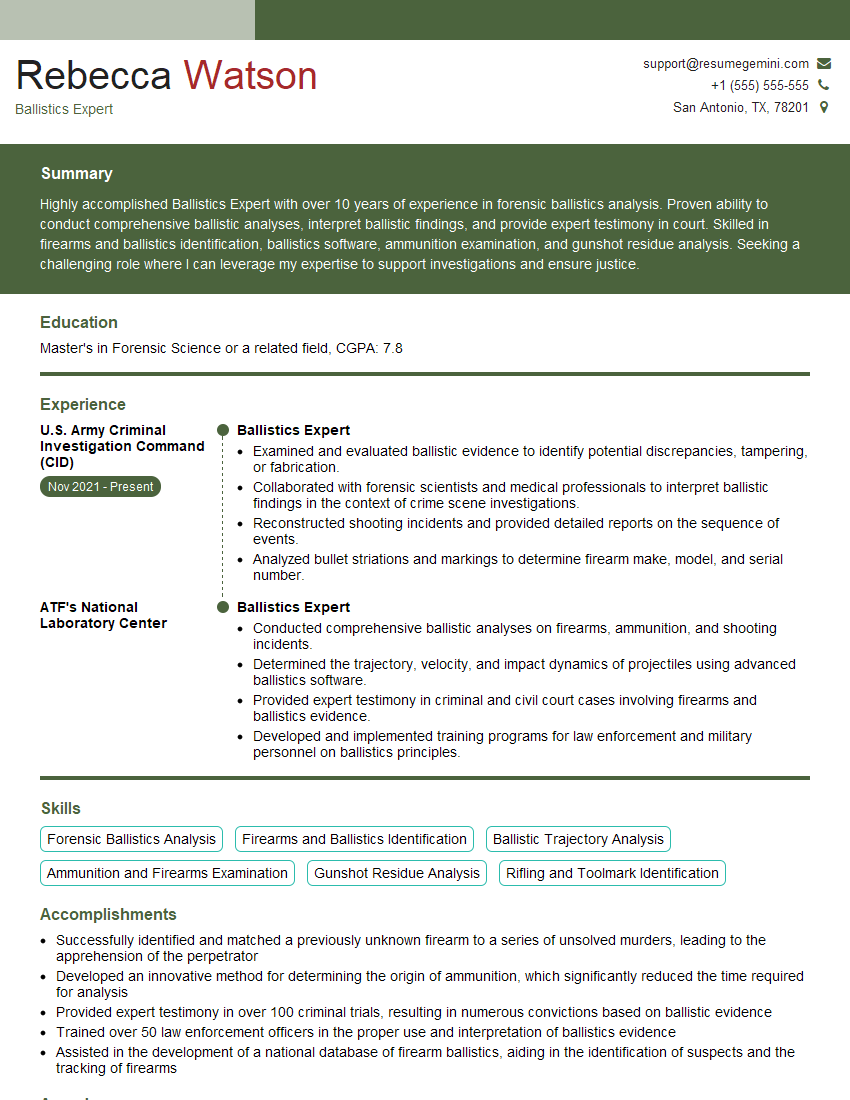
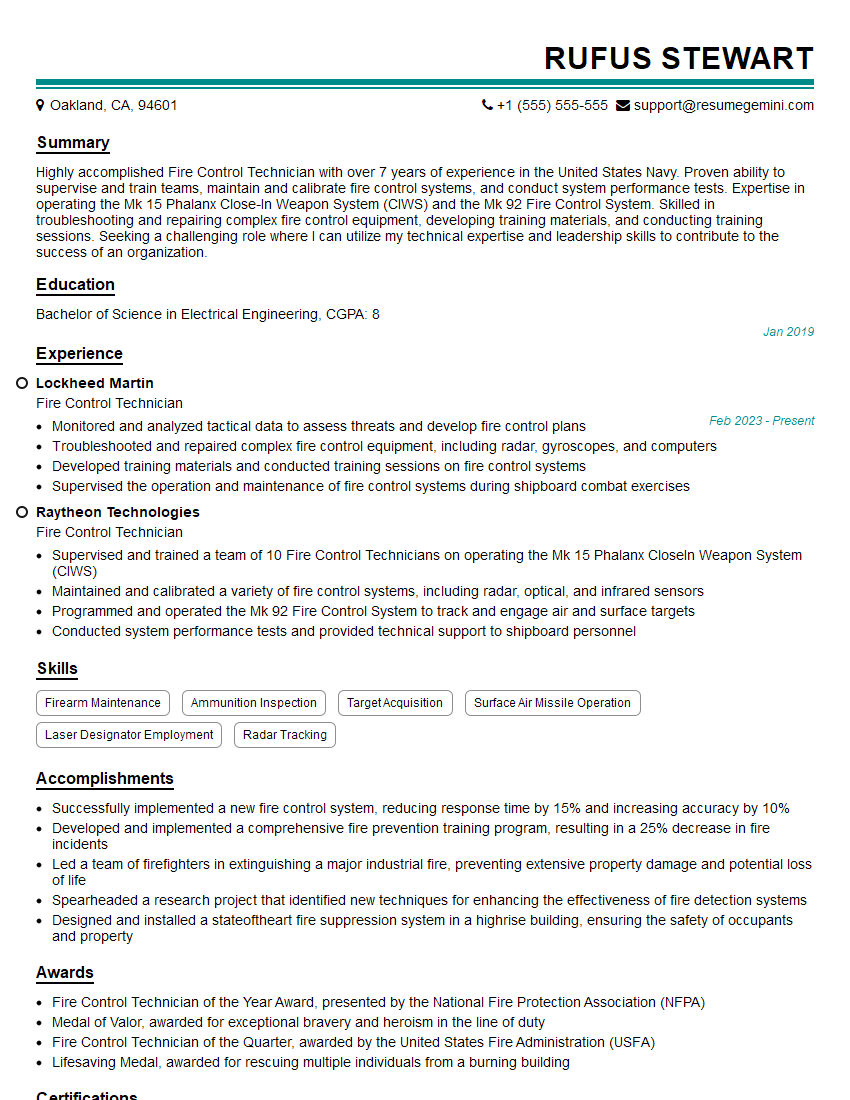
Mastering Gunnery principles opens doors to exciting and challenging careers in defense, aerospace, and related fields. To maximize your job prospects, it’s crucial to present your skills effectively. An ATS-friendly resume is paramount for getting your application noticed. We strongly recommend using ResumeGemini to build a professional resume that highlights your expertise and experience. ResumeGemini provides examples of resumes tailored specifically to Gunnery roles, allowing you to craft a compelling application that showcases your unique strengths and qualifications.
Explore more articles
Users Rating of Our Blogs
Share Your Experience
We value your feedback! Please rate our content and share your thoughts (optional).
What Readers Say About Our Blog
Very informative content, great job.
good