The thought of an interview can be nerve-wracking, but the right preparation can make all the difference. Explore this comprehensive guide to Automotive Functional Safety interview questions and gain the confidence you need to showcase your abilities and secure the role.
Questions Asked in Automotive Functional Safety Interview
Q 1. Explain the concept of Automotive Functional Safety and its importance.
Automotive Functional Safety is a systematic approach to managing hazards associated with malfunctions in electrical/electronic (E/E) systems within vehicles. Its core goal is to prevent accidents and injuries by ensuring that these systems behave predictably and safely, even in the event of failures. Think of it as a rigorous safety net woven into the design and development process to minimize risks to vehicle occupants, pedestrians, and the environment.
Its importance is paramount because modern vehicles rely heavily on complex E/E systems controlling critical functions like braking, steering, and airbag deployment. A malfunction in these systems can have catastrophic consequences. Functional safety ensures that the probability of such malfunctions and their resulting harm is reduced to an acceptable level.
Q 2. Describe the Automotive Safety Integrity Level (ASIL) and its determination.
The Automotive Safety Integrity Level (ASIL) is a classification scheme that quantifies the risk associated with a hazardous situation. It’s a four-level scale (ASIL A, B, C, D) ranging from the lowest (A) to the highest (D) risk. Determining the ASIL involves a systematic Hazard Analysis and Risk Assessment (HARA) process. This process meticulously examines potential hazards, their severity, probability of occurrence, and controllability. The combination of these factors results in the assignment of an ASIL level to each identified hazard. A higher ASIL requires more stringent safety measures during development.
Imagine designing a cruise control system. A minor malfunction (ASIL A) might cause a slight speed variation, whereas a complete system failure (ASIL D) could lead to a serious accident. The HARA process ensures that the appropriate ASIL is assigned, driving the necessary safety requirements for the system.
Q 3. What are the key differences between ASIL A, B, C, and D?
The key differences between ASIL levels lie in the required level of safety. ASIL D demands the most rigorous safety measures, while ASIL A requires the least. These differences manifest in various aspects of the development process:
- ASIL A: Low risk, basic safety measures sufficient.
- ASIL B: Moderate risk, increased rigor in design, verification, and validation.
- ASIL C: High risk, extensive safety measures, demanding testing and analysis.
- ASIL D: Very high risk, extremely stringent safety measures, multiple redundancy and fault tolerance mechanisms are crucial.
Think of it like building a house. ASIL A might be a simple shed, while ASIL D is a high-rise building with multiple safety features like fire sprinklers and redundant structural elements. The higher the ASIL, the more resources and effort are needed to ensure safety.
Q 4. Explain the ISO 26262 standard and its lifecycle phases.
ISO 26262 is the international standard for functional safety of electrical/electronic systems in automotive applications. It provides a comprehensive framework for managing safety throughout the entire automotive development lifecycle. This lifecycle is divided into several phases:
- Product Concept and System Design: Preliminary safety assessment, hazard analysis.
- System Design: Detailed safety requirements, architecture design.
- Hardware and Software Architectural Design: Selecting safety mechanisms, defining interfaces.
- Hardware and Software Unit Design and Implementation: Coding, component testing.
- Hardware and Software Integration and Verification: System integration, testing, and validation.
- Product Validation: Testing the complete system, verification against safety goals.
- Production and Operation: Monitoring and maintenance of the system in the field.
ISO 26262 guides each phase, ensuring a systematic approach to managing safety risks. Each phase includes specific tasks and deliverables, creating traceability and accountability throughout the process.
Q 5. Describe the Hazard Analysis and Risk Assessment (HARA) process.
Hazard Analysis and Risk Assessment (HARA) is a crucial process in functional safety, focusing on identifying potential hazards, analyzing their severity and likelihood, and determining the necessary safety requirements. It’s an iterative process that typically involves these steps:
- Hazard Identification: Brainstorming, FMEA (Failure Mode and Effects Analysis), fault tree analysis to identify potential hazards.
- Hazard Classification: Assessing the severity (injury potential), probability (likelihood of occurrence), and controllability (ease of mitigating the hazard).
- Risk Assessment: Combining severity, probability, and controllability to determine the ASIL level.
- Risk Reduction: Defining safety requirements and safety mechanisms to reduce the risk to an acceptable level.
Imagine designing an automatic emergency braking system. HARA would identify hazards like sensor failure (leading to a late braking response) and software malfunctions. The severity, probability, and controllability of these hazards would then be assessed to determine the appropriate ASIL, driving the design of redundant sensors and robust software architecture.
Q 6. What techniques are used for Hazard identification in Automotive Safety?
Several techniques are used for hazard identification in automotive safety:
- Failure Mode and Effects Analysis (FMEA): A systematic approach to identify potential failure modes, their effects, and severity.
- Fault Tree Analysis (FTA): A top-down approach that starts with an undesired event (top event) and works backward to identify potential causes.
- Hazard and Operability Study (HAZOP): A structured review technique to identify potential hazards and operability problems.
- Safety Requirements Specification (SRS): This document lays down safety goals and requirements to be fulfilled by the system.
- Brainstorming Sessions: Collaborative sessions where engineers identify potential hazards.
These techniques are often used in combination to ensure comprehensive hazard identification. For instance, a team might use FMEA to analyze individual components and FTA to analyze the interactions between them.
Q 7. How are Safety Requirements derived from Hazards?
Safety requirements are derived directly from the hazards identified during the HARA process. Each hazard, with its assigned ASIL, translates into specific safety requirements that must be met to mitigate the risk. For instance, a hazard classified as ASIL D might result in requirements such as:
- Redundancy: Implementing multiple independent systems to perform the same function.
- Fault tolerance: Designing systems to continue operating even with component failures.
- Diagnostic coverage: Ensuring that potential failures are detected and reported.
- Safety mechanisms: Implementing features that reduce the severity of potential accidents.
This traceability from hazard to safety requirement is crucial for demonstrating compliance with ISO 26262. Each safety requirement should be linked back to a specific hazard, ensuring that all identified risks are addressed.
Q 8. Explain the concept of Safety Goals and Safety Requirements.
Safety Goals define the overall objectives of a safety-critical system, aiming to prevent hazards and mitigate risks. Think of it as the big picture – what are we trying to achieve in terms of safety? For example, a safety goal for an Advanced Driver-Assistance System (ADAS) might be “Prevent collisions caused by driver inattention.” Safety Requirements, on the other hand, are the specific, verifiable actions needed to meet those goals. They detail how the system will achieve the safety goals, like “The system shall issue an audible warning within 1 second of detecting an imminent collision.” Safety goals are high-level and qualitative, while safety requirements are low-level, concrete, and quantitative.
Example: A safety goal for an airbag system could be ‘Minimize injury to occupants in a crash’. A corresponding safety requirement could be ‘The airbag shall inflate within 30 milliseconds of a crash sensor triggering.’
Q 9. What are the different safety mechanisms used in automotive systems?
Automotive systems employ various safety mechanisms to prevent or mitigate hazards. These include:
- Redundancy: Using multiple independent components to perform the same function. If one fails, the others can take over. For example, having two independent braking systems.
- Diversification: Employing different technologies or algorithms to accomplish the same task. This reduces the risk of a common-mode failure. For instance, using both a radar and a camera for object detection.
- Fail-operational Behavior: Designing the system to continue operating safely, even if a component fails. A fly-by-wire system might degrade gracefully in case of partial component failures.
- Fail-safe Behavior: Designing the system to revert to a safe state upon failure. For example, an engine control unit reverting to a limp mode if a critical sensor fails.
- Watchdog Timers: These timers monitor the operation of a system. If the system doesn’t ‘check in’ within a certain timeframe, it triggers a safety action, such as shutting down the system.
- Diagnostics: Continuous monitoring of the system to detect errors or faults. This allows for early detection of potential problems, preventing them from escalating.
The selection of safety mechanisms depends on the ASIL level of the function and the severity of the potential hazards.
Q 10. How do you determine the ASIL level for a given function?
Determining the Automotive Safety Integrity Level (ASIL) involves a hazard analysis and risk assessment process defined in ISO 26262. This process follows these steps:
- Hazard Identification: Identifying potential hazards that could arise from malfunctioning functions.
- Hazard Analysis: Analyzing the severity, probability of occurrence, and controllability of each identified hazard.
- Risk Assessment: Combining the severity, probability, and controllability to determine the risk level.
- ASIL Determination: Assigning an ASIL level (A, B, C, or D) based on the risk level. ASIL D represents the highest risk and requires the most rigorous safety measures, while ASIL A represents the lowest.
Example: A malfunction in the Electronic Stability Control (ESC) system could lead to a vehicle accident. The severity would be high, the probability of occurrence might be moderate (depending on road conditions and driver behavior), and the controllability could be low. This would likely result in an ASIL B or C classification.
Q 11. Explain the difference between Functional Safety and Safety Integrity.
While closely related, Functional Safety and Safety Integrity have distinct meanings:
- Functional Safety refers to the application of systematic engineering techniques to ensure that a system performs its intended function safely and prevents hazardous events. It’s the overall concept of designing a safe system.
- Safety Integrity refers to the trustworthiness of the system to perform its intended function and avoid hazardous behavior, as quantified by an ASIL level. It’s a measure of how well the system’s design and implementation meet its safety requirements.
Think of it this way: Functional safety is the what (the overall approach), and Safety Integrity is the how well (the level of confidence) we achieve it.
Q 12. What are the key methods for verification and validation in Functional Safety?
Verification and Validation (V&V) are crucial in functional safety. Key methods include:
- Reviews and Audits: Systematic inspections of the safety case and documentation to identify any inconsistencies or gaps.
- Testing: Various types of tests, including unit testing, integration testing, and system testing, to ensure that the system meets its safety requirements. This includes fault injection testing.
- Analysis: Static code analysis, hazard analysis, and fault tree analysis to identify potential hazards and weaknesses.
- Simulation: Simulating various driving scenarios to evaluate the system’s performance under different conditions.
- Inspection: Checking that the hardware and software meet the specified requirements.
These methods are employed throughout the development lifecycle to provide confidence that the system is safe.
Q 13. Describe different fault injection techniques.
Fault injection techniques simulate faults in a system to assess its robustness and resilience. This helps determine how the system responds to failures and whether the safety mechanisms are effective. Common techniques include:
- Hardware Fault Injection: Physically injecting faults into hardware components, such as inducing voltage spikes or applying radiation.
- Software Fault Injection: Introducing faults into the software code, such as manipulating variables, altering memory locations, or introducing timing errors. This can be done using tools like fuzzers.
- Hybrid Fault Injection: Combining hardware and software fault injection techniques.
These techniques help identify weaknesses and improve the overall safety of the system by revealing how it behaves under fault conditions.
Q 14. Explain the importance of Safety Requirements Traceability.
Safety Requirements Traceability is essential for demonstrating that all safety requirements have been addressed and verified throughout the development lifecycle. It’s a critical part of building a strong safety case. This involves establishing a clear and auditable link between:
- Safety Goals: The overall objectives of the system.
- Safety Requirements: The specific actions to achieve the safety goals.
- Design: The system architecture and implementation.
- Verification and Validation Activities: The methods used to verify that the requirements and design are met.
Traceability ensures that any change to a safety requirement is properly propagated through the entire process and that no requirements are inadvertently overlooked. It’s like a safety net, ensuring that all bases are covered.
Q 15. What are the key metrics for measuring Functional Safety performance?
Measuring Functional Safety performance relies on a set of key metrics that quantify the effectiveness of safety mechanisms and the overall risk reduction achieved. These metrics aren’t standalone; they work together to paint a complete picture.
- Probability of Failure on Demand (PFD): This metric represents the probability that a safety-related system will fail to perform its required function when demanded. A lower PFD indicates higher safety. For example, a PFD of 10-5 means the system is expected to fail once in 100,000 demands.
- Safety Integrity Level (SIL): Defined by standards like IEC 61508 and ISO 26262, SIL categorizes the required level of safety for a system based on the severity of potential hazards. SIL 4 represents the highest level of safety integrity, requiring the most stringent design and verification measures.
- Metric-based Coverage: This encompasses various types of coverage, like code coverage (statement, branch, condition, MC/DC), requirements coverage, and test coverage. Achieving high coverage demonstrates thorough verification and validation.
- Failure Rate (λ): This metric indicates the frequency of failures in a system over a given time period. A lower failure rate signifies improved reliability and safety. It is often expressed in failures per million hours (FIT).
- Mean Time Between Failures (MTBF): Represents the average time between failures of a system. A higher MTBF indicates greater system reliability.
In practice, we combine these metrics to assess the overall safety performance. For instance, we might target a specific PFD based on the assigned SIL, and then track metrics like failure rate and code coverage to ensure we meet the target.
Career Expert Tips:
- Ace those interviews! Prepare effectively by reviewing the Top 50 Most Common Interview Questions on ResumeGemini.
- Navigate your job search with confidence! Explore a wide range of Career Tips on ResumeGemini. Learn about common challenges and recommendations to overcome them.
- Craft the perfect resume! Master the Art of Resume Writing with ResumeGemini’s guide. Showcase your unique qualifications and achievements effectively.
- Don’t miss out on holiday savings! Build your dream resume with ResumeGemini’s ATS optimized templates.
Q 16. How do you manage safety-related design changes throughout the development process?
Managing safety-related design changes requires a rigorous and traceable process to ensure the continued safety integrity of the system. Think of it like building with LEGOs, where each change requires careful consideration of its impact on the overall structure.
- Impact Assessment: Any change, no matter how small, must undergo a thorough impact assessment. This identifies potential consequences on safety requirements, existing functionalities, and verification activities.
- Change Control Board (CCB): A CCB reviews proposed changes, assesses their impact on safety, and approves or rejects them based on established criteria. This ensures that only justified changes are implemented.
- Traceability: Maintaining complete traceability is crucial. This means documenting the rationale for every change, linking it to requirements, and demonstrating that the implemented change meets all safety requirements.
- Re-verification and Re-validation: After a change is implemented, re-verification and re-validation activities are necessary to ensure that the system continues to meet its safety goals. This may include additional testing, analysis, or simulations.
- Configuration Management: Employing a robust configuration management system helps track all changes, versions, and associated documentation, ensuring that everyone works with the latest validated version.
For example, if a software module needs modification, the change request will go through a CCB. After approval, the modifications are implemented, and the affected test cases are re-executed. All these steps are meticulously documented, maintaining the traceability chain.
Q 17. What is a Safety Case and why is it important?
A Safety Case is a structured argument, supported by evidence, demonstrating that a system is adequately safe for its intended use. Think of it as a legal defense for the safety of your system.
It’s essential because it provides a systematic and comprehensive demonstration that all safety risks have been identified, assessed, and mitigated to an acceptable level. It’s not merely a collection of documents; it’s a structured argument that connects hazards, risks, and implemented safety measures.
- Structure: A Safety Case typically includes a hierarchical structure, starting with high-level safety goals and progressively detailing the means to achieve these goals. This might involve presenting evidence of hazard analysis, risk assessments, and the effectiveness of safety mechanisms.
- Evidence: The Safety Case relies on various evidence types, such as test results, analysis reports, design specifications, and verification and validation plans. This evidence forms the pillars supporting the safety argument.
- Stakeholder Review: Independent experts usually review the Safety Case to ensure its completeness, consistency, and robustness. This increases confidence in the safety of the system.
Imagine a self-driving car. The Safety Case would demonstrate that the system’s design, software, sensors, and actuators meet the required safety standards, minimizing the risk of accidents. It’s a living document that’s updated throughout the vehicle’s lifecycle, reflecting any design changes or new safety requirements.
Q 18. Explain the role of different safety analysis techniques (e.g., FMEA, FTA).
Various safety analysis techniques play crucial roles in identifying and mitigating hazards during the design and development of safety-critical systems. They are like different tools in a toolbox, each with its own strengths.
- Failure Mode and Effects Analysis (FMEA): A proactive technique used to identify potential failure modes in a system, analyze their effects, and determine the severity and likelihood of those effects. It helps prioritize mitigation actions based on risk assessment. Imagine analyzing a braking system: FMEA would identify potential failure modes like brake line rupture, sensor malfunction, or actuator failure, then assess their impact on the vehicle.
- Fault Tree Analysis (FTA): A top-down deductive technique that starts with an undesired event (top event) and works backward to identify the possible combinations of faults that could lead to that event. It helps understand how faults propagate and interact. For example, analyzing a vehicle collision as the top event might reveal multiple fault paths involving sensor failures, software bugs, and actuator malfunctions.
- Hazard Analysis and Risk Assessment (HARA): A crucial initial step that identifies potential hazards related to the system and assesses the associated risks. It usually involves determining the severity, likelihood, and risk level of each hazard. HARA helps define the necessary safety integrity level (SIL) for various system components.
These techniques are often used in conjunction. For instance, HARA might identify a hazard, FMEA would analyze potential failures contributing to that hazard, and FTA might reveal different fault scenarios leading to the same hazard. The results from these analyses inform the design of safety mechanisms and guide the development process.
Q 19. Describe your experience with Safety Requirements specification tools.
My experience with safety requirements specification tools encompasses both formal and informal approaches. I’ve worked with tools that support requirements traceability, model-based systems engineering (MBSE), and formal methods.
- DOORS (Dynamic Object-Oriented Requirements System): This is a popular tool for managing and tracing requirements throughout the development lifecycle. It facilitates linking requirements to design, code, and test cases, ensuring traceability and aiding impact analysis of design changes.
- Polarion ALM: This platform provides collaborative requirements management, test management, and defect tracking. It enables teams to efficiently manage safety-related requirements and their associated verification and validation activities.
- IBM Rational Rhapsody: I have used MBSE tools like Rhapsody to model systems, capture safety requirements, and simulate system behavior. This aids in early detection of safety issues and improves overall design quality.
Choosing the right tool depends on the project’s complexity and the team’s preferences. However, the crucial aspects are clear requirement definition, traceability, and the ability to manage changes while maintaining consistency with safety standards. In addition to the listed tools, I’ve also utilized spreadsheets, complemented by strong change management practices for smaller projects with less complex safety demands. The key is effective tracking and management.
Q 20. What are the challenges in implementing Functional Safety in AUTOSAR?
Implementing Functional Safety in AUTOSAR (AUTomotive Open System ARchitecture) presents several challenges due to the complexity of the architecture and the need to integrate safety mechanisms effectively. This is like trying to fit intricate puzzle pieces, where each piece must perfectly align for the overall image to be complete.
- Communication Stack Complexity: AUTOSAR’s communication stack (e.g., CAN, LIN, Ethernet) adds layers of complexity that need to be carefully analyzed for potential safety issues. Safeguarding the communication across various ECUs (Electronic Control Units) requires meticulous design.
- Software Component Interactions: Managing interactions between multiple software components, especially those with different SIL ratings, requires a well-defined architecture to prevent unintended interactions and safety violations. Strict communication protocols and interfaces are crucial.
- Memory Protection: Ensuring memory protection to prevent software faults from propagating to other components is critical in AUTOSAR. Techniques like memory partitioning, watchdog timers, and error detection mechanisms are essential.
- Integration Complexity: Integrating various safety mechanisms, such as diagnostic routines and error handling, into the existing AUTOSAR architecture can be challenging and require specialized expertise.
For example, ensuring that a critical safety function doesn’t get affected by a low-SIL component failure requires robust design and careful configuration of the AUTOSAR architecture. The use of dedicated AUTOSAR safety modules and following safety guidelines for integration are essential to overcome these challenges.
Q 21. How do you handle safety-related conflicts between different engineering disciplines?
Handling safety-related conflicts between different engineering disciplines, like software, hardware, and mechanical engineering, requires a collaborative approach and a clear escalation path. This is like orchestrating a symphony, where all instruments must play in harmony to produce a beautiful outcome.
- Cross-Disciplinary Collaboration: Establishing a cross-functional team with representatives from all relevant disciplines is crucial for effective communication and conflict resolution.
- Clearly Defined Interfaces: Defining clear interfaces and responsibilities between different engineering disciplines helps prevent conflicts. Each discipline should understand its role and its interaction with others.
- Technical Decision Making Process: Establishing a formal process for resolving technical disagreements, including escalation paths and decision-making authorities, is essential. This prevents deadlock and ensures timely resolution.
- Traceability and Documentation: All decisions made regarding safety-related conflicts must be documented and linked to the requirements and analysis results. This provides a record of how conflicts were resolved and ensures transparency.
- Risk Assessment: When conflicts arise, assessing the associated risk is vital to prioritize the resolution effort based on potential safety implications.
For example, a conflict might arise between the software team requiring more processing power and the hardware team facing constraints in providing it. The resolution would involve a risk assessment, collaboration to find an alternative solution (e.g., optimizing the software), and documenting the decision and its impact on safety.
Q 22. Explain the concepts of hardware and software safety mechanisms.
Hardware and software safety mechanisms are crucial for preventing hazardous situations in automotive systems. They work in tandem to mitigate risks associated with malfunctions.
Hardware Safety Mechanisms focus on the physical components and their resilience. Examples include:
- Redundancy: Employing multiple identical components (e.g., two independent sensors measuring the same parameter). If one fails, the other takes over, ensuring continued functionality. Think of a braking system with dual hydraulic circuits.
- Diversity: Using different technologies to achieve the same function (e.g., a pressure sensor and an ultrasonic sensor for distance measurement). This reduces the probability of simultaneous failure due to a common cause.
- Fail-Operational/Fail-Safe Design: Designing the system to either maintain functionality at a reduced level or transition to a safe state upon a hardware failure (e.g., a car slowing down gently if the engine fails).
- Hardware Watchdogs: Timers that monitor the operation of critical hardware components. If a component fails to signal within a specific time, the watchdog triggers a safety action.
Software Safety Mechanisms focus on preventing software errors from causing hazards. Examples include:
- Defensive Programming: Writing code that anticipates and handles potential errors (e.g., input validation, error checking, and boundary condition handling). This prevents unexpected behavior.
- Independent Safety Software: Having separate software components responsible for safety-critical functions, isolating them from potentially faulty parts of the main system. This limits the impact of software errors.
- Software Watchdogs: Similar to hardware watchdogs, these monitor software execution and trigger a safety action if anomalies are detected.
- Memory Protection: Preventing one software component from accessing or corrupting the memory space of another. This improves software stability and prevents crashes.
- Formal Methods: Using mathematical techniques to verify software correctness and prove the absence of certain types of errors.
Both hardware and software mechanisms are integrated to achieve the required Automotive Safety Integrity Level (ASIL).
Q 23. Describe your experience with safety-related testing and analysis tools.
My experience encompasses a wide range of safety-related testing and analysis tools. I’ve extensively used tools for:
- Requirements Management: Tools like DOORS and Polarion for managing and tracing safety requirements throughout the development lifecycle.
- Static Code Analysis: Tools like Coverity and Parasoft C/C++test to identify potential software defects early in the development process. This helps prevent errors from propagating.
- Dynamic Testing: Tools such as dSPACE and Vector CANoe for conducting simulations and hardware-in-the-loop (HIL) testing. These techniques validate the safety mechanisms under realistic conditions.
- Fault Injection: Tools that allow me to deliberately inject faults into the system (hardware or software) to observe its response and verify the effectiveness of safety mechanisms. This proactive approach allows us to pinpoint weaknesses.
- Model Checking: Tools like SPIN and UPPAAL for formally verifying the behavior of complex systems and detecting potential safety violations. This is particularly crucial for high-ASIL applications.
In addition to these, I’m proficient in using various scripting languages (Python, MATLAB) for automating testing processes, data analysis, and report generation. I also utilize specialized tools for Failure Mode and Effects Analysis (FMEA) and Fault Tree Analysis (FTA).
Q 24. How do you ensure compliance with ISO 26262 throughout the product lifecycle?
Ensuring ISO 26262 compliance is a continuous process spanning the entire product lifecycle. This involves meticulous planning and execution across various stages.
- Concept Phase: Defining the functional safety concept, identifying hazards, and determining the ASIL for each function. This sets the stage for subsequent activities.
- System Design: Developing the system architecture, specifying safety requirements, and selecting appropriate safety mechanisms. This phase is crucial for managing safety risks.
- Hardware and Software Development: Implementing safety requirements in the hardware and software designs, following coding guidelines, and employing suitable verification and validation methods. This is where the safety mechanisms are actually realized.
- Verification and Validation: Thoroughly testing and validating the system to ensure that it meets the safety requirements. This involves various testing techniques, including unit, integration, and system testing, as well as simulations and HIL tests. Proof that the system meets requirements is vital.
- Production and Operation: Maintaining compliance throughout the production and operation phases. This includes ensuring that the manufacturing process is controlled, potential failures are addressed, and appropriate safety measures are in place.
- Safety Case: Creating a comprehensive safety case that demonstrates the fulfilment of all safety requirements and presents justification for all safety decisions. This becomes an important reference document.
Throughout the entire process, rigorous documentation and traceability are paramount. Each safety requirement is meticulously linked to the design, implementation, and verification activities. This allows for complete auditability and transparency, contributing to successful ISO 26262 certification.
Q 25. What is the significance of a Safety Plan in a Functional Safety project?
The Safety Plan is the cornerstone of any Functional Safety project. It’s a crucial document that outlines the overall approach for managing safety throughout the development lifecycle. Think of it as the roadmap for ensuring the safety of the system.
A well-defined Safety Plan includes:
- Safety Goals: Clearly stating the safety objectives and the level of safety to be achieved (e.g., achieving ASIL D for a specific system function).
- Methodology: Defining the processes and methods to be used for hazard analysis, risk assessment, and safety requirement specification (e.g., using FMEA and FTA).
- Roles and Responsibilities: Clearly assigning roles and responsibilities for safety-related activities. This ensures accountability and prevents gaps in responsibility.
- Tools and Techniques: Identifying the tools and techniques to be employed during development, verification, and validation activities. The right tools are critical for success.
- Metrics and Reporting: Specifying metrics to track progress and identify potential issues. Regular reports are essential to keep stakeholders informed.
- Review and Audit Procedures: Defining a process for reviewing and auditing safety-related activities to ensure compliance. This makes the entire process transparent.
The Safety Plan provides a structured approach, minimizes safety-related risks, facilitates better communication and collaboration amongst team members, and serves as an important reference throughout the project.
Q 26. Explain the concept of a safety requirement specification.
A Safety Requirement Specification (SRS) documents the safety requirements that must be fulfilled to ensure the safe operation of an automotive system. It’s a critical document that bridges the gap between hazard analysis and system design.
An SRS typically contains:
- Safety Goals: Overall safety objectives for the system.
- Safety Requirements: Specific requirements derived from the hazard analysis that address identified hazards. These might include requirements for fault tolerance, fail-safe mechanisms, diagnostic coverage, and reaction times.
- ASIL Decomposition: Allocation of ASIL levels to specific functions or system components. This helps to prioritize safety efforts.
- Traceability Matrix: Linking safety requirements to the hazard analysis, design, implementation, and verification activities. This provides full traceability.
- Verification Methods: Specifying the methods to be used to verify that the safety requirements have been met. This could include testing, analysis, or simulations.
A well-defined SRS ensures that the safety requirements are understood, documented, and consistently addressed throughout the development process. It is an integral part of the safety case.
Q 27. How do you handle deviations from the ISO 26262 standard?
Deviations from the ISO 26262 standard must be handled with utmost care and documented meticulously. Simply ignoring them is unacceptable.
The process typically involves:
- Justification: Providing a detailed justification for the deviation, explaining why strict adherence to the standard is not feasible or practical. This needs to show why the alternative approach maintains, or even improves, the safety level.
- Risk Assessment: Conducting a thorough risk assessment to evaluate the impact of the deviation on the overall safety of the system. This ensures that the deviation does not compromise safety.
- Mitigation Strategies: Implementing appropriate mitigation strategies to reduce or eliminate the risks associated with the deviation. This may involve adding additional safety measures.
- Documentation: Thoroughly documenting the deviation, justification, risk assessment, and mitigation strategies. This forms part of the safety case.
- Review and Approval: Obtaining formal review and approval from relevant stakeholders, including safety managers and certification authorities. This ensures that the deviation is properly reviewed and controlled.
The key is to ensure that any deviation from the standard does not negatively impact the safety of the system. Transparency, justification, and mitigation are essential for managing deviations effectively.
Q 28. Describe a situation where you had to troubleshoot a safety-related issue.
During the development of an advanced driver-assistance system (ADAS), we encountered an intermittent fault where the emergency braking system would activate unexpectedly at low speeds. This was a high-ASIL system, requiring immediate attention.
Our troubleshooting involved a systematic approach:
- Reproducing the Fault: We first attempted to reproduce the fault in a controlled environment using HIL testing. This proved difficult initially.
- Data Analysis: We examined extensive sensor data logs from various test runs. This revealed a correlation between the unexpected braking activation and specific environmental conditions (strong sunlight causing sensor interference).
- Software Investigation: The software team analyzed the code, focusing on the sensor data processing and decision-making algorithms. A bug in signal filtering was identified which did not robustly handle the high level of sun reflection.
- Mitigation: The issue was resolved by improving the sensor signal filtering algorithm to handle the interference effectively. Additional checks were put in place to ensure that the braking was only activated under genuine emergency conditions.
- Verification and Validation: We extensively retested the system after the fix, both in simulation and real-world tests. This verified the effectiveness of the solution.
This situation highlighted the importance of rigorous testing, detailed data analysis, and a systematic troubleshooting approach in handling safety-related issues. The success depended on teamwork and methodical investigation.
Key Topics to Learn for Automotive Functional Safety Interview
- Safety Requirements and Standards: Understand ISO 26262, its Automotive Safety Integrity Levels (ASILs), and how they influence design decisions. Explore the practical application of these standards in real-world automotive projects.
- Hazard Analysis and Risk Assessment (HARA): Learn techniques for identifying potential hazards in automotive systems, assessing their risks, and determining the appropriate ASIL levels. Practice applying these techniques to case studies.
- Safety Mechanisms and Architectures: Familiarize yourself with various safety mechanisms like redundancy, fault tolerance, and diverse architectures. Understand their strengths, weaknesses, and appropriate application scenarios.
- Safety Cases and Verification & Validation (V&V): Grasp the process of building a convincing safety case to demonstrate compliance with standards. Understand the role of various V&V techniques, such as testing, analysis, and reviews.
- Functional Safety in Specific Automotive Systems: Explore the unique safety challenges and solutions in different automotive systems, such as Advanced Driver-Assistance Systems (ADAS), powertrain control, and braking systems.
- Safety-Related Software Development: Understand coding guidelines for functional safety, static and dynamic analysis techniques, and methods for ensuring software reliability and robustness.
- Problem-Solving in Functional Safety: Develop your ability to analyze safety-related problems, propose solutions, and justify your choices based on sound engineering principles and standards.
Next Steps
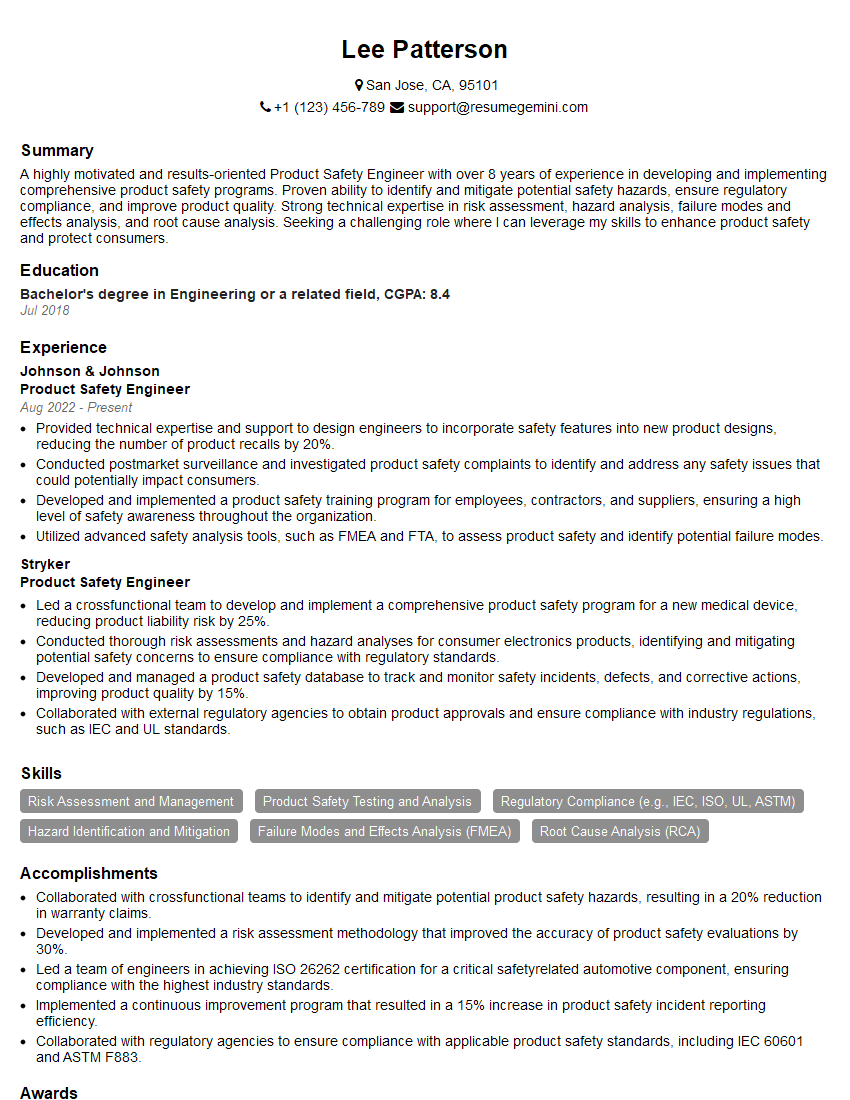
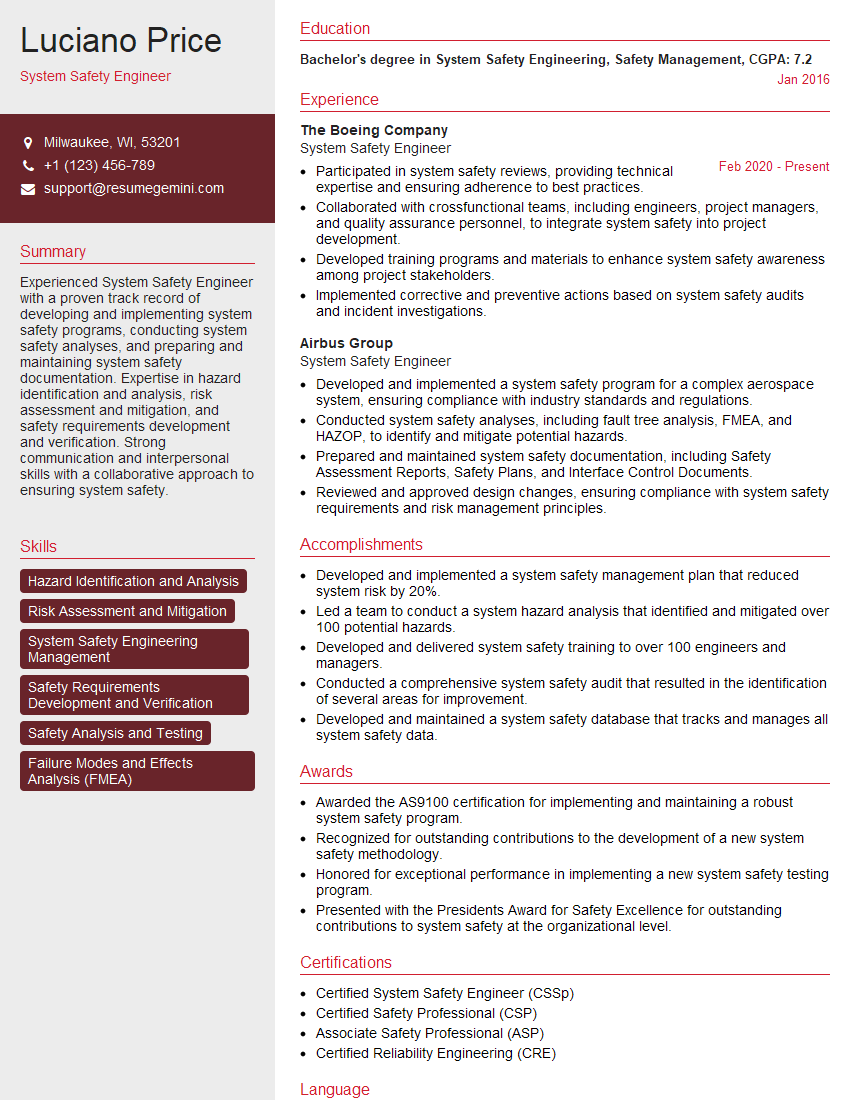
Mastering Automotive Functional Safety opens doors to exciting and high-demand roles within the automotive industry, offering significant career growth potential and competitive compensation. To maximize your job prospects, it’s crucial to present your skills effectively. Creating an ATS-friendly resume is essential for getting your application noticed by recruiters and hiring managers. ResumeGemini is a trusted resource to help you build a professional and impactful resume that highlights your expertise in Automotive Functional Safety. We provide examples of resumes tailored to this specific field to give you a head start. Invest in your career future – craft a compelling resume that showcases your knowledge and experience in Automotive Functional Safety.
Explore more articles
Users Rating of Our Blogs
Share Your Experience
We value your feedback! Please rate our content and share your thoughts (optional).
What Readers Say About Our Blog
Very informative content, great job.
good