Every successful interview starts with knowing what to expect. In this blog, we’ll take you through the top Half-Soleing interview questions, breaking them down with expert tips to help you deliver impactful answers. Step into your next interview fully prepared and ready to succeed.
Questions Asked in Half-Soleing Interview
Q 1. What types of leather are best suited for half-soleing?
Choosing the right leather for half-soling is crucial for durability and longevity. Ideally, you want a leather that’s both tough and flexible.
- Full-grain leather: This is the top choice, offering excellent strength and wear resistance. It’s the most durable option but also the most expensive.
- Top-grain leather: A slightly more affordable alternative, still quite robust, although potentially less resistant to scratches and scuffs than full-grain.
- Corrected-grain leather: This is usually less expensive, and while suitable for some projects, it might not offer the same longevity as full-grain. It’s often treated to improve its surface, but this treatment can weaken its inherent strength.
The thickness of the leather is also important; you’ll need a thickness that’s appropriate for the shoe’s style and the expected wear. Too thin, and it will wear out quickly; too thick, and it can cause discomfort or affect the shoe’s fit.
Q 2. Describe the process of preparing a shoe for half-soleing.
Preparing a shoe for half-soling is a meticulous process that ensures a successful and long-lasting repair. Think of it like preparing a canvas before painting a masterpiece. First, I thoroughly inspect the shoe, identifying any damage beyond the sole, such as worn heels or stitching that needs attention. Next, I remove the old sole carefully using a sharp knife, being mindful not to damage the upper leather. This process usually involves separating the welt from the old sole. Once the old sole is off, I clean the welt thoroughly, removing any old adhesive or debris. Finally, I examine the welt for any damage and make necessary repairs. This could include replacing worn-out sections or reinforcing weak points to provide a sturdy base for the new sole. This step is crucial; a poorly prepared welt means a poor-quality half-sole job.
Q 3. What tools and materials are essential for efficient half-soleing?
Having the right tools is paramount. It’s like having the right ingredients for a perfect recipe. Here’s a list of essential tools and materials:
- Sharp knives: For removing the old sole and preparing the welt.
- Lasts (shoe forms): To hold the shoe firmly during the repair process.
- Pliers: Various types for holding and manipulating materials.
- Stitching awl: To create holes for stitching the new sole.
- Stitching groover: Creates channels for a neater and more durable stitching.
- Hammer: To drive in nails and flatten down materials.
- Adhesive: A high-quality cobbler’s adhesive.
- Leather: Of course, the leather for the half-sole.
- Thread: Strong and durable thread appropriate for leather work.
- Rubber cement: For temporary bonding and securing of elements before stitching.
Q 4. How do you determine the correct size and shape of a half-sole?
Determining the correct size and shape is critical for a comfortable and aesthetically pleasing repair. I trace the outline of the old half-sole to get an accurate template. Then, I might make minor adjustments based on the wear pattern and the condition of the upper.
For example, if the heel area shows significant wear, I might add a bit of material in that specific area to extend the life of the repair. The new sole must match the original sole’s contour as closely as possible; otherwise, the shoe’s balance and gait might be affected. It is important to also check for a precise fit to the welt of the shoe.
Q 5. Explain the different stitching methods used in half-soleing.
Several stitching methods exist for half-soling, each with its strengths and weaknesses.
- Hand-stitching: This is the traditional and most durable method, offering excellent strength and flexibility. It’s a time-consuming process but produces a superior result. Each stitch is carefully placed using a stitching awl and specialized needles. It often involves a lock stitch that ensures great strength and longevity.
- Machine stitching: Faster than hand-stitching, but can be less durable if not done properly. Using a specialized stitching machine allows for speed and efficiency. There are different types of stitches available for machine stitching too, each affecting the overall appearance and durability of the stitching.
The choice of method depends on factors such as the type of shoe, the desired durability, and the time constraints.
Q 6. How do you handle different types of soles (e.g., leather, rubber, composite)?
Handling different sole materials requires adjusting techniques and materials.
- Leather soles: These require careful preparation and stitching, usually with a hand-stitching method.
- Rubber soles: These are easier to work with, often glued and sometimes stitched. They offer better grip and water resistance than leather.
- Composite soles: These materials require specific adhesives designed for their composition. Some may be suitable for both gluing and stitching; others may only allow for gluing.
For instance, when working with rubber soles, proper adhesion is paramount, as these soles are generally thicker and heavier. Using a specialized adhesive or a combination of adhesion and stitching is sometimes used for a very strong bond.
Q 7. What are the common challenges encountered during half-soleing?
Half-soling presents several challenges.
- Uneven wear: An old sole might be worn unevenly, making it challenging to create a new sole that fits perfectly. Careful measurement and adjustments are essential.
- Damaged welt: A damaged welt can make stitching or gluing the new sole difficult or impossible, requiring specialized repairs before the half-sole can be applied.
- Difficult leather: Some leathers are more challenging to work with than others, making stitching harder or requiring special tools and techniques.
- Adhesive issues: Improper adhesive application or selection can result in poor bonding and premature failure of the repair. Adhesion is often the weakest point of the repair, so precision is key.
Overcoming these challenges requires experience, attention to detail, and the right tools. For instance, when dealing with uneven wear, I often use filler material to even out the surface before applying the new sole to ensure proper adhesion.
Q 8. How do you ensure a precise fit and alignment of the half-sole?
Achieving a precise fit and alignment during half-soleing is crucial for both the shoe’s longevity and its comfort. It’s like fitting a perfectly tailored suit – every detail matters. We start by carefully tracing the outline of the existing sole onto the new half-sole material. This tracing acts as our template, ensuring an accurate fit. Next, we meticulously trim the half-sole to match this template, paying close attention to the heel and toe contours. Precise alignment is achieved by referencing the shoe’s existing sole, ensuring that the new half-sole sits flush against the existing outsole, without any overhang or gaps. For added precision, I often use specialized marking tools and clamps to hold the half-sole in place before applying the adhesive. This process minimizes any potential for slippage or misalignment during the bonding process.
Think of it like building with LEGOs: Each piece must fit perfectly to create a strong and stable structure. Any misalignment in the half-sole will compromise the structural integrity of the shoe, leading to premature wear and tear.
Q 9. Describe your process for cleaning and preparing the shoe’s existing sole.
Cleaning and preparing the shoe’s existing sole is a critical preparatory step. It’s similar to prepping a canvas before painting; a clean surface ensures optimal adhesion. The process typically involves several steps. First, I thoroughly clean the sole using a stiff brush and a suitable cleaner to remove any dirt, debris, or old adhesive residue. This ensures a clean, solid base for the new half-sole. I then carefully inspect the sole for any damage, such as cracks or significant wear, which may necessitate additional repairs before proceeding with the half-sole application. Once clean and dry, the sole’s surface is often lightly abraded using sandpaper to create a slightly rough surface to improve the adhesive’s grip. This improves the bonding surface, ensuring the new half-sole adheres strongly to the existing sole. The entire process ensures a long-lasting bond.
Q 10. How do you assess the condition of a shoe to determine if half-soleing is appropriate?
Assessing a shoe’s suitability for half-soleing involves a thorough examination. I carefully inspect the shoe’s upper, heel, and sole. Half-soleing is most appropriate when the upper and heel are in good condition, but the sole shows significant wear. The wear should primarily be on the outsole and not extend to the midsole. If the midsole is compromised, a full sole replacement is usually required. Consider the analogy of a car: Half-soleing is like replacing the tires, leaving the rest of the car intact. If the chassis is damaged, extensive repairs beyond a tire change are necessary. I also consider the shoe’s overall construction and material. Some shoes are better suited for half-soleing than others; for example, a delicate dress shoe may not benefit from this repair.
Q 11. What are the signs of improper half-soleing?
Signs of improper half-soleing are often visible and can compromise the shoe’s functionality and appearance. Common indicators include uneven edges, where the half-sole is visibly misaligned or doesn’t sit flush with the existing sole. This often indicates poor cutting or application of the adhesive. Gaps or wrinkles between the half-sole and the original sole indicate inadequate preparation or poor adhesive application. Loose or peeling edges suggest the use of inappropriate adhesive or insufficient surface preparation. The half-sole’s edges should be neatly finished, flush with the original sole, providing a smooth transition and extending the lifespan of the shoe. A poorly done half-soleing job can look clumsy and may lead to faster wear and tear.
Q 12. Explain how to deal with damaged or uneven shoe lasts.
Dealing with damaged or uneven shoe lasts requires careful attention and often involves advanced techniques. Uneven lasts can cause misalignment during the half-soleing process, resulting in a poor fit. If a last is severely damaged, it might need professional restoration before half-soleing can be attempted. Less severe issues can often be addressed by applying additional padding or shims under the insole to create a more even surface for the new half sole to adhere to. In some cases, slight irregularities can be accommodated by carefully shaping the new half-sole to conform to the existing sole. However, significant structural damage to the last often means the shoe is beyond repair. It is important to assess the overall condition of the shoe to determine if a repair is feasible or if the shoe should be discarded.
Q 13. How do you handle repairs to heels in conjunction with half-soleing?
Heel repairs often accompany half-soleing, especially in well-worn shoes. The process integrates seamlessly with half-soleing; you’re essentially rebuilding the base of the shoe. If the heel is simply worn down, a new heel lift can be applied. This involves removing the old lift and replacing it with a new one, matching it to the original contour. If the heel is cracked or severely damaged, more extensive repair might be needed, such as a complete heel replacement. Before applying a new heel lift, it’s crucial to ensure the heel is clean and properly prepared, using similar techniques to sole preparation. Proper adhesive application is also paramount to ensure a durable bond. The new heel lift and half-sole should work harmoniously, extending the life and comfort of the shoe.
Q 14. Describe your experience with different types of adhesives used in half-soleing.
Over the years, I’ve worked with various adhesives in half-soleing, each with its own properties and applications. Rubber cement is a common choice, known for its flexibility and durability. It adheres well to leather and rubber soles, creating a strong bond. Contact cement offers superior bonding strength but requires precise application due to its fast-drying nature. For certain materials or specific applications, specialized adhesives may be necessary. Each adhesive requires proper handling and application based on its specifications. Proper ventilation and adherence to safety measures are crucial. The choice of adhesive often depends on the type of material being used for the half-sole, as well as the materials of the existing sole and upper. It’s important to select the adhesive that provides the best balance of strength, flexibility, and longevity.
Q 15. What are the best practices for maintaining the quality of your work?
Maintaining high-quality half-soleing work hinges on meticulous attention to detail and a commitment to using premium materials. It’s like baking a cake – using the finest ingredients is only half the battle; the process itself needs precision.
- Precision in Measurement and Cutting: Accurate measurements are paramount. I use precise tools to ensure the new sole is perfectly sized and shaped, avoiding any slippage or unevenness. A poorly cut sole will show immediately, compromising the shoe’s appearance and wear.
- Quality Materials: I only use high-grade leather or rubber for soles, ensuring durability and longevity. The choice of material depends on the customer’s needs and the type of shoe. A high-end dress shoe would demand a superior leather sole, while a more rugged boot might use a durable rubber.
- Proper Adhesion: The glue used is crucial. I employ high-quality, long-lasting adhesive designed specifically for shoe repair, ensuring a strong, lasting bond between the old and new sole. Improper adhesion is the most common cause of failure.
- Finishing Touches: Neat stitching and a smooth finish are essential for a professional look. I take the time to carefully stitch the sole, ensuring even spacing and a secure bond. The final finish is then polished for a sleek appearance.
- Regular Tool Maintenance: My tools are my most valuable assets. Regular sharpening, cleaning, and maintenance ensure they perform at their best, contributing to precision and efficiency.
Career Expert Tips:
- Ace those interviews! Prepare effectively by reviewing the Top 50 Most Common Interview Questions on ResumeGemini.
- Navigate your job search with confidence! Explore a wide range of Career Tips on ResumeGemini. Learn about common challenges and recommendations to overcome them.
- Craft the perfect resume! Master the Art of Resume Writing with ResumeGemini’s guide. Showcase your unique qualifications and achievements effectively.
- Don’t miss out on holiday savings! Build your dream resume with ResumeGemini’s ATS optimized templates.
Q 16. How do you handle customer complaints or concerns about your half-soleing work?
Handling customer complaints is a critical part of the job. I approach each situation with empathy and a desire to find a solution that satisfies the customer. It’s about building trust and demonstrating my commitment to quality workmanship.
- Active Listening: First, I listen carefully to the customer’s concerns, allowing them to fully explain their issue without interruption. This shows respect and helps me understand the problem precisely.
- Thorough Inspection: I then thoroughly inspect the work to identify the source of the problem. This might involve checking the stitching, adhesion, or the overall fit of the new sole.
- Honest Assessment: I offer an honest assessment of the situation. If there was a genuine error on my part, I take full responsibility and explain what happened. If the issue arose from misuse or unforeseen circumstances, I explain this transparently.
- Fair Resolution: I aim to provide a fair solution, whether it’s a repair, a partial refund, or a replacement. The goal is to leave the customer feeling valued and understood.
- Follow-up: I always follow up with the customer after the resolution to ensure they are satisfied with the outcome. This proactive approach helps build long-term relationships.
Q 17. What safety precautions do you take during half-soleing?
Safety is paramount in my workshop. Half-soleing involves sharp tools and chemicals, necessitating a cautious approach. Think of it like working in a small but potent chemistry lab!
- Sharp Tools: I always use sharp tools; dull tools require more force, increasing the risk of injury. Regular sharpening is crucial.
- Protective Gear: I wear safety glasses to protect my eyes from flying debris, and gloves to protect my hands from chemicals and sharp edges. Dust masks are essential when working with materials that produce dust.
- Proper Ventilation: The workshop is well-ventilated to minimize exposure to adhesive fumes and dust. This protects my respiratory health and creates a comfortable workspace.
- Clean Workspace: Maintaining a clean and organized workspace minimizes tripping hazards and the risk of accidental cuts. Tools are stored properly when not in use.
- First-Aid Kit: A well-stocked first-aid kit is readily available to address minor injuries immediately.
Q 18. How do you estimate the time required for a half-soleing job?
Estimating time for a half-soleing job depends on several factors. It’s not just about the sole itself; the shoe’s construction and condition greatly influence the process. It’s a bit like assessing a home renovation project – the more complex the construction, the longer it takes.
- Shoe Type: Different shoe constructions (e.g., Goodyear welt, cemented, Blake stitched) require varying levels of disassembly and reassembly, significantly impacting time.
- Sole Material: Leather soles generally take longer to prepare and attach than rubber soles.
- Condition of the Shoe: Damaged heels, significant wear, or existing repairs add to the overall time requirement. Severe wear might necessitate additional repairs beyond a simple half-sole.
- Experience: My experience allows for efficient workflow; however, complex jobs still demand adequate time for quality work. Speed isn’t the focus; precision is.
- Prioritization: I communicate the estimated timeframe to the customer upfront, emphasizing the importance of quality over speed. Transparency ensures realistic expectations.
Q 19. How do you price your half-soleing services?
Pricing half-soleing services involves a balance of several factors. It’s similar to pricing any service; the complexity and the materials used are crucial.
- Cost of Materials: The type and quality of the sole material (leather, rubber, etc.) significantly affect the cost.
- Labor Costs: This accounts for my time, expertise, and overhead.
- Shoe Type and Condition: More complex shoe constructions and greater levels of wear necessitate more time and effort, justifying a higher price.
- Market Research: I regularly check the prices of competitors to ensure my rates are competitive yet reflect the quality of my work. Undercutting is not desirable; it usually reflects on the quality of materials and service.
- Transparency: I provide customers with a clear breakdown of the pricing, including the cost of materials and labor. Transparency builds trust.
Q 20. How do you stay updated on the latest techniques and trends in shoe repair?
Staying current is essential in any craft, and shoe repair is no exception. New techniques and materials constantly emerge, and I actively seek out opportunities to learn and improve.
- Professional Organizations: I’m a member of professional shoe repair associations, accessing industry publications, newsletters, and attending workshops. These resources provide insights into new technologies and best practices.
- Trade Shows and Conferences: Attending industry events offers exposure to the latest innovations in materials, tools, and techniques.
- Online Resources: I utilize online forums and educational platforms to stay abreast of trends and discuss techniques with fellow professionals. It’s a powerful tool for collaboration and learning.
- Mentorship and Collaboration: I actively seek mentorship and collaborate with other experienced shoe repair professionals, sharing knowledge and insights.
- Continuous Experimentation: I constantly experiment with new techniques and materials, critically evaluating their effectiveness and adapting my practices accordingly. Trial and error, done carefully and safely, is a powerful teacher.
Q 21. What is your experience with different types of shoe construction?
Understanding different shoe constructions is fundamental to successful half-soleing. Each construction type dictates the approach to repair. Think of it like knowing the blueprint of a house before renovation.
- Goodyear Welt: This robust construction involves a welt stitching the upper to a midsole, allowing for easy sole replacement. It’s my favorite method for half-soleing.
- Blake Stitched: In this method, the upper is stitched directly to the insole, making half-soleing more challenging as it requires more precision. It often necessitates specialized techniques.
- Cemented Construction: The upper is glued to the sole. Half-soleing can be more straightforward, but the repair is less durable than welt or Blake constructions.
- Stitchdown: The upper is stitched directly to the outsole, offering a durable and repairable option, but demanding specialized tools and skills.
- Experience with Various Styles: My experience spans various styles, including dress shoes, boots, and casual footwear, allowing me to adapt my techniques to each construction type and specific shoe needs. Each has its nuances that require understanding and specific skills.
Q 22. Describe your experience with working with high-end footwear.
My experience with high-end footwear spans over 15 years, encompassing work with various luxury brands like Gucci, Prada, and bespoke shoemakers. I’ve handled everything from delicate Italian leather to exotic skins like alligator and ostrich. This experience has honed my skills in understanding the nuances of different materials and construction techniques, crucial for precise and respectful half-soleing.
I’m particularly adept at working with intricate stitching patterns, delicate welt constructions, and complex heel designs often found in higher-end shoes. For instance, I recently completed a half-sole on a pair of bespoke hand-stitched leather shoes, requiring meticulous attention to detail to ensure the integrity of the original craftsmanship was maintained.
Q 23. How do you manage your inventory of materials and supplies?
Inventory management is critical for efficient half-soleing. I utilize a combination of digital and physical methods. A spreadsheet tracks my stock levels of leather soles (categorized by thickness, color, and type), heel taps, adhesives, and other consumables. This allows me to anticipate needs and reorder materials promptly, minimizing project delays.
Physically, I maintain a well-organized workshop where materials are stored according to type and frequency of use. This ensures quick access during repairs and facilitates a clean, efficient workspace. Regularly auditing my inventory helps prevent waste and maintains a consistently high standard of quality in materials.
Q 24. Describe a time you had to troubleshoot a challenging half-soleing repair.
One particularly challenging repair involved a pair of antique dress shoes with severely damaged leather soles and a delicate, almost invisible welt stitching. The original leather was extremely brittle, and any aggressive approach risked tearing the stitching.
My solution involved a multi-step process. First, I carefully cleaned and conditioned the existing leather to increase its flexibility. Then, I used a very thin, pliable leather for the half-sole to minimize bulk and stress on the stitches. I applied the new sole using a specialized, low-heat adhesive to avoid damaging the existing material. Finally, I used a microscopic stitching technique to replace the compromised portions of the welt stitching. The result was a beautifully restored pair of shoes that retained their historical integrity.
Q 25. What are your strengths and weaknesses as a half-soleing specialist?
My strengths lie in my meticulous attention to detail, my extensive knowledge of different leather types and shoe construction, and my ability to troubleshoot complex repairs. I possess exceptional dexterity and patience, essential for this precise work. I am also a proactive learner, constantly researching new techniques and materials.
A weakness I’ve identified is my perfectionism, which can sometimes lead to slower turnaround times. I’m actively working on improving my time management skills while maintaining my commitment to high-quality work. I believe this balance will improve with experience and better organization.
Q 26. What are your salary expectations?
My salary expectations are in the range of [Insert Salary Range] annually, reflecting my experience and expertise in high-end footwear repair. This is competitive with the market rate for experienced half-soleing specialists with my level of skill and client base.
Q 27. What are your long-term career goals in shoe repair?
My long-term goals involve establishing myself as a leading expert in the field of high-end shoe repair. I aspire to potentially open my own workshop, offering a wider range of services, including full sole replacements, heel repairs, and even bespoke shoemaking. Ultimately, I want to contribute to preserving the craftsmanship and longevity of fine footwear.
Q 28. Why are you interested in this specific half-soleing position?
This specific half-soleing position intrigues me because of [Company Name]’s reputation for excellence and its commitment to using high-quality materials. I am particularly drawn to the opportunity to work on [mention specific aspects, e.g., a diverse range of footwear styles, the company’s commitment to sustainable practices, etc.]. The chance to collaborate with skilled professionals within a structured environment aligns perfectly with my career aspirations.
Key Topics to Learn for Half-Soleing Interview
- Understanding Leather Types and Properties: Knowing the characteristics of different leathers (e.g., full-grain, top-grain) and how they impact the half-soleing process is crucial. This includes understanding leather thickness, durability, and suitability for various shoe types.
- Selecting the Right Materials: Choosing appropriate half soles (e.g., leather, rubber, composite) based on the original sole, shoe type, and customer needs demonstrates practical knowledge. This also includes understanding the properties of different heel lifts and their application.
- Preparation and Measurement Techniques: Accurate measurements and proper preparation of the shoe (e.g., removing the old sole, cleaning the surface) are fundamental skills. This includes understanding the importance of maintaining the shoe’s original shape and structure.
- Attachment Methods and Techniques: Mastering various attachment methods (e.g., stitching, cementing, nailing) and understanding their applications is key. This involves knowing the advantages and disadvantages of each method and selecting the most appropriate for different shoe types and leather properties.
- Finishing and Refinishing: Understanding how to achieve a clean, professional finish, including edge finishing, coloring, and polishing, demonstrates attention to detail and quality craftsmanship. This also includes understanding how to address potential issues, such as uneven stitching or loose threads.
- Troubleshooting and Problem-Solving: Being able to identify and resolve common issues, such as uneven wear, sole separation, or damage to the upper, demonstrates practical experience and problem-solving ability.
- Tools and Equipment Knowledge: Familiarity with common tools and equipment used in half-soleing (e.g., stitching machines, cutting tools, clamps) is essential. Understanding their proper use and maintenance is also important.
Next Steps
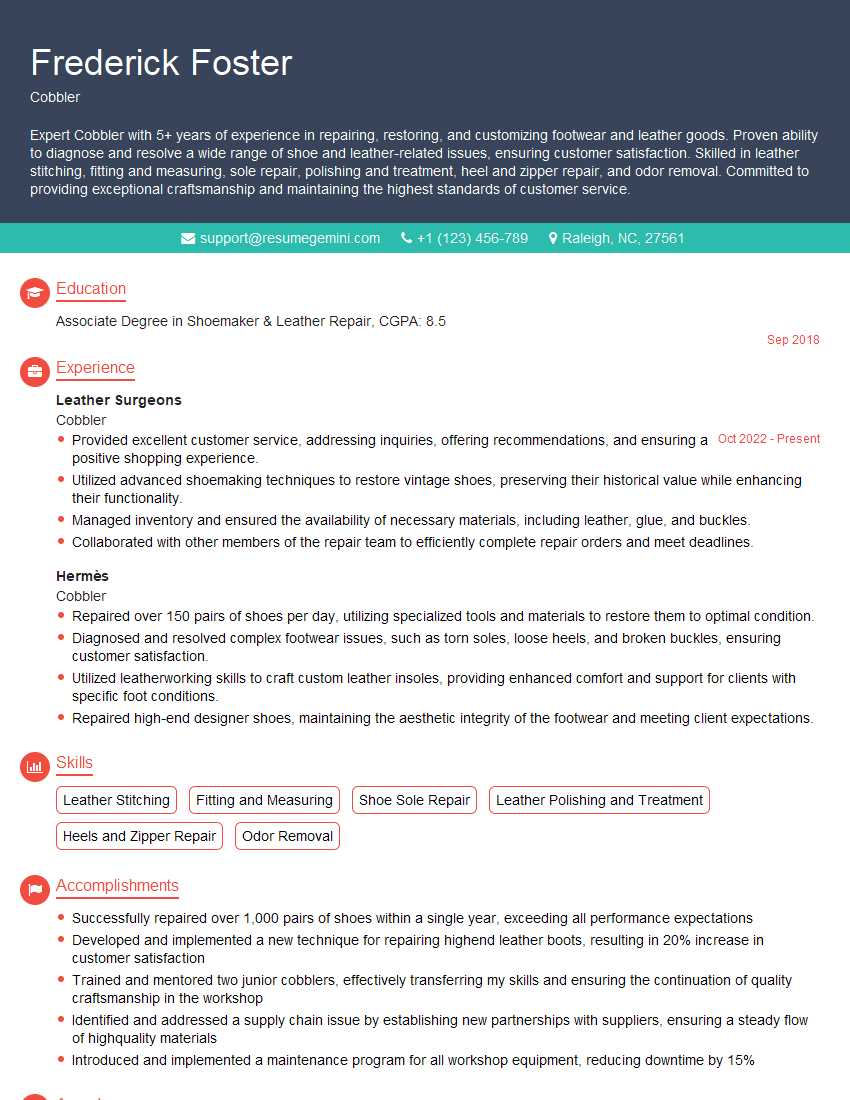
Mastering half-soleing techniques opens doors to rewarding and specialized roles within the footwear industry, offering excellent career growth potential. To significantly increase your chances of landing your dream job, focus on crafting an ATS-friendly resume that highlights your skills and experience effectively. ResumeGemini is a trusted resource to help you build a professional and impactful resume tailored to the specifics of the half-soleing field. Examples of resumes tailored to Half-Soleing are available for your review, providing valuable insights into how to best present your qualifications.
Explore more articles
Users Rating of Our Blogs
Share Your Experience
We value your feedback! Please rate our content and share your thoughts (optional).
What Readers Say About Our Blog
Very informative content, great job.
good