Interviews are more than just a Q&A session—they’re a chance to prove your worth. This blog dives into essential Heel Nailing Machine Operation interview questions and expert tips to help you align your answers with what hiring managers are looking for. Start preparing to shine!
Questions Asked in Heel Nailing Machine Operation Interview
Q 1. Describe your experience operating a heel nailing machine.
My experience with heel nailing machines spans over eight years, encompassing various machine types and applications within the woodworking and furniture manufacturing industries. I’ve worked extensively with both automated and semi-automated systems, from smaller benchtop models to large-scale industrial machines used in high-volume production lines. This experience includes not only operating the machines but also performing routine maintenance, troubleshooting malfunctions, and ensuring consistent product quality. For example, in my previous role, I was responsible for operating a high-speed heel nailing machine that produced over 500 chair legs per hour, maintaining a defect rate of under 0.5%.
Q 2. What are the different types of heel nailing machines you’re familiar with?
Heel nailing machines vary significantly in size, automation level, and capacity. I’m familiar with several types:
- Pneumatic Heel Nailers: These are commonly found in smaller workshops and use compressed air to drive nails. They are relatively simple to operate and maintain but have lower production speeds.
- Electric Heel Nailers: These offer increased power and speed compared to pneumatic models, often incorporating features like automatic nail feeding and depth adjustment.
- Automated/Robotic Heel Nailers: Found in large-scale manufacturing, these machines integrate with conveyor systems and other automated processes for high-throughput production. They are complex to operate and require specialized training.
- Specialty Heel Nailers: Some machines are designed for specific applications, such as curved or angled components, offering specialized features like adjustable nail angles or curved clamping mechanisms.
My experience encompasses a wide range within these categories, allowing me to adapt quickly to different machine types.
Q 3. Explain the process of setting up a heel nailing machine for a specific job.
Setting up a heel nailing machine involves several crucial steps, and the specifics vary depending on the machine type and the job requirements. Generally, the process includes:
- Selecting the appropriate nails: This depends on the wood type, thickness, and desired nail holding strength. For example, harder woods might require longer, thicker nails.
- Adjusting nail depth: The depth of nail penetration needs to be precisely adjusted to avoid splitting the wood or insufficient holding power. This often involves calibrating the machine’s settings using test pieces.
- Clamping mechanism adjustment: The clamping system ensures the workpiece is securely held during nailing. Adjustments might be needed depending on the dimensions and shape of the component. The pressure needs to be sufficient for secure nailing but not so strong as to damage the wood.
- Nail feed adjustment (if applicable): Automated machines usually have a nail feed mechanism that needs to be calibrated to ensure a consistent supply of nails.
- Testing and fine-tuning: After initial setup, test nailing is crucial to ensure consistent results before starting mass production. This helps identify and correct minor adjustments needed for optimal performance.
This systematic approach minimizes errors and ensures efficient and high-quality production.
Q 4. How do you ensure the quality of the heel nailing process?
Quality control in heel nailing focuses on ensuring consistent nail penetration, proper alignment, and absence of damage to the workpiece. My strategies include:
- Regular inspection of nails: This checks for bent or damaged nails that could lead to malfunctions or poor quality.
- Visual inspection of finished pieces: A thorough visual check reveals any misaligned nails, surface damage, or insufficient penetration.
- Regular machine maintenance: Preventative maintenance minimizes the risk of malfunctions and ensures consistent operation. Cleaning, lubrication, and checking for wear and tear are essential.
- Statistical Process Control (SPC): For high-volume production, SPC techniques monitor key parameters like nail depth and alignment to identify and address potential problems proactively.
By combining visual checks with regular maintenance, we can maintain high-quality production and minimize defects.
Q 5. What safety precautions do you take when operating a heel nailing machine?
Safety is paramount when operating heel nailing machines. My routine includes:
- Wearing appropriate safety gear: This always includes safety glasses, hearing protection, and work gloves to protect against flying debris and noise.
- Ensuring proper machine guarding: All guards and safety interlocks must be in place and functioning correctly before operation.
- Following lockout/tagout procedures: Before performing maintenance or repairs, the machine must be properly locked out and tagged to prevent accidental operation.
- Keeping the work area clear: Removing debris and ensuring adequate workspace minimizes the risk of trips or falls.
- Regular machine inspection: Identifying and addressing potential hazards, like loose parts or worn components, proactively prevents accidents.
Safety awareness and adherence to established procedures are integral to my work practices.
Q 6. How do you troubleshoot common malfunctions of a heel nailing machine?
Troubleshooting heel nailing machines involves a systematic approach. Common malfunctions and their solutions include:
- Machine jams: This often involves clearing obstructions in the nail feed mechanism or checking for bent or damaged nails.
- Inconsistent nail depth: Adjusting the depth setting and ensuring proper clamping are key solutions. Sometimes, it might involve inspecting the nail driving mechanism for wear and tear.
- Nail misalignment: This usually requires adjustments to the nailing mechanism or the workpiece clamping system. Checking for worn parts might also be necessary.
- Pneumatic system issues (for pneumatic machines): Low air pressure or leaks in the air lines need to be addressed.
My experience allows me to identify the root cause of malfunctions quickly and efficiently, minimizing downtime.
Q 7. What are the different types of nails used in heel nailing?
The type of nail used in heel nailing depends on the application and material. Common types include:
- Helical nails: These have a spiral thread that provides excellent holding power, reducing the risk of the nail pulling out. They are often preferred for hardwood applications.
- Straight nails: These are simpler and cheaper but offer less holding power than helical nails.
- Ring-shank nails: These nails have rings around the shaft, providing additional holding power, especially in softer woods.
- Different gauge and length nails: Nail gauge and length are selected based on the thickness and hardness of the wood.
Selecting the appropriate nail type is crucial for ensuring strength and durability.
Q 8. How do you adjust the machine settings for different types of heels and materials?
Adjusting a heel nailing machine for different heel types and materials involves understanding the interplay between nail size, penetration depth, and material density. Think of it like adjusting a sewing machine for different fabric weights – you need the right needle and stitch length to achieve a quality result.
Heel Type: For example, a thicker, more robust leather heel will require a longer, sturdier nail and potentially a higher impact setting compared to a thinner, synthetic heel. The machine’s settings for nail depth and impact strength are crucial here. Too shallow, and the nail won’t hold; too deep, and you risk damage to the heel or outsole.
Material: Harder materials like wood heels will require greater impact force than softer materials like rubber or plastic. You might adjust the machine’s pneumatic pressure or impact mechanism accordingly. You need to balance speed and power to prevent the nail from bending or the heel from splitting.
Nail Size: Different nails are designed for different materials and heel thicknesses. The machine will need to be configured to accommodate the specific nail length and diameter. This is often done through a simple adjustment of the nail feed mechanism.
Typically, these adjustments are made using a combination of dials, levers, or digital interfaces provided on the machine control panel. The manufacturer’s manual will provide specific instructions and recommended settings for different types of materials and heels.
Q 9. What is the typical production rate you can achieve with a heel nailing machine?
The production rate of a heel nailing machine varies significantly based on several factors, including the machine’s model, operator skill, heel type, and material. A modern, high-speed machine can achieve upwards of 1000 to 1500 pairs of shoes per hour for simpler heel types and materials. However, more complex heel designs or tougher materials might reduce this rate to 500-800 pairs per hour.
Think of it like an assembly line. A well-oiled, efficient line with skilled workers will naturally produce more than a slower line with inexperienced workers or frequent stoppages for adjustments or repairs.
Factors impacting production include:
- Machine Model: Older models are naturally slower than newer, automated versions.
- Operator Skill: A skilled operator can maintain a consistent pace and minimize downtime.
- Material Handling: Efficient material handling minimizes delays.
- Heel Complexity: Elaborate heels require more precise placement and thus reduce the speed.
Q 10. How do you maintain and clean a heel nailing machine?
Maintaining and cleaning a heel nailing machine is vital for its longevity, efficiency, and safety. Imagine a car – regular maintenance ensures it runs smoothly and reliably.
Daily Cleaning: Remove excess debris like wood shavings, rubber scraps, and nail dust. Compressed air is great for this, followed by wiping down surfaces with a soft cloth.
Regular Lubrication: Moving parts like the pneumatic cylinders and the nail feed mechanism require regular lubrication to reduce friction and wear. Consult your machine’s manual for recommended lubricants and lubrication points.
Nail Feed Mechanism Inspection: Regularly check the nail feed mechanism for any jams or obstructions. Ensure smooth operation to prevent bent nails or damaged heels.
Pneumatic System Check: Inspect air hoses for leaks and ensure adequate air pressure for optimal performance.
Periodic Maintenance: This includes more in-depth checks, such as inspecting the impact mechanism for wear, adjusting the tension on belts and chains, and checking electrical connections. This should be performed according to the manufacturer’s recommendations, perhaps every few months or annually.
Q 11. Describe your experience with different heel nailing machine brands.
Throughout my career, I’ve had extensive experience operating several leading brands of heel nailing machines. I’ve worked with models from [Brand A], known for their robust build and consistent performance, and machines from [Brand B], which excel in their user-friendly interface and automated features. I also have experience with [Brand C] machines, which are quite popular for their speed and suitability for high-volume production.
Each brand presents its own nuances. For example, [Brand A] requires more frequent lubrication, while [Brand B] features a self-diagnostic system which facilitates faster troubleshooting. My experience across different brands has broadened my understanding of the variations in design, functionality, and maintenance procedures, enabling me to efficiently handle any machine I encounter.
Q 12. How do you identify and resolve issues with misaligned nails or damaged heels?
Misaligned nails or damaged heels are common issues in heel nailing. Addressing them requires a systematic approach, paying attention to several key areas.
Misaligned Nails: This often stems from issues with the nail feed mechanism, improper heel placement, or worn parts. I would first inspect the nail feed mechanism for any obstructions or malfunctions. Next, I would verify the heel’s proper position within the machine’s jig. Finally, I’d check for wear on components that influence nail placement accuracy. If the problem persists, I would carefully check for any inconsistencies in nail delivery or any possible malfunction.
Damaged Heels: Heel damage often results from excessive impact force, a faulty nail, or improper machine setup. I would begin by reviewing the machine settings, such as impact strength and penetration depth, adjusting these values as needed. I would also inspect the nails themselves for any defects. If the damage continues, it might indicate a problem within the impact mechanism.
Troubleshooting involves carefully examining each step in the process, from material handling to machine settings to ensure that every component is working correctly. A detailed understanding of the machine’s mechanics and a systematic approach to problem-solving are crucial to resolving these issues efficiently.
Q 13. What are the key performance indicators (KPIs) you monitor during heel nailing?
Key Performance Indicators (KPIs) during heel nailing operations ensure efficient production and product quality. My focus lies on several key metrics:
Production Rate (Units per Hour): This tracks the overall efficiency of the operation and highlights potential bottlenecks.
Defect Rate (%): This metric measures the percentage of heels with misaligned nails, damage, or other defects, indicating potential issues with the machine or the process.
Downtime (Minutes per Shift): This metric measures how much time the machine was out of operation due to maintenance, repairs, or other issues, highlighting areas for improvement.
Material Waste (%): This tracks the amount of material wasted during the process, suggesting opportunities for optimization.
Maintenance Costs ($ per Unit): Tracking these costs helps optimize maintenance procedures and identify potentially expensive recurring issues.
By consistently monitoring these KPIs, we can identify areas needing improvement and implement proactive strategies to enhance productivity, efficiency, and product quality.
Q 14. Explain the importance of following the manufacturer’s guidelines for operation and maintenance.
Following the manufacturer’s guidelines for operation and maintenance is paramount for several reasons. Think of it as a recipe – deviating from the instructions can lead to poor outcomes.
Safety: Manufacturer guidelines prioritize safety. Failing to follow them can increase the risk of accidents or injuries.
Performance: Operating the machine within specified parameters ensures optimal performance and longevity. Ignoring these guidelines can lead to reduced efficiency and increased wear and tear.
Warranty: Most manufacturers’ warranties stipulate adherence to their guidelines. Failure to do so may void the warranty, leaving you responsible for repair costs.
Consistency: Following these guidelines ensures consistency in the quality of the finished product. This consistency is crucial for maintaining reputation and meeting customer expectations.
Essentially, adhering to manufacturer guidelines is not merely a suggestion but a critical aspect of ensuring safe, productive, and cost-effective operation of the heel nailing machine.
Q 15. How do you ensure the consistent quality of the finished product?
Consistent quality in heel nailing relies on a multi-faceted approach. It begins with meticulous attention to detail in the setup phase, ensuring the machine is properly calibrated for nail depth, pressure, and placement according to the specific heel type and material. This includes verifying the correct nail type and size are being used. Throughout the process, regular visual inspections of the finished product are vital. I look for consistent nail penetration, absence of damage to the heel material (e.g., cracks or splitting), and correct nail alignment. Statistical Process Control (SPC) charts are also invaluable. By tracking key metrics like nail penetration depth and reject rate, we can identify and address any deviations from the target before they become significant problems. For example, a sudden increase in reject rates might point to a worn nail feed mechanism requiring adjustment or replacement.
Furthermore, maintaining a clean and organized work area is essential. This prevents material jams and ensures optimal machine function, directly impacting product consistency. Finally, regular operator training reinforces proper procedures and proactive identification of potential quality issues.
Career Expert Tips:
- Ace those interviews! Prepare effectively by reviewing the Top 50 Most Common Interview Questions on ResumeGemini.
- Navigate your job search with confidence! Explore a wide range of Career Tips on ResumeGemini. Learn about common challenges and recommendations to overcome them.
- Craft the perfect resume! Master the Art of Resume Writing with ResumeGemini’s guide. Showcase your unique qualifications and achievements effectively.
- Don’t miss out on holiday savings! Build your dream resume with ResumeGemini’s ATS optimized templates.
Q 16. What is your experience with preventative maintenance on heel nailing machines?
Preventative maintenance is the cornerstone of efficient and reliable heel nailing machine operation. My experience encompasses a comprehensive routine that includes daily, weekly, and monthly checks. Daily checks involve inspecting the nail feed mechanism for obstructions, lubricating moving parts, and visually inspecting the machine for any signs of wear or damage. Weekly maintenance includes more thorough cleaning, checking air pressure and connections, and verifying the alignment of the nailing heads. Monthly maintenance typically involves more extensive lubrication, replacing worn parts as needed (such as belts or pneumatic components), and a complete inspection of the entire system. I meticulously document all maintenance activities, including the date, type of work performed, and any parts replaced. This detailed record-keeping helps track the machine’s health, predicts potential issues, and ensures compliance with safety regulations.
A proactive approach to maintenance prevents costly downtime and ensures consistent high-quality output. I’ve found that by catching minor issues early, I can prevent major breakdowns which could cost far more in lost production than routine maintenance ever would.
Q 17. Describe a time you had to fix a malfunctioning heel nailing machine.
During a particularly busy production run, we experienced a malfunction where the heel nailing machine started misfiring – sometimes driving the nails too deep, other times missing the target entirely. My first step was to systematically isolate the problem. I started by carefully examining the nail feed mechanism, ensuring nails were feeding correctly and weren’t jammed. Then, I checked the air pressure, as inconsistent air pressure can lead to inconsistent nailing. After finding that the air pressure was fluctuating, I traced the issue to a faulty regulator.
Once I identified the faulty regulator, I followed the established maintenance procedure to replace it. Before restarting the machine, I conducted a complete system check, including the air pressure, nail feed, and alignment of the nailing head. This systematic troubleshooting approach allowed me to quickly identify and resolve the issue, minimizing production downtime and preventing further defects. Documenting this incident, including the root cause and solution, contributed to our preventative maintenance program, preventing similar issues from occurring in the future.
Q 18. How do you handle production delays or bottlenecks related to the heel nailing process?
Production delays or bottlenecks in heel nailing can stem from various sources, such as machine malfunctions, material shortages, or operator errors. My approach to handling these issues is systematic and proactive. First, I identify the root cause of the delay, utilizing tools like process flow analysis to pinpoint the bottleneck. For example, if the delay is due to a material shortage, I immediately communicate with the supply chain team to expedite the delivery. If it’s a machine malfunction, my expertise allows me to promptly diagnose and resolve the problem, as outlined in previous examples.
If the bottleneck is related to operator performance or training, I address it through targeted training or by providing additional support and guidance to the team. In some cases, optimizing the production workflow by identifying opportunities for parallel processing can alleviate bottlenecks. Prioritization of tasks and proactive communication with other team members and supervisors are vital in ensuring that any delays are minimized and production is back on track efficiently. I believe in teamwork and open communication to address these challenges.
Q 19. What is your understanding of different heel types and their specific nailing requirements?
Different heel types, such as leather, synthetic, or composite materials, have varying densities and thicknesses which influence nailing requirements. Leather heels, for example, are more prone to splitting if the nails are driven too forcefully or at incorrect angles, requiring careful adjustment of nailing pressure and depth. Synthetic heels might require a different nail type or size to ensure secure fastening while preventing damage. Composite heels, depending on their specific composition, may necessitate specialized nailing techniques or even alternative fastening methods altogether.
My understanding encompasses not just the material properties but also the associated nail specifications—nail type (e.g., galvanized, stainless steel), diameter, length, and even the nail’s point shape—to optimize fastening strength, durability, and appearance. This knowledge ensures proper machine setup for each heel type, resulting in consistent quality and minimizing product defects.
Q 20. How do you work effectively within a team environment on the production line?
Effective teamwork is essential in a high-volume production environment. I actively contribute to a positive and productive team dynamic by fostering open communication, sharing my expertise, and actively assisting my colleagues. This includes helping train new team members, providing support when others face challenges, and proactively identifying and resolving any issues that affect team productivity. For example, if I notice a colleague struggling with a particular aspect of the process, I’ll offer assistance or share a helpful tip from my experience.
I also believe in collaborative problem-solving. When faced with a production challenge, I actively participate in brainstorming solutions and contribute my knowledge to the team’s effort. By working collaboratively and sharing my expertise, I contribute to a smoother, more efficient production process and a positive work environment for everyone.
Q 21. Describe your experience with different types of heel materials.
My experience encompasses a broad range of heel materials, including natural leather (various thicknesses and tanning methods), synthetic materials like PU (polyurethane) and PVC (polyvinyl chloride), and composite materials combining different materials for enhanced properties. Each material presents unique challenges and opportunities. Natural leather requires precise nailing to avoid splitting or tearing, whereas synthetic materials often require a different nail type and driving pressure to achieve secure fastening. Composite heels may necessitate specific nailing techniques depending on their structural composition.
Understanding the properties of each material, from their density and hardness to their flexibility and susceptibility to damage, is crucial for setting up the heel nailing machine correctly and achieving optimal results. This knowledge allows me to adjust parameters such as nail penetration depth, impact force, and nail alignment to produce consistent, high-quality results across all heel types.
Q 22. What are the potential hazards associated with heel nailing machines?
Heel nailing machines, while efficient, present several potential hazards. The most significant is the risk of injury from the moving parts. The rapidly moving nailing mechanism can easily cause finger or hand injuries if not handled correctly. Further, improper use can lead to kickback, where the workpiece unexpectedly flies back towards the operator. Additionally, there’s the risk of eye injuries from flying debris (nail fragments, wood splinters) and repetitive strain injuries (RSI) from prolonged operation.
- Pinch points: Areas where moving parts can trap fingers or hands.
- Kickback: The sudden, forceful return of the workpiece.
- Flying debris: Nail fragments, wood chips, etc., posing a threat to eyes and skin.
- RSI: Repetitive strain injuries such as carpal tunnel syndrome from repetitive actions.
Q 23. How do you ensure the safety of yourself and your coworkers while operating the machine?
Safety is paramount. Before operating the heel nailing machine, I always ensure all safety guards are in place and functioning correctly. I wear appropriate personal protective equipment (PPE), including safety glasses, hearing protection, and gloves. I also carefully inspect the workpiece for any defects or loose parts that could cause malfunctions. Furthermore, I maintain a clean and organized workspace to minimize tripping hazards. I follow the lock-out/tag-out procedure before any maintenance or cleaning. Finally, I regularly communicate with coworkers, making sure the work area is clear and everyone understands the machine’s operational parameters and safety protocols.
Think of it like this: just like a race car driver needs protective gear and a well-maintained vehicle, operating a heel nailing machine safely requires a similar level of diligence and attention to detail.
Q 24. What is your understanding of quality control procedures in heel nailing?
Quality control in heel nailing is crucial. It begins with the inspection of raw materials – ensuring the nails are the correct size and type and the footwear lasts are free from defects. During the nailing process, I visually check each shoe for proper nail placement, depth, and straightness. I frequently monitor the machine’s settings (nail penetration depth and force) to ensure consistency. After nailing, each shoe is inspected for any damage or misaligned nails. I use various measuring instruments (calipers, gauges) to ensure dimensions are within the specified tolerance. Defective shoes are immediately set aside and the cause is investigated. Regular calibration of the machine and recording of quality control data (number of rejects, etc.) are also essential.
Q 25. How do you handle different types of footwear last sizes?
Heel nailing machines are usually adjustable to accommodate various footwear last sizes. This is commonly done via adjustable clamping mechanisms and sometimes by changing the position of the nailing head itself. Before operating the machine for a different size, I thoroughly review the machine’s operation manual and carefully adjust the settings according to the size specifications. This includes aligning the last correctly in the machine’s jig. Incorrect adjustments can lead to misaligned nails or damage to the last. I always perform a test run on a sample last before starting a large batch. This ensures that the machine is properly set up and functioning correctly, avoiding costly mistakes and potential damage.
Q 26. How do you identify and report defects or irregularities in the heel nailing process?
Identifying and reporting defects is vital. During and after the heel nailing process, I meticulously examine each shoe for any irregularities. These might include: nails driven at incorrect angles, nails that are too deep or too shallow, damaged lasts, or missing nails. When a defect is identified, I immediately stop the process and document the defect, noting the type of defect, the number of affected shoes, and any potential root cause. This information is then reported to the supervisor to initiate corrective actions. We use a standardized defect reporting form which helps maintain consistent documentation. Addressing issues promptly prevents further defects and ensures high-quality output.
Q 27. What are your skills in using measuring instruments related to heel nailing?
I am proficient in using various measuring instruments crucial for heel nailing, including:
- Calipers: To accurately measure the depth of nail penetration and the overall dimensions of the heel.
- Gauges: To check the diameter of the nails and ensure they are within specification.
- Rulers and measuring tapes: For verifying the overall dimensions of the footwear.
Accurate measurements are vital for maintaining consistent nail placement and preventing defects. I regularly check the calibration of these tools to ensure accuracy and reliability. Improper use of measuring instruments could lead to inconsistencies and reduce the quality of the finished product.
Q 28. Describe your experience with different types of nail heads.
I have experience with several types of nail heads used in heel nailing, including:
- Round heads: These offer good holding power and are commonly used.
- Serrated heads: Providing enhanced grip and preventing slippage.
- Countersunk heads: Designed to sit flush with the surface of the heel.
The selection of the nail head type depends on the specific material of the last and the overall design requirements of the footwear. For example, serrated heads might be preferred for harder materials to maximize grip. Understanding the characteristics of each nail head is crucial for ensuring the durability and appearance of the finished product.
Key Topics to Learn for Heel Nailing Machine Operation Interview
- Machine Setup and Calibration: Understanding the various controls, adjustments, and safety mechanisms of the heel nailing machine. This includes proper alignment and tension settings.
- Operation and Maintenance: Practical application of operating procedures, including loading materials, initiating the nailing process, and monitoring machine performance. Understanding routine maintenance tasks and troubleshooting minor issues is crucial.
- Safety Procedures and Regulations: Deep understanding of all relevant safety protocols, including personal protective equipment (PPE) requirements and emergency procedures. Familiarity with OSHA regulations pertaining to machine operation.
- Material Handling and Quality Control: Proper techniques for handling different materials, identifying defects, and ensuring consistent nail placement for high-quality output. This includes understanding material specifications and their impact on the nailing process.
- Troubleshooting and Repair: Identifying common malfunctions, performing basic troubleshooting steps, and knowing when to call for professional maintenance. Understanding the machine’s mechanical components and their functions.
- Production Efficiency and Optimization: Strategies for maximizing output while maintaining quality and adhering to safety standards. Understanding the impact of different operational parameters on production speed and efficiency.
Next Steps
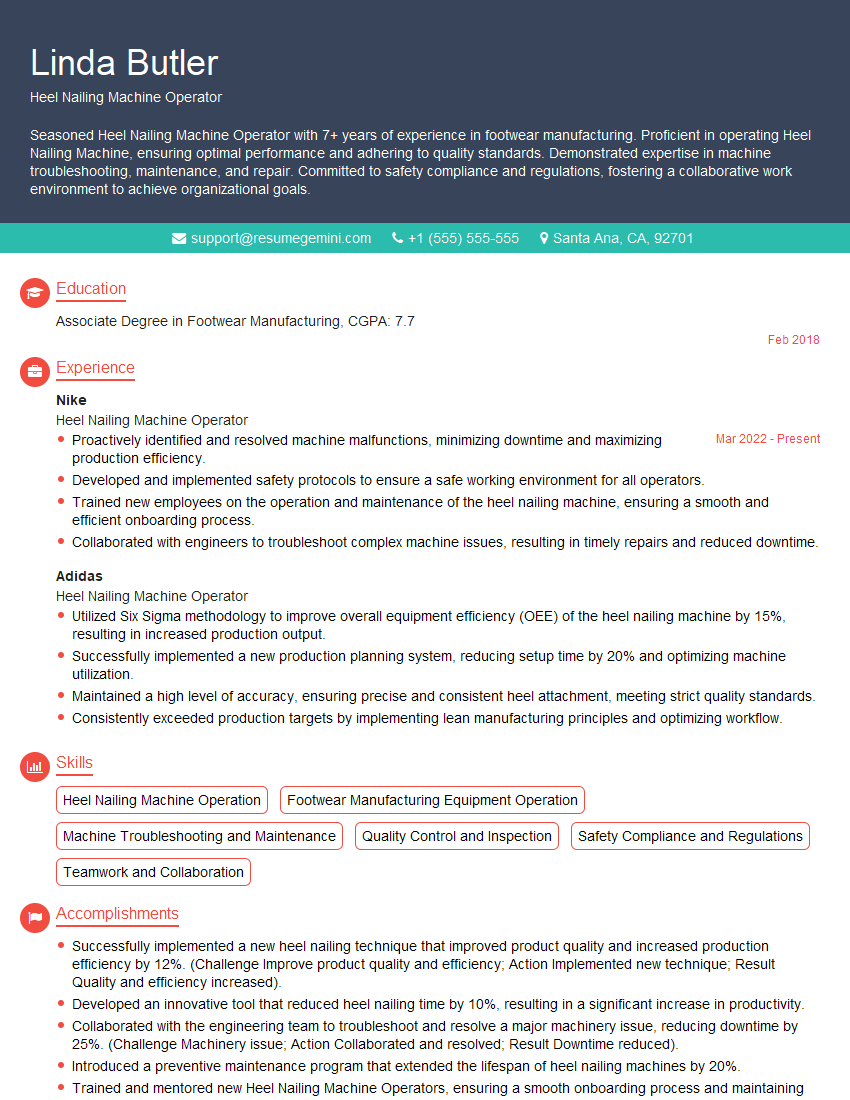
Mastering Heel Nailing Machine Operation opens doors to rewarding careers with excellent growth potential in manufacturing and related industries. Your expertise in this specialized skill is highly valuable! To maximize your job prospects, focus on creating an ATS-friendly resume that highlights your skills and experience effectively. ResumeGemini is a trusted resource that can help you build a professional resume that stands out. We provide examples of resumes tailored to Heel Nailing Machine Operation to guide you in crafting a compelling application that showcases your abilities. Take the next step towards your dream career – invest in a strong resume today!

Explore more articles
Users Rating of Our Blogs
Share Your Experience
We value your feedback! Please rate our content and share your thoughts (optional).
What Readers Say About Our Blog
Very informative content, great job.
good