Are you ready to stand out in your next interview? Understanding and preparing for HF interview questions is a game-changer. In this blog, we’ve compiled key questions and expert advice to help you showcase your skills with confidence and precision. Let’s get started on your journey to acing the interview.
Questions Asked in HF Interview
Q 1. Explain the concept of market microstructure.
Market microstructure focuses on the mechanics of how prices are formed and orders are executed in financial markets. Think of it as zooming in on the very details of the trading process – the nuts and bolts of how buyers and sellers interact at a very granular level. It’s not about broad market trends, but the specific actions of individual traders and the impact of their orders on price discovery.
Key aspects of market microstructure include:
- Order book dynamics: How the order book (a list of buy and sell orders at different prices) changes over time, revealing the supply and demand at each price level.
- Trading mechanisms: The rules and technologies used to match buy and sell orders, including auction mechanisms and continuous trading.
- Information asymmetry: The fact that some traders may have access to more or better information than others, which affects their trading decisions.
- Transaction costs: The various costs associated with trading, including commissions, slippage (the difference between the expected and actual execution price), and the bid-ask spread (the difference between the highest buy and lowest sell price).
- High-frequency trading (HFT): The use of sophisticated computer algorithms to execute a large number of trades very quickly, often impacting market microstructure significantly.
Understanding market microstructure is crucial for anyone involved in trading, investment management, or market regulation. It allows for a deeper understanding of how prices are determined and how to minimize transaction costs.
Q 2. Describe different order types used in high-frequency trading.
High-frequency trading (HFT) firms utilize a variety of sophisticated order types to gain a competitive edge. These go beyond the simple market and limit orders of retail trading.
- Market Orders: These orders are executed immediately at the best available price in the market. Simple, but can result in slippage if market conditions change rapidly.
- Limit Orders: These orders specify a maximum price (for a buy order) or minimum price (for a sell order) at which the trader is willing to execute. They are not guaranteed to be filled.
- Stop Orders: These orders become market orders when the price of the asset reaches a specified level (the stop price). Often used to limit losses or protect profits.
- Iceberg Orders: These orders hide the true size of the order, revealing only a small portion to the market. This helps to prevent market manipulation or adverse price movements.
- Hidden Orders: Similar to Iceberg orders, these orders are completely hidden from the market until filled, often used for large institutional trades to avoid impacting the price.
- TWAP (Time-Weighted Average Price) Orders: These orders aim to execute a large order at the average price over a specific time period, minimizing market impact.
- VWAP (Volume-Weighted Average Price) Orders: These orders aim to execute a trade at the average price weighted by volume over a specified time, also aiming to minimize market impact.
The choice of order type depends heavily on the specific trading strategy and the current market conditions. HFT algorithms often use a combination of these order types, dynamically adjusting based on real-time market data.
Q 3. What are the advantages and disadvantages of co-location?
Co-location involves placing a trading firm’s servers physically close to the exchange’s servers. This minimizes network latency, giving the firm a significant speed advantage.
Advantages:
- Reduced Latency: The most significant advantage. Shorter distances mean faster data transmission, leading to quicker order execution and potentially greater profitability.
- Predictable Performance: Co-location provides more control over the network environment, leading to more consistent and predictable performance.
- Competitive Advantage: The speed advantage can be crucial in HFT, where milliseconds can make a huge difference.
Disadvantages:
- High Cost: Co-location involves significant upfront investment in hardware, software, and ongoing rental fees.
- Increased Complexity: Managing and maintaining servers in a co-location facility requires specialized expertise and resources.
- Security Concerns: Co-location raises security concerns regarding the protection of proprietary algorithms and data.
- Dependence on Exchange Infrastructure: The trading firm becomes dependent on the exchange’s infrastructure, potentially leading to disruptions if the exchange experiences problems.
The decision of whether or not to co-locate depends on a firm’s trading strategy, risk tolerance, and budget. For HFT firms, it’s often a necessity, while other firms may find it too expensive or unnecessary.
Q 4. How does latency affect HFT strategies?
Latency, the delay in data transmission and processing, is the arch-nemesis of HFT strategies. Even tiny delays can significantly impact profitability and potentially lead to losses. Imagine a race where the slightest stumble determines the winner; in HFT, milliseconds determine success or failure.
Latency impacts HFT in several ways:
- Order Execution: Higher latency means orders are executed later, potentially missing out on favorable price movements.
- Market Impact: Delayed orders can worsen a trader’s market impact, meaning their trades move the price more than they would ideally like.
- Algorithmic Arbitrage: HFT often relies on exploiting tiny price differences across different exchanges or markets. High latency can make these arbitrage opportunities disappear before they can be captured.
- Risk Management: Latency can hinder effective risk management, as timely responses to market changes are crucial in mitigating losses.
HFT firms invest heavily in reducing latency through various means, including co-location, specialized hardware, and optimized algorithms. Even a few microseconds of reduced latency can significantly increase profitability.
Q 5. Explain different types of latency and their impact on trading.
Latency comes in several forms, each impacting trading differently:
- Network Latency: This is the time it takes for data to travel across the network, from the trader’s server to the exchange and back. It’s influenced by physical distance, network congestion, and the quality of network infrastructure.
- Hardware Latency: This relates to the speed of processing within the trader’s hardware (servers, CPUs, memory). Faster processors and more efficient memory access reduce hardware latency.
- Software Latency: This encompasses delays caused by inefficiencies in the trading software, algorithms, and operating systems. Optimized code and efficient algorithms minimize software latency.
- Exchange Latency: This is the time the exchange takes to process an order. This is largely outside the trader’s control but can vary across exchanges.
- Market Data Latency: The delay in receiving real-time market data. This can significantly impact decision-making speed and the ability to react to market movements.
Minimizing each type of latency is crucial for HFT. Imagine a relay race – a slow leg in any part of the process will affect the overall time.
Q 6. What are some common challenges in building a low-latency trading system?
Building a low-latency trading system presents numerous challenges:
- Hardware Selection: Choosing the right hardware (servers, network cards, etc.) that can handle the high volume and speed of transactions is crucial and complex.
- Software Optimization: Writing efficient and optimized code is vital for minimizing software latency. This often involves using low-level programming languages like C++ and careful attention to algorithm design.
- Network Design: Designing a robust and low-latency network infrastructure requires specialized knowledge and careful planning, including consideration of network topology, bandwidth, and redundancy.
- Data Management: Efficiently storing, retrieving, and processing vast amounts of real-time market data is essential. Databases must be highly performant.
- Algorithm Design: Creating sophisticated algorithms that can quickly analyze market data and make optimal trading decisions is paramount. This often requires advanced mathematical modeling and machine learning techniques.
- Testing and Monitoring: Rigorous testing and continuous monitoring are essential to identify and resolve any performance bottlenecks or issues in the system.
- Regulatory Compliance: Trading systems must comply with various regulations, which can add complexity and increase development time.
Each of these aspects requires specialized expertise and careful attention to detail. One small oversight can have significant consequences in terms of latency and potential profitability.
Q 7. Describe different techniques for order book analysis.
Order book analysis involves examining the order book data to infer market dynamics and inform trading strategies. This provides insights into the underlying supply and demand for a given asset.
Techniques include:
- Order Book Depth and Shape: Examining the distribution of buy and sell orders at different prices reveals the liquidity of the asset at various price levels. A deep and balanced order book suggests high liquidity and price stability, whereas a shallow or skewed order book may indicate low liquidity and potential for price volatility.
- Order Flow Analysis: Tracking the changes in the order book over time provides insights into the actions of different market participants, helping to identify patterns and potential trading opportunities. For example, a sudden influx of large buy orders might signal an upcoming price increase.
- Order Book Imbalances: Identifying imbalances between buy and sell orders (e.g., more aggressive buy orders) can indicate potential price movements. If buy orders are significantly greater than sell orders at a given price level, the price might increase.
- Statistical Methods: Applying statistical techniques like time series analysis to the order book data helps identify patterns and predict future price movements. This may involve things like identifying volatility clusters.
- Machine Learning: Machine learning algorithms can be used to analyze massive datasets of order book information, identifying subtle patterns that may not be readily apparent to human analysts. This may be used for predictive modeling or to improve the effectiveness of trading strategies.
These techniques are crucial for HFT firms, allowing them to make informed decisions about order placement, price discovery, and risk management. Combining multiple techniques often provides the most accurate and insightful view of market dynamics.
Q 8. Explain how market impact affects HFT strategies.
Market impact in High-Frequency Trading (HFT) refers to the price movement caused by a large order’s execution. Imagine trying to buy 10,000 shares of a stock at once – your demand will likely push the price up, costing you more than if you’d bought them gradually. This is a significant challenge for HFT because these strategies rely on executing many trades quickly. The larger the order, the greater the impact and the less profitable the trade becomes.
HFT strategies mitigate market impact through several techniques:
- Order splitting: Breaking down large orders into smaller pieces and executing them over time minimizes price slippage. Instead of one large order, you might send out multiple smaller orders at slightly different prices.
- Algorithmic order placement: Using sophisticated algorithms that analyze order books and market conditions to determine optimal order sizes and timing. For example, an algorithm might detect periods of low liquidity and reduce order size to avoid significantly affecting price.
- Dark pools: Utilizing dark pools, private exchanges where large orders can be executed without revealing the full size to the market, reducing the impact on public exchanges.
- Hidden orders: Placing orders that are only partially visible to the market, reducing the immediate impact of the trade while still achieving execution.
Failing to account for market impact can lead to significant losses. A strategy that works well on small orders might fail dramatically when scaled up due to the increased price movement.
Q 9. How do you handle data streams in high-frequency trading?
Handling data streams in HFT is paramount, requiring extremely efficient and low-latency systems. We’re talking about processing millions of messages per second from multiple exchanges simultaneously. This involves several key steps:
- Direct market access (DMA): Establishing ultra-low latency connections directly to exchanges through co-location facilities, which physically places our servers very close to exchange servers to minimize network delays.
- Message queuing: Utilizing specialized message queues like Kafka or ZeroMQ to buffer incoming data streams and prioritize critical messages. This ensures that no important market data is lost during bursts of high activity.
- Parallel processing: Employing techniques such as multi-threading and distributed computing to process data concurrently. Imagine dividing the data stream amongst several powerful processors so each one processes a fraction of the data simultaneously, making it much faster.
- Data normalization and cleansing: This critical step involves cleaning up and standardizing data formats received from different exchanges to ensure consistent data quality and reliable analysis. Inconsistent data formats can significantly impact algorithmic trading decisions.
- Database management: Utilizing in-memory databases or highly optimized relational databases for fast retrieval and storage of critical market data. This ensures quick access to historical market data when needed for analysis or execution decision.
Imagine a river of data; we need a system of dams, channels, and turbines (our infrastructure) to manage the flow, filter out impurities, and use the energy (data) effectively.
Q 10. What are some common HFT algorithms?
Many HFT algorithms exist, but some common types include:
- Statistical arbitrage: Exploits temporary mispricings between related assets (like pairs trading or index arbitrage). For example, if two stocks historically move in tandem, a statistical arbitrage strategy might buy the undervalued stock and short the overvalued one, profiting when the prices revert.
- Market making: Providing liquidity by quoting bid and ask prices for assets. These algorithms constantly adjust prices based on incoming orders and market conditions to profit from the bid-ask spread.
- News-based trading: Utilizing natural language processing (NLP) to analyze news feeds and react to news events faster than human traders. This requires sophisticated NLP algorithms and extremely fast execution capabilities.
- Order book analysis: Analyzing the order book to identify patterns and predict price movements. These algorithms may look for patterns in the size and location of orders to predict which way the price will move.
- Momentum trading: Riding trends by automatically buying assets showing upward momentum and selling those showing downward momentum.
The choice of algorithm depends on factors like market conditions, risk tolerance, and the specific trading strategy. Each algorithm needs to be rigorously tested and monitored for performance and stability.
Q 11. Explain the concept of arbitrage in HFT.
Arbitrage in HFT exploits price discrepancies between different markets or exchanges. Imagine the same stock trading at $100 on one exchange and $100.05 on another. An HFT algorithm can simultaneously buy at the lower price and sell at the higher price, earning a risk-free profit of $0.05 per share, minus transaction costs.
Several types of arbitrage are used in HFT:
- Spatial arbitrage: Exploiting price differences between different exchanges or trading venues.
- Triangular arbitrage: Exploiting price differences in the foreign exchange (forex) market across three different currencies.
- Statistical arbitrage: (as mentioned above) Exploiting temporary mispricings between correlated assets.
The key is speed; HFT algorithms need to identify and exploit these tiny price differences before they disappear due to market forces. These opportunities are often fleeting, lasting only milliseconds.
Q 12. Describe various risk management techniques in HFT.
Risk management in HFT is crucial because the speed and volume of trading amplify potential losses. Key techniques include:
- Position sizing: Limiting the amount of capital allocated to any single trade or position to avoid catastrophic losses from a single adverse event.
- Stop-loss orders: Automatically exiting a position when it reaches a predetermined loss level to prevent further losses.
- Real-time risk monitoring: Continuously monitoring market conditions and the performance of trading strategies to identify and address emerging risks.
- Stress testing: Simulating extreme market conditions to assess the resilience of trading strategies and risk management systems. This could include back-testing during past market crashes or simulating flash crashes.
- Circuit breakers: Automatically halting trading activity when certain market conditions are met (e.g., significant price movements) to limit potential damage during volatile periods.
- Diversification: Spreading trades across multiple assets or markets to reduce the impact of losses in any one particular area.
Risk management is not just about preventing losses, but also about managing the trade-off between risk and reward. HFT firms must carefully balance the potential for high returns with the risks of rapid losses.
Q 13. How do you measure the performance of an HFT strategy?
Measuring the performance of an HFT strategy requires considering several metrics:
- Sharpe ratio: Measures risk-adjusted return – how much return you get per unit of risk. A higher Sharpe ratio indicates better performance.
- Sortino ratio: Similar to the Sharpe ratio but only considers downside risk (losses), providing a more nuanced view of risk-adjusted performance.
- Maximum drawdown: The largest percentage decline from a peak to a trough in the strategy’s performance. This metric helps assess the strategy’s resilience during adverse market conditions. A lower maximum drawdown is preferred.
- Average trade profitability: The average profit or loss generated per trade. This metric shows the strategy’s efficiency in generating profits on individual trades.
- Trading frequency: The number of trades executed per day or per unit of time. This is highly relevant for HFT strategies which execute many trades within a short timeframe.
- Slippage: The difference between the expected price and the actual execution price. Lower slippage indicates more efficient execution.
- Latency: The time it takes to execute a trade. Lower latency is crucial for HFT strategies.
Simply looking at raw profit might be misleading. These metrics help understand the risk-adjusted return, resilience, and efficiency of the strategy.
Q 14. What are some regulatory considerations for HFT?
HFT faces significant regulatory scrutiny due to its potential to impact market stability and fairness. Key regulatory considerations include:
- Market manipulation: Regulations aim to prevent HFT strategies from artificially inflating or deflating prices, disrupting market order and creating unfair advantages.
- Order spoofing: Placing and quickly canceling large orders to deceive other market participants. This practice is strictly forbidden and is heavily penalized.
- Latency arbitrage: Exploiting slight differences in data dissemination times between different market participants. Regulation aims to ensure fair and equal access to market data.
- Algorithmic trading guidelines: Regulatory bodies often set guidelines on algorithmic trading practices, requiring robust testing, risk management, and transparency.
- Data security and privacy: Regulations protect sensitive market data used by HFT firms and protect against cyberattacks and data breaches.
- Transparency and reporting: HFT firms are usually required to report their trading activity and strategies to regulatory authorities for monitoring and supervision.
Regulations continuously evolve to address the unique challenges presented by HFT. Staying informed about the regulatory landscape is essential for any HFT firm.
Q 15. Explain the role of order routing in HFT.
Order routing in High-Frequency Trading (HFT) is the crucial process of choosing the best exchange or venue to execute a trade. Imagine you’re a shopper comparing prices across different stores before buying – HFT algorithms do the same, but at lightning speed. The goal is to minimize trading costs (like commissions and slippage) and maximize the chances of filling orders quickly.
Several factors influence routing decisions: price, liquidity (how easily an asset can be bought or sold), latency (delay in communication), and regulatory considerations. Advanced algorithms use sophisticated routing logic, often incorporating machine learning, to analyze real-time market data and dynamically select the most advantageous exchange for each order. For example, if one exchange has a significantly better price for a specific asset, the algorithm will route the order there. If that exchange suddenly becomes illiquid, the algorithm might switch to an alternative venue.
A sophisticated order routing system might prioritize speed for certain trades (like arbitrage opportunities) while favoring cost-effectiveness for others (larger, less time-sensitive orders). Effective routing is paramount in HFT as even milliseconds of delay can significantly impact profitability.
Career Expert Tips:
- Ace those interviews! Prepare effectively by reviewing the Top 50 Most Common Interview Questions on ResumeGemini.
- Navigate your job search with confidence! Explore a wide range of Career Tips on ResumeGemini. Learn about common challenges and recommendations to overcome them.
- Craft the perfect resume! Master the Art of Resume Writing with ResumeGemini’s guide. Showcase your unique qualifications and achievements effectively.
- Don’t miss out on holiday savings! Build your dream resume with ResumeGemini’s ATS optimized templates.
Q 16. Discuss the ethical implications of HFT.
The ethical implications of HFT are complex and multifaceted. While HFT enhances market liquidity and reduces trading costs for many, its speed and complexity raise several ethical concerns.
- Market Manipulation: HFT algorithms can be used to artificially inflate or deflate prices, creating opportunities for profitable trades while harming other market participants. Techniques like spoofing (placing orders with no intention to fill them) and layering (placing multiple orders at different price levels to mask trading intentions) are significant concerns.
- Information Asymmetry: HFT firms often possess a significant advantage due to their access to faster data feeds and advanced technology, creating an information imbalance compared to retail investors.
- Systemic Risk: The speed and automated nature of HFT can exacerbate market volatility, increasing the risk of flash crashes. The interconnectedness of global markets further intensifies this risk.
- Transparency and Regulation: The opaque nature of many HFT algorithms makes it challenging to monitor their activities and ensure compliance with regulations, increasing the risk of unethical practices.
Addressing these ethical challenges requires a combination of robust regulatory frameworks, increased transparency in algorithmic trading, and the development of ethical guidelines for HFT firms. Ultimately, fostering a fair and efficient market requires a thoughtful consideration of the ethical implications of this high-speed technology.
Q 17. What programming languages are commonly used in HFT?
HFT demands exceptional performance and efficiency, driving the choice of programming languages toward those offering speed and low latency. C++ remains the dominant language due to its fine-grained control over memory management and its speed.
- C++: Offers speed, efficiency, and control over system resources, making it ideal for handling high-volume, low-latency trading operations. Many HFT systems are written almost entirely in C++.
- Java: Used less frequently than C++, but its platform independence and robust libraries can be beneficial in certain aspects of HFT systems, especially for data processing and back-end operations.
- Python: Primarily used for back-testing, data analysis, and research supporting the development and optimization of HFT strategies. Its rapid prototyping capabilities are invaluable in this phase but its speed is generally not sufficient for core trading engines.
The choice often involves a combination of languages, with C++ forming the core trading engine and other languages used for supporting tasks.
Q 18. Explain your understanding of different market data feeds.
Market data feeds are the lifeblood of HFT. These feeds provide real-time information about market activity, including prices, order book levels, and trade executions. Different feeds cater to different needs and budgets.
- Level 1 data: Provides basic market information like best bid and ask prices and last traded price. It’s relatively inexpensive but offers limited detail.
- Level 2 data: Includes the full order book, showing all buy and sell orders at various price levels. This granular information is crucial for HFT strategies.
- Level 3 data: The most comprehensive feed, including details like order sizes, timestamps, and even the identities of market participants (often anonymized). This level offers the most complete market picture but also comes at a premium cost.
The choice of data feed depends on the specific HFT strategy and the firm’s budget. Factors to consider include the speed of data delivery (latency), the reliability of the feed, the depth of market information, and cost. Direct feeds from exchanges offer the lowest latency but can be expensive. Consolidated feeds from third-party vendors provide aggregated data from multiple exchanges but might have slightly higher latency.
Q 19. How do you handle network issues in an HFT environment?
Network issues are a constant threat in HFT, as even the briefest interruption can result in significant financial losses. Robust strategies are crucial for mitigation.
- Redundancy: Multiple network paths and connections are vital to ensure that if one path fails, others are immediately available. This could involve geographically diverse connections and multiple providers.
- Low-Latency Infrastructure: HFT relies on extremely fast network connections, often dedicated dark fiber links or microwave systems. The shorter the distance, the lower the latency.
- Real-time Monitoring: Constant monitoring of network performance is essential, with automated alerts for any anomalies or potential problems. This allows for prompt intervention to prevent cascading failures.
- Failover Mechanisms: Automated failover systems redirect traffic to backup systems instantaneously when a primary connection or server fails. This ensures minimal disruption to trading operations.
- Network Optimization Techniques: Implementing techniques like TCP tuning and traffic shaping to ensure efficient data transmission and minimize congestion.
Handling network issues in HFT is not just about reacting to failures; it’s about proactively designing and maintaining a highly resilient network infrastructure.
Q 20. Describe your experience with various databases for HFT.
Databases in HFT must handle incredibly high volumes of data with exceptional speed and reliability. Traditional relational databases often fall short, leading to the use of specialized solutions.
- In-Memory Databases: These databases store data entirely in RAM, enabling extremely fast access speeds. Examples include kdb+ and Redis. They are ideal for real-time analytics and storing market data for immediate use.
- Columnar Databases: These databases optimize for analytical queries by storing data column-wise, making it efficient to retrieve specific data points. They are well-suited for storing historical trading data for analysis and back-testing.
- Time-Series Databases: Optimized for handling time-stamped data, these databases are perfect for storing market data, which is inherently time-series in nature. InfluxDB and TimescaleDB are examples.
The choice of database depends on the specific requirements: in-memory databases for speed-critical applications, columnar or time-series databases for data analysis and storage. Often, a combination of database technologies is used, with each serving a specific purpose within the HFT system.
Q 21. What are your strategies for dealing with market manipulation?
Dealing with market manipulation in HFT requires a multifaceted approach combining technology, strategy, and vigilance.
- Advanced Detection Algorithms: Developing algorithms that can identify suspicious trading patterns, such as spoofing or layering, is crucial. These algorithms use machine learning and statistical analysis to detect anomalies in trading activity.
- Real-time Monitoring and Alerting: Constant monitoring of market data and trading activity for any indication of manipulation. Real-time alerts allow for quick responses to suspicious behavior.
- Compliance and Regulatory Reporting: Strict adherence to regulations and the timely reporting of any suspicious activity is essential to minimize the firm’s exposure to penalties and legal repercussions.
- Collaboration and Information Sharing: Working with exchanges, regulators, and other market participants to share information on suspicious trading activities is crucial for collective action against manipulation.
- Robust Order Management System: An advanced order management system can help to minimize the firm’s vulnerability to manipulation by providing tools for managing order placement, cancellation, and routing in a controlled manner.
Successfully combating market manipulation requires a proactive, multi-layered approach that leverages technology, adherence to regulations, and collaboration within the industry.
Q 22. How would you optimize an HFT algorithm for speed?
Optimizing an HFT algorithm for speed is paramount. It involves a multi-faceted approach targeting every stage of the trading process, from data acquisition to order execution. Think of it like fine-tuning a Formula 1 car – every millisecond counts.
- Data Ingestion and Preprocessing: Utilize low-latency data feeds and employ efficient data structures like in-memory databases (e.g., Redis) for rapid access. Preprocessing should be streamlined, minimizing computations and using vectorized operations where possible. For example, instead of looping through each element of a price array, use NumPy’s array operations for significantly faster processing.
- Algorithm Design: Choose algorithms known for their speed. Avoid computationally intensive methods like complex machine learning models in favor of simpler, faster approaches that might sacrifice a slight bit of accuracy for a significant gain in speed. Linear regression or simpler statistical models are often preferred in this context.
- Hardware Optimization: Employ specialized hardware like FPGA (Field-Programmable Gate Array) or ASIC (Application-Specific Integrated Circuit) to accelerate critical computations. These hardware platforms offer orders of magnitude speed improvements over CPUs for specific tasks. This is crucial for tasks like order matching and market data processing.
- Network Optimization: Minimize network latency through co-location of servers near the exchange and use high-bandwidth, low-latency network connections. Optimize network communication protocols to reduce overhead.
- Code Optimization: Write highly optimized code in a language like C++ that offers fine-grained control over memory management and execution. Employ profiling tools to identify bottlenecks and address them effectively. Avoid unnecessary memory allocations and deallocations.
For example, if your algorithm involves calculating moving averages, you can optimize it by using a cumulative sum approach instead of recalculating the sum for each new data point. This can lead to significant speed gains for high-frequency data.
Q 23. Explain your understanding of statistical arbitrage.
Statistical arbitrage is a quantitative trading strategy that exploits temporary mispricings between correlated assets. It’s based on the idea that while prices might deviate in the short term due to market noise, they should generally converge over the long term. It’s like spotting a temporary sale on two similar items – you buy the cheaper one, hoping the price difference will disappear, allowing you to profit.
In practice, this often involves identifying pairs of stocks, ETFs, or other instruments that historically exhibit a strong correlation. The algorithm then monitors the spread between these assets, looking for deviations from the historical relationship. When a deviation is detected, the algorithm executes trades to capitalize on the anticipated price convergence. For example, if Stock A and Stock B usually trade within 1% of each other, and suddenly Stock A trades 3% higher, a statistical arbitrage strategy might short Stock A and long Stock B, expecting the spread to narrow.
Successful implementation hinges on robust statistical modeling, accurate risk management, and low-latency execution capabilities. The key challenge lies in predicting the speed and magnitude of mean reversion. Unexpected events or changes in correlation can lead to significant losses.
Q 24. How do you backtest an HFT strategy?
Backtesting an HFT strategy involves simulating its performance using historical market data. It’s a crucial step to evaluate the strategy’s profitability, risk profile, and robustness. This is like test driving a car before buying it – you wouldn’t buy it without first checking its performance, right?
A robust backtest incorporates:
- High-quality data: Tick-level data (all trades and quotes) is essential for accurate simulation. Data cleaning and validation is crucial to remove erroneous or missing data that can skew results.
- Realistic simulation: The backtesting environment must accurately reflect the actual trading environment, including order routing, slippage, commissions, and market microstructure effects. Often, specialized backtesting platforms are used to achieve this.
- Parameter optimization: The strategy’s parameters (e.g., thresholds, time constants) should be optimized through rigorous testing using different time periods and market conditions. This can be done using techniques like grid search or genetic algorithms.
- Robustness checks: The backtested strategy should be tested against various market conditions, including bull, bear, and sideways markets, as well as periods of high volatility. This helps reveal potential weaknesses.
- Statistical significance: Results should be evaluated for statistical significance to ensure they’re not due to random chance.
// Example pseudocode:for each historical tick: if strategy conditions are met: simulate order placement and execution, accounting for slippage and commissions update portfolio valuecalculate overall profit/loss, Sharpe ratio, maximum drawdown, etc.
Q 25. Describe your experience with hardware acceleration for HFT.
Hardware acceleration is indispensable in HFT. CPUs alone are simply not fast enough to handle the massive data volumes and rapid execution demands. We’re talking about shaving off microseconds to gain an edge.
My experience includes leveraging:
- FPGAs: These programmable logic devices allow us to implement custom logic circuits for specific tasks, such as market data parsing and order book management. They provide unparalleled speed and low latency. I’ve used FPGAs to accelerate order book reconstruction and matching logic, significantly reducing execution times.
- ASICs: These application-specific integrated circuits offer even higher performance than FPGAs but require a larger upfront investment and are less flexible. They’re ideal for highly specialized tasks where performance is absolutely critical.
- GPUs: While not as suitable for the core real-time trading logic as FPGAs or ASICs, GPUs excel at parallel processing and can be useful for tasks like backtesting and model training.
- Co-location: The physical proximity of servers to the exchange’s infrastructure is critical for reducing network latency. I have experience in co-locating our systems in exchange data centers to minimize round-trip times.
Choosing the right hardware depends on the specific algorithm, performance requirements, and budget constraints. A holistic approach often involves a combination of different hardware components working together in a high-performance computing cluster.
Q 26. Explain your understanding of mean reversion strategies in HFT.
Mean reversion strategies in HFT exploit the tendency of prices to revert to their average or mean value over time. Imagine a pendulum swinging – it moves away from its center point but eventually returns. It’s a similar concept, but in the world of finance.
These strategies involve identifying assets whose prices have deviated significantly from their historical mean. The algorithm then places trades anticipating a return towards the mean. For example, if a stock’s price suddenly drops sharply but its fundamentals haven’t changed, a mean reversion strategy might bet on its price rebounding.
Several approaches exist, including:
- Statistical models: Time series analysis techniques, such as ARIMA or GARCH models, are often employed to forecast the mean reversion speed and amplitude. This helps determine appropriate entry and exit points.
- Pairs trading: Identifying pairs of correlated assets and trading on the spread between their prices, as described earlier in the statistical arbitrage explanation, can be considered a form of mean reversion.
- Mean reversion indicators: Technical indicators like moving averages, Bollinger Bands, and RSI can help identify potential mean reversion opportunities.
However, mean reversion isn’t always guaranteed. Significant and prolonged deviations from the mean can occur, resulting in significant losses. Risk management is therefore crucial, including stop-loss orders and position sizing.
Q 27. How would you design a robust and scalable HFT system?
Designing a robust and scalable HFT system requires careful consideration of several aspects. Think of it as building a high-performance race car – it needs to be fast, reliable, and easily upgradable.
Key design principles include:
- Modular architecture: Breaking down the system into independent modules facilitates development, testing, and maintenance. This allows for easier scaling and upgrades.
- Low-latency infrastructure: This involves utilizing high-bandwidth, low-latency networking equipment, co-location in exchange data centers, and employing hardware acceleration techniques.
- Redundancy and failover: Built-in redundancy in all system components ensures high availability and minimizes downtime. Failover mechanisms are crucial for handling unexpected failures.
- Real-time monitoring and alerting: Comprehensive monitoring of the system’s performance, health, and order execution is crucial. Real-time alerts warn of potential issues, allowing for timely intervention.
- Scalability: The system should be easily scalable to handle increasing volumes of trades and data. This might involve distributing components across multiple servers in a cluster.
- Security: Robust security measures must be implemented to protect against unauthorized access and data breaches. This involves network security, data encryption, and access controls.
Furthermore, a robust testing strategy is critical. This includes unit testing of individual components, integration testing of the entire system, and simulated trading tests using historical and synthetic data.
Q 28. Discuss your familiarity with different trading venues and their characteristics.
Familiarity with various trading venues and their characteristics is essential. Each exchange has its own unique features that can impact trading strategy performance. It’s like knowing the different terrains of a race track to optimize the car’s performance.
My experience encompasses understanding and working with:
- Order book characteristics: Different exchanges have varying order book structures and depths, influencing the ease of execution and price discovery. Some exchanges are known for their high liquidity, others for their specific order types.
- Latency and bandwidth: Network latency and bandwidth vary across exchanges. Strategies need to be adapted accordingly. Direct connections to exchanges are almost always a requirement.
- Fees and rebates: Exchange fees and maker-taker rebates affect profitability. Strategies need to account for these costs.
- Regulations and compliance: Exchanges operate under different regulatory frameworks. The strategy must comply with the relevant rules and regulations of each venue.
- Technology and infrastructure: Exchanges have different technological capabilities and infrastructures, impacting the ease of integration and execution speed.
For instance, some exchanges are known for their high-frequency trading (HFT) ecosystem and advanced order types, making them suitable for certain strategies while being less suitable for others. Understanding these nuances is critical for successful HFT operations.
Key Topics to Learn for HF Interview
- High-Frequency Trading Fundamentals: Understand the core principles of HFT, including market microstructure, order book dynamics, and latency optimization.
- Algorithmic Trading Strategies: Explore various algorithmic strategies employed in HFT, such as market making, arbitrage, and statistical arbitrage. Focus on understanding their strengths, weaknesses, and practical implementation.
- Data Structures and Algorithms: Master fundamental data structures (e.g., hash tables, trees, graphs) and algorithms (e.g., sorting, searching, graph traversal) crucial for efficient HFT system design and execution.
- Network Programming and Low-Latency Systems: Gain a solid understanding of network protocols, socket programming, and techniques for minimizing latency in high-throughput environments. Consider exploring message queues and distributed systems.
- Quantitative Finance Concepts: Develop a strong grasp of relevant quantitative finance concepts, including risk management, statistical modeling, and time series analysis, to inform algorithmic strategy design and risk mitigation.
- Hardware and System Architecture: Familiarize yourself with the hardware components and system architecture used in HFT systems. This includes understanding the role of specialized hardware (e.g., FPGAs) and network infrastructure.
- Regulatory Compliance: Understand the regulatory landscape surrounding HFT and the importance of compliance with relevant regulations and best practices.
- Problem-Solving and Analytical Skills: Practice applying your technical knowledge to solve complex problems efficiently and effectively. Be prepared to discuss your approach to troubleshooting and optimizing HFT systems.
Next Steps
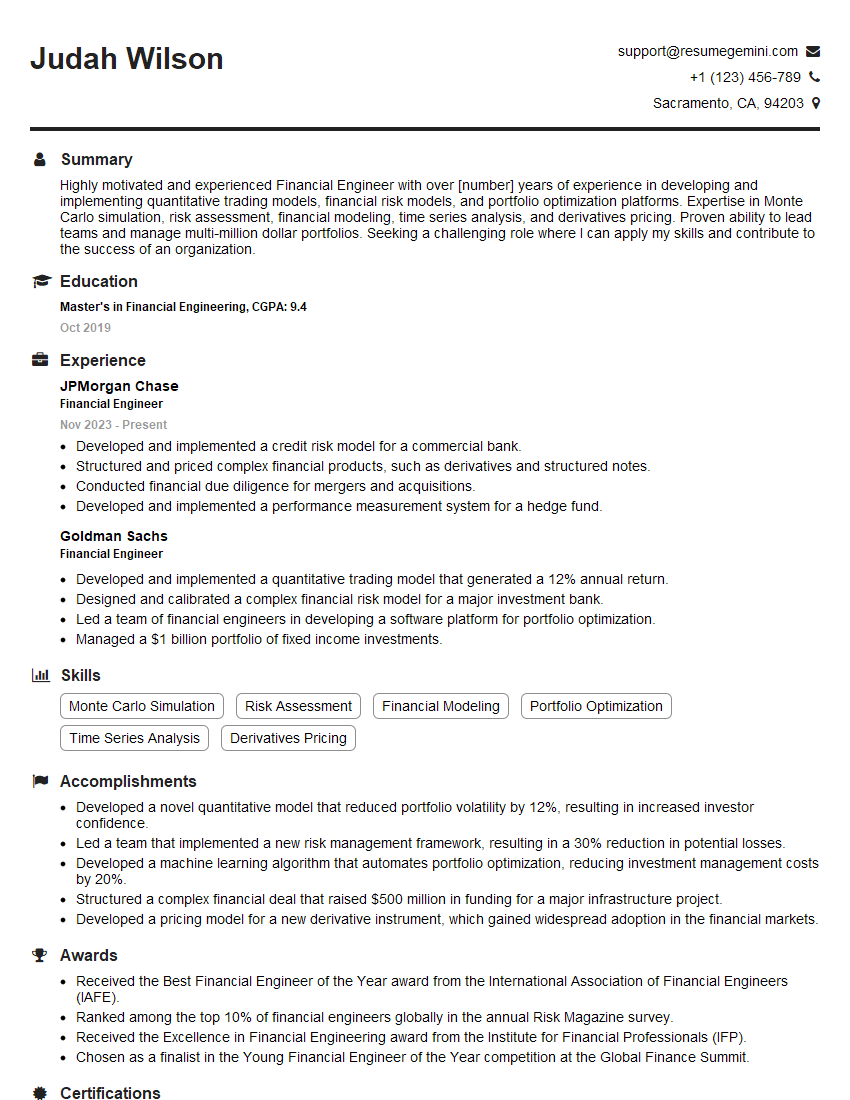
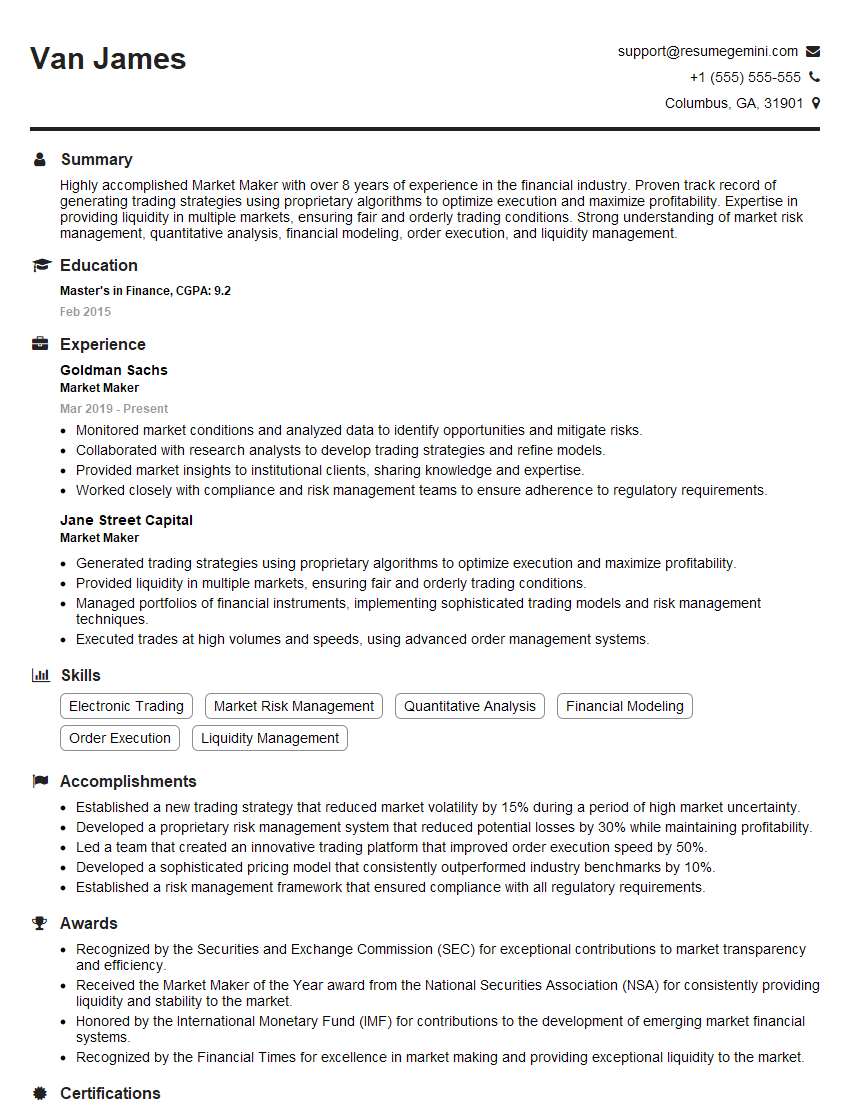
Mastering the intricacies of High-Frequency Trading opens doors to exciting and lucrative career opportunities in the financial technology sector. To significantly enhance your job prospects, creating a compelling and ATS-friendly resume is paramount. ResumeGemini is a trusted resource that can help you build a professional resume that highlights your skills and experience effectively. Examples of resumes tailored to the High-Frequency Trading industry are available to help you get started.
Explore more articles
Users Rating of Our Blogs
Share Your Experience
We value your feedback! Please rate our content and share your thoughts (optional).
What Readers Say About Our Blog
Very informative content, great job.
good