The right preparation can turn an interview into an opportunity to showcase your expertise. This guide to Horseback Riding Techniques interview questions is your ultimate resource, providing key insights and tips to help you ace your responses and stand out as a top candidate.
Questions Asked in Horseback Riding Techniques Interview
Q 1. Describe the different types of bridles and their appropriate uses.
Bridles are the equipment used to control a horse’s head and direct its movement. Different types cater to various disciplines and horse needs. The choice depends on the horse’s comfort, the rider’s skill, and the type of riding being performed.
- Snaffle Bridle: The simplest type, consisting of a snaffle bit and reins. It exerts direct pressure on the horse’s mouth, suitable for beginners and general riding. Think of it as the equivalent of a simple steering wheel in a car.
- Double Bridle: Used in more advanced riding, particularly dressage. It incorporates a snaffle bit and a curb bit, offering more control and leverage. This allows for finer adjustments and more precise movements, much like having both a steering wheel and power steering.
- Hackamore Bridle: A bitless bridle using leverage on the nose and poll (back of the head) to control the horse. It’s often used for horses with sensitive mouths or those being trained without a bit. Consider this a more gentle, indirect steering mechanism.
- Kimberwick Bridle: A combination bit offering a degree of both direct and leverage action. It’s a versatile option providing more control than a snaffle but less than a double bridle. It’s like having a adjustable steering system.
Choosing the right bridle is crucial for both horse comfort and rider effectiveness. A poorly fitting or inappropriate bridle can lead to discomfort, resistance, and even injury.
Q 2. Explain the principles of proper saddle fitting.
Proper saddle fitting is paramount for both horse and rider well-being. An ill-fitting saddle can cause significant discomfort, leading to sores, muscle imbalances, and behavioral issues in the horse. For the rider, an improperly fitting saddle can lead to discomfort, poor posture and even injury.
Key aspects of saddle fitting include:
- Tree Width: The saddle tree must fit the horse’s back width appropriately. Too narrow and it will pinch; too wide and it will sit improperly distributing pressure unevenly. A qualified saddle fitter can use a specialized tool to measure the horse’s back and match it to the saddle’s tree width.
- Gullet Clearance: The gullet (the space under the saddle’s pommel) must provide enough room for the horse’s withers (the ridge at the base of the neck). If the gullet is too narrow, it will put pressure on the withers, causing discomfort.
- Panel Fit: The saddle panels should distribute weight evenly across the horse’s back. Uneven pressure can lead to sores. Proper saddle pads can help even weight distribution.
- Rider Position: The saddle should also be positioned correctly to allow the rider to sit comfortably and have proper balance and support.
Regular saddle checks are essential, particularly after a growth spurt in a young horse, changes in muscle conditioning, or any significant weight changes.
Q 3. What are the key elements of a balanced seat?
A balanced seat is the foundation of good riding. It allows the rider to effectively communicate with the horse, maintain stability, and absorb the horse’s movement without interfering with its natural gait. Think of it as being centered and grounded like a tree firmly planted in the earth, able to weather the wind.
- Upright Posture: Maintain an erect posture with shoulders relaxed and back straight, avoiding slouching or leaning. Imagine a string gently pulling you up from the crown of your head.
- Centered Position: Your weight should be evenly distributed over your seat bones, feeling grounded and stable. Avoid leaning too far forward or backward.
- Independent Seat and Legs: Your seat should move independently of your legs and hands, allowing for subtle adjustments in balance and communication without disrupting the horse’s rhythm. Maintain a light, independent contact with the horse without gripping.
- Relaxed Core: Engage your core muscles for stability and balance. This improves your posture and allows for smoother movements with the horse. This is like maintaining a calm, steady center for all your movements.
- Heel-Down Position: Keep your heels down and your lower legs resting gently against the horse’s sides, providing steady support without clinging.
Developing a balanced seat takes time and practice, but consistent effort pays off in improved riding and better communication with your horse.
Q 4. How would you teach a beginner rider to post the trot?
Teaching a beginner to post the trot involves a gradual progression, focusing on safety and understanding the movement. Posting is a two-beat gait where the rider rises out of the saddle on each upward beat. It is a way to avoid being excessively bounced in the saddle.
- Start at a walk: Begin by ensuring the rider has a secure and balanced seat at the walk. They should feel comfortable and confident before proceeding.
- Introduce the two-beat rhythm: Have the rider feel the horse’s trot rhythm by lightly bouncing their seat at the walk, mimicking the up and down movement of the trot. Counting “one, two, one, two” aloud helps with rhythm.
- Practice rising and sitting: From the walk, have the rider practice rising out of the saddle with the horse’s movement, then sitting back down, creating a rhythmic pattern. Use a simple ‘up-down’ movement to begin with.
- Incorporate the trot: Transition the horse to a trot and have the rider maintain the same up-down movement, only now coordinating it with the horse’s motion. Start slowly in a small arena.
- Refine the posture: The rider should rise from the stirrups while keeping a balanced posture. Their heels should stay down, body upright. It’s not a full stand up-and-down, but more of a controlled rise and fall.
- Focus on timing: The rider should rise as the horse’s hindquarters move forward and sit as the hindquarters move under the body. This is often described as rising with the horse and sitting with the horse.
Remember to praise and encourage positive effort, ensuring a positive and safe learning experience. It is crucial to start slowly and gradually increase the difficulty. Safety should be the foremost consideration.
Q 5. Describe the different gaits of a horse and how to recognize them.
Horses exhibit several distinct gaits, each characterized by its rhythm and footfalls. Recognizing these gaits is crucial for rider safety and effective communication.
- Walk: A four-beat gait, with each foot striking the ground separately. It’s a slow, relaxed gait, ideal for transitions and relaxing the horse. It is easy to distinguish as four separate beats.
- Trot: A two-beat gait, with diagonal pairs of legs moving together. It has a bouncing rhythm, felt more strongly in the saddle without posting, or ‘rising trot’. Imagine a rocking horse.
- Canter/Lope: A three-beat gait, with a period of suspension between strides. The horse’s body moves in a smoother, more flowing motion than the trot. This feels more flowing and suspended compared to the other gaits.
- Gallop: A four-beat gait, but with a different sequence of footfalls than the walk. It’s the horse’s fastest gait, only used occasionally and usually under controlled circumstances. This is the fastest gait and feels more energetic.
Observing the rhythm and sequence of the horse’s footfalls helps distinguish these gaits, which improve understanding and communication between horse and rider.
Q 6. Explain the use of leg aids and rein aids in dressage.
In dressage, leg and rein aids are subtle cues used to guide the horse’s movement and create harmonious, precise performance. They are a form of non-verbal communication that, when used correctly, result in a fluid dance between horse and rider. The skill lies in subtlety and timing.
Leg Aids: These use the rider’s legs and lower legs to influence the horse’s impulsion, direction, and lateral movements. They work by applying pressure to specific areas of the horse’s sides.
- Inside Leg: Controls the horse’s bend and aids in turning.
- Outside Leg: Maintains straightness and aids in controlling the horse’s hindquarters.
- Both Legs: Stimulates forward movement, increasing the horse’s impulsion.
Rein Aids: These utilize the reins to control the horse’s head, neck and direction, influencing its balance and posture.
- Direct Rein: Used for simple turns and direction changes.
- Indirect Rein: Used to guide the horse’s hindquarters while maintaining bend and balance.
- Inside Rein: Guides the horse’s forehand and influences the bend.
- Outside Rein: Maintains straightness and guides the horse’s neck and shoulder.
Effective use of leg and rein aids requires sensitivity, timing, and a good understanding of how these cues impact the horse’s reactions. It is a delicate interplay, requiring practice and experience.
Q 7. How would you handle a horse that is spooking or exhibiting fear?
Handling a spooking or fearful horse requires calm, confident handling and a patient approach. Your reactions directly influence the horse’s behavior. The goal is to reassure the horse, not to punish it for its fear.
- Remain Calm: Your own anxiety will amplify the horse’s fear. Maintain a relaxed posture and a calm voice.
- Assess the Situation: Identify the source of the spook. This may involve observing the horse’s environment for anything unusual, such as noisy objects or unexpected movements.
- Gentle Reassurance: Speak softly to the horse in a soothing tone. Gentle stroking or patting can also help. Avoid sudden movements.
- Controlled Movement: If possible, gently move the horse away from the source of fear, using subtle cues to guide the horse’s movement. Avoid abrupt turns or jerky motions, and maintain a gentle contact with the horse.
- Desensitization: If the source of fear can be safely approached, gradual desensitization can be effective. Expose the horse to the frightening stimulus at a distance, gradually decreasing the distance as the horse’s anxiety reduces. Always maintain a safe distance and never force the horse.
- Professional Help: If the horse’s fear is severe or persistent, or if you are unable to manage the situation safely, seek help from an experienced horse trainer or equine behaviorist. Their expertise can prevent potential injuries to the horse or yourself.
Remember that patience and understanding are key. Building trust and confidence is crucial in helping a fearful horse overcome its anxieties.
Q 8. What are the signs of lameness in a horse?
Identifying lameness in a horse requires careful observation and a keen eye. Lameness is essentially any abnormality in gait or movement, indicating pain or discomfort. It can manifest in many ways, and early detection is crucial for effective treatment.
- Shortened stride: The horse may take noticeably shorter steps on one leg compared to the others.
- Head bobbing: A rhythmic up-and-down movement of the head, often synchronized with the affected leg’s movement. Think of it like the horse trying to counterbalance the pain.
- Limping: A clear limp, where the horse favors one leg and doesn’t put full weight on it. This is a more obvious sign.
- Stance abnormality: The horse may shift its weight to avoid putting pressure on the affected leg, standing with its leg angled differently.
- Changes in gait: Hesitation, stumbling, or stiffness can all indicate lameness.
- Heat and swelling: Palpable heat or swelling in the leg, particularly in the joint area, should be investigated immediately.
For example, a horse with a subtle lameness might only show a slight head bob or a slightly shorter stride, easily missed by an inexperienced observer. A veterinarian should always be consulted if you suspect lameness to determine the underlying cause.
Q 9. Describe the different types of horse shoeing and their applications.
Horseshoeing is a crucial aspect of equine care, protecting hooves from wear and tear and aiding in proper weight distribution. There are several types, each suited to different needs:
- Standard shoeing: The most common type, using a simple horseshoe to protect the hoof. This is suitable for most horses, particularly those used for general riding or light work. It simply provides protection.
- Therapeutic shoeing: Used to address specific hoof problems like laminitis, navicular disease, or other structural issues. These shoes are often custom-made and might incorporate wedges or other modifications to redistribute weight or correct abnormalities. Imagine it as wearing orthopedic shoes for a foot problem.
- Racing plates: Lightweight shoes designed for racing horses to minimize weight and maximize speed. These are very minimalist shoes.
- Egg bar shoes: These have a raised bar in the center, offering support to the heel and frog (the soft part of the hoof) often used to help heal certain foot issues.
- Pads and wedges: These are often used in conjunction with shoes to improve comfort, correct hoof angles, or aid healing. The pad might provide cushioning, while wedges change the angle of the hoof.
The choice of shoeing depends entirely on the horse’s individual needs, its discipline, and the condition of its hooves. A farrier, a skilled craftsman specializing in horseshoeing, will assess these factors to provide the best protection and support for the horse.
Q 10. How do you assess a horse’s temperament and suitability for a rider?
Assessing a horse’s temperament and suitability is vital for safety and enjoyment. This involves a multi-faceted approach.
- Observation: Observe the horse in its environment, noting its behavior, reactions to stimuli (such as sudden noises or other horses), and general demeanor. Is it calm and approachable, or nervous and reactive?
- Handling: Gently approach and handle the horse, assessing its response to touch. Does it back away or become tense, or does it stand calmly and accept the interaction?
- Riding assessment: If possible, observe the horse being ridden, noting its responsiveness to cues and its overall demeanor under saddle. Is it easy to control and willing to cooperate, or difficult and unpredictable?
- Past history: Inquire about the horse’s history and past experiences, including any known behavioral issues or training challenges. A horse’s history can be very revealing.
- Rider skill level: Match the horse’s temperament and experience to the rider’s skill level. A novice rider shouldn’t start with a spirited horse.
For instance, a horse that easily spooks might not be ideal for a beginner, while a highly spirited horse would be inappropriate for a leisure rider wanting a calm experience. A thorough assessment ensures the right horse is matched with the right rider.
Q 11. What are the safety procedures for mounting and dismounting a horse?
Safety is paramount when mounting and dismounting. These procedures minimize the risk of injury to both horse and rider.
- Mounting: Always mount from the horse’s near side (left). Make sure the saddle is secure. Stand facing the horse, place your left foot in the stirrup, and swing your right leg over the horse’s back. Keep a secure grip on the mane or saddle horn while you settle into the saddle.
- Dismounting: Dismount from the horse’s near side. Once again, this consistency is for safety. Bring the horse to a complete stop, remove your foot from the stirrup on the side you are dismounting from and swing your leg over the horse’s back. Keep a firm grip while you dismount, and safely step down, away from the horse.
- Additional Safety Measures: Always have someone hold the horse, especially when mounting and dismounting. Check tack and equipment for security beforehand. Make sure you are wearing appropriate footwear and attire.
Imagine the consequences of an uncontrolled horse while mounting or dismounting – it’s essential to follow these procedures to keep everyone safe. Consistency in these actions, and clear communication with the horse and potential handler, are key elements to safety.
Q 12. Explain the proper procedures for caring for tack and equipment.
Proper tack and equipment care extends the life of your gear and ensures its functionality. Neglect can lead to equipment failure and safety risks.
- Cleaning: After each use, clean tack with a damp cloth and appropriate leather cleaner. Remove any dirt, mud, or sweat. For synthetic materials, use a gentle soap and water.
- Drying: Allow leather tack to air dry completely before storing. Avoid direct sunlight or heat, which can damage the leather. Synthetic materials can be air dried or gently wiped.
- Conditioning: Regularly condition leather tack to maintain its suppleness and prevent cracking. Use a high-quality leather conditioner.
- Storage: Store tack in a cool, dry place away from direct sunlight and moisture. Use appropriate tack storage to prevent damage and maintain shape.
- Regular Inspection: Check tack for wear and tear before each use. Replace any worn or damaged components.
Think of your tack as an extension of your body. Neglecting maintenance increases your risk of an accident. Proper care ensures both your safety and the longevity of your equipment.
Q 13. How would you handle a horse refusing a jump?
A refusal at a jump can stem from various factors: fear, lack of confidence, poor technique, or physical limitations. Handling the situation requires patience and understanding.
- Assess the Cause: Try to determine why the horse refused. Was it the height, the distance, or something else? Did something spook the horse?
- Re-approach Carefully: Don’t force the horse. Gently encourage it to walk towards the jump, allowing it to approach at its own pace. Use your voice to reassure it.
- Adjust Technique: If the refusal is due to poor technique, adjust your approach and riding style. Work on getting the horse to the correct distance and with the appropriate momentum. For instance, a horse might refuse if the rider is too far back in the saddle.
- Seek Professional Help: If the refusals persist, seek help from a qualified instructor or trainer. They can assess the situation and provide guidance.
- Desensitization: For fear-based refusals, desensitization exercises can help build the horse’s confidence over time.
Forcing a jump can be dangerous, potentially leading to injury for both horse and rider. Patience and understanding are key to overcoming this challenge and developing a trusting partnership.
Q 14. Describe the principles of correct posture and balance while riding.
Correct posture and balance are fundamental for effective riding and safety. They allow for clear communication with the horse and prevent rider interference.
- Posture: Maintain an upright posture with a relaxed but engaged core. Keep your shoulders relaxed and down, avoiding hunching. Your heels should be down, and your weight should be balanced over the horse.
- Balance: A balanced position means your weight is evenly distributed across your seat bones, avoiding leaning too far forward or backward. Use your core muscles to maintain balance and absorb the horse’s movement. Imagine that you are sitting firmly in the center of your saddle.
- Independent Seat: Maintain a flexible, independent seat – this means being able to move independently of the horse’s movement. It’s not rigid, but rather soft and yielding.
- Following the Motion: Allow your body to follow the natural rhythm of the horse’s movement. Avoid bracing or fighting against the horse’s motion.
Incorrect posture and balance not only affect your riding performance but also compromise the horse’s ability to move effectively and comfortably. A balanced and centered rider is a key component to harmonious and effective riding.
Q 15. What are the different types of bits and how do they affect the horse?
Bits are the metal pieces in a horse’s mouth that a rider uses to communicate direction and control. Different bits exert pressure in various ways, affecting the horse’s response. Choosing the right bit is crucial for both comfort and effectiveness.
- Snaffle Bits: These are the most common type for beginners. They have a simple, direct action, placing pressure on the corners of the horse’s mouth. A loose-ring snaffle is gentler than a full cheek snaffle, which offers more leverage. Think of it like using a simple steering wheel versus one with power steering.
- Curb Bits: These bits use leverage to amplify the rider’s cues. They have a shanks (long arms) that extend beyond the horse’s mouth, creating more pressure when used with the reins. They require a more experienced rider to use effectively. It’s like comparing a simple bicycle brake to a powerful disc brake – more control, but requiring greater skill.
- Pelham Bits: Combining elements of snaffles and curb bits, these offer versatility. They can act as a snaffle or use leverage depending on the rein handling. It’s a bit of a hybrid, giving the rider options depending on the horse’s response.
- Kimberwick Bits: Similar to a pelham but with a different design offering even more control. These require very experienced riders
The wrong bit can cause discomfort and pain, leading to resistance and behavioral problems. A well-fitted and appropriate bit, used with sensitive hands, is essential for clear communication and a positive riding experience. For example, using a curb bit on a young, inexperienced horse could be detrimental, while a snaffle bit might be inadequate for a strong, experienced horse.
Career Expert Tips:
- Ace those interviews! Prepare effectively by reviewing the Top 50 Most Common Interview Questions on ResumeGemini.
- Navigate your job search with confidence! Explore a wide range of Career Tips on ResumeGemini. Learn about common challenges and recommendations to overcome them.
- Craft the perfect resume! Master the Art of Resume Writing with ResumeGemini’s guide. Showcase your unique qualifications and achievements effectively.
- Don’t miss out on holiday savings! Build your dream resume with ResumeGemini’s ATS optimized templates.
Q 16. How do you identify and address common rider faults?
Identifying rider faults requires careful observation and understanding of biomechanics. Common faults often stem from a lack of balance, improper posture, or ineffective communication with the horse.
- Poor Posture: Rounded shoulders, slouched back, or leaning too far forward or backward disrupt balance and hinder effective aids. Imagine trying to steer a car while slumped over – it’s difficult and unsafe!
- Inconsistent Aids: Jerky rein movements, uneven leg pressure, or unclear signals confuse the horse. Think of it like giving unclear directions – the horse won’t know what to do.
- Excessive Use of Aids: Over-reliance on aids can make a horse tense and resistant. This is like yelling instructions instead of calmly guiding someone.
- Lack of Balance: This can lead to the rider shifting their weight incorrectly, causing discomfort for the horse and interfering with their movement.
Addressing these faults involves targeted exercises focused on improving posture, balance, and effective use of aids. I utilize positive reinforcement, breaking down complex movements into smaller, manageable steps. For instance, to correct leaning, I might have the rider perform exercises focusing on core strength and maintaining an upright posture while mounted on a stationary horse or barrel.
Q 17. Explain the importance of regular horse health checks.
Regular health checks are paramount to a horse’s well-being and performance. Ignoring potential problems can lead to serious health issues and impact the horse’s ability to work comfortably.
These checks should include:
- Daily Observation: Checking for changes in behavior, appetite, coat condition, and manure. A simple observation can sometimes reveal subtle signs of illness.
- Regular Dental Care: Improper dental health can affect eating and overall health. A veterinarian should check and address dental issues regularly.
- Routine Farrier Visits: Regular hoof trimming and shoeing prevent lameness and ensures sound movement. A farrier is a qualified hoof professional.
- Vaccinations and Deworming: Protecting against common diseases and parasites is vital for overall health.
- Veterinary Examinations: Annual check-ups by a veterinarian allow early detection of any health concerns.
Failing to adhere to a regular health plan may result in expensive treatments and compromised welfare for the horse. It’s far better to proactively prevent and address issues, like an annual service for your car, rather than to deal with a major breakdown down the line.
Q 18. What are your methods for teaching different riding disciplines?
My teaching methods adapt to the specific discipline and the rider’s skill level, but they always prioritize safety, clear communication, and positive reinforcement.
- English Disciplines (Dressage, Jumping, Eventing): I start with basic posture and balance exercises before progressing to more advanced techniques. For example, in dressage, I focus on developing correct posture and independent seat before introducing lateral movements.
- Western Disciplines (Reining, Cutting, Trail Riding): I emphasize effective communication with the horse using weight, seat, and rein aids, while also working on control and responsiveness. For example, in reining, I start with basic maneuvers like circles and turns before progressing to more advanced spins and sliding stops.
I use a combination of practical instruction, demonstrations, and video analysis to provide personalized feedback. I also emphasize the importance of understanding equine biomechanics and psychology to build a strong partnership between horse and rider. A consistent learning structure combined with consistent feedback is key to student improvement.
Q 19. How would you manage a group lesson with riders of varying skill levels?
Managing a group lesson with varying skill levels requires careful planning and organization. Safety is always the top priority.
My approach involves:
- Grouping Riders: Separating riders into smaller groups based on skill and experience allows for more focused instruction and attention. For instance, beginners might learn basic handling, while more advanced riders work on more advanced exercises.
- Individualized Instruction: While providing group instruction, I make sure to address each rider’s individual needs and provide specific feedback and corrections. This may involve providing different exercises for different skill sets simultaneously.
- Progressive Learning: I structure lessons to build upon previously learned skills, ensuring everyone progresses at their own pace. This will help beginners to steadily build skills while still keeping intermediate or advanced riders engaged and challenged.
- Clear Communication: Giving clear, concise instructions and providing regular feedback ensures that everyone understands the goals and expectations of the lesson.
Maintaining a positive and supportive learning environment is crucial to ensure everyone feels comfortable and confident. By keeping all students in mind and creating a supportive environment, overall learning is improved.
Q 20. What is your approach to addressing difficult or challenging horses?
Addressing challenging horses requires patience, understanding, and a systematic approach focusing on identifying the root cause of the behavior.
My strategy involves:
- Professional Assessment: Consulting with a veterinarian and equine behaviorist to rule out underlying medical or psychological issues is often the first step.
- Behavioral Analysis: Carefully observing the horse’s behavior to identify triggers and patterns can help to pinpoint underlying issues.
- Positive Reinforcement: Rewarding desired behaviors is far more effective than punishment. It builds trust and encourages cooperation.
- Consistency and Patience: It takes time and consistency to change a horse’s behavior. Patience and understanding are key to a successful outcome.
- Desensitization and Counter-Conditioning: Gradually exposing the horse to feared stimuli while pairing it with positive experiences can help to overcome anxieties or fears.
I emphasize a humane approach prioritizing the horse’s well-being. It is never acceptable to use harsh or coercive methods. Working collaboratively with the horse, slowly overcoming issues is far more productive than punishment based training.
Q 21. How do you promote safety in a riding environment?
Safety is paramount in any riding environment. My approach to promoting safety involves a multi-faceted strategy.
- Proper Equipment: Ensuring riders wear appropriate safety gear, including helmets, boots, and gloves, is essential. A well-maintained riding arena is also part of safety.
- Safe Handling Procedures: Implementing clear protocols for mounting, dismounting, and handling horses minimizes risks.
- Risk Assessment: Identifying potential hazards and implementing mitigation strategies is crucial. This includes regular inspection of tack and the arena itself.
- Rider Education: Thoroughly educating riders on safety procedures and emergency protocols is paramount. Understanding the risks can help mitigate some of them.
- Supervision: Providing adequate supervision, especially for beginners and younger riders, helps to prevent accidents.
- Emergency Plan: Having a well-defined emergency plan in place, including access to first aid and veterinary services is critical.
Safety is not just a matter of rules; it’s a culture. By fostering a safety-conscious environment where everyone takes responsibility for their own actions and the well-being of others, we minimize risks and ensure a positive riding experience for all.
Q 22. Describe your experience with horse first aid and emergency procedures.
Horse first aid and emergency procedures are crucial for the safety and well-being of the horse. My experience encompasses a wide range of situations, from minor injuries like cuts and abrasions to more serious emergencies such as colic, lameness, and respiratory distress. I’m certified in equine first aid and have attended numerous continuing education courses to stay updated on the latest techniques and protocols.
My approach is always to prioritize the horse’s safety and comfort. This involves a calm and systematic assessment of the situation, focusing on the ABCs – Airway, Breathing, Circulation. For example, if a horse is exhibiting signs of colic (severe abdominal pain), my immediate actions would include contacting a veterinarian, keeping the horse quiet and warm, and monitoring vital signs. I’m proficient in techniques like applying bandages, administering oral medications (under veterinary guidance), and recognizing signs that require immediate veterinary intervention. I also know how to handle various types of wounds, including cleaning, disinfecting, and applying appropriate dressings.
Experience has taught me the importance of acting quickly and decisively while remaining calm and focused. Knowing when to call for veterinary assistance is paramount. I’ve worked alongside experienced equine veterinarians in multiple emergency scenarios and have a strong understanding of the limitations of first aid and the need for professional medical care.
Q 23. What are your strategies for building trust and rapport with horses?
Building trust and rapport with horses is fundamental to safe and effective horsemanship. It’s a process built on understanding their body language, respecting their boundaries, and consistently demonstrating kindness and patience.
- Observation: I begin by carefully observing the horse’s behavior, noting any signs of anxiety or nervousness. This helps me to understand their individual personality and temperament.
- Gentle Handling: I approach slowly and calmly, speaking in a soothing voice. I allow the horse to sniff my hand before making any physical contact. I avoid sudden movements or loud noises.
- Positive Reinforcement: I utilize positive reinforcement techniques like rewarding calm behavior with gentle petting and verbal praise. This creates a positive association with human interaction.
- Groundwork Exercises: I use groundwork exercises such as leading, grooming, and desensitization to build a strong connection and trust. This helps the horse to understand my expectations and respond accordingly.
- Consistency: Consistency is key. Maintaining a predictable and reliable approach helps the horse feel safe and secure.
For example, I had a particularly nervous mare who was initially afraid of human touch. By spending time with her in the paddock, simply being present without pressure, and offering treats from my open palm, I gradually built her trust. It took weeks, but eventually she sought out my attention and allowed me to groom and handle her without fear.
Q 24. Explain the different types of riding helmets and their safety features.
Riding helmets are vital for rider safety, protecting against head injuries in the event of a fall. Several types exist, each with specific safety features:
- Standard Riding Helmets: These are the most common type, offering basic protection. They typically feature a hard outer shell, an impact-absorbing liner, and adjustable straps for a secure fit. Look for helmets certified to ASTM/SEI standards.
- Grade Helmets: These are designed for cross-country eventing and other disciplines involving jumps, often incorporating a stronger shell and more robust padding for greater protection during falls.
- Specialized Helmets: Some helmets are designed for specific disciplines such as western riding or driving, incorporating features that meet the needs of each unique riding style. Many now offer features like improved ventilation systems, which is very important.
Key safety features to look for include: a snug fit (no excessive movement), proper strap adjustment (preventing the helmet from sliding during a fall), and appropriate certification (meeting safety standards like ASTM/SEI or similar). The helmet should be replaced after any significant impact, even if no visible damage is apparent. A damaged helmet will not offer the same level of protection.
Q 25. How would you handle a horse exhibiting aggressive behavior?
Handling a horse exhibiting aggressive behavior requires a calm, assertive, and knowledgeable approach. Safety is paramount. Never approach an aggressive horse alone. The first step is identifying the cause of the aggression – is it fear, pain, dominance issues, or something else? Understanding the root cause is critical for effective intervention.
My strategy involves:
- Maintaining Distance: Avoid getting too close or making sudden movements that could escalate the situation.
- Calm Demeanor: Maintain a calm and assertive demeanor; avoid showing fear or nervousness.
- Clear Communication: Use clear, assertive body language and verbal cues.
- Seeking Assistance: Call for assistance from experienced handlers or professionals, if necessary.
- Professional Help: If the aggressive behavior is persistent or severe, it’s crucial to consult with a veterinarian or equine behaviorist to determine the underlying cause and implement a tailored behavior modification plan.
For example, a stallion displaying aggressive mounting behavior might require training focusing on redirecting his energy and establishing a clear dominance hierarchy. A horse reacting aggressively due to pain would require veterinary assessment and treatment before behavioral interventions are attempted. Safety measures like using appropriate barriers and protective equipment may be needed until the root cause is addressed.
Q 26. Describe your experience with teaching different age groups.
I have extensive experience teaching horseback riding to diverse age groups, from young children to adults. My approach is tailored to the specific developmental stage and learning capabilities of each group.
- Children (Ages 4-8): Lessons focus on building foundational skills such as balance, coordination, and horsemanship etiquette. The lessons are fun, engaging, and use games and activities to keep them interested.
- Youth (Ages 9-17): Lessons progress to more advanced skills, including riding gaits, basic dressage, and jumping techniques. The emphasis is on developing a strong understanding of horsemanship and equestrian sport.
- Adults: Lessons are customized to meet individual goals and experience levels. Adults might be learning to ride for the first time, improving their skills in a particular discipline, or addressing specific riding challenges. Lessons are tailored to adult learning styles.
In all cases, safety is always the top priority. Students are taught proper mounting and dismounting procedures, fall safety techniques, and basic horse care procedures.
Q 27. How do you adapt your teaching style to meet the needs of individual riders?
Adapting my teaching style to individual riders is crucial for effective learning. Every rider has unique strengths, weaknesses, and learning styles. I use a variety of methods to cater to these individual needs. This includes:
- Assessment: I begin by assessing each rider’s skill level, experience, physical abilities, and learning style through observation and conversation.
- Goal Setting: We work together to set realistic and achievable goals. These goals are reviewed and adjusted regularly to ensure progress and motivation.
- Personalized Feedback: I provide constructive and encouraging feedback tailored to each rider’s specific needs and progress.
- Differentiated Instruction: I adjust the pace, content, and complexity of the lesson to match each rider’s abilities and learning style. This might involve focusing on specific skills or using different teaching methods.
- Positive Reinforcement: I consistently use positive reinforcement to encourage progress and build confidence.
For instance, one student might excel at balance and coordination but struggle with steering, while another might be comfortable with the basic gaits but fear jumping. I adapt my instruction accordingly, focusing on strengthening weaknesses while building on existing strengths. The goal is to foster a positive and supportive learning environment where each rider feels challenged and empowered to achieve their goals.
Key Topics to Learn for Horseback Riding Techniques Interview
- Seat and Posture: Understanding the importance of correct posture for balance, effective communication with the horse, and preventing rider fatigue. Practical application includes demonstrating proper posture and explaining its impact on the horse’s movement.
- Aids and Communication: Mastering the use of reins, legs, seat, and weight to effectively communicate desired movements to the horse. This includes understanding the nuances of different aids and how to combine them for clear communication. Problem-solving involves identifying and correcting communication breakdowns between rider and horse.
- Gaits and Transitions: Understanding the different gaits (walk, trot, canter, gallop) and the techniques for smooth and controlled transitions between them. Practical application focuses on demonstrating correct execution and identifying common errors in transitions.
- Safety Procedures: Knowing and implementing safe riding practices, including mounting and dismounting, handling horses safely, and emergency procedures. This includes understanding horse behavior and recognizing potential hazards.
- Horse Care and Management: Basic understanding of horse care, including grooming, tacking up, and recognizing signs of illness or injury. This demonstrates responsibility and commitment to equine welfare.
- Specific Disciplines (if applicable): Depending on the specific job, you might need deeper knowledge in a particular discipline like dressage, jumping, western riding, etc. Research the specific requirements of the job description.
- Troubleshooting and Problem Solving: Be prepared to discuss how you would address common riding challenges, such as a horse resisting a transition or exhibiting unwanted behavior. Highlight your ability to adapt your techniques based on the horse’s individual needs.
Next Steps
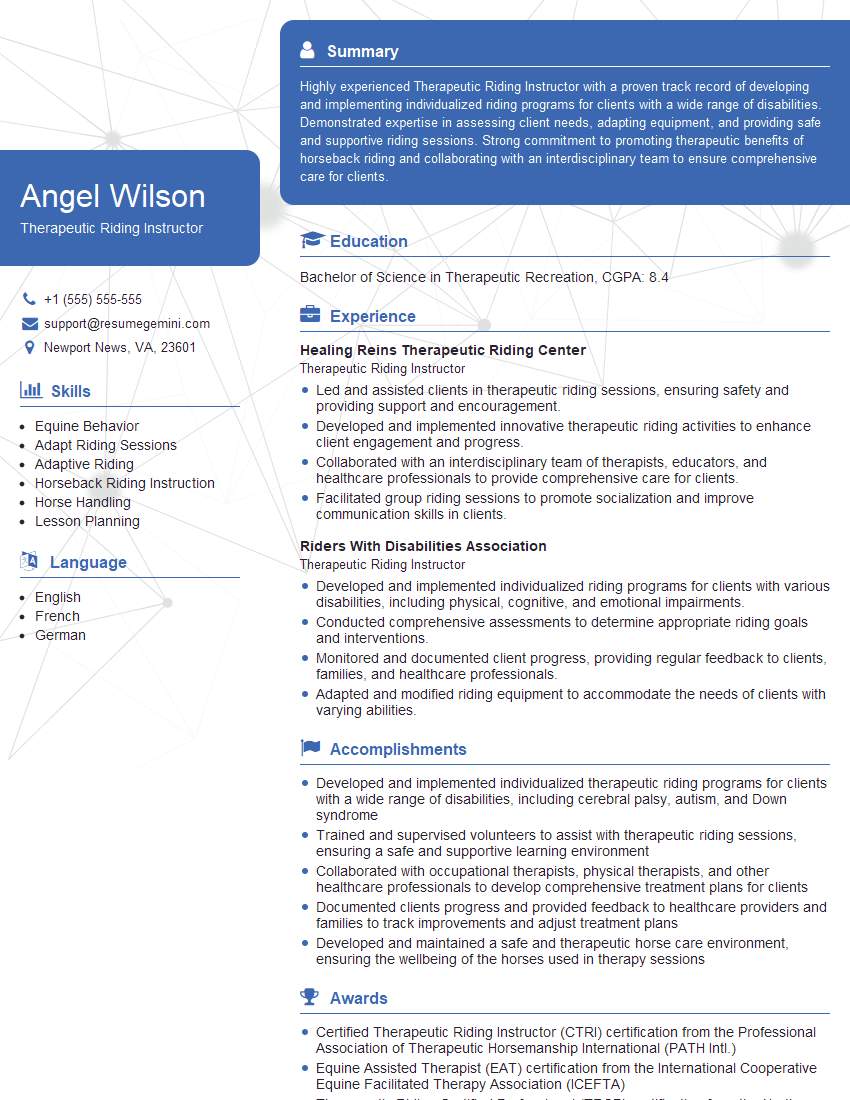
Mastering horseback riding techniques is crucial for career advancement in the equestrian field, opening doors to more challenging and rewarding opportunities. A strong resume is your key to unlocking these possibilities. Creating an ATS-friendly resume ensures your application gets noticed by recruiters. To build a professional and effective resume that highlights your skills and experience, we recommend using ResumeGemini. ResumeGemini provides a streamlined process and offers examples of resumes tailored to Horseback Riding Techniques, ensuring your application stands out.
Explore more articles
Users Rating of Our Blogs
Share Your Experience
We value your feedback! Please rate our content and share your thoughts (optional).
What Readers Say About Our Blog
Very informative content, great job.
good