Unlock your full potential by mastering the most common Hymn Tune Improvisation interview questions. This blog offers a deep dive into the critical topics, ensuring you’re not only prepared to answer but to excel. With these insights, you’ll approach your interview with clarity and confidence.
Questions Asked in Hymn Tune Improvisation Interview
Q 1. Explain the difference between modal improvisation and tonal improvisation within the context of hymn tunes.
The core difference between modal and tonal improvisation on hymn tunes lies in how we approach harmony. Tonal improvisation centers around a specific key, using its major or minor scales and chords to create a sense of harmonic direction and resolution. Think of it like staying on a well-defined path. We’re grounded in a home base (tonic chord) and our improvisations naturally gravitate towards it. Modal improvisation, on the other hand, explores the inherent modes (like Dorian, Phrygian, Lydian, etc.) within a given hymn tune’s key. This allows for a wider range of colors and feels, stepping away from the rigid major/minor structure. It’s like venturing off the main path into a beautiful meadow with diverse plants – each mode offering a distinct harmonic landscape.
For example, if a hymn is in C major, tonal improvisation would stick to C major chords and scale. Modal improvisation might borrow chords and notes from the parallel minor (C minor) or even explore the D Dorian mode (which shares many notes with C major but has a different character).
Q 2. Describe your process for improvising a postlude based on a given hymn tune.
My process for improvising a postlude starts with careful listening! I analyze the hymn tune’s melody, harmony, and overall mood. I identify the key and look for characteristic melodic phrases or rhythmic patterns that can be developed. Then, I choose a harmonic framework – this could be a simple progression based on the hymn’s tonic, dominant, and subdominant chords, or a more adventurous progression drawing on modal interchange.
Next, I start by creating a brief thematic statement based on the hymn tune, maybe a variation on the opening phrase. From there, I develop this theme, adding ornamentation, countermelodies, and rhythmic variations. I might introduce a contrasting section, perhaps a quieter passage based on the hymn’s subdominant, followed by a return to the opening theme for a satisfying resolution. I always keep the original hymn tune’s character in mind, aiming to enhance its beauty rather than obscure it. Think of it as a conversation with the hymn; my improvisation is a response to its inherent message and emotional weight.
Q 3. How would you adapt a hymn tune for a contemporary worship setting while maintaining its integrity?
Adapting a hymn tune for contemporary worship while preserving its integrity requires a delicate balance. I might begin by changing the instrumentation. A traditionally organ-based hymn might become vibrant with a contemporary drumbeat, bassline, and electric guitars. However, I would maintain the core harmonic structure of the hymn and ensure the melody remains recognizable. Another technique is to harmonize the melody differently, perhaps using voicings that are more common in contemporary music genres.
For example, you could take a hymn with a simple four-part harmony and reharmonize it using seventh chords, add passing chords, or introduce syncopation to create a contemporary feel. It’s also possible to subtly alter the rhythm, perhaps by adding syncopation or creating a more driving feel. The key is to find a fresh perspective without sacrificing the emotional core of the hymn.
Q 4. Discuss the role of rhythmic variation in hymn tune improvisation.
Rhythmic variation is crucial for adding interest and dynamism to hymn tune improvisation. A simple hymn tune, played repeatedly in the same rhythm, can become monotonous. By introducing rhythmic variations, we can create a sense of movement and excitement. This can include techniques like syncopation (placing accents on unexpected beats), using different note values (e.g., changing from quarter notes to eighth notes), or adding rhythmic figures that complement or contrast with the main melody.
Think of it like dancing: a simple waltz can become more engaging with subtle changes in pace and rhythm. Similarly, a hymn tune’s rhythm can be transformed using simple rhythmic embellishments. A simple example is adding eighth-note triplets to a passage originally written with quarter notes, adding a sense of swing and flow.
Q 5. How do you handle unexpected harmonic changes or modulations while improvising?
Unexpected harmonic changes or modulations require adaptability and a good understanding of music theory. My approach involves listening carefully to the changing chords and quickly identifying the new key or mode. I might use passing chords or pivot chords to smoothly transition between the different harmonic areas. A good understanding of chord substitutions and modal interchange is invaluable here. I might also use a short melodic figure or rhythmic motif to bridge the gap between the two sections, acting as a musical signpost.
If a modulation takes the improvisation to a remote key, it may be best to return to a related key before concluding, for a better sense of resolution. The goal is always to maintain musical coherence and avoid jarring transitions; think of navigating a mountain range; well-planned transitions keep the flow going.
Q 6. What are some common harmonic progressions used in hymn tune improvisation?
Common harmonic progressions in hymn tune improvisation often revolve around the tonic, subdominant, and dominant chords (I, IV, V). These form a solid foundation and provide natural points of resolution. Beyond this basic framework, you can add color and interest using secondary dominants (V/V, V/vi etc.), passing chords, and modal interchange.
For example, a simple progression might be I-IV-V-I, but we can make it more complex by introducing a secondary dominant (vi-IV-V7-I, for instance). Other progressions might involve borrowing chords from parallel or relative keys, adding unexpected harmonic twists, and always aiming for a balance of stability and surprise.
Q 7. Explain the concept of ‘voice leading’ in the context of hymn tune improvisation.
Voice leading refers to how the individual melodic lines (voices) move within a harmony. Smooth voice leading is crucial for creating a pleasing and coherent sound. In hymn tune improvisation, it means ensuring that the melodic lines move stepwise or in small leaps, avoiding large jumps that can sound awkward or dissonant. This is particularly important when adding countermelodies or inner voices to the hymn tune. Good voice leading prevents clashes between voices and enhances the overall smoothness and clarity of the improvisation.
Imagine a choir singing: if the voices don’t move together smoothly, the performance becomes chaotic. The same principle applies to improvisation – smooth voice leading avoids sudden jumps and jarring transitions. Careful planning and understanding of basic voice-leading rules ensures the entire composition sounds melodic and harmonious.
Q 8. How do you incorporate counterpoint in your improvisations?
Counterpoint is the art of combining two or more independent melodic lines simultaneously. In hymn tune improvisation, it adds depth and richness. I often begin by establishing a solid, hymn-like melody in the main voice (usually the soprano or top line on the organ). Then, I carefully construct a countermelody in a lower voice (alto, tenor, or bass), ensuring it complements the main melody rhythmically and harmonically, but remains independent and interesting. This might involve using contrary motion (melodies moving in opposite directions), similar motion (melodies moving in the same direction), or oblique motion (one voice remains on the same note while the other moves).
For example, if the hymn tune is in a major key, I might use a countermelody that borrows notes from the parallel minor key, creating a sense of harmonic tension and release. The key is to maintain a balance – the countermelody should enhance, not overwhelm, the main melody. Think of it like a conversation: two distinct voices engaging in a musical dialogue. Experienced improvisers can even incorporate multiple countermelodies, creating rich textures.
I often employ techniques like imitation, where a melodic phrase from the main melody is echoed in the countermelody, perhaps slightly altered or inverted. This creates a sense of unity and coherence within the overall texture.
Q 9. Describe your approach to improvising a prelude based on a given hymn tune.
Improvising a prelude on a given hymn tune starts with careful analysis of the tune itself. I consider its melodic contours, harmonic structure, and rhythmic character. My approach involves several stages. First, I extract the essential melodic and harmonic ideas from the tune, focusing on the key phrases and cadences. Then, I create a harmonic framework for my improvisation, perhaps using a sequence of chords derived from the hymn tune’s harmony, or exploring related keys.
Next, I begin to develop melodic ideas based on these harmonies, possibly using motifs or fragments of the hymn tune itself. I may introduce variations or embellishments on the main theme, or explore related melodic ideas. I might start with a slow, reflective introduction, gradually building in intensity and complexity until I naturally arrive at the statement of the hymn tune itself. The prelude’s conclusion usually involves a gentle winding down, returning to the harmonic simplicity of the opening.
For instance, if the hymn tune is in C major, I might start with a prelude in C minor, gradually modulating towards C major, using passing chords and sequences to create a journey towards the hymn’s key. This allows for a surprising and satisfying transition to the hymn tune itself.
Q 10. How do you select appropriate registration for your improvisation on the organ?
Registration, the selection of stops on an organ, is crucial for shaping the sound and character of a hymn tune improvisation. My choices depend on several factors: the style of the hymn tune, the liturgical context, and the desired mood. A majestic hymn might call for a full, rich registration, perhaps using the 8’ and 16’ stops in the Principal family along with reeds to add brilliance and power.
Conversely, a more introspective hymn might benefit from a softer, more intimate registration. I might select a flute stop or a softer reed, using only the middle and higher manuals. I often use a combination of stops—for example, a string stop for a more lyrical effect, or a flute stop for a gentle, ethereal sound. Furthermore, I might change the registration throughout the improvisation to reflect shifts in dynamics and mood, mimicking how a symphony orchestra might use different instrument combinations to express different emotions.
Consider a hymn tune with a joyful, celebratory character. A registration featuring bright stops like the Trumpet and Clarinet stops, possibly alongside flutes, could amplify that feeling of joy and festivity. Registration is a dynamic tool, mirroring the emotions expressed within the musical improvisation itself.
Q 11. What are some common stylistic approaches to hymn tune improvisation?
Several stylistic approaches to hymn tune improvisation exist. A common approach is the free style, where the improviser takes considerable liberties with the original tune, freely exploring different harmonic and melodic ideas. In contrast, a strict style improvisation would adhere more closely to the original tune’s melody and harmony, focusing on variation and embellishment rather than radical departures.
Imitative counterpoint is a technique frequently used; the improviser creates a new line that imitates melodic fragments from the hymn tune, often in different voices or at different rhythmic values. Fugal improvisations start with a single theme and then develop it through imitative counterpoint in different voices, eventually combining multiple themes. Finally, chorale-prelude style improvisations might explore the hymn tune’s harmony in detail, using chord progressions and countermelodies to create variations on the harmonic framework of the hymn tune.
The chosen style reflects the liturgical context and desired artistic effect. A more contemporary service might warrant a freer approach, while a traditional service might call for a more conservative style that respects the hymn tune’s inherent dignity and character.
Q 12. How do you balance creativity with reverence when improvising in a liturgical setting?
Balancing creativity and reverence in a liturgical setting is paramount. While improvisation allows for personal expression, it must always serve the worship context. My approach involves careful consideration of the hymn’s theological message and the overall atmosphere of the service. I choose a style of improvisation that complements, rather than detracts from, the worship experience.
This means avoiding overly showy or virtuosic displays that might overshadow the congregational singing or distract from prayer. I prefer to prioritize musical integrity and thoughtful articulation over mere technical brilliance. Simple, heartfelt phrasing, carefully chosen harmonies, and a reverent tempo will often be more effective in conveying reverence than flashy technique.
One could imagine improvising a reflective prelude for a penitential service, using quiet, introspective harmonies and a subdued registration. This would contrast sharply with a jubilant improvisation using bright, celebratory harmonies for a festive occasion. The key is to let the liturgical context dictate the musical character of the improvisation.
Q 13. Explain your understanding of ornamentation in hymn tune improvisation.
Ornamentation in hymn tune improvisation involves adding embellishments to the original melody to enhance its expressive qualities. This can include trills, mordents, turns, appoggiaturas, and passing tones. The goal is not mere decoration, but to shape phrases, highlight key notes, or create expressive nuances. Ornamentation should always be used judiciously, enhancing the underlying melody rather than obscuring it.
For example, a trill on a held note can add vibrancy, while a mordent can create a subtle emphasis on a particular pitch. An appoggiatura adds a passing note before the main note, creating a sense of anticipation. However, too much ornamentation can become cluttered and distracting. The key is to use ornamentation sparingly and strategically, creating a sense of elegance and refinement, reflecting the emotional content of the music.
Effective ornamentation requires a deep understanding of musical phrasing and the expressive capabilities of different embellishments. The goal is to let the ornamentation enhance the melody’s inherent beauty, rather than overshadowing it.
Q 14. Discuss your familiarity with various hymn tune meters and how they influence your improvisation.
Hymn tune meters significantly influence my improvisations. The meter dictates the rhythmic framework, influencing melodic phrasing and harmonic structures. Common meters like 8.7.8.7D (Long Meter) or 7.6.7.6D (Short Meter) suggest specific rhythmic patterns. Understanding these patterns is vital for creating improvisations that feel natural and coherent.
A Long Meter hymn (8.7.8.7D) offers more space for melodic elaboration, potentially incorporating longer phrases and richer harmonic structures. A Short Meter hymn (7.6.7.6D) tends to favor shorter, more concise phrases. The rhythmic character of the meter directly impacts phrasing, rhythmic choices, and the overall feel of the improvisation. A faster meter might call for a more lively and energetic improvisation, while a slower meter might invite a more reflective and contemplative style.
For instance, an improvisation on a hymn in 8.7.8.7D meter might involve longer melodic lines and more elaborate harmonic progressions, reflecting the grandeur inherent in this meter. Conversely, a hymn tune in 7.6.7.6D would likely inspire a more concise and rhythmically focused improvisation. The meter serves as a foundational element influencing all aspects of the improvised performance.
Q 15. How do you ensure your improvisation complements and enhances the hymn’s message?
Ensuring my improvisation complements a hymn’s message involves a deep understanding of both the musical structure and the theological content. I begin by carefully listening to the hymn’s melody and harmony, identifying its emotional core. Is it a hymn of praise, lament, hope, or reflection? This emotional core guides my improvisation.
For example, if the hymn is a joyful hymn of praise like ‘Joyful, Joyful, We Adore Thee,’ my improvisation would likely be bright, major-key, and use a celebratory rhythmic style. Conversely, a hymn of lament, such as ‘O Sacred Head, Now Wounded,’ would inspire a slower tempo, a minor key or modal harmony, and a more introspective melodic line. I also pay attention to the text; key phrases or repeated words can be musically echoed or developed in my improvisation to reinforce the lyrical message.
Ultimately, the goal is not to overshadow the hymn but to enrich it, adding layers of musical expression that resonate with the spiritual message.
Career Expert Tips:
- Ace those interviews! Prepare effectively by reviewing the Top 50 Most Common Interview Questions on ResumeGemini.
- Navigate your job search with confidence! Explore a wide range of Career Tips on ResumeGemini. Learn about common challenges and recommendations to overcome them.
- Craft the perfect resume! Master the Art of Resume Writing with ResumeGemini’s guide. Showcase your unique qualifications and achievements effectively.
- Don’t miss out on holiday savings! Build your dream resume with ResumeGemini’s ATS optimized templates.
Q 16. Describe a time you had to adapt your improvisation based on the congregation’s response.
During a recent service, I was improvising a postlude on ‘Amazing Grace.’ I started with a fairly intricate, embellished variation of the melody, full of ornamentation. However, I noticed that the congregation seemed to be somewhat subdued, even a little restless. Their response was subtle, a slight shift in body language, a lack of the usual quiet attentiveness.
I realized my improvisation, while technically proficient, was perhaps too complex and didn’t leave enough space for the hymn’s inherent beauty to shine through. I immediately adjusted my approach. I simplified the melodic lines, slowed the tempo slightly, and focused on creating a more contemplative atmosphere. I emphasized the harmonic progressions, letting the hymn’s inherent strength and grace speak through a more restrained and supportive improvisation. The shift in my playing was met with a palpable sense of calm and reflection from the congregation; it was a clear indication that my adaptation was successful.
Q 17. How do you incorporate elements of call and response in your improvisations?
Call and response is a powerful technique in hymn tune improvisation, allowing for a natural dialogue between the pre-composed hymn and the improvised material. It can be incorporated in several ways.
- Motivic Development: A short melodic phrase from the hymn can be used as a ‘call,’ which I then respond to with a contrasting but related phrase. This could involve harmonic variation, rhythmic changes, or melodic sequence.
- Harmonic Exchange: The hymn’s harmony can act as a ‘call,’ setting up a harmonic expectation that my improvisation responds to. I might create a contrasting harmony, leading back to the original harmony of the hymn.
- Dynamic Interaction: A quiet section of the hymn could act as a ‘call’ leading to a more powerful, dramatic response in the improvisation, or vice versa.
For instance, in a hymn with a strong, repeated phrase, I might play that phrase (the ‘call’) and then respond with a variation using a different voicing or texture on the organ.
Q 18. What strategies do you use to maintain musical interest over an extended improvisation?
Maintaining musical interest during an extended improvisation requires careful planning and execution. Several strategies are crucial:
- Varied Textures: Shifting between different registrations (on an organ), or voicing (on a piano), keeps the sound from becoming monotonous. I might go from a full, rich sound to a more delicate one, or alternate between homophonic and polyphonic textures.
- Harmonic Exploration: Moving beyond the basic harmony of the hymn, exploring related keys or modes, can add depth and intrigue. Careful modulation back to the tonic key creates a satisfying sense of resolution.
- Melodic Development: Introducing new melodic ideas that are related to the hymn’s melody, perhaps using sequences or variations, keeps the improvisation fresh. Avoid repeating the same melodic figures over and over.
- Rhythmic Variation: Alternating between different rhythmic patterns, shifting from steady pulse to rubato (flexible tempo), keeps the feel dynamic and engaging.
- Dynamic Shaping: Careful use of dynamics, creating crescendos and diminuendos, adds drama and expression to the improvisation.
Think of it like telling a story: you need variety in the narrative to keep the listener engaged.
Q 19. How do you choose appropriate dynamics and articulation for your improvisation?
Choosing appropriate dynamics and articulation is vital for conveying the emotion and meaning of the hymn within the improvisation. I often begin by considering the overall mood of the hymn and then apply dynamics and articulation accordingly.
A hymn of praise might call for a broader dynamic range, with strong accents and bold articulation to express joyous energy. In contrast, a hymn of reflection might benefit from softer dynamics, legato articulation, and a more subdued approach to emphasize introspection. The text itself also influences these choices; certain phrases might require a more forceful articulation, while others need a gentler touch. For example, a crescendo leading to a powerful climax on a key line of text can enhance the message.
It’s also important to ensure a balance between expressiveness and clarity. The improvisation should enhance, not obscure, the original hymn’s beauty.
Q 20. Explain your familiarity with different hymn tune traditions (e.g., Anglican, Lutheran, etc.)
My familiarity with various hymn tune traditions is extensive. I have studied the distinctive characteristics of Anglican, Lutheran, Genevan, and other traditions, understanding their unique harmonic languages, melodic styles, and rhythmic approaches.
Anglican hymnody often features elaborate counterpoint and rich harmonies, reflecting the liturgical context. Lutheran hymns frequently utilize chorale melodies, characterized by strong, memorable tunes and simple, yet profound harmonies. Genevan Psalm tunes are often simpler, yet incredibly effective in conveying their message. Understanding these differences enables me to tailor my improvisations to the specific style and context of the hymn being used, honoring its historical and theological roots. This avoids stylistic clashes and helps maintain the integrity of the original hymn.
Q 21. Describe your experience with improvising using different instruments (organ, piano, etc.)
I’m proficient in improvising on both the organ and the piano, recognizing that each instrument presents unique possibilities and challenges. The organ’s vast range of tonal colors and registration possibilities allows for a greater degree of textural variety in my improvisations. I can easily shift between different stops to create contrasting moods and build sonic landscapes.
The piano, on the other hand, encourages a different kind of approach. Its more intimate sound encourages a focus on melodic and harmonic details. My improvisations on piano are often characterized by a more delicate touch and a greater emphasis on clear articulation and voicing.
In either case, my approach remains consistent: I seek to complement and enhance the hymn’s message through thoughtful melodic development, harmonic exploration, and careful consideration of the overall emotional arc.
Q 22. How do you incorporate the melodic contour of the hymn tune into your improvisation?
Incorporating the melodic contour of a hymn tune into improvisation is crucial for maintaining its inherent character. Think of the contour as the tune’s ‘skeleton’ – its overall shape and direction. It’s the foundation upon which I build my improvisations. I begin by carefully analyzing the tune’s melodic range, identifying its high and low points, its leaps and stepwise motions. This gives me a framework to work within. For example, if a tune has a predominantly stepwise ascending phrase followed by a large descending leap, I’ll try to mirror that pattern in my improvisation, perhaps using smaller leaps and more stepwise motion in my own variations. I might emphasize the peaks and valleys of the original melody by adding embellishments around those points, creating a sense of dramatic arc that echoes the original.
Let’s take ‘Amazing Grace’ as an example. Its opening phrase has a gentle, stepwise ascent. My improvisation might retain this gentle ascent but add passing tones or appoggiaturas to embellish the melody, while still respecting the general upward motion. Conversely, a dramatic descent in the original could inspire a similar descent in my improvisation, perhaps using more chromaticism or syncopation to add interest.
Q 23. What are some common pitfalls to avoid when improvising hymn tunes?
Several common pitfalls can detract from a successful hymn tune improvisation. One is straying too far from the harmonic structure of the hymn. Improvising outside the key or using dissonances that clash jarringly with the hymn’s harmony can create a chaotic and disjointed feel. Another is ignoring the rhythmic character of the hymn. If the hymn is stately and flowing, a frenetic improvisation will sound out of place. Conversely, a slow, ponderous improvisation on a lively hymn will feel dull.
Another major pitfall is neglecting the overall phrasing and articulation of the original tune. Improvisation should enhance, not contradict, the natural phrasing and breathing of the hymn. Finally, excessive ornamentation can obscure the hymn’s beauty. Less is often more. Instead of overwhelming the listener with notes, focus on carefully chosen embellishments that enhance the melodic line.
Q 24. Describe your method for practicing and preparing for improvisational performances.
My preparation for improvising hymn tunes involves a multi-faceted approach. Firstly, I thoroughly learn the hymn tune, analyzing its melodic, harmonic, and rhythmic structure. I’ll play through it slowly, identifying key phrases, cadences, and harmonic changes. I then begin experimenting with simple variations, adding passing tones, neighbor tones, or simple ornamentation to different phrases. This helps me become intimately familiar with the tune’s possibilities.
Next, I explore different harmonic possibilities within the hymn’s key. I might try adding seventh chords, suspensions, or passing chords to enrich the harmonic texture. I also practice rhythmic variations, experimenting with different note values and syncopations while maintaining the overall feel of the hymn. I’ll record myself improvising and critically listen back to identify areas for improvement. This process involves a great deal of mindful listening, seeking to develop both my technical proficiency and the musicality of my improvisations.
Q 25. How do you use melodic and harmonic motives to develop your improvisations?
Melodic and harmonic motives are essential tools for developing improvisations. A motive is a short, memorable melodic or harmonic fragment that can be repeated, varied, and developed throughout an improvisation. I often extract motives from the hymn tune itself, using them as building blocks for my improvisation. For example, a distinctive rhythmic figure or a short melodic sequence can serve as a motive. I might then transform this motive by changing its rhythm, its contour, or its harmony.
Imagine a hymn with a repeated melodic phrase. I might use that phrase as a motive, playing it in a different octave, with different rhythms, or in a slightly altered melodic form. I could also develop the harmonic implications of that phrase, building a longer passage based on its underlying harmonies. The interplay between developing these melodic and harmonic motives provides a sense of unity and coherence within the improvisation, preventing it from becoming a random collection of notes.
Q 26. How do you balance improvisation with maintaining the structural integrity of the hymn tune?
Balancing improvisation with the structural integrity of the hymn tune requires a delicate touch. The improvisation shouldn’t overshadow the hymn but rather enhance it. I achieve this balance by focusing on building my improvisations around the harmonic and rhythmic structure of the tune. I might use the hymn’s phrases as a framework, creating variations within each phrase that maintain the overall shape and flow.
Think of it like building a house: the hymn tune is the architectural plan. My improvisation is the interior design. I can be creative and add my own flair, but I must always respect the overall structure of the house. Too much deviation can lead to a structurally unsound and ultimately unpleasing result. I always listen back to my improvised work to ensure the structural integrity is preserved and the original hymn tune remains recognizable and honored.
Q 27. Explain the role of texture in hymn tune improvisation.
Texture plays a vital role in creating a rich and engaging improvisation. A simple hymn tune might have a single melodic line with a plain accompaniment. Improvisation allows us to expand on this texture. I might add countermelodies, creating a polyphonic texture that adds interest and depth. I could introduce harmonies using chords, arpeggios, or other textural devices. I might also use rhythmic variations to create different textural layers.
For instance, a simple homophonic hymn tune (one melody with accompaniment) can be transformed into a richer texture by introducing a countermelody that complements or contrasts with the original melody. This allows for a more complex and nuanced musical experience without disrupting the underlying harmony of the hymn. Careful consideration of texture, therefore, is key to a successful and enriching improvisation.
Q 28. How do you assess the success of your improvisation in a liturgical context?
Assessing the success of a hymn tune improvisation in a liturgical context requires a multifaceted approach. Firstly, did the improvisation enhance the worship experience? Did it contribute to the overall atmosphere of reverence and devotion? Secondly, was the improvisation musically effective? Did it complement the hymn tune without overshadowing it? Did it maintain the integrity of the hymn’s structure and spirit? Finally, did the improvisation connect with the congregation? Did it seem to resonate with them emotionally and spiritually?
I often seek feedback from fellow musicians and members of the congregation. Their perspectives can provide valuable insights into the effectiveness of my improvisation. It’s also helpful to reflect on my own performance, identifying areas for improvement. Ultimately, the success of a liturgical improvisation is judged not solely on musical merit, but on its ability to enhance the spiritual atmosphere of the service and connect with the hearts and minds of the worshippers.
Key Topics to Learn for Hymn Tune Improvisation Interview
- Harmonic Understanding: Mastering chord progressions common in hymn tunes, including their function and relationships. Practical application: Demonstrate your ability to build improvisations based on different harmonic frameworks.
- Melodic Contour and Phraseology: Understanding how melodies are shaped within the context of hymn tunes. Practical application: Compose short improvisations that demonstrate a clear melodic direction and phrasing appropriate to the hymn style.
- Rhythmic Variation and Ornamentation: Exploring rhythmic possibilities within the framework of the hymn tune. Practical application: Show your ability to add rhythmic interest without disrupting the overall feel of the tune.
- Voice Leading and Part Writing (if applicable): Understanding how individual voices interact harmonically within a hymn tune improvisation (particularly relevant for multi-part improvisations). Practical application: Demonstrate skillful voice leading and smooth transitions between chords.
- Improvisational Techniques: Exploring various approaches to improvisation, such as modal interchange, sequential patterns, and call and response. Practical application: Demonstrate flexibility and creativity in your improvisational approach.
- Stylistic Awareness: Understanding the historical and stylistic contexts of hymn tunes, and how to apply this knowledge to your improvisations. Practical application: Show your ability to adapt your improvisational style to different hymn tune styles.
- Aural Skills: Developing strong aural skills to quickly analyze and respond to harmonic and melodic cues. Practical application: Demonstrate the ability to immediately create a fitting improvisation based on a given hymn tune fragment.
Next Steps
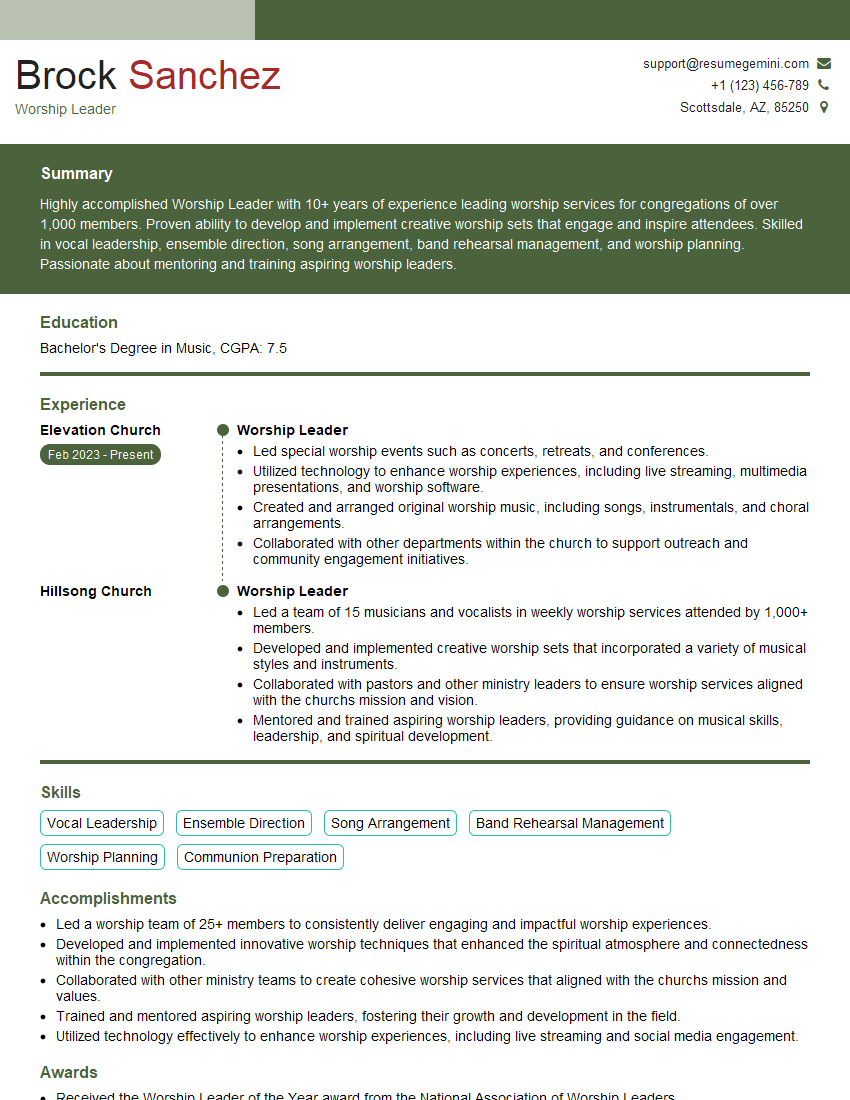
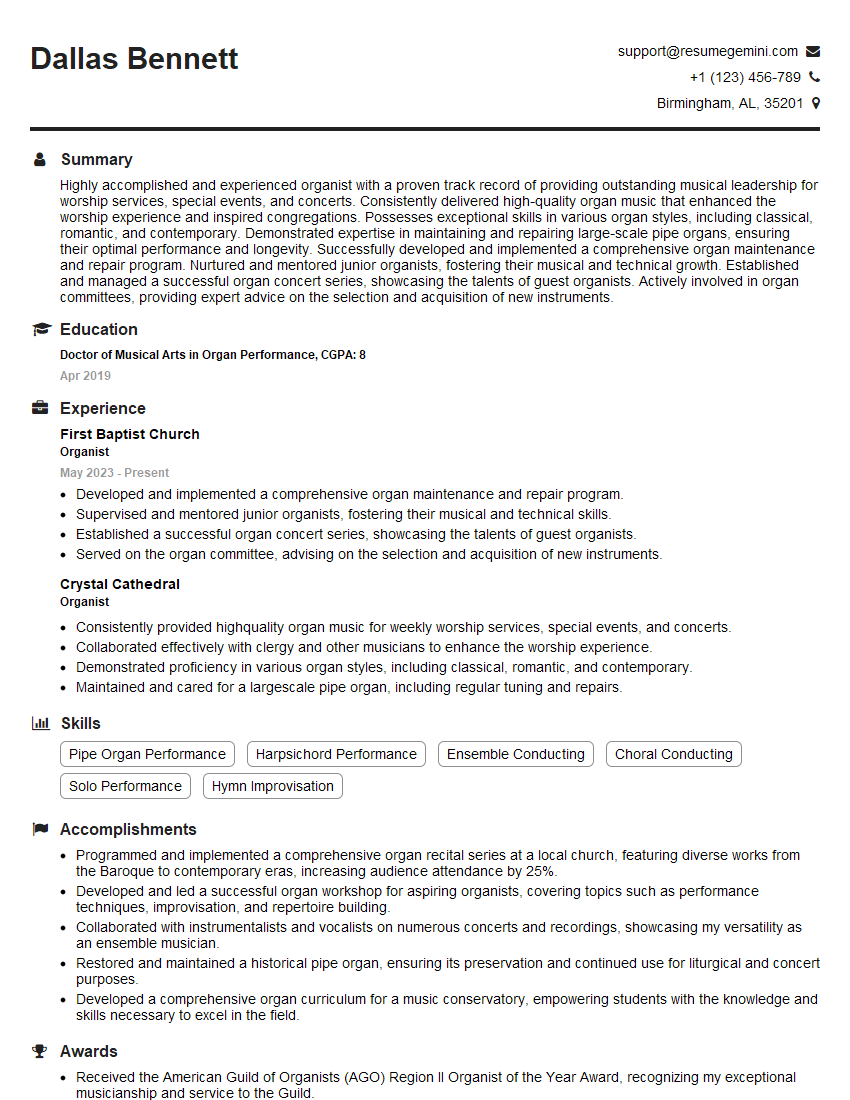
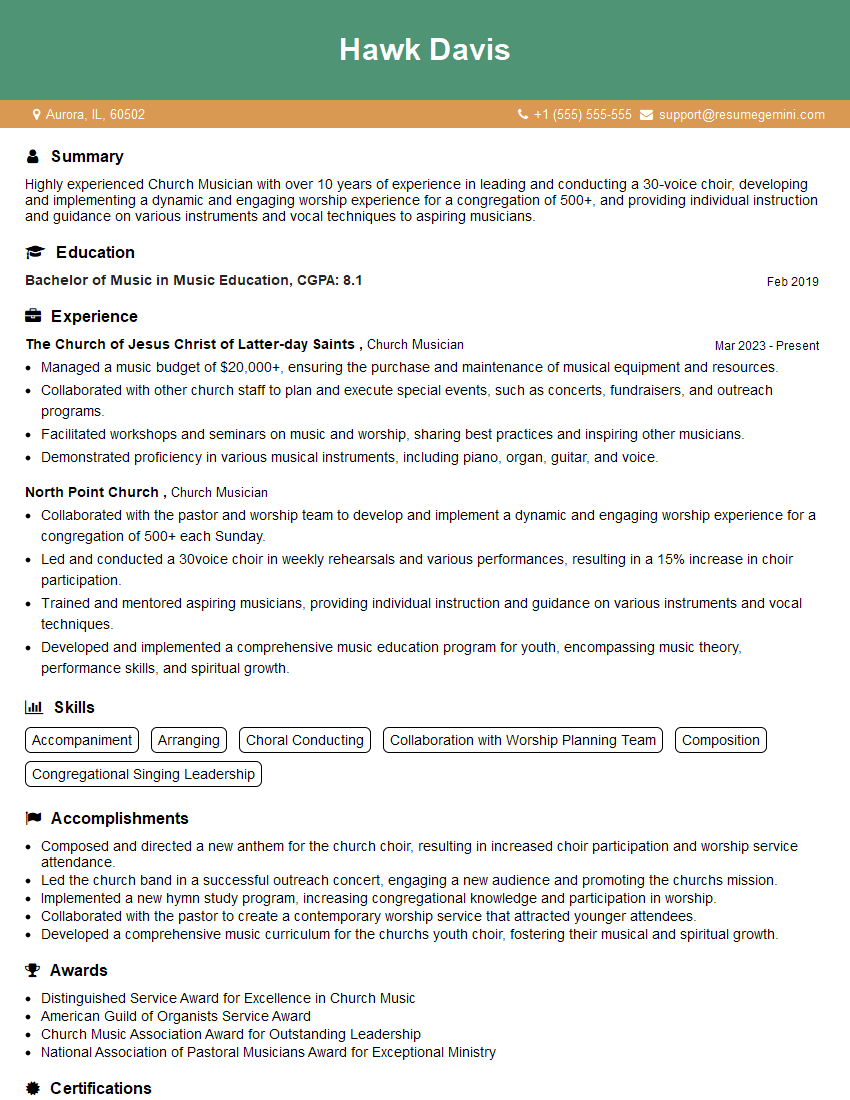
Mastering Hymn Tune Improvisation significantly enhances your musical capabilities and opens doors to diverse career opportunities, from church music positions to collaborative projects with other musicians. To maximize your chances of landing your dream role, crafting an ATS-friendly resume is crucial. ResumeGemini is a trusted resource to help you build a professional and impactful resume that highlights your skills and experience. Examples of resumes tailored specifically to Hymn Tune Improvisation are available to guide you through this process.
Explore more articles
Users Rating of Our Blogs
Share Your Experience
We value your feedback! Please rate our content and share your thoughts (optional).
What Readers Say About Our Blog
Very informative content, great job.
good