Interviews are opportunities to demonstrate your expertise, and this guide is here to help you shine. Explore the essential Routing Techniques interview questions that employers frequently ask, paired with strategies for crafting responses that set you apart from the competition.
Questions Asked in Routing Techniques Interview
Q 1. Explain the difference between static and dynamic routing.
Static routing and dynamic routing are two fundamental approaches to network routing. The key difference lies in how routing tables are populated and updated.
Static Routing: In static routing, network administrators manually configure the routing table on each router. This means explicitly defining each route, specifying the destination network and the next-hop router to reach it. Think of it like meticulously planning a road trip, writing down each turn and highway exit yourself. It’s simple for small networks, but becomes incredibly complex and time-consuming as the network grows.
Dynamic Routing: Dynamic routing automatically learns and updates routing information through the exchange of routing protocols between routers. Instead of manual configuration, routers share network topology information, allowing them to build and maintain their routing tables independently. This is like using a GPS navigation system; it automatically calculates the best route and updates the route if necessary due to traffic or road closures. It’s far more scalable and efficient than static routing for larger networks.
- Advantages of Static Routing: Simple to implement in small networks, predictable routing behavior, increased security (as routes aren’t exchanged openly).
- Disadvantages of Static Routing: Not scalable, requires significant manual configuration, limited adaptability to network changes.
- Advantages of Dynamic Routing: Scalable, self-configuring, adapts to network changes automatically, reduces administrative overhead.
- Disadvantages of Dynamic Routing: Can be more complex to configure and troubleshoot, potential for routing loops (though protocols have mechanisms to mitigate this), potential security vulnerabilities if not properly secured.
Q 2. Describe the operation of RIP (Routing Information Protocol). What are its limitations?
RIP, or Routing Information Protocol, is a distance-vector routing protocol. It operates by periodically exchanging routing information with neighboring routers. Each router shares its distance to known networks, and routers use this information to build their routing tables.
Imagine a group of friends sharing information about the shortest paths to different locations. Each person tells their friends how far they are from each location, and everyone uses this information to update their own knowledge of the shortest paths.
Operation:
- Routers exchange routing updates every 30 seconds using a hop count as the metric (distance).
- The hop count represents the number of routers a packet needs to traverse to reach a destination. A maximum hop count (typically 15) limits the network size.
- RIP uses a distance-vector algorithm, meaning each router only knows the distances to networks from its immediate neighbors, not the entire network topology.
Limitations:
- Limited Network Size: The maximum hop count of 15 severely restricts the network size.
- Slow Convergence: It takes time for the network to converge to a stable state after a topology change, potentially leading to routing loops and network instability.
- No support for VLSM (Variable Length Subnet Masking): Makes efficient IP address utilization difficult.
- Uses a broadcast mechanism, increasing overhead
Q 3. Explain the concept of OSPF (Open Shortest Path First) and its advantages over RIP.
OSPF, or Open Shortest Path First, is a link-state routing protocol that uses Dijkstra’s algorithm to calculate the shortest path to all known networks. Unlike RIP’s distance-vector approach, OSPF allows each router to have a complete picture of the network topology.
Think of OSPF as a sophisticated mapping service. Each router creates a map of the entire network, including all connected links and their costs. This map is then used to compute the best routes to all destinations.
Advantages over RIP:
- Scalability: Handles much larger networks than RIP.
- Faster Convergence: Converges much more quickly after topology changes, reducing network instability.
- Support for VLSM: Allows for efficient IP address allocation.
- Hierarchical Design: Through the use of areas, it can be designed to manage large complex networks in a modular fashion.
- Robustness: Has better mechanisms to detect and resolve routing loops.
- Support for Authentication: Offers better security features to prevent unauthorized configuration changes.
Q 4. What are OSPF areas and why are they used?
OSPF areas are sub-divisions of an OSPF autonomous system. They are used to break down a large, complex network into smaller, more manageable parts. This hierarchical design improves scalability and reduces the computational load on individual routers.
Imagine a large city divided into smaller neighborhoods. Each neighborhood has its own internal roads and connections, but there are also main roads connecting the neighborhoods to each other. OSPF areas function similarly; each area manages routing within its boundaries, while inter-area routing handles communication between areas.
Why use areas?
- Scalability: Reduces the amount of routing information each router needs to process.
- Reduced Convergence Time: Faster convergence after topology changes within an area, as the impact is localized.
- Security: Areas allow for better control and security by limiting the propagation of routing information.
- Administrative Simplicity: Easier to manage and configure large networks by segmenting them.
The most common area types are: Backbone area (Area 0), Transit areas and Stub areas. The backbone area connects all other areas in the autonomous system.
Q 5. How does OSPF handle route summarization?
OSPF uses route summarization to reduce the amount of routing information exchanged between areas. Instead of advertising each individual network within an area, OSPF summarizes multiple networks into a single, more concise route.
Imagine you’re giving directions to a visitor. Instead of listing every single street they need to turn on, you’d likely provide summary instructions like ‘take highway X to the city center’. Route summarization works similarly; it aggregates multiple smaller routes into a single, higher-level route.
Route summarization is achieved through the use of summary-range statements in the OSPF configuration. These statements specify the range of IP addresses that should be summarized into a single route. This significantly reduces the amount of routing information exchanged, improving scalability and efficiency.
There are several methods to achieve route summarization in OSPF. One of the key methods relies on understanding the network address and subnet mask of the range of networks needing summarization. The summary route is then created based on this information, advertised between areas, and used by routers to route traffic accordingly.
Q 6. Explain the concept of BGP (Border Gateway Protocol) and its role in the internet.
BGP, or Border Gateway Protocol, is a path-vector routing protocol used to exchange routing information between autonomous systems (ASes) on the internet. It’s the glue that holds the internet together, enabling different networks to connect and communicate with each other.
Imagine BGP as the global air traffic control system for the internet. Each airline (autonomous system) uses BGP to share flight plans (routing information) with other airlines, ensuring that planes (data packets) can reach their destinations efficiently and reliably.
Role in the Internet:
- Inter-AS Routing: BGP enables communication between different autonomous systems, forming the backbone of the internet.
- Policy-Based Routing: Allows network administrators to define routing policies, controlling which paths traffic can take. This is crucial for managing network traffic and security.
- Scalability: Designed to scale to the massive size of the internet, handling millions of routes.
Q 7. What are AS numbers and how do they relate to BGP?
AS numbers are unique identifiers assigned to autonomous systems. They are essentially the unique ‘postal codes’ for networks on the internet. Each AS is a network or a collection of networks under a single administrative domain.
Relationship to BGP: BGP uses AS numbers to identify and exchange routing information between different ASes. Routers use AS numbers to determine the path a packet should take to traverse different autonomous systems to reach its destination. In a BGP routing update message, the AS path, showing which ASes a route passes through, is fundamental to the BGP routing process.
Think of it like this: When you mail a letter, the address includes a zip code, which helps the postal service route the letter efficiently. AS numbers serve a similar purpose in internet routing, helping BGP direct traffic across the internet.
Q 8. Describe the different BGP attributes and their importance.
BGP attributes are like little tags attached to routing information, telling the network how to handle it. They influence how a BGP speaker selects the best path to a destination. Some key attributes include:
- AS_PATH: A list of Autonomous Systems (ASes) a route has traversed. It prevents routing loops – if an AS appears twice, the route is rejected. Think of it like a passport stamp showing the route’s journey.
- NEXT_HOP: The IP address of the next router towards the destination. It’s the address of the neighbor to send the traffic to.
- MED (Multi-Exit Discriminator): Used by BGP speakers within the same AS to influence route selection among different paths to the same destination. Lower MED values are preferred. Imagine it as a priority system within a single company’s network.
- LOCAL_PREF: Used within an AS to influence path selection; higher values are preferred. Think of this as an internal ranking system within the same AS.
- WEIGHT: A configurable attribute used to influence path selection among equal cost routes, usually between directly connected neighbors. Higher weight is preferred.
- COMMUNITY: Allows network administrators to group routes based on certain characteristics, for example, routes that should be filtered or treated differently. They are like labels to specify a group for particular treatment.
Understanding these attributes is crucial for effective BGP configuration and troubleshooting. For example, misconfiguring the AS_PATH can lead to routing loops, and incorrect MED values can disrupt traffic flow.
Q 9. Explain how BGP handles route selection.
BGP uses a hierarchical approach for route selection. It’s like a competition where the best route wins. Here’s a simplified breakdown:
- Local Preference: Routes with higher Local Preference are preferred within an autonomous system (AS).
- AS Path Length: Shorter AS paths are preferred; this prevents routing loops.
- Origin: Routes originating from the network itself (IGP) are generally preferred.
- Multi-Exit Discriminator (MED): Within the same AS, routes with lower MED values are preferred.
- Weight: Used to select between equal cost paths to directly connected neighbors; higher weight is preferred.
- Next Hop: The IP address of the next router on the path. BGP selects the route with the best next hop based on factors mentioned above.
- Tie-breaker: If all other factors are equal, BGP selects the route based on the router ID of the neighbor advertising the route (highest router ID is preferred).
BGP’s complex selection process ensures that networks efficiently and reliably route traffic to its intended destination.
Q 10. What is path vector routing?
Path vector routing is a dynamic routing protocol, like BGP, that shares complete routing information with its neighbors. Unlike distance-vector routing (like RIP), which only shares the distance to a destination, path-vector routing shares the entire path to reach a destination. This entire path is represented as a vector, hence the name.
This complete path information is essential because it allows the routers to make better informed decisions about route selection, reducing the chance of routing loops. Imagine it as receiving directions: instead of just hearing the distance to your destination, you get a full map of the route.
BGP is the most prominent example of a path-vector routing protocol.
Q 11. Compare and contrast OSPF and BGP.
OSPF (Open Shortest Path First) and BGP (Border Gateway Protocol) are both routing protocols, but they operate at different levels and have distinct characteristics.
| Feature | OSPF | BGP |
|---|---|---|
| Scope | Interior Gateway Protocol (IGP); operates within a single autonomous system. | Exterior Gateway Protocol (EGP); operates between autonomous systems. |
| Routing Algorithm | Link-state; calculates the shortest path to all destinations based on cost. | Path-vector; exchanges complete path information with neighbors. |
| Metric | Cost (typically bandwidth). | AS path length, Local Preference, MED, etc. |
| Scalability | Generally scales well within a single AS, but can become challenging in very large networks. | Designed for scalability across multiple ASes. |
| Convergence Time | Relatively fast convergence. | Convergence time can be slower depending on network size and configuration. |
| Administrative Overhead | Requires less configuration for smaller networks. | More complex to configure and manage, especially in large networks. |
In essence, OSPF is ideal for routing within a single organization’s network, while BGP is crucial for internet routing connecting different organizations and networks.
Q 12. Explain the concept of EIGRP (Enhanced Interior Gateway Routing Protocol).
EIGRP (Enhanced Interior Gateway Routing Protocol) is a Cisco proprietary advanced distance-vector routing protocol. Unlike traditional distance-vector protocols, EIGRP utilizes a hybrid approach combining distance-vector and link-state features, offering both fast convergence and scalability.
It uses the Diffusing Update Algorithm (DUAL) to quickly detect and respond to topology changes, providing rapid convergence. It also employs a sophisticated neighbor discovery mechanism and supports unequal-cost load balancing. Imagine it as a highly efficient delivery system that quickly adjusts its routes based on traffic and road conditions.
Key features include: fast convergence, load balancing, support for VLSM (Variable Length Subnet Masking), and relatively easy configuration.
Q 13. What are the advantages of EIGRP over OSPF?
EIGRP offers several advantages over OSPF, particularly in specific scenarios:
- Faster Convergence: EIGRP’s DUAL algorithm generally provides faster convergence compared to OSPF, especially in large networks with frequent topology changes.
- Bounded Update: EIGRP updates only the information that is necessary. This leads to less routing overhead compared to OSPF.
- Support for Unequal Cost Load Balancing (UCLP): EIGRP allows traffic to be distributed across multiple paths with unequal costs, improving bandwidth utilization. OSPF does not support this natively.
- Cisco Proprietary: Being a Cisco protocol, it often integrates seamlessly with other Cisco networking products, making management and monitoring more straightforward in a Cisco environment.
However, OSPF is an open standard, leading to greater vendor interoperability. The choice between EIGRP and OSPF depends on specific network requirements and the vendor ecosystem in place.
Q 14. How does EIGRP handle unequal cost paths?
EIGRP handles unequal cost paths through Unequal Cost Load Balancing (UCLP). It allows traffic to be distributed across multiple paths with varying costs, but only up to a certain limit. The maximum number of paths allowed is determined by the variance of the costs. It’s like having multiple roads leading to the same destination; some roads might be faster than others, and EIGRP will distribute traffic across them based on their respective speeds, up to a certain threshold.
For example, if the best path has a cost of 10, EIGRP might allow paths with costs up to 10 * (K-factor), where K-factor is typically set to 1 (though configurable). Paths with costs exceeding this limit will not be considered for load balancing. This ensures network stability and prevents sending excessive traffic over significantly slower paths.
Q 15. Explain the concept of route redistribution.
Route redistribution is the process of sharing routing information learned from one routing protocol with another. Imagine you have multiple maps (routing protocols) showing different roads (networks). Route redistribution allows you to combine information from these maps into a single, comprehensive view, so your navigation system (router) can find the best route regardless of which map it originally learned the route from. This is crucial in large networks using multiple routing protocols for different parts of the network.
For example, a network might use OSPF (Open Shortest Path First) for its internal routing and BGP (Border Gateway Protocol) for external routing to the internet. Route redistribution allows the OSPF domain to advertise its routes into the BGP domain and vice-versa, enabling seamless connectivity across the entire network.
Career Expert Tips:
- Ace those interviews! Prepare effectively by reviewing the Top 50 Most Common Interview Questions on ResumeGemini.
- Navigate your job search with confidence! Explore a wide range of Career Tips on ResumeGemini. Learn about common challenges and recommendations to overcome them.
- Craft the perfect resume! Master the Art of Resume Writing with ResumeGemini’s guide. Showcase your unique qualifications and achievements effectively.
- Don’t miss out on holiday savings! Build your dream resume with ResumeGemini’s ATS optimized templates.
Q 16. What are the challenges associated with route redistribution?
Route redistribution presents several challenges:
- Administrative Distance Conflicts: Each routing protocol has an administrative distance (AD), representing its trustworthiness. When redistributing, conflicts can arise if routes from different protocols have the same destination but different ADs. The router must choose which route to prefer.
- Routing Loops: Redistributing routes without careful consideration can lead to routing loops, where packets endlessly circulate between routers without reaching the destination.
- Route Summarization and Filtering: Redistributing all routes from one protocol to another can overwhelm the receiving protocol. Careful summarization and filtering of routes are essential. Summarizing groups multiple routes into a single, more general route, simplifying the routing table. Filtering lets you control which routes get shared.
- Metric Conversions: Routing protocols use different metrics (e.g., hop count, bandwidth). Converting these metrics during redistribution requires careful mapping to ensure accurate route selection.
- Protocol Instability: Instability in one protocol during redistribution can affect the entire network.
Q 17. What is a routing table and how is it used?
A routing table is a data structure within a router that stores information about network paths. It’s essentially the router’s map of the network. Each entry in the table contains details about a destination network (prefix), the next hop router to forward packets to, and metrics like the cost or distance to that destination.
The router uses its routing table to decide the best path to forward packets towards their intended destination. When a packet arrives, the router examines its destination IP address and consults its routing table. Based on the longest prefix match, it determines the next hop router or interface to forward the packet. Think of it as a phone book for the network: you look up the number (destination) and it tells you which line (interface/next hop) to use to connect.
Q 18. How does a router determine the best path to a destination?
A router uses several criteria to select the best path, primarily:
- Administrative Distance (AD): A metric representing the trustworthiness of a routing protocol. Lower AD means higher trust.
- Routing Metrics: These metrics vary based on the protocol. Common examples include hop count (number of routers packets must traverse), bandwidth, delay, and load. The router selects the path with the lowest metric according to the routing protocol’s algorithm.
- Path Cost: Based on metrics, the routing protocol computes a path cost. The path with the lowest cost is generally preferred.
- Longest Prefix Match: When multiple routes match the destination IP address, the router chooses the route with the longest matching prefix. This improves specificity and reduces routing ambiguity.
For instance, if a router has routes to the same network from OSPF (AD 110) and RIP (AD 120), it will prefer the OSPF route because of its lower AD.
Q 19. Explain the concept of convergence in routing protocols.
Convergence in routing protocols refers to the process by which all routers in a network reach a consistent view of the network topology after a topology change (like a link failure or router restart). Imagine a group of people trying to find the best route to a destination, initially everyone might have a different idea, but eventually, through communication and information sharing, they agree on the optimal path. That’s convergence.
Faster convergence is highly desirable, as network instability and routing black holes can occur during the convergence process. Factors like routing protocol design, network size, and the speed of information exchange affect convergence time. Techniques like fast convergence mechanisms (such as hello protocols) and optimized algorithms significantly reduce convergence times.
Q 20. What are common metrics used in routing protocols?
Common metrics used in routing protocols include:
- Hop Count: The number of routers a packet must traverse to reach the destination. Simpler but less accurate in evaluating path quality.
- Bandwidth: The data transmission capacity of a link. A higher bandwidth usually indicates a better path.
- Delay: The time it takes for a packet to travel across a link. Low delay is crucial for real-time applications.
- Load: The current utilization of a link. A lower load indicates a less congested path.
- Cost: A generalized metric combining several factors (like bandwidth and delay) to represent the overall cost of using a particular link.
Different protocols might weigh these metrics differently to determine the best path based on the network’s requirements.
Q 21. Explain the concept of routing loops and how they are prevented.
A routing loop is a situation where packets endlessly circulate between routers without reaching their destination. This happens when incorrect routing information leads routers to forward packets in a circular path. Imagine a group of friends trying to meet up, but they keep going in circles due to inaccurate directions – that’s a routing loop.
Several mechanisms prevent routing loops:
- Split Horizon: A router doesn’t advertise a route back to the interface from which it learned the route. This prevents packets from being sent back along the same path they came from.
- Split Horizon with Poison Reverse: A more robust version of split horizon, where a router advertises a route with an infinite metric (poison) back to the interface it learned it from. This actively blocks the loop.
- Loop-Free Algorithms: Protocols like OSPF and IS-IS use link-state algorithms that ensure loop-free routing by building a comprehensive topology map before computing routes.
- Hop Count Limits: Protocols like RIP use hop count limits to prevent routing loops. If a route exceeds the hop count limit, it’s discarded.
Careful configuration and selection of appropriate routing protocols are crucial for preventing routing loops.
Q 22. What are the different types of routing protocols (Interior/Exterior Gateway Protocols)?
Routing protocols are the sets of rules and algorithms that govern how routers exchange routing information and determine the best path for data packets to travel across a network. They’re broadly categorized into Interior Gateway Protocols (IGPs) and Exterior Gateway Protocols (EGPs).
- Interior Gateway Protocols (IGPs): These protocols are used within an autonomous system (AS), which is a collection of networks under a single administrative domain (like a company’s internal network). Examples include:
RIP (Routing Information Protocol): A distance-vector protocol, simple to configure but limited in scale.OSPF (Open Shortest Path First): A link-state protocol, more scalable and robust than RIP, using Dijkstra’s algorithm for path calculation.EIGRP (Enhanced Interior Gateway Routing Protocol): A Cisco proprietary distance-vector protocol with features like hybrid operation and fast convergence.IS-IS (Intermediate System to Intermediate System): A link-state protocol, commonly used in large service provider networks.- Exterior Gateway Protocols (EGPs): These protocols are used to exchange routing information between different autonomous systems. The primary example is:
BGP (Border Gateway Protocol): The de facto standard for routing on the internet. It’s a path-vector protocol, capable of handling complex routing policies and large-scale networks.
Choosing the right protocol depends on factors like network size, topology, and administrative requirements. For instance, a small office network might use RIP, while a large service provider network relies on BGP and IS-IS.
Q 23. Describe different types of routing updates.
Routing updates are messages exchanged between routers to share information about network topology and reachable destinations. Different types exist, depending on the protocol:
- Full updates (distance-vector protocols): In protocols like RIP, routers periodically send their entire routing table to their neighbors. This ensures everyone has a complete picture, but can lead to a lot of traffic in large networks.
- Incremental updates (link-state protocols): Protocols like OSPF and IS-IS only send updates when changes occur. This is more efficient as only relevant information is shared.
- Triggered updates: Some protocols, like EIGRP, can send updates immediately when a topology change is detected. This speeds up convergence, meaning the network quickly adapts to changes.
- Periodic updates: A regular transmission of routing information, common in many protocols to maintain consistency.
The type of update heavily influences network convergence speed and stability. Incremental updates significantly reduce bandwidth usage compared to full updates, especially in large networks.
Q 24. Explain the concept of hop count in routing.
Hop count represents the number of routers a data packet traverses to reach its destination. It’s a metric used by some routing protocols (like RIP) to determine the best path. A lower hop count generally implies a faster route because each hop introduces some delay. Think of it like the number of stops on a bus journey – fewer stops, quicker journey.
However, hop count is a simplistic metric and doesn’t account for factors like link bandwidth or congestion. This is why more sophisticated protocols use more complex metrics like bandwidth, delay, and load to determine optimal paths. Imagine a situation where one route has fewer hops but very slow links, compared to a route with more hops but faster links; the latter might be the more efficient path in reality.
Q 25. What is a default route and when is it used?
A default route is a route configured on a router that directs traffic destined for any network not explicitly defined in the router’s routing table. It’s essentially a ‘catch-all’ route. Imagine it as a general delivery address – if a letter doesn’t have a specific address, it goes to the general delivery.
Default routes are useful in several scenarios:
- Connecting to a larger network: A router in a branch office might have a default route pointing to its headquarters’ router, handling all traffic that’s not destined for the local network.
- Simplifying configuration: Using a default route reduces the number of static routes needed, simplifying router configuration, especially in smaller networks.
- Dynamic routing fallback: When a primary routing protocol fails, a default route can ensure basic connectivity until the protocol recovers.
The default route is usually configured using a gateway address, signifying the next hop router to forward the unknown traffic.
Q 26. Describe different types of routing filters.
Routing filters control which routing information is advertised or accepted by a router. This prevents the spread of unwanted routes, enhances network security, and improves routing table efficiency. There are several types:
- Access lists: These are used to permit or deny specific IP addresses, networks, or ports. They act as a firewall for routing information, allowing only certain routes to be advertised or accepted.
- Route maps: More sophisticated than access lists, route maps allow you to manipulate routing information. You can change metrics, set communities, or even create new routes.
- Prefix lists: These filter routes based on their network prefixes (the network address portion of an IP address). This allows for fine-grained control over which networks are advertised or accepted.
For instance, an access list might prevent a router from advertising its internal network to the internet, enhancing security. Route maps can be used for advanced traffic engineering tasks such as preferential routing or policy-based routing.
Q 27. How do you troubleshoot routing issues?
Troubleshooting routing issues involves a systematic approach. Here’s a process:
- Identify the problem: Pinpoint the symptoms – are certain destinations unreachable? Is there slow connectivity? Is the problem affecting all users or specific ones?
- Gather information: Check router configurations, look at routing tables (
show ip routeon Cisco devices), check interface status (show ip interface brief), and examine logs for any errors or warnings. - Isolate the problem: Use tools like
tracerouteorpingto trace the path packets take. This helps to pinpoint which router or network segment is causing the problem. Analyze the output for any unexpected behavior – high latency, packet loss, etc. - Test connectivity: Use ping and traceroute to test connectivity between different points in the network. This will help in identifying broken links or unreachable destinations.
- Implement solutions: Based on your analysis, make changes to router configurations, fix hardware issues, or reconfigure network settings. Remember to document all changes made.
- Verify the fix: After making changes, test thoroughly to make sure the problem is resolved and no new issues have been created. Monitor your network for any unusual changes or patterns.
Remember to always follow the network’s change management procedures before making any configuration changes.
Q 28. Explain the importance of network monitoring tools in routing
Network monitoring tools are crucial for efficient routing management. They provide real-time visibility into network performance and help proactively identify and address potential issues before they significantly impact users.
Tools provide various functions:
- Real-time monitoring of routing protocols: These tools show routing table updates, protocol state changes (e.g., convergence times), and identify routing protocol inconsistencies.
- Performance monitoring: Monitoring metrics like latency, jitter, and packet loss on critical links and routers, allowing for proactive identification of congestion or failure.
- Alerting and notifications: Automated alerts triggered by critical events such as router failures, link outages, or routing protocol instability. This enables prompt response to incidents.
- Traffic analysis: Tools can analyze network traffic patterns to detect anomalies that may indicate routing problems. For instance, sudden spikes or unusual traffic patterns.
- Topology mapping and visualization: Tools provide a visual representation of the network topology, facilitating easier identification of potential bottlenecks or points of failure.
Examples include SolarWinds, PRTG Network Monitor, and Nagios. Using such tools empowers network administrators to maintain network stability and optimize routing performance, minimizing downtime and ensuring optimal network service delivery.
Key Topics to Learn for Routing Techniques Interview
- Routing Protocols: Understand the inner workings of common protocols like BGP, OSPF, EIGRP, RIP. Focus on their functionalities, advantages, and disadvantages in various network topologies.
- Routing Table Management: Learn how routing tables are built, updated, and used to forward packets. Explore concepts like route aggregation, redistribution, and policy-based routing.
- Network Addressing and Subnetting: Master IP addressing schemes (IPv4 and IPv6), subnetting techniques, and their impact on efficient routing. Practice various subnetting scenarios.
- Path Selection Algorithms: Understand how routers choose the best path for packet forwarding. Explore concepts like shortest path first, cost metrics, and load balancing.
- Troubleshooting Routing Issues: Develop skills in diagnosing and resolving common routing problems. Familiarize yourself with tools like traceroute and ping for network analysis.
- WAN Technologies and MPLS: Gain knowledge of Wide Area Network technologies and the role of MPLS in efficient and scalable routing across geographically dispersed networks.
- Security in Routing: Understand the security implications of routing protocols and best practices for securing routing infrastructure against attacks.
- Practical Application: Consider designing a network topology, configuring routing protocols in a simulated environment, and troubleshooting potential routing issues in a case study.
Next Steps
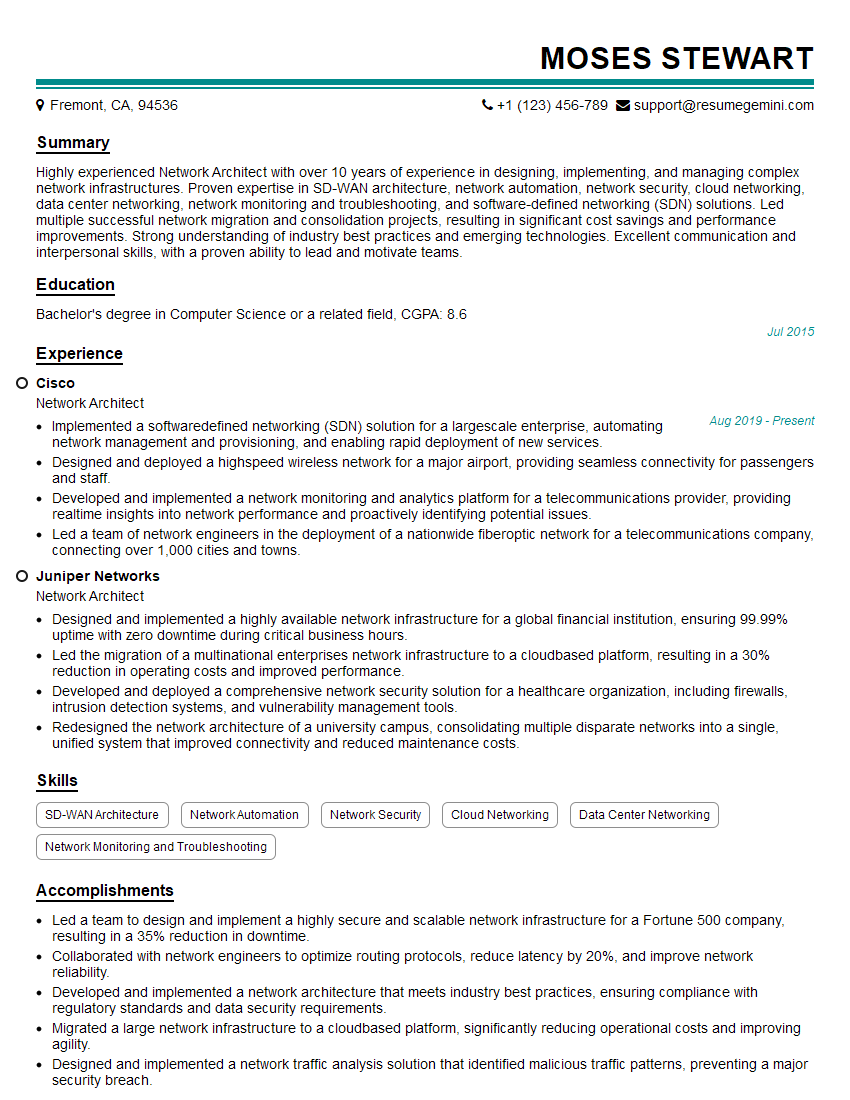
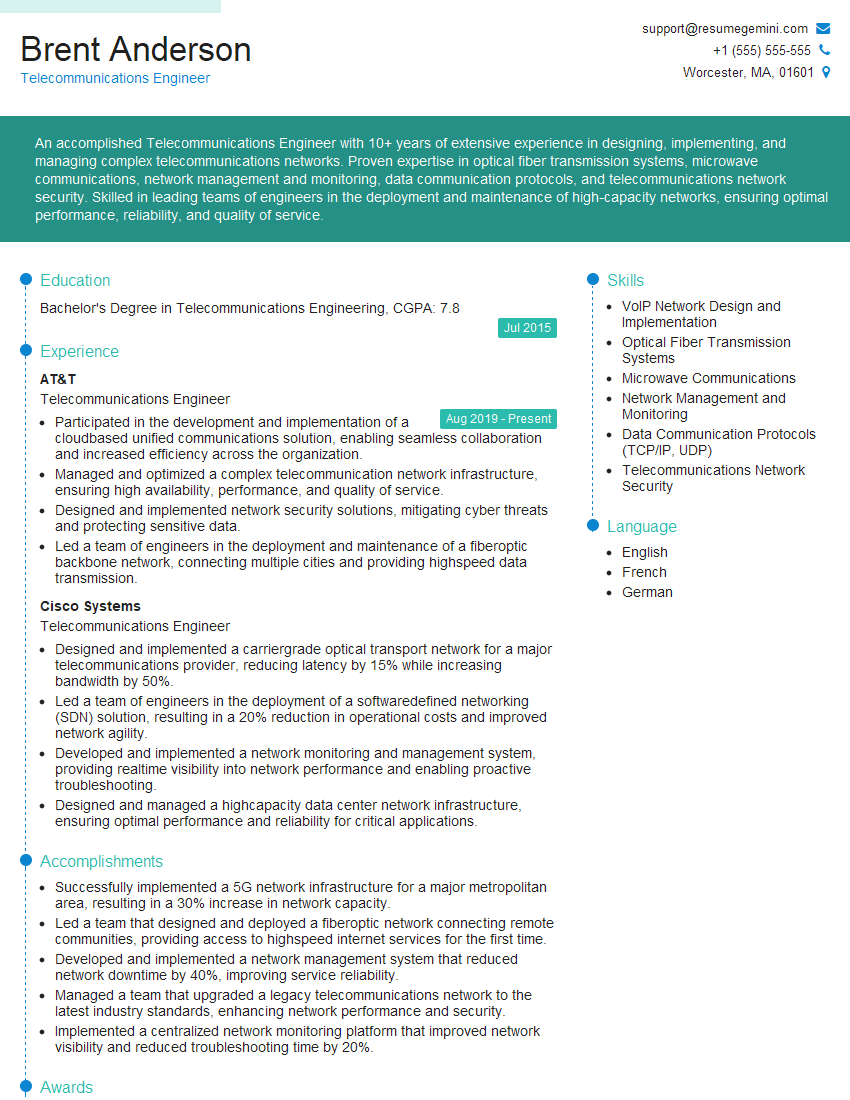
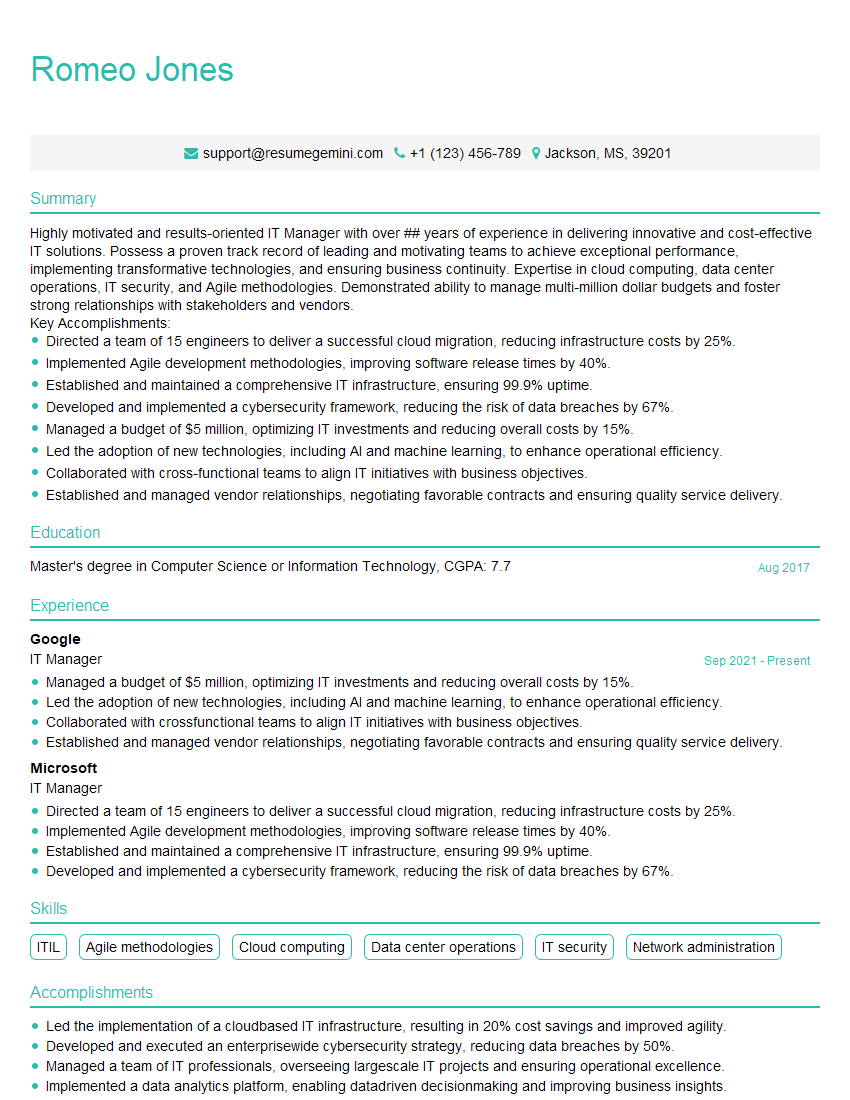
Mastering routing techniques is crucial for career advancement in networking, opening doors to specialized roles and higher earning potential. A strong understanding of routing protocols and network design is highly sought after by employers. To maximize your job prospects, invest time in creating an ATS-friendly resume that highlights your skills and experience effectively. ResumeGemini is a trusted resource for building professional resumes, and we provide examples of resumes tailored to Routing Techniques to help you showcase your expertise. Crafting a compelling resume is a significant step towards landing your dream networking role. Take advantage of the resources available to present yourself in the best possible light.
Explore more articles
Users Rating of Our Blogs
Share Your Experience
We value your feedback! Please rate our content and share your thoughts (optional).
What Readers Say About Our Blog
Very informative content, great job.
good