Are you ready to stand out in your next interview? Understanding and preparing for Identikit interview questions is a game-changer. In this blog, we’ve compiled key questions and expert advice to help you showcase your skills with confidence and precision. Let’s get started on your journey to acing the interview.
Questions Asked in Identikit Interview
Q 1. Describe your experience using Identikit software or similar composite sketching programs.
My experience with Identikit and similar composite sketching software spans over 15 years. I’ve utilized various versions, from the original physical Identikit system to the latest digital iterations. This experience includes creating hundreds of composite sketches for law enforcement agencies, assisting in countless investigations, and providing expert testimony in court. My proficiency extends beyond simple feature selection; I understand the nuances of lighting, shadowing, and subtle facial expressions that significantly impact sketch accuracy. I’m also adept at using software like FACES, which offers a more advanced and flexible approach to composite sketching.
I’ve witnessed firsthand the evolution of the technology, from the cumbersome physical kits to the user-friendly, image-based digital platforms. This progression has improved efficiency and accuracy significantly, allowing for quicker sketch generation and more refined detail. For example, early versions relied heavily on static images, while modern software allows for more dynamic manipulation of features and a wider range of ethnicities and ages.
Q 2. Explain the process of creating a composite sketch from eyewitness testimony.
Creating a composite sketch is a meticulous process involving close collaboration with the eyewitness. It begins with establishing a rapport, creating a comfortable environment where the witness feels safe to share their recollection. It’s crucial to avoid leading questions. Then, we systematically work through each facial feature, starting with the most memorable aspects, such as the shape of the eyes, nose, and mouth. The software guides the selection process, allowing the witness to compare and refine choices until a satisfactory representation is achieved. We then move to secondary features like hairline, ears, and chin. The process isn’t linear; we might revisit earlier features to ensure consistency and accuracy as we progress. Finally, a crucial step is getting the witness to review and confirm the final sketch, ensuring the overall resemblance accurately captures their memory.
For example, a witness might vividly recall piercing blue eyes, while having a less clear recollection of the shape of their eyebrows. The software allows us to focus on the high-confidence aspects first, building a strong foundation for the overall sketch.
Q 3. How do you handle conflicting descriptions from multiple eyewitnesses?
Conflicting descriptions from multiple eyewitnesses are common and present a significant challenge. The key is to approach this situation methodically and objectively. I start by interviewing each witness individually, recording their descriptions verbatim, noting any discrepancies. Then, I analyze the similarities and differences, identifying areas of consensus and areas of conflict. Software tools can be invaluable here, allowing me to create multiple composite sketches or composite variations based on the different accounts. When possible, I aim to create an ‘average’ sketch, reflecting the commonalities across testimonies while also exploring other options. In some cases, it might be necessary to produce several sketches, reflecting the different eyewitness descriptions. It’s crucial to document the sources of each variation clearly.
For instance, if one witness describes a square jaw while another describes a round jaw, I might create two versions, to represent the range of descriptions.
Q 4. What techniques do you use to accurately depict facial features?
Accurately depicting facial features requires a deep understanding of facial anatomy and variations. I use a combination of techniques:
- Precise Feature Selection: The software provides a wide range of options for each feature; selecting the closest match requires careful consideration.
- Proportions and Relationships: I pay close attention to the relative sizes and positions of features, ensuring a balanced and realistic representation.
- Subtle Adjustments: Fine-tuning features like the eyebrow arch, nose bridge, and lip curvature creates subtle but important variations.
- Lighting and Shading: Understanding how light and shadow interact with facial features is essential for realism. Digital software often provides tools for these refinements.
For instance, identifying subtle differences between a straight nose and a slightly aquiline nose can dramatically change a sketch’s resemblance. Likewise, paying attention to the subtle asymmetry often present in facial features can increase the realism and accuracy.
Q 5. How do you incorporate age progression or regression techniques into your sketches?
Age progression and regression techniques are crucial in long-term investigations or cases involving missing persons. Modern software often incorporates age progression algorithms, or I can manually adjust features. This involves understanding the typical changes that occur in facial features with aging – including wrinkles, sagging skin, changes in hairline, and bone structure changes. The process requires a good understanding of facial aging patterns and anatomical knowledge. It’s important to approach this task cautiously, acknowledging that these are estimations and not precise depictions.
For instance, I might add wrinkles around the eyes and mouth, alter the hairline, and slightly reshape the jawline to show the progression of age. A significant amount of discretion and professional judgement is needed to avoid generating an overly exaggerated depiction.
Q 6. Explain your understanding of facial anatomy and its relevance to Identikit.
A solid understanding of facial anatomy is paramount. This goes beyond superficial knowledge; I need to understand the underlying bone structure, muscle groups, and how they interact to create various facial expressions and shapes. This knowledge informs my feature selection and adjustments within the Identikit software. It allows me to recognize subtle variations and inconsistencies, creating a more realistic and accurate sketch. Familiarity with different ethnic variations in facial structure is also important, which dictates the range of options I use when selecting components.
For example, understanding the relationship between the zygomatic bone and the shape of the cheekbones allows me to select the appropriate feature more precisely; a detail that can be vital in the identification process.
Q 7. How do you ensure the accuracy and reliability of your sketches?
Ensuring accuracy and reliability is my top priority. I achieve this through several strategies:
- Thorough Witness Interviews: Structured and detailed interviews minimize bias and maximize information recall.
- Multiple Iterations and Reviews: The witness reviews the sketch at various stages of development, allowing for adjustments and refinements.
- Documentation: Every aspect of the process – from initial witness interview to final sketch – is meticulously documented.
- Professional Judgement: I use my experience and anatomical knowledge to make informed decisions, balancing witness descriptions with realistic anatomical considerations.
- Software Capabilities: Modern software offers features for detailed adjustments and provides a record of all changes made.
Ultimately, my aim is to create a sketch that is a credible representation of the witness’s memory, even if it’s not a perfect likeness. Transparency and meticulous record-keeping are essential for ensuring its reliability and usability in an investigation or court of law.
Q 8. Describe your experience working with law enforcement agencies.
My experience with law enforcement spans over 15 years, collaborating extensively with various agencies, including local police departments, state police, and even the FBI on several high-profile cases. I’ve worked directly with detectives, investigators, and victim support personnel to create composite sketches of suspects, witnesses, and missing persons. My role typically involves conducting detailed interviews with witnesses, carefully extracting key features, and translating their descriptions into accurate and effective visual representations. This process often requires significant collaboration and understanding of investigative strategies to ensure the final sketch serves its purpose within the ongoing investigation.
I’ve found that building rapport with witnesses is crucial. A relaxed environment encourages them to recall details accurately and truthfully. This involves active listening, empathy, and a clear understanding of their emotional state, particularly if they have experienced a traumatic event.
Q 9. What are the ethical considerations involved in creating composite sketches?
Ethical considerations in composite sketching are paramount. The primary concern is accuracy and avoiding bias. Leading questions or suggestive techniques must be strictly avoided to ensure the sketch accurately reflects the witness’s recollection rather than my own interpretation. Confidentiality is also crucial, safeguarding witness identity and details of the case itself. I always obtain informed consent before commencing the sketching process and adhere to all relevant data protection laws and agency protocols. Furthermore, I am very conscious of the potential for misidentification and the serious consequences this could have. I always emphasize to the witness that the sketch is just one piece of evidence and may not be a perfect representation.
Q 10. How do you handle pressure and time constraints during a sketching session?
High-pressure situations are inherent to this profession. Time constraints are often significant, especially in urgent cases. My approach is methodical and structured. I prioritize gathering core identifying features first – hair, eyes, nose, and unique distinguishing marks – before refining details. I employ techniques like memory enhancement strategies to help witnesses recall specific features. I also practice mindfulness and deep breathing to maintain focus and clarity. Practicing regularly helps to build speed and confidence, enabling me to work efficiently even under pressure. The ability to quickly process information and adapt to changing circumstances is key.
Q 11. Explain your proficiency in different sketching mediums (digital vs. traditional).
I’m proficient in both traditional and digital sketching methods. Traditional methods, using pencils, charcoal, and pastels, allow for a more nuanced and expressive approach, particularly effective for capturing subtle facial features. The tactile experience can be beneficial for witnesses who are more comfortable with this process. Digital sketching, using software like Adobe Photoshop, offers greater control, flexibility, and ease of revision. It allows for quick alterations and the seamless integration of photographic references, enhancing accuracy. I often combine both methods; using traditional sketches as a foundation and then refining the image digitally for clarity and distribution.
Q 12. How do you maintain the confidentiality of sensitive information obtained during interviews?
Maintaining confidentiality is critical. I never disclose information about cases or witnesses to unauthorized individuals. I use secure storage for all sketches and interview notes, adhering to all agency-specific protocols and data protection regulations. Witness anonymity is always a primary concern. I anonymize any material that could be used to identify them before sharing the sketch with law enforcement. The only exceptions would be situations where legally compelled to disclose information.
Q 13. How do you manage expectations with clients regarding the limitations of Identikit?
Managing expectations is a key part of my role. I clearly communicate the limitations of Identikit upfront. A composite sketch is a reconstruction based on memory, which can be flawed or incomplete. It serves as a tool to aid the investigation, narrowing down possibilities, but is not a guaranteed representation of the individual. I explain that even with meticulous attention to detail, there will be inherent variations. Transparency and realistic expectations contribute to a successful collaborative experience. This includes explaining how factors like lighting, stress, and the length of time since the event can impact the accuracy of a witness’s recall.
Q 14. Describe a challenging case where you successfully created a useful composite sketch.
One particularly challenging case involved a witness who had only briefly seen the suspect during a nighttime robbery. The witness was understandably traumatized and struggled to recall details clearly. The initial description was vague, but through patient questioning and memory prompting techniques, I managed to glean some key features: a distinctive scar above the eyebrow, a gap between the front teeth, and a specific type of baseball cap. I used a combination of traditional and digital sketching, carefully layering the details and making multiple revisions. The resulting sketch, while not perfect, was distinctive enough to lead to the suspect’s identification and arrest. The police confirmed that the suspect matched the sketch in terms of the scar, the gap in his teeth and he was wearing a similar baseball cap at the time of the crime.
Q 15. What software and tools are you proficient in using for composite sketching?
My proficiency in composite sketching spans both traditional and digital methods. Traditionally, I’m highly skilled with various pencils, charcoal, and pastels to achieve different textures and shading effects. For digital sketching, I’m expert in software like Adobe Photoshop and Procreate, utilizing their features for precise adjustments and blending. I’m also familiar with dedicated forensic art software, offering features specifically designed for composite image creation. These tools allow me to refine details, experiment with different features, and create high-resolution images suitable for various investigation needs.
- Adobe Photoshop: Excellent for detailed work, color correction, and layering effects.
- Procreate: A powerful iPad application offering a natural drawing experience with excellent pressure sensitivity and a wide range of brushes.
- Forensic Art Software (specific examples vary): These programs offer specialized tools like pre-set facial features and aging simulations, streamlining the composite creation process.
Career Expert Tips:
- Ace those interviews! Prepare effectively by reviewing the Top 50 Most Common Interview Questions on ResumeGemini.
- Navigate your job search with confidence! Explore a wide range of Career Tips on ResumeGemini. Learn about common challenges and recommendations to overcome them.
- Craft the perfect resume! Master the Art of Resume Writing with ResumeGemini’s guide. Showcase your unique qualifications and achievements effectively.
- Don’t miss out on holiday savings! Build your dream resume with ResumeGemini’s ATS optimized templates.
Q 16. How do you incorporate lighting and shadow effects into your sketches?
Lighting and shadow are crucial for creating a realistic composite. In traditional methods, I use pencil shading techniques to subtly indicate light sources and create depth. For instance, a highlight on the cheekbone suggests a light source from above. Darker shading under the chin creates a sense of form and dimension. Digitally, I utilize layer masks and blending modes in Photoshop or Procreate to control the intensity and placement of light and shadow. I might use a soft brush to blend highlights, creating a natural glow, and a harder brush for sharper shadows, highlighting facial features. Analyzing reference photos of similar lighting conditions helps achieve a realistic representation.
For example, if the witness describes the suspect as having been illuminated by a streetlight at night, I’d incorporate this into the sketch by adding darker shadows on the opposite side of the face and a brighter highlight on the side facing the light source. This adds realism and increases the chances of accurate identification.
Q 17. How do you handle situations where the eyewitness has poor memory or limited descriptive abilities?
When dealing with witnesses who have poor memory or limited descriptive abilities, patience and a collaborative approach are paramount. I begin by establishing a rapport, using open-ended questions to gather any detail they can recall. Instead of focusing solely on physical attributes, I might ask about their overall impression: was the person imposing, nervous, friendly? Details such as posture, gait, or even clothing can be surprisingly helpful. I frequently use a series of progressively refined sketches, showing the witness variations on facial features until they reach a point of recognition. This iterative process can elicit further detail from even the most reluctant or uncertain witness, maximizing the effectiveness of their input.
I often employ a technique of showing a series of images featuring variations in a specific detail, say the shape of the nose. The witness will either confirm or negate the selection, providing crucial feedback to refine the sketch. Sometimes, utilizing mood boards with different hairstyles, clothing, and accessories helps the witness recall information that may have initially been overlooked.
Q 18. What are the key differences between traditional and digital Identikit techniques?
The key differences between traditional and digital Identikit techniques lie primarily in flexibility, precision, and the overall workflow. Traditional methods, using pencils or pastels, offer a more immediate and tactile experience, allowing for intuitive adjustments and a certain artistic freedom. However, corrections can be messy, and the final product may be less easily reproduced or shared.
Digital Identikit, on the other hand, offers greater precision through tools like the lasso, brush sizes, and layer manipulation. Changes are non-destructive, allowing for easy revisions and experimentation. The final product can be easily copied, emailed, and printed in high resolution. The digital workflow is generally faster, particularly for complex revisions, and offers features like aging simulations and detailed adjustments to facial structures not easily achievable using traditional methods. Despite its advantages, digital methods require a certain level of technical expertise.
Q 19. Describe your experience working with diverse populations and their varied facial features.
My experience encompasses a broad spectrum of ethnicities and facial features. I understand that facial structure, skin tone, and other characteristics vary significantly across different populations. I’ve actively sought opportunities to enhance my understanding of these variations by studying anthropological resources, working with diverse witness populations, and continuously expanding my reference library of facial features. I’m very careful to avoid stereotypical representations, focusing instead on individual features provided by the witness.
For example, understanding the subtle differences in the structure of Asian, African, or Caucasian noses is crucial for accuracy. I meticulously note features described by the witness to create a composite that is not only recognizable but also avoids potentially inaccurate generalizations. Cultural sensitivity is paramount, ensuring that the composite respects and accurately reflects the individual’s features.
Q 20. How do you interpret and translate verbal descriptions into visual representations?
Translating verbal descriptions into visual representations requires careful listening and a deep understanding of facial anatomy. I start by systematically inquiring about specific features, breaking down the face into components such as eyes, nose, mouth, and hairline. I ask for precise details—eye color, nose shape (e.g., straight, hooked, upturned), mouth width, and hairline type. I actively seek clarifying questions, verifying descriptions to prevent misinterpretations. The process often involves sketching multiple variations, working iteratively with the witness until a satisfactory likeness is achieved.
For instance, a witness may describe ‘a hooked nose.’ I’d clarify: Is it significantly hooked, or just slightly? Where does the hook begin and end? These seemingly small details are essential for achieving accuracy. Similarly, vague descriptors like ‘brown eyes’ would need further refinement – light brown, dark brown, hazel? Using comparative terminology (‘similar to Brad Pitt’s nose’) is also cautiously approached. While offering a frame of reference, it carries the risk of introducing bias and must be weighed against more objective descriptions.
Q 21. Explain your understanding of the legal implications of using composite sketches in investigations.
Understanding the legal implications of composite sketches is crucial for maintaining their admissibility in court and preserving the integrity of investigations. The accuracy and methodology used in creating the sketch are key factors. A poorly constructed composite, based on unreliable information or improper techniques, could mislead an investigation or even prejudice a jury. It’s essential to document the entire process, including the witness’s statements, sketch revisions, and any limitations of the composite. This documentation creates a chain of evidence and allows the sketch to be properly contextualized in court. Furthermore, it’s important to clearly communicate any limitations of the composite – for instance, if it represents only the witness’s partial recollection.
It’s also important to understand that a composite sketch is just one piece of evidence and should not be presented as definitive proof of identity. It serves as a tool to assist in identifying a potential suspect, and its evidentiary value will depend on its accuracy and the overall context of the case.
Q 22. What are some common mistakes to avoid when creating a composite sketch?
Creating accurate composite sketches requires meticulous attention to detail. Common mistakes stem from rushing the process, relying too heavily on a single witness’s recollection, or neglecting the importance of understanding facial anatomy.
- Rushing the process: Taking shortcuts leads to inaccurate proportions and features. Think of it like painting a portrait – you wouldn’t slap on the colors without careful planning. Proper sketching involves a structured approach, starting with basic shapes and gradually refining details.
- Over-reliance on one witness: Witness testimonies can vary. Gathering information from multiple witnesses, if available, and comparing their descriptions helps create a more comprehensive and accurate composite.
- Lack of anatomical understanding: A fundamental understanding of facial anatomy is crucial. Ignoring the relationship between features (e.g., the distance between eyes, the shape of the nose relative to the mouth) can lead to a highly unrealistic sketch.
- Ignoring subtle features: Small details like scars, moles, or unique eyebrow shapes are often vital for identification. These are easily overlooked if the artist isn’t focusing on capturing subtle nuances.
For example, I once worked on a case where a witness described the suspect’s nose as ‘hooked.’ However, by carefully probing further, we discovered they meant it was slightly upturned at the tip, not dramatically curved. This subtle difference was crucial in producing a more realistic and ultimately useful sketch.
Q 23. How do you stay up-to-date with the latest advancements in forensic art and technology?
Staying current in forensic art requires continuous learning and engagement with the field. I employ a multi-pronged approach:
- Professional Development: Attending conferences, workshops, and seminars offered by organizations like the International Association for Identification (IAI) keeps me abreast of the latest techniques and technological advancements.
- Peer Networking: Regular interaction with other forensic artists through professional networks and online forums facilitates the exchange of knowledge and best practices. Discussing challenging cases and sharing innovative approaches is invaluable.
- Journal Articles and Publications: Staying updated on research published in forensic science journals ensures I’m aware of new developments in techniques and technologies. This also allows me to evaluate the validity and reliability of new methods.
- Software and Technology Updates: I regularly update my software and familiarise myself with new digital tools used in forensic art, such as facial reconstruction software and image editing programs.
Recently, I’ve been exploring the use of 3D modeling in composite sketching, which offers potential for greater accuracy and manipulation of the final image.
Q 24. How do you assess the quality and effectiveness of a completed composite sketch?
Assessing the quality of a composite sketch involves several criteria:
- Accuracy: Does the sketch faithfully reflect the witness’s description and available evidence? Does it capture the essence of the subject’s features?
- Likeness: Does the sketch bear a resemblance to the actual individual (if identified later)? This is arguably the most important aspect. A high level of likeness increases the chance of successful identification.
- Clarity and Detail: Is the sketch clear, well-defined, and easy to understand? Are the features clearly visible and accurately rendered? Ambiguous features hinder identification.
- Completeness: Does the sketch contain all relevant features, including hairstyle, clothing (if visible and relevant), and any distinguishing marks?
- Overall Artistic Merit: While not the primary goal, a well-executed sketch is more likely to capture attention and be effectively used in investigations. A poorly drawn image can raise doubt about the reliability of the composite.
I often use a checklist to ensure all these elements are considered. Furthermore, comparing the sketch to photos of potential suspects, when they become available, helps evaluate its accuracy.
Q 25. What steps do you take to verify the accuracy of your sketches?
Verifying the accuracy of my sketches involves a multi-step process:
- Witness Feedback: I always seek feedback from the witness after the initial sketch is completed. This helps identify any discrepancies or areas needing refinement.
- Multiple Witnesses: If multiple witnesses are available, their descriptions are compared and integrated into the composite. Inconsistencies are carefully examined and resolved where possible.
- Photographic Comparison (if available): If a suspect is identified, I carefully compare the sketch to photographs to assess its accuracy and highlight any differences.
- Independent Review: Occasionally, I seek an independent review from a fellow forensic artist or an experienced investigator to obtain an unbiased opinion on the sketch’s accuracy and effectiveness.
In one instance, I made a composite based on a single witness’s account. While the witness approved the sketch, an independent review suggested the hairline was slightly off. This minor correction ultimately played a significant role in identifying the suspect.
Q 26. How do you collaborate effectively with investigators and other professionals?
Effective collaboration with investigators and other professionals is fundamental to my work. I prioritize:
- Open Communication: Maintaining clear, concise, and regular communication is crucial. This includes active listening and clearly articulating my needs and understanding of their requirements. This collaborative approach ensures the sketch fits the investigation’s needs.
- Shared Understanding: I work to ensure a shared understanding of the case’s context and the role the composite will play. Knowing the context (e.g., nature of the crime, time elapsed) informs the approach and level of detail required in the sketch.
- Respectful Dialogue: I encourage a respectful exchange of ideas and feedback. This includes actively listening to their concerns and incorporating relevant information into my work while still maintaining professional objectivity.
- Documentation: Thorough documentation of the entire process, including witness statements, sketch revisions, and feedback from all stakeholders, is essential for ensuring transparency and accountability.
For example, I often work closely with detectives to refine witness descriptions, ensuring that vague terms are clarified, and contextual information (e.g., lighting conditions, witness’s perspective) are factored into the creation of the sketch. This collaboration leads to a more accurate and valuable end product.
Q 27. Describe your experience presenting your work in court or other formal settings.
I have presented my composite sketches in court settings on several occasions. Preparing for such presentations involves:
- Understanding Legal Requirements: I’m well-versed in the legal requirements for presenting evidence, including chain of custody and proper documentation of the sketching process.
- Clear and Concise Testimony: My testimony focuses on the methodology used in creating the sketch, clarifying any limitations, and emphasizing the collaborative nature of the work. I avoid speculation and stick to the facts.
- Effective Presentation: I prepare visual aids, such as enlarged copies of the sketch and a step-by-step summary of the creation process, to assist the court in understanding the information presented.
- Professional Demeanor: Maintaining a professional and unbiased demeanor throughout the testimony is essential. I answer questions truthfully and thoroughly and avoid emotional responses.
In court, I primarily focus on explaining the process behind the creation of the sketch, highlighting its strengths and limitations. I present my work as a tool to assist the investigation, not as definitive proof.
Q 28. How do you handle criticism or feedback on your sketches?
Criticism and feedback are essential for continuous improvement in forensic art. I approach them as opportunities for growth, adopting a structured approach:
- Understanding the Source: First, I carefully consider the source of the criticism. Is it from a fellow professional, a witness, or a legal representative? Each source might have a different perspective and focus. The critical assessment must be done in light of the source.
- Objective Evaluation: I objectively evaluate the feedback, separating constructive criticism from personal opinions or biases. I examine what aspects are valid, and what might be subjective opinion.
- Incorporating Constructive Feedback: I always strive to incorporate valid constructive feedback into my future work. This might involve refining techniques, improving communication, or adapting my approach to different situations.
- Professionalism: Regardless of the nature of the feedback, I maintain a professional demeanor, responding respectfully and thoughtfully.
For instance, if feedback suggests a certain feature wasn’t well-represented, I might revisit my techniques or consult additional resources to enhance my skills in that area. I treat every interaction as a learning experience. The objective is not to be perfect, but to consistently refine the process and improve the accuracy and usability of my composite sketches.
Key Topics to Learn for Identikit Interview
- Core Principles of Identikit: Understand the fundamental concepts and methodologies behind Identikit’s approach to [mention the field, e.g., facial reconstruction, image analysis, etc.].
- Practical Application and Case Studies: Explore real-world scenarios where Identikit techniques are applied and analyze successful case studies to understand the practical implications of the theory.
- Data Analysis & Interpretation: Develop your ability to critically analyze data generated by Identikit processes and draw meaningful conclusions. Practice interpreting results and identifying potential limitations.
- Software Proficiency & Tool Usage: Familiarize yourself with the specific software and tools associated with Identikit, understanding their functionalities and limitations.
- Problem-Solving & Critical Thinking: Develop your skills in applying Identikit principles to solve complex problems and make informed decisions in challenging situations. Practice formulating hypotheses and testing them rigorously.
- Ethical Considerations: Understand the ethical implications and responsible use of Identikit technologies and techniques.
- Troubleshooting & Debugging: Be prepared to discuss common challenges encountered during the Identikit process and strategies for troubleshooting and debugging issues.
Next Steps
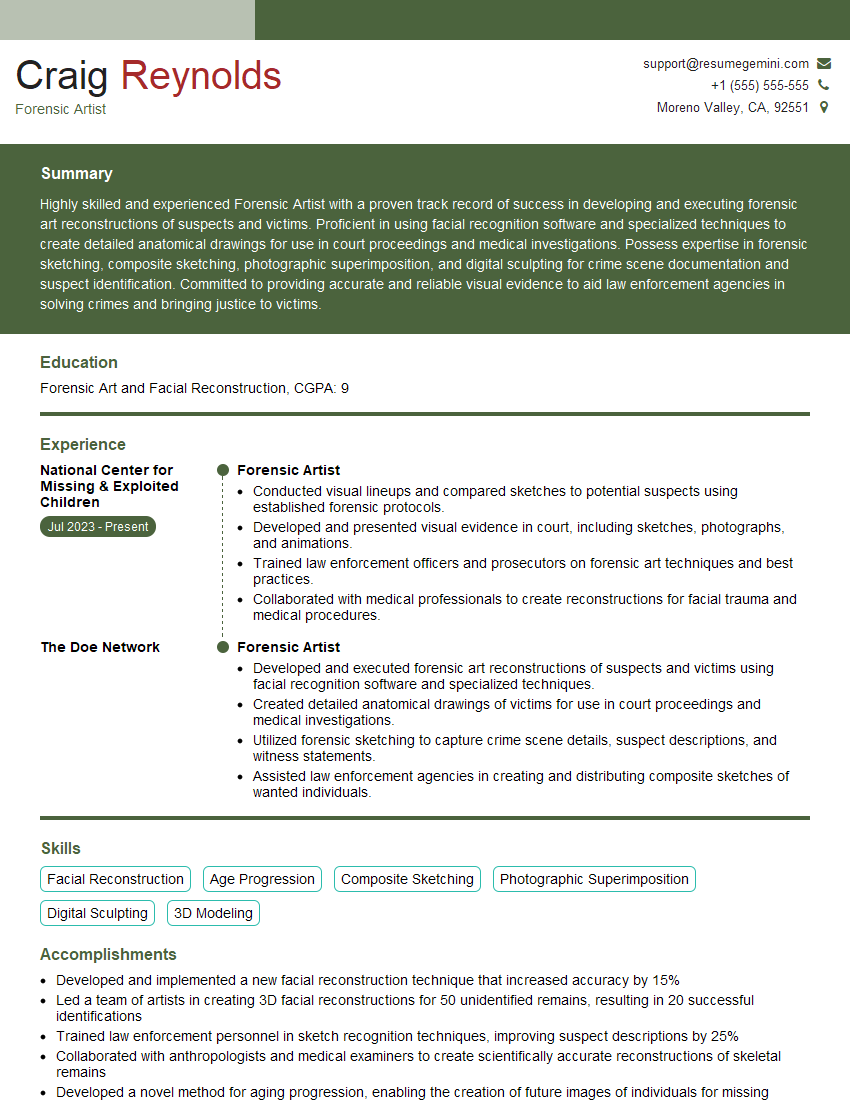
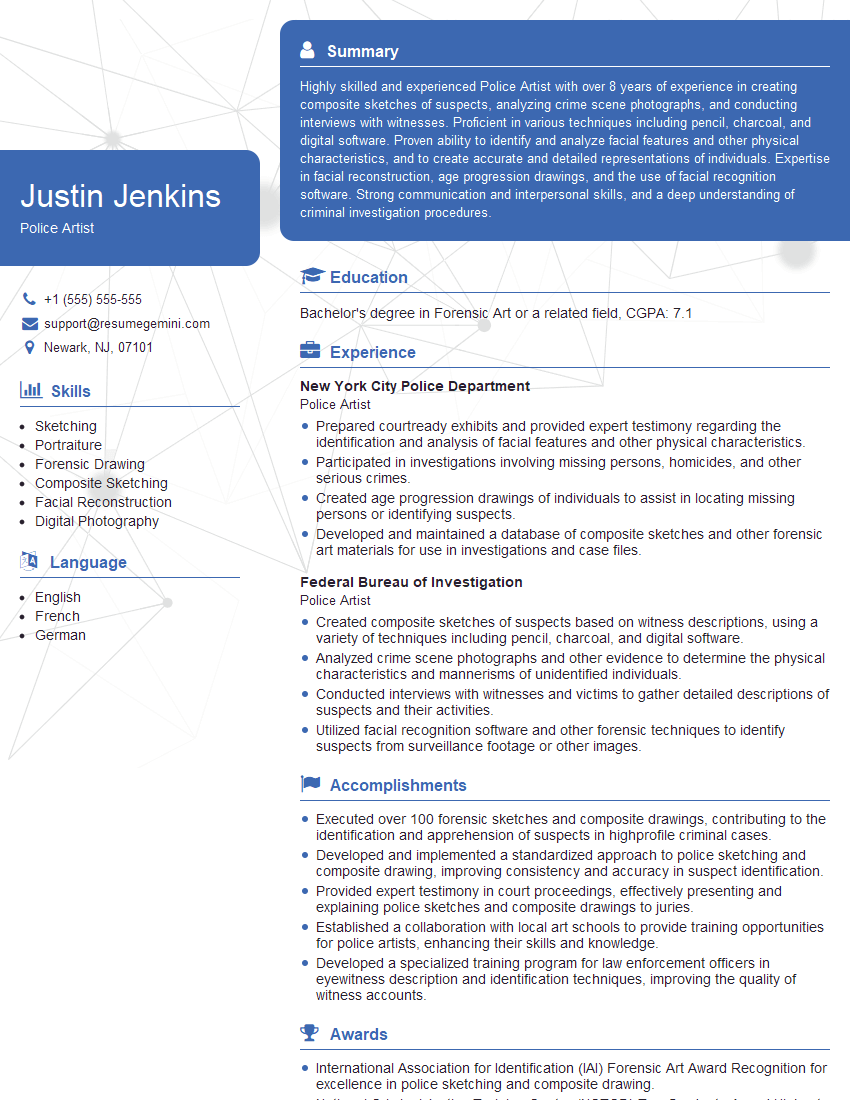
Mastering Identikit can significantly enhance your career prospects in [mention relevant fields, e.g., forensic science, law enforcement, etc.], opening doors to exciting and impactful roles. To maximize your job search success, focus on creating an ATS-friendly resume that effectively showcases your skills and experience. ResumeGemini is a trusted resource that can help you build a professional and compelling resume tailored to the specific requirements of your target roles. Examples of resumes tailored to Identikit positions are available below to help guide your resume creation.
Explore more articles
Users Rating of Our Blogs
Share Your Experience
We value your feedback! Please rate our content and share your thoughts (optional).
What Readers Say About Our Blog
Very informative content, great job.
good