Feeling uncertain about what to expect in your upcoming interview? We’ve got you covered! This blog highlights the most important Track Laying interview questions and provides actionable advice to help you stand out as the ideal candidate. Let’s pave the way for your success.
Questions Asked in Track Laying Interview
Q 1. Explain the different types of railway track construction.
Railway track construction can be broadly classified into several types, primarily based on the type of ballast used, the track structure itself, and the intended purpose. Let’s explore some common types:
- Ballasted Track: This is the most common type, where the rails rest on sleepers (ties) embedded in a bed of ballast (crushed stone). Ballast provides drainage, stability, and support for the track structure. Variations exist depending on ballast depth and sleeper type (e.g., concrete or wooden sleepers). Think of it like building a foundation for a house – the ballast is the crucial base.
- Ballastless Track: In this type, the rails are directly fixed to a concrete slab or other solid foundation without ballast. This offers increased stability, reduced maintenance, and higher speed capabilities. It’s often preferred in high-speed rail lines or urban environments where space is limited. Imagine it as a solid, poured concrete foundation, eliminating the need for loose materials.
- Pre-stressed Concrete Sleepers: These sleepers are pre-fabricated concrete units designed to enhance track stiffness and reduce maintenance compared to traditional wooden or even some concrete sleepers. The pre-stressing contributes to greater longevity and reduces the likelihood of track sagging.
- Floating Slab Track: This system uses a reinforced concrete slab that’s laid on elastomeric pads, separating the track from the underlying ground. This greatly reduces vibration and noise transmission. Think of it as a shock absorber system for the track, minimizing the impact of train movement.
The choice of track construction method depends on factors like terrain, speed requirements, expected traffic volume, and budget constraints.
Q 2. Describe the process of track laying, from planning to completion.
Track laying is a multi-stage process demanding precision and coordination. It starts with detailed planning and extends to final inspections. Here’s a breakdown:
- Planning and Surveying: This involves accurate surveying to determine the track alignment and grade, considering the terrain and environmental factors. This phase is crucial for ensuring the safety and efficiency of the track.
- Subgrade Preparation: The ground is prepared to provide a stable foundation. This might involve excavation, compaction, and drainage improvements, depending on soil conditions. A solid foundation is paramount for track longevity.
- Ballast Placement: The ballast is spread, leveled, and compacted to create a uniform base for the sleepers. The depth and type of ballast are carefully selected based on the design specifications.
- Sleeper Placement: Sleepers are placed accurately according to the design, ensuring correct spacing and alignment. This requires precise measurements and meticulous work.
- Rail Placement: Rails are laid on the sleepers, ensuring proper alignment and gauge (distance between the rails). Specialized equipment like rail cranes is often used for this task.
- Fastening: Rails are fastened securely to the sleepers using appropriate fastenings (e.g., clips, screws, fishplates). This step is critical for ensuring track stability and safety.
- Track Lining and Levelling: The track is precisely lined and leveled using specialized tools and techniques to ensure accurate alignment and gauge. Any deviations are corrected immediately. This is where precision is paramount.
- Ballast Tamping: The ballast under and around the sleepers is compacted using tamping machines to maintain stability and prevent settlement. It’s like solidifying the support for the rails.
- Inspection and Testing: Finally, the track undergoes thorough inspection to verify alignment, gauge, and overall stability. Measurements are taken to ensure the track conforms to the specifications.
The entire process requires strict adherence to safety protocols and quality control measures to ensure a safe and efficient railway system.
Q 3. What are the key safety regulations and procedures in track laying?
Safety is paramount in track laying. Key regulations and procedures include:
- Risk Assessments: Thorough risk assessments are conducted before any work commences, identifying potential hazards and implementing control measures.
- Personal Protective Equipment (PPE): Workers must wear appropriate PPE, including safety helmets, high-visibility clothing, gloves, and safety footwear.
- Safe Work Procedures: Strict procedures are followed to ensure the safety of workers and equipment. This includes clear communication, designated safe zones, and proper use of tools and machinery.
- Traffic Control: Effective traffic control measures are crucial, especially on operational lines. This might involve speed restrictions, track closures, and the use of signaling systems.
- Emergency Response Plan: A comprehensive emergency response plan must be in place to handle any incidents or accidents.
- Training and Competency: Workers must be adequately trained and competent in the relevant safety procedures and techniques.
- Regular Inspections: Regular inspections and maintenance are carried out to identify and address any potential safety issues before they escalate.
Non-compliance with safety regulations can lead to severe consequences, including accidents and injuries. Adherence to safety regulations is not just a guideline; it’s a necessity.
Q 4. How do you ensure the accuracy of track alignment and gauge?
Ensuring accurate track alignment and gauge is critical for safe and smooth train operation. This is achieved through a combination of techniques and technologies:
- Precise Surveying: Initial surveying establishes the baseline for track alignment and gauge. Modern surveying equipment like total stations and GPS systems are used to achieve high accuracy.
- Track Geometry Measurement: Specialized tools and equipment are used to measure track geometry parameters like alignment, gauge, level, and twist. This is frequently done during and after construction.
- Track Lining and Levelling Machines: These machines automate the process of lining and leveling the track, ensuring accurate alignment and gauge. Think of them as precision tools for track adjustment.
- Optical Instruments: Optical instruments like theodolites and levels are used to check alignment and level, providing immediate feedback for adjustments.
- Data Acquisition Systems: Modern track geometry cars can automatically record and process data, providing comprehensive information on track geometry parameters. This enables quick identification and correction of deviations.
- Continuous Monitoring Systems: Some advanced systems provide continuous monitoring of track geometry, enabling early detection of defects and proactive maintenance.
Regular monitoring and maintenance are vital to maintain the accuracy of track alignment and gauge over time. Even small deviations can accumulate and lead to significant problems.
Q 5. Explain the importance of proper ballast maintenance.
Proper ballast maintenance is crucial for maintaining track stability, drainage, and overall track geometry. Neglecting ballast maintenance can lead to track settlement, gauge widening, and increased maintenance costs.
- Regular Cleaning: Ballast needs regular cleaning to remove dirt, debris, and vegetation that can compromise drainage and stability. This is often done with specialized machines that remove unwanted material and even re-shape the ballast bed.
- Ballast Tamping: Periodic tamping is essential to compact the ballast under and around the sleepers, maintaining the correct track level and preventing settlement. This process ensures that the ballast continues to provide the necessary support for the rails.
- Ballast Renewal: In cases of significant degradation or contamination, ballast renewal may be necessary. This involves removing the old ballast and replacing it with fresh material. It is a more extensive undertaking than just cleaning and tamping.
- Drainage Improvement: Good drainage is crucial for preventing water accumulation in the ballast, which can lead to frost heave and instability. This often involves careful grading and the installation of drainage systems.
The frequency of ballast maintenance depends on factors like traffic volume, climate, and ballast type. Regular maintenance is far cheaper than costly repairs necessitated by neglect.
Q 6. Describe different types of rail fastenings and their applications.
Various types of rail fastenings are used, each with specific applications:
- Pandrol Clips: These elastic clips are commonly used to secure rails to concrete sleepers. They are known for their resilience and ease of installation.
- Screw Spikes: These are screws that fasten rails to wooden sleepers, offering a secure and robust connection. They are highly effective, though can require more time for installation.
- Dog Spikes: These are large nails used to fasten rails to wooden sleepers; they’re more traditional but less effective than modern options.
- Fishplates: These are steel plates used to join two lengths of rail together, creating a continuous track. They’re bolted securely for strong joint integrity. Essential for rail continuity.
- Rail Pads: These elastomeric pads are placed between the rail and the sleeper, reducing vibration and noise transmission. They act as shock absorbers, improving ride quality.
The choice of fastening depends on factors like sleeper type, rail profile, track design requirements, and budget. Each fastening system is tailored for its specific use-case. Improper fastening can lead to loosening of the rail and cause safety issues.
Q 7. How do you handle track geometry defects?
Track geometry defects can impact safety and ride quality. Handling them involves a systematic approach:
- Detection: Defects are detected through regular inspections using specialized equipment and techniques, such as track geometry cars. Early detection is vital for preventing escalation of problems.
- Classification: Defects are classified based on their severity and type (e.g., alignment defects, gauge defects, level defects). This categorisation allows for prioritizing repairs.
- Corrective Actions: Corrective actions depend on the nature and severity of the defect. Minor defects may be corrected using hand tools, while more significant defects may require the use of specialized machines like track liners and tampers. These tools can adjust, realign, and level the track as needed.
- Monitoring: After corrections, the track is re-inspected to ensure the defect has been adequately addressed. Continuous monitoring helps identify recurring issues.
- Record Keeping: Detailed records are kept of all detected defects, corrective actions taken, and the results of inspections. This aids in proactive maintenance planning and track life cycle management.
Ignoring track geometry defects can lead to derailments and other safety hazards. Proactive detection and correction are essential for ensuring the safe and efficient operation of the railway system.
Q 8. What are the common causes of track buckling and how can they be prevented?
Track buckling, a dangerous deformation where the rails lift and separate from the sleepers, is primarily caused by excessive heat expansion. Think of it like a metal ruler expanding in the sun – the rail gets longer and, if constrained, buckles. Other causes include inadequate ballast (the stones supporting the track), insufficient drainage leading to water seeping under the track and causing uplift, and poorly maintained track geometry.
Prevention strategies involve several steps. First, proper design is crucial – using rails with appropriate expansion gaps and selecting ballast that allows for effective drainage. Second, regular track inspections are vital to identify potential problems early on. Third, effective track temperature monitoring, especially during hot weather, allows for proactive adjustments or speed restrictions. Lastly, maintaining the proper ballast depth and ensuring good drainage through effective drainage systems are key to long-term stability. Ignoring these can lead to costly repairs and potential derailments. Imagine a train’s wheels encountering a buckled track – the consequences could be catastrophic!
Q 9. Explain the use of different track surveying instruments.
Track surveying uses specialized instruments to ensure the track’s precise alignment, level, and geometry. The most common tools include:
- Level: Used to measure the vertical alignment of the track, ensuring it’s level and free from excessive gradients. Imagine using a spirit level on a much larger scale.
- Theodolite: This precise instrument measures both horizontal and vertical angles, crucial for setting out the track alignment and checking its accuracy over long distances. It’s like a highly accurate protractor for large-scale projects.
- Total Station: A sophisticated surveying device that combines the functions of a theodolite, electronic distance meter (EDM), and data recorder. It automates many aspects of track surveying, providing quick and accurate measurements.
- Track Gauge Measuring Instruments: Used to ensure the precise distance between the rails is maintained consistently along the entire length of the track, crucial for safe train operation.
These instruments work together to ensure the track is built to specification and remains safe and efficient.
Q 10. How do you ensure the proper drainage of track beds?
Proper track drainage is crucial for preventing water damage and maintaining track stability. Water accumulating beneath the track can cause issues like ballast degradation, track settlement, and ultimately, buckling. Effective drainage systems involve:
- Ballast Drainage: Using well-graded ballast that allows water to drain effectively through it. Imagine a sponge soaking up water but then releasing it.
- Cross-Drainage: Installing cross-drains – often ditches or pipes – to divert water away from the track bed. These are essential for moving water across the track bed.
- Longitudinal Drainage: Constructing longitudinal drains (parallel to the track) to collect and channel water away from the track. They work like gutters alongside a road.
- Sub-Ballast Drainage: In some cases, a layer of granular material, such as gravel or crushed stone, is placed beneath the ballast to further enhance drainage. This adds an extra layer of protection.
Regular cleaning and maintenance of these drainage systems are essential to maintain their effectiveness. Neglecting drainage can lead to significant problems later on.
Q 11. Describe the process of track welding and its importance.
Track welding is a critical process that joins individual rails together to form continuous lengths, improving track strength and reducing maintenance needs. The most common method is flash butt welding, where the ends of the rails are heated to a high temperature, then squeezed and forged together to create a solid weld.
The process involves carefully aligning the rail ends, heating them using an electric arc, and then applying pressure to forge the weld. The importance of this process lies in enhancing track strength, reducing the occurrence of rail breaks, minimizing the noise and vibration, improving ride comfort and reducing maintenance intervals. Imagine driving on a smooth, continuous road versus a road with many gaps and bumps. The welded rail is analogous to the smooth road.
Regular inspection of the welds is critical to ensure they remain sound. Defects can be identified through visual inspection and, more advanced methods like ultrasonic testing.
Q 12. What are the different types of track switches and crossings?
Track switches and crossings allow trains to change tracks safely. There are various types, including:
- Simple Switches: These are basic switches using a movable point to divert the train onto a different track. Think of a simple lever that diverts a train to a different set of rails.
- Double Slip Switches: These allow trains to change tracks from either direction. They’re more complex, allowing for more traffic movement.
- Three-Way Switches: These direct trains to one of three tracks.
- Crossings: These allow trains to cross from one track to another at an angle, often using a diamond shaped intersection. These are more complex and require more precise engineering.
The selection of a particular switch or crossing depends on the specific operational requirements, traffic volume, and speed of trains.
Q 13. How do you maintain track stability in different weather conditions?
Maintaining track stability in different weather conditions requires a proactive approach. Extreme temperatures, heavy rainfall, and snow can all affect track geometry and integrity. Strategies include:
- Temperature Management: Using techniques such as adjusting expansion gaps in hot weather and employing measures to prevent excessive rail temperature rises.
- Drainage Management: Ensuring effective drainage systems remain clear and functional, preventing water from accumulating under the track and causing issues.
- Snow and Ice Removal: Timely and efficient removal of snow and ice is crucial to prevent derailments caused by slippery rails and reduced traction.
- Ballast Stabilization: In areas prone to extreme weather conditions, techniques may be employed to improve ballast stability and reduce the effects of frost heave or heavy rains.
Regular inspections and adjustments are crucial to counteract the impact of varying weather patterns. Think of it as providing preventative care to a body to prevent it from developing illnesses.
Q 14. What are the key performance indicators (KPIs) for track maintenance?
Key Performance Indicators (KPIs) for track maintenance focus on safety, efficiency, and cost-effectiveness. Some key metrics include:
- Track Geometry Defects: Number and severity of track alignment and level defects, indicating the overall condition of the track.
- Number of Derailments: A critical indicator of track safety and the effectiveness of maintenance programs.
- Maintenance Cost Per Track Kilometer: Tracking costs to ensure efficiency and optimize resource allocation.
- Track Availability (Uptime): The percentage of time the track is available for safe and efficient train operation.
- Mean Time Between Failures (MTBF): The average time between track failures or maintenance interventions.
These KPIs provide valuable data for tracking performance, identifying areas for improvement, and optimizing maintenance strategies. Regular monitoring and analysis are key to ensuring a safe and efficient railway system.
Q 15. Explain the importance of regular track inspections.
Regular track inspections are paramount to railway safety and operational efficiency. Think of it like a doctor’s checkup for the railway – preventative maintenance is far cheaper and safer than emergency repairs. These inspections identify potential problems before they escalate into major incidents, causing delays, derailments, or even casualties.
- Visual Inspections: Trained inspectors walk or ride along the track, looking for signs of wear and tear, such as rail corrugation, broken ties, gauge widening, or ballast fouling (contamination of the ballast, the supporting material under the track).
- Ultrasonic Testing: This non-destructive technique uses sound waves to detect internal rail flaws, like cracks that aren’t visible on the surface. This is crucial for preventing catastrophic rail failures.
- Geometric Measurements: Precise measurements of track geometry – alignment, level, and gauge – are taken to ensure the track conforms to strict specifications. Deviations can lead to derailments.
- Data Logging Systems: Modern railways utilize sophisticated systems that continuously monitor track parameters. These systems automatically flag any deviations from the norm, allowing for prompt intervention.
For example, early detection of a subtle track alignment issue through regular inspections might prevent a derailment that could have cost millions in damages and potentially injured passengers.
Career Expert Tips:
- Ace those interviews! Prepare effectively by reviewing the Top 50 Most Common Interview Questions on ResumeGemini.
- Navigate your job search with confidence! Explore a wide range of Career Tips on ResumeGemini. Learn about common challenges and recommendations to overcome them.
- Craft the perfect resume! Master the Art of Resume Writing with ResumeGemini’s guide. Showcase your unique qualifications and achievements effectively.
- Don’t miss out on holiday savings! Build your dream resume with ResumeGemini’s ATS optimized templates.
Q 16. Describe the process of repairing damaged track sections.
Repairing damaged track sections is a precise and often complex process that depends on the nature and extent of the damage. Safety is always the top priority. Before any work begins, the area must be secured and train movements restricted.
- Assessment: A thorough assessment of the damage is crucial. This involves determining the cause of the damage, the extent of the affected area, and the necessary repairs.
- Preparation: The damaged section is cleared and prepared for repairs. This might involve removing damaged rails, ties, or ballast.
- Repair: The repair method depends on the type of damage. This could range from replacing individual ties or rails to undertaking more extensive repairs involving ballast renewal, track realignment, and gauge correction.
- Testing: Once the repairs are complete, the repaired section is rigorously tested to ensure that it meets safety standards. This includes geometric measurements and potentially further ultrasonic testing.
- Documentation: Detailed records of the repairs, including the cause of the damage, the repair method, and the testing results, are meticulously documented.
Imagine a section of track damaged by a landslide. The repair process would involve clearing debris, replacing damaged rails and ties, compacting the ballast, and realigning the track before resuming train operations.
Q 17. What is the significance of track maintenance in ensuring railway safety?
Track maintenance is the cornerstone of railway safety. Neglecting maintenance is akin to driving a car with worn-out tires and brakes – it’s a recipe for disaster. Regular maintenance directly reduces the risk of derailments, collisions, and other accidents. It ensures the track remains within specified tolerances, preventing unsafe conditions that could lead to accidents.
- Preventing Derailments: Proper maintenance of track geometry, including alignment, level, and gauge, significantly reduces the risk of derailments caused by track irregularities.
- Reducing Wear and Tear: Regular inspections and repairs minimize wear and tear on the track infrastructure, preventing sudden and catastrophic failures.
- Ensuring Smooth Operation: Well-maintained tracks provide a smooth and stable ride for trains, reducing wear and tear on the rolling stock and improving passenger comfort.
- Improving Operational Efficiency: Reduced delays and disruptions due to track issues contribute to overall operational efficiency and punctuality.
Investing in track maintenance is a cost-effective way to prevent far more expensive accidents and operational disruptions. The cost of a derailment, including repair costs, delays, and potential liabilities, far outweighs the cost of preventive maintenance.
Q 18. How do you identify and address potential track instability issues?
Identifying and addressing potential track instability issues requires a multi-faceted approach combining routine inspections, advanced monitoring techniques, and geotechnical assessments. Signs of instability can be subtle, so vigilance is crucial.
- Visual Inspections: Look for signs of ground settlement, embankment erosion, or damage to retaining walls. Cracks in the ground or on supporting structures can indicate potential instability.
- Ground Penetrating Radar (GPR): This technology can detect subsurface voids or other anomalies that might weaken the track foundation.
- Inclinometers: These instruments measure ground movement, providing early warning signs of potential instability.
- Geotechnical Investigations: In cases of suspected instability, detailed geotechnical investigations are conducted to assess ground conditions and determine appropriate mitigation measures. This may include soil testing and analysis.
For example, if an area shows signs of subsidence (sinking ground), a geotechnical investigation might reveal a need for ground improvement techniques, such as grouting or soil stabilization, to prevent further settlement and ensure track stability.
Q 19. Explain the process of managing track work during train operations.
Managing track work during train operations requires meticulous planning, precise coordination, and stringent safety protocols. It’s a complex undertaking that involves several stakeholders, including track maintenance crews, train dispatchers, and signaling engineers. Safety is paramount, and minimizing disruption to train schedules is a key goal.
- Planning & Scheduling: Track work is planned well in advance, considering train schedules and minimizing disruption. This often involves working during off-peak hours or utilizing temporary speed restrictions.
- Possession of Track: Before any work begins, the section of track needing attention is ‘possessed’ – formally taken out of service. This requires coordination with train dispatchers to ensure no trains enter the work zone.
- Safety Procedures: Stringent safety procedures, including the use of lookouts, warning signals, and safety equipment, are implemented to protect workers and prevent accidents.
- Communication: Clear and effective communication between track workers, train dispatchers, and other stakeholders is crucial throughout the process.
- Post-Work Inspection: After the work is completed, a thorough inspection is conducted to ensure that the track meets safety standards before resuming train operations.
Think of it like a carefully choreographed dance, where every move must be coordinated to ensure that train operations continue smoothly while track work is carried out safely and efficiently.
Q 20. What are the different types of track materials and their properties?
Track materials are carefully selected based on their strength, durability, and resistance to wear and tear. The choice of materials depends on factors such as traffic volume, speed, and environmental conditions.
- Rails: Traditionally made of steel, rails are the load-bearing components of the track. High-strength steel alloys are used to withstand heavy loads and repeated stress. Modern rails are often heat-treated for improved wear resistance.
- Sleepers (Ties): These support the rails and distribute the load to the ballast. Common materials include wood (creosote-treated for durability), concrete, and composite materials. Concrete sleepers are becoming increasingly popular due to their strength and long lifespan.
- Ballast: This granular material, typically crushed stone, provides drainage, stability, and support for the sleepers. The choice of ballast depends on the local geology and environmental conditions.
- Fasteners: These connect the rails to the sleepers, ensuring that the track maintains its correct gauge (width) and alignment. Materials include steel clips, bolts, and plates.
For high-speed lines, stronger, more wear-resistant materials, such as advanced steel alloys for rails and reinforced concrete sleepers, are often employed. The choice of materials is critical for safety and minimizing lifecycle costs.
Q 21. Describe the use of track machines and equipment.
Track machines and equipment are essential for efficient and safe track maintenance and construction. They range from simple hand tools to sophisticated, highly automated machines.
- Tamper: This machine lifts, levels, and compacts the ballast, ensuring the correct track geometry and stability. Tamper use improves ride quality and reduces track deterioration.
- Rail Grinder: Removes surface irregularities from the rails, improving ride comfort and reducing noise and wheel wear. It helps prevent rail corrugation.
- Track Renewal Machine: Automated system capable of removing old track components (rails, sleepers, and ballast) and installing new ones, significantly increasing efficiency.
- Crane: Used to lift and place heavy components like rails and sleepers. Larger cranes are necessary for bridge track maintenance.
- Measurement Train: Equipped with sophisticated sensors that measure track geometry and other parameters with high precision, identifying sections requiring maintenance.
These machines significantly enhance the speed and efficiency of track maintenance and construction, reducing the time the track is out of service and improving overall safety.
Q 22. How do you address the challenges of laying track in different terrains?
Laying track in diverse terrains presents unique challenges. The approach must be adaptable, considering factors like soil composition, slope, climate, and environmental regulations. For instance, laying track in mountainous regions requires specialized techniques and equipment to ensure stability and safety on steep inclines. This might involve using reinforced ballast, retaining walls, or even specialized track designs for curves.
- Soft Ground: In areas with soft soil, geotechnical investigations are crucial. This involves soil testing to determine the bearing capacity, followed by ground improvement techniques like vibro-compaction, stone columns, or the use of specialized ballast materials to provide adequate support.
- Rocky Terrain: Rocky terrain necessitates blasting and excavation, demanding careful planning and adherence to safety protocols. The use of specialized machinery, such as rock breakers and excavators, is essential. The layout of the track itself might be adjusted to minimize blasting requirements.
- Swampy Areas: Swampy areas require careful consideration of drainage and the use of specialized foundation techniques, such as pile driving or the construction of elevated track beds to prevent settlement and instability.
- Permafrost Regions: In permafrost regions, the track must be designed to minimize thawing, employing techniques like thermal insulation or specialized ballast to maintain the integrity of the ground.
Careful planning, incorporating site-specific assessments, and the utilization of appropriate engineering techniques are fundamental to successful track laying in various terrains.
Q 23. What is your experience with track design software?
My experience with track design software is extensive. I’m proficient in using industry-standard software such as OpenTrack, Bentley Rail Track, and MicroStation. These programs allow for the creation of detailed track plans, including alignments, gradients, curves, and superelevation calculations. I’m skilled in using these tools to generate accurate designs, perform simulations of track behavior under various load conditions, and produce comprehensive documentation for construction.
For example, in a recent project, I used OpenTrack to model a complex track layout with multiple curves and switches. The software’s ability to accurately calculate stresses and deflections on the track structure proved invaluable in optimizing the design for both safety and efficiency. This allowed us to identify potential issues before construction even began, saving time and money.
Q 24. Explain your understanding of track standards and specifications.
My understanding of track standards and specifications is comprehensive, encompassing both international and regional standards. I am familiar with AREMA (American Railway Engineering and Maintenance-of-Way Association), UIC (International Union of Railways), and other relevant standards. These standards cover various aspects of track design, construction, and maintenance, including:
- Gauge: The distance between the running rails, crucial for safe train operation.
- Alignment: The straightness or curvature of the track, directly impacting train speed and safety.
- Gradient: The slope of the track, influencing train traction and braking.
- Ballast: The material used to support the sleepers and provide drainage.
- Sleepers: The transverse support members for the rails.
- Rails: The steel components on which the train wheels run.
- Fastenings: Components that secure the rails to the sleepers.
Adherence to these standards is paramount for ensuring the safety and operational efficiency of the railway network. Deviations require rigorous justification and approval.
Q 25. How do you manage a team during a track laying project?
Managing a track laying team requires strong leadership, effective communication, and a focus on safety. I employ a collaborative approach, fostering open communication and clear delegation of responsibilities. Before starting any project, I ensure each team member understands their role and the project’s overall goals. I use regular team meetings to track progress, address challenges, and provide support. Safety briefings and training are crucial, ensuring everyone understands and adheres to safety protocols.
I believe in leading by example, demonstrating a commitment to safety and quality. I regularly monitor the worksite for any potential hazards and provide immediate feedback and corrections. Motivating the team and creating a positive working environment are also critical for achieving project success.
Q 26. Describe a time you had to troubleshoot a track issue under pressure.
During a high-speed rail line construction, we encountered a significant delay due to unexpected ground conditions. The soil proved to be far less stable than the initial geotechnical surveys indicated, leading to track settlement. Under pressure to meet the deadline, we first paused the work and conducted thorough investigations to identify the root cause.
Next, we developed a solution involving additional soil stabilization techniques (deep soil mixing) along with a revised ballast design. This required close coordination with the geotechnical engineers and changes to the project plan. With efficient communication and teamwork, we managed to implement the changes, resume construction, and ultimately complete the project within a reasonable timeframe. This situation highlighted the importance of adaptability, problem-solving skills, and effective communication under pressure.
Q 27. How do you prioritize tasks in track maintenance?
Prioritizing tasks in track maintenance involves a structured approach, prioritizing safety and operational efficiency. I use a risk-based approach, classifying maintenance tasks according to their potential impact on safety and train operations. This involves:
- Critical Tasks: Addressing immediate safety hazards, such as broken rails or significant track geometry defects, takes top priority.
- High-Priority Tasks: Issues that could lead to significant operational disruptions or compromise train speeds are next.
- Medium-Priority Tasks: Tasks that address minor defects or preventative maintenance measures.
- Low-Priority Tasks: Tasks that can be deferred without immediate risk.
Track inspection data, coupled with predictive maintenance models, informs the prioritization process. This ensures that resources are allocated effectively to address the most critical issues first, maintaining a balance between proactive maintenance and reactive repairs.
Q 28. Describe your experience working with various stakeholders in a railway project.
Working with various stakeholders in a railway project demands strong communication and collaboration skills. Stakeholders include clients, engineers, contractors, regulatory bodies, and local communities. I’ve successfully navigated these complex relationships by establishing clear communication channels, providing regular updates, and actively seeking input from all parties. This includes:
- Regular Meetings: Facilitating regular meetings to keep all stakeholders informed of progress and address any concerns.
- Transparent Communication: Openly sharing information, including potential risks and challenges.
- Conflict Resolution: Proactively addressing disagreements and finding mutually agreeable solutions.
- Community Engagement: Consulting with local communities to address their concerns and mitigate potential impacts.
Effective stakeholder management is vital for project success, ensuring that all parties are aligned and contribute to a positive outcome. My experience has shown that a proactive, collaborative approach yields the best results.
Key Topics to Learn for Track Laying Interview
- Track Geometry and Alignment: Understanding curves, tangents, superelevation, and their impact on train operation and safety. Consider practical applications like calculating curve radii and superelevation based on train speed and track gauge.
- Ballast and Substructure: Knowledge of different ballast types, their properties, and the importance of proper drainage and subgrade preparation. Think about scenarios involving ballast degradation and solutions for maintaining track stability.
- Rail Fastening Systems: Familiarize yourself with various fastening systems (e.g., screw spikes, clips) and their advantages and disadvantages in different track conditions. Analyze practical applications, considering factors like rail wear, temperature changes, and maintenance needs.
- Track Maintenance and Inspection: Understanding routine maintenance procedures, including track gauging, alignment checks, and defect identification. Practice problem-solving: How would you address a specific track defect (e.g., gauge widening, rail break) and prioritize repairs?
- Signaling and Safety Systems: Basic understanding of how track laying integrates with signaling systems to ensure safe train operations. Consider the implications of track geometry on signaling system design and maintenance.
- Track Laying Equipment and Techniques: Knowledge of various machines used in track laying (e.g., tamper, crane) and their operation. Think about the challenges and best practices involved in efficient and precise track laying procedures.
- Regulations and Standards: Familiarity with relevant safety regulations and industry standards governing track construction and maintenance. Consider the consequences of non-compliance and how to ensure adherence to standards.
Next Steps
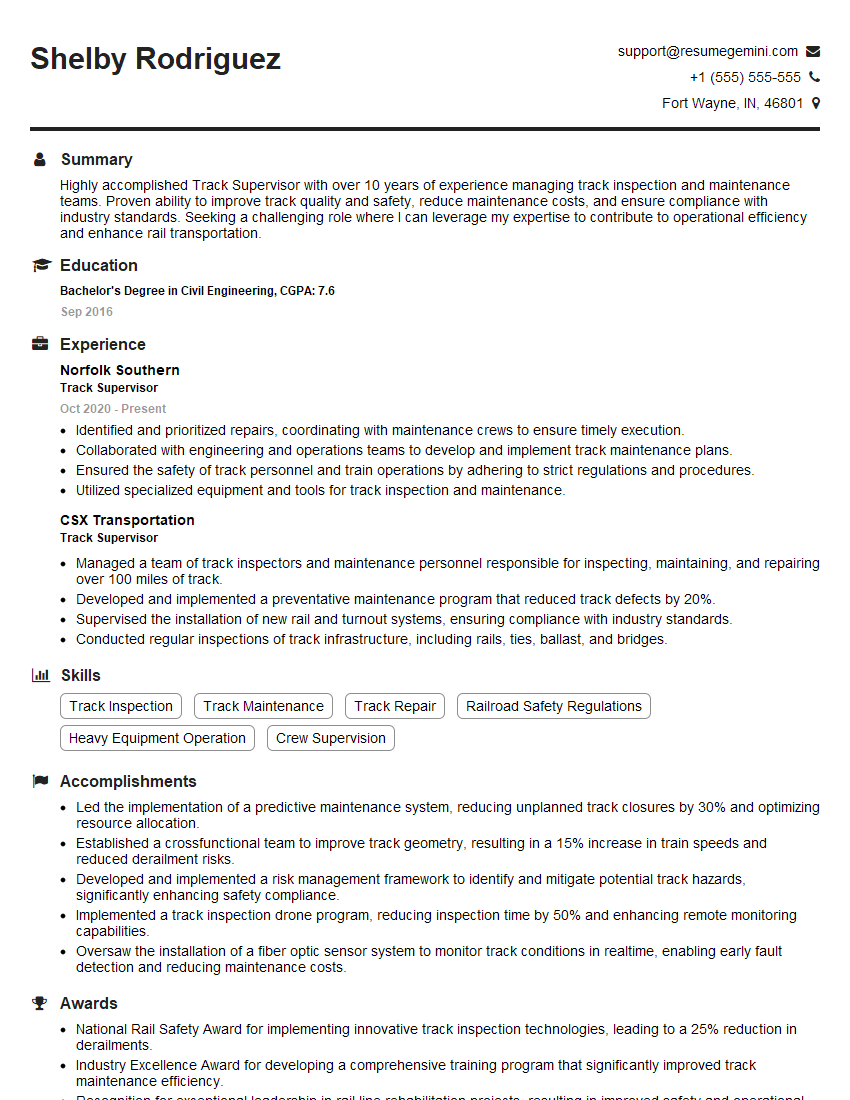
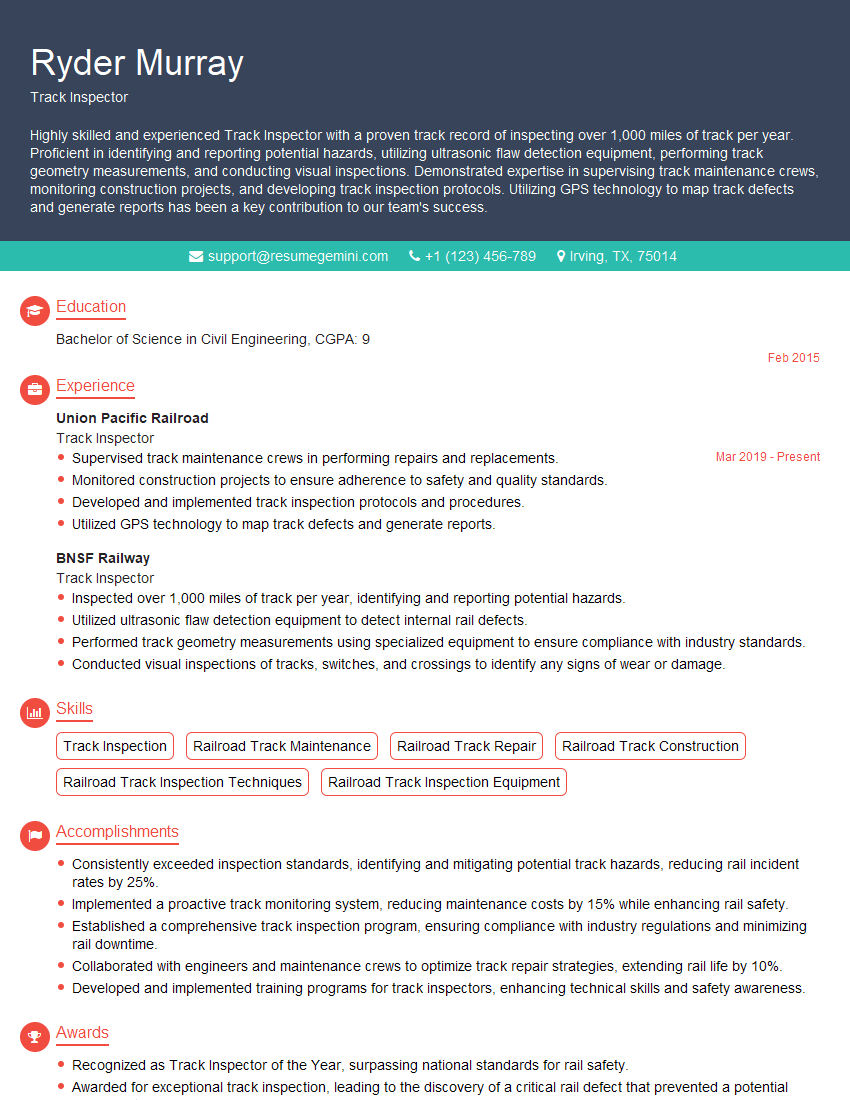
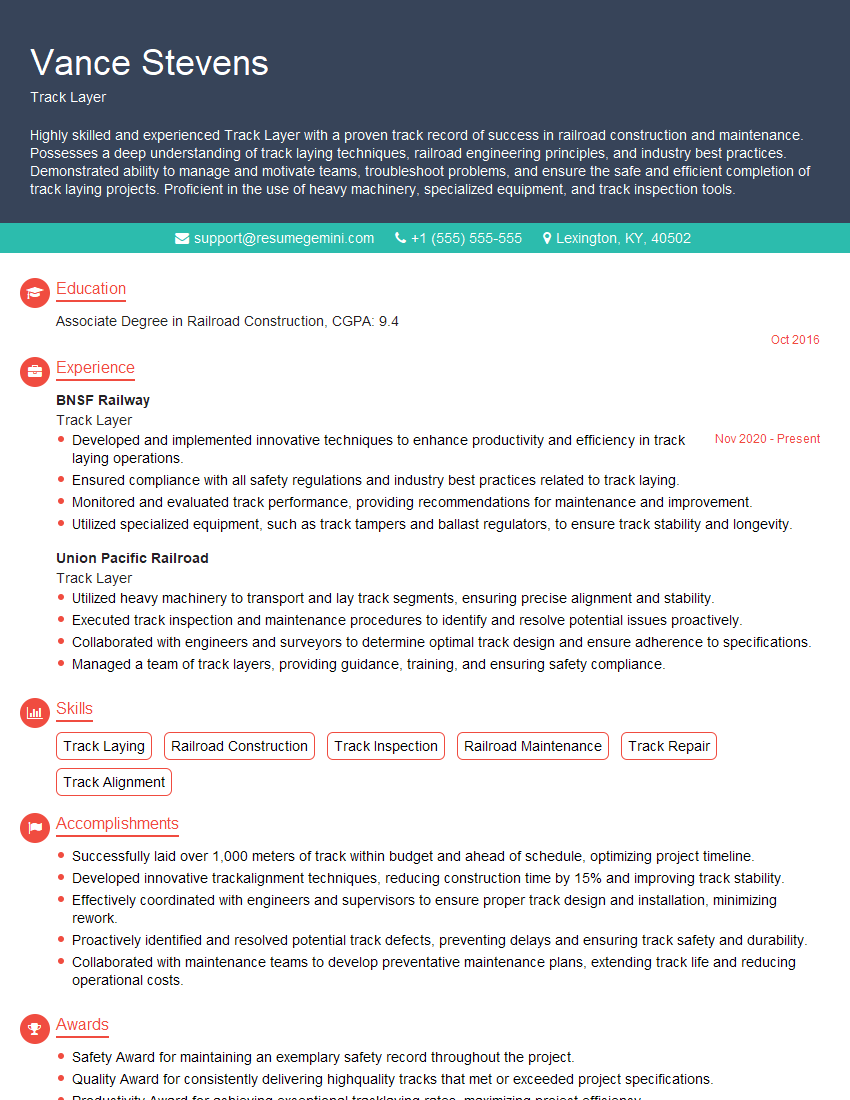
Mastering track laying opens doors to a rewarding career with excellent growth potential in the rail industry. To stand out and maximize your job prospects, crafting an ATS-friendly resume is crucial. ResumeGemini is a trusted resource to help you build a professional and impactful resume that highlights your skills and experience effectively. Examples of resumes tailored specifically to Track Laying are available to help guide you. Invest time in creating a strong resume; it’s your first impression on potential employers.
Explore more articles
Users Rating of Our Blogs
Share Your Experience
We value your feedback! Please rate our content and share your thoughts (optional).
What Readers Say About Our Blog
Very informative content, great job.
good