Every successful interview starts with knowing what to expect. In this blog, we’ll take you through the top IED Detection interview questions, breaking them down with expert tips to help you deliver impactful answers. Step into your next interview fully prepared and ready to succeed.
Questions Asked in IED Detection Interview
Q 1. Describe the different types of IEDs and their common components.
Improvised Explosive Devices (IEDs) are homemade bombs, incredibly diverse in their construction and destructive potential. They can be broadly categorized based on their triggering mechanism, explosive type, and construction.
- Based on triggering mechanism: We have command-detonated IEDs (remotely triggered), victim-operated IEDs (triggered by the intended victim’s actions, like a pressure plate), and time-delayed IEDs (exploding after a preset time).
- Based on explosive type: Common explosives include military-grade materials like C4 or TNT, but also readily available substances such as fertilizer-fuel oil mixtures (ANFO), homemade black powder, or even seemingly innocuous materials like household chemicals when improperly combined.
- Based on construction: IEDs range from simple pipe bombs to sophisticated devices incorporating sophisticated circuitry and multiple explosive charges. Some may be concealed within seemingly ordinary objects, making detection challenging.
Common components often include the explosive material itself, a detonator (to initiate the explosion), a power source (batteries for electronic detonators), a triggering mechanism (switch, pressure plate, timer), and a casing or container to house the device. The complexity varies wildly, from crude devices using readily available materials to highly sophisticated ones incorporating advanced electronics and concealment techniques.
Q 2. Explain the process of conducting a preliminary IED threat assessment.
A preliminary IED threat assessment involves systematically evaluating the likelihood of an IED attack. It starts with gathering intelligence – this could involve reviewing previous incidents, analyzing local security situations, considering potential targets and motivations, and assessing the capabilities of potential perpetrators.
Next, we need to define the specific area or location to be assessed. This might be a building, a public space, or a transportation hub. Then, a visual inspection should be carried out, looking for anything suspicious – unusual packages, wires, or anything out of place. This is followed by a more detailed assessment incorporating available technology like metal detectors and x-ray machines, where appropriate and depending on the circumstances. Finally, we need to interpret the findings, weighing the collected evidence to establish the probability of an IED being present. This assessment informs security protocols and determines the need for more advanced detection measures.
For example, a heightened threat level following a credible intelligence report about a planned attack on a specific landmark would warrant a much more thorough and rigorous assessment compared to a routine security sweep in a low-risk environment.
Q 3. What are the limitations of various IED detection technologies (e.g., X-ray, metal detectors, sniffer dogs)?
While valuable, each IED detection technology has limitations:
- X-ray machines: Excellent for detecting dense metallic objects, but less effective against non-metallic explosives or cleverly concealed devices. The image interpretation also requires trained personnel and can be subjective. Furthermore, the size and portability of X-ray machines can restrict their deployment in certain locations.
- Metal detectors: Primarily detect metallic components, making them ineffective against explosives concealed within non-metallic containers. Their sensitivity and range also limit their ability to identify smaller or deeply buried devices.
- Sniffer dogs: Highly effective at detecting trace amounts of explosive residues, but their performance depends on factors like dog training, environmental conditions, and the presence of masking agents or interfering odors. They are also resource-intensive, requiring specialized training, handlers, and maintenance.
It’s crucial to remember that no single technology offers foolproof detection. A layered approach, combining various methods, maximizes effectiveness and mitigates individual limitations.
Q 4. How do you prioritize potential IED threats based on available intelligence and risk assessment?
Prioritizing IED threats necessitates a structured risk assessment, blending intelligence data with threat probabilities. We use a system that weighs factors like:
- Credibility of intelligence: Sources, verification methods, and the timeliness of information are crucial.
- Target vulnerability: A densely populated area or a high-value target naturally commands higher priority.
- Perpetrator capability: Assessing the resources and expertise of potential attackers gives insights into the complexity and potential of the IED.
- Threat level: Combining all these factors, we assign a risk score, guiding the allocation of resources and response efforts. Higher-risk threats receive immediate attention and more extensive resources than lower-risk ones.
Imagine two potential threats: a vague tip regarding a possible device in a park versus a detailed, confirmed intelligence report about a sophisticated IED planned for a crowded concert. The latter would undoubtedly receive top priority given its higher credibility, potential impact, and the perpetrator’s demonstrated capabilities.
Q 5. What safety precautions must be taken during an IED detection operation?
Safety is paramount during IED detection operations. Standard operating procedures emphasize:
- Controlled access: Restricting access to the potential IED scene to authorized personnel only, establishing a secure perimeter.
- Personal protective equipment (PPE): Using appropriate PPE such as ballistic vests, helmets, and eye protection.
- Safe distances: Maintaining a safe standoff distance from the suspected device to minimize risk during investigation and disposal.
- Communication protocols: Using clear and concise communication channels to coordinate actions and ensure safety among the team.
- Evacuation plans: Having clear evacuation plans and procedures for the public and personnel.
- Emergency response preparedness: Having immediate access to medical support and bomb disposal experts.
These procedures are strictly adhered to, minimizing risks and ensuring the safety of everyone involved.
Q 6. Explain the procedures for handling and disposing of suspected IEDs.
Handling suspected IEDs requires extreme caution and specialized expertise. It’s never attempted by untrained individuals. Procedures typically involve:
- Secure isolation: Establishing a large secure perimeter around the suspect device, controlling and monitoring access.
- Initial assessment: A thorough visual inspection from a safe distance, potentially utilizing remote sensing technologies, to determine the type and potential threat level.
- Disruption or disposal: Specialized bomb disposal units are called in to disarm or dispose of the device using techniques like controlled detonation or other safe disposal methods, depending on the specific circumstances and materials involved.
- Post-blast investigation: After a controlled explosion or disposal, a thorough investigation collects evidence, such as explosive residue or components, to analyze the IED’s construction and potential origin.
These procedures are always conducted by highly trained professionals who have the appropriate equipment and safety measures in place, adhering to strict protocols to minimize risks.
Q 7. Describe your experience with different types of IED detection equipment.
Throughout my career, I’ve gained extensive experience with a variety of IED detection equipment, including:
- Handheld metal detectors: Useful for initial screening and preliminary checks but limited in their detection capabilities. I’ve used them extensively in security checkpoints and preliminary sweeps.
- X-ray systems: From portable baggage scanners to larger, more sophisticated systems, I’ve been involved in their operation and interpretation of the results. I’m proficient in identifying suspicious objects and anomalies.
- Trace explosive detectors: I have experience with ion mobility spectrometers (IMS) and other technologies used to detect trace amounts of explosive residues. These are invaluable in identifying potential explosive threats in challenging environments.
- Ground penetrating radar (GPR): I’ve used GPR systems to locate buried or concealed devices underground, particularly valuable in scenarios involving suspicious packages or landmines.
- Robotics: I’m experienced in operating and utilizing remotely operated robots for investigating and manipulating suspect devices from a safe distance, reducing risk to human personnel.
My experience spans different operational environments, from airport security to conflict zones, providing a broad understanding of the strengths and limitations of each technology within specific contexts.
Q 8. How do you interpret and analyze data from IED detection sensors?
Interpreting data from IED detection sensors involves a multi-step process that combines technical understanding with critical thinking. First, we must understand the sensor’s technology. Is it a metal detector, a ground-penetrating radar (GPR), a chemical sensor, or a combination? Each technology has unique signatures and limitations. For instance, a metal detector might register a high reading near a buried metal object, but this could be a harmless piece of scrap metal or a crucial component of an IED. A GPR generates images of subsurface structures; interpretation requires knowledge of soil composition and the expected appearance of different objects. Chemical sensors detect traces of explosives; false positives are possible due to similar compounds in everyday materials.
Second, the context is crucial. Location, time of day, recent intelligence reports, and surrounding environment all inform the analysis. A high reading in a high-risk area is significantly more concerning than a similar reading in a low-risk area.
Third, data triangulation is critical. We rarely rely on a single sensor reading. Multiple sensors with different capabilities provide a more comprehensive picture. For example, combining metal detection data with GPR data might reveal a buried metallic object consistent with an IED casing.
Finally, any anomaly requires careful and methodical investigation, possibly including visual inspection and controlled excavation under strict safety protocols. It is better to be cautious than to risk a premature judgment.
Q 9. What are the key elements of a successful C-IED strategy?
A successful Counter-Improvised Explosive Device (C-IED) strategy hinges on several key elements. Firstly, comprehensive intelligence gathering is paramount. This involves developing a strong network of human intelligence (HUMINT), signal intelligence (SIGINT), and open-source intelligence (OSINT) to identify potential IED threats, predict trends, and learn from past attacks.
- Human Intelligence (HUMINT): Gathering information from informants and local populations is invaluable.
- Signal Intelligence (SIGINT): Intercepting communications related to IED planning and placement.
- Open-Source Intelligence (OSINT): Utilizing publicly available information like social media and news reports.
Secondly, robust technical capabilities are essential. This includes utilizing a range of detection technologies (metal detectors, GPR, chemical sensors, canine units), employing effective search techniques, and maintaining well-trained and equipped teams.
Thirdly, strong community engagement is vital. Building trust with the local population encourages information sharing and fosters a sense of collective responsibility in combating IED threats. This often involves education and outreach programs to help people recognize and report suspicious items.
Finally, a well-defined operational plan that accounts for all potential scenarios is necessary. This plan must detail roles, responsibilities, and communication protocols to ensure effective response and mitigation in case an IED is discovered. Regular training and drills will further ensure that the team is able to quickly and safely respond to any threat.
Q 10. Explain the role of communication and coordination during an IED response.
Communication and coordination are absolutely critical during an IED response. A breakdown in communication can lead to tragic consequences. Clear, concise, and unambiguous communication protocols are essential from initial detection to final disposal. Think of it like a well-orchestrated symphony; every instrument (team member, agency) must play its part in perfect harmony.
This involves using a combination of communication channels – secure radios, dedicated communication networks, and perhaps even hand signals in certain situations. A designated incident commander ensures that all parties are informed of the situation, understand their roles, and maintain situational awareness. This often involves the use of pre-established communication trees and check-in procedures.
Furthermore, maintaining accurate records of all actions, observations, and decisions is critical for post-incident analysis and future training. This documentation allows for a review of procedures, identification of areas for improvement, and the possibility of gathering further intelligence.
For example, imagine a scenario where an IED is discovered in a crowded market. The first responder needs to immediately communicate the threat to the incident commander, who then coordinates the evacuation of the area, the arrival of specialist disposal units, and any necessary law enforcement intervention. Every step requires precise and timely communication.
Q 11. Describe your experience working with interagency or multinational teams on IED detection operations.
Throughout my career, I’ve had extensive experience working with interagency and multinational teams on IED detection operations. This includes collaborations with military units, law enforcement agencies, intelligence services, and humanitarian organizations from various countries. Successful collaboration requires a deep understanding of cultural nuances, communication styles, and operational procedures of each team member. It necessitates mutual respect, trust, and a shared commitment to achieving a common goal.
A particularly memorable experience involved a multinational team tasked with clearing IEDs from a heavily contaminated area post-conflict. The diverse expertise of the team (explosives ordnance disposal, engineers, medical personnel) was pivotal to ensuring the safety of the operation while effectively neutralising the threat. Regular briefings, shared situational awareness, and robust communication protocols were vital for our success. In such scenarios, adapting communication to match the skill level and background of each team member ensures shared understanding and efficient execution.
These collaborative endeavors highlight the importance of standardized procedures and shared terminology in complex multinational operations. Effective coordination necessitates clear communication, trust, and a mutual understanding of each other’s capabilities and limitations. It often involves pre-operation briefings, regularly scheduled updates, and post-operation debriefings to identify areas of success and improvement.
Q 12. How do you handle a situation where an IED detection device malfunctions?
Malfunctions of IED detection devices are a serious concern, as they can lead to a failure to detect a threat. The immediate response depends on the nature of the malfunction. If it’s a minor issue like a dead battery, replacement is straightforward. However, more complex malfunctions require a more systematic approach.
The first step is to immediately isolate the device and inform the team. Any potential threat should be treated with extreme caution. The next step is to attempt basic troubleshooting based on the device’s operating manual. This might involve checking connections, power sources, or performing a system reset. If the malfunction persists, the device should be removed from service and sent for repair or replacement.
In the meantime, alternative detection methods must be implemented. This could involve deploying backup devices, utilizing different detection technologies (e.g., using a hand-held metal detector if the GPR malfunctions), or resorting to more traditional visual inspection methods. The key is to maintain a thorough and systematic approach to minimize the risk of overlooking any potential threat.
Thorough device maintenance and regular calibration are essential in preventing malfunctions. This includes keeping detailed maintenance logs for every device, ensuring it’s properly cleaned and stored, and adhering to manufacturer recommendations regarding calibration schedules.
Q 13. What are the ethical considerations involved in IED detection and disposal?
Ethical considerations in IED detection and disposal are multifaceted and demand careful consideration at every stage. The primary ethical imperative is the safety of civilians and personnel involved in the operation. This demands adherence to strict safety protocols, thorough risk assessments, and prioritizing the protection of human life above all else.
Secondly, there are significant legal and humanitarian considerations. The use of force, particularly in civilian areas, must be proportionate to the threat, minimizing collateral damage to property and avoiding any unnecessary loss of life. Disposal procedures must adhere to international humanitarian law and national regulations.
Thirdly, the collection and handling of evidence requires strict adherence to legal protocols to ensure admissibility in any potential legal proceedings. This includes maintaining a detailed chain of custody for any recovered evidence.
Moreover, the potential for misuse of IED detection technologies raises important ethical questions. These technologies must be deployed responsibly and transparently, and their applications must align with human rights principles. Preventing the technology from falling into the wrong hands is paramount.
Finally, a post-incident review is critical to identify and learn from any mistakes made during the operation, ensuring that future procedures are even more sensitive to ethical considerations and improve the efficacy of response and mitigation efforts. This includes evaluating the impact on civilians, reviewing communication protocols, and assessing potential improvements to training practices.
Q 14. Explain your understanding of improvised explosive device (IED) construction techniques.
Understanding IED construction techniques is vital for effective detection and mitigation. IEDs are incredibly diverse, ranging from simple pressure-activated devices to sophisticated electronically detonated systems. However, several common elements exist across various designs.
The basic components typically include an explosive charge (main charge), a detonator (trigger), and an initiation system. The explosive charge can be anything from commercially available explosives like dynamite or military-grade plastic explosives like C4 to homemade mixtures. The detonator initiates the explosion and might be a simple fuse, an electric detonator, or even a cell phone trigger. The initiation system is the method used to set off the detonator.
Construction techniques vary significantly. Simple IEDs might involve crudely assembled components, whereas sophisticated IEDs might incorporate camouflage, concealment techniques, and anti-tamper mechanisms. Improvised devices are often built using readily available materials – fertilizer, household chemicals, readily available metals, even common household items. Understanding these construction techniques is critical in anticipating how an IED might be constructed and concealed, informing search strategies and improving detection capabilities.
Furthermore, the construction techniques can often reveal information about the bomb-maker’s capabilities, resources, and likely intent, which is invaluable intelligence information. Analyzing the construction materials and the sophistication of the device may offer clues regarding potential future threats. This knowledge greatly aids in developing effective countermeasures and proactive strategies.
Q 15. Describe different methods for searching for IEDs in various environments (urban, rural, etc.).
Searching for IEDs requires a multi-faceted approach tailored to the specific environment. Urban environments present unique challenges due to high population density and complex infrastructure. Methods here often involve a combination of:
- Visual inspections: Trained personnel systematically examine areas for suspicious objects, paying close attention to unusual placements or anomalies.
- Canine detection: Highly trained dogs possess an exceptional sense of smell and can detect trace amounts of explosives, significantly speeding up the search process in cluttered areas. We often use them in conjunction with other methods for maximum effectiveness.
- Technical detection: Portable X-ray and millimeter-wave scanners can be used to examine suspicious packages non-destructively, revealing potential internal components. Ground-penetrating radar (GPR) can also be employed to locate buried devices.
- CCTV and other surveillance methods: Reviewing footage can help identify suspicious activity leading up to a potential IED placement.
Rural environments present different challenges, often involving larger search areas and less readily available infrastructure. Methods here include:
- Aerial surveillance: Drones and aircraft equipped with high-resolution cameras and sensors can cover vast areas quickly.
- Vehicle-mounted detection systems: These systems can scan roadsides for buried or concealed IEDs, enhancing the security of patrols.
- Foot patrols: Although more time-consuming, foot patrols are essential for thoroughly searching rough terrain inaccessible to vehicles.
In both urban and rural settings, collaboration and information sharing are crucial. Intelligence from local communities, law enforcement, and other agencies can greatly enhance search effectiveness. Remember, safety always comes first – adhering to proper procedures is paramount to minimize risk.
Career Expert Tips:
- Ace those interviews! Prepare effectively by reviewing the Top 50 Most Common Interview Questions on ResumeGemini.
- Navigate your job search with confidence! Explore a wide range of Career Tips on ResumeGemini. Learn about common challenges and recommendations to overcome them.
- Craft the perfect resume! Master the Art of Resume Writing with ResumeGemini’s guide. Showcase your unique qualifications and achievements effectively.
- Don’t miss out on holiday savings! Build your dream resume with ResumeGemini’s ATS optimized templates.
Q 16. How would you mitigate the risk of secondary IEDs?
Mitigating the risk of secondary IEDs is critical. Secondary devices are often designed to target first responders and those involved in the initial response. This requires a layered approach:
- Controlled detonation: Where safe and feasible, trained explosive ordnance disposal (EOD) technicians may opt for controlled detonation of a suspected primary IED, reducing the risk of triggering a secondary device.
- Careful search and cordoning: Establishing a large security perimeter around the initial blast site significantly reduces the chance of anyone coming into contact with a secondary device. Thorough searches are crucial for finding secondary devices within this perimeter. We utilize various methods as discussed earlier, including canine detection and technical scans.
- Robotic investigation: Employing robots to initially investigate suspicious packages limits potential exposure to personnel, reducing the chance of triggering a secondary device. They can carry cameras, sensors, and even small explosive disruption tools.
- Intelligence gathering: Post-blast investigations, discussed later, are key to uncovering intelligence on potential secondary devices and patterns used by the perpetrators.
- Personnel training: Training first responders on secondary device awareness and safe practices is crucial. This includes understanding common tactics used by terrorists and recognizing potential warning signs.
The overall goal is to create a controlled environment that minimizes risk during the aftermath of an IED incident.
Q 17. What are the common indicators of an IED?
Recognizing the signs of an IED requires vigilance and a keen eye for detail. There’s no single definitive indicator, but a combination of suspicious circumstances should raise concerns. Common indicators include:
- Unusual objects in unexpected locations: A backpack left unattended in a crowded area, a package near a building entrance, or anything out of place warrants investigation.
- Suspicious wiring or components: Visible wires, timers, batteries, or other electronic components can be clear signs of an IED.
- Unusual odors: The smell of certain chemicals associated with explosives should be reported immediately. This requires training to distinguish these odors from other common smells.
- Unexplained packages or containers: Anything that seems out of place, especially if it’s sealed or doesn’t appear to have a clear purpose, should be treated with caution.
- Suspicious behavior: Individuals acting nervously, avoiding eye contact, or constantly looking around could be attempting to place or trigger an IED.
- Intelligence reports: Information from various sources can help identify potential targets and IED threats.
It’s crucial to remember that a lack of visible components doesn’t automatically rule out an IED. Sophisticated devices can be cleverly concealed.
Q 18. Explain the importance of post-blast investigation in IED incidents.
Post-blast investigations are critical for several reasons: they provide crucial evidence for law enforcement, help prevent future attacks, and inform counter-terrorism strategies. The investigation focuses on:
- Evidence collection: Gathering physical evidence from the blast site, such as explosive residue, device components, and any available fingerprints or DNA, is vital for identifying the perpetrators and understanding the device’s construction.
- Reconstruction of the event: Analyzing the blast site to determine the type and size of the explosive used, the placement of the device, and the likely detonation method aids in identifying the modus operandi.
- Intelligence gathering: This involves identifying the individuals or groups responsible for the attack, their motives, and any potential links to other terrorist activities.
- Lessons learned: The investigation helps understand weaknesses in security measures, vulnerabilities exploited, and inform updated procedures to prevent future similar incidents.
A thorough post-blast investigation is a complex and meticulous process requiring specialized skills and equipment. The findings directly inform future security protocols and counter-terrorism efforts, preventing future attacks.
Q 19. How do you maintain situational awareness during an IED operation?
Maintaining situational awareness during an IED operation is crucial for the safety of personnel and the success of the operation. This involves:
- Continuous observation: Keeping a constant watch on the surroundings, including potential threats, the team’s position, and the immediate area of operation.
- Communication: Maintaining clear and constant communication with the team and command center ensures coordinated actions and rapid responses to changing situations.
- Risk assessment: Continuously evaluating potential threats and adjusting tactics as needed. This includes considering potential secondary devices or other hazards.
- Use of technology: Employing technologies such as surveillance equipment, GPS tracking, and communication systems enhances situational awareness.
- Personnel training: Highly trained personnel are essential. This includes training on threat assessment, communication protocols, and emergency procedures.
Situational awareness is a dynamic process – it requires constant vigilance and adaptation based on changing circumstances. A lapse in awareness can have severe consequences.
Q 20. Describe your experience with using technical intelligence to identify potential IED threats.
Technical intelligence plays a crucial role in identifying potential IED threats. My experience includes analyzing various forms of intelligence, such as intercepted communications, open-source data, and signals intelligence, to identify patterns, trends, and potential IED threats. For example, intercepted communications could reveal plans to construct or deploy an IED, while open-source intelligence might uncover potential target locations or the acquisition of bomb-making materials. I’ve been involved in:
- Analyzing intercepted communications: Identifying keywords, coded language, and other indicators of IED planning or deployment.
- Geospatial analysis: Using mapping and geographic information systems to identify potential target locations based on intelligence reports.
- Data mining: Using algorithms and software to identify patterns and anomalies in large datasets of intelligence information.
- Collaborating with other agencies: Sharing intelligence information with law enforcement and other intelligence agencies to build a comprehensive understanding of the threat landscape.
This process allows us to predict potential IED attacks, prioritize resources, and deploy countermeasures effectively. It’s crucial to analyze intelligence rapidly and disseminate it to relevant teams.
Q 21. What are the challenges of using dogs for IED detection?
While canine detection is highly effective, it presents some challenges:
- Training and maintenance: Training dogs to reliably detect explosives requires specialized expertise and ongoing training and maintenance. Their performance can be affected by their health and overall well-being.
- Environmental factors: External factors such as weather conditions, ground cover, and the presence of other scents can affect a dog’s ability to detect explosives.
- False positives and negatives: Dogs, like any detection system, are not perfect. They can sometimes give false positives (indicating the presence of explosives when none exist) or false negatives (missing explosives that are present).
- Limited range: A dog’s detection range is limited, meaning they must be deployed strategically to thoroughly cover a search area.
- Safety concerns: Deploying dogs in hazardous environments presents risks to their safety and well-being.
Despite these challenges, the advantages of canine detection, particularly their speed and effectiveness, often outweigh the drawbacks. Careful planning, meticulous training, and proper safety precautions are crucial to mitigate these challenges.
Q 22. Explain the use of different types of explosives in IED construction.
Improvised Explosive Devices (IEDs) utilize a wide range of explosives, each with unique properties influencing their effectiveness and detection. The choice of explosive often depends on availability, desired destructive power, and the intended target.
Military-grade explosives: These are powerful, readily available (though often illegally) and include materials like C4 (Composition C4), Semtex, and RDX. They offer high blast power and are commonly used in sophisticated IEDs.
Commercial explosives: These are legally available materials, such as dynamite or blasting agents (ammonium nitrate-fuel oil mixtures – ANFO), often diverted for illicit use. ANFO, while less powerful than military-grade explosives, is easily accessible and readily mixed, making it a common component in IEDs.
Homemade explosives: These are mixtures of readily available chemicals, such as fertilizer and fuel oil (creating a crude form of ANFO), or peroxide-based explosives (Triacetone Triperoxide – TATP). These are dangerous to make, often unstable, and their power is less predictable, but their accessibility makes them attractive to IED constructors.
Understanding the specific explosive used is crucial for effective detection and disposal. The chemical signature, sensitivity, and explosive yield all differ significantly between these types, influencing the methods used to detect and neutralize the device.
Q 23. What is your experience with using remote-controlled robots for IED disposal?
I have extensive experience utilizing remote-controlled robots, specifically the iRobot PackBot and similar models, for IED disposal. These robots are invaluable tools, allowing for safe examination and manipulation of suspicious devices from a safe distance. My experience includes both observation and disposal tasks, such as using the robot’s manipulator arm to carefully disable triggering mechanisms or cut wires.
A typical scenario involves deploying the robot equipped with cameras and a variety of tools, including a disruptor (for disabling electronic components), cutting tools, and a grappling hook. The robot provides a live feed to the operator, allowing for precise manipulation while keeping personnel out of harm’s way. We utilize the robot’s mobility to maneuver through difficult terrain or navigate confined spaces where visual inspection or manual intervention would be too risky.
Moreover, the robot’s data logging capabilities are crucial. We can record the entire operation, providing valuable evidence for post-incident analysis and improvements to future procedures.
Q 24. How would you respond to a false positive IED alert?
Responding to a false positive IED alert requires a methodical approach prioritizing safety and minimizing disruption. The first step is to secure the area, establishing a perimeter to prevent unauthorized access. Then, a thorough reassessment is conducted, focusing on eliminating all possible sources of the false positive.
Recalibration of equipment: If the alert originated from a sensor, such as a metal detector or X-ray machine, a recalibration check is immediately performed to ensure it’s functioning correctly and hasn’t been compromised.
Visual inspection: A thorough visual inspection of the area is carried out, closely examining all items previously deemed suspicious. Often, a harmless object might be mistaken for an explosive component.
Canine search: If available and appropriate for the environment, an explosives detection canine team is deployed for a secondary search to verify the initial alert.
Expert assessment: In complex cases, bomb disposal experts provide an independent assessment, using various detection tools, to confirm the absence of any explosive device.
Documentation of all actions taken during the assessment and the reasons for dismissing the alert is critical. It allows for future analysis and helps improve procedures to minimize false positives in future operations.
Q 25. Describe your experience with different types of explosive detection dogs and their capabilities.
My experience includes working with various breeds of explosive detection canines, primarily Labrador Retrievers and German Shepherds. These dogs possess exceptional olfactory senses, capable of detecting minute traces of explosive compounds, often undetectable by human senses or technology.
Their capabilities vary based on the dog’s individual training and specialization. Some dogs excel at detecting specific explosives, like TNT or Semtex, while others are trained for a broader range of compounds. Regular training, including exposure to a wide range of substances and environmental conditions, is essential to maintain their proficiency and reliability.
Canine teams are invaluable assets, particularly in situations where a thorough, rapid search is needed. They excel at detecting explosives concealed in complex environments or hidden within crowded areas, complementing technological detection methods. It is always important to understand their limitations and complement them with other forms of detection.
Q 26. What are some common IED triggering mechanisms?
IED triggering mechanisms can vary greatly in sophistication and complexity, ranging from simple to highly intricate systems. The choice of triggering mechanism often influences the device’s overall design and effectiveness.
Time-delay fuses: These use a simple timer to detonate the device after a pre-set time, allowing for controlled detonation.
Pressure switches: These are activated by the application of pressure on the device. For instance, weight or a victim stepping on a pressure plate.
Tripwires: These simple mechanical devices detonate the IED when a wire is disturbed.
Remote control: Often employing radio frequencies or cell phone signals, this offers the perpetrator control over the timing and location of detonation.
Victim-operated switches: These devices require some sort of interaction from the victim, such as turning a key or pressing a button, before detonation.
Understanding the various triggering mechanisms is crucial for effective countermeasures and for analyzing post-blast evidence to identify the perpetrators and methods used.
Q 27. How familiar are you with different types of countermeasures against IEDs?
My familiarity with countermeasures against IEDs is extensive, encompassing both technical and procedural aspects. Effective countermeasures require a multi-layered approach, combining technological advancements with rigorous procedures and training.
Technological countermeasures: This includes advanced detection systems such as X-ray machines, metal detectors, and explosives trace detectors. Jammers can also disrupt remote-controlled detonations.
Procedural countermeasures: These involve established protocols for handling suspicious packages, vehicle checkpoints, and personnel screening. Proper training of personnel and awareness among the public are key components of procedural countermeasures.
Protective measures: This includes using armored vehicles, blast-resistant structures, and personal protective equipment to mitigate the impact of explosions.
Intelligence gathering: Proactive intelligence gathering and analysis are crucial in identifying potential threats and preventing IED attacks.
The effectiveness of countermeasures is highly dependent on adapting strategies to the specific threat environment and constantly evolving in response to new IED techniques.
Q 28. What are the potential long-term health effects associated with IED detection work?
IED detection work carries significant potential long-term health risks. Exposure to explosive materials, even in small amounts, can have severe consequences.
Hearing loss: The deafening blasts associated with IED explosions, even at safe distances, can cause permanent hearing damage.
Respiratory problems: Exposure to dust and fumes generated by explosions can cause respiratory illnesses, including asthma and chronic obstructive pulmonary disease (COPD).
Psychological trauma: Witnessing or responding to IED attacks can lead to post-traumatic stress disorder (PTSD) and other psychological conditions.
Exposure to hazardous chemicals: Handling or being near explosives exposes personnel to various harmful chemicals, leading to long-term health issues.
Therefore, stringent safety protocols, including proper personal protective equipment (PPE) and regular medical checkups, are critical to mitigate these risks. Psychological support and rehabilitation are essential for those impacted by traumatic events.
Key Topics to Learn for IED Detection Interview
- Fundamentals of Explosives: Understanding different types of explosives, their composition, and detonation mechanisms. This includes recognizing common precursors and improvised explosive devices (IEDs).
- IED Construction and Design: Analyzing the common components of IEDs, including triggering mechanisms, power sources, and casing materials. Practical application involves interpreting schematics and understanding potential variations in IED construction.
- Detection Technologies: Familiarize yourself with various detection methods, such as X-ray, millimeter-wave, trace detection (explosive residue analysis), and canine detection. Understand the strengths and limitations of each technology.
- Threat Assessment and Risk Management: Learn to analyze threat information, assess risk levels, and develop appropriate response strategies. This includes understanding the implications of false positives and false negatives in detection.
- Search Techniques and Procedures: Master systematic search methods for both personnel and vehicle searches, understanding safety protocols and best practices for handling potential IEDs.
- Counter-IED (C-IED) Tactics and Strategies: Explore C-IED methodologies, including proactive measures, preventative strategies, and response procedures during incidents. This involves understanding the importance of coordination and collaboration.
- Legal and Ethical Considerations: Understand the legal and ethical implications of IED detection, including search warrants, privacy concerns, and the handling of evidence.
- Data Analysis and Interpretation: Practice analyzing data from various detection systems and interpreting results effectively. This involves understanding statistical concepts and making informed decisions based on available information.
Next Steps
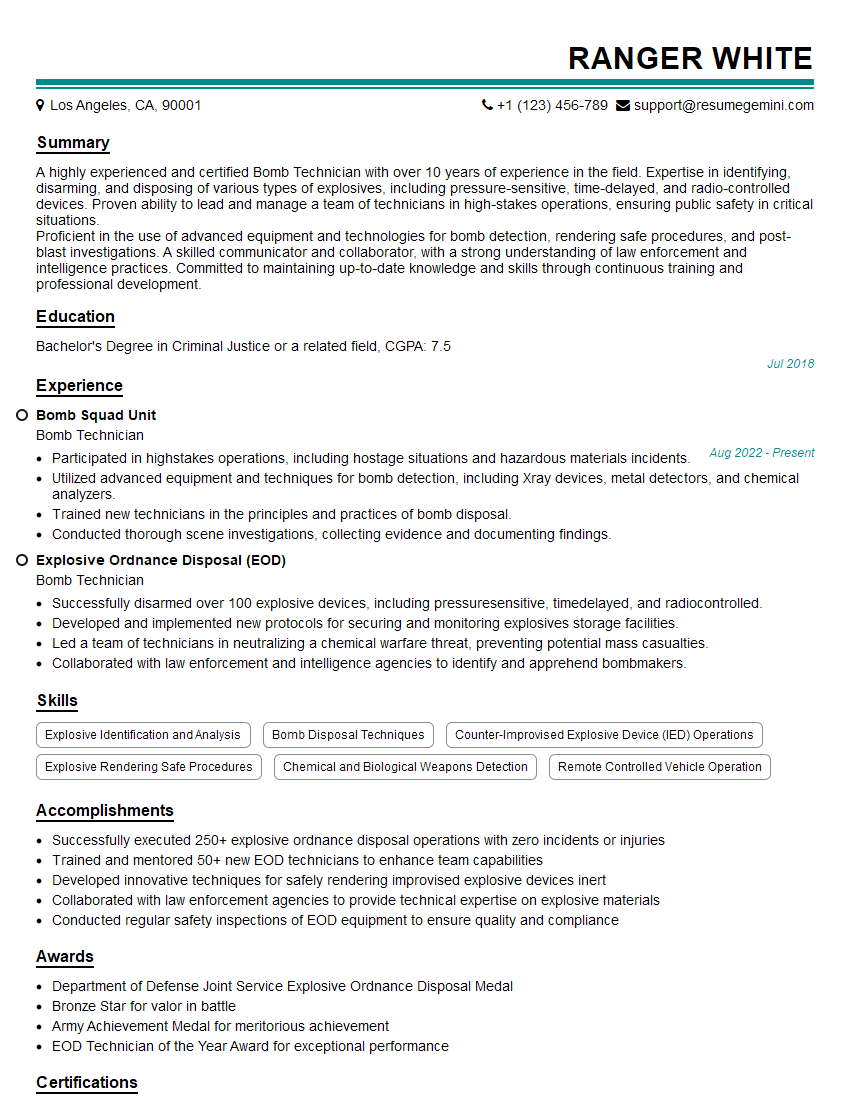
Mastering IED detection opens doors to a rewarding career with significant impact. Proficiency in this field is highly sought after, offering excellent opportunities for growth and specialization. To maximize your chances of landing your dream role, creating a strong, ATS-friendly resume is crucial. ResumeGemini is a trusted resource to help you build a professional and impactful resume that showcases your skills and experience effectively. Examples of resumes tailored to IED Detection are available within ResumeGemini to help guide your efforts.
Explore more articles
Users Rating of Our Blogs
Share Your Experience
We value your feedback! Please rate our content and share your thoughts (optional).
What Readers Say About Our Blog
Very informative content, great job.
good