Feeling uncertain about what to expect in your upcoming interview? We’ve got you covered! This blog highlights the most important Illuminance Calculations interview questions and provides actionable advice to help you stand out as the ideal candidate. Let’s pave the way for your success.
Questions Asked in Illuminance Calculations Interview
Q 1. Define illuminance and luminance. What are their units?
Illuminance and luminance are both crucial photometric quantities describing light, but they focus on different aspects. Illuminance refers to the amount of light falling on a surface, essentially how much light is incident on a specific area. Think of it as the ‘lighting level’ at a point. Its unit is the lux (lx), which is one lumen per square meter (lm/m²). Luminance, on the other hand, is the amount of light emitted, reflected, or transmitted from a surface in a particular direction per unit area per unit solid angle. It describes how bright a surface appears to an observer. Its unit is the candela per square meter (cd/m²), also known as a nit. Imagine comparing the brightness of a computer screen (luminance) and the lighting level in the room (illuminance).
Q 2. Explain the inverse square law as it relates to illuminance.
The inverse square law describes the relationship between illuminance (E) and distance (d) from a point light source. It states that illuminance is inversely proportional to the square of the distance from the source. Mathematically: E ∝ 1/d². This means if you double the distance from a light source, the illuminance drops to one-fourth. If you triple the distance, the illuminance drops to one-ninth. Think of it like shining a flashlight: the light spreads out as it travels, reducing its intensity per unit area over a larger surface area at increasing distances. This law is fundamental in lighting design, allowing us to predict illuminance levels at different distances from a light source and account for the spread of light.
Q 3. How do you calculate illuminance using the point source method?
Calculating illuminance using the point source method is relatively straightforward. The formula is: E = I * cos(θ) / d², where:
Eis the illuminance (lux)Iis the luminous intensity of the source (candela, cd)θis the angle between the light ray and the surface normal (perpendicular to the surface)dis the distance between the light source and the surface (meters, m)
For a surface directly facing the source, cos(θ) = 1. Let’s say we have a light source with a luminous intensity of 1000 cd, and we want to calculate the illuminance at a distance of 2 meters on a surface directly facing the light. The calculation would be: E = 1000 cd * cos(0°) / (2 m)² = 250 lx. This method assumes a perfect point source and doesn’t account for light absorption or reflection in the environment, but it’s a good starting point for initial estimations.
Q 4. Describe the different types of light sources and their luminous efficacy.
Various light sources exist, each with its luminous efficacy – the ratio of luminous flux (lumens) to power consumption (watts). Higher efficacy indicates more light per watt. Here are a few examples:
- Incandescent lamps: Low efficacy (around 10-20 lm/W), produce heat alongside light.
- Fluorescent lamps: Higher efficacy (50-100 lm/W), longer lifespan than incandescent but contain mercury.
- High-Intensity Discharge (HID) lamps (e.g., metal halide, high-pressure sodium): Very high efficacy (80-150 lm/W), used in large spaces.
- Light-Emitting Diodes (LEDs): Very high efficacy (up to 200 lm/W or more), long lifespan, energy-efficient, and offer design flexibility.
The choice of light source depends on factors such as application, energy efficiency requirements, lifespan expectations, color rendering capabilities, and initial cost.
Q 5. What are the key factors influencing illuminance levels in a space?
Several factors influence illuminance levels:
- Light source characteristics: Luminous intensity, luminous flux, and spectral distribution of the source.
- Distance from the source: As explained by the inverse square law.
- Surface reflectivity: Highly reflective surfaces increase illuminance levels.
- Light absorption and scattering: Materials in the environment absorb and scatter light, reducing illuminance.
- Room geometry and layout: Room size, shape, and the positioning of light fixtures affect illuminance distribution.
- Number and type of light fixtures: More fixtures or higher-intensity fixtures increase illuminance.
Understanding these factors is crucial for designing efficient and effective lighting systems. For example, a dark-colored wall absorbs more light than a light-colored one, directly impacting the illuminance in the room.
Q 6. Explain the concept of illuminance uniformity and its importance.
Illuminance uniformity refers to the evenness of light distribution across a surface or space. High uniformity means relatively consistent illuminance levels throughout, minimizing harsh shadows and glare, leading to better visual comfort. Low uniformity results in uneven lighting, potentially causing discomfort and strain on the eyes. The importance of uniformity depends on the application. For instance, a high degree of uniformity is desirable in an office or classroom to ensure comfortable and visually productive environments. In contrast, a retail space might benefit from a more varied illuminance to highlight specific products or create ambiance.
Q 7. How do you determine the required illuminance levels for different applications (e.g., office, classroom, retail)?
Required illuminance levels vary significantly depending on the application. These levels are usually determined based on codes, standards, and best practices that consider visual tasks and safety. Here are some examples:
- Offices: Typically 300-500 lx, depending on the visual tasks involved.
- Classrooms: Usually 500-750 lx, to facilitate reading and writing.
- Retail spaces: Often 500-1000 lx or higher, with higher levels used to highlight merchandise.
Several lighting design standards and guidelines, such as those published by the Illuminating Engineering Society (IES), provide detailed recommendations for different applications. These standards account for factors like the type of visual tasks, age of occupants, and ambient conditions. Consulting these guidelines is critical in lighting design to ensure the right illuminance levels for various spaces and activities are achieved.
Q 8. What are the common methods used for measuring illuminance?
Illuminance, the amount of light falling on a surface, is measured using instruments called lux meters or illuminance meters. These devices typically employ a photodiode or photocell that converts light into an electrical signal, which is then processed to display the illuminance in lux (lx), the SI unit of illuminance. There are several types of lux meters, ranging from simple handheld devices for quick measurements to more sophisticated instruments used for detailed studies. Some advanced models can even log data over time and provide spectral information, which is particularly useful in specialized applications like spectral power distribution analysis.
The measurement process involves positioning the sensor of the lux meter perpendicular to the surface being measured and taking multiple readings at different locations to get an average illuminance. Accurate measurement also requires considering factors like ambient light, sensor calibration, and the cosine correction of the sensor to account for light incident at different angles.
Q 9. Explain the principles of daylighting design and its impact on illuminance.
Daylighting design focuses on harnessing natural light to illuminate interior spaces, reducing reliance on electric lighting and lowering energy consumption. The principles involve strategic placement of windows, skylights, light shelves, and other architectural elements to maximize daylight penetration and distribution. Effective daylighting considers factors such as the orientation of the building, the climate, and the type of glazing used, aiming for a comfortable and well-lit interior environment.
The impact on illuminance is significant. By optimizing natural light sources, daylighting design can significantly increase the illuminance levels within a space during daytime hours, often reducing the need for artificial lighting and leading to considerable energy savings. However, it’s crucial to manage daylight effectively to prevent glare and excessive brightness, which can negatively impact visual comfort. This often involves incorporating light diffusing elements, blinds, or other light control strategies. Consider a well-designed atrium in an office building – its strategic skylights and carefully chosen glazing materials maximize daylight penetration, contributing significantly to the overall illuminance levels, potentially eliminating the need for artificial lighting during parts of the day. This reduces energy consumption and creates a more pleasant and healthy work environment.
Q 10. How do you account for light reflections and absorptions in illuminance calculations?
Light reflections and absorptions significantly influence illuminance calculations. We use the concept of reflectance (the ratio of reflected light to incident light) and absorptance (the ratio of absorbed light to incident light). These properties vary widely depending on the surface material. A white surface has high reflectance, while a black surface has low reflectance and high absorptance. Ignoring reflections can lead to underestimation of illuminance, while ignoring absorption causes overestimation.
In illuminance calculations, the impact of reflections and absorptions is often modeled using ray tracing or radiance simulation techniques. These sophisticated computational methods trace the path of light rays as they bounce off and are absorbed by surfaces within a space, providing a more accurate representation of the final illuminance distribution. For simpler scenarios, the Luminous Exitance (M) and Illuminance (E) can be used with adjustments based on surface properties and the Inverse Square Law for a basic approximation.
For example, a classroom with light-colored walls and ceiling will have a higher illuminance than a classroom with dark walls and ceiling for the same amount of light input because of differences in reflectance. Professional lighting design software packages employ these advanced algorithms to simulate lighting scenarios and predict illuminance levels accurately.
Q 11. Describe the role of lighting controls in optimizing illuminance levels.
Lighting controls play a crucial role in optimizing illuminance levels by enabling dynamic adjustment of light output according to the needs of the space and occupancy. These controls can range from simple on/off switches to sophisticated systems that integrate sensors, timers, and dimming capabilities. The goal is to provide appropriate illuminance without excessive energy consumption. Dimming controls, for instance, allow us to gradually reduce light output during periods of low occupancy or when daylight is sufficient, reducing wasted energy.
Occupancy sensors automatically switch lights on and off based on the presence or absence of people, preventing unnecessary energy waste in unoccupied areas. Daylight harvesting systems dynamically adjust artificial lighting levels based on the availability of daylight, reducing the need for electric lighting during the day. These systems often incorporate sensors that measure ambient illuminance, automatically adjusting light output from artificial sources to maintain a target illuminance level, ensuring a comfortable and energy-efficient environment. Consider a large office building employing a sophisticated lighting management system – it’ll use occupancy sensors to shut off lights in empty rooms, daylight sensors to dim lights during sunny days and automated scheduling to optimize energy efficiency throughout the day.
Q 12. What are the advantages and disadvantages of different lighting technologies (e.g., LED, fluorescent, HID)?
Various lighting technologies offer different advantages and disadvantages in terms of illuminance, energy efficiency, lifespan, and cost. Let’s compare LED, fluorescent, and HID (High-Intensity Discharge) technologies:
- LED (Light Emitting Diode):
- Advantages: High energy efficiency, long lifespan, compact size, directional light output, wide range of color temperatures.
- Disadvantages: Can be more expensive upfront, potential for glare if not properly designed.
- Fluorescent:
- Advantages: Good energy efficiency (though less than LEDs), relatively inexpensive, long lifespan.
- Disadvantages: Lower lumen output compared to LEDs, can flicker, contain mercury (requiring special disposal).
- HID (High-Intensity Discharge):
- Advantages: Very high lumen output, suitable for large areas.
- Disadvantages: Lower energy efficiency compared to LEDs and fluorescents, longer warm-up time, shorter lifespan, may require ballasts.
The choice of technology depends on specific needs and application. For example, LEDs are preferred for residential and office lighting due to high energy efficiency and long lifespan. HID is more suitable for large outdoor areas or sports stadiums because of their high lumen output, though their lower energy efficiency is a significant factor to consider.
Q 13. How do you design lighting for energy efficiency and sustainability?
Designing for energy efficiency and sustainability in lighting involves integrating several strategies. Firstly, we should prioritize using highly energy-efficient lighting technologies like LEDs. Secondly, optimizing natural lighting through daylighting design can significantly reduce the need for artificial lighting. Thirdly, implementing effective lighting controls, such as occupancy sensors and daylight harvesting systems, can prevent energy waste. Finally, selecting fixtures with high efficacy (lumens per watt) is crucial.
Beyond technology choice, sustainable lighting design considers the entire lifecycle of lighting products, from manufacturing to disposal. This includes choosing products made from recycled materials and those that can be easily recycled at the end of their life. Proper maintenance and timely replacement of lighting fixtures also extend the lifespan of the system and minimize waste. Consider a retail store employing a combination of energy-efficient LEDs, automated daylight harvesting, and occupancy sensors – this holistic approach will significantly reduce the store’s carbon footprint and operating costs while maintaining adequate illuminance levels. The store can also opt for fixtures with a high CRI to further enhance the quality and comfort of its lighting.
Q 14. Explain the concept of color rendering index (CRI) and its significance.
The Color Rendering Index (CRI) is a measure of how accurately a light source renders the colors of objects compared to a reference light source (usually daylight). It ranges from 0 to 100, with 100 being perfect color rendering. A higher CRI indicates better color rendition, meaning colors appear more natural and vivid under that light source.
The significance of CRI lies in its impact on visual perception and comfort. In applications where accurate color perception is critical, such as museums, art galleries, or retail stores displaying colorful merchandise, a high CRI is essential. Low CRI lighting can distort colors, making them appear dull, washed out, or unnatural. For instance, a high CRI lighting system in a food supermarket will ensure that the produce appears fresh and appealing to customers.
Conversely, a lower CRI might be acceptable in applications where accurate color representation is less important, such as in industrial settings. But it’s worth noting that lower CRI can contribute to lower visual comfort and therefore negatively affect productivity. Choosing lighting with a high CRI often balances a small cost premium against improved workplace satisfaction and visual accuracy.
Q 15. How do you calculate illuminance from a non-point light source?
Calculating illuminance from a non-point light source is more complex than from a point source because the light intensity isn’t uniform across all directions. We need to consider the luminous intensity distribution of the source, often represented by a photometric data file (IES file). This file provides data on the luminous intensity (candela) at various angles. The process involves integrating the luminous intensity over the surface area of the receiving plane.
Imagine a long fluorescent tube. The light isn’t concentrated at a single point; it emits light across its entire length. To calculate the illuminance at a point on a surface below the tube, we’d need to consider the contribution from each tiny segment of the tube. This usually requires numerical integration methods, often done using specialized software. A simplified approach, suitable for rough estimations, involves treating the source as a series of point sources along its length, calculating the illuminance due to each point source, and then summing the contributions. However, for accurate results, sophisticated photometric software is necessary.
The formula is still based on the inverse square law, but it becomes an integral: E = ∫(I(θ,φ) * cos(θ) * dA) / r², where E is illuminance, I(θ,φ) is the luminous intensity at angles θ and φ, θ is the angle between the surface normal and the direction to the source, dA is an infinitesimal area element on the source, and r is the distance from dA to the point on the receiving surface. This integral is often solved numerically.
Career Expert Tips:
- Ace those interviews! Prepare effectively by reviewing the Top 50 Most Common Interview Questions on ResumeGemini.
- Navigate your job search with confidence! Explore a wide range of Career Tips on ResumeGemini. Learn about common challenges and recommendations to overcome them.
- Craft the perfect resume! Master the Art of Resume Writing with ResumeGemini’s guide. Showcase your unique qualifications and achievements effectively.
- Don’t miss out on holiday savings! Build your dream resume with ResumeGemini’s ATS optimized templates.
Q 16. What is the difference between direct and indirect lighting?
Direct lighting involves light traveling directly from the source to the illuminated surface. Think of a spotlight shining on a stage; the light travels in a straight line from the spotlight to the stage. Indirect lighting, on the other hand, uses reflective surfaces to redirect the light. For example, a ceiling-mounted light fixture might illuminate the ceiling, and the ceiling, in turn, reflects the light downward, providing softer, more diffused illumination.
The key difference lies in the path the light takes: direct lighting is a straight path, while indirect lighting involves one or more reflections. This has a significant impact on the quality of the light; direct lighting tends to be more intense and creates sharper shadows, while indirect lighting is typically softer and more evenly distributed, reducing harsh shadows.
In practice, most lighting designs involve a combination of both direct and indirect components. The ratio of direct to indirect light depends on the desired ambiance and the specific requirements of the space. A task-oriented space, like a drafting room, might need more direct lighting, whereas a living room might prioritize soft, diffused indirect lighting.
Q 17. How do you handle glare in lighting design?
Glare, the sensation of discomfort or visual impairment caused by excessive brightness, is a critical concern in lighting design. We handle it using several strategies:
- Limiting luminance: Reducing the brightness of light sources, particularly those in the field of view. This is often achieved by using diffusing materials or shielding the light source.
- Controlling brightness ratios: Minimizing the difference in brightness between adjacent surfaces. A large contrast in brightness can lead to discomfort and glare. Careful selection of finishes and light levels can help manage these ratios.
- Using appropriate luminaires: Selecting fixtures that minimize direct glare by incorporating baffles, louvers, or other shielding mechanisms. The design of the fixture itself plays a crucial role in glare control.
- Strategic positioning of light sources: Avoiding placing light sources directly in the line of sight. Proper placement can significantly reduce the amount of direct glare.
- Employing indirect lighting: Relying more on indirect lighting schemes reduces the direct contribution of light sources to glare.
For instance, in an office environment, we might use recessed troffers with diffusers to soften the light and avoid direct glare from the fixtures. We would also consider the reflectivity of the walls and ceiling to manage brightness ratios. In designing a retail store, the aim is to highlight products effectively while avoiding harsh glare that might obscure details.
Q 18. What are the common lighting design software packages you are familiar with?
I’m proficient in several lighting design software packages, including:
- Dialux evo: A popular and widely-used software for lighting design and calculation.
- Relux: Another powerful software package known for its comprehensive features and accurate simulations.
- Agilent LightTools: A more advanced package often employed for detailed optical simulations, particularly useful for complex lighting systems.
- Autodesk Revit (with lighting plugins): While not solely a lighting design tool, Revit, combined with appropriate plugins, allows for lighting design within a larger BIM (Building Information Modeling) workflow.
My choice of software depends on the project’s complexity and specific requirements. For simple projects, Dialux evo might suffice; for more complex simulations, I’d use Agilent LightTools or Relux. The ability to integrate lighting design within a BIM environment, using Revit and its plugins, is crucial for larger projects.
Q 19. Explain the process of lighting design, from initial concept to final implementation.
The lighting design process is iterative and involves several key stages:
- Understanding the client’s needs: This includes identifying the purpose of the space, desired ambiance, functional requirements (e.g., task lighting, ambient lighting), and budget constraints. A thorough understanding of the client’s vision is paramount.
- Space planning and analysis: This stage involves analyzing the architectural plans, identifying key areas, and understanding the spatial characteristics of the environment.
- Lighting concept development: Based on the client’s needs and spatial analysis, a lighting concept is developed. This involves selecting the types of lighting fixtures, light sources, and specifying the general layout. Sketching and mood boards can be helpful at this stage.
- Photometric calculations and simulations: Here, we utilize lighting design software to perform detailed calculations to determine the required number and placement of fixtures to achieve the desired illuminance levels and avoid glare. This stage involves iterative refinement of the design.
- Material selection and specification: This stage involves choosing materials with appropriate light reflectance properties to enhance the overall lighting scheme. The reflectivity of walls, ceilings, and floors significantly impacts the illuminance levels and the overall ambiance.
- Documentation and presentation: The design is documented thoroughly, including detailed drawings, specifications, and lighting calculations, which are presented to the client for review and approval.
- Installation and commissioning: This stage involves overseeing the installation of the lighting system and verifying that the design meets the specified requirements.
Throughout the process, communication with the client and other stakeholders is crucial to ensure that the final design meets their expectations.
Q 20. Describe your experience with photometric calculations and simulations.
I have extensive experience with photometric calculations and simulations, using software like Dialux evo, Relux, and Agilent LightTools. I’m comfortable working with IES files, understanding luminous intensity distributions, and performing illuminance calculations for various lighting scenarios. I’ve used simulations to optimize lighting layouts, predict illuminance levels, and assess the impact of different fixture types and materials on the overall lighting performance. For example, on a recent project involving a large museum, I used Relux to simulate the lighting scheme, ensuring even illumination of artifacts while minimizing glare and UV damage. The software allowed for detailed modeling of the space, including the geometry of the exhibits and the reflective properties of the walls and ceilings. This allowed us to fine-tune the lighting design to meet the specific needs of the museum.
My experience also extends to analyzing simulation results to identify potential issues like glare or uneven illumination, and iteratively refine the design to achieve the desired outcome. I’m adept at interpreting photometric data to make informed design decisions, ensuring the final lighting installation meets the required standards and creates the desired visual environment.
Q 21. How do you ensure the safety of lighting systems?
Ensuring the safety of lighting systems is paramount. My approach includes:
- Compliance with relevant codes and standards: All designs adhere to local and national electrical codes and safety regulations (e.g., NEC in the US, BS 7671 in the UK). This ensures compliance with safety requirements for voltage, wiring, and fixture installation.
- Selection of appropriate fixtures and components: Using fixtures and components that are certified and rated for the intended application. This includes considering factors such as ingress protection (IP rating) to protect against moisture and dust.
- Proper grounding and earthing: Implementing proper grounding techniques to prevent electrical shock hazards. This is crucial for safety and is strictly adhered to in all designs.
- Thermal management: Considering the heat generated by lighting fixtures, especially high-intensity discharge lamps, to prevent fire hazards. Adequate ventilation or heat sinks are incorporated as needed.
- Emergency lighting provisions: Incorporating emergency lighting systems that automatically activate in case of power failure, ensuring safe evacuation in case of emergencies.
- Risk assessment: A thorough risk assessment is performed to identify potential hazards associated with the lighting system and to implement mitigation strategies. This is particularly important in locations with high risks like industrial settings or hazardous environments.
For example, in a hospital setting, we would use fixtures with high IP ratings to protect against moisture and sterilize them appropriately. In industrial environments, we would focus on robust fixtures that can withstand harsh conditions and have safety features to prevent accidents. A thorough understanding of the environment and associated risks are crucial for designing a safe lighting system.
Q 22. How do you address lighting design challenges in specific architectural contexts?
Addressing lighting design challenges in specific architectural contexts requires a holistic approach. It’s not just about achieving the right illuminance levels; it’s about understanding the space’s function, aesthetics, and the occupants’ needs. For instance, a museum needs very different lighting than a restaurant.
- Function: A library requires even, glare-free illumination for reading, while a retail space might benefit from accent lighting to highlight merchandise. I analyze the space’s purpose and activity patterns to determine the ideal illuminance levels and light distribution.
- Aesthetics: Architectural styles dictate appropriate lighting styles. A modern building might use sleek linear fixtures, while a historic building could benefit from warmer, more traditional lighting. I collaborate with architects and interior designers to ensure the lighting complements the overall design.
- Occupant Needs: Consideration for user comfort and wellbeing is crucial. This includes aspects like minimizing glare, avoiding harsh shadows, and selecting appropriate color temperatures. For example, cool-toned light is often preferred in offices to enhance alertness, whereas warmer tones are better suited for relaxing environments like bedrooms.
- Energy Efficiency: Sustainable design practices are paramount. I always explore energy-efficient lighting technologies, such as LED lighting with intelligent controls, to reduce energy consumption and environmental impact.
For example, in designing the lighting for a high-ceilinged atrium, I would use a combination of ambient, accent, and task lighting to create a visually appealing and functional space, while considering energy efficiency and the impact of natural light.
Q 23. Explain your understanding of IES files and their use in lighting design.
IES files (Illuminating Engineering Society files) are standardized data files that contain detailed photometric information about a light fixture. Think of them as the ‘fingerprint’ of a light, describing its light distribution in all directions. They are crucial in lighting design software for accurate simulations and calculations.
These files contain data points representing the luminous intensity of the fixture at various angles. Lighting design software uses this information to calculate illuminance levels on surfaces within a space. This allows for precise placement and selection of fixtures to achieve the desired lighting effect. Without IES files, designing lighting would be largely guesswork.
Imagine trying to bake a cake without a recipe—you might get something edible, but it won’t be precise or consistent. Similarly, IES files provide the recipe for accurately predicting how a light fixture will perform in a given space.
Example of data within an IES file: candela values at different angles (e.g., 0°, 10°, 20°, etc.).Q 24. Describe your experience working with lighting standards and codes (e.g., IES, CIE).
My experience with lighting standards and codes, such as those published by the IES and CIE (Commission Internationale de l’Éclairage), is extensive. I routinely consult these standards to ensure my designs comply with regulations and best practices. These standards cover aspects such as illuminance levels (lux), glare limits, color rendering index (CRI), and energy efficiency.
- IES Standards: I utilize IES standards for lighting calculations, fixture performance data, and best practices in lighting design. This ensures consistency and accuracy in my work.
- CIE Standards: I refer to CIE standards for colorimetry (color science), photometry (light measurement), and visual performance. This helps me select appropriate light sources and ensure accurate color rendering.
- Building Codes: I am familiar with local and national building codes related to lighting, ensuring compliance with regulations regarding emergency lighting, energy efficiency, and accessibility.
For example, in a recent project, I had to ensure that the illuminance levels in a hospital operating room met the stringent requirements of both the relevant building codes and the IES recommendations for surgical environments. This involved careful selection of fixtures, their placement, and the overall design to ensure compliance and a safe, functional working environment.
Q 25. How do you incorporate user feedback into your lighting design process?
User feedback is integral to the success of any lighting design project. I actively solicit and incorporate feedback throughout the process. This includes various methods:
- Initial Consultations: Early discussions with clients to understand their preferences, needs, and expectations. This helps define the project goals and scope from the start.
- Mock-ups and Simulations: Presenting visual representations (renderings and simulations) of the proposed lighting scheme allows clients to visualize the final result and provide feedback before implementation.
- Post-Installation Feedback: Following installation, gathering feedback from occupants helps assess the design’s effectiveness and identify any areas for improvement. This feedback loop is crucial for optimizing the design.
- Surveys and Questionnaires: Using formal tools to gather data on occupant satisfaction, lighting comfort, and task performance provides quantitative data to support design adjustments.
For example, in a recent office lighting project, initial feedback indicated that the chosen light fixtures were causing glare. Based on this feedback, I adjusted fixture placement and implemented anti-glare measures, significantly improving occupant comfort and satisfaction. The iterative feedback process ensured a lighting design tailored to the users’ needs.
Q 26. Describe a situation where you had to solve a challenging lighting design problem. What was your approach?
One challenging project involved designing the lighting for a large, open-plan office space with high ceilings and extensive natural daylighting. The challenge was to balance the natural light with artificial lighting to provide consistent, comfortable illumination throughout the day and minimize energy consumption. My approach was multifaceted:
- Daylight Harvesting: I used daylight sensors and automated dimming systems to adjust the artificial lighting based on the available natural light. This minimized energy use while maintaining consistent illuminance levels.
- Zonal Lighting Control: Instead of a single, uniform lighting system, I implemented zonal controls that allowed for independent control of lighting in different areas of the office. This catered to the varying needs of different work zones.
- Light Level Simulations: I used lighting design software with detailed IES files to simulate the performance of various lighting schemes and ensure optimal illuminance distribution under different daylight conditions.
- Material Selection: I considered the reflectance of ceiling, wall, and floor surfaces to optimize light reflection and reduce the energy needed for artificial illumination.
The result was a highly efficient and comfortable lighting system that responded dynamically to changes in natural light, reducing energy consumption by over 40% compared to a conventional system, while maintaining excellent visual comfort for the occupants.
Q 27. What are your future goals in the field of lighting design?
My future goals in lighting design revolve around integrating innovative technologies and sustainable practices. I aim to:
- Master Human-centric Lighting (HCL): I want to deepen my expertise in HCL, using dynamic lighting systems to optimize occupant wellbeing and productivity through precise control of light color temperature and intensity.
- Explore Smart Lighting Systems: I am keen to utilize IoT (Internet of Things) and AI to create smart lighting systems that are adaptive, energy-efficient, and responsive to the changing needs of occupants.
- Advance Sustainable Lighting Design: I want to actively contribute to the development and implementation of more sustainable lighting solutions, focusing on reducing the environmental impact of lighting throughout its lifecycle.
- Contribute to Research and Development: I aspire to participate in research and development efforts that advance the field of lighting design and its positive impact on society.
Ultimately, I want to help create spaces that are not only well-lit but also promote health, wellbeing, and sustainability.
Key Topics to Learn for Illuminance Calculations Interview
- Inverse Square Law: Understanding how illuminance changes with distance from the light source. Practical application: Determining appropriate luminaire spacing for even illumination.
- Luminous Flux and Illuminance: Differentiating between luminous flux (total light output) and illuminance (light falling on a surface). Practical application: Calculating the required luminous flux for a specific illuminance level in a room.
- Luminance and its relationship to Illuminance: Understanding the difference between luminance (brightness of a surface) and illuminance, and how they are related. Practical application: Designing lighting schemes that consider both illuminance and luminance for visual comfort.
- Light Reflectance and its impact on Illuminance: Understanding how surface reflectance affects the illuminance levels in a space. Practical application: Selecting appropriate wall and ceiling finishes to optimize illumination.
- Different Lighting Systems: Familiarity with various lighting systems (e.g., incandescent, fluorescent, LED) and their characteristics. Practical application: Choosing the optimal lighting system for a specific application based on efficiency, cost, and color rendering.
- Illuminance Calculation Methods: Proficiency in using various calculation methods (e.g., point-by-point, zonal cavity) and software tools. Practical application: Designing efficient and effective lighting systems for diverse spaces.
- IES (Illuminating Engineering Society) standards and recommendations: Familiarity with relevant lighting design standards and codes. Practical application: Ensuring compliance with industry best practices and safety regulations.
- Energy Efficiency Considerations: Understanding the impact of lighting design on energy consumption and ways to optimize energy efficiency. Practical application: Designing energy-efficient lighting solutions that minimize environmental impact.
Next Steps
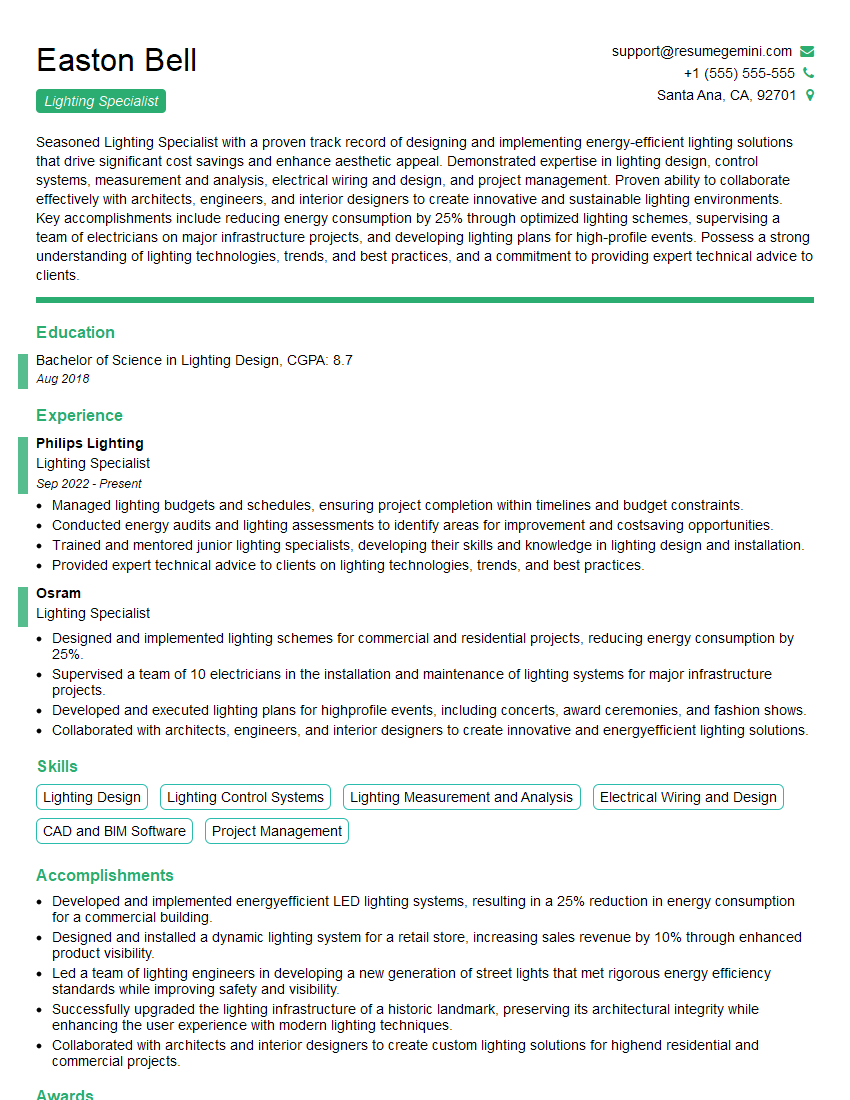
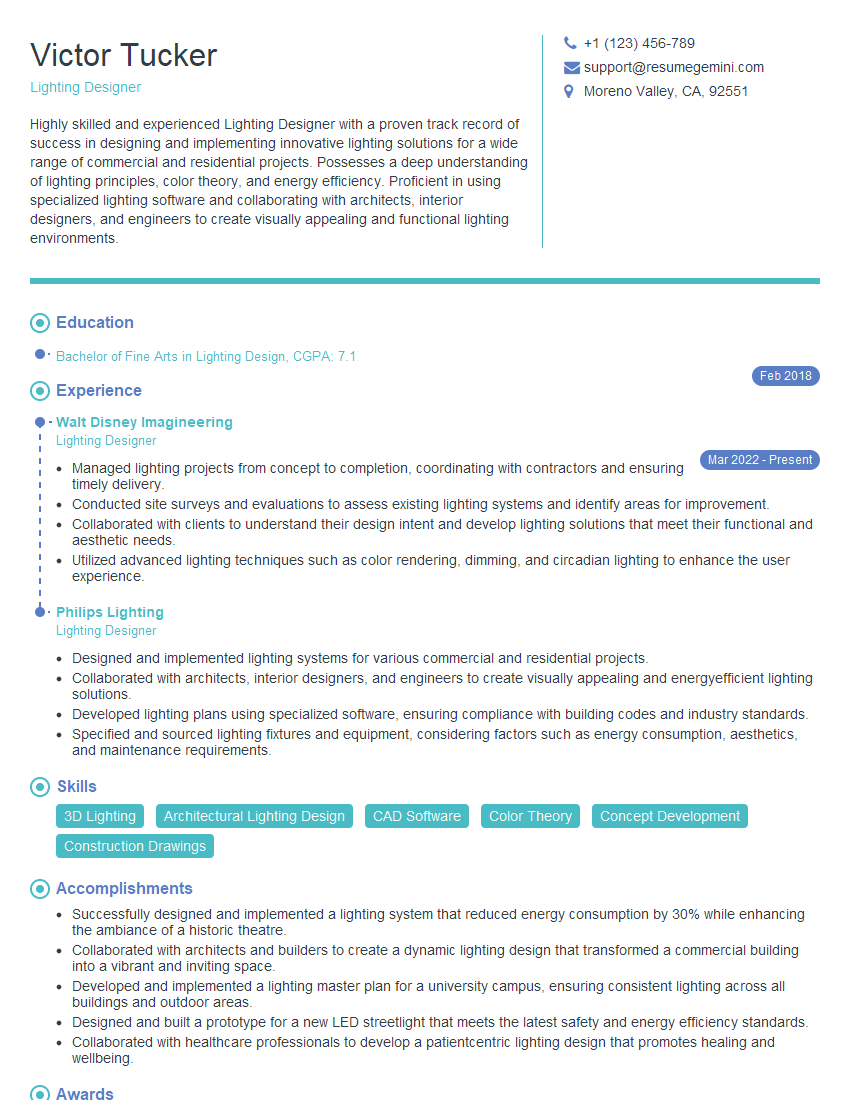
Mastering illuminance calculations is crucial for a successful career in lighting design and related fields. A strong understanding of these principles opens doors to exciting opportunities and demonstrates a commitment to technical excellence. To enhance your job prospects, focus on creating an ATS-friendly resume that highlights your skills and experience effectively. ResumeGemini is a trusted resource to help you build a professional and impactful resume. They offer examples of resumes tailored to Illuminance Calculations to help guide you. This will ensure your application stands out and increases your chances of landing your dream job.
Explore more articles
Users Rating of Our Blogs
Share Your Experience
We value your feedback! Please rate our content and share your thoughts (optional).
What Readers Say About Our Blog
Very informative content, great job.
good