Interviews are more than just a Q&A session—they’re a chance to prove your worth. This blog dives into essential Imaging Optics interview questions and expert tips to help you align your answers with what hiring managers are looking for. Start preparing to shine!
Questions Asked in Imaging Optics Interview
Q 1. Explain the concept of diffraction and its impact on image resolution.
Diffraction is a wave phenomenon where light bends around obstacles or spreads out after passing through an aperture. Imagine throwing a pebble into a calm pond; the ripples spread out – that’s analogous to light diffracting. In imaging optics, this means that even with a perfectly focused lens, light from a point source won’t form a perfect point on the sensor; instead, it’ll create a diffraction pattern, a small blurry spot called the Airy disk.
This diffraction-limited spot size directly impacts image resolution. The smaller the Airy disk, the better the resolution, as we can distinguish between closely spaced points. The size of the Airy disk is determined by the wavelength of light and the aperture diameter. A smaller wavelength or a larger aperture leads to a smaller Airy disk and thus better resolution. This is why high-resolution lenses often have large apertures.
For instance, consider comparing a telescope with a small aperture to one with a large aperture. The telescope with the larger aperture will resolve fainter stars and finer details because its Airy disks are smaller, allowing it to better distinguish between closely spaced celestial objects.
Q 2. Describe different types of optical aberrations and their correction methods.
Optical aberrations are imperfections in an optical system that cause light rays to not converge perfectly at a single point, resulting in blurry or distorted images. Several types exist:
- Spherical Aberration: Rays passing through the outer zones of a lens focus at a different point than those passing through the center. This results in a blurred image. Correction involves using aspherical lenses or lens combinations.
- Chromatic Aberration: Different wavelengths of light (colors) are refracted differently, resulting in color fringing. Achromatic lenses, which use a combination of lenses with different refractive indices, are commonly used for correction.
- Coma: Off-axis points appear as comet-shaped blurs. Correction involves using carefully designed lens elements.
- Astigmatism: Off-axis points are imaged as two lines oriented at right angles. This results in blurred and distorted images. It’s corrected using cylindrical lenses or complex lens designs.
- Distortion: Straight lines near the edges of the image are curved. This is either barrel distortion (lines curve outwards) or pincushion distortion (lines curve inwards). Correction often requires complex lens designs or digital post-processing.
Correction methods often involve using multiple lens elements with different shapes and refractive indices to counteract the effects of each aberration. Sophisticated computer-aided design tools are crucial in designing modern lens systems with minimized aberrations.
Q 3. What are the key differences between refractive and reflective optical systems?
Refractive and reflective optical systems both form images, but they do so using different principles:
- Refractive systems use lenses to bend light through refraction (the change in speed of light as it passes from one medium to another). They are compact and often cheaper to manufacture but can suffer from chromatic aberration.
- Reflective systems use mirrors to reflect light. They don’t suffer from chromatic aberration and can handle higher power levels but are typically bulkier and more challenging to design and manufacture. Reflecting telescopes are a prime example.
Think of a magnifying glass (refractive) versus a reflecting telescope (reflective). The magnifying glass uses a curved lens to bend light and create a magnified image, while the reflecting telescope uses mirrors to reflect light and focus it onto an eyepiece. The choice between refractive and reflective systems depends on the specific application and its requirements for size, cost, performance, and other factors.
Q 4. How does the f-number affect depth of field and image brightness?
The f-number (focal length divided by aperture diameter) is a crucial parameter in photography and imaging. It controls both depth of field and image brightness:
- Depth of Field: A smaller f-number (e.g., f/1.4) results in a shallower depth of field (only a small range of distances is in focus), while a larger f-number (e.g., f/16) yields a larger depth of field (a wider range of distances is in focus). This is why portraits often use wide apertures for a blurry background, whereas landscape photography often employs narrow apertures for everything to be in focus.
- Image Brightness: A smaller f-number allows more light to reach the sensor, resulting in a brighter image. A larger f-number reduces the amount of light, leading to a darker image. This is why photographers need to adjust their shutter speed and ISO to compensate for changes in f-number.
For example, a photographer shooting a portrait might use a wide aperture (small f-number, like f/2.8) to blur the background and isolate the subject. In contrast, a landscape photographer might use a narrow aperture (large f-number, like f/16) to ensure that both the foreground and background are in sharp focus.
Q 5. Explain the principles of optical modulation transfer function (MTF).
The Optical Modulation Transfer Function (MTF) is a measure of how well an optical system can transfer different spatial frequencies (details) from the object to the image. It essentially quantifies the sharpness and contrast of an imaging system. It’s expressed as a function of spatial frequency (cycles per millimeter), with values ranging from 0 to 1 (or 0% to 100%).
An MTF of 1 indicates perfect transfer of that spatial frequency – no loss of contrast or sharpness. As the spatial frequency increases (finer details), the MTF generally decreases, indicating that the system struggles to resolve finer details. The MTF curve visually represents the system’s ability to reproduce details of different sizes.
Think of it like this: Imagine trying to reproduce a fine-striped pattern. A high MTF system would reproduce the stripes with sharp edges and clear contrast, while a low MTF system would blur the stripes and reduce the contrast. MTF is crucial for evaluating lens quality and comparing different optical systems.
Q 6. Describe the working principle of a charge-coupled device (CCD) and a complementary metal-oxide-semiconductor (CMOS) image sensor.
Both CCDs (Charge-Coupled Devices) and CMOS (Complementary Metal-Oxide-Semiconductor) image sensors are used to convert light into digital signals, but they differ in their architecture and operation:
- CCD: A CCD sensor uses a photoelectric effect to convert photons of light into electrons. These electrons are then transferred (charged) along the sensor’s surface in a bucket brigade fashion to be read out one by one. This sequential readout process leads to high image quality but can be slower.
- CMOS: A CMOS sensor integrates photodiodes and amplification circuitry directly onto each pixel. Each pixel processes and reads out its data independently, resulting in faster readout times and lower power consumption. However, this integration can sometimes lead to higher noise levels compared to CCDs.
Historically, CCDs were preferred for their superior image quality, especially in professional cameras and scientific applications. However, advancements in CMOS technology have narrowed the gap, and CMOS sensors have become dominant in many applications due to their cost-effectiveness and faster readout speeds.
Q 7. What are the advantages and disadvantages of different lens designs (e.g., singlet, doublet, aspheric)?
Different lens designs offer trade-offs between cost, complexity, and performance:
- Singlet Lens: A simple lens made of a single element. It’s inexpensive but suffers from significant aberrations. It’s suitable for simple, low-cost applications where high performance isn’t crucial.
- Doublet Lens: A lens made of two elements cemented together. This design significantly reduces aberrations compared to a singlet, improving image quality at a moderate cost increase. It’s a good balance between cost and performance, making it popular in many applications.
- Aspheric Lens: A lens with a non-spherical surface. Aspheric lenses offer superior aberration correction, leading to sharper images and wider fields of view compared to spherical lenses. However, they are more complex and expensive to manufacture.
Choosing the appropriate lens design depends heavily on the application’s demands. A simple magnifying glass might only need a singlet lens, while a high-performance camera lens would likely utilize a complex system incorporating multiple aspheric elements to minimize aberrations and achieve high image quality.
Q 8. How do you design an optical system for a specific application (e.g., microscopy, astronomy)?
Designing an optical system, whether for a microscope or a telescope, is an iterative process involving careful consideration of several factors. It begins with a thorough understanding of the application’s requirements. For example, a high-resolution microscopy system demands different design choices than a wide-field astronomy telescope.
Step 1: Defining Specifications: This includes determining key parameters like resolution, field of view, magnification, wavelength range, image quality (e.g., minimizing aberrations), and the overall size and weight constraints. For microscopy, we might focus on achieving high numerical aperture (NA) for resolving fine details, while in astronomy, light-gathering ability and minimizing diffraction effects are paramount.
Step 2: Optical Design Software: Software like Zemax or Code V is crucial for simulating and optimizing the system. We’ll start with initial lens configurations, potentially using pre-designed elements as a starting point. The software allows us to model the light propagation through the system and assess various performance metrics.
Step 3: Optimization and Iteration: This iterative process involves fine-tuning the lens parameters (curvatures, thicknesses, separations, glass types) to achieve the desired specifications. Optimization algorithms within the software help find the best solution, but the designer’s experience plays a vital role in guiding the process. We’ll balance competing factors, for instance, maximizing resolution might lead to larger and more expensive lenses.
Step 4: Tolerance Analysis: We need to determine how sensitive the system is to manufacturing imperfections. Tolerance analysis helps identify critical parameters that need tighter manufacturing tolerances to maintain performance. This can significantly impact the cost and feasibility of mass production.
Step 5: Prototype and Testing: Finally, a physical prototype is built and tested to validate the design. Measurements are compared to the simulation results, and any discrepancies are addressed through further design iterations.
Example: Designing a high-resolution objective lens for a confocal microscope would involve selecting high-index glass materials to achieve a high NA, optimizing the lens curvatures to minimize spherical and chromatic aberrations, and using aspheric surfaces to correct for field curvature.
Q 9. Explain the concept of chromatic aberration and its correction techniques.
Chromatic aberration is a lens defect where different wavelengths of light focus at different points. This results in a blurry or colored fringe around the image, especially noticeable at the edges. Think of it like a prism separating white light into its constituent colors.
It arises because the refractive index of a lens material varies with wavelength. Blue light, for example, is refracted more strongly than red light, leading to different focal points.
Correction Techniques:
- Achromatic Doublets: The most common method uses a combination of two lenses made of different glasses with different dispersive properties. One lens is usually a converging lens (positive power) and the other is a diverging lens (negative power). The combination is designed such that the chromatic aberrations of the two lenses largely cancel each other out.
- Apochromatic Lenses: These lenses use three or more lens elements to correct for chromatic aberration over a wider range of wavelengths. They offer significantly improved color correction compared to achromatic doublets but are more complex and expensive.
- Diffractive Optical Elements (DOEs): DOEs use diffractive structures to control the wavelength-dependent refraction, providing another approach to chromatic aberration correction. This is particularly useful for correcting aberrations in specific spectral regions.
Example: A high-quality camera lens often incorporates multiple achromatic doublets and apochromatic lens elements to minimize chromatic aberration across the visible spectrum.
Q 10. What are the different types of optical filters and their applications?
Optical filters selectively transmit or block specific wavelengths or polarization states of light. They are essential components in many imaging systems.
Types and Applications:
- Bandpass Filters: Transmit light within a specific wavelength range while blocking light outside that range. Used in fluorescence microscopy, spectroscopy, and remote sensing to isolate specific emission wavelengths.
- Longpass Filters (High-pass): Transmit light above a certain wavelength and block light below it. Useful for removing short-wavelength noise or for specific fluorescence applications.
- Shortpass Filters (Low-pass): Transmit light below a certain wavelength and block light above it. These are often used in conjunction with longpass filters.
- Neutral Density (ND) Filters: Reduce the intensity of light uniformly across a wide wavelength range without altering the color balance. Used in photography to control exposure or in microscopy to reduce light intensity for sensitive samples.
- Polarizing Filters: Transmit light with a specific polarization orientation while blocking light with other orientations. Used in photography to reduce glare, enhance contrast, and control reflections. They’re also critical in polarized light microscopy.
Example: In fluorescence microscopy, bandpass filters are crucial for isolating the emission light from a fluorophore while blocking excitation light. An ND filter can help prevent photobleaching of the sample.
Q 11. Discuss the importance of optical tolerancing in lens design.
Optical tolerancing is the process of determining acceptable manufacturing variations for lens parameters (e.g., radius of curvature, thickness, center thickness, surface irregularity) that still allow the optical system to meet its performance specifications. It’s critical because perfect manufacturing is impossible. There’s always some variation.
Importance:
- Cost Control: Tighter tolerances generally lead to higher manufacturing costs. Optical tolerancing helps to find a balance between performance requirements and manufacturing costs. Looser tolerances allow more freedom and reduce manufacturing expenses.
- Yield Improvement: Proper tolerancing helps ensure that a higher percentage of manufactured lenses meet performance criteria, reducing waste and increasing production yield.
- System Performance: Tolerancing directly impacts the final performance of the system. A poorly toleranced system can suffer from significantly degraded image quality or other performance issues.
Methods: Optical tolerancing often involves Monte Carlo simulations, where variations in lens parameters are randomly generated within defined tolerance ranges, and the system’s performance is evaluated for each set of variations. This provides a statistical estimate of the system’s robustness to manufacturing errors.
Example: In mass production of camera lenses, tolerancing helps minimize the impact of variations in lens curvature and thickness on image quality. Careful tolerancing of the lens elements will ensure that the vast majority of manufactured lenses will produce sharp and well-corrected images.
Q 12. How do you evaluate the performance of an optical system?
Evaluating the performance of an optical system involves both theoretical analysis and experimental measurements. The goal is to quantify how well the system meets its design specifications.
Methods:
- Optical Design Software: Software like Zemax or Code V can provide detailed analyses of image quality metrics such as Modulation Transfer Function (MTF), Spot Diagrams, Point Spread Function (PSF), and wavefront error.
- MTF (Modulation Transfer Function): Measures the ability of the system to transfer contrast at different spatial frequencies. A high MTF indicates good resolution and sharpness.
- Spot Diagrams: Show the distribution of light rays on the image plane. Small and compact spot diagrams indicate good image quality.
- PSF (Point Spread Function): Describes the intensity distribution of the image of a point source. A narrow PSF indicates good resolution.
- Wavefront Error: Measures deviations of the wavefront from an ideal spherical or plane wave. Low wavefront error indicates good image quality.
- Experimental Measurements: Physical measurements of the optical system’s performance often involve using interferometers, MTF measurement systems, or imaging sensors to assess resolution, contrast, distortion, and other relevant parameters.
Example: In evaluating a telescope’s performance, we might measure its Strehl ratio (a measure of wavefront error), the size of the Airy disk (related to the PSF), and the MTF to assess its resolution and image quality. If the measured values don’t match the design specifications, we might need to refine the design or investigate manufacturing imperfections.
Q 13. What software packages are you familiar with for optical design and simulation (e.g., Zemax, Code V)?
I am proficient in several optical design and simulation software packages, including Zemax OpticStudio and Code V. These are industry-standard tools used extensively for designing and analyzing optical systems.
Zemax OpticStudio: Offers a comprehensive suite of tools for designing, analyzing, and optimizing various types of optical systems. I’m experienced in using its features for lens design, tolerance analysis, illumination design, and non-sequential ray tracing.
Code V: Another powerful software package with robust capabilities for optical design, tolerancing, and optimization. I’ve utilized Code V for many complex optical system projects, leveraging its strengths in handling large and intricate systems.
My experience extends to using these packages to simulate different manufacturing processes and analyze their impact on optical performance. This is crucial for ensuring that the designed systems can be successfully manufactured and meet their intended specifications.
Q 14. Explain the concept of polarization and its role in imaging systems.
Polarization refers to the direction of oscillation of the electric field vector in an electromagnetic wave like light. Unlike scalar quantities (e.g., intensity), polarization is a vector quantity, meaning it has both magnitude and direction.
Light can be linearly polarized (oscillation in a single plane), circularly polarized (oscillation in a rotating circle), or elliptically polarized (a combination of linear and circular polarization).
Role in Imaging Systems:
- Polarization control: Polarizing filters and elements are frequently incorporated in imaging systems to control and manipulate the polarization state of light. This is crucial for enhancing contrast, reducing glare, and improving image quality.
- Polarization-sensitive imaging: Certain imaging techniques, such as polarized light microscopy and remote sensing, exploit the polarization properties of light to obtain information about the sample’s structure or composition. For example, polarized light microscopy can reveal details about the crystalline structure of materials.
- Reducing glare and reflections: Polarizing filters can effectively eliminate reflections from non-metallic surfaces, resulting in clearer and more detailed images, especially in photography and remote sensing.
- Stress analysis: In certain applications, polarized light is used to analyze stress and strain within transparent materials. The birefringence (double refraction) induced by stress causes changes in polarization that can be detected and analyzed.
Example: Polarizing filters are routinely used in photography to eliminate glare from water or glass surfaces, resulting in richer and more saturated colors in the final image. In microscopy, polarized light is used to examine birefringent materials, revealing information about their crystalline structures that isn’t visible with standard microscopy techniques.
Q 15. What are the different types of light sources used in imaging systems and their characteristics?
Imaging systems utilize a variety of light sources, each with unique characteristics impacting image quality and application suitability. The choice depends heavily on the specific imaging task.
- Incandescent Lamps: These produce a broad, continuous spectrum of light, similar to sunlight, but are less efficient and generate significant heat. Think of a traditional lightbulb – good for general illumination but not ideal for precision imaging.
- Fluorescent Lamps: More energy-efficient than incandescent, they produce light in discrete spectral lines, leading to a less smooth spectral distribution. This can cause color rendering issues in certain applications, like photography or medical imaging.
- LEDs (Light Emitting Diodes): Highly efficient and available in a wide range of wavelengths (colors), making them versatile. They’re widely used in many modern imaging systems because of their controllability and longevity. You see them in everything from smartphone cameras to advanced microscopes.
- Lasers: These emit highly coherent and monochromatic light, ideal for applications requiring high precision and specificity like laser scanning confocal microscopy or laser-induced breakdown spectroscopy (LIBS).
- Xenon Flash Lamps: Used in high-speed photography and other applications requiring short, intense bursts of light. Their broad spectrum closely resembles daylight, making them suitable for color-accurate imaging.
The selection of a light source involves considering factors like spectral output, intensity, stability, lifespan, and cost. For instance, choosing an LED for a microscopy application would allow for precise control of the wavelength, enabling specific fluorescence excitation.
Career Expert Tips:
- Ace those interviews! Prepare effectively by reviewing the Top 50 Most Common Interview Questions on ResumeGemini.
- Navigate your job search with confidence! Explore a wide range of Career Tips on ResumeGemini. Learn about common challenges and recommendations to overcome them.
- Craft the perfect resume! Master the Art of Resume Writing with ResumeGemini’s guide. Showcase your unique qualifications and achievements effectively.
- Don’t miss out on holiday savings! Build your dream resume with ResumeGemini’s ATS optimized templates.
Q 16. Describe the process of image formation in a camera system.
Image formation in a camera system is a fascinating interplay of optics and electronics. Let’s imagine it as a process of light gathering and conversion.
- Light Gathering: The lens system collects light reflected or emitted from the scene. The lens focuses this light onto an image plane, effectively creating a miniature, inverted image of the scene. The quality of this image depends on factors like the lens’s aperture, focal length, and overall optical design. Think of it like an eye focusing light onto the retina.
- Image Sensing: This inverted image falls onto an image sensor (typically a CMOS or CCD). Each tiny photosensitive element (pixel) in the sensor converts the incident light into an electrical signal, proportional to the light intensity at that particular point. This step is crucial for translating the optical image into digital data.
- Signal Processing: The electrical signals from the sensor are processed by electronics within the camera. This involves amplification, digitization (conversion into digital numbers), noise reduction, and potentially other image processing algorithms. For example, the camera might adjust brightness, contrast, or apply sharpening filters.
- Image Output: Finally, the processed digital image data is stored, displayed on a screen, or transmitted to another device. This might be a JPEG file on your phone or a raw image file used for more advanced editing.
An example: A DSLR camera gathers light through a sophisticated lens system, focusing it onto a high-resolution sensor. The sensor’s signals are then processed using proprietary algorithms to create the final image. Different cameras offer varied capabilities in these steps, influencing image quality and features.
Q 17. Explain the concepts of spatial resolution and spectral resolution.
Spatial and spectral resolution are two crucial parameters determining the quality and information content of an image. They represent the ability of an imaging system to resolve details in space and wavelength, respectively.
- Spatial Resolution: This refers to the smallest distance between two distinguishable points in an image. It’s often expressed in lines per millimeter (lp/mm) or pixels per inch (ppi). Higher spatial resolution means finer details are visible. Think of comparing a low-resolution image (e.g., a pixelated image) with a high-resolution image (e.g., a sharp, clear photo). The high-resolution image has better spatial resolution.
- Spectral Resolution: This refers to the ability of an imaging system to distinguish between different wavelengths of light. It’s often expressed as the smallest wavelength difference that can be resolved. A higher spectral resolution means a more detailed spectral signature is obtained. This is critically important in applications such as hyperspectral imaging, where subtle variations in spectral reflectance are used to identify materials or analyze chemical composition. Imagine a rainbow: high spectral resolution would allow for separating individual colors much more precisely than low spectral resolution where the colors would appear blurred or blended.
These two resolutions are often intertwined. For example, a high-resolution hyperspectral camera combines high spatial resolution (detailed image) with high spectral resolution (detailed spectral information for every pixel).
Q 18. How do you perform image analysis and processing?
Image analysis and processing encompass a vast range of techniques, aiming to extract meaningful information or enhance the quality of images. This involves both manual and automated methods.
- Image Enhancement: Techniques like contrast adjustment, sharpening, noise reduction, and filtering are used to improve the visual appearance and clarity of the image. These can be simple adjustments or complex algorithms.
- Image Segmentation: This involves partitioning an image into meaningful regions based on characteristics such as intensity, color, or texture. For example, segmenting a medical image to isolate a tumor from surrounding tissue.
- Feature Extraction: This entails identifying and quantifying relevant features within an image. This might involve edge detection, corner detection, or calculating texture features. These features then serve as inputs for further analysis, like object recognition.
- Object Recognition and Classification: Advanced techniques like machine learning are employed to identify and classify objects within an image. This has applications in autonomous driving, medical diagnosis, and many other areas.
- Image Restoration: This focuses on recovering an image degraded by factors like blur, noise, or distortions. Techniques like deconvolution and inpainting are used to mitigate these degradation effects.
Software like ImageJ, MATLAB, and Python libraries (like OpenCV and scikit-image) provide powerful tools for performing these analyses. For example, in a microscopy application, we might use image segmentation to identify individual cells in a tissue sample and feature extraction to quantify their size and shape.
Q 19. What are the challenges associated with designing high-resolution imaging systems?
Designing high-resolution imaging systems presents numerous challenges, often pushing the boundaries of optics, electronics, and manufacturing.
- Diffraction Limit: The wave nature of light limits the achievable spatial resolution. The smaller the details you want to resolve, the more challenging it is to overcome diffraction effects. This means that achieving extremely high resolution requires increasingly sophisticated optical designs and potentially non-conventional imaging approaches.
- Aberrations: Optical lenses suffer from aberrations, introducing distortions and blurring in the image. Minimizing aberrations requires precise lens design and manufacturing, often involving aspheric lenses or complex lens systems.
- Sensor Technology: The resolution and sensitivity of the image sensor play a crucial role. High-resolution imaging requires sensors with a large number of pixels and high quantum efficiency (ability to convert light into electrical signals).
- Data Handling: High-resolution images generate massive amounts of data, requiring robust data acquisition, storage, and processing systems. Efficient data compression techniques are also critical.
- Cost and Complexity: High-resolution systems are often expensive and complex to design, manufacture, and maintain.
For example, designing a high-resolution space telescope requires careful consideration of all these aspects, as even minor aberrations or diffraction effects can significantly impact the quality of images obtained from vast distances.
Q 20. Explain the concept of geometric distortion and its correction methods.
Geometric distortion refers to a type of image distortion where the shape and position of objects in an image are not accurately represented. It’s essentially a non-linear mapping of the object space to the image plane.
- Types of Geometric Distortion: Common types include pincushion distortion (straight lines bulge outward), barrel distortion (straight lines curve inward), and tangential distortion (objects appear skewed). These distortions arise from lens imperfections or inaccuracies in the imaging system’s geometry.
- Causes: Lens design, manufacturing errors, sensor misalignment, and perspective effects can all contribute to geometric distortion.
- Correction Methods: Geometric distortion can be corrected using image processing techniques. These methods generally involve a transformation or mapping that corrects the positions of pixels in the distorted image. Methods include:
- Polynomial Correction: Models the distortion using a polynomial function and applies an inverse transformation to correct the image. This is a commonly used approach.
- Lookup Tables: Creates a mapping between distorted and undistorted pixel locations. This approach can be computationally efficient for real-time applications.
- Camera Calibration: Estimating the internal and external parameters of the camera and using this information to create a distortion model for correction. This often involves using a calibration target with known geometry.
Example: In aerial photography, barrel distortion can be a significant issue, leading to inaccurate measurements of distances and areas. Calibration and correction are crucial to obtain reliable results.
Q 21. Describe your experience with optical testing and metrology techniques.
My experience in optical testing and metrology encompasses a wide range of techniques for characterizing optical components and systems. I’m proficient in both classical and modern methods.
- Interferometry: I have extensive experience using interferometers (like Fizeau and Twyman-Green) to measure surface irregularities and wavefront aberrations in lenses, mirrors, and other optical elements. This involves analyzing interference patterns to determine the optical path differences and quantify the surface quality.
- MTF (Modulation Transfer Function) Measurement: I’ve conducted numerous MTF measurements to characterize the spatial resolution and contrast transfer capabilities of imaging systems. This involves using a test chart with known spatial frequencies and analyzing the image to determine the system’s ability to resolve detail.
- Optical Scatterometry: I’ve used scatterometry to characterize surface roughness and other microstructural features. This involves measuring the angular distribution of scattered light to determine surface properties.
- Autocollimation: I’ve employed autocollimation techniques for high-precision angular measurements, crucial for aligning optical systems.
- Optical Profilometry: I have experience using optical profilers (e.g., confocal microscopy) to measure surface topography with high accuracy. This provides detailed 3D surface profiles of components.
I’ve used these techniques in various applications, including characterizing the performance of high-precision lenses for astronomical telescopes, evaluating the surface quality of optical components in laser systems, and assessing the image quality of various cameras. My expertise extends to both manual and automated testing methods.
Q 22. How do you handle misalignments in optical systems?
Misalignments in optical systems are a common challenge, leading to decreased performance, image degradation, and even system failure. Handling them effectively involves a combination of careful design, precise manufacturing, and robust alignment procedures.
During the design phase, we minimize misalignment sensitivity by incorporating features like robust mounts, tolerance analysis, and the use of self-aligning components. For instance, using kinematic mounts ensures only six degrees of freedom, simplifying the alignment process. Tolerance analysis helps quantify the acceptable deviations in component positions and orientations, guiding manufacturing precision.
During assembly and testing, we employ various alignment techniques. These include:
- Autocollimation: Using a collimated beam and autocollimator to precisely align optical elements by reflecting the beam back into the instrument.
- Knife-edge scanning: Measuring the beam profile at the image plane to determine the centering and tilt of individual components.
- Laser interferometry: Highly accurate technique for measuring distances and angles, useful for ensuring precise alignment of complex optical systems.
- Shack-Hartmann wavefront sensors: These devices measure the wavefront aberrations, providing detailed information about misalignment and other optical errors, enabling precise adjustments.
In real-world scenarios, I’ve used Shack-Hartmann sensors to align a high-resolution imaging system for semiconductor inspection. The system’s high sensitivity to misalignment required extremely precise alignment, and the sensor allowed us to achieve sub-micron accuracy.
Q 23. What are your experiences with different types of optical materials and their properties?
My experience spans a wide range of optical materials, each with its unique properties influencing its suitability for different applications. The choice of material depends critically on the wavelength range, environmental conditions, and required optical performance.
- Glass: The workhorse of optical systems. Different types like BK7 (borosilicate crown glass), fused silica, and various types of flint glasses offer a trade-off between refractive index, dispersion, and cost. Fused silica exhibits excellent transmission across a broad spectrum, making it ideal for applications requiring UV or IR transmission. Flint glasses have high refractive indices, useful in designing compact optical systems but usually exhibit higher dispersion.
- Crystals: Materials like Calcium Fluoride (CaF2) and Zinc Selenide (ZnSe) are used in IR optics due to their excellent transmission in those wavelengths. Crystals also find use in non-linear optical applications.
- Polymers: Plastics like PMMA (acrylic) and polycarbonate offer cost-effectiveness and ease of fabrication, particularly for simpler applications or large-volume production. However, they generally exhibit lower scratch resistance and temperature stability than glass or crystals.
For example, in a project designing a high-power laser system, we chose Zinc Selenide for its high transmission and resistance to high-intensity laser radiation, whereas for a consumer-grade camera lens, we opted for cost-effective plastic lenses that are suitable for visible light and offer good imaging capabilities at a significantly lower price point.
Q 24. Discuss the impact of environmental factors (temperature, humidity) on optical system performance.
Environmental factors like temperature and humidity significantly impact optical system performance. These effects can manifest in various ways:
- Thermal Expansion: Temperature changes cause changes in the physical dimensions of optical components, leading to misalignment and shifts in focal length. This is particularly critical in precision systems.
- Refractive Index Changes: Temperature and pressure affect the refractive index of optical materials, altering the optical path length and potentially causing image aberrations.
- Humidity Effects: High humidity can lead to condensation on optical surfaces, scattering light and reducing image quality. It can also affect the performance of certain coatings.
Mitigation strategies involve careful material selection (e.g., using materials with low thermal expansion coefficients), precise temperature control (e.g., using thermoelectric coolers or ovens), and environmentally sealed housings to control humidity and prevent condensation. Moreover, designing with temperature compensation mechanisms, like using thermally stable mounts and actively controlling the component positions, is essential for high-precision systems.
I once worked on a project where temperature fluctuations significantly affected the performance of a high-precision laser interferometer. By implementing a closed-loop temperature control system and using low-expansion materials, we successfully minimized the impact of temperature variations, ensuring consistent performance.
Q 25. Explain your understanding of Fourier optics and its applications.
Fourier optics is a powerful framework that uses Fourier transforms to analyze and manipulate optical systems. It states that the far-field diffraction pattern of an object is the Fourier transform of its spatial intensity distribution. This is crucial because it allows us to understand and design optical systems in the frequency domain, where various operations are often simpler to implement.
Key applications include:
- Optical Signal Processing: Fourier optics allows for the design of spatial filters that manipulate the spatial frequency content of an image. For example, a high-pass filter can enhance edges and details, while a low-pass filter can smooth the image.
- Optical Imaging Systems: Understanding the Fourier transform properties of lenses is crucial for designing and analyzing imaging systems. It helps determine the system’s resolution, depth of field, and other key performance parameters.
- Holography: Holography relies heavily on Fourier optics principles. The recording and reconstruction of holograms involve the manipulation of the spatial frequency content of light waves.
- Optical Correlation: Fourier optics provides the foundation for optical pattern recognition systems, which use the correlation between the Fourier transforms of an input image and a reference pattern to detect the presence of the pattern in the input image.
For example, I’ve used Fourier optics principles to design a custom spatial filter for a microscopy system to enhance the contrast of specific features of interest in a biological sample.
Q 26. How would you approach troubleshooting problems in an optical imaging system?
Troubleshooting an optical imaging system requires a systematic approach. I typically follow these steps:
- Visual Inspection: Begin with a thorough visual inspection of the entire system, looking for any obvious problems like loose connections, misaligned components, damage to optics, or contamination on surfaces.
- Testing Individual Components: Test each component individually to identify the source of the problem. This might involve checking the functionality of lasers, detectors, and other individual parts.
- Measurement and Analysis: Use appropriate measurement tools to quantify the system’s performance. This might include measuring the system’s Modulation Transfer Function (MTF), Spot Diagram, or other relevant metrics.
- Systematic Approach to Alignment: If misalignment is suspected, use the appropriate alignment techniques (as described in Question 1) to realign the system.
- Environmental Considerations: Check if environmental factors (temperature, humidity) are affecting the system’s performance.
- Software and Control Systems: Review the software and control systems to rule out issues related to the control system or software algorithm.
In a recent project, a microscopy system was producing blurry images. By systematically checking each component and using MTF measurements, we discovered that a slight misalignment of the objective lens was the culprit. Once realigned, the image quality was restored.
Q 27. Describe your experience with designing or working with fiber optic imaging systems.
I have extensive experience designing and working with fiber optic imaging systems. These systems utilize optical fibers to transmit images, offering advantages in flexibility, miniaturization, and remote sensing.
My work involved designing endoscopes for medical imaging applications. These systems require careful consideration of several factors:
- Fiber Bundle Design: Selecting the appropriate type of fiber bundle (e.g., coherent or incoherent) based on image resolution requirements and light transmission efficiency.
- Image Quality: Minimizing image distortion and aberrations introduced by the fiber bundle is crucial. This often involves the use of specialized fiber arrangements and image processing techniques.
- Light Source and Illumination: Choosing a suitable light source and illumination scheme for adequate image brightness and contrast.
- Image Sensors and Processing: Selecting appropriate image sensors and developing image processing algorithms to enhance image quality and remove artifacts.
In one project, we developed a flexible endoscope for minimally invasive surgery. The design involved using a high-resolution coherent fiber bundle to achieve superior image quality and a compact, flexible probe to access hard-to-reach areas. The system incorporated advanced image processing algorithms to enhance contrast and reduce noise.
Key Topics to Learn for Imaging Optics Interview
- Geometric Optics: Understanding ray tracing, lenses (thin lens approximation, aberrations), mirrors, and optical systems design. Practical application: Designing a simple camera lens system.
- Physical Optics: Grasping concepts like diffraction, interference, polarization, and coherence. Practical application: Analyzing the resolution limits of a microscope.
- Optical Instruments: Familiarize yourself with the principles and workings of microscopes, telescopes, cameras, and spectrometers. Practical application: Troubleshooting a malfunctioning optical system.
- Image Formation and Processing: Comprehending image formation in various optical systems, including understanding spatial and frequency domains, and image enhancement techniques. Practical application: Developing algorithms for image restoration.
- Optical Materials and Coatings: Knowledge of different optical materials (glass types, crystals) and their properties, as well as anti-reflective and other coatings. Practical application: Selecting appropriate materials for a specific optical application.
- Optical Design Software: Familiarity with common optical design software packages (e.g., Zemax, Code V) is a significant advantage. Practical application: Simulating and optimizing optical system performance.
- Optical Metrology and Testing: Understanding techniques for measuring and characterizing optical components and systems. Practical application: Performing quality control checks on manufactured lenses.
- Problem-solving approach: Develop your ability to approach optical problems systematically, using both theoretical knowledge and practical considerations. Practical application: Diagnosing and solving issues in an existing optical system.
Next Steps
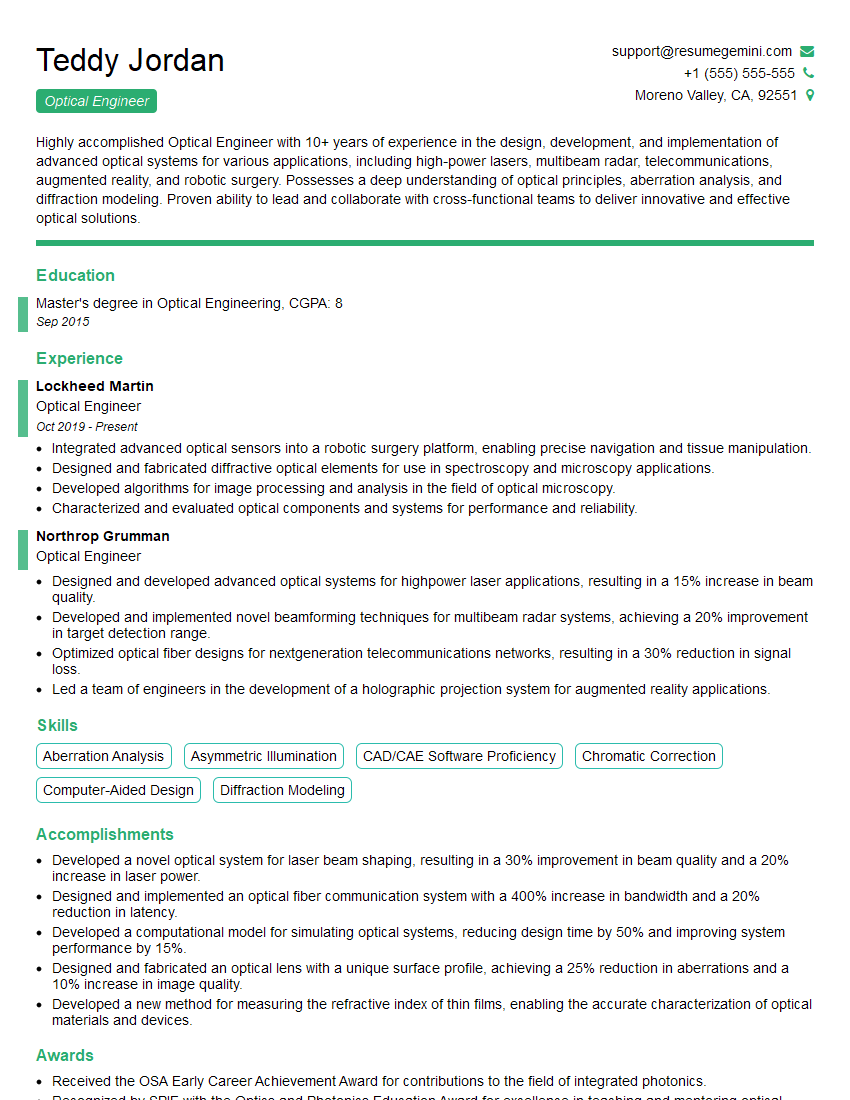
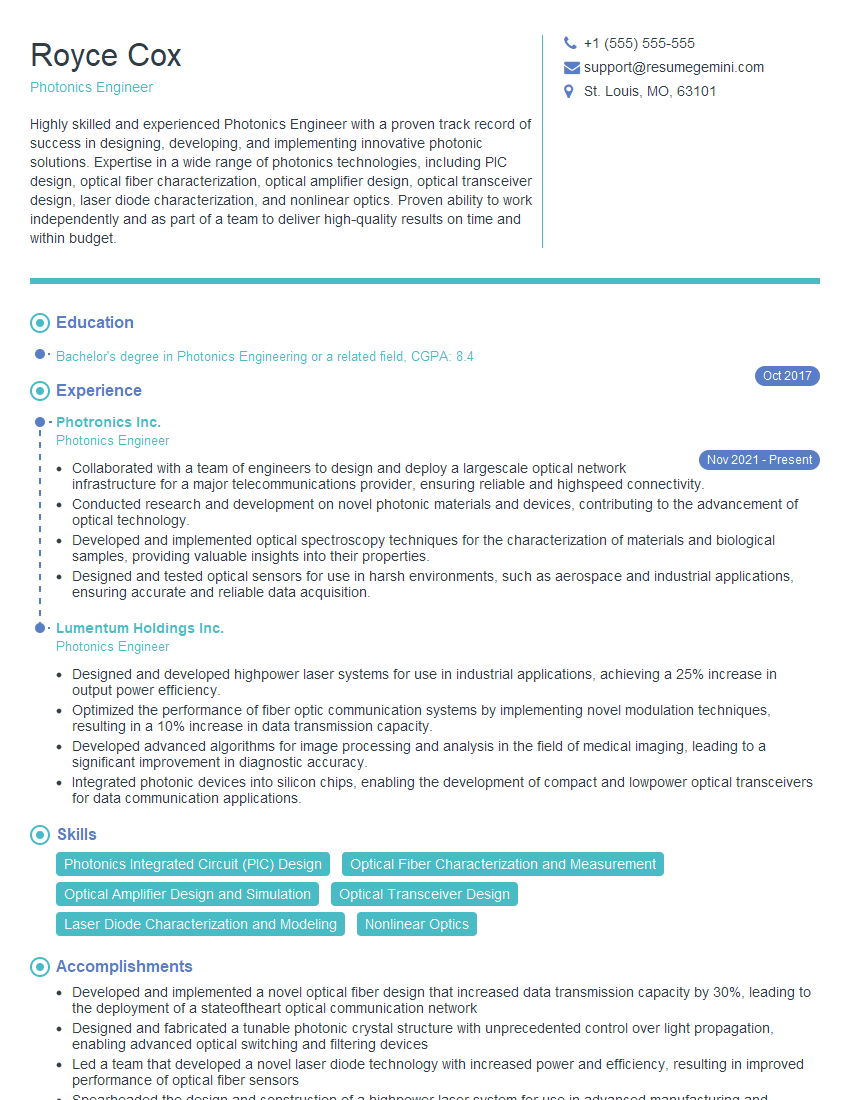
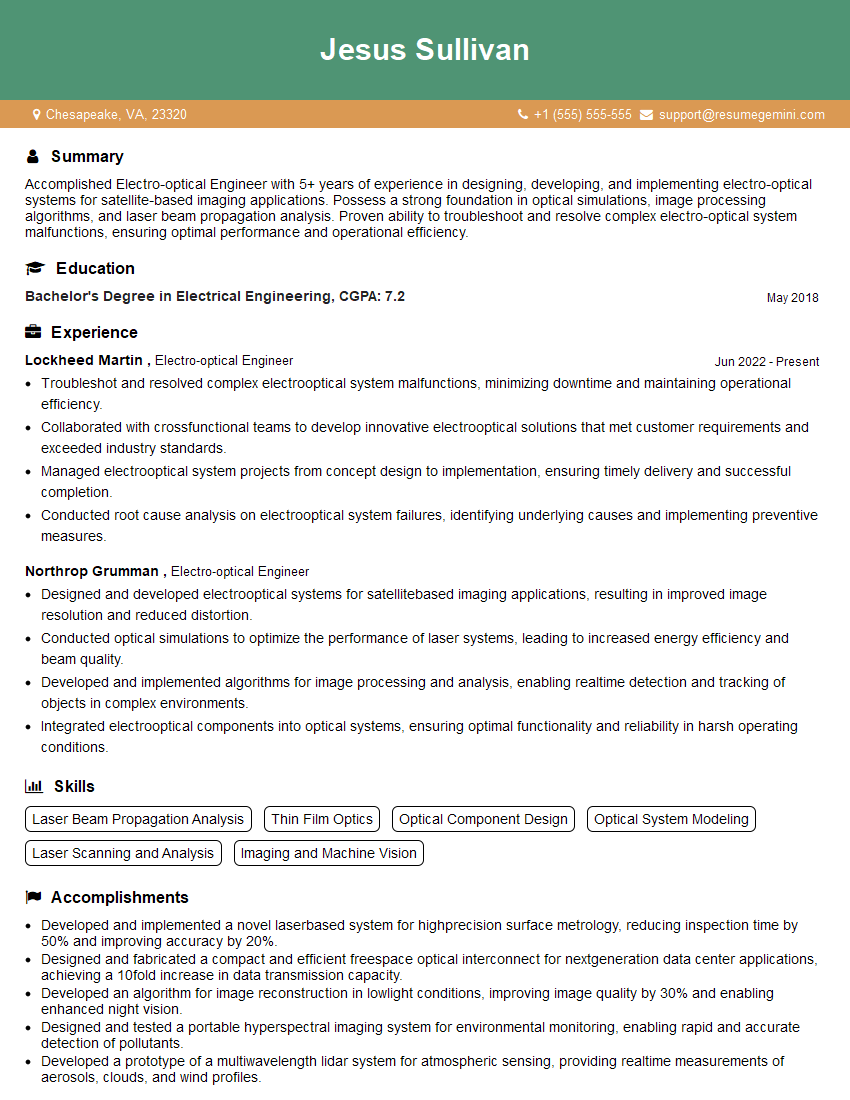
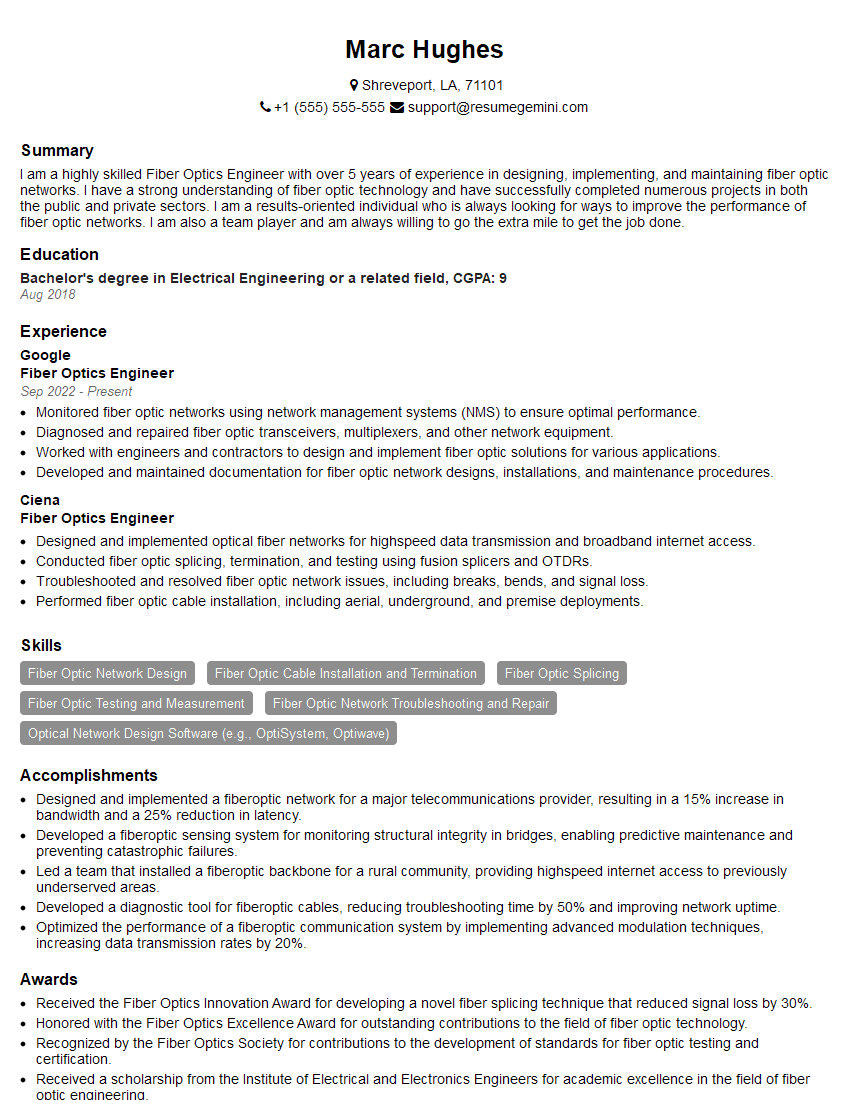
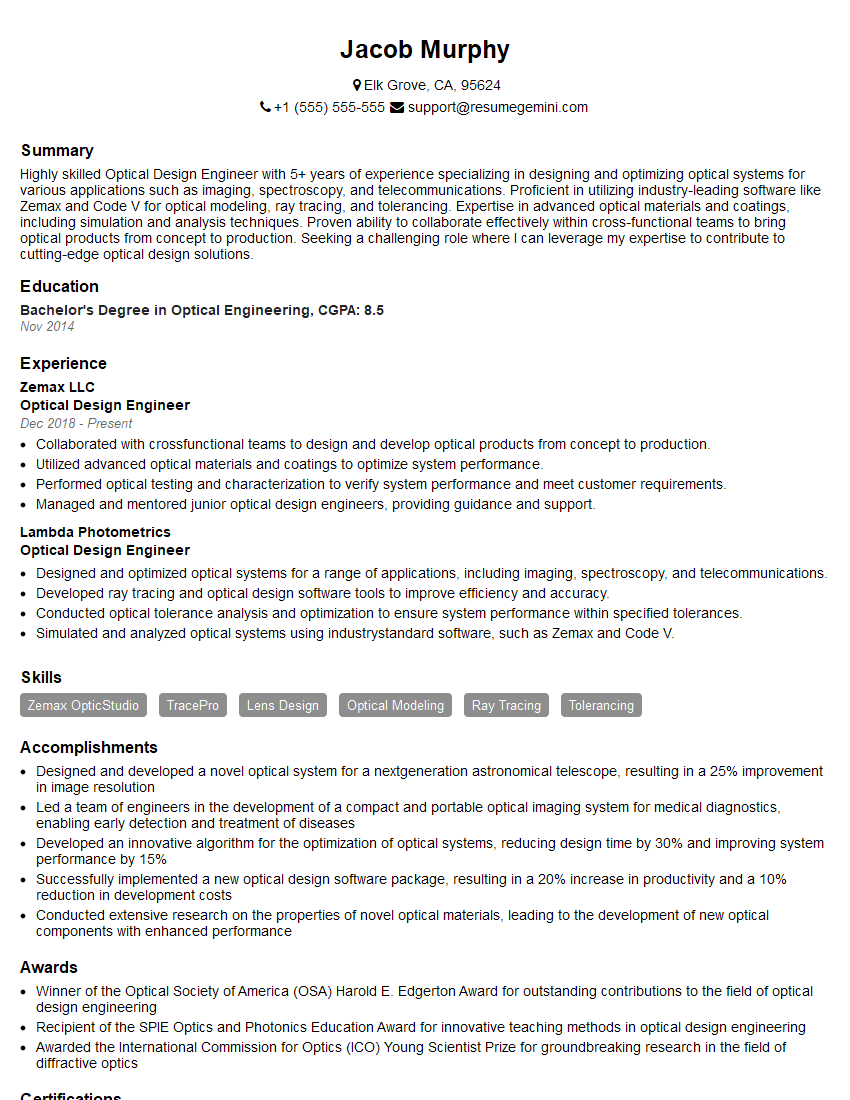
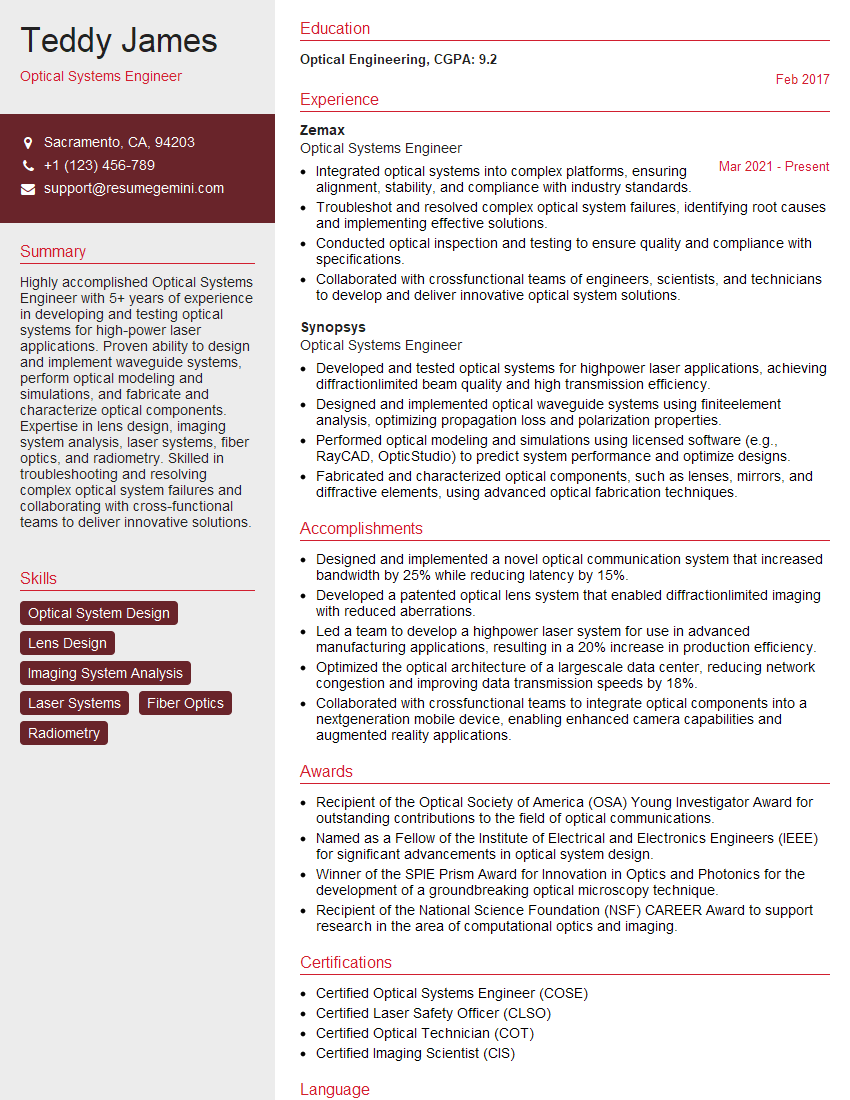
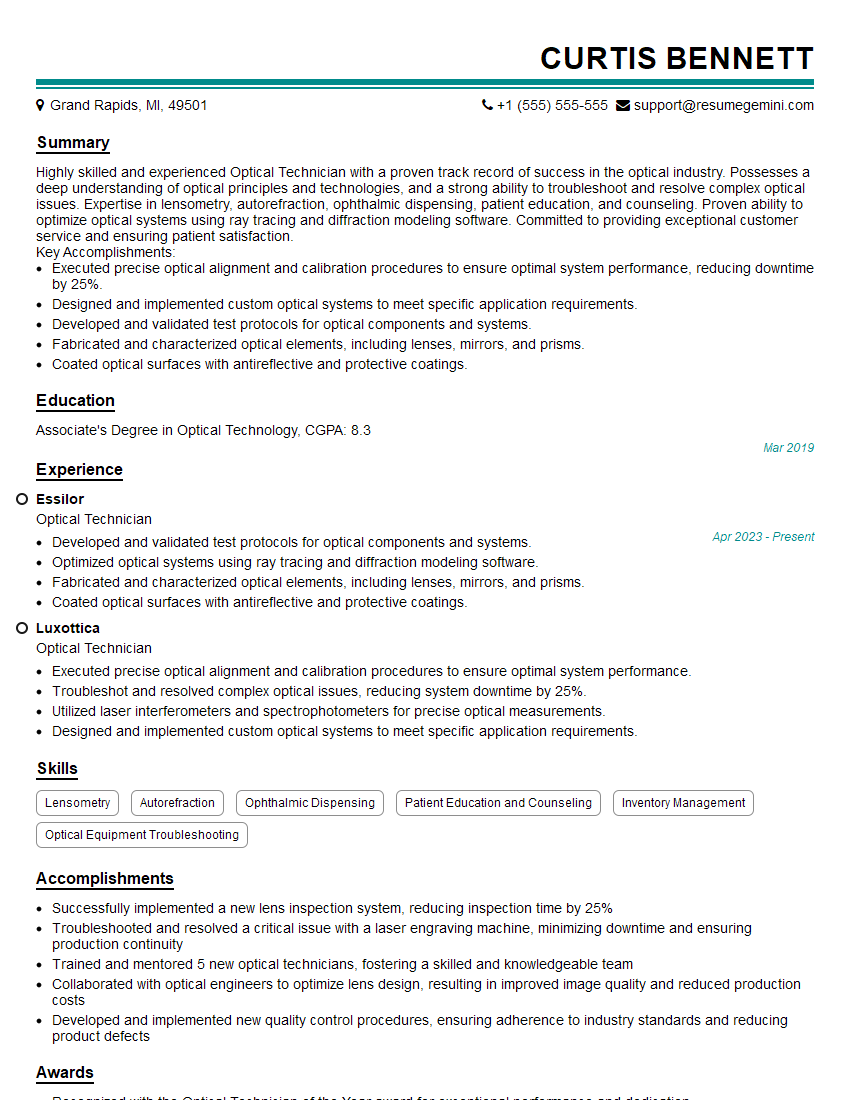
Mastering Imaging Optics opens doors to exciting careers in cutting-edge fields like medical imaging, astronomy, telecommunications, and more. To maximize your job prospects, crafting a strong, ATS-friendly resume is crucial. ResumeGemini is a trusted resource to help you build a professional and effective resume that highlights your skills and experience in Imaging Optics. Examples of resumes tailored to Imaging Optics are available to guide you. Invest the time to build a compelling resume—it’s a vital step in landing your dream job.
Explore more articles
Users Rating of Our Blogs
Share Your Experience
We value your feedback! Please rate our content and share your thoughts (optional).
What Readers Say About Our Blog
Very informative content, great job.
good