The thought of an interview can be nerve-wracking, but the right preparation can make all the difference. Explore this comprehensive guide to Industrial Hygiene Software and IT Applications interview questions and gain the confidence you need to showcase your abilities and secure the role.
Questions Asked in Industrial Hygiene Software and IT Applications Interview
Q 1. Describe your experience with various Industrial Hygiene software packages.
My experience spans a wide range of Industrial Hygiene (IH) software packages, including both dedicated IH platforms and more general Environmental, Health, and Safety (EHS) systems with IH modules. I’ve worked extensively with software like AccuReg, Intelex EHS, Enablon, and SAP EHS Management. My experience isn’t limited to just using these packages; I’ve also been involved in their implementation, configuration, data migration, and training end-users. For instance, during a recent project implementing Intelex EHS, I was responsible for customizing the system to meet our specific IH data reporting requirements, including configuring automated alerts for exceeding exposure limits.
Each software offers unique strengths. AccuReg, for example, excels in real-time noise monitoring and dosimetry data analysis, while Enablon provides a more comprehensive EHS platform with robust reporting and analytics capabilities applicable to IH. I’ve learned to adapt my approach based on the specific capabilities of each system, ensuring optimal utilization for data collection, analysis, and reporting.
Q 2. Explain your understanding of data validation and cleaning within EHS software.
Data validation and cleaning in EHS software are crucial for ensuring data accuracy and reliability in IH assessments. It’s akin to carefully inspecting and preparing ingredients before cooking a complex dish – if the ingredients are flawed, the final product will be compromised. Data validation involves checking that the data conforms to predefined rules and standards. This might include verifying that exposure values are within plausible ranges, checking for consistency across multiple data points, and confirming that required fields are populated. For example, a noise level reading of 200 dB would trigger a validation error as it’s far beyond typical industrial noise levels.
Data cleaning addresses inconsistencies or errors that slip through validation. This could involve handling missing values (e.g., using imputation techniques), correcting outliers (e.g., identifying and correcting data entry errors), or standardizing data formats (e.g., ensuring consistent units of measurement). Imagine discovering a typo in a spreadsheet; data cleaning is the process of correcting that typo and ensuring it doesn’t affect the analysis. Effective data validation and cleaning workflows are critical for maintaining the integrity of the IH data used for risk assessments and regulatory compliance.
Q 3. How would you troubleshoot a software malfunction impacting industrial hygiene data collection?
Troubleshooting a software malfunction impacting IH data collection requires a systematic approach. Think of it like diagnosing a car problem—you need to follow a logical path to identify the root cause. My first step would be to identify the nature of the malfunction: is it a complete system failure, data entry issues, or problems with specific functionalities? I would then gather information from several sources: error messages, user reports, system logs, and data backups. This information helps isolate the problem. For example, if multiple users report issues with uploading data at a specific time, the problem might lie with the server or network connectivity.
Following this initial assessment, I would attempt to replicate the problem. This helps in verifying the issue and identifying any specific triggers. Depending on the complexity, I’d explore solutions such as restarting the software, checking network connectivity, reviewing software updates, or checking the database integrity. If the problem persists, I’d escalate the issue to the IT department or the software vendor, providing them with the detailed information gathered during the troubleshooting process. This methodical approach ensures a swift resolution, minimizing disruption to data collection and IH activities.
Q 4. What are the key features of a good Industrial Hygiene database system?
A robust IH database system needs several key features. First, it must efficiently store and manage diverse data types, including chemical information, exposure monitoring data, personal protective equipment (PPE) usage records, and medical surveillance information. Imagine a recipe; it requires specific ingredients in specific quantities. The database is the recipe book, managing various data points required for comprehensive IH management.
- Data Security and Access Control: Strict control over data access is essential, ensuring only authorized personnel can view or modify sensitive information.
- Reporting and Analytics: The system should facilitate the generation of reports needed for compliance and decision-making (e.g., exposure summaries, trend analysis).
- Integration with other systems: Integration with other EHS software or enterprise resource planning (ERP) systems enables streamlined workflows and data sharing.
- Data Backup and Recovery: Regular backups protect against data loss due to hardware or software failure.
- Auditing Capabilities: A robust audit trail enables tracking data changes and ensuring accountability.
These features combined ensure the system effectively supports IH professionals in managing exposure risks and complying with regulations.
Q 5. Discuss your experience with data analysis techniques applied to industrial hygiene data.
My experience includes applying various data analysis techniques to IH data, from simple descriptive statistics to more advanced statistical modeling. Descriptive statistics, such as calculating mean, median, and standard deviation of exposure levels, provide a basic understanding of the data. This is like getting a summary of your sales figures; it gives you a broad understanding of the business performance.
More sophisticated techniques include regression analysis to identify correlations between exposure levels and other factors (e.g., job tasks, work practices), and time-series analysis to identify trends in exposure levels over time. Imagine using regression to discover whether exposure to dust is linked to the number of hours worked in a specific area – this allows you to target preventative actions. Statistical process control (SPC) charts are also used to monitor exposure levels and identify potential excursions from acceptable limits. The choice of technique depends on the research question and the nature of the data. I have extensive experience with statistical software like R and SAS for IH data analysis.
Q 6. How do you ensure data accuracy and integrity in Industrial Hygiene software applications?
Ensuring data accuracy and integrity in IH software is paramount for reliable risk assessments. It’s like building a house; a strong foundation ensures a stable structure. This involves a multi-pronged approach:
- Data Validation Rules: Implementing data validation rules within the software to catch errors during data entry, such as implausible values or inconsistent units.
- Regular Data Audits: Conducting regular audits to compare data from different sources and identify discrepancies.
- Data Cleaning Procedures: Establishing clear procedures for handling missing or inconsistent data.
- Training and Education: Providing training to users on proper data entry procedures and best practices.
- Version Control: Maintaining version control for data and reports to track changes and revert to previous versions if necessary.
- Secure Data Storage: Employing robust data storage mechanisms with access controls to prevent unauthorized access or modification.
By combining these strategies, we build confidence in the data’s integrity and reliability, which is essential for informed decision-making in IH.
Q 7. Describe your familiarity with different data visualization tools for presenting industrial hygiene findings.
I’m proficient in various data visualization tools for presenting IH findings effectively. Effective visualization is crucial for communicating complex data to a diverse audience; it makes data easy to understand, similar to how an infographic simplifies a long research paper.
I utilize tools like Microsoft Excel, Tableau, and Power BI to create charts, graphs, and dashboards that illustrate key findings. For instance, I might use bar charts to compare exposure levels across different work areas, line graphs to display exposure trends over time, and maps to illustrate spatial variations in exposure. The choice of visualization method depends on the nature of the data and the target audience. In addition to these commercial tools, I have experience using ggplot2 in R for creating customized and publication-quality visualizations.
Q 8. Explain how you would design a report using Industrial Hygiene software to meet specific regulatory requirements.
Designing a report in industrial hygiene software to meet regulatory requirements involves a structured approach focusing on data accuracy, completeness, and compliance with specific standards like OSHA or local regulations. This starts with understanding the precise requirements of the relevant regulations. For example, OSHA’s requirements for noise exposure monitoring demand specific data points (noise levels, duration, employee exposure), and the report must clearly present this information in a format OSHA accepts.
The design process involves:
- Defining Report Scope: Clearly identify the data needed (e.g., air sampling results, noise levels, personal protective equipment (PPE) usage), the regulatory standards, and the report’s audience (e.g., regulatory agencies, management, employees).
- Data Selection and Validation: Select the relevant data from the software’s database, ensuring its accuracy and completeness. This might involve quality control checks, data validation rules, and audits to maintain data integrity.
- Report Structure and Formatting: Design a clear, concise report structure following regulatory guidelines. This involves using tables, charts, and graphs to effectively present the data. The report needs to have a clear title, date, location, project details, and a concise summary of the findings.
- Compliance Checks: Implement automated checks within the reporting process to ensure the report meets all regulatory requirements before finalization. For instance, if permissible exposure limits (PELs) are exceeded, the report should highlight this in a prominent way, potentially using color-coding or warnings.
- Version Control: Implement a version control system to track changes to reports and ensure auditability. This is crucial for demonstrating compliance and tracking corrections or updates.
Example: Let’s say we’re generating a noise exposure report for a construction site. The software should allow us to select noise measurements linked to specific employees and equipment, calculate daily and annual noise doses, compare them to OSHA PELs, and generate a report including all this data with clear visual representations (graphs showing noise levels over time, tables summarizing employee exposure). The report would clearly state whether any PELs were exceeded and recommend necessary actions.
Q 9. What are the ethical considerations in handling sensitive industrial hygiene data?
Ethical considerations in handling sensitive industrial hygiene data are paramount. This data often includes personally identifiable information (PII) about employees’ health, exposure levels, and medical conditions. Therefore, maintaining confidentiality, ensuring data accuracy, and upholding transparency are key principles.
- Confidentiality: Access to the data should be strictly controlled, limited to authorized personnel with a legitimate need to know. Strong password policies, role-based access control, and encryption are crucial.
- Data Accuracy: Maintaining the accuracy and integrity of the data is essential for making informed decisions. This requires careful data entry, validation, and quality control processes. Any inaccuracies must be promptly corrected and documented.
- Transparency: Employees should be informed about how their data is collected, used, and protected. A clear privacy policy should be in place, and employees should be given the opportunity to review and correct their data.
- Data Security: Robust security measures should be implemented to protect against unauthorized access, use, disclosure, disruption, modification, or destruction of the data. This includes regular security audits, penetration testing, and incident response plans.
- Compliance: The handling of industrial hygiene data must comply with all relevant laws and regulations, including HIPAA (in the US) and GDPR (in Europe), depending on the location and nature of the data.
Example: If an employee’s medical records are linked to their exposure data, ensuring that only authorized medical professionals and the employee (with their consent) have access is crucial. This necessitates secure data storage, encryption, and strict access controls within the software.
Q 10. How would you integrate Industrial Hygiene software with other EHS management systems?
Integrating industrial hygiene software with other EHS (Environmental, Health, and Safety) management systems improves efficiency and data consistency. This integration usually involves using APIs (Application Programming Interfaces) or data exchange protocols.
Here’s how it works:
- API Integration: Many modern EHS systems offer APIs to enable seamless data exchange. This allows for automated transfer of data such as employee information, incident reports, or environmental monitoring data between the industrial hygiene software and other systems (e.g., safety management software, environmental monitoring systems).
- Data Mapping and Transformation: Data needs to be mapped correctly between different systems. This may involve transforming data formats to ensure compatibility. For example, data fields for employee IDs or exposure levels might need to be aligned between systems.
- Data Synchronization: The integration should ensure data synchronization between systems. Changes in one system should be reflected in the other to maintain data consistency. This might involve real-time synchronization or scheduled updates.
- Reporting and Analytics: The integration facilitates the creation of comprehensive EHS reports, incorporating data from multiple sources. This enhances the ability to perform comprehensive risk assessments and track performance.
Example: Integrating the industrial hygiene software with a safety management system can allow for automatic updates of employee exposure data in the safety system following an incident. This streamlines incident investigation and helps identify potential hazards more rapidly.
Q 11. Explain your understanding of data security and compliance relevant to Industrial Hygiene software.
Data security and compliance are critical for industrial hygiene software. Sensitive data requires robust protection against unauthorized access, modification, or disclosure.
- Data Encryption: Data should be encrypted both in transit (during transfer) and at rest (when stored). This protects the data even if the system is compromised.
- Access Control: Role-based access control (RBAC) is essential to restrict access to sensitive data based on user roles and responsibilities. Only authorized personnel should have access to specific data.
- Regular Security Audits: Regular security audits and penetration testing help identify vulnerabilities and ensure that security measures are effective. This involves simulating attacks to find weaknesses in the system.
- Compliance with Regulations: The software must comply with relevant data privacy regulations such as HIPAA, GDPR, and others. This includes implementing appropriate data retention policies and procedures for data breaches.
- Data Backup and Recovery: Regular data backups are crucial for business continuity. A robust data recovery plan should be in place to restore data in case of system failure or data loss.
- Password Management: Strong password policies are required to prevent unauthorized access. This includes enforcing password complexity, regular password changes, and multi-factor authentication (MFA).
Example: A software system might use AES-256 encryption to protect data at rest, implement RBAC to limit access based on user roles (e.g., only supervisors can see full employee exposure data), and follow HIPAA guidelines for protecting patient health information (PHI) if applicable.
Q 12. Describe your experience with software implementation and training in an Industrial Hygiene context.
My experience with industrial hygiene software implementation and training involves a phased approach, prioritizing user needs and ensuring a smooth transition. I’ve been involved in several projects involving the implementation of different software solutions.
- Needs Assessment: I begin with a thorough needs assessment to understand the client’s requirements, existing systems, and workflows. This ensures the selected software aligns with their specific needs.
- Software Selection: The software selection process considers factors like functionality, scalability, ease of use, integration capabilities, and cost. This might involve evaluating multiple vendors and solutions before selecting the best fit.
- Data Migration: Data migration from legacy systems is a critical step. This requires careful planning and execution to ensure data integrity and accuracy. It often involves data cleaning, transformation, and validation.
- System Configuration: The software is configured to meet the specific needs of the organization, customizing workflows, reports, and user access permissions.
- Training and Support: Comprehensive training is provided to end-users, covering all aspects of the software. This involves hands-on training sessions, documentation, and ongoing support to address user queries.
- Go-Live Support: Post-implementation support is critical to address any issues or challenges that arise during the initial use of the software.
Example: In a recent project, I managed the implementation of a new industrial hygiene software package for a manufacturing plant. This involved migrating data from their existing spreadsheet-based system, configuring the software to meet their specific needs, and providing comprehensive training to over 50 users. We used a phased rollout approach, starting with a pilot group before expanding to the entire organization.
Q 13. What are your preferred methods for ensuring user adoption of new Industrial Hygiene software?
Ensuring user adoption of new industrial hygiene software requires a multi-faceted approach focusing on communication, training, and ongoing support.
- Clear Communication: Communicate the benefits of the new software to users clearly and effectively. This might include presentations, demonstrations, and written materials highlighting how it simplifies tasks, improves efficiency, and enhances safety.
- Effective Training: Provide comprehensive training tailored to different user groups’ needs. This includes hands-on training, online tutorials, and user manuals.
- Champions and Mentors: Identify and train key users as champions or mentors to provide support and guidance to other users.
- User Feedback and Iteration: Regularly solicit user feedback and use it to improve the software and address any issues or concerns.
- Gamification and Incentives: Consider using gamification techniques or incentives to encourage user adoption and engagement.
- Technical Support: Provide readily accessible technical support channels to address user issues promptly.
Example: We might run a contest awarding prizes to users who complete training modules and demonstrate proficiency in using the new software. We might also create a user community forum where users can share tips, ask questions, and provide feedback.
Q 14. How do you stay updated with the latest advancements in Industrial Hygiene software and technologies?
Staying updated on advancements in industrial hygiene software and technologies is crucial for remaining competitive and providing the best services. My approach is multifaceted:
- Professional Organizations: Active membership in professional organizations like the AIHA (American Industrial Hygiene Association) provides access to publications, conferences, and networking opportunities to learn about the latest trends.
- Industry Publications and Journals: Regularly reading industry publications, journals, and online resources keeps me informed about new software releases, technologies, and best practices.
- Conferences and Webinars: Attending industry conferences and webinars provides opportunities to learn from experts and network with peers in the field. This often includes hands-on demonstrations and discussions.
- Vendor Engagement: Maintaining relationships with software vendors allows access to product updates, training, and support. Regular communication with vendors keeps me updated on their roadmap and developments.
- Online Courses and Certifications: Continuous learning through online courses and certifications keeps my skills updated with the latest industry standards and technologies.
Example: I subscribe to AIHA’s journals and regularly attend their conferences. I also actively participate in online forums and communities dedicated to industrial hygiene software, engaging with other professionals and learning about their experiences.
Q 15. Describe your experience with different types of Industrial Hygiene monitoring equipment and associated software.
My experience encompasses a wide range of Industrial Hygiene (IH) monitoring equipment and their associated software. This includes personal monitoring devices like air sampling pumps and dosimeters (for noise, radiation, etc.), fixed-location monitors (for gases, particulates, and environmental conditions), and more specialized equipment such as direct-reading instruments for immediate hazard assessments. The software I’ve worked with ranges from simple data loggers to sophisticated software packages capable of handling large datasets, generating reports, and integrating with other systems. For example, I’ve used software to manage data from personal noise dosimeters, analyzing noise levels over time to ensure compliance with OSHA regulations. I’ve also worked extensively with software that integrates data from multiple gas detectors in a manufacturing facility, creating real-time monitoring dashboards to identify potential hazards.
Specific software examples include [Software Name A] for noise monitoring, [Software Name B] for air sampling data management, and [Software Name C] for comprehensive environmental monitoring and risk assessment. Each software differs in its capabilities, from data import and export options to the type of analytical tools offered. My experience lies in selecting the appropriate software and hardware for specific applications and integrating them effectively.
Career Expert Tips:
- Ace those interviews! Prepare effectively by reviewing the Top 50 Most Common Interview Questions on ResumeGemini.
- Navigate your job search with confidence! Explore a wide range of Career Tips on ResumeGemini. Learn about common challenges and recommendations to overcome them.
- Craft the perfect resume! Master the Art of Resume Writing with ResumeGemini’s guide. Showcase your unique qualifications and achievements effectively.
- Don’t miss out on holiday savings! Build your dream resume with ResumeGemini’s ATS optimized templates.
Q 16. How do you handle conflicting data from different Industrial Hygiene software sources?
Conflicting data from different IH software sources is a common challenge. My approach involves a structured investigation to identify the root cause of the discrepancy. This process typically begins with data validation. I carefully examine the metadata associated with each dataset – instrument calibration dates, sampling methodologies, and data acquisition parameters. Inconsistencies in these areas might explain the differences.
Next, I look for potential instrument malfunctions or human error. Were there any issues with the calibration of the instruments? Were the sampling procedures consistently followed? Was there any data entry error? Following this, I might employ statistical analysis to determine if the differences are significant or within the expected range of measurement uncertainty. If the conflict persists after this investigation, I may need to conduct further field investigations or repeat the measurements. Ultimately, the resolution depends on the context and the potential risk associated with the discrepancies. Proper documentation of this entire process is crucial for maintaining audit trails and transparency.
Q 17. What are the limitations of using Industrial Hygiene software, and how do you mitigate them?
Industrial Hygiene software, while powerful, has limitations. One key limitation is the reliance on accurate data input; garbage in, garbage out. Errors in data entry, instrument calibration, or sampling procedures directly impact the reliability of the results. Another limitation is the software’s inability to account for all variables in complex work environments. Software models often make assumptions that might not perfectly reflect reality. Finally, the cost of software and training can be a significant barrier for some organizations, especially smaller ones.
To mitigate these limitations, I employ several strategies: rigorous quality control procedures for data entry and instrument calibration, verification of software algorithms and assumptions against real-world conditions through field studies and validation, and proactive training programs to ensure that users understand the software’s capabilities and limitations. I also explore cost-effective alternatives, such as open-source software or cloud-based solutions, when appropriate. The key is a proactive and multifaceted approach to risk management.
Q 18. Explain your understanding of different types of Industrial Hygiene software (e.g., monitoring, modeling, risk assessment).
Industrial Hygiene software falls into several categories based on its function. Monitoring software collects, stores, and analyzes data from IH monitoring equipment. Modeling software simulates the dispersion of contaminants in the workplace to predict exposure levels under various scenarios. Risk assessment software helps quantify the risks associated with workplace hazards and guides the development of control measures. There’s also software specifically designed for regulatory compliance, assisting with reporting requirements.
For example, monitoring software might be used to track noise levels over time, flagging potential violations. Modeling software could simulate the spread of airborne particulates in a welding shop to identify areas of high exposure. Risk assessment software would help evaluate the probability and severity of an incident, then suggest control measures. My experience covers all these types, allowing me to select and integrate the appropriate software tools based on the specific IH challenges faced by the organization.
Q 19. Describe your experience with creating customized reports and dashboards using Industrial Hygiene software.
I have extensive experience in creating customized reports and dashboards using various IH software packages. This involves not only utilizing built-in reporting features but also leveraging programming skills (e.g., using scripting languages like Python or R) to create more tailored outputs. For instance, I’ve developed custom reports that visualize exposure trends over time, highlight outliers that require further investigation, and automatically generate regulatory compliance reports.
Creating effective dashboards requires careful consideration of the target audience and the information they need. A dashboard for senior management might focus on high-level summaries and key performance indicators (KPIs), while a dashboard for IH professionals might include more detailed data and analytical tools. I focus on clear visualizations, intuitive layouts, and data-driven insights, ensuring that the information is easily understood and actionable. A real-world example is a dashboard I created for a manufacturing plant that tracks real-time particulate matter concentrations at various workstations, instantly notifying supervisors if pre-defined thresholds are exceeded.
Q 20. How do you assess the effectiveness of an Industrial Hygiene software solution?
Assessing the effectiveness of an IH software solution requires a multifaceted approach. First, I evaluate its accuracy and reliability by comparing its results with independent measurements and established standards. This includes examining data quality, identifying any biases, and assessing the uncertainty associated with the measurements. Secondly, I assess the software’s usability and its ability to meet the organization’s specific needs. This involves reviewing user feedback, evaluating the software’s ease of use, and determining whether it integrates smoothly with other systems. Finally, I evaluate the software’s impact on the organization’s IH program, examining improvements in data management, reporting efficiency, and risk mitigation. Key metrics could include a reduction in record-keeping time, improved response times to potential hazards, or demonstrable improvements in worker safety.
Q 21. How would you train new employees on using Industrial Hygiene software?
Training new employees on IH software is crucial for its effective utilization. My approach is a multi-stage process that combines online training modules, hands-on workshops, and ongoing mentorship. Online modules introduce the software’s basic functionalities and concepts, allowing learners to proceed at their own pace. Hands-on workshops provide practical experience, allowing participants to work with real data and tackle realistic scenarios under the guidance of experienced trainers. Finally, ongoing mentorship provides continued support and addresses any questions or challenges that may arise during daily use.
To ensure effective learning, I incorporate interactive elements, real-world case studies, and regular assessments. The training materials are carefully designed to match the users’ skill levels and roles within the organization. Post-training evaluations are conducted to measure the effectiveness of the training and to identify areas for improvement. This approach ensures that employees are not only proficient in using the software but also understand its applications within the context of a comprehensive IH program.
Q 22. Describe your experience with managing and maintaining Industrial Hygiene software databases.
Managing and maintaining Industrial Hygiene software databases requires a multifaceted approach encompassing data integrity, security, and accessibility. My experience involves working with various database systems, including relational databases like SQL Server and cloud-based solutions such as those offered by AWS or Azure. This includes designing robust database schemas, ensuring data validation rules are in place to prevent errors, and implementing regular backups and disaster recovery plans. For example, in a previous role, I implemented a system of automated data validation checks within our primary IH database, catching inconsistencies in air sampling results before they could impact risk assessments. This prevented costly errors and ensured the accuracy of our reports. I am also proficient in using query languages (like SQL) to extract, analyze, and report on data, providing critical insights for decision-making. Furthermore, I understand the importance of access control and user permissions to protect sensitive employee health data, adhering to all relevant privacy regulations.
Q 23. How do you prioritize tasks when managing multiple Industrial Hygiene software projects?
Prioritizing tasks in multiple Industrial Hygiene software projects requires a structured approach. I utilize project management methodologies like Agile or Kanban, breaking down large projects into smaller, manageable tasks. I employ prioritization matrices, such as the Eisenhower Matrix (urgent/important), to identify high-impact tasks. For instance, if a critical regulatory deadline is approaching for submitting exposure data, that task would naturally take precedence over less time-sensitive projects like database optimization. Regular project status meetings with stakeholders ensure alignment and allow for dynamic adjustments to priorities based on evolving needs. Tools like Jira or Asana are valuable for tracking progress and managing dependencies across different projects.
Q 24. What are your strategies for improving the efficiency of Industrial Hygiene data collection processes?
Improving the efficiency of Industrial Hygiene data collection relies heavily on streamlining workflows and leveraging technology. My strategies include implementing mobile data collection apps that reduce manual entry and improve data accuracy. For example, using barcode scanners linked to a custom-designed app ensures quick and accurate identification of samples and locations. We can also incorporate automated data import from monitoring equipment, eliminating the need for manual transcription. Another critical aspect is providing comprehensive training to data collectors on proper data entry procedures and best practices. Finally, regularly reviewing and updating data collection procedures to identify areas for improvement is essential to maintain efficiency and ensure accuracy.
Q 25. Discuss your experience with the regulatory requirements related to Industrial Hygiene software and data management.
Regulatory compliance is paramount in Industrial Hygiene software and data management. My experience covers OSHA, NIOSH, and other relevant regulations, including data privacy laws like HIPAA. I understand the importance of maintaining auditable trails, ensuring data integrity, and adhering to specific record-retention policies. For example, I’ve been involved in designing and implementing systems that track sample chain-of-custody, ensuring complete traceability and meeting regulatory requirements for data validation and verification. Staying abreast of evolving regulations is a continuous process, and I regularly participate in professional development activities to maintain my knowledge and ensure our systems remain compliant. Data security is also a vital aspect; I ensure all systems are secured in accordance with current best practices and regulations.
Q 26. Explain your experience with troubleshooting hardware and software issues related to Industrial Hygiene data acquisition.
Troubleshooting hardware and software issues in Industrial Hygiene data acquisition involves a systematic approach. I start by identifying the nature of the problem, whether it’s a hardware malfunction (e.g., a faulty sensor) or a software glitch (e.g., a corrupted data file). I use diagnostic tools specific to the hardware and software involved to isolate the root cause. For instance, I might use a multimeter to test the functionality of a sensor, or check log files for clues regarding software errors. I am proficient in using remote diagnostic capabilities where applicable, minimizing downtime. Once the problem is identified, I implement the appropriate solution, ranging from simple software updates or hardware replacements to more complex system repairs or reconfigurations. Documentation of troubleshooting steps is crucial for future reference and to maintain a history of system maintenance and repairs.
Q 27. How would you develop and implement a new Industrial Hygiene software solution within your organization?
Developing and implementing a new Industrial Hygiene software solution involves a structured process starting with needs assessment and requirements gathering. This involves close collaboration with stakeholders across different departments, understanding their specific needs, and incorporating those into the system design. The next phase is the selection of appropriate hardware and software components and building a prototype. Thorough testing and user acceptance testing (UAT) are crucial to ensure the solution meets requirements and is user-friendly. The implementation phase involves training end-users, migrating data from existing systems, and providing ongoing technical support. Post-implementation reviews provide valuable insights for continuous improvement and updates. For example, in developing a new air monitoring system, we prioritized ease of use and integration with our existing safety management platform, ensuring a seamless workflow.
Q 28. Describe your experience with data migration and integration in an Industrial Hygiene context.
Data migration and integration in Industrial Hygiene are often complex tasks, particularly when dealing with legacy systems. My experience includes developing strategies for extracting data from various sources, transforming it into a compatible format, and loading it into the target system. Data cleansing and validation are crucial to ensure data accuracy and integrity before migration. I employ ETL (Extract, Transform, Load) processes and use various tools to automate the migration. For example, when merging data from two different IH databases, I designed a custom ETL script to handle data inconsistencies and ensure a smooth transition while maintaining data integrity. Careful planning and thorough testing are vital to minimize disruption during the migration process. Post-migration validation is critical to ensure the accuracy and completeness of the transferred data.
Key Topics to Learn for Industrial Hygiene Software and IT Applications Interview
- Data Management and Analysis: Understanding how to collect, clean, analyze, and interpret large datasets related to industrial hygiene parameters. This includes proficiency in statistical software packages commonly used in this field.
- Software Proficiency: Demonstrate practical experience with industry-standard software applications for industrial hygiene, including data logging, reporting, and modeling. Be prepared to discuss specific software packages and your expertise in using them for real-world problems.
- Regulatory Compliance and Reporting: Familiarity with relevant health and safety regulations and the ability to generate compliant reports using software applications. This includes understanding data formats and reporting requirements.
- Database Management Systems (DBMS): Knowledge of relational databases and SQL, including querying, data manipulation, and reporting within the context of industrial hygiene data. This demonstrates the ability to manage and extract valuable insights from large datasets.
- Risk Assessment and Modeling: Understanding how to use software to model risk and predict potential exposure scenarios. Be prepared to discuss different modeling techniques and their application to real-world industrial hygiene challenges.
- Data Visualization and Reporting: Ability to present complex data effectively using charts, graphs, and other visual tools. This is crucial for communicating findings to stakeholders and making data-driven decisions.
- Troubleshooting and Problem Solving: Be ready to discuss how you approach technical issues, troubleshoot software problems, and implement solutions within the context of industrial hygiene applications.
- IT Infrastructure and Security: Basic understanding of network security and data privacy best practices within the context of industrial hygiene data management. This demonstrates awareness of crucial safety and compliance protocols.
Next Steps
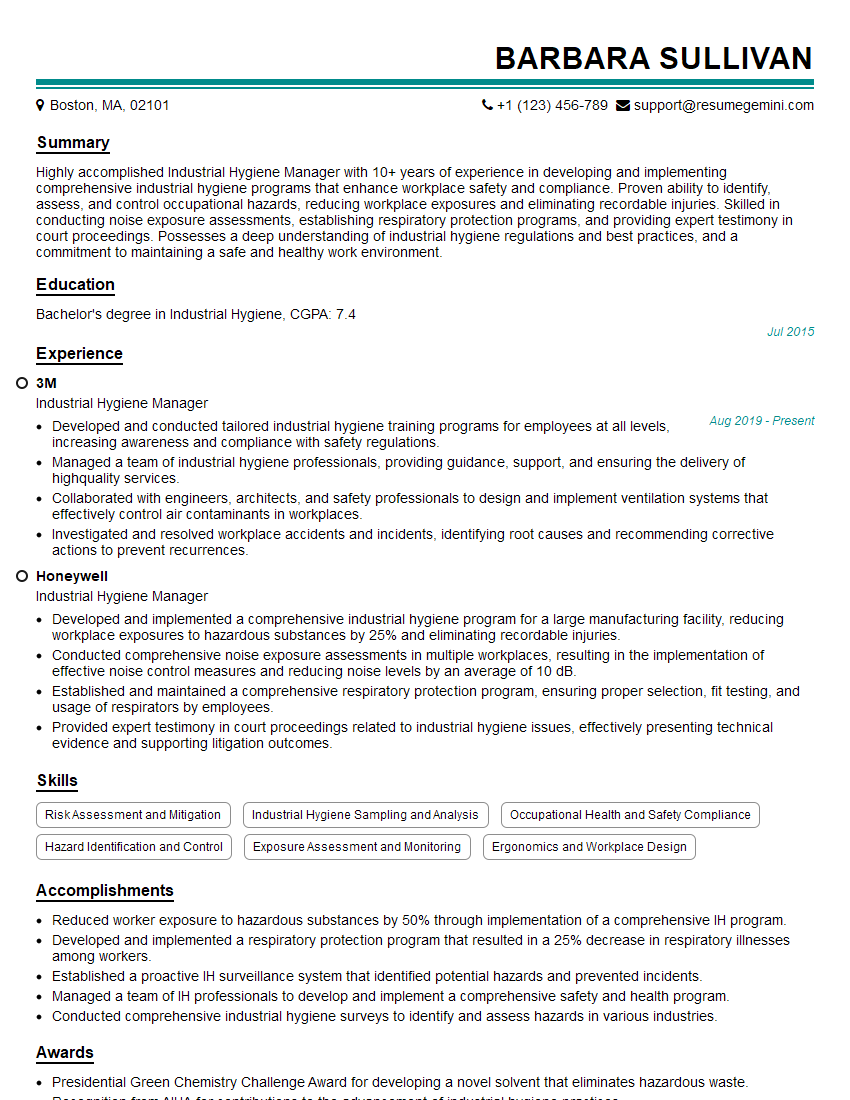
Mastering Industrial Hygiene Software and IT Applications is crucial for career advancement in this field. Proficiency in these areas positions you as a valuable asset, capable of handling complex data analysis, risk assessment, and regulatory compliance. To maximize your job prospects, creating an ATS-friendly resume is essential. ResumeGemini can help you build a professional, impactful resume that highlights your skills and experience effectively. ResumeGemini provides examples of resumes tailored to Industrial Hygiene Software and IT Applications to guide you in crafting a compelling application. Invest time in building a strong resume – it’s your first impression to potential employers.
Explore more articles
Users Rating of Our Blogs
Share Your Experience
We value your feedback! Please rate our content and share your thoughts (optional).
What Readers Say About Our Blog
Very informative content, great job.
good