Interviews are more than just a Q&A session—they’re a chance to prove your worth. This blog dives into essential Information Warfare and Cyber Security interview questions and expert tips to help you align your answers with what hiring managers are looking for. Start preparing to shine!
Questions Asked in Information Warfare and Cyber Security Interview
Q 1. Explain the difference between symmetric and asymmetric encryption.
Symmetric and asymmetric encryption are two fundamental approaches to securing data. The core difference lies in the number of keys used for encryption and decryption.
Symmetric Encryption: Uses a single secret key for both encrypting and decrypting data. Think of it like a secret code you and your friend share; only someone with that code can decipher the message. This is efficient and fast, but the key exchange process can be a security challenge. Examples include AES (Advanced Encryption Standard) and DES (Data Encryption Standard).
Asymmetric Encryption: Employs a pair of keys: a public key for encryption and a private key for decryption. The public key can be freely distributed, while the private key must remain secret. This solves the key exchange problem of symmetric encryption because you can encrypt data with someone’s public key, and only they (with their private key) can decrypt it. Examples include RSA (Rivest-Shamir-Adleman) and ECC (Elliptic Curve Cryptography). Digital signatures rely heavily on this technology.
Analogy: Imagine sending a letter. Symmetric encryption is like using a lock with only one key – you and the recipient need the same key to open it. Asymmetric encryption is like using a mailbox with a slot for letters (public key) – anyone can put a letter in, but only you (with your private key) have the key to open your mailbox and read it.
Q 2. Describe the CIA triad (Confidentiality, Integrity, Availability).
The CIA triad – Confidentiality, Integrity, and Availability – forms the cornerstone of information security. It represents the three core principles that must be protected to ensure data security.
- Confidentiality: Ensuring that only authorized individuals or systems can access sensitive data. This involves access controls, encryption, and data loss prevention techniques. Think of a bank account – only you and the authorized personnel should be able to see your balance and transaction details.
- Integrity: Guaranteeing the accuracy and completeness of data, ensuring it has not been tampered with or altered in an unauthorized manner. Hashing algorithms and digital signatures are used to maintain data integrity. Imagine a digital document – a digital signature verifies the document hasn’t been modified since it was signed.
- Availability: Ensuring that authorized users can access data and resources when needed. This involves redundancy, disaster recovery planning, and robust infrastructure. A website crashing during peak hours violates availability.
The CIA triad is interconnected. For example, a breach of confidentiality can affect integrity (if data is altered) and availability (if the system is taken offline). A comprehensive security posture requires balanced attention to all three aspects.
Q 3. What are the common types of cyber threats?
Cyber threats are constantly evolving, but some common types include:
- Malware: Malicious software designed to damage, disrupt, or gain unauthorized access to computer systems. This includes viruses, worms, Trojans, ransomware, and spyware.
- Phishing: Deceptive attempts to acquire sensitive information such as usernames, passwords, and credit card details by masquerading as a trustworthy entity in electronic communication.
- Denial-of-Service (DoS) attacks: Overwhelming a system with traffic to make it unavailable to legitimate users.
- SQL Injection: Exploiting vulnerabilities in database applications to gain unauthorized access to data.
- Man-in-the-Middle (MitM) attacks: Intercepting communication between two parties to eavesdrop or manipulate the data exchange.
- Zero-day exploits: Exploiting previously unknown vulnerabilities in software before a patch is available.
- Insider threats: Malicious or negligent actions by individuals with authorized access to an organization’s systems and data.
Understanding these threats is crucial for implementing effective security measures.
Q 4. What are the key components of a security information and event management (SIEM) system?
A Security Information and Event Management (SIEM) system is a crucial tool for security monitoring and incident response. Key components include:
- Log Collection and Aggregation: Gathering security logs from various sources such as firewalls, servers, and network devices.
- Normalization and Correlation: Transforming logs into a standardized format and identifying relationships between different events to detect patterns indicative of attacks.
- Real-time Monitoring and Alerting: Continuously analyzing logs and generating alerts on suspicious activity.
- Security Information Dashboard: Providing a centralized view of security events and trends.
- Incident Response and Forensics: Facilitating investigation and remediation of security incidents.
- Reporting and Analytics: Generating reports to assess security posture and compliance.
A well-configured SIEM system provides a comprehensive view of an organization’s security landscape, enabling proactive threat detection and rapid response to incidents.
Q 5. Explain the concept of zero-trust security.
Zero-trust security is a security model based on the principle of ‘never trust, always verify’. It assumes that no user or device, even those inside the network, should be automatically trusted. Every access request is verified regardless of origin.
Instead of a perimeter-based approach (trusting everything inside the network), zero-trust enforces strict access controls based on least privilege, continuous verification, and micro-segmentation. Every user, device, and application must prove its identity and authorization before accessing any resource.
Key aspects of Zero Trust:
- Strong Authentication and Authorization: Multi-factor authentication and granular access control.
- Microsegmentation: Dividing the network into smaller, isolated segments to limit the impact of a breach.
- Data Encryption: Protecting data both in transit and at rest.
- Continuous Monitoring and Threat Detection: Constantly assessing the security posture and detecting suspicious activity.
Zero trust helps minimize the blast radius of a security breach by preventing lateral movement within the network.
Q 6. Describe your experience with penetration testing methodologies.
My penetration testing experience encompasses a wide range of methodologies, primarily adhering to the OWASP (Open Web Application Security Project) guidelines and NIST (National Institute of Standards and Technology) frameworks. I’ve conducted both black-box and white-box penetration tests, employing various techniques depending on the client’s requirements and the scope of the engagement.
Black-box testing simulates real-world attacks with minimal prior knowledge of the target system. This helps identify vulnerabilities that might be missed in a white-box test. I leverage automated vulnerability scanners, manual reconnaissance techniques, and exploit frameworks to discover and exploit weaknesses.
White-box testing provides testers with detailed knowledge of the target system, including source code, architecture, and network diagrams. This allows for a more targeted and in-depth analysis, focusing on specific areas of concern. This methodology is often more efficient, but may miss vulnerabilities that would only be apparent through a black-box perspective.
My approach always prioritizes ethical conduct, ensuring compliance with legal and ethical guidelines throughout the testing process. Comprehensive reporting and vulnerability remediation recommendations are vital parts of my deliverable.
I’ve worked extensively with various penetration testing tools like Metasploit, Nmap, Burp Suite, and Nessus to identify and exploit vulnerabilities.
Q 7. How do you perform vulnerability assessments?
Vulnerability assessments are crucial for identifying security weaknesses in systems and applications. My approach involves a multi-faceted strategy combining automated and manual techniques:
- Reconnaissance: Gathering information about the target system, including its network configuration, software versions, and operating systems. This involves using both open-source intelligence (OSINT) techniques and automated scanners like Nmap.
- Automated Vulnerability Scanning: Employing vulnerability scanners such as Nessus, OpenVAS, or QualysGuard to identify known vulnerabilities based on their vulnerability databases.
- Manual Penetration Testing (as needed): Following up on the findings from automated scans to confirm vulnerabilities and assess their exploitability. This involves manual testing of web applications, network devices, and operating systems.
- Code Review (if applicable): Analyzing source code to find vulnerabilities in application logic or programming errors.
- Reporting: Creating a detailed report of identified vulnerabilities, including their severity, potential impact, and remediation recommendations. The report usually follows a structured format to facilitate understanding and prioritization by the client.
Throughout the assessment, I meticulously document each step, ensuring complete traceability and providing clients with a comprehensive understanding of the identified weaknesses and their implications. The goal is not only to identify vulnerabilities but also to provide actionable steps to mitigate them.
Q 8. Explain your understanding of incident response procedures.
Incident response procedures are a structured, systematic approach to handling security incidents, from initial detection to post-incident activity. Think of it as a meticulously planned fire drill for your digital assets. It involves a series of steps designed to minimize damage, contain the threat, and recover from the incident.
- Preparation: This includes establishing policies, procedures, and communication plans, conducting regular security assessments, and training personnel. For instance, creating a playbook outlining roles and responsibilities during a ransomware attack is crucial.
- Detection and Analysis: This phase involves identifying the incident, understanding its nature, and determining its impact. Tools like SIEM (Security Information and Event Management) systems play a vital role here. Let’s say we detect unusual network activity – the next step would be to analyze logs, network traffic, and system events to pinpoint the source and scope of the breach.
- Containment: This critical step involves isolating the affected systems or networks to prevent further damage. This could involve disconnecting a compromised server from the network or blocking malicious IP addresses. Imagine a building on fire; containment is like isolating the fire to prevent it from spreading to other parts.
- Eradication: This stage involves removing the malware or threat and restoring systems to a secure state. This often requires thorough forensic analysis and may involve reinstalling operating systems or applications. We need to make sure we remove all traces of the malware and patch any vulnerabilities that were exploited.
- Recovery: Restoring systems and data to their pre-incident state. This may involve restoring data from backups and validating system functionality. Imagine recovering data from a cloud backup after a hard drive failure – this is analogous to system recovery.
- Post-Incident Activity: This involves reviewing the incident, identifying lessons learned, and updating security policies and procedures to prevent future incidents. A post-mortem analysis is vital to improving future responses. We need to document what happened, why it happened, how we responded, and what we can do differently next time.
Q 9. What are your experience with various malware analysis techniques?
My malware analysis experience encompasses both static and dynamic techniques. Static analysis involves examining the malware without executing it, looking for suspicious code patterns, strings, and metadata. This is like studying a blueprint of a building to understand its structure. Dynamic analysis, on the other hand, involves running the malware in a controlled environment (like a sandbox) to observe its behavior. This allows us to see how the malware actually operates in real-time. Imagine watching a movie versus reading the screenplay.
I’m proficient in using various tools such as IDA Pro (Interactive Disassembler) for reverse engineering, Wireshark for network traffic analysis, and Cuckoo Sandbox for dynamic analysis. I’ve also worked extensively with different malware families, including ransomware, trojans, and rootkits, developing expertise in identifying their signatures, techniques, and evasion tactics. For example, I recently analyzed a novel piece of ransomware that used advanced encryption techniques and leveraged a previously unknown vulnerability to spread quickly. Through static and dynamic analysis, I was able to identify the encryption keys and develop a decryption tool.
Q 10. How do you handle social engineering attacks?
Handling social engineering attacks requires a multi-faceted approach focused on prevention, detection, and response. Prevention involves educating users about common social engineering tactics such as phishing, baiting, and pretexting. Think of it like teaching someone to spot a counterfeit bill.
Detection relies on monitoring systems for unusual activity, suspicious emails, and user behavior. Security awareness training is crucial here. For instance, if an employee clicks on a suspicious link, we investigate the link and take action to ensure that no harmful files were executed.
Response includes isolating affected systems, containing the breach, and restoring affected accounts. Incident response processes are vital for a swift response. If a phishing email compromises an employee’s account, we would immediately change the password, review user access rights, and thoroughly investigate the potential impact. A well-defined incident response plan is crucial for minimizing damage.
Ultimately, combating social engineering is as much about human psychology as it is about technology. Building a strong security culture and making employees aware of the threat is paramount.
Q 11. Describe your knowledge of different types of firewalls.
Firewalls are the gatekeepers of a network, controlling the flow of traffic between internal and external networks. They work by comparing incoming and outgoing network traffic against a set of predefined rules. Different firewall types offer varying levels of protection:
- Packet Filtering Firewalls: These examine individual packets based on IP addresses, ports, and protocols. They’re simple but can be easily bypassed by sophisticated attacks. Think of it as a simple bouncer at a club checking IDs.
- Stateful Inspection Firewalls: These firewalls maintain a record of network connections, allowing them to analyze traffic in context. They’re more effective than packet filtering firewalls as they understand the ‘conversation’ between systems. This is like a more sophisticated bouncer who tracks guests who have been admitted.
- Application-Level Gateways: These firewalls inspect application-specific data, enabling deeper scrutiny of traffic. For example, they can inspect the contents of email headers or web requests. This is like a customs officer who inspects the contents of luggage.
- Next-Generation Firewalls (NGFWs): These combine features from the above types and add advanced security functions such as intrusion prevention, malware detection, and application control. They represent the most comprehensive protection. They are like an airport security system with multiple layers of protection.
Q 12. Explain your experience with intrusion detection and prevention systems (IDS/IPS).
Intrusion Detection and Prevention Systems (IDS/IPS) are crucial components of a robust security architecture. IDS passively monitors network traffic for suspicious activity, alerting administrators to potential threats. IPS actively blocks or mitigates threats. Think of IDS as a security camera system that records suspicious activity, while IPS is like a security guard who intervenes to stop threats.
My experience encompasses deploying, managing, and analyzing data from both network-based and host-based IDS/IPS solutions. I’m familiar with various signature-based and anomaly-based detection methods. For example, I’ve used Snort (a network-based IDS) to detect and analyze malicious network traffic, and I’ve worked with host-based IPS solutions to block malware execution on individual systems. Analyzing the alerts generated by these systems requires a keen eye for detail and strong knowledge of network protocols and security threats.
Q 13. How familiar are you with various network protocols (TCP/IP, UDP, etc.)?
I have extensive familiarity with various network protocols, most notably TCP/IP, UDP, and HTTP. TCP/IP forms the foundation of the internet, providing a reliable, connection-oriented service. UDP offers a faster, connectionless alternative, suitable for applications where reliability is less critical. HTTP is the protocol used for web communication.
Understanding these protocols is essential for analyzing network traffic, troubleshooting network issues, and securing networks. For instance, I can diagnose network connectivity problems by analyzing TCP/IP header information, or identify malicious activity by observing unusual UDP traffic patterns. A thorough understanding of network protocols is a crucial skill for any cybersecurity professional.
Q 14. Describe your experience with cloud security best practices (AWS, Azure, GCP).
My experience with cloud security best practices across AWS, Azure, and GCP includes implementing and managing security controls for various cloud services. This encompasses:
- Identity and Access Management (IAM): Implementing strong authentication and authorization mechanisms to restrict access to sensitive resources. This includes using multi-factor authentication, least privilege access principles, and regular IAM role reviews.
- Data Encryption: Protecting data both in transit and at rest using encryption services provided by each cloud provider. For instance, I’ve utilized AWS KMS, Azure Key Vault, and Google Cloud KMS for key management and encryption.
- Network Security: Establishing secure virtual networks (VPCs), configuring firewalls, and implementing intrusion detection and prevention systems. I’ve used services like AWS Security Hub, Azure Security Center, and Google Cloud Security Command Center for centralized security monitoring and management.
- Vulnerability Management: Utilizing cloud-native vulnerability scanning tools to identify and remediate security weaknesses. I’ve used services like AWS Inspector, Azure Security Center, and Google Cloud Security Scanner.
- Compliance and Auditing: Ensuring compliance with industry regulations and best practices through logging, monitoring, and auditing. For example, I’ve helped organizations achieve compliance with standards such as SOC 2 and PCI DSS in cloud environments.
Working with these cloud providers requires a deep understanding of their unique security features and services. It’s vital to leverage the security tools each provider offers to protect data and applications in the cloud.
Q 15. What is your understanding of data loss prevention (DLP) techniques?
Data Loss Prevention (DLP) techniques are a set of security measures designed to prevent sensitive data from leaving an organization’s control. Think of it as a sophisticated bouncer at the door, meticulously checking every piece of data trying to exit. This involves identifying, monitoring, and protecting confidential information across various channels, including email, cloud storage, USB drives, and even printed documents.
DLP strategies typically involve a multi-layered approach:
- Data Discovery and Classification: This initial step involves identifying and categorizing sensitive data based on its value and risk level (e.g., Personally Identifiable Information (PII), financial records, intellectual property). This is often done using automated tools that scan for keywords, patterns, and data types.
- Monitoring and Alerting: Once sensitive data is identified, DLP systems monitor its movement. Any attempt to access, copy, or transfer this data outside of approved channels triggers alerts, allowing security personnel to investigate.
- Prevention and Remediation: This is the reactive stage, where the DLP system either blocks the unauthorized data transfer or initiates remediation actions, such as quarantining the data or notifying the user.
- Encryption: Encrypting sensitive data at rest and in transit adds an extra layer of protection. Even if the data is intercepted, it remains unreadable without the decryption key.
For example, a DLP system might block an email containing a credit card number from being sent outside the organization’s network unless it’s sent to an approved recipient or the email itself is encrypted.
Another example would be a DLP solution monitoring file transfers to external storage devices, flagging any attempts to copy sensitive files onto USB drives without proper authorization.
Career Expert Tips:
- Ace those interviews! Prepare effectively by reviewing the Top 50 Most Common Interview Questions on ResumeGemini.
- Navigate your job search with confidence! Explore a wide range of Career Tips on ResumeGemini. Learn about common challenges and recommendations to overcome them.
- Craft the perfect resume! Master the Art of Resume Writing with ResumeGemini’s guide. Showcase your unique qualifications and achievements effectively.
- Don’t miss out on holiday savings! Build your dream resume with ResumeGemini’s ATS optimized templates.
Q 16. How do you perform risk assessments?
Performing a risk assessment is a systematic process of identifying, analyzing, and prioritizing potential threats and vulnerabilities to an organization’s assets. Think of it as a thorough security checkup for your business. The goal is to understand what could go wrong, how likely it is to happen, and what the impact would be.
My approach to risk assessments typically follows these steps:
- Asset Identification: What are the organization’s valuable assets? This includes hardware, software, data, intellectual property, and even reputation.
- Threat Identification: What are the potential threats that could affect these assets? This might involve natural disasters, cyberattacks, insider threats, or accidental data loss.
- Vulnerability Identification: What weaknesses in the organization’s security posture could be exploited by these threats? This includes outdated software, weak passwords, insecure network configurations, or lack of employee training.
- Risk Analysis: This step involves assessing the likelihood and potential impact of each threat exploiting a vulnerability. We typically use a risk matrix to categorize risks based on their severity.
- Risk Response Planning: Based on the risk analysis, we develop a plan to mitigate the identified risks. This might involve implementing security controls, transferring the risk (e.g., purchasing insurance), accepting the risk (if the likelihood or impact is low), or avoiding the risk altogether.
- Monitoring and Review: Risk assessments aren’t one-time events. They should be regularly reviewed and updated to account for changes in the threat landscape and the organization’s security posture.
For example, if a risk assessment identifies a high likelihood of a ransomware attack due to outdated antivirus software, the risk response plan might involve updating the software, implementing regular backups, and employee training on phishing awareness.
Q 17. Explain your experience with security audits and compliance frameworks (e.g., ISO 27001, NIST).
Security audits and compliance frameworks like ISO 27001 and NIST Cybersecurity Framework are essential for demonstrating a commitment to robust cybersecurity practices. I’ve been involved in numerous security audits, guiding organizations through the process of assessing their security controls against these established standards.
My experience includes:
- Conducting Gap Analyses: I’ve compared an organization’s existing security controls against the requirements of ISO 27001 or NIST, identifying areas where improvements are needed.
- Developing Remediation Plans: Based on the gap analysis, I’ve worked with organizations to develop and implement plans to address identified weaknesses.
- Performing Vulnerability Assessments: This involves scanning systems and networks for known vulnerabilities to ensure they are patched or mitigated.
- Penetration Testing: I’ve simulated real-world attacks to identify weaknesses in security defenses.
- Auditing Compliance Documentation: I’ve reviewed an organization’s security policies, procedures, and other documentation to ensure they align with relevant standards and regulations.
Working with these frameworks is like building a house to code – ensuring that the structure is strong, safe and meets the required specifications. ISO 27001 focuses on establishing an Information Security Management System (ISMS), while the NIST Cybersecurity Framework provides a voluntary framework for improving cybersecurity risk management. Both are crucial for reducing organizational risk.
Q 18. Describe your experience with log management and analysis.
Log management and analysis are critical for detecting and responding to security incidents. Logs are like a security camera’s recording – they capture everything that happens on a system or network. Effective log management involves collecting, storing, analyzing, and using those logs to identify threats and patterns.
My experience encompasses:
- Implementing centralized log management systems: I’ve deployed and configured tools like ELK stack (Elasticsearch, Logstash, Kibana), Splunk, or Graylog to centralize log collection from diverse sources.
- Developing log analysis rules and alerts: I’ve created rules to identify suspicious activities, such as failed login attempts, unusual network traffic, or access to sensitive files. These rules trigger alerts to security teams, allowing for prompt response.
- Investigating security incidents: When security events occur, I leverage log data to reconstruct the sequence of events, identify the attacker, and determine the extent of the breach.
- Forensic analysis: I have experience performing forensic analysis on log data to gather evidence for incident reporting and legal proceedings.
For example, by analyzing authentication logs, we might detect a brute-force attack targeting user accounts. Analyzing network logs could reveal unauthorized access attempts or data exfiltration. A well-structured log management system is the bedrock of effective incident response.
Q 19. Explain your understanding of the kill chain model.
The Cyber Kill Chain is a model that describes the stages of a cyberattack. Think of it as a roadmap for attackers. Understanding this model is crucial for building defenses at each stage.
The stages include:
- Reconnaissance: The attacker gathers information about the target.
- Weaponization: The attacker creates a malicious payload (e.g., malware).
- Delivery: The attacker delivers the payload to the target (e.g., phishing email).
- Exploitation: The attacker exploits a vulnerability to gain access.
- Installation: The attacker installs malware or establishes persistence.
- Command and Control: The attacker communicates with the malware to control it.
- Actions on Objectives: The attacker achieves their goals (e.g., data theft).
By understanding the kill chain, we can implement security controls at each stage to disrupt or prevent the attack. For instance, implementing strong email filtering can hinder delivery, while regular patching can prevent exploitation. Intrusion Detection Systems (IDS) can detect malicious activity during the command and control phase.
Q 20. How do you stay up-to-date with the latest cybersecurity threats and vulnerabilities?
Staying current with cybersecurity threats and vulnerabilities is crucial. The threat landscape is constantly evolving; therefore, continuous learning is paramount.
My methods include:
- Following reputable security news sources: I regularly read publications like KrebsOnSecurity, Threatpost, and The Hacker News to stay informed about emerging threats and vulnerabilities.
- Participating in security communities: I actively engage in online forums, attending conferences, and participating in professional organizations (e.g., (ISC)²).
- Utilizing vulnerability databases: I leverage databases like the National Vulnerability Database (NVD) and Exploit-DB to track known vulnerabilities and understand their potential impact.
- Performing regular security assessments: Conducting regular penetration testing and vulnerability assessments helps to identify potential weaknesses in my organization’s security posture.
- Staying updated on certifications: Continuously pursuing advanced certifications keeps me sharp and up-to-date on the latest best practices and technologies.
Think of it as being a detective: constantly updating your knowledge, investigating new cases (threats), and mastering new techniques is essential to staying ahead of the criminals.
Q 21. Explain your experience with scripting languages (Python, PowerShell) for security automation.
Scripting languages like Python and PowerShell are invaluable for automating security tasks, increasing efficiency and reducing human error. Automation is crucial to manage the ever-growing complexities of modern IT environments.
My experience includes:
- Automating security assessments: I’ve used Python to automate vulnerability scanning, penetration testing, and log analysis tasks.
- Developing security tools: I’ve built custom tools in Python and PowerShell for tasks like automating incident response, malware analysis, and security reporting. For instance, I’ve created a script in Python to analyze log files for suspicious activities, automatically generating reports based on the findings.
- Automating system administration tasks: I’ve used PowerShell to automate repetitive tasks, such as user account management, software patching, and security configuration.
- Creating custom security scripts: I regularly develop tailored scripts to address specific security challenges.
Here’s a simple example of a Python script to check if a website is up:
import requests

def check_website(url):
    try:
        response = requests.get(url)
        response.raise_for_status()  # Raise an exception for bad status codes
        print(f"{url} is up!")
    except requests.exceptions.RequestException as e:
        print(f"{url} is down: {e}")

check_website("https://www.example.com")
This is just a small example; the possibilities for automation are limitless. Efficient scripting significantly improves security posture and allows for a more proactive and responsive security team.
Q 22. Describe your experience with security monitoring and alerting systems.
Security monitoring and alerting systems are the backbone of any robust cybersecurity posture. They involve deploying tools and techniques to continuously observe network traffic, system logs, and user activity for suspicious behavior. This allows for early detection of threats and timely responses. My experience encompasses a wide range of these systems, from traditional Security Information and Event Management (SIEM) solutions like Splunk and QRadar to more specialized tools focusing on specific threats like endpoint detection and response (EDR) platforms.
For example, in a previous role, I implemented a SIEM solution that integrated with various network devices, servers, and applications. This enabled real-time monitoring of security events, generating alerts based on pre-defined rules and anomaly detection. One particular instance involved the detection of a sophisticated phishing campaign targeting high-level executives. The SIEM alerted us to unusual login attempts from unusual geographic locations, allowing us to quickly block the attacks and mitigate potential data breaches. We also used the system’s reporting capabilities to analyze trends and improve our security posture over time. The process involves configuring thresholds, establishing baselines, developing correlation rules to identify patterns, and integrating with incident response systems for efficient threat handling. This is all underpinned by a solid understanding of logging best practices and proper alert management to prevent alert fatigue.
Q 23. What is your understanding of ethical hacking principles?
Ethical hacking, also known as penetration testing, is a crucial element in strengthening cybersecurity. It’s about proactively identifying vulnerabilities in a system or network *with the explicit permission* of the owner. Ethical hackers employ the same techniques as malicious actors but with the goal of improving security. Key principles include:
- Explicit Permission: All activities must be authorized in writing.
- Scope Definition: Clearly defined boundaries and objectives to avoid unintended damage.
- Non-Malicious Intent: The primary goal is to discover vulnerabilities, not to cause harm or damage.
- Professionalism and Transparency: Adhering to a code of conduct and providing detailed reports of findings.
- Legal Compliance: Following all relevant laws and regulations.
For instance, in one project, I conducted a penetration test on a client’s web application. I used various techniques, including vulnerability scanning, SQL injection testing, and cross-site scripting (XSS) checks, to identify weaknesses. My findings were documented in a detailed report, providing recommendations for remediation. This allowed the client to proactively address potential vulnerabilities before they could be exploited by malicious actors.
Q 24. Explain your experience with various security frameworks (e.g., MITRE ATT&CK).
Security frameworks provide a structured approach to managing and improving cybersecurity. MITRE ATT&CK is a particularly valuable framework that catalogs known adversary tactics and techniques based on real-world observations. It provides a common language and model for understanding adversary behavior across various attack phases. I have extensive experience using ATT&CK to inform threat modeling, vulnerability assessments, and incident response.
For example, when investigating a suspected intrusion, we used the ATT&CK framework to map observed indicators of compromise (IOCs) to specific tactics and techniques. This helped us quickly understand the adversary’s goals, methods, and likely next steps, enabling a more focused and effective response. We used the framework to analyze logs and identify potential lateral movement within the network, based on common techniques used in real-world attacks described in ATT&CK. Beyond MITRE ATT&CK, I am also familiar with other frameworks like NIST Cybersecurity Framework, ISO 27001, and CIS Controls. Each offers a different perspective, but all share the common goal of systematic risk management and proactive threat mitigation.
Q 25. How familiar are you with different types of cryptography algorithms?
Cryptography is fundamental to cybersecurity, providing confidentiality, integrity, and authentication. My familiarity spans various algorithms, including:
- Symmetric-key cryptography: Algorithms like AES (Advanced Encryption Standard) and DES (Data Encryption Standard) where the same key is used for encryption and decryption. AES is widely considered the industry standard for symmetric encryption.
- Asymmetric-key cryptography (Public-key cryptography): Algorithms like RSA (Rivest-Shamir-Adleman) and ECC (Elliptic Curve Cryptography) where a pair of keys—a public key and a private key—are used. RSA is often used for digital signatures and key exchange, while ECC offers greater efficiency with shorter key lengths.
- Hashing algorithms: Algorithms like SHA-256 (Secure Hash Algorithm 256-bit) and MD5 (Message Digest 5) which generate a fixed-size string (hash) from an input. These are crucial for data integrity verification.
Understanding the strengths and weaknesses of each algorithm is crucial for choosing the appropriate cryptographic solution for a specific security requirement. For example, choosing the right key size for AES depends on the sensitivity of the data and the expected lifespan of the encryption. Similarly, the selection of a hashing algorithm needs to consider its collision resistance and computational cost.
Q 26. Describe your approach to identifying and mitigating insider threats.
Insider threats represent a significant risk, as they often involve individuals with legitimate access to sensitive information. My approach to identifying and mitigating insider threats is multifaceted:
- Strong Access Control: Implementing the principle of least privilege, granting users only the access they absolutely need for their job functions. Regular access reviews are essential.
- Data Loss Prevention (DLP): Deploying DLP tools to monitor and prevent sensitive data from leaving the organization’s control, whether through email, removable media, or other channels.
- User and Entity Behavior Analytics (UEBA): Leveraging UEBA solutions to detect anomalous user activities, such as unusual access patterns or data exfiltration attempts.
- Security Awareness Training: Regular training programs educate employees about security risks and best practices, reinforcing responsible data handling.
- Background Checks and Vetting: Rigorous background checks and vetting procedures for all employees, especially those with high-level access.
- Monitoring and Alerting: Setting up monitoring systems to track user activities, with alerts triggered by suspicious behavior. This includes reviewing audit logs and security logs regularly.
For instance, I was involved in an investigation where a UEBA system detected unusual data access patterns by an employee. Further investigation revealed that the employee was attempting to exfiltrate sensitive customer data. This was immediately addressed, mitigating a potential significant breach.
Q 27. Explain your understanding of the role of artificial intelligence and machine learning in cybersecurity.
Artificial intelligence (AI) and machine learning (ML) are transforming cybersecurity by automating tasks and enhancing the ability to detect and respond to threats. AI/ML algorithms can analyze vast amounts of data—far beyond human capabilities—to identify patterns and anomalies indicative of malicious activity.
- Threat Detection: AI/ML can be used to detect sophisticated attacks that might go unnoticed by traditional security tools. For example, they can identify subtle deviations from normal network traffic patterns or user behavior.
- Vulnerability Management: AI/ML can be used to prioritize vulnerabilities, focusing on the most critical ones first. This can streamline the process of patching and remediation.
- Incident Response: AI/ML can automate aspects of incident response, speeding up the process and reducing the impact of attacks.
- Security Information and Event Management (SIEM): AI/ML can significantly improve the effectiveness of SIEM systems by enabling more sophisticated anomaly detection and threat correlation.
However, it’s crucial to remember that AI/ML is not a silver bullet. It requires careful design, implementation, and ongoing monitoring. Adversaries are also adapting and learning to evade these systems. Therefore, a layered security approach combining AI/ML with traditional security measures remains essential.
Key Topics to Learn for Information Warfare and Cyber Security Interview
- Network Security Fundamentals: Understanding network protocols, vulnerabilities, and security architectures (e.g., firewalls, intrusion detection systems).
- Cyber Threat Intelligence: Analyzing threat actors, their motives, and techniques to proactively mitigate risks. Practical application: Developing threat models and incident response plans.
- Cryptography and Encryption: Knowledge of various encryption algorithms, digital signatures, and their application in securing sensitive data. Practical application: Evaluating the security of different cryptographic systems.
- Incident Response and Forensics: Investigating cyber security incidents, collecting evidence, and restoring systems to a secure state. Practical application: Developing and testing incident response plans.
- Information Warfare Concepts: Understanding the strategic and tactical aspects of information warfare, including propaganda, disinformation, and influence operations. Practical application: Analyzing information warfare campaigns and developing countermeasures.
- Vulnerability Assessment and Penetration Testing: Identifying and exploiting security vulnerabilities in systems and networks. Practical application: Conducting ethical hacking exercises to identify weaknesses.
- Data Security and Privacy: Understanding data protection regulations (e.g., GDPR, CCPA) and implementing secure data handling practices. Practical application: Designing secure data storage and access control mechanisms.
- Cloud Security: Securing cloud-based infrastructure and applications. Practical application: Implementing security best practices for cloud environments (AWS, Azure, GCP).
- Security Auditing and Compliance: Conducting security audits and ensuring compliance with industry standards and regulations. Practical application: Developing and implementing security policies and procedures.
Next Steps
Mastering Information Warfare and Cyber Security opens doors to exciting and impactful careers with significant growth potential. A strong resume is crucial for showcasing your skills and experience to potential employers. Creating an ATS-friendly resume is essential to ensure your application gets noticed. We highly recommend using ResumeGemini, a trusted resource, to build a professional and effective resume that highlights your unique qualifications. ResumeGemini provides examples of resumes tailored specifically to Information Warfare and Cyber Security roles, helping you present yourself in the best possible light.

Compliance Officer Resume Sample
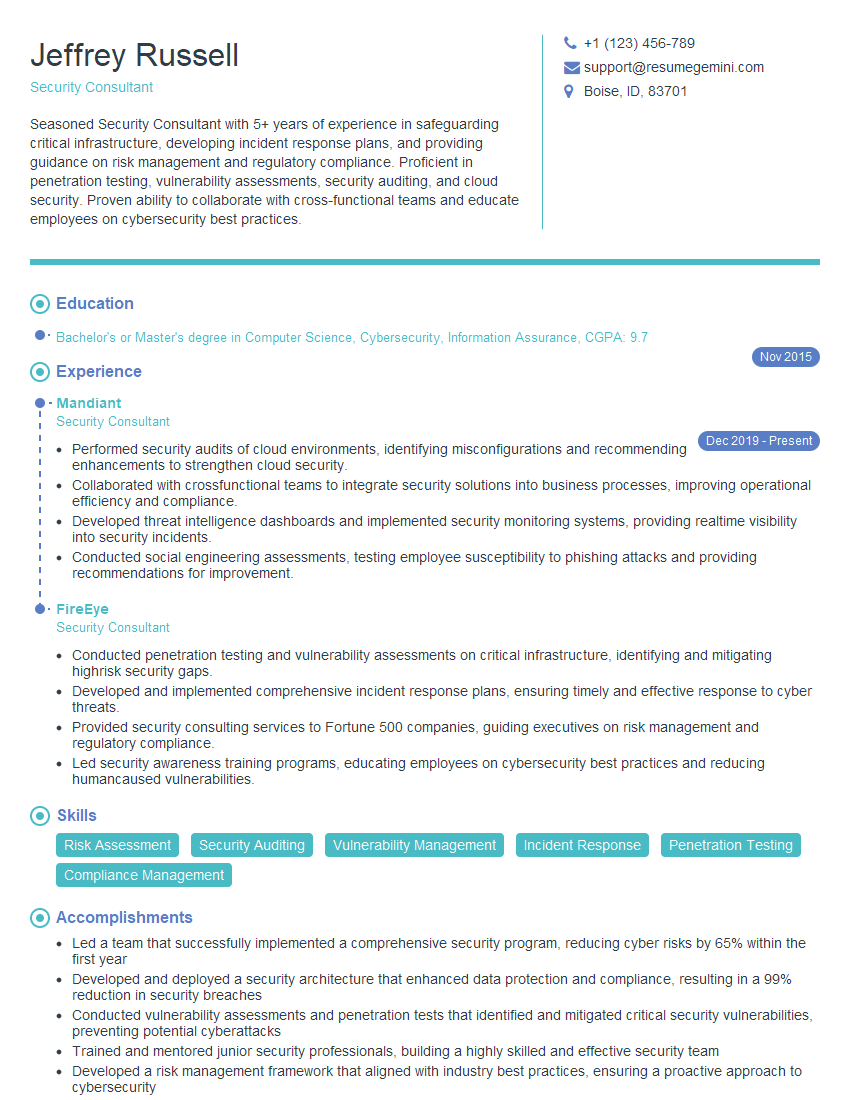
Security Consultant Resume Sample
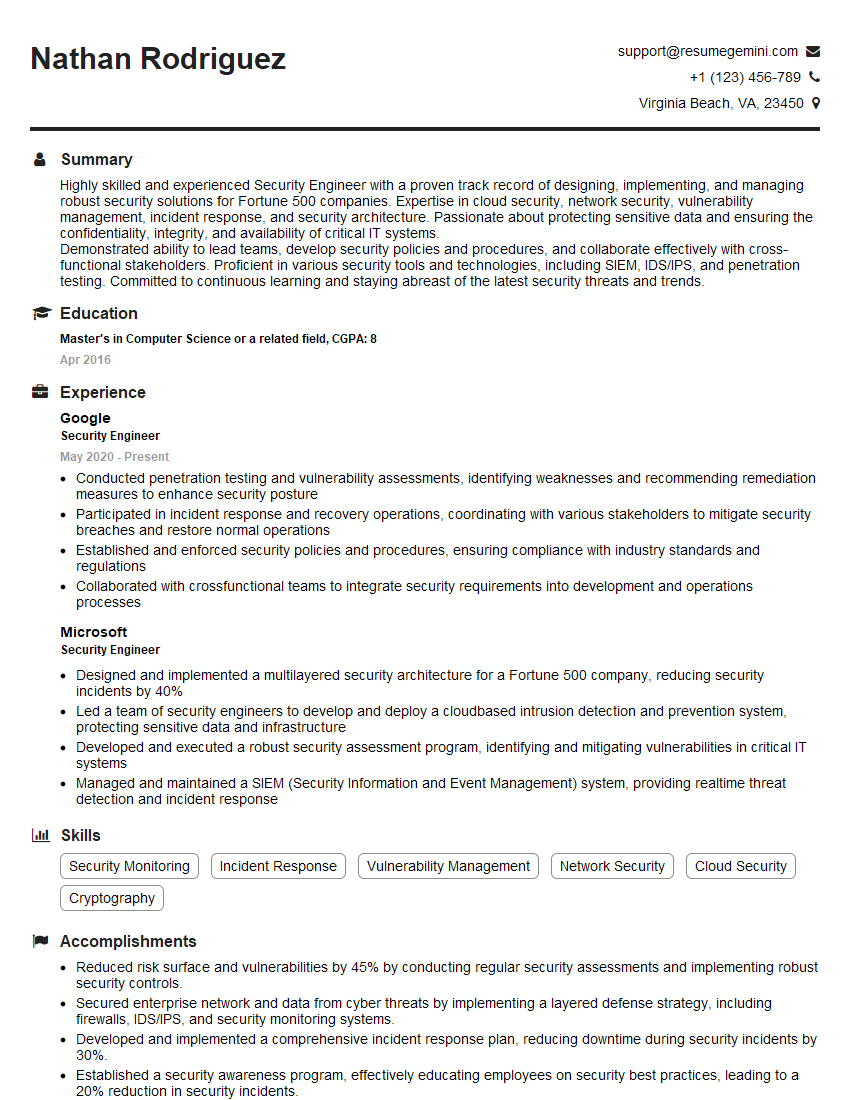
Security Engineer Resume Sample
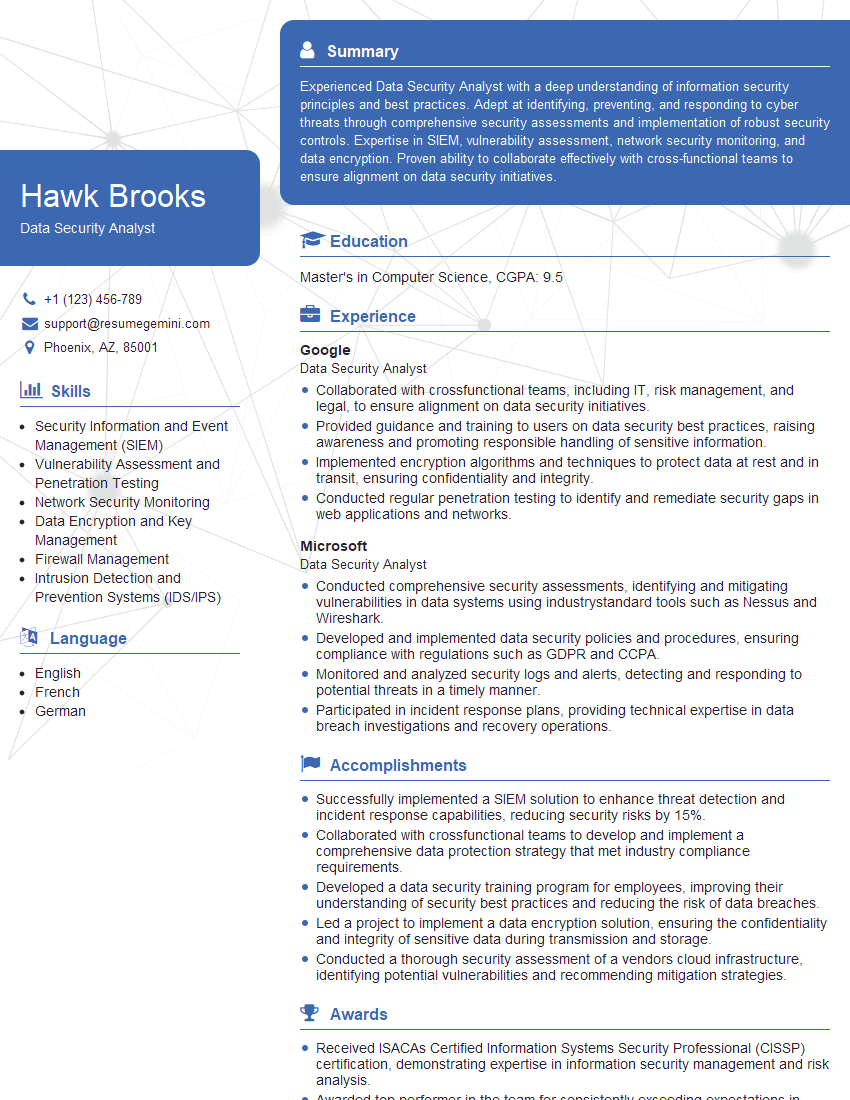
Data Security Analyst Resume Sample
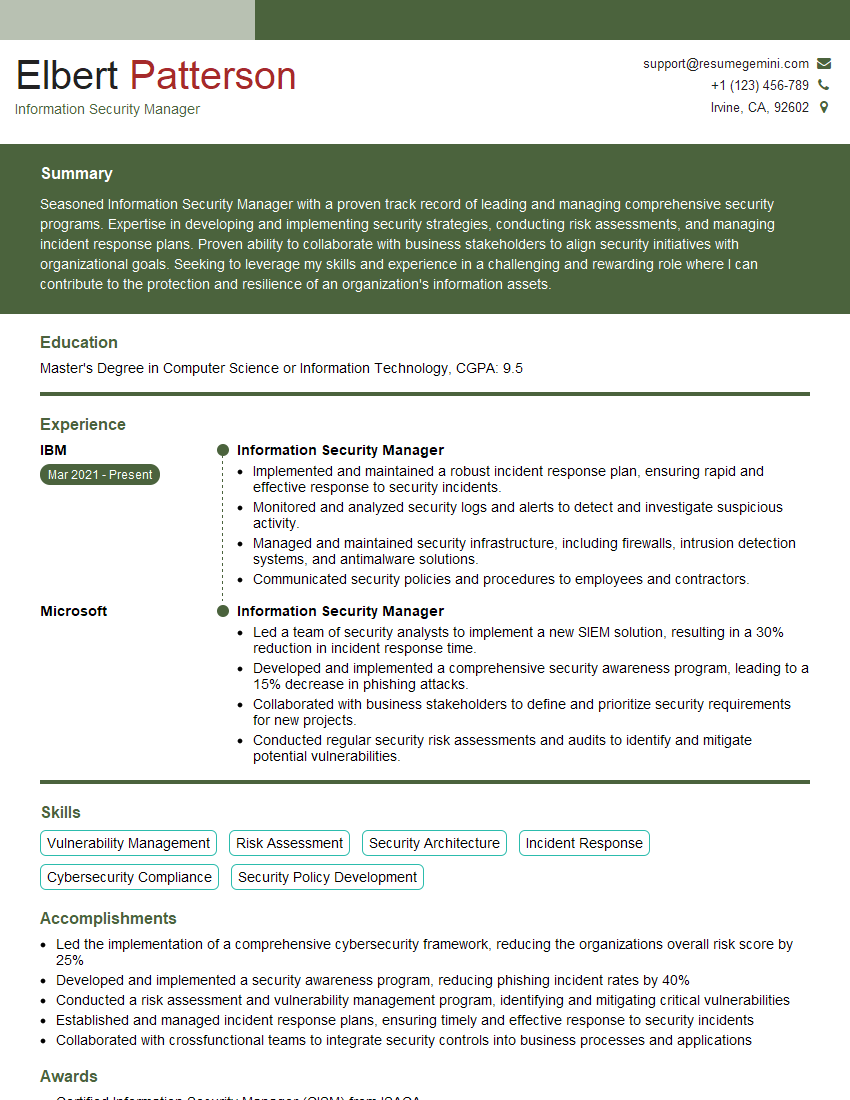
Information Security Manager Resume Sample
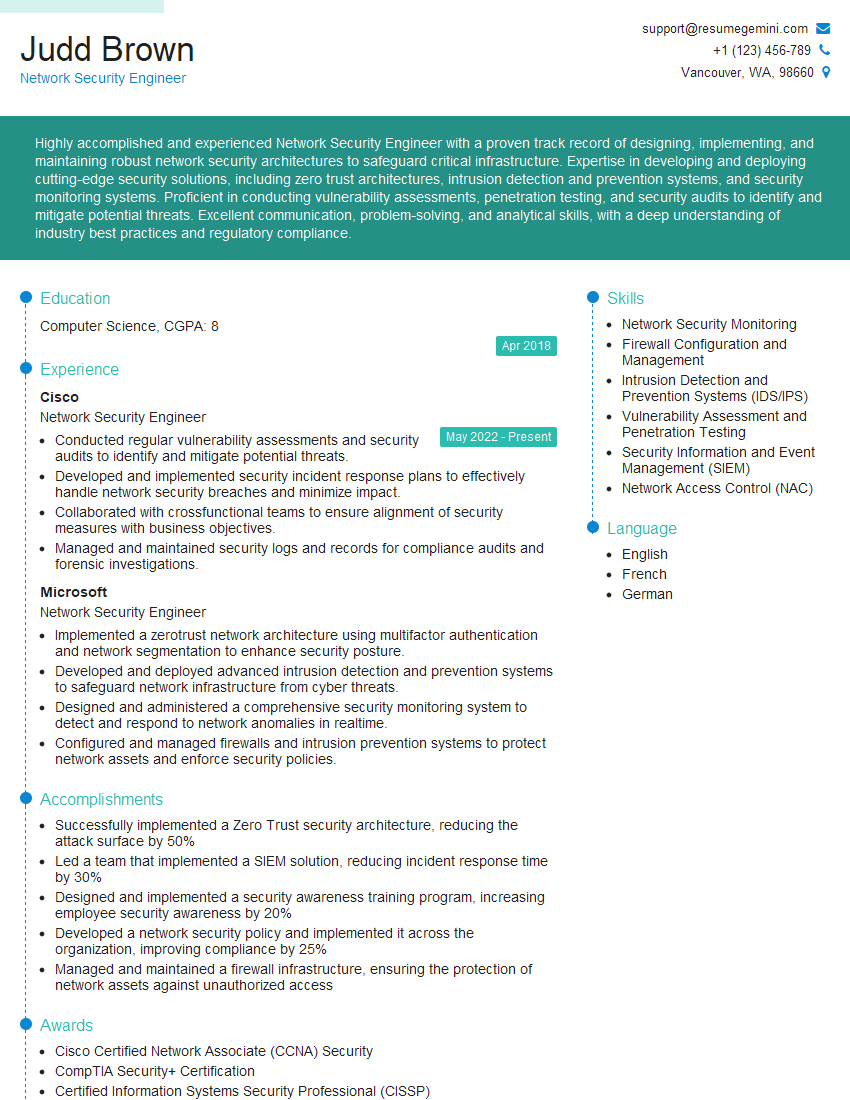
Network Security Engineer Resume Sample
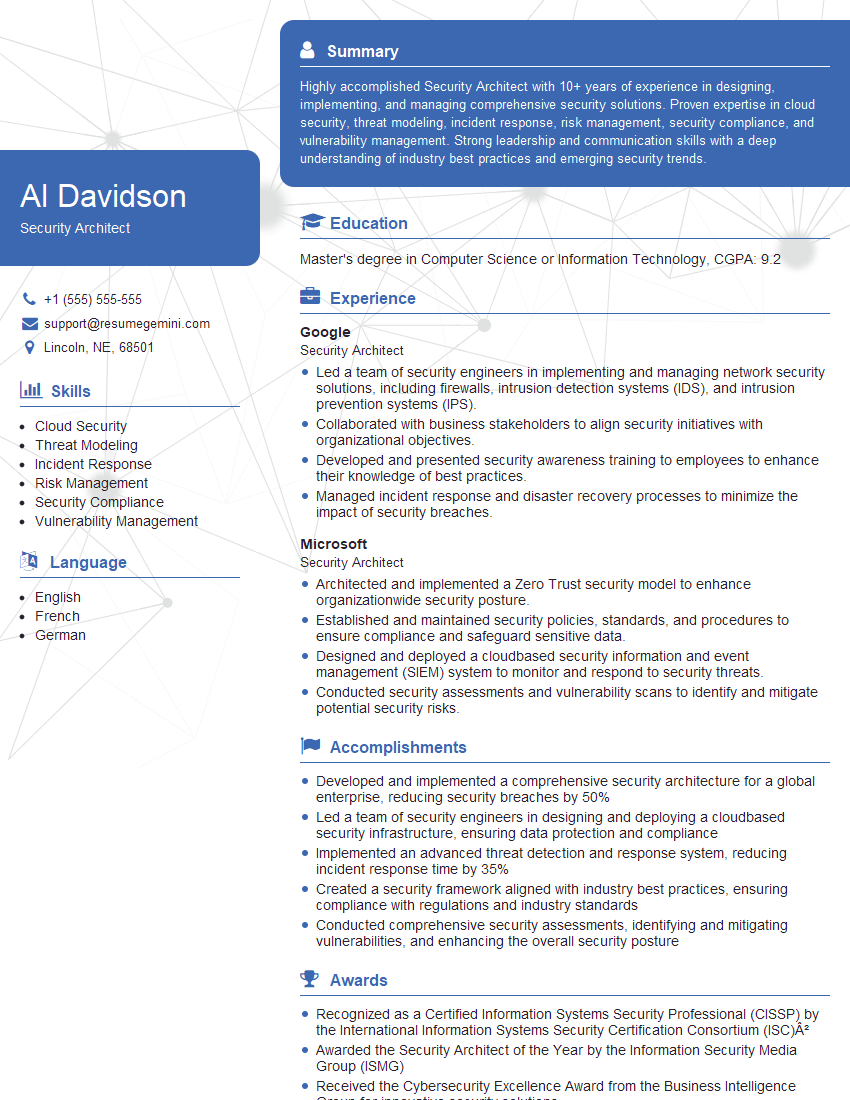
Security Architect Resume Sample
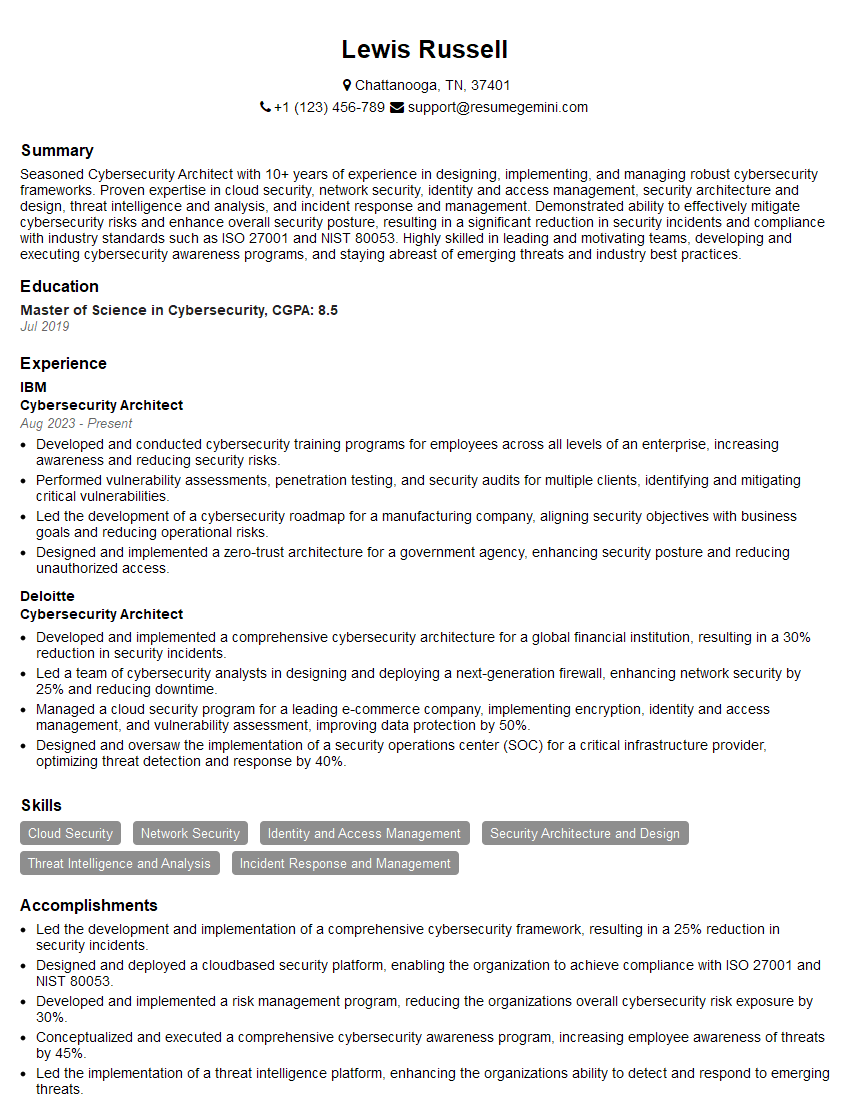
Cybersecurity Architect Resume Sample
Explore more articles
Users Rating of Our Blogs
Share Your Experience
We value your feedback! Please rate our content and share your thoughts (optional).
What Readers Say About Our Blog
Very informative content, great job.
good