Feeling uncertain about what to expect in your upcoming interview? We’ve got you covered! This blog highlights the most important Inserting Documents into Envelopes interview questions and provides actionable advice to help you stand out as the ideal candidate. Let’s pave the way for your success.
Questions Asked in Inserting Documents into Envelopes Interview
Q 1. What are the different types of envelopes commonly used for document insertion?
Envelope selection is crucial for efficient and reliable document insertion. The choice depends on factors like document size, mailing class, and desired level of security. Common types include:
- Standard #10 Envelopes: The most common size, ideal for letters and single-page documents.
- Monarch Envelopes: Slightly larger than #10, offering more space.
- Business Envelopes: Vary in size, often used for marketing materials or larger documents.
- Window Envelopes: Have a transparent window, allowing the address on the document to show through, eliminating the need for separate addressing.
- Security Envelopes: Often opaque and sometimes include tamper-evident features to protect sensitive information.
For instance, when mailing invoices, a #10 envelope might suffice, while a bulky report might necessitate a larger envelope or even a flat-rate mailer. Selecting the right envelope type streamlines the process and ensures efficient postal handling.
Q 2. Describe your experience with high-speed inserting machines.
I have extensive experience operating high-speed inserting machines, ranging from entry-level models to sophisticated systems capable of processing thousands of envelopes per hour. My expertise includes setup, operation, troubleshooting, and preventative maintenance. I’m familiar with various functionalities like:
- Sheet feeders: Efficiently handling large stacks of documents.
- Envelope feeders: Ensuring a continuous flow of envelopes.
- Document alignment and registration: Precisely positioning documents for accurate insertion.
- Multiple document feeders: Managing multiple inserts, such as letters, brochures, and flyers.
- Data verification systems: Matching documents with correct envelopes based on address data.
In one instance, we transitioned to a new high-speed inserter which improved our throughput by 30% and reduced jams significantly. Understanding the machine’s capabilities is key, along with routine maintenance to minimize downtime and maximize efficiency.
Q 3. How do you ensure the correct documents are inserted into the correct envelopes?
Accurate document insertion hinges on a robust system that integrates data management and automation. We employ several methods:
- Data Matching: Each document is linked to its corresponding envelope address through a database or software. This ensures the correct document goes into the correct envelope. Barcodes or unique identifiers are often used for this purpose.
- Visual Verification: While automated systems excel, visual spot-checks are performed periodically to ensure accuracy. For highly sensitive documents, 100% manual verification may be necessary.
- Automated Error Detection: Modern inserters often have built-in mechanisms that detect mismatches or jams, alerting operators to potential problems.
Imagine mailing personalized offers. Data matching ensures each customer receives the appropriate offer. Any discrepancy could result in dissatisfaction and lost revenue, underscoring the importance of accurate document matching.
Q 4. What is your experience with different types of mail (e.g., first-class, bulk)?
My experience encompasses various mailing classes, each with its unique requirements and preparation protocols:
- First-Class Mail: Requires proper addressing, postage, and sorting for efficient delivery. I’m adept at handling individualized mail pieces and ensuring timely delivery.
- Bulk Mail: Involves larger volumes with shared characteristics, requiring careful preparation, sorting, and adherence to USPS standards for discounts. This includes accurate postal coding and tray sorting for optimal efficiency.
- Marketing Mail: Requires attention to details like mail piece dimensions and addressing standards to comply with regulations and achieve the best mail stream efficiency.
I once managed a large bulk mailing campaign for a non-profit organization, ensuring all materials adhered to USPS guidelines, ultimately securing significant cost savings through effective bulk mail preparation.
Q 5. Explain your process for handling sensitive documents during insertion.
Handling sensitive documents requires stringent protocols to maintain confidentiality and comply with relevant regulations (like HIPAA or GDPR, depending on the nature of the data). Our procedures include:
- Secure Handling: Documents are stored in locked cabinets or secured areas during the entire process.
- Access Control: Only authorized personnel with necessary security clearances can access sensitive information and equipment.
- Shredding of Waste: Any discarded documents or printouts are immediately shredded using a cross-cut shredder to prevent reconstruction.
- Data Encryption: Where applicable, data is encrypted both at rest and in transit, adding an extra layer of security.
For example, when processing medical records, we use a dedicated, secured area and maintain strict log of who handles the documents at each step, ensuring full compliance with HIPAA guidelines.
Q 6. How do you handle addressing errors or mismatched documents?
Addressing errors and mismatched documents are addressed through a combination of preventative measures and corrective actions:
- Pre-insertion Verification: Using software to compare addresses and document details before insertion helps reduce errors.
- Quality Control Checks: Spot checking throughout the insertion process to catch errors early.
- Error Correction Procedures: Establishing clear protocols for handling mismatched documents, including separating them for review and correction, possibly through manual re-insertion or reprinting.
- Reporting and Tracking: Documenting and analyzing errors helps identify trends and improve processes.
A recent instance involved a small batch of mismatched documents. Our error correction protocol allowed us to identify and rectify the issue promptly, minimizing the impact on our client.
Q 7. What is your experience with postal regulations and mail preparation standards?
Staying current with postal regulations and mail preparation standards is paramount. I am familiar with:
- USPS (United States Postal Service) guidelines: including mailing classes, postage rates, and dimensional weight calculations.
- International mailing regulations: understanding the specific requirements for sending mail to different countries.
- Mail preparation best practices: optimizing mail for efficient processing and delivery through proper sorting, addressing, and packaging.
- Compliance requirements: adhering to rules regarding marketing materials, bulk mail, and sensitive information.
Knowledge of these standards is critical for cost optimization, legal compliance, and ensuring that our mail reaches its intended recipients smoothly and efficiently. Regular updates and training keep my knowledge current on any changes.
Q 8. How do you maintain accuracy and speed during high-volume mail processing?
Maintaining accuracy and speed in high-volume mail processing hinges on a combination of efficient workflow, meticulous preparation, and the right technology. Think of it like an assembly line – each step needs to be optimized.
- Pre-sorting and batching: We group documents by mailing address or recipient category before insertion. This significantly reduces handling time and minimizes errors. Imagine sorting socks before putting them into pairs – it’s much faster than searching for matches later.
- Using automated insertion equipment: High-speed inserters dramatically increase throughput while minimizing human error. These machines can process thousands of mail pieces per hour with impressive accuracy. Think of these as robotic assistants that perfectly fold and insert documents into envelopes.
- Regular quality checks: We conduct random audits throughout the process to verify accuracy and identify potential issues early. Catching mistakes early prevents major backlogs and ensures client satisfaction. This is analogous to a quality control check in a manufacturing plant.
- Staff training and process standardization: Well-trained staff following standardized procedures are crucial. Everyone understands their role and operates with the same level of precision. This is akin to a well-rehearsed orchestra producing a harmonious outcome.
Q 9. Describe a time you had to troubleshoot a problem with a mailing machine.
During a large university mailing campaign, our high-speed inserter started jamming repeatedly. The error message was vague, indicating a ‘paper feed problem’.
- Systematic troubleshooting: First, I checked the obvious: paper type, weight, and alignment. Everything seemed fine.
- Process of Elimination: Next, I inspected the rollers and sensors for any obstructions or damage. I found a small piece of crumpled paper lodged in one of the rollers, causing the jam.
- Solution Implementation: After removing the obstruction and cleaning the rollers, I ran a test batch. The machine operated smoothly. I then implemented a more rigorous quality check of the incoming paper to prevent future issues. This included a more detailed inspection of the paper’s condition and better alignment of the paper stack.
This experience underscored the importance of methodical troubleshooting and proactive maintenance to prevent costly downtime.
Q 10. How do you organize and prepare documents for efficient insertion?
Organizing documents for efficient insertion is critical for speed and accuracy. It’s like organizing a filing cabinet – a systematic approach is vital.
- Collating: Documents are gathered in the correct order for each envelope. Imagine carefully arranging a deck of cards before shuffling; a disorganized deck makes a mess.
- Batching: Documents are grouped by recipient or address, facilitating quick insertion. This resembles batching similar orders in a restaurant for faster processing.
- Sequence Check: This ensures that documents are in the right order for accurate insertion. Similar to verifying sequence numbers for data processing.
- Using trays and dividers: Properly labeled trays and dividers keep everything organized and readily accessible. This is analogous to using labeled folders and drawers for efficient file management.
Q 11. What safety precautions do you take when operating mailing equipment?
Safety is paramount when operating mailing equipment. We follow strict protocols to prevent injuries and equipment damage. Think of a construction site – safety procedures are essential for everyone’s well-being.
- Proper training: All staff receive comprehensive training on equipment operation and safety procedures.
- Personal protective equipment (PPE): Appropriate PPE, such as safety glasses, is worn when operating machinery to protect against potential hazards.
- Regular maintenance: Machines are regularly inspected and maintained to prevent malfunctions. Regular check-ups are like car servicing; preventing minor problems avoids major breakdowns.
- Lockout/Tagout procedures: Before performing maintenance, we use lockout/tagout procedures to prevent accidental startup. This prevents accidental injuries from unexpected activation.
Q 12. What are your strategies for preventing jams or errors during document insertion?
Preventing jams and errors requires a multi-pronged approach, focusing on both the documents and the machine. Think of it as preventative car maintenance – regular checks minimize breakdowns.
- Paper quality control: Using consistent, high-quality paper minimizes jams and misfeeds. Using the right type of paper is as important as selecting the right tools for a project.
- Regular cleaning of equipment: Dust and debris can accumulate, causing jams and malfunctions. Keeping the equipment clean is similar to cleaning house appliances for proper function.
- Proper alignment: Ensuring that documents and envelopes are aligned correctly within the machine prevents misfeeds. Proper alignment is analogous to parallel parking; precision is key.
- Monitoring machine performance: Regularly monitoring the machine’s performance and addressing minor issues quickly prevents major problems. Paying attention to warning signs will ensure no unexpected issues.
Q 13. How do you prioritize tasks when handling multiple mailings?
Prioritizing tasks when handling multiple mailings involves careful planning and efficient scheduling. Think of a project manager – prioritizing tasks keeps everything running smoothly.
- Deadline prioritization: Mailings with the closest deadlines are prioritized. The most urgent tasks are tackled first. This is similar to a fireman prioritizing a burning building over a minor incident.
- Volume considerations: Larger mailings may require more time and resources, influencing the order of operations. Large shipments must have sufficient time allocation.
- Client requirements: Client-specific requirements and preferences, such as special handling, can also influence task prioritization. The clients’ needs dictate project direction.
- Resource allocation: Tasks are prioritized based on the available resources, including personnel and equipment. This is comparable to assigning workers to a construction project according to their skillset.
Q 14. What software or systems have you used for tracking mailings?
We utilize various software and systems for tracking mailings, providing a comprehensive overview of the entire process. Think of a logistics company – detailed tracking is essential for efficiency and accountability.
- Database Management Systems (DBMS): We use DBMS such as MySQL or PostgreSQL to store mailing information, including recipient details and mailing dates. This ensures accurate data recording for efficient tracking.
- Custom-built tracking applications: In-house applications allow us to track mailing progress in real-time, identifying potential issues quickly. This is similar to how delivery services track packages.
- Mailing software integration: Integration with mailing software provides automated tracking, minimizing manual input and improving accuracy. Software integration optimizes workflow and enhances overall efficiency.
- Reporting dashboards: Interactive dashboards visualize key metrics, providing a clear picture of mailing progress and performance. Dashboards summarize information for a quick overview.
Q 15. How do you handle damaged or misprinted documents?
Handling damaged or misprinted documents is crucial for maintaining the quality of a mailing campaign. My approach involves a multi-step process. First, I visually inspect each document for damage, such as tears, creases, or smudges. Misprints are identified by comparing against a sample or digital copy.
For damaged documents, I assess the extent of the damage. Minor tears or creases can often be repaired using tape or careful pressing. However, if the damage is extensive, the document is rejected and replaced. Misprinted documents follow a similar protocol; if the error is minor and doesn’t affect readability, it might be acceptable depending on the client’s specifications, otherwise replacement is needed. Maintaining a log of rejected documents helps in tracking errors and improving future processes. For example, a batch with consistent misprinting may point to a problem with the printer settings needing adjustment.
The rejection and replacement process usually includes clear documentation, specifying the reason for rejection and the subsequent action taken. This ensures accountability and helps track potential issues within the printing or handling process.
Career Expert Tips:
- Ace those interviews! Prepare effectively by reviewing the Top 50 Most Common Interview Questions on ResumeGemini.
- Navigate your job search with confidence! Explore a wide range of Career Tips on ResumeGemini. Learn about common challenges and recommendations to overcome them.
- Craft the perfect resume! Master the Art of Resume Writing with ResumeGemini’s guide. Showcase your unique qualifications and achievements effectively.
- Don’t miss out on holiday savings! Build your dream resume with ResumeGemini’s ATS optimized templates.
Q 16. How do you ensure that all inserts are securely fastened within the envelope?
Securely fastening inserts within envelopes is paramount to prevent loss and maintain the professional image of the mailing. The method used depends on the number and type of inserts. For single sheets, proper folding and insertion is usually sufficient. For multiple inserts, or heavier materials, I utilize several techniques to ensure secure containment.
- Stapling: A quick and reliable method for attaching multiple sheets or securing heavier inserts. I’d ensure staples are placed strategically to avoid damaging printed content.
- Inserting into sleeves or folders: This protects inserts and provides additional security, especially for sensitive information. This adds extra steps but increases reliability.
- Using adhesive: Glue sticks or other adhesives can help secure inserts, but it’s crucial to use a method that won’t damage the documents and allows the recipient to easily remove the contents.
Regardless of the method used, I always perform a visual check to ensure the inserts are fully enclosed and won’t fall out during transit. Imagine sending a vital offer only to have it fall out – that’s a problem we carefully avoid.
Q 17. What is your experience with different folding techniques for inserting documents?
Proficiency in various folding techniques is essential for efficient and visually appealing document insertion. I am experienced with a range of folds, each chosen based on the size and number of pages.
- Simple Half-Fold: Ideal for single-sheet documents or brochures.
- Letter Fold (Thirds Fold): Common for letters and multi-page documents; it creates a neat, compact package.
- Double Parallel Fold: Suitable for fitting larger documents into standard-sized envelopes.
- Gate Fold: Creates a more sophisticated look, often used for brochures or marketing materials; it opens like a gate, showing a different section of the document on each panel.
The choice of fold impacts both the ease of insertion and the overall presentation of the mailed item. For example, a poorly executed fold can create creases that detract from the professional image, or even make it difficult to open.
Q 18. What is your level of comfort working independently and as part of a team?
I’m equally comfortable working independently and as part of a team. When working independently, I maintain a high level of focus and efficiency, ensuring tasks are completed accurately and on schedule. I use project management tools like checklists and timelines to organize my workload and track progress.
Teamwork is also a strength. I readily collaborate with colleagues, sharing knowledge and contributing my skills to achieve shared goals. I communicate effectively, proactively seeking clarification when needed and readily offering support to teammates. For example, during peak mailing periods, a collaborative effort makes sure everything is running smoothly and efficiently.
Q 19. Describe your experience with quality control checks during mail processing.
Quality control is an integral part of my workflow. My approach includes multiple checks at various stages of the mail processing. I begin with a pre-insertion check of documents for any damage or misprints, as mentioned before. Then, as I insert documents, I visually inspect each envelope for correct inserts and proper sealing.
Following insertion, random samples are selected for a final quality check to ensure all inserts are present, correctly folded, and securely fastened. This helps identify any inconsistencies or potential problems early on. Any identified issues are documented and addressed, to improve future mailings.
This multi-layered approach minimizes errors and ensures a high-quality final product. Think of it like a manufacturing process: multiple quality checkpoints ensure the final product meets the required standards.
Q 20. How familiar are you with different types of postage and their applications?
I am familiar with various postage types and their applications, including:
- First-Class Mail: For letters, postcards, and small packages; it offers a reliable and relatively fast delivery option.
- Priority Mail: Provides faster delivery than First-Class Mail and is suitable for time-sensitive items.
- Parcel Post: Used for larger or heavier packages.
- Certified Mail: Offers proof of mailing and delivery confirmation.
- Registered Mail: Provides the highest level of security and tracking for valuable items.
The selection of appropriate postage depends on factors like weight, dimensions, delivery speed, and required tracking. Miscalculating postage can result in delays or additional costs.
Q 21. How do you manage your time effectively during peak mailing periods?
Managing time effectively during peak mailing periods requires a proactive approach. I prioritize tasks based on urgency and deadlines. I utilize organizational tools, such as spreadsheets or task management software, to track progress and ensure all tasks are completed within the timeframe. Collaboration with my team is crucial; clear communication and division of labor ensure efficiency.
I also implement strategies such as batch processing to streamline repetitive tasks and avoid unnecessary delays. For example, I might group envelopes with similar postage and address types for faster processing. Essentially, it’s all about optimization and efficient workflow management.
Q 22. What is your experience using different mail sorting and stacking methods?
My experience encompasses a wide range of mail sorting and stacking methods, from manual sorting and stacking to utilizing automated equipment like inserters and mail sorters. I’m proficient in various techniques, including:
- Batch Sorting: Grouping mail by recipient, postal code, or other criteria before inserting documents.
- Sequence Sorting: Arranging mail in a specific order, such as numerically or alphabetically, for efficient processing.
- Stacking Methods: Using different stacking techniques to optimize space and prevent jams during insertion (e.g., alternating stacks, creating smaller, manageable bundles).
- Automated Systems: Operating high-speed inserters, understanding their configurations and troubleshooting potential issues. I’m familiar with systems using different feeding mechanisms and sorting logic.
For example, in a previous role, we processed a large volume of marketing materials. By implementing a batch sorting system based on geographic zones, we reduced processing time by 20% and improved delivery speed significantly. I also have experience with using advanced inserters that utilize barcode scanning and address verification to improve accuracy and efficiency.
Q 23. What is your understanding of the importance of accuracy in mail processing?
Accuracy in mail processing is paramount. Inaccurate insertion can lead to significant consequences, including:
- Damaged Reputation: Sending incorrect documents can damage a company’s credibility with clients.
- Financial Losses: Incorrect invoices, statements, or other financial documents can lead to payment delays or disputes.
- Legal Ramifications: In some cases, inaccurate mail processing can have legal implications, particularly if sensitive information is involved.
- Wasted Resources: Incorrectly inserted mail often requires additional time and resources to rectify, decreasing overall efficiency.
Therefore, I employ meticulous attention to detail throughout the entire process. This includes verifying document batches against mailing lists, regularly checking for errors during insertion, and using quality control checks at each stage.
Q 24. How do you stay organized and efficient while managing multiple tasks?
Managing multiple tasks in a fast-paced mailroom environment requires a highly organized and efficient approach. I utilize several strategies:
- Prioritization: I prioritize tasks based on urgency and deadlines. Critical tasks are tackled first to ensure timely completion.
- Time Management Techniques: I use time blocking and task scheduling to allocate specific time slots for different activities.
- Workflow Optimization: I constantly look for ways to streamline workflows, eliminating redundant steps and improving efficiency.
- Clear Communication: I maintain open communication with colleagues to ensure everyone is aware of deadlines and potential issues.
- Technology Utilization: I leverage technology such as mail tracking software and automation tools to improve organization and efficiency.
For example, I use a project management tool to track my progress on various mail-related tasks, ensuring no deadlines are missed. This enables me to provide regular updates and proactively address potential delays.
Q 25. Explain your approach to meeting deadlines in a fast-paced mailroom environment.
Meeting deadlines in a fast-paced mailroom is crucial. My approach involves:
- Proactive Planning: I carefully plan the workflow, considering potential bottlenecks and allocating sufficient time for each task.
- Resource Allocation: Efficiently allocating resources such as equipment, personnel, and materials to meet the deadlines.
- Continuous Monitoring: Regularly monitoring progress and adjusting the plan as needed. This includes addressing any unexpected delays or challenges.
- Teamwork: Collaborating effectively with team members to share workloads and ensure timely completion.
- Escalation: Communicating potential delays promptly to supervisors and seeking support when necessary.
In a previous role, I successfully managed a significant increase in mail volume during a peak season by proactively anticipating the higher workload, adjusting our staffing levels, and optimizing our processes. This prevented any delays and ensured we met all deadlines.
Q 26. How would you handle a large volume of mail with a short deadline?
Handling a large volume of mail with a short deadline requires a strategic and collaborative approach. My strategy would involve:
- Assessing the Situation: Quickly determining the volume, type of mail, and available resources.
- Prioritization and Triage: Prioritizing the most urgent items and assigning tasks accordingly.
- Teamwork and Delegation: Effectively delegating tasks to team members and coordinating efforts.
- Automation: Utilizing available automation tools to expedite the process. This could involve using high-speed inserters or other mail processing equipment.
- Overtime or Additional Resources: If necessary, requesting overtime or seeking additional support to meet the deadline.
For instance, if faced with a large bulk mailing campaign with a tight deadline, I would first analyze the volume, then explore using an automated inserter to maximize efficiency. I would also delegate tasks to team members, ensuring everyone understands their role and responsibilities.
Q 27. What are some ways to improve the efficiency of the document insertion process?
Improving the efficiency of the document insertion process involves a multifaceted approach:
- Automation: Implementing automated inserters significantly increases speed and accuracy. These machines can handle large volumes of mail quickly and efficiently.
- Workflow Optimization: Streamlining the process, eliminating redundant steps, and creating a smooth, continuous flow.
- Proper Training: Ensuring staff receives adequate training on the equipment and procedures, minimizing errors.
- Quality Control Checks: Implementing regular quality control checks at various stages to detect errors early.
- Data Management: Effective database management and integration to ensure accurate data matching between documents and recipient addresses.
- Ergonomics: Designing the workspace to optimize efficiency and reduce staff fatigue.
For example, we could implement barcode scanning at the beginning of the process to automatically sort documents and improve accuracy throughout insertion. This would reduce manual handling, minimizing errors and increasing speed.
Q 28. How would you deal with a situation where you discover an incorrect document has been inserted?
Discovering an incorrect document insertion requires a swift and methodical response:
- Immediately Halt the Process: Stop further insertions to prevent more errors.
- Identify the Extent of the Error: Determine how many documents were incorrectly inserted and the nature of the mistake.
- Isolate Affected Documents: Separate the incorrectly inserted documents to prevent them from being further processed or delivered.
- Correct the Error: Insert the correct documents, or if needed, replace the incorrectly inserted documents with the correct ones.
- Investigate the Cause: Determine the root cause of the error to prevent future occurrences. This might involve reviewing training procedures, equipment maintenance, or data accuracy.
- Document and Report: Document the incident, including the number of affected documents, the nature of the error, and the corrective action taken. Report this to relevant supervisors.
For example, if incorrect invoices were inserted, I would immediately stop the process, identify the affected invoices, and re-insert the correct ones. I would then report the issue to management and initiate a review of our document verification procedures.
Key Topics to Learn for Inserting Documents into Envelopes Interview
- Understanding Envelope Types and Sizes: Learn to identify different envelope types (e.g., #10, A2, DL) and their appropriate uses based on document size and mailing requirements. This includes understanding the implications of choosing the wrong size.
- Efficient Folding Techniques: Master various document folding methods (e.g., letter fold, tri-fold) to ensure documents fit neatly into envelopes without creasing or damaging them. Practice different techniques for varying document lengths and paper types.
- Accurate Addressing and Labeling: Explore the importance of accurate and legible addressing, including proper placement, font size, and the use of return addresses. Understand the implications of incorrect addressing on mail delivery.
- Using Inserting Machines (if applicable): If the role involves using automated inserting machines, familiarize yourself with their operation, troubleshooting common issues, and maintaining efficiency. Understand the different types of machines and their capabilities.
- Quality Control and Accuracy: Develop strategies for ensuring all documents are accurately inserted into the correct envelopes and that the entire process is error-free. Understand the consequences of errors and how to minimize them.
- Workplace Safety and Ergonomics: Learn about safe handling procedures for large volumes of mail, proper posture to avoid repetitive strain injuries, and understanding workplace safety regulations related to mail handling.
- Productivity and Efficiency Strategies: Explore techniques for maximizing speed and accuracy while maintaining quality, including workflow optimization and time management.
Next Steps
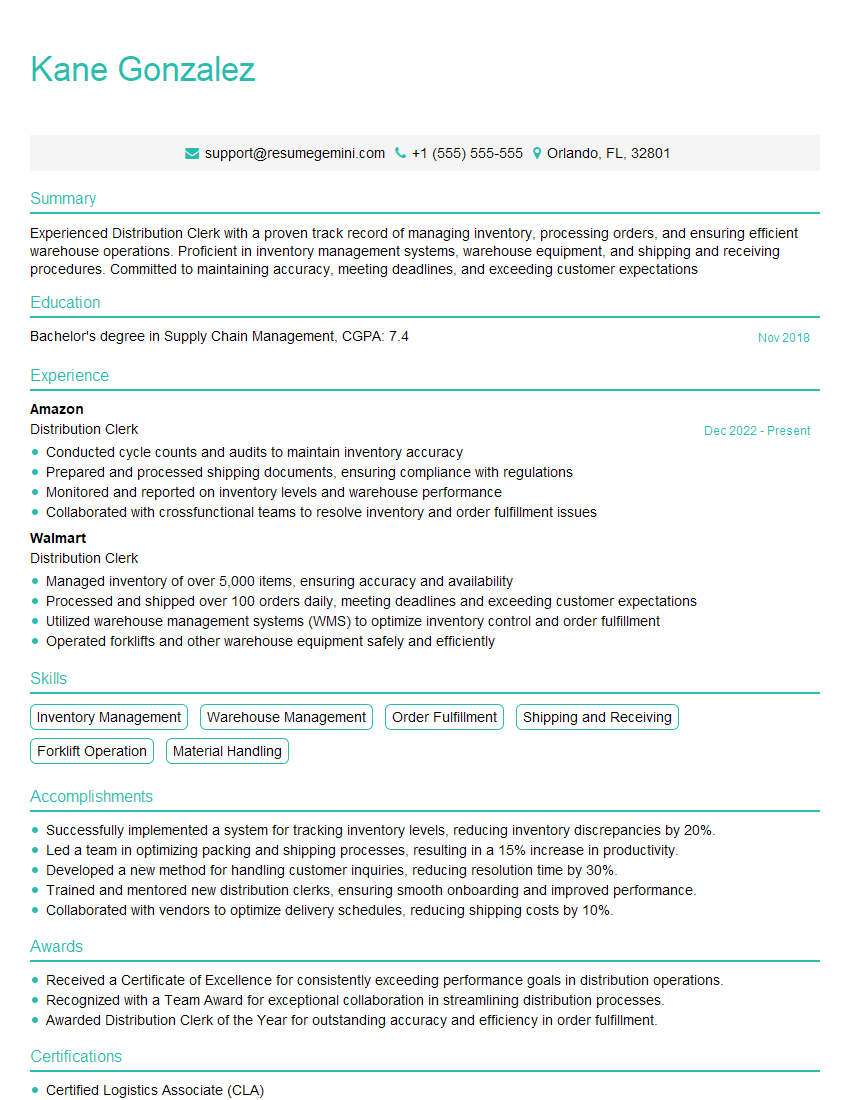
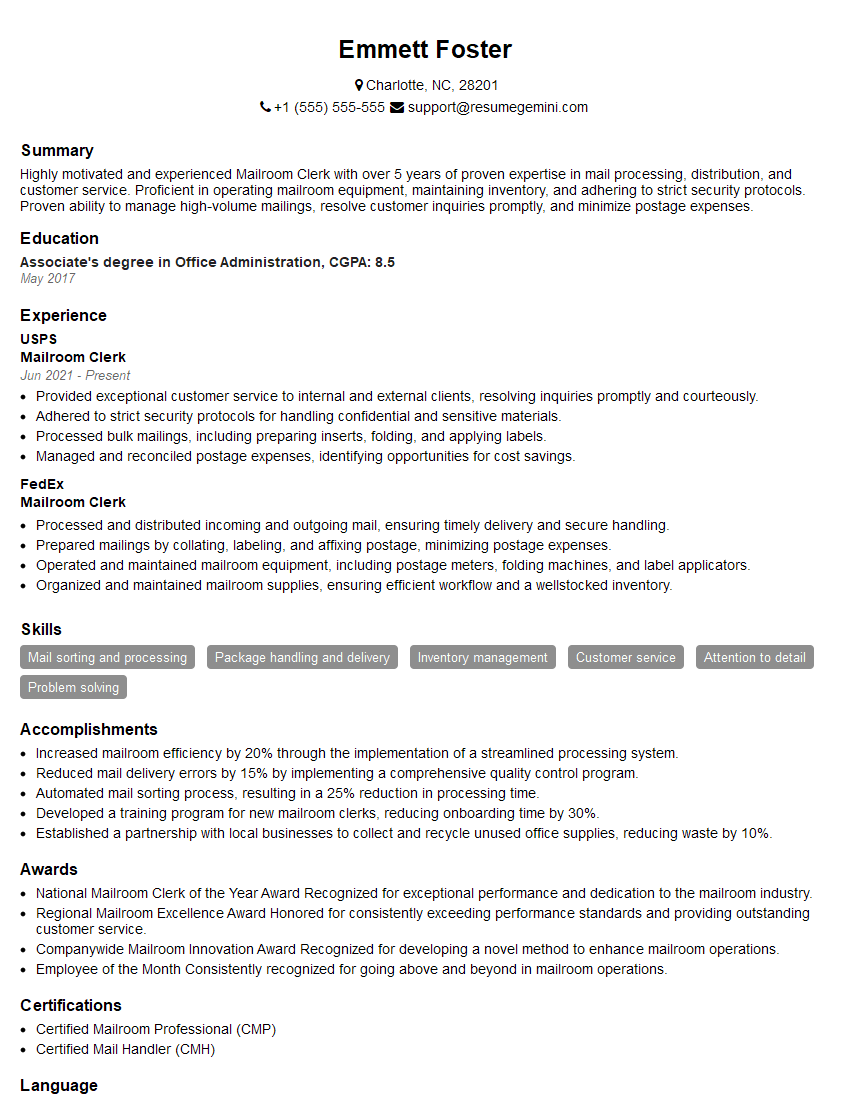
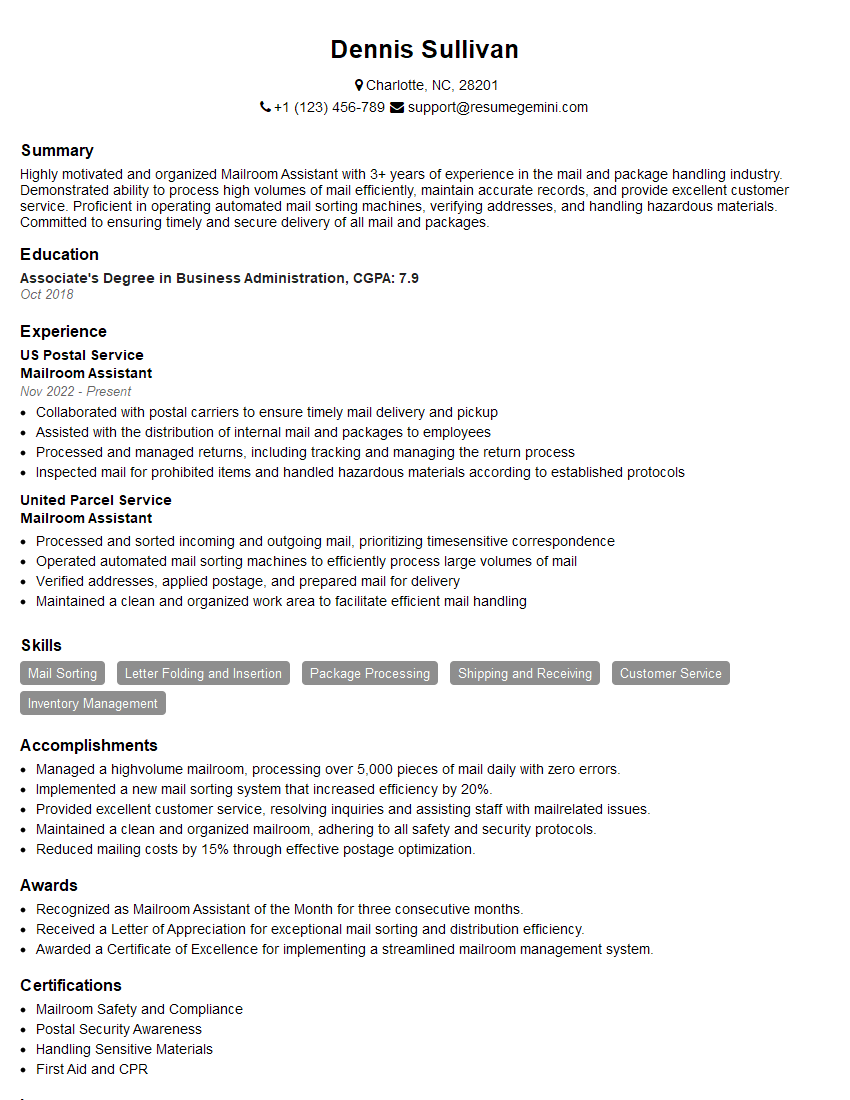
Mastering the art of inserting documents into envelopes might seem like a small skill, but it’s a crucial component of efficient office operations and demonstrates attention to detail and accuracy – highly valued qualities in any workplace. A strong resume highlighting these skills is key to securing your next opportunity. Creating an ATS-friendly resume is essential to getting your application noticed. ResumeGemini is a trusted resource to help you build a professional and effective resume that showcases your abilities. Examples of resumes tailored to highlight skills in Inserting Documents into Envelopes are available within ResumeGemini to guide your efforts.

Explore more articles
Users Rating of Our Blogs
Share Your Experience
We value your feedback! Please rate our content and share your thoughts (optional).
What Readers Say About Our Blog
Very informative content, great job.
good