Feeling uncertain about what to expect in your upcoming interview? We’ve got you covered! This blog highlights the most important Contract Administration and Negotiations interview questions and provides actionable advice to help you stand out as the ideal candidate. Let’s pave the way for your success.
Questions Asked in Contract Administration and Negotiations Interview
Q 1. Explain the different types of contracts.
Contracts come in many forms, each designed for a specific purpose and relationship. Broadly, they can be categorized as:
- Fixed-Price Contracts: The total price is predetermined, regardless of the actual cost incurred. This is ideal for projects with clearly defined scopes, minimizing cost uncertainty for both parties. Example: Hiring a contractor to build a deck for a fixed sum.
- Time and Materials Contracts: The client pays for the contractor’s time and the materials used. This is suitable for projects where the scope is less defined or may evolve, offering flexibility but potentially leading to unpredictable costs. Example: Engaging a consultant for ongoing IT support.
- Cost-Plus Contracts: The client reimburses the contractor’s costs plus a predetermined fee or percentage. This type is common for complex projects with significant uncertainty regarding the resources needed. Example: A large-scale construction project.
- Indemnity Contracts: One party agrees to compensate the other for losses or damages. This is crucial for risk allocation, especially in high-stakes scenarios. Example: A lease agreement containing clauses that specify which party is responsible for property damage.
- Service Level Agreements (SLAs): These define the expected performance levels of a service provider. They’re essential for ensuring quality and accountability in outsourcing relationships. Example: An agreement between a company and its internet service provider outlining uptime guarantees.
The choice of contract type depends heavily on the specific circumstances, risk tolerance of the involved parties, and the complexity of the project or service involved.
Q 2. Describe your experience with contract lifecycle management.
My experience with Contract Lifecycle Management (CLM) spans over ten years, encompassing all stages from initial drafting and negotiation to execution, performance monitoring, and eventual closure. I’ve utilized various CLM systems, including both simple document management systems and sophisticated software platforms that automate tasks like approvals, reminders, and reporting. In my previous role, I implemented a new CLM system for a large multinational corporation, significantly reducing contract cycle times and improving compliance. This involved training staff, integrating the system with existing databases, and developing custom workflows to fit our specific needs. A key success was improving visibility across all active contracts, allowing us to proactively identify and manage potential risks and opportunities.
Q 3. How do you identify and mitigate contract risks?
Identifying and mitigating contract risks is a proactive process requiring a detailed understanding of the contract’s terms, the involved parties, and the market landscape. I employ a risk assessment framework that includes:
- Thorough Due Diligence: This involves scrutinizing the counterparty’s financial stability, reputation, and history of contract performance.
- Clause-by-Clause Review: Examining each provision for potential ambiguities, loopholes, or unfavorable terms. I pay particular attention to clauses related to payment terms, intellectual property rights, liabilities, and termination rights.
- Scenario Planning: This involves considering potential problems that could arise during the contract’s lifetime, such as delays, disputes, or changes in market conditions. This helps in developing contingency plans and negotiating appropriate safeguards.
- Insurance and Bonds: Where appropriate, using insurance policies or performance bonds to mitigate specific risks, such as non-payment or non-performance.
For example, in a recent project, we identified a significant risk related to potential supply chain disruptions. By incorporating a force majeure clause that explicitly addressed this, we minimized the financial impact for both parties in the event of unforeseen circumstances.
Q 4. What are your strategies for negotiating favorable contract terms?
Negotiating favorable contract terms is a strategic process requiring strong analytical skills, diplomacy, and a thorough understanding of the other party’s needs and priorities. My approach involves:
- Preparation: Thoroughly researching the market, understanding comparable contracts, and defining our client’s objectives and acceptable compromises.
- Value Proposition: Clearly articulating the value our client brings to the table and emphasizing the benefits of collaboration.
- Strategic Concessions: Making calculated concessions on less important points to secure favorable terms on more critical aspects. It’s about trading wisely.
- BATNA (Best Alternative To a Negotiated Agreement): Having a clear understanding of our best alternative if the negotiation fails strengthens our position.
- Documentation: Meticulously documenting all agreed-upon terms to avoid misunderstandings and disputes later.
In one negotiation, we initially faced pushback on our payment terms. By highlighting the financial strength and long-term commitment of our client, we were able to secure more favorable payment schedules while offering other concessions on less critical aspects of the agreement.
Q 5. How do you handle contract disputes?
Contract disputes should be addressed promptly and professionally, aiming for amicable resolution wherever possible. My approach involves:
- Communication: Opening a clear and direct dialogue with the other party to understand their concerns and explore potential solutions.
- Mediation: Utilizing a neutral third party to facilitate discussions and help reach a mutually acceptable agreement.
- Arbitration: Employing a binding arbitration process if mediation fails to resolve the dispute. This is a less formal and often faster alternative to litigation.
- Litigation: As a last resort, pursuing legal action to resolve the dispute through the courts. However, litigation is expensive and time-consuming.
My goal is always to find the most efficient and cost-effective solution that protects my client’s interests. In one instance, we successfully mediated a dispute over delayed project completion by negotiating an extension with associated financial adjustments, preventing costly litigation.
Q 6. Explain your experience with contract redlining and revisions.
Contract redlining and revisions are integral parts of the negotiation process. I use track changes extensively to document every alteration, ensuring complete transparency and accountability. My approach focuses on clarity and precision. Each change is accompanied by a concise explanation, minimizing the risk of misinterpretations. I use a standardized color-coding system (e.g., red for deletions, blue for insertions) for easy review. I also leverage version control systems to track all modifications and maintain a clear audit trail. This detailed approach is critical for managing multiple rounds of revisions and avoiding disputes over the final agreed-upon version. In practice, this might mean using tools like Microsoft Word’s track changes or dedicated contract lifecycle management software with robust version history capabilities.
Q 7. Describe your process for ensuring contract compliance.
Ensuring contract compliance is an ongoing process requiring meticulous attention to detail and proactive monitoring. My process includes:
- Regular Reviews: Periodically reviewing the contract’s performance against its key terms and conditions.
- Performance Metrics: Defining and monitoring key performance indicators (KPIs) to track progress and identify potential compliance issues early.
- Reporting and Documentation: Maintaining comprehensive records of all contract-related activities, including correspondence, approvals, and performance data.
- Training and Communication: Educating relevant personnel about their contractual obligations and providing ongoing support to ensure compliance.
- Audits: Conducting periodic internal audits to assess compliance and identify areas for improvement.
For example, in managing a large software licensing agreement, we implemented a system for tracking software usage and regularly comparing this against the license’s terms to ensure compliance. This proactive approach prevented potential legal and financial risks.
Q 8. How do you manage multiple contracts simultaneously?
Managing multiple contracts effectively requires a systematic approach. Think of it like conducting an orchestra – each instrument (contract) needs attention, but the conductor (you) must ensure harmony. I utilize a combination of tools and techniques to achieve this. Firstly, I employ a robust contract management system (CMS) to centralize all contracts, track deadlines, and monitor key performance indicators (KPIs). This allows for a bird’s-eye view of all active agreements. Secondly, I prioritize contracts based on criticality and urgency, using a prioritization matrix that considers factors such as financial implications, legal risks, and stakeholder impact. Finally, I break down complex contracts into manageable tasks, delegating responsibilities where appropriate and regularly reviewing progress to ensure timely completion. For instance, if I’m managing 10 contracts simultaneously, I might dedicate Monday mornings to reviewing compliance, Tuesday afternoons to handling vendor communications, and so on. This structured approach allows me to avoid being overwhelmed and ensures that each contract receives the necessary attention.
Q 9. How familiar are you with different contract clauses (e.g., force majeure, indemnification)?
I possess extensive familiarity with a wide array of contract clauses. Key clauses like force majeure and indemnification are crucial components of contract negotiation and administration. Force majeure clauses address unforeseen events, like natural disasters, that prevent contract performance. Understanding these clauses is critical for identifying potential risks and mitigating them. For example, a properly drafted force majeure clause might specify the procedures for determining if an event qualifies as force majeure and how the parties will proceed. Indemnification clauses, on the other hand, outline how parties will compensate each other for losses or damages. A typical indemnification clause would define the types of losses covered and the limits of liability. I am also well-versed in clauses related to payment terms, intellectual property rights, confidentiality, termination, and dispute resolution. My experience allows me to not only understand these clauses but also to skillfully negotiate their inclusion or modification to protect my organization’s interests.
Q 10. How do you prioritize conflicting contract deadlines?
Prioritizing conflicting contract deadlines necessitates a clear and objective approach. I typically use a decision-making framework that considers several factors. First, I assess the potential consequences of missing each deadline, considering factors like financial penalties, reputational damage, and legal ramifications. Second, I evaluate the feasibility of meeting each deadline, considering the resources available and potential challenges. Third, I identify any interdependencies between contracts; delaying one deadline might impact others. Based on this assessment, I create a prioritized list of deadlines, focusing on those with the most severe consequences. This process might involve renegotiating deadlines with stakeholders, securing additional resources, or re-allocating tasks to ensure that the most critical deadlines are met. This is like managing a project with multiple milestones; some milestones are more critical than others. I employ project management techniques to ensure that resources are allocated appropriately.
Q 11. How do you build and maintain strong relationships with stakeholders?
Building and maintaining strong stakeholder relationships is paramount in contract administration. It’s not just about fulfilling contractual obligations; it’s about fostering trust and collaboration. My approach involves proactive communication, transparency, and responsiveness. I regularly communicate with stakeholders, providing updates on contract progress, addressing concerns promptly, and seeking feedback. For example, I regularly schedule meetings with vendors to discuss performance, ensuring early detection and resolution of any issues. Active listening and empathy are also key. Understanding their perspectives and addressing their needs creates a collaborative environment. Moreover, I strive to be fair and equitable in my dealings, ensuring that all stakeholders feel valued and respected. In essence, I treat each interaction as an opportunity to build rapport, leading to stronger, mutually beneficial relationships.
Q 12. Explain your experience using contract management software.
I have extensive experience using various contract management software solutions, including [Software Name 1] and [Software Name 2]. My experience spans data entry, report generation, and workflow automation. In [Software Name 1], for example, I utilized the automated workflow features to streamline the contract approval process, significantly reducing processing time. This involved configuring the system to route contracts to the appropriate approvers based on pre-defined rules and automatically generating notifications. In [Software Name 2], I leveraged the reporting capabilities to track key metrics such as contract value, renewal dates, and compliance status, providing valuable insights for strategic decision-making. I am adept at leveraging the software’s features to improve efficiency, enhance compliance, and minimize risks. I am always open to learning new software; the key is how effectively the software supports a systematic contract management approach.
Q 13. What is your approach to interpreting ambiguous contract language?
Interpreting ambiguous contract language requires a careful and methodical approach. I begin by thoroughly reviewing the entire contract, considering the context of each clause and its relationship to other provisions. This holistic approach helps to avoid misinterpretations based on isolated sections. Then, I consult relevant legal precedents, industry standards, and any prior communications between parties to help clarify the intent. If ambiguity persists, I might propose modifications to clarify the language, working collaboratively with all stakeholders to reach a mutually agreeable interpretation. The goal is not to exploit loopholes but to understand the parties’ intentions and ensure fairness. I approach this as a collaborative problem-solving exercise rather than a confrontational legal battle. Remember, clear communication is key to prevent ambiguity in the first place.
Q 14. How do you ensure contracts are legally sound and compliant?
Ensuring contracts are legally sound and compliant is a crucial responsibility. This involves a multi-faceted approach. First, I leverage my knowledge of relevant laws and regulations, including contract law, intellectual property law, and data privacy regulations. Second, I employ a rigorous review process, checking for completeness, clarity, and consistency in the contract language. This includes verifying that all essential terms are clearly defined and that the contract language aligns with the agreed-upon terms. Third, I might consult with legal counsel to ensure compliance with all relevant regulations and to address any potential legal risks. Fourth, I maintain a system for tracking changes to relevant laws and regulations and regularly review contracts for compliance. Finally, I ensure that appropriate records are maintained throughout the contract lifecycle. Essentially, it’s about proactive risk management and due diligence to ensure the contract protects the interests of all parties involved and remains compliant with applicable laws.
Q 15. What metrics do you use to measure the success of your contract management efforts?
Measuring the success of contract management isn’t just about the bottom line; it’s about holistic performance. I use a multi-faceted approach, tracking key metrics across several categories.
- Cost Savings: This tracks actual costs against budgeted costs, identifying areas where we’ve successfully negotiated favorable terms or avoided potential overruns. For example, successfully negotiating a lower price per unit for a significant raw material supply saved our company X amount last year.
- Risk Mitigation: This involves measuring the reduction in contract-related risks, such as legal disputes or breaches. A key metric here is the number of contract-related disputes resolved efficiently and cost-effectively. We track this using a dedicated dispute resolution process and a database to record outcomes and lessons learned.
- Compliance: Ensuring compliance with all relevant regulations and internal policies is vital. Here, metrics would include the number of compliance audits passed and the percentage of contracts that are fully compliant with our internal controls. We conduct regular training to improve awareness and track completion rates.
- Contract Lifecycle Efficiency: This measures how efficiently we manage the entire contract lifecycle, from negotiation to renewal. Key metrics include the average time it takes to negotiate and execute a contract and the percentage of contracts completed on time and within budget. Implementing a contract management system helped reduce our average contract processing time by 20%.
- Stakeholder Satisfaction: Gathering feedback from key stakeholders—internal departments and external partners—to gauge their satisfaction with the contract management process is crucial. This could involve surveys or regular feedback sessions. High stakeholder satisfaction ensures smoother collaborations and reduces friction.
By regularly monitoring and analyzing these metrics, I can identify areas for improvement, optimize processes, and demonstrate the overall value of effective contract management.
Career Expert Tips:
- Ace those interviews! Prepare effectively by reviewing the Top 50 Most Common Interview Questions on ResumeGemini.
- Navigate your job search with confidence! Explore a wide range of Career Tips on ResumeGemini. Learn about common challenges and recommendations to overcome them.
- Craft the perfect resume! Master the Art of Resume Writing with ResumeGemini’s guide. Showcase your unique qualifications and achievements effectively.
- Don’t miss out on holiday savings! Build your dream resume with ResumeGemini’s ATS optimized templates.
Q 16. How do you handle changes to contracts after they are signed?
Handling contract changes after signing requires a methodical approach, always prioritizing adherence to the original contract’s terms and conditions. Changes need to be documented formally, using a structured change order process to avoid disputes later.
- Formal Change Request: All changes must initiate with a formal written request from the involved party, clearly outlining the proposed changes, rationale, and impact.
- Mutual Agreement: The change order requires mutual agreement from all parties involved, ideally documented in writing and signed by authorized representatives. This ensures clarity and prevents misunderstandings.
- Price and Timeline Adjustments: Any changes that impact the scope of work or deliverables usually necessitate price or timeline adjustments, which need to be negotiated and documented in the change order.
- Version Control: Maintaining version control of the original contract and all subsequent change orders is crucial. Each change order should be numbered and clearly linked to the original contract. We often utilize a digital contract management system to ensure easy access and accurate tracking.
- Legal Review: For significant changes, legal review is recommended to ensure compliance with all applicable laws and regulations. This safeguards all parties involved.
Thinking of a change order as a mini-contract within the larger contract helps ensure a clear and legally sound process for managing post-signing modifications.
Q 17. Describe a time you had to renegotiate a contract.
In a previous role, we had a significant disagreement with a key supplier regarding performance metrics within a fixed-price contract. They were consistently failing to meet their delivery deadlines, impacting our production schedule. Initially, we attempted to resolve the issue through internal communication, highlighting the contract’s terms and outlining the consequences of their non-compliance. However, this proved ineffective.
Therefore, I initiated a renegotiation process. I started by gathering all relevant data: performance reports, communication logs, and the original contract. I then prepared a detailed proposal outlining the issues, the impact on our business, and our proposed solutions. This included options like extending the timeline with a corresponding price adjustment or implementing a revised performance-based incentive structure. The negotiation involved several meetings and involved carefully balancing our need for improved performance with the supplier’s constraints.
Ultimately, we agreed on a revised contract with a modified timeline, performance milestones, and a revised payment schedule reflecting the agreed-upon risk mitigation strategy. This renegotiation not only resolved the immediate performance issues but also strengthened our relationship with the supplier through a more collaborative approach going forward. The key was clear, data-driven communication and a willingness to find mutually beneficial solutions.
Q 18. How do you stay current on contract law and best practices?
Staying current in contract law and best practices is an ongoing process requiring a multi-pronged approach.
- Professional Development: I regularly attend industry conferences and webinars, focusing on updates in contract law, negotiation strategies, and risk management. Many professional organizations offer continuing education opportunities.
- Legal and Industry Publications: I subscribe to relevant legal journals and industry publications to stay informed about changes in legislation and best practices. This keeps me abreast of emerging trends and legal precedents.
- Networking: Networking with other contract professionals helps share knowledge and learn from others’ experiences. Participating in professional groups provides opportunities for discussion and collaborative learning.
- Online Resources: I leverage online resources such as legal databases and reputable online publications to access up-to-date information on contract law and best practices.
- Legal Counsel: When dealing with complex legal matters or significant contract negotiations, I always consult with legal counsel to ensure compliance and minimize risk.
This proactive approach ensures I’m always equipped with the latest knowledge and best practices in contract management, leading to more effective contract negotiation and risk mitigation.
Q 19. What is your experience with different contract types (e.g., fixed-price, time-and-materials)?
My experience encompasses a wide range of contract types, each requiring a unique approach.
- Fixed-Price Contracts: These define a specific scope of work and a fixed price. The focus during negotiation is on clearly defining the scope to avoid ambiguities and potential disputes over extra work. Risk management here is centered around precise specifications and thorough due diligence.
- Time-and-Materials Contracts: These are based on the time spent and materials used. Negotiation centers on establishing clear hourly rates, reimbursable expenses, and reporting mechanisms. Risk mitigation involves close monitoring of time and expenses to avoid cost overruns.
- Cost-Plus Contracts: These reimburse the contractor for costs incurred plus a predetermined fee or percentage. Negotiation involves defining allowable costs and the fee structure, with a strong emphasis on transparency and cost control mechanisms.
- Incentive Contracts: These incorporate incentives for exceeding performance targets. Negotiation focuses on defining clear performance metrics and the corresponding incentives. This demands strong performance measurement and reporting.
Understanding the nuances of each contract type is crucial to structuring the agreement effectively, minimizing risk, and ensuring a successful outcome. My experience allows me to tailor my negotiation strategy to the specific characteristics of each type of contract.
Q 20. How do you balance the needs of different stakeholders in contract negotiations?
Balancing stakeholder needs in contract negotiations requires strong communication, active listening, and a collaborative approach. It’s about finding a solution that addresses the concerns and priorities of all involved parties, even if it means compromising on some aspects.
- Identify Stakeholders: Begin by clearly identifying all stakeholders involved – internal teams, legal, finance, and the external contracting party. Understand each stakeholder’s key objectives and concerns.
- Prioritize Needs: Work to prioritize the needs of each stakeholder. This might involve ranking them based on impact or urgency.
- Facilitate Communication: Create a platform for open communication where each stakeholder can express their needs and concerns. This could be formal meetings or informal discussions.
- Negotiate and Compromise: Engage in constructive negotiation, focusing on finding common ground and areas of mutual benefit. Compromise is key to reaching a mutually agreeable solution. Sometimes, creative problem-solving can help uncover win-win scenarios.
- Document Agreements: Clearly document all agreed-upon terms and conditions to avoid future misunderstandings.
My approach emphasizes active listening and a transparent process. This promotes trust and collaboration, leading to more effective negotiations and mutually beneficial outcomes.
Q 21. Describe your experience with international contracts.
My experience with international contracts involves navigating the complexities of differing legal systems, cultural nuances, and regulatory frameworks. It necessitates a more thorough and detailed approach than domestic contracts.
- Jurisdiction and Governing Law: Clearly defining the governing law and jurisdiction is crucial. This dictates which country’s laws will apply in case of disputes.
- Language and Translation: Ensuring accurate translation of the contract into the relevant languages is essential to avoid misunderstandings. Legal expertise in both languages is advisable for complex contracts.
- Cultural Differences: Understanding cultural differences in communication styles and negotiation tactics is crucial for effective collaboration. This requires cultural sensitivity and adaptability.
- International Regulations: Navigating international regulations and trade agreements is critical. This can involve compliance with specific export controls, data protection laws, and other relevant international statutes.
- Dispute Resolution Mechanisms: Specifying appropriate dispute resolution mechanisms, such as arbitration or litigation in a neutral venue, is essential to provide a framework for resolving conflicts effectively. This often involves specifying arbitration bodies and locations.
Working on international contracts demands a higher level of due diligence, legal expertise, and cultural understanding. It’s a challenging but rewarding aspect of contract administration that requires meticulous attention to detail and a proactive approach to risk management.
Q 22. How do you manage contract performance and track key deliverables?
Managing contract performance and tracking key deliverables requires a proactive and structured approach. It’s not just about reacting to problems; it’s about anticipating them and ensuring the project stays on track. I typically begin by establishing clear, measurable, achievable, relevant, and time-bound (SMART) objectives for each deliverable outlined in the contract. This forms the foundation of our performance monitoring system.
Regular Progress Meetings: I schedule regular meetings with all stakeholders – the client, my team, and any relevant subcontractors – to review progress against the agreed-upon milestones. These meetings aren’t just for reporting; they’re opportunities to identify potential issues early and proactively address them.
Reporting and Dashboards: I utilize project management software and create customized dashboards to track key performance indicators (KPIs). These KPIs are directly linked to the deliverables and provide a visual representation of progress. For example, if the contract involves software development, KPIs might include lines of code completed, bug fixes implemented, or test cases passed.
Variance Analysis: Regularly, I conduct variance analysis comparing planned versus actual performance. This helps pinpoint deviations and understand their root causes. For example, if a deliverable is behind schedule, we investigate whether it’s due to resource constraints, unforeseen technical challenges, or changes in scope.
Formal Documentation: All progress, issues, and decisions are meticulously documented. This creates an audit trail, protects against disputes, and ensures transparency.
For instance, in a recent project involving the construction of a new facility, we used a Gantt chart to visualize the schedule and track progress on each phase, from site preparation to final inspection. By identifying a potential delay in the structural steel delivery, we were able to proactively renegotiate the timeline with the client and avoid significant cost overruns.
Q 23. How do you handle breaches of contract?
Handling breaches of contract requires a measured and strategic approach. My first step is always to understand the nature and severity of the breach. Is it a minor infraction or a material breach that fundamentally impacts the contract’s objectives? Communication is key. I initiate a dialogue with the breaching party, seeking to understand their perspective and find a mutually agreeable solution. This might involve issuing a formal notice outlining the breach and requesting remediation.
Negotiation and Mediation: I strive for a negotiated settlement whenever possible. This might involve extending deadlines, adjusting deliverables, or making other concessions. Mediation can be a valuable tool in facilitating a mutually acceptable outcome.
Legal Action: If negotiation fails to resolve the issue, and the breach is material, legal action might be necessary. This could involve filing a lawsuit, initiating arbitration, or pursuing other legal remedies outlined in the contract. The decision to pursue legal action depends on several factors, including the cost-benefit analysis, the strength of our legal position, and the long-term relationship with the other party.
Documentation: Throughout the process, I maintain detailed records of all communications, negotiations, and attempts at resolution. This documentation is crucial if legal action becomes necessary.
For example, in a previous project where a supplier failed to deliver materials on time, resulting in project delays, we initiated discussions to determine the cause of the delay. Through negotiation, we secured a revised delivery schedule and secured compensation for the incurred costs. This avoided lengthy and costly litigation.
Q 24. What is your approach to building consensus in contract negotiations?
Building consensus in contract negotiations requires strong communication, empathy, and a collaborative spirit. It’s not about winning; it’s about creating a mutually beneficial agreement. My approach involves a combination of preparation, active listening, and strategic concessions.
Preparation: Before entering negotiations, I thoroughly understand my client’s objectives, the market landscape, and the other party’s likely positions. This allows me to develop a well-informed negotiation strategy.
Active Listening: I actively listen to the other party’s concerns and perspectives. Understanding their needs is crucial for finding common ground.
Identifying Shared Interests: I focus on identifying areas of common interest and building on them. This helps create a collaborative atmosphere and facilitates agreement.
Strategic Concessions: I’m willing to make strategic concessions, but only when they align with our overall objectives. This demonstrates goodwill and helps build trust.
Win-Win Outcomes: I always strive for a win-win outcome, where both parties feel satisfied with the agreement.
In a recent negotiation for a software licensing agreement, I carefully listened to the client’s concerns regarding pricing and support. By offering a customized support package and structuring the pricing to align with their budget, I secured the deal while addressing their key concerns. This fostered a strong, ongoing relationship with the client.
Q 25. Explain your understanding of intellectual property rights in contracts.
Intellectual property rights (IPR) are crucial considerations in contracts. IPR encompasses various forms of creations of the mind, including patents, trademarks, copyrights, and trade secrets. In contracts, it’s vital to clearly define ownership, usage rights, and limitations regarding any IPR involved. Failure to do so can lead to costly disputes.
Ownership and Licensing: Contracts should explicitly state who owns the IPR (e.g., the client, the contractor, or a third party). If the contractor creates intellectual property during the contract execution, the agreement should clarify who owns the resulting IP and under what conditions it can be used.
Usage Rights: The contract needs to define how the IPR can be used, including geographic limitations, permitted uses, and any restrictions on sublicensing or assignment.
Confidentiality: Confidentiality clauses are essential to protect sensitive information related to IPR. These clauses should specify what information is considered confidential, how it should be protected, and for how long.
Indemnification: Contracts should include clauses that address potential infringement claims related to the use of IPR. This might involve indemnification provisions where one party agrees to compensate the other for losses arising from IPR infringement.
For example, in a software development contract, we carefully defined the ownership of the source code, the client’s exclusive rights to use the software, and the contractor’s obligation to ensure the software is free from IP infringement. This prevented potential disputes later in the project.
Q 26. How do you ensure the confidentiality of sensitive contract information?
Ensuring confidentiality of sensitive contract information is paramount. My approach involves a multi-layered strategy encompassing physical, technical, and procedural safeguards.
Secure Storage: Physical documents are stored in locked cabinets or secure facilities with limited access. Digital information is encrypted and stored on secure servers with access control mechanisms.
Access Control: Access to sensitive information is restricted to authorized personnel only, based on the principle of least privilege. Access is managed through password protection, multi-factor authentication, and role-based access controls.
Data Encryption: Sensitive data is encrypted both at rest and in transit to prevent unauthorized access even if the data is intercepted. This is particularly important for data transmitted electronically.
Confidentiality Agreements: All individuals involved in the contract, including employees, consultants, and third parties, are required to sign confidentiality agreements. These agreements legally obligate them to maintain confidentiality.
Regular Audits: Regular security audits are conducted to identify vulnerabilities and ensure the effectiveness of security measures.
For instance, in handling sensitive financial data within a contract, we utilize end-to-end encryption for all electronic communications, restrict access to this information to authorized personnel only, and enforce strict password policies.
Q 27. Describe your experience with contract termination and closeout processes.
Contract termination and closeout processes are crucial for ensuring a smooth and legally sound conclusion to the contractual relationship. They involve a series of steps designed to finalize all obligations, resolve any outstanding issues, and formally close the contract.
Notice and Grounds for Termination: The contract should clearly outline the grounds for termination (e.g., breach of contract, mutual agreement, or force majeure). Proper notice must be provided according to the contractual terms.
Final Payment and Invoices: All outstanding invoices must be reviewed and paid. This includes payments for completed work, change orders, and any other agreed-upon compensation.
Return of Property: Any property or equipment belonging to either party must be returned or transferred according to the terms of the contract.
Completion of Deliverables: All deliverables must be completed and accepted, or any outstanding deliverables must be addressed according to the agreed-upon procedures.
Dispute Resolution: If any disputes arise during the termination process, the contract should specify the mechanisms for resolving these disputes, such as negotiation, mediation, or arbitration.
Formal Documentation: The entire termination and closeout process should be carefully documented, including notices, agreements, and payment records.
In a project where a contract was terminated due to mutual agreement, we carefully documented the agreed-upon termination date, the final payment schedule, and the return of equipment. This ensured a smooth and amicable conclusion to the contractual relationship, minimizing the risk of future disputes.
Key Topics to Learn for Contract Administration and Negotiations Interview
- Contract Lifecycle Management: Understanding the entire process from initiation to closure, including pre-contract planning, negotiation, execution, performance management, and closeout.
- Negotiation Strategies and Tactics: Mastering various negotiation techniques, such as principled negotiation, integrative bargaining, and understanding different negotiation styles to achieve mutually beneficial outcomes. Practical application: Role-playing common negotiation scenarios.
- Risk Management in Contracts: Identifying, assessing, and mitigating potential risks throughout the contract lifecycle. Practical application: Developing a risk mitigation plan for a hypothetical contract.
- Contract Interpretation and Compliance: Analyzing contract terms, understanding legal implications, and ensuring compliance with all relevant regulations and laws. Practical application: Analyzing sample contract clauses for potential ambiguities or risks.
- Dispute Resolution: Understanding different dispute resolution mechanisms, such as mediation, arbitration, and litigation, and knowing when to utilize each. Practical application: Evaluating the pros and cons of different dispute resolution methods.
- Contract Documentation and Record Keeping: Maintaining accurate and organized contract records, ensuring proper version control and accessibility. Practical application: Designing a system for effective contract record management.
- Change Management in Contracts: Effectively managing contract modifications and amendments, ensuring proper authorization and documentation. Practical application: Developing a process for handling contract change requests.
- Technology in Contract Administration: Familiarity with contract management software and tools to streamline processes and improve efficiency.
Next Steps
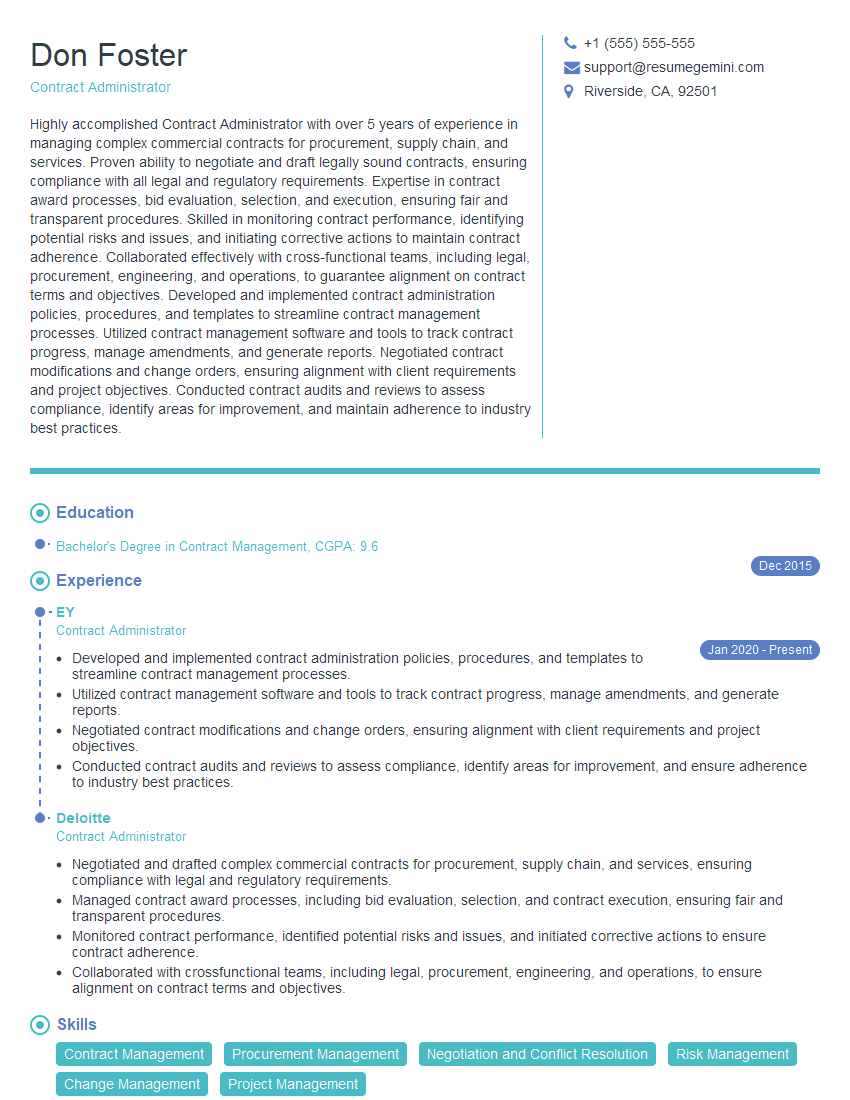
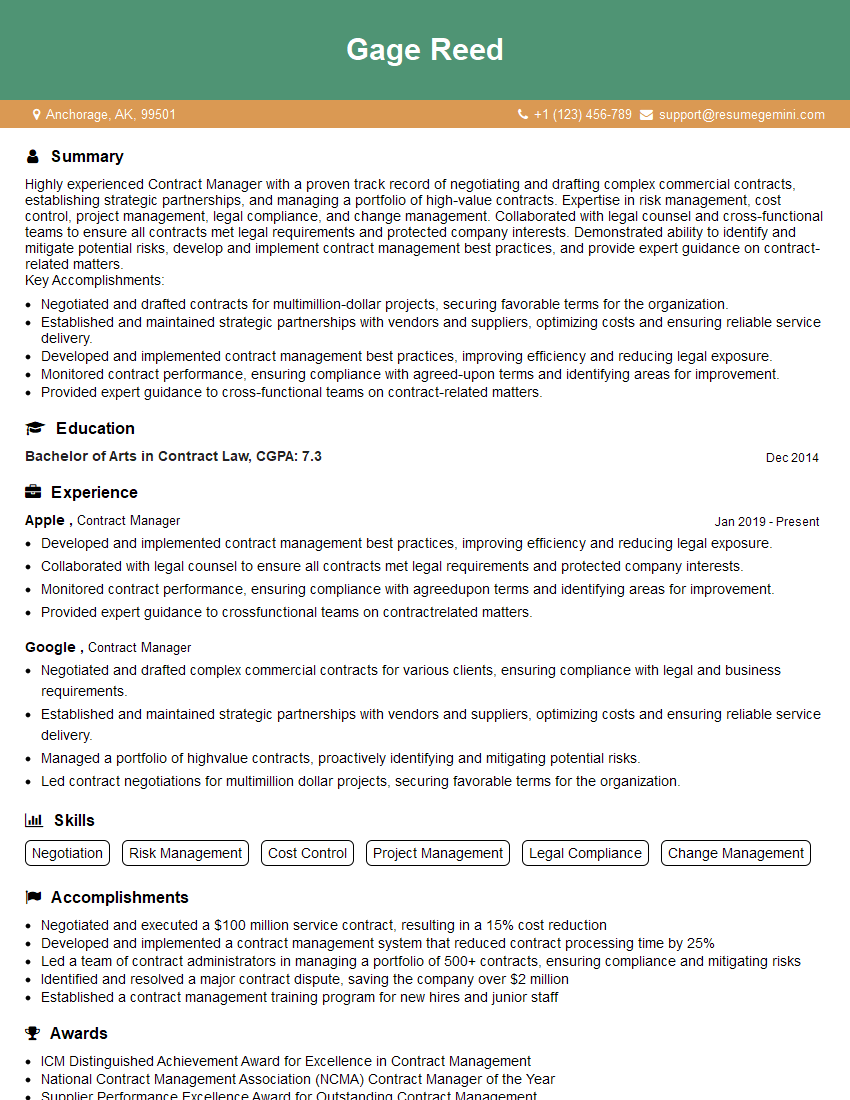
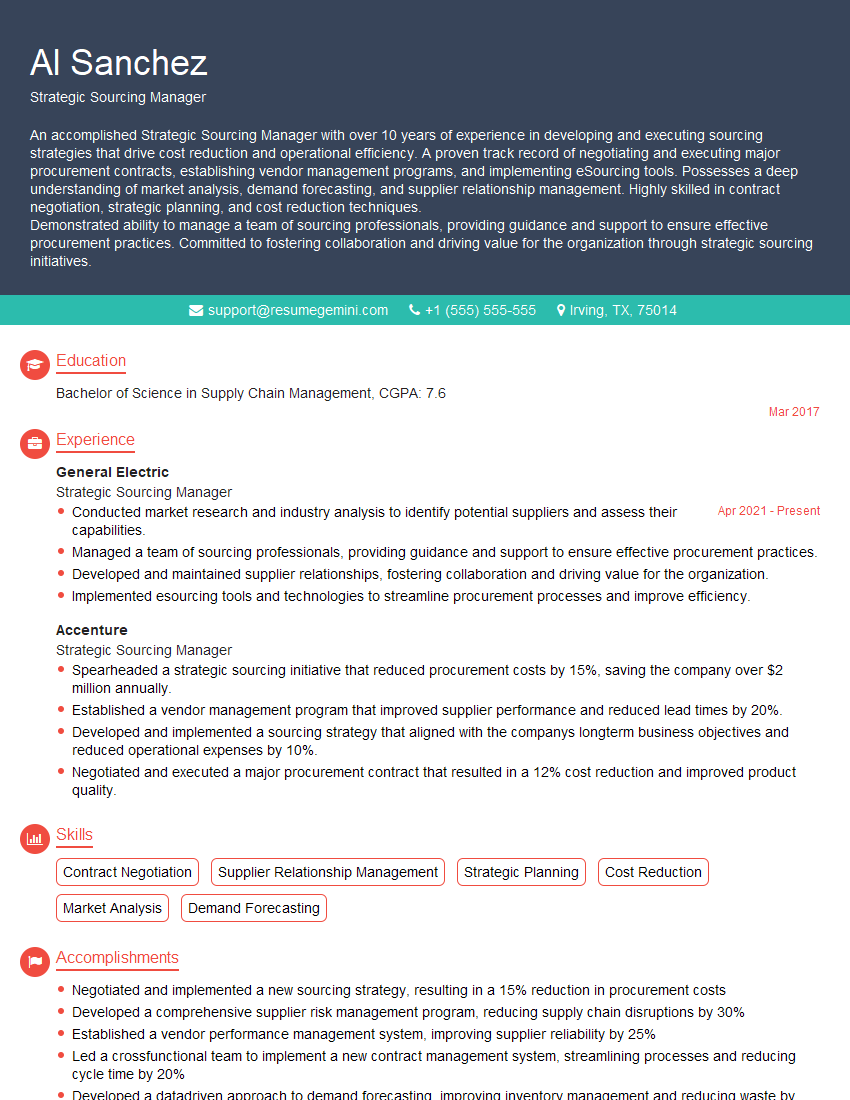
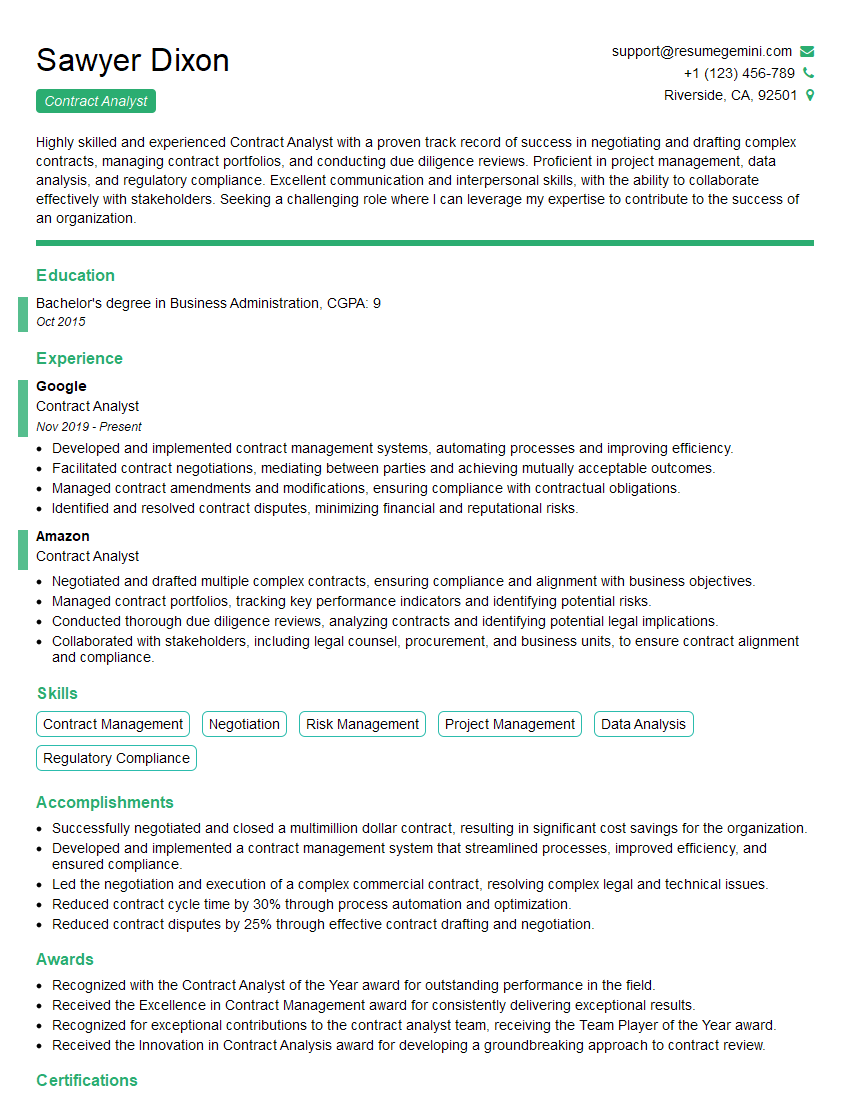
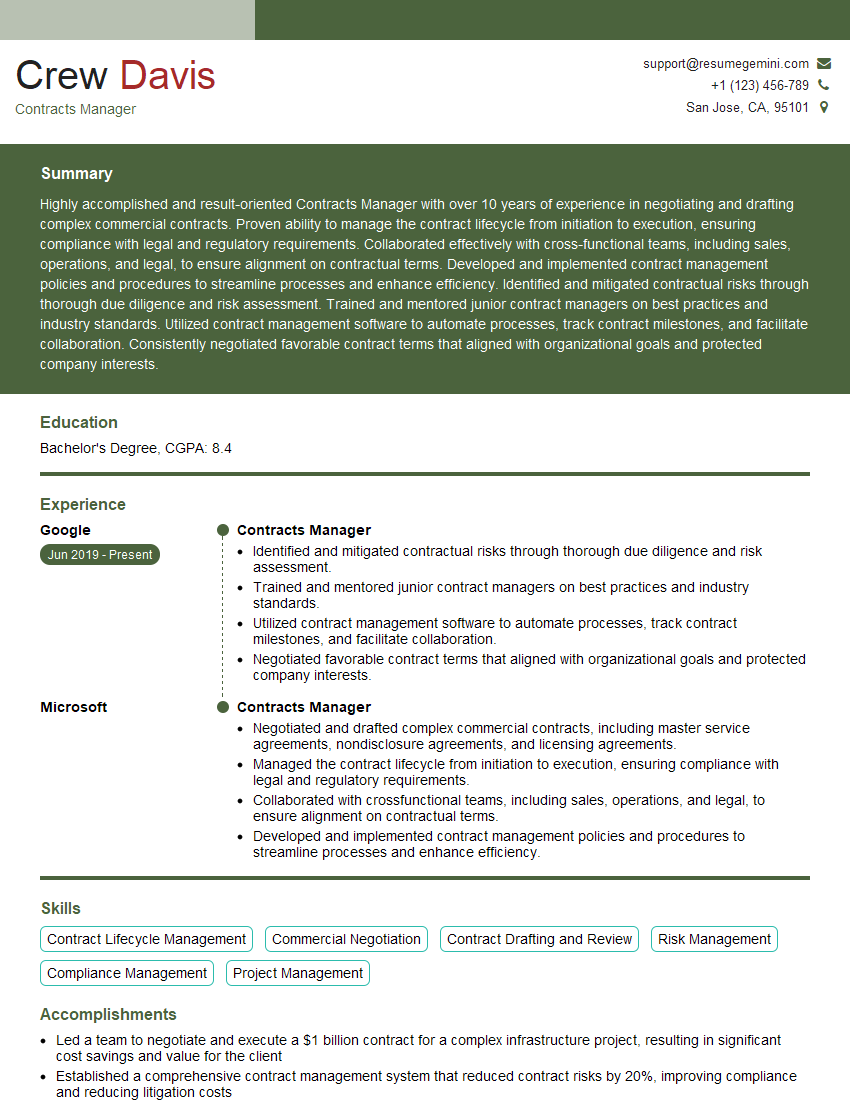
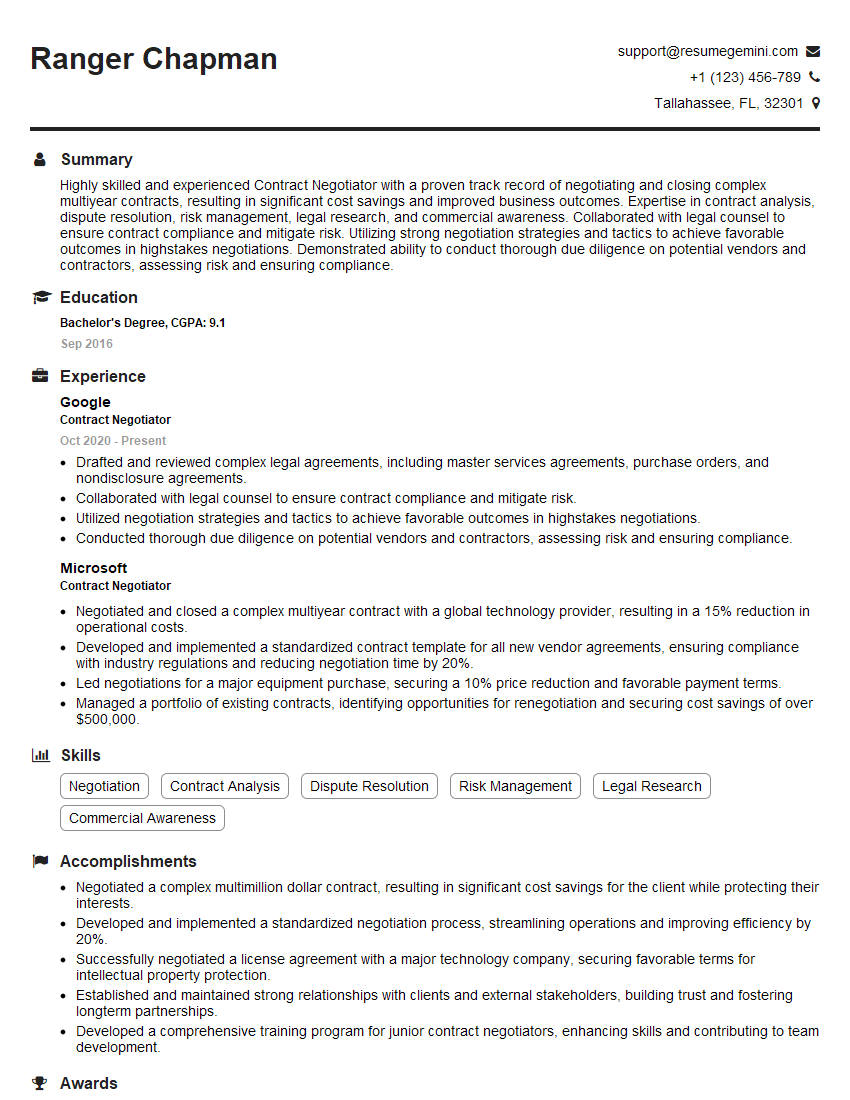
Mastering Contract Administration and Negotiations is crucial for career advancement in many fields, opening doors to leadership roles and higher earning potential. A strong understanding of these concepts demonstrates valuable skills in problem-solving, communication, and strategic thinking. To maximize your job prospects, create an ATS-friendly resume that showcases your expertise. ResumeGemini is a trusted resource for building professional resumes that stand out. We provide examples of resumes tailored to Contract Administration and Negotiations to help you craft a compelling application. Take the next step towards your dream career today!

Explore more articles
Users Rating of Our Blogs
Share Your Experience
We value your feedback! Please rate our content and share your thoughts (optional).
What Readers Say About Our Blog
Very informative content, great job.
good