Cracking a skill-specific interview, like one for International Geotechnical Standards, requires understanding the nuances of the role. In this blog, we present the questions you’re most likely to encounter, along with insights into how to answer them effectively. Let’s ensure you’re ready to make a strong impression.
Questions Asked in International Geotechnical Standards Interview
Q 1. Explain the differences between ISO, Eurocodes, and ASTM geotechnical standards.
ISO (International Organization for Standardization), Eurocodes, and ASTM (American Society for Testing and Materials) are all prominent players in the world of geotechnical standards, but they differ significantly in scope and application.
ISO standards are international in nature, aiming for global consistency. They provide a framework for various aspects of geotechnical engineering but often lack the detailed, prescriptive nature of other standards. Think of them as setting broad guidelines.
Eurocodes, on the other hand, are a collection of European standards specifically designed for structural and geotechnical engineering within the European Union. They are more prescriptive, providing detailed design procedures and calculation methods applicable to European conditions. They are legally binding in many EU member states.
ASTM standards are primarily focused on the American context. They provide detailed testing methods and material specifications widely used in the United States and beyond. They tend to be more focused on testing protocols and material properties rather than comprehensive design methodologies.
Analogy: Imagine building a house. ISO standards are like the overall blueprint – the general idea of the structure. Eurocodes are the detailed building codes specifying materials and construction methods. ASTM standards are like the specifications for the bricks, cement, and wood you’ll use.
Q 2. Describe your experience with soil classification systems (e.g., Unified Soil Classification System, AASHTO).
I have extensive experience with both the Unified Soil Classification System (USCS) and the American Association of State Highway and Transportation Officials (AASHTO) soil classification systems. These systems are crucial for characterizing soil behavior and selecting appropriate design parameters.
The USCS is widely used internationally, classifying soils based on particle size and plasticity characteristics. It utilizes symbols like GW (well-graded gravel), CL (low plasticity clay), etc., providing a quick and effective way to summarize soil properties. For example, encountering a SP-SM soil (poorly graded sand with some silt) would immediately suggest a relatively well-drained, potentially loose material requiring consideration in foundation design.
The AASHTO system, primarily used in the United States for highway projects, is similar but uses a slightly different grouping and classification criteria. It focuses more on the engineering properties relevant to pavement design, emphasizing factors like the plasticity index and the liquid limit.
My experience involves using these systems not only for initial site characterization but also for selecting appropriate laboratory testing to further refine the classification and determine parameters like shear strength and compressibility.
Q 3. How do you determine the appropriate geotechnical investigation methodology for a specific project?
Determining the appropriate geotechnical investigation methodology requires a systematic approach. It begins with a thorough understanding of the project’s scope, potential risks, and regulatory requirements.
Step 1: Project Understanding: What type of structure will be built? What are the anticipated loads? What are the environmental conditions (e.g., seismic activity, groundwater levels)? What are the local geological conditions?
Step 2: Preliminary Site Reconnaissance: A visual inspection of the site provides crucial initial information. This includes assessing topography, surface geology, and evidence of previous construction or ground disturbances.
Step 3: Desk Study: Reviewing existing geological maps, aerial photographs, and historical data provides a broader understanding of the site’s geology and potential hazards. This may involve researching past investigations or environmental reports.
Step 4: Field Investigation: The choice of field investigation methods depends on the project’s complexity and the information needed. This could include anything from simple test pits to more advanced techniques like cone penetration testing (CPT) or borehole drilling for sampling and in-situ testing.
Step 5: Laboratory Testing: Samples obtained from the field investigation will be subjected to laboratory testing to determine key soil properties like shear strength, compressibility, and permeability.
Example: For a high-rise building in an area with potentially soft clays, a comprehensive investigation including boreholes, CPTs, and laboratory testing would be essential. In contrast, a small residential building on stable bedrock might only require a limited number of test pits.
Q 4. What are the key considerations for slope stability analysis?
Slope stability analysis is a critical aspect of geotechnical engineering, ensuring the safety of slopes and embankments. Key considerations include:
- Geotechnical Properties: Accurate determination of soil shear strength parameters (cohesion and angle of internal friction) is paramount. This involves laboratory and in-situ testing tailored to the specific soil conditions.
- Groundwater Conditions: The presence of groundwater significantly affects slope stability, often reducing effective stress and shear strength. Careful consideration of groundwater levels and seepage analysis is crucial.
- Geometry of the Slope: The slope angle, height, and overall geometry heavily influence stability. Steeper slopes and higher embankments are inherently more susceptible to failure.
- Loading Conditions: External loads, such as surcharge from buildings or roadways, can significantly increase stresses and reduce stability. This requires careful assessment and incorporation into the analysis.
- Seismic Effects: In seismically active regions, earthquake loading can induce significant dynamic stresses and dramatically reduce slope stability. Seismic analysis must be incorporated, often employing dynamic soil properties and specialized software.
- Method of Analysis: Various methods exist, from simple limit equilibrium methods (e.g., Bishop’s method, Janbu’s method) to more sophisticated finite element analysis techniques. The choice of method depends on the complexity of the slope geometry and soil conditions. For example, for complex geometries, finite element analysis is frequently used.
Example: Analyzing the stability of a highway cut through a clay slope would involve determining the shear strength of the clay, assessing groundwater conditions (including seepage), modeling the geometry of the cut, and using a suitable slope stability analysis method (such as Bishop’s simplified method or a finite element model) to evaluate the factor of safety.
Q 5. Explain your experience with different types of foundation design (e.g., shallow foundations, deep foundations).
My experience encompasses a wide range of foundation designs, including both shallow and deep foundations. The selection depends heavily on the soil conditions, structural loads, and project constraints.
Shallow Foundations: These include footings (spread, strip, combined), rafts, and mats. They are suitable for relatively strong, shallow soil profiles with minimal settlement concerns. For instance, a single-story house on well-drained sandy soil would often utilize spread footings.
Deep Foundations: These include piles (driven, cast-in-place, drilled shafts), piers, and caissons. They are utilized when shallow foundations are not feasible due to weak soils, significant settlement potential, or large loads. For example, a high-rise building on soft clay may necessitate the use of driven piles to transfer loads to a stronger stratum deeper in the soil profile.
Design Considerations: Key considerations in foundation design include bearing capacity, settlement, and differential settlement. Design involves performing calculations to ensure the foundation’s stability and serviceability under the anticipated loads. Factors of safety are included to account for uncertainties in soil properties and modeling.
Example: Designing the foundation for a bridge would likely involve deep foundations, such as piles or drilled shafts, to transfer the significant loads to deeper, more competent soil layers. The specific type of deep foundation would depend on the soil conditions at the site. A soil investigation would determine the suitability of different deep foundation options.
Q 6. How do you incorporate ground improvement techniques into your design?
Ground improvement techniques are often essential for modifying unfavorable soil conditions and improving foundation support. The selection of appropriate techniques depends on the soil type, desired improvement, and project constraints.
Common Techniques:
- Compaction: Increases soil density and shear strength, suitable for granular soils. This can involve methods like vibratory rollers or dynamic compaction.
- Vibro-flotation: Used to improve loose saturated sands by densification and displacement of water.
- Soil Stabilization: Improves soil properties by adding binding agents like cement or lime. This is commonly used to increase the shear strength and reduce permeability of clays and silts.
- Stone Columns: Columns of compacted granular material installed into soft soils to increase bearing capacity and reduce settlement.
- Deep Mixing: In-situ mixing of soil with binding agents to create columns of improved material.
Incorporation into Design: The design process involves assessing the effectiveness of the selected ground improvement technique, verifying its performance through appropriate monitoring, and incorporating the improved soil properties into the foundation design. This may involve finite element analysis or other numerical modeling techniques to simulate the behavior of the improved ground.
Example: To improve the bearing capacity of a soft clay deposit for a large industrial building, stone columns might be installed. Design would then account for the increased bearing capacity provided by the stone columns, modifying the foundation design accordingly and conducting analyses to assess settlement reduction.
Q 7. Describe your experience with in-situ testing methods (e.g., CPT, SPT, DMT).
I have extensive experience with various in-situ testing methods, which are crucial for obtaining data on soil properties directly in the ground. These methods provide valuable information for characterizing the soil profile and informing design decisions.
Cone Penetration Test (CPT): The CPT involves pushing a cone-shaped probe into the ground and measuring the resistance to penetration. It provides continuous data on soil density, strength, and stratigraphy. The data is analyzed to determine soil type and parameters for design, such as undrained shear strength for clays.
Standard Penetration Test (SPT): The SPT involves driving a split-barrel sampler into the ground and counting the number of blows required to drive the sampler a set distance. The ‘N-value’ obtained is an indicator of soil density and strength. While simpler and less costly than CPT, it provides less continuous and less precise data compared to CPT.
Dilatometer Test (DMT): The DMT involves pushing a flat membrane against the soil to determine the soil stiffness (ED) and other properties. This method is particularly useful for characterizing the stiffness of soft clays and determining the coefficient of consolidation.
Integration into Projects: The results from these tests are used to develop a detailed soil profile, select appropriate design parameters, and validate assumptions made in the design process. For example, CPT data can be used to determine the depth and extent of weak layers, informing the design of deep foundations. SPT data can assist in classifying the soil and estimating parameters for use in slope stability analyses.
Q 8. How do you interpret laboratory test results (e.g., shear strength, consolidation)?
Interpreting laboratory test results, such as shear strength and consolidation parameters, is crucial for accurate geotechnical design. It’s not just about the numbers; it’s about understanding what those numbers *mean* in the context of the project.
For shear strength tests (e.g., direct shear, triaxial), we look at parameters like the angle of internal friction (φ) and cohesion (c). These define the soil’s resistance to shearing forces. A higher φ and c indicate greater strength. We must consider the test conditions – confining pressure, drainage conditions – as they significantly impact the results. For instance, a drained triaxial test will yield different parameters than an undrained test. We would then compare these results to established correlations and empirical relationships to estimate the in-situ strength characteristics.
Consolidation tests (e.g., oedometer) help determine the soil’s compressibility characteristics. Key parameters include the coefficient of consolidation (cv) and the compression index (Cc). Cv indicates how quickly the soil consolidates under load, while Cc shows how much it compresses. A high Cc suggests a highly compressible soil, which is crucial for foundation design to avoid excessive settlement. We would analyze the void ratio versus effective stress curve obtained from the consolidation test to determine these parameters. We use this data to predict settlement under anticipated loading conditions. For example, a building foundation on a highly compressible clay might require special considerations like preloading or deep foundations.
In both cases, careful consideration of the soil type, sampling methods, and test procedures is crucial to avoid misinterpretations. We also compare the lab results with field observations whenever possible to ensure accuracy and consistency.
Q 9. Explain your understanding of geotechnical risk assessment and mitigation.
Geotechnical risk assessment involves identifying, analyzing, and evaluating potential hazards associated with a geotechnical project. This could include issues like settlement, slope instability, liquefaction, and erosion. Mitigation involves implementing measures to reduce or eliminate these risks.
A typical risk assessment would involve:
- Hazard Identification: Identifying potential geotechnical hazards based on site investigation data, geological maps, and historical information.
- Risk Analysis: Quantifying the likelihood and consequence of each identified hazard. This often involves probabilistic methods and may include considering uncertainties in the input data.
- Risk Evaluation: Evaluating the overall risk level based on the likelihood and consequence analysis. This often involves comparing the risk level to acceptable thresholds.
- Risk Mitigation: Developing and implementing strategies to reduce or eliminate the identified risks. This could include using improved design methods, employing ground improvement techniques (e.g., soil stabilization, deep mixing), implementing monitoring programs, or selecting alternative design solutions.
For example, if a site is prone to liquefaction during earthquakes, mitigation strategies might involve ground improvement techniques like vibro-compaction or stone columns. The selection of appropriate mitigation measures depends on several factors, including the nature and magnitude of the hazards, cost, and constructability.
Q 10. How do you address uncertainty in geotechnical design?
Uncertainty is inherent in geotechnical engineering due to the variability of soil properties and the limitations of site investigation techniques. We address this through a combination of approaches:
- Probabilistic Methods: Instead of relying on single deterministic values for soil parameters, we use probability distributions to represent the uncertainty in these parameters. This allows us to quantify the uncertainty in design parameters and assess the risk associated with potential failures.
- Sensitivity Analysis: We perform sensitivity analyses to determine which input parameters have the greatest influence on the design outputs. This helps prioritize efforts to improve the accuracy of these parameters. For example, we might conduct additional testing on parameters that have a significant impact on the design.
- Factor of Safety: We use factors of safety in our designs to account for uncertainties. These factors are determined based on the level of risk tolerance and the implications of potential failures. Different international standards specify different levels of factors of safety.
- Redundancy: In some cases, we can design for redundancy by incorporating multiple safety features. This reduces the likelihood of failure even if one component fails.
- Monitoring and Instrumentation: During construction and operation, we might utilize monitoring and instrumentation to observe the performance of the geotechnical structures. This data helps to validate design assumptions and can provide early warnings of potential problems.
For example, in foundation design, we might use a probabilistic approach to estimate the settlement of the foundation and consider a larger factor of safety for the bearing capacity to account for the inherent uncertainty in soil parameters.
Q 11. Discuss your experience with numerical modeling software (e.g., PLAXIS, ABAQUS).
I have extensive experience using numerical modeling software such as PLAXIS and ABAQUS for geotechnical analyses. PLAXIS is particularly well-suited for analyzing soil-structure interaction problems, while ABAQUS offers a wider range of material models and capabilities, but requires a deeper understanding of finite element methods.
In my work, I’ve used PLAXIS for tasks such as:
- Analyzing the stability of earth retaining structures (e.g., retaining walls, sheet pile walls).
- Evaluating the settlement of shallow and deep foundations.
- Simulating the behavior of slopes and embankments.
- Assessing the potential for liquefaction.
With ABAQUS, I’ve focused more on complex problems involving coupled fluid-flow and stress analysis, such as seepage analysis in earth dams and modeling the behavior of complex geotechnical materials under various loading conditions. The choice of software depends heavily on the complexity of the problem and the specific requirements of the analysis.
The use of these programs requires a strong understanding of the underlying geotechnical principles, material models, and boundary conditions. It is crucial to calibrate the model with field and laboratory data to ensure its accuracy and reliability. The results from numerical modeling should always be interpreted cautiously and in conjunction with sound geotechnical judgment.
Q 12. Describe your experience with finite element analysis in geotechnical engineering.
Finite element analysis (FEA) is a powerful numerical technique used to simulate the behavior of geotechnical structures. It involves dividing the soil mass and structures into smaller elements and solving the governing equations for each element. This allows for a detailed representation of the stress and strain distribution within the soil and structures.
My experience with FEA in geotechnical engineering includes:
- Foundation Design: Using FEA to predict the settlement and bearing capacity of foundations under various loading conditions. This often involves defining appropriate soil models (e.g., Mohr-Coulomb, Drucker-Prager) and boundary conditions that accurately represent the field conditions.
- Slope Stability Analysis: Employing FEA to assess the stability of slopes, embankments, and cuttings, considering factors like pore water pressure and seismic loading.
- Retaining Wall Design: Using FEA to analyze the stresses and displacements in retaining walls and their interaction with the surrounding soil.
- Tunnel Design: Modeling the behavior of tunnels during excavation and construction, considering factors like ground pressure and support systems.
One significant advantage of FEA is its ability to model complex geometries and material behaviors. It also allows for the incorporation of different loading scenarios and the investigation of various design options. However, accurate modeling requires careful consideration of input parameters, element meshing, and boundary conditions. The results should be interpreted within the context of the simplifying assumptions made during the analysis.
Q 13. How do you ensure compliance with relevant international geotechnical standards?
Ensuring compliance with relevant international geotechnical standards is paramount for ensuring the safety and reliability of geotechnical structures. This involves a multi-faceted approach:
- Understanding Applicable Standards: Identifying and thoroughly understanding the relevant standards for the specific project location and type of work. These standards may include those published by organizations like ISO, Eurocode, ASTM, and others, depending on the geographic location and project needs. For example, Eurocodes are commonly used in Europe, while ASTM standards are prevalent in North America.
- Site Investigation and Testing: Conducting comprehensive site investigations and laboratory testing in accordance with relevant standards. This ensures that the data used in the design process is reliable and representative of the in-situ conditions.
- Design and Analysis: Performing design calculations and analyses using appropriate methods and employing factors of safety as specified in the standards. This ensures that the design considers potential uncertainties and risks.
- Construction Supervision: Providing thorough supervision during construction to ensure that the work is carried out according to the design specifications and the requirements of the relevant standards. This includes regular inspections and quality control checks.
- Documentation: Maintaining complete and accurate documentation of all aspects of the project, including site investigation data, design calculations, construction records, and testing results. This enables audits and provides a detailed history of the project.
Throughout the project lifecycle, we must stay updated on the latest revisions and interpretations of these standards, ensuring our practices remain compliant and aligned with best practices in the field. This may involve participating in professional development courses and staying abreast of research and advancements.
Q 14. Explain your understanding of seismic design considerations for geotechnical structures.
Seismic design considerations for geotechnical structures are crucial in seismically active regions. These structures need to withstand the dynamic forces and ground motions generated by earthquakes. The design process must account for several key factors:
- Seismic Hazard Assessment: Determining the seismic hazard at the site using probabilistic seismic hazard analysis (PSHA) to estimate the likelihood of ground motions of different intensities.
- Ground Motion Characterization: Defining the characteristics of the ground motion, including peak ground acceleration (PGA), peak ground velocity (PGV), and spectral acceleration (Sa). This informs the design of the structure to resist these motions.
- Soil Liquefaction Assessment: Evaluating the potential for soil liquefaction, which is the loss of strength and stiffness of saturated sandy soils during earthquake shaking. This often requires performing liquefaction analyses and implementing mitigation measures if liquefaction is a concern.
- Site Response Analysis: Assessing how the ground at the site will respond to seismic waves. This is especially important in areas with soft soils, where amplification of ground motions can occur.
- Seismic Design of Foundations: Designing foundations that can withstand the seismic forces and avoid excessive settlements or instability. This might involve using pile foundations, deep foundations, or other suitable solutions.
- Seismic Design of Retaining Structures: Designing retaining walls and other earth-retaining structures that can resist the seismic forces and avoid failure. This often involves considering the potential for overturning and sliding.
The seismic design of geotechnical structures is complex and requires a thorough understanding of earthquake engineering principles and geotechnical mechanics. We use advanced analysis techniques, including dynamic finite element analysis, to evaluate the response of these structures to seismic loading and ensure their safety during and after an earthquake.
Q 15. How do you manage geotechnical risks during construction?
Managing geotechnical risks during construction involves a proactive, multi-stage approach. It starts with a thorough site investigation, which includes geotechnical site characterization, followed by detailed geotechnical analysis and design. This is crucial to identify potential hazards like unstable soil conditions, high water tables, or seismic activity. We then develop mitigation strategies, which might include ground improvement techniques (such as soil stabilization or deep mixing), structural design modifications, or construction sequencing changes.
For example, on a recent high-rise project in a seismically active zone, our initial investigation revealed soft clay layers. This posed a significant settlement risk. Our mitigation strategy involved using deep foundations (piles) and incorporating a robust structural design that accommodated differential settlements. Regular monitoring throughout construction ensured the effectiveness of our mitigation strategy and allowed for timely adjustments.
Risk management also involves contingency planning. Unexpected conditions are always a possibility; therefore, we build in flexibility into our design and construction schedules to address unforeseen challenges. This proactive approach significantly minimizes potential delays and cost overruns, ensuring a safe and successful project.
Career Expert Tips:
- Ace those interviews! Prepare effectively by reviewing the Top 50 Most Common Interview Questions on ResumeGemini.
- Navigate your job search with confidence! Explore a wide range of Career Tips on ResumeGemini. Learn about common challenges and recommendations to overcome them.
- Craft the perfect resume! Master the Art of Resume Writing with ResumeGemini’s guide. Showcase your unique qualifications and achievements effectively.
- Don’t miss out on holiday savings! Build your dream resume with ResumeGemini’s ATS optimized templates.
Q 16. Describe your experience with ground water control techniques.
My experience with groundwater control techniques spans various methods, chosen based on project specifics and the site’s hydrogeological conditions. These techniques range from simple measures like dewatering wells to more complex solutions like deep well dewatering, electro-osmosis, and grouting.
For instance, during the construction of a large underground parking garage, we encountered a high water table. Simple sump pumps were insufficient. We employed a deep well dewatering system, which involved strategically placing wells around the excavation perimeter. This effectively lowered the water table, allowing for safe and efficient excavation. The design of the well points considered the permeability of the soil and the required drawdown, ensuring minimal environmental impact.
Another project involved a challenging situation where excavation needed to occur below the water table, in a sensitive environmental area near a river. We opted for a combination of grouting to seal the permeable layers and then using a slurry wall. This maintained the integrity of the ground while minimizing environmental disturbances. The selection of techniques always involves careful consideration of environmental regulations and best practices.
Q 17. What are your experiences working with different types of soil and rock materials?
My experience encompasses a wide range of soil and rock types, including clays (both soft and stiff), sands, gravels, and various rock formations. I’m proficient in identifying and characterizing these materials using various techniques like visual inspection, laboratory testing (e.g., Atterberg limits, triaxial tests, direct shear tests), and in-situ testing (e.g., Standard Penetration Test (SPT), Cone Penetration Test (CPT)).
For example, I’ve worked on projects where dealing with expansive clays was critical. Expansive clays exhibit significant volume changes with variations in moisture content, leading to potential foundation issues. We used techniques like pre-wetting or lime stabilization to improve the strength and reduce swelling potential.
Similarly, working with weathered rock required specialized techniques. We had a project where the rock was highly fractured and weak. We employed rock bolting and shotcrete to stabilize the slopes and ensure the safety of the excavation. My understanding of the diverse properties of different geological materials directly informs the design and selection of appropriate ground improvement and foundation solutions.
Q 18. Describe your knowledge of geotechnical instrumentation and monitoring.
Geotechnical instrumentation and monitoring are essential for ensuring the safety and stability of structures. My expertise includes installing and interpreting data from a variety of instruments, such as inclinometers, piezometers, extensometers, settlement plates, and pore water pressure transducers. These tools provide real-time data on ground movement, pore water pressure, and other critical parameters.
For instance, on a large embankment project, we installed inclinometers to monitor lateral movement of the soil. The data collected allowed us to assess the stability of the slope and to take corrective action if necessary. Any deviation from expected behavior triggered a thorough investigation and, in one case, a reinforcement of the slope using geosynthetics.
Data analysis is crucial. I use specialized software to analyze the monitoring data, identifying trends and anomalies that could signal potential problems. This proactive approach allows for timely interventions, preventing potential failures and ensuring the overall safety of the project.
Q 19. How do you handle discrepancies between laboratory and field test results?
Discrepancies between laboratory and field test results are common and often require careful investigation. Several factors can contribute to these differences, including sampling errors, variations in soil properties across the site, and the limitations of testing methods.
My approach involves a systematic investigation of potential causes. First, I review the testing procedures to identify any errors or inconsistencies. Then, I compare the results with other available data, such as in-situ test results and geological logs. Sometimes, additional testing is required to clarify the discrepancies.
For example, we experienced a discrepancy in the shear strength of a soil sample between lab tests and field CPT results. After a thorough review, we realized the lab sample was not representative of the in-situ conditions. This led us to conduct additional field testing and adjust our design to reflect the actual soil properties. It’s important to remember that the design must reflect field conditions, rather than relying solely on potentially non-representative lab results. A conservative design approach is always recommended in such situations.
Q 20. Explain your approach to geotechnical report writing and presentation.
My approach to geotechnical report writing and presentation prioritizes clarity, accuracy, and accessibility. Reports are structured logically, starting with a concise summary of the findings and conclusions. The main body details the methodology, results, and interpretations, with clear visuals (charts, graphs, and cross-sections).
I use plain language, avoiding unnecessary jargon, so the information is easily understandable by non-specialists, such as project managers or clients. The report also clearly states any limitations of the study and acknowledges uncertainties.
Presentations are tailored to the audience. For technical audiences, I can delve into the details of the analysis and data. For non-technical audiences, I focus on the key findings and recommendations, using visual aids to enhance understanding. The goal is always effective communication of complex technical information.
Q 21. Discuss your familiarity with specific geotechnical design codes (mention specific codes relevant to your experience).
My familiarity with geotechnical design codes includes Eurocode 7 (EC7), American Society of Civil Engineers (ASCE) 7, and Australian Standard AS 2870. The choice of code depends heavily on the project’s location and the applicable regulations.
For example, in Europe, EC7 is widely adopted and provides guidance on geotechnical design and ground improvement techniques. It involves detailed assessment and design considering the loads on the structure, as well as the properties of the soil. I have successfully designed foundations for structures in Europe using EC7 and it requires a thorough understanding of the different design parameters and factors of safety provided by the code.
In the US, I have utilized ASCE 7, particularly for seismic design considerations, ensuring that structures are capable of withstanding earthquake forces. The specific requirements differ depending on the seismic zone. The application of these codes is not just about following the rules but applying engineering judgment to interpret and apply the code requirements appropriately to unique site conditions and project needs.
Q 22. Explain the importance of considering environmental impact in geotechnical projects.
Considering environmental impact in geotechnical projects is paramount for sustainable development. It’s not just about meeting regulatory requirements; it’s about minimizing the project’s footprint and ensuring long-term environmental health. This involves a holistic approach, encompassing several key aspects:
- Minimizing waste generation: Efficient material use and careful excavation planning reduce landfill burden. For example, reusing excavated material on-site instead of transporting it reduces fuel consumption and associated emissions.
- Protecting water resources: Preventing soil erosion, controlling runoff, and managing dewatering are crucial to avoid contamination of surface and groundwater. Proper design of drainage systems and the use of sediment control measures are essential.
- Protecting biodiversity: Careful site selection, habitat restoration, and minimizing disturbance to existing ecosystems are vital. This may involve relocating protected species or implementing measures to mitigate habitat loss.
- Reducing greenhouse gas emissions: Selecting materials with lower embodied carbon, optimizing transportation routes, and employing energy-efficient construction methods contribute to reducing carbon footprint.
- Remediation of contaminated sites: Geotechnical engineers often work on contaminated sites. Proper remediation strategies are crucial for human health and environmental protection.
Ignoring environmental considerations can lead to significant legal penalties, reputational damage, and long-term environmental liabilities. A proactive and integrated approach ensures a project’s environmental sustainability and aligns with best practices promoted by organizations like the International Society for Soil Mechanics and Geotechnical Engineering (ISSMGE).
Q 23. How do you account for the effects of climate change in geotechnical design?
Climate change significantly impacts geotechnical design. We must account for increased frequency and intensity of extreme weather events and long-term changes in temperature and precipitation. This involves:
- Increased rainfall and flooding: Designs must accommodate higher design flood levels, considering factors like sea-level rise and changes in rainfall patterns. Improved drainage systems and flood defenses are essential.
- More intense storms: Structures need to withstand higher wind loads and increased wave action in coastal areas. Soil erosion and slope stability must be carefully considered.
- Rising temperatures: Increased temperatures can affect soil properties, leading to changes in strength, stiffness, and consolidation behavior. This requires using appropriate material models and considering the effects of thermal expansion and contraction.
- Permafrost thaw: In cold regions, permafrost thaw can significantly destabilize foundations and infrastructure, requiring specialized design techniques and considerations of thermal effects on the ground.
- Sea-level rise: Coastal structures need to account for increased inundation and erosion. This requires more extensive protection measures and a shift toward more resilient design concepts.
Incorporating climate change considerations often involves probabilistic analysis and the use of climate change scenarios provided by relevant meteorological agencies. This approach allows for a more resilient and sustainable design that can adapt to future climate change impacts.
Q 24. Describe your experience with the design and analysis of retaining structures.
I have extensive experience in the design and analysis of retaining structures, ranging from simple earth retaining walls to complex basement excavations in urban environments. My approach involves:
- Site investigation and characterization: Thorough soil investigation is the cornerstone of a successful design. This includes laboratory testing to determine soil properties and in-situ testing to verify the findings.
- Selection of appropriate design method: The chosen method depends on factors like soil type, loading conditions, and project constraints. Common methods include limit equilibrium methods, finite element analysis, and empirical methods.
- Stability analysis: This crucial step assesses the stability of the retaining structure against various failure mechanisms such as sliding, overturning, and bearing capacity failure. Software like PLAXIS or ABAQUS are commonly employed.
- Detail design and construction specifications: This includes selecting appropriate materials, specifying construction techniques, and preparing detailed drawings. It’s essential to ensure constructability and maintain quality control during construction.
- Instrumentation and monitoring: Installing instrumentation allows for monitoring the performance of the structure during and after construction. This helps verify the design assumptions and detect any potential problems early on.
For instance, I worked on a project involving a deep basement excavation in a dense urban area. We used a combination of diaphragm walls and anchored sheet piles to support the excavation, along with detailed finite element analysis to account for complex soil-structure interaction and groundwater conditions.
Q 25. Explain your experience with the design and construction of embankments.
My experience with embankment design and construction encompasses various types of embankments, including highway embankments, railway embankments, and earth dams. The process typically includes:
- Geotechnical site investigation: This involves a comprehensive study of subsurface conditions, including soil stratigraphy, shear strength parameters, permeability, and groundwater levels.
- Embankment design: This includes determining the embankment geometry, material properties, and construction methods to ensure stability and meet performance requirements. This often involves using specialized geotechnical software to analyze stability, settlement, and seepage.
- Construction management: Overseeing the construction process to ensure that the embankment is constructed according to the design specifications. This includes quality control of the materials used and compaction levels achieved.
- Instrumentation and monitoring: Installing instruments to monitor the performance of the embankment during and after construction. This may include settlement gauges, piezometers, and inclinometers.
- Addressing potential issues: Identifying and mitigating potential issues during construction, such as soft ground conditions or unstable slopes. This may require ground improvement techniques or alternative construction methods.
For example, I was involved in the construction of a large highway embankment over a compressible soil layer. We employed pre-loading techniques and utilized lightweight fill materials to minimize settlement and ensure the long-term stability of the structure.
Q 26. Discuss the impact of various construction methods on the stability of geotechnical structures.
Different construction methods significantly influence the stability of geotechnical structures. For instance:
- Deep excavation techniques: Methods like diaphragm walls, sheet piling, and soil nailing offer excellent support during excavation, minimizing ground movement and ensuring stability. However, they can be costly and time-consuming.
- Ground improvement techniques: Methods such as vibro-compaction, soil stabilization, and deep mixing improve the strength and stiffness of the soil, reducing settlement and increasing bearing capacity. They are effective for problematic soils but require specialized equipment and expertise.
- Compaction techniques: Proper compaction of fill materials is crucial for embankment stability. Insufficient compaction can lead to settlement and instability. Different compaction methods, such as vibratory rollers and sheep-foot rollers, achieve varying levels of compaction.
- Dewatering techniques: Managing groundwater is critical in many projects. Dewatering methods like wellpoints and deep wells can significantly affect the stability of excavations and embankments by reducing pore water pressure. However, improper dewatering can induce settlement or instability in adjacent structures.
The selection of the appropriate construction method must consider several factors such as soil conditions, project requirements, and cost-effectiveness. A thorough understanding of the interaction between construction methods and soil behavior is essential for successful project execution.
Q 27. How do you validate your geotechnical models?
Validating geotechnical models involves a multi-step process to ensure the accuracy and reliability of the predictions. Key steps include:
- Comparison with field data: Model results are compared with in-situ measurements such as settlement data, pore water pressure readings, and inclinometer data obtained during and after construction. This helps assess the model’s ability to accurately capture the actual behavior of the structure.
- Sensitivity analysis: The model’s response to changes in input parameters is evaluated. This helps understand the influence of uncertainties in soil properties and loading conditions on the model predictions.
- Peer review: The model and its results are reviewed by independent experts to identify any potential errors or limitations.
- Calibration and refinement: Based on the comparison with field data and sensitivity analysis, the model parameters or assumptions are adjusted to improve its accuracy and reliability. This iterative process helps refine the model and enhance the confidence in the predictions.
- Back-analysis: If available, data from similar past projects with known outcomes can be used to fine-tune model parameters, enhancing the validation process.
By employing these techniques, we can increase our confidence in the accuracy of the geotechnical models used for design and decision-making.
Q 28. Explain your knowledge of advanced geotechnical topics such as liquefaction or expansive soils.
My knowledge of advanced geotechnical topics includes expertise in liquefaction and expansive soils.
- Liquefaction: This phenomenon occurs in saturated loose sandy soils during earthquakes, causing significant ground deformation and potentially catastrophic damage to structures. My experience includes conducting liquefaction hazard assessments using methods such as the simplified procedure and the cyclic stress ratio method. This often involves using specialized software to simulate the soil’s behavior during seismic events. Mitigation measures include ground improvement techniques such as densification or vibro-compaction.
- Expansive soils: These soils exhibit significant volume changes due to variations in moisture content. This can cause substantial damage to structures, particularly foundations. My experience involves characterizing expansive soils, designing foundations to accommodate their volume changes (such as using reinforced concrete footings or deep foundations), and implementing moisture control measures to minimize swelling and shrinkage.
I have worked on several projects involving these challenging soil conditions, employing advanced analytical techniques and mitigation strategies to ensure the safety and stability of structures. Understanding the complex behavior of these soils is crucial for designing reliable and durable infrastructure.
Key Topics to Learn for International Geotechnical Standards Interview
- Soil Classification and Index Properties: Understanding different soil classification systems (e.g., Unified Soil Classification System – USCS, AASHTO) and their implications for geotechnical design. Practical application: Interpreting laboratory test results to determine appropriate design parameters.
- Shear Strength and Slope Stability: Mastering concepts of shear strength, effective stress, and factors of safety. Practical application: Analyzing slope stability using various methods (e.g., limit equilibrium analysis) and designing retaining structures.
- Consolidation and Settlement: Grasping the principles of consolidation and predicting settlement under various loading conditions. Practical application: Designing foundations considering consolidation settlement and differential settlement.
- Foundation Engineering: Familiarizing yourself with different foundation types (shallow and deep), their design considerations, and bearing capacity calculations. Practical application: Selecting appropriate foundation types for specific soil conditions and structural loads.
- Earth Retaining Structures: Understanding the design principles of retaining walls (gravity, cantilever, anchored), their stability analysis, and potential failure mechanisms. Practical application: Evaluating existing retaining walls and designing new ones according to international standards.
- International Standards (e.g., ISO, ASTM): Familiarize yourself with relevant international standards and their applications in geotechnical engineering projects. Practical application: Ensuring project compliance and selecting appropriate design parameters according to standards.
- Ground Improvement Techniques: Explore various ground improvement techniques (e.g., compaction, grouting, soil stabilization) and their applications. Practical application: Selecting suitable ground improvement methods based on site conditions and project requirements.
- In-situ Testing Methods: Understanding the principles and applications of common in-situ testing methods (e.g., Standard Penetration Test – SPT, Cone Penetration Test – CPT). Practical application: Interpreting in-situ test data to characterize soil properties.
Next Steps
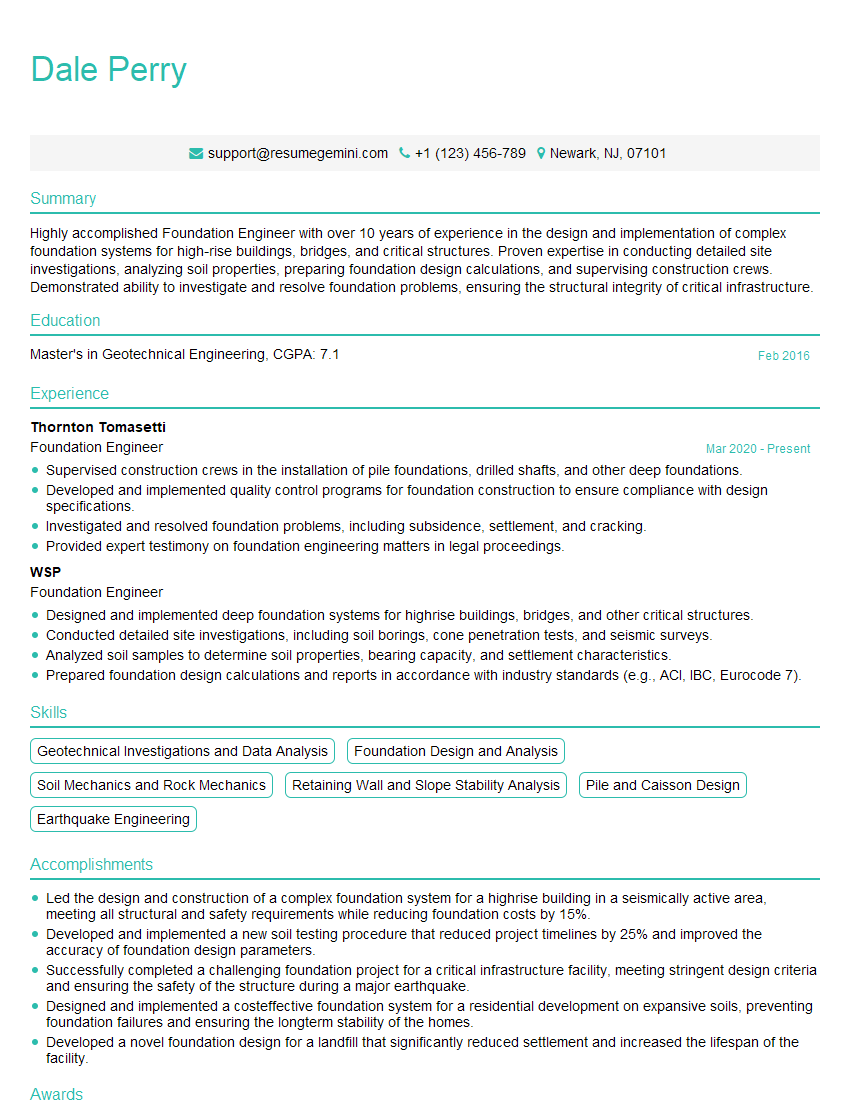
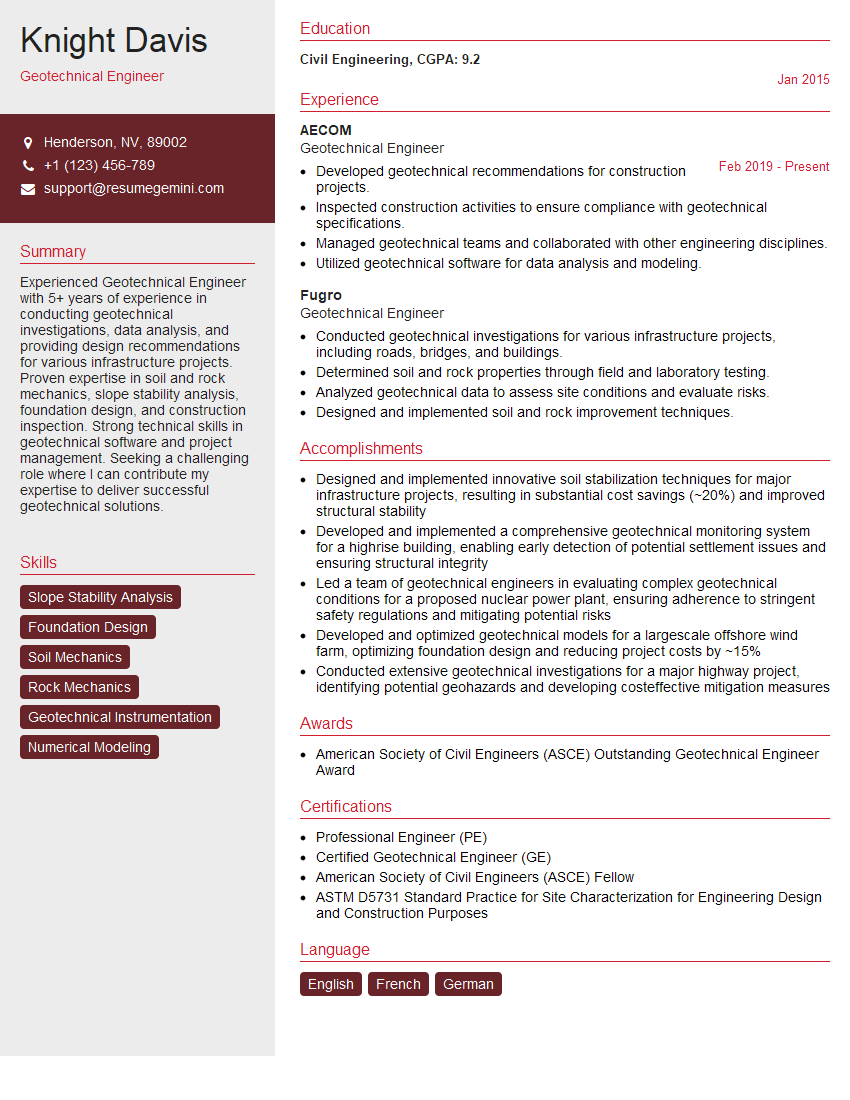
Mastering International Geotechnical Standards is crucial for advancing your career in geotechnical engineering. A strong understanding of these standards demonstrates your competency and professionalism, opening doors to more challenging and rewarding opportunities. To maximize your job prospects, creating an ATS-friendly resume is essential. ResumeGemini can help you build a professional and impactful resume that highlights your skills and experience effectively. Examples of resumes tailored to International Geotechnical Standards are available to help you get started. Invest in your future – build a resume that showcases your expertise.
Explore more articles
Users Rating of Our Blogs
Share Your Experience
We value your feedback! Please rate our content and share your thoughts (optional).
What Readers Say About Our Blog
Very informative content, great job.
good