The thought of an interview can be nerve-wracking, but the right preparation can make all the difference. Explore this comprehensive guide to ISO 90012015 Quality Management System interview questions and gain the confidence you need to showcase your abilities and secure the role.
Questions Asked in ISO 90012015 Quality Management System Interview
Q 1. Explain the key principles of ISO 9001:2015.
ISO 9001:2015 is built on several key principles that guide organizations in establishing and maintaining an effective Quality Management System (QMS). These principles aren’t just suggestions; they’re the foundation for achieving consistent customer satisfaction and improved organizational performance.
- Customer Focus: Understanding and meeting customer needs and expectations is paramount. This involves actively soliciting feedback, analyzing market trends, and proactively identifying opportunities to exceed customer requirements. For example, a software company might conduct user surveys and beta testing to ensure their product aligns with user needs.
- Leadership: Leaders at all levels must demonstrate commitment to the QMS, fostering a culture of quality and providing the necessary resources. A strong leadership commitment ensures everyone understands the importance of quality and contributes to its improvement.
- Engagement of People: Empowering employees at all levels is crucial. When employees feel valued and involved, they are more likely to contribute to quality improvement initiatives. This might include involving employees in problem-solving teams or providing training opportunities.
- Process Approach: Managing work as interconnected processes rather than individual tasks leads to greater efficiency and effectiveness. Identifying and optimizing key processes ensures consistent outputs and minimized errors. Think of an assembly line – each step is a process, and optimization of the whole line improves overall output quality.
- Improvement: Continuously striving for improvement is fundamental. This includes regular monitoring, analysis, and improvement of processes and systems. This could involve implementing Lean methodologies or Six Sigma techniques.
- Evidence-based Decision Making: Decisions should be made based on data and analysis, not intuition. This ensures objective assessment and effective problem-solving. For example, analyzing defect rates to pinpoint process weaknesses.
- Relationship Management: Establishing strong relationships with suppliers and other stakeholders contributes to the overall success of the QMS. This includes collaborative partnerships and transparent communication.
Q 2. Describe the Plan-Do-Check-Act (PDCA) cycle and its application in a QMS.
The Plan-Do-Check-Act (PDCA) cycle is a continuous improvement model that drives iterative enhancements. It’s a cyclical process, not a linear one, meaning you constantly revisit and refine your approaches.
- Plan: Define objectives, processes, and resources needed to achieve those objectives. This stage involves thorough planning, risk assessment, and resource allocation. For example, planning a new training program for staff on a specific piece of equipment.
- Do: Implement the plan and collect data on the results. This is the execution phase, where the plan is put into action. The software company might roll out the new software version to a select group of users.
- Check: Analyze the data collected during the ‘Do’ phase. This includes reviewing metrics, analyzing results, and identifying areas for improvement. The software company analyzes user feedback and bug reports after the beta testing period.
- Act: Take action based on the analysis, making changes to improve the process. This could involve modifying processes, updating documentation, or implementing corrective actions. Based on feedback, the software company implements code fixes and updates the user interface.
The PDCA cycle is applied iteratively throughout the QMS, continuously improving every aspect from production to customer service. It’s the engine for continuous improvement within ISO 9001.
Q 3. What are the requirements for documenting the QMS?
ISO 9001:2015 requires documented information to demonstrate the effectiveness of the QMS. This documentation needs to be controlled and maintained, but it’s not about excessive paperwork. The focus is on creating and maintaining information that’s necessary, accessible, and up-to-date.
- Documented Information: This includes procedures, work instructions, records, and other forms of information necessary to support the QMS operations. It ensures consistency and traceability. This could range from a standard operating procedure for a manufacturing process to a record of a customer complaint.
- Control of Documented Information: The organization needs a system for creating, reviewing, approving, updating, and retaining documented information. This helps maintain accuracy and prevent the use of outdated or incorrect procedures.
- Records Management: Records are a type of documented information that provide evidence of activities and results. Robust record management is essential for audits and demonstrating compliance. This could include calibration certificates, inspection reports, and training records.
The key is to have sufficient documentation to demonstrate compliance but avoid unnecessary documentation that becomes burdensome and difficult to manage. A well-structured system with readily accessible information is crucial.
Q 4. How does a Quality Management System (QMS) contribute to customer satisfaction?
A well-implemented QMS directly contributes to enhanced customer satisfaction in several ways.
- Consistent Product/Service Quality: By standardizing processes and focusing on continuous improvement, the QMS ensures consistent quality in the products or services delivered to customers. This builds trust and loyalty.
- Meeting Customer Requirements: The customer-centric approach of ISO 9001 emphasizes understanding and meeting customer needs. By actively seeking feedback and incorporating it into process improvements, the QMS ensures products and services align with expectations.
- Effective Complaint Handling: A robust QMS includes mechanisms for effectively addressing customer complaints and resolving issues promptly. This demonstrates responsiveness and a commitment to customer satisfaction.
- Improved Communication: Clear communication channels throughout the organization ensure customers are kept informed about the status of their orders, potential delays, or other important updates. This fosters trust and transparency.
Ultimately, a strong QMS fosters a culture that prioritizes customer needs and expectations, leading to higher levels of satisfaction and increased loyalty.
Q 5. Explain the importance of internal audits in maintaining ISO 9001 compliance.
Internal audits are crucial for maintaining ISO 9001 compliance. They act as a proactive mechanism to identify potential gaps and areas for improvement before an external audit. Think of them as a health check for your QMS.
- Identifying Nonconformities: Internal audits systematically assess the effectiveness of the QMS against the ISO 9001 requirements and internal procedures. This reveals any gaps or weaknesses in the system.
- Verifying Effectiveness: Audits help to confirm that the QMS is being implemented as intended and is achieving its objectives. It verifies that procedures are being followed and that controls are working.
- Promoting Continuous Improvement: The findings from internal audits provide valuable insights into areas for improvement, driving continuous improvement within the QMS. This proactive approach prevents major issues from arising.
- Demonstrating Compliance: A well-documented internal audit program provides evidence of proactive compliance efforts during external audits, showcasing a commitment to quality.
Regular, planned internal audits, conducted by trained auditors, are essential for ensuring sustained ISO 9001 compliance and preventing costly corrective actions down the line.
Q 6. What are the critical aspects of managing nonconformities within a QMS?
Managing nonconformities—instances where products, processes, or systems don’t meet requirements—is critical for maintaining a robust QMS. Effective management prevents recurrence and protects customer satisfaction.
- Identification and Control: Nonconformities must be identified promptly, documented, and controlled to prevent further use or delivery of nonconforming products or services. This might involve isolating defective products or temporarily suspending a process.
- Investigation and Analysis: A thorough investigation is required to determine the root cause of the nonconformity. This could involve using tools like 5 Whys or fishbone diagrams to uncover underlying issues.
- Corrective Actions: Based on the root cause analysis, appropriate corrective actions must be implemented to prevent recurrence. This could involve revising procedures, updating equipment, or providing additional employee training.
- Verification and Documentation: Effectiveness of corrective actions should be verified. All stages of managing nonconformities, from identification to verification, must be documented.
Ignoring nonconformities risks reputational damage, customer dissatisfaction, and even legal repercussions. A structured approach is crucial for managing these effectively.
Q 7. Describe your experience with Corrective Actions (CAPA).
My experience with Corrective Actions (CAPA) spans several years and diverse industries. I’ve been involved in developing and implementing CAPA procedures, conducting root cause analyses, and verifying the effectiveness of corrective actions. I’ve witnessed firsthand the transformative power of a well-structured CAPA system.
In one project involving a medical device manufacturer, we experienced a recurring issue with a specific component failing. Through a thorough root cause analysis, involving data analysis, process mapping, and employee interviews, we identified a deficiency in the supplier’s quality control process. The CAPA involved working collaboratively with the supplier to implement improved quality control measures, including enhanced testing and stricter material specifications. This resulted in a significant reduction in component failures and improved overall product quality.
In another instance, a manufacturing error resulted in a batch of products not meeting specifications. Our CAPA process involved identifying the root cause (a malfunctioning machine), implementing immediate corrective actions (isolating the defective batch), performing preventative maintenance on the machine, and revising the maintenance schedule to prevent future occurrences. We also updated our training materials to emphasize the importance of regular machine checks.
My approach to CAPA emphasizes a data-driven, collaborative effort involving all relevant stakeholders to identify root causes and implement effective, verifiable solutions. This ensures not only immediate problem resolution but also prevents future recurrences, enhancing the overall robustness of the QMS.
Q 8. How do you ensure continuous improvement within a QMS?
Continuous improvement, a cornerstone of ISO 9001:2015, isn’t a one-time event but an ongoing process. It’s about consistently seeking ways to enhance the effectiveness of the Quality Management System (QMS) and the organization’s overall performance. Think of it like regularly tuning your car – small adjustments over time lead to significant improvements in fuel efficiency and performance.
- Data Analysis: Regularly analyzing data from various sources – customer feedback, internal audits, process performance indicators (KPIs), and corrective actions – provides valuable insights into areas needing improvement. For example, tracking customer complaints might reveal a recurring issue with a specific product feature, prompting design changes.
- Corrective and Preventive Actions (CAPA): A robust CAPA process is crucial. When problems arise, we don’t just fix the immediate issue; we investigate the root cause and implement preventive measures to stop it from recurring. Let’s say a machine malfunctioned, causing production delays. A thorough investigation might reveal inadequate maintenance procedures, leading to improved training and scheduling.
- Management Review: Regular management reviews are essential for evaluating the QMS’s effectiveness and identifying opportunities for improvement. This is a high-level assessment, looking at overall performance and strategic direction. It’s where leadership makes key decisions about resource allocation and future improvements.
- Employee Involvement: Engaging employees at all levels is vital. They often have the most direct experience with processes and are a rich source of improvement ideas. Implementing suggestion schemes and providing training on continuous improvement methodologies empowers employees to actively participate.
By systematically applying these methods, we build a culture of continuous improvement, leading to greater efficiency, higher quality, and enhanced customer satisfaction.
Q 9. What is a risk-based thinking approach and how does it apply to ISO 9001?
Risk-based thinking is a proactive approach to identifying and managing potential risks and opportunities that could impact the QMS’s objectives. Instead of reacting to problems, we anticipate and mitigate them. It’s like planning for a potential storm instead of waiting for it to hit.
In ISO 9001, risk-based thinking is integrated throughout the entire QMS. This includes:
- Risk Assessment: Identifying potential risks and opportunities related to context of the organization, the QMS, and its processes. For example, a new supplier might pose a risk of late deliveries; a change in market demand could present an opportunity for growth.
- Risk Evaluation: Analyzing the likelihood and impact of identified risks and opportunities. This helps prioritize which ones require immediate attention.
- Risk Treatment: Developing and implementing controls to address identified risks and capitalize on opportunities. This might involve diversifying suppliers, creating a marketing strategy to address market changes, or improving training to prevent operator errors.
- Risk Monitoring and Review: Regularly monitoring the effectiveness of implemented controls and updating the risk assessment as needed. This is an iterative process; risks and opportunities evolve over time.
By embedding risk-based thinking, organizations can proactively manage potential problems, enhance resilience, and improve their overall performance and ability to achieve objectives.
Q 10. Describe your experience with conducting management reviews.
I have extensive experience conducting management reviews, having led these sessions in various organizations across diverse industries. My approach is always data-driven and focuses on collaboration. The review isn’t just a reporting exercise; it’s a strategic opportunity for improvement.
My typical process involves:
- Data Gathering: Collecting data from internal audits, customer feedback, process performance indicators (KPIs), and other relevant sources. This helps paint a comprehensive picture of the QMS’s performance.
- Review Meeting Facilitation: Leading a collaborative meeting with top management to discuss the collected data and identify areas of strength and weakness. I encourage open discussion and participation from all attendees.
- Action Plan Development: Collaboratively developing an action plan based on the identified improvement opportunities. This plan includes clear responsibilities, timelines, and measurable objectives. It’s critical that these actions are aligned with the organization’s strategic goals.
- Follow-up and Monitoring: Tracking the progress of the implemented actions and ensuring the effectiveness of implemented changes. I will often schedule follow-up meetings to review progress and address any roadblocks.
In one particular instance, a management review revealed low customer satisfaction scores related to product delivery times. Through detailed analysis, we identified bottlenecks in the logistics process and implemented improvements, resulting in a significant improvement in customer satisfaction and on-time delivery rates.
Q 11. Explain the role of top management in establishing and maintaining a QMS.
Top management’s role in establishing and maintaining a QMS is paramount. They are the driving force behind the entire system’s effectiveness. Without their commitment, the QMS will struggle to function properly. They need to champion the system and embody its principles.
Their responsibilities include:
- Commitment and Leadership: Demonstrating visible commitment to the QMS, establishing a culture of quality, and ensuring its integration into organizational strategy.
- Resource Allocation: Providing the necessary resources – financial, human, and technological – for the QMS to operate effectively. This means investing in training, equipment, and personnel.
- Defining the Quality Policy: Establishing a quality policy that reflects the organization’s commitment to quality and aligns with its overall business objectives.
- Ensuring Compliance: Making sure the QMS complies with ISO 9001 requirements and relevant legal and regulatory obligations.
- Management Review Participation: Actively participating in management reviews to evaluate the QMS’s effectiveness and guide future improvements. This is where they make strategic decisions.
In short, top management’s leadership and unwavering support are the key ingredients to a successful and sustainable QMS.
Q 12. What are the key differences between ISO 9001:2008 and ISO 9001:2015?
While both ISO 9001:2008 and ISO 9001:2015 aim to establish a robust QMS, the 2015 version introduced significant changes to align with a more risk-based and process-oriented approach.
- Risk-Based Thinking: ISO 9001:2015 emphasizes a risk-based approach throughout the entire QMS, whereas 2008 focused more on reactive problem-solving. This shift is fundamental.
- Process Approach: Both versions promote a process approach, but 2015 reinforces the importance of understanding the interrelationships between processes and managing them effectively to achieve objectives.
- Leadership Engagement: While 2008 touched upon management responsibility, 2015 strongly emphasizes the active leadership role in establishing, implementing, maintaining, and continuously improving the QMS.
- Context of the Organization: The 2015 version requires a clear understanding of the organization’s context – its internal and external environment – to ensure the QMS is relevant and effective.
- Interested Parties: ISO 9001:2015 emphasizes understanding and addressing the needs and expectations of interested parties, such as customers, employees, and suppliers, leading to more customer-centric QMS.
In essence, ISO 9001:2015 is a more proactive, risk-aware, and leadership-driven framework compared to its predecessor. It’s about anticipating and mitigating risks, rather than just reacting to problems after they occur.
Q 13. How do you measure the effectiveness of a QMS?
Measuring the effectiveness of a QMS is an ongoing process requiring multiple metrics and a holistic perspective. It’s not just about passing audits; it’s about demonstrating real improvements in key areas.
Effective measurements include:
- Customer Satisfaction: Regularly surveying customers to gauge their satisfaction with products, services, and overall experience. This is a critical indicator of QMS effectiveness.
- Process Performance Indicators (KPIs): Monitoring key metrics related to various processes, such as defect rates, cycle times, and efficiency levels. This allows for identification of bottlenecks and areas for improvement.
- Internal Audit Results: Analyzing the findings of internal audits to assess the effectiveness of controls and compliance with the QMS. Trends in audit findings can signal systemic issues.
- Corrective and Preventive Action (CAPA) Effectiveness: Tracking the effectiveness of implemented CAPAs to ensure problems are addressed and don’t reoccur. This is a measure of the system’s ability to learn from its mistakes.
- Employee Satisfaction: Assessing employee satisfaction with the QMS and their role in it. This is critical as employee engagement is essential for achieving quality objectives.
By regularly monitoring these metrics and comparing them against targets and previous performance, organizations can gain valuable insights into their QMS effectiveness and make necessary adjustments to further enhance performance and achieve sustained quality.
Q 14. Describe your experience with implementing a QMS.
I’ve been involved in numerous QMS implementations across diverse organizations. My approach is always collaborative and tailored to the specific needs and context of each organization. It’s never a ‘one-size-fits-all’ solution.
The implementation process typically involves:
- Gap Analysis: Conducting a thorough gap analysis to assess the current state of the organization’s processes and identify the gap between its current practices and the requirements of ISO 9001:2015.
- QMS Development: Developing or adapting the QMS documentation, including the quality manual, procedures, and work instructions, to meet the specific needs of the organization.
- Training and Awareness: Providing comprehensive training to employees on the QMS requirements, procedures, and their individual roles and responsibilities.
- Implementation and Deployment: Implementing and deploying the QMS across the organization, gradually transitioning from existing practices to the new system.
- Internal Audits: Conducting internal audits to verify the effectiveness of the implemented QMS and identify areas for improvement.
- Management Review: Regularly reviewing the QMS’s performance and effectiveness through management reviews.
- Certification (Optional): Seeking certification from an accredited certification body (if desired) to demonstrate compliance with ISO 9001.
In one project, we implemented a QMS in a manufacturing company experiencing high levels of defects. Through a combination of process mapping, root cause analysis, and employee training, we significantly reduced defect rates and improved overall product quality, leading to increased customer satisfaction and profitability.
Q 15. What are the benefits of achieving ISO 9001 certification?
Achieving ISO 9001 certification offers numerous benefits, significantly enhancing an organization’s credibility and operational efficiency. It’s like getting a globally recognized stamp of approval for your quality management system.
- Enhanced Customer Satisfaction: A robust QMS ensures consistent product or service quality, leading to increased customer loyalty and satisfaction. Imagine a customer consistently receiving high-quality products – they’re far more likely to return.
- Improved Efficiency and Productivity: ISO 9001 encourages process optimization and waste reduction. This translates to streamlined workflows and increased productivity, saving both time and resources.
- Increased Market Access: Many clients and government agencies require ISO 9001 certification for business partnerships. It opens doors to new markets and opportunities.
- Reduced Risks and Costs: By proactively identifying and mitigating risks, ISO 9001 helps prevent costly errors and rework. Think of it as insurance against potential problems.
- Improved Employee Morale and Engagement: A well-defined QMS clarifies roles and responsibilities, leading to greater employee empowerment and job satisfaction. When everyone knows their part, the work flows smoother.
- Competitive Advantage: ISO 9001 certification demonstrates a commitment to quality, providing a significant competitive edge in the marketplace.
Career Expert Tips:
- Ace those interviews! Prepare effectively by reviewing the Top 50 Most Common Interview Questions on ResumeGemini.
- Navigate your job search with confidence! Explore a wide range of Career Tips on ResumeGemini. Learn about common challenges and recommendations to overcome them.
- Craft the perfect resume! Master the Art of Resume Writing with ResumeGemini’s guide. Showcase your unique qualifications and achievements effectively.
- Don’t miss out on holiday savings! Build your dream resume with ResumeGemini’s ATS optimized templates.
Q 16. Explain the concept of process approach within a QMS.
The process approach, a cornerstone of ISO 9001, views an organization’s activities as interconnected processes. Instead of focusing on individual tasks, it emphasizes the flow and interaction between processes to achieve desired outcomes. It’s like a well-oiled machine where each part plays a vital role.
Think of a manufacturing company. Instead of viewing individual departments (design, manufacturing, shipping) in isolation, the process approach examines the entire product lifecycle as a series of interconnected processes. This includes planning, design, procurement, production, delivery, and even customer feedback. Mapping these processes helps identify potential bottlenecks and inefficiencies.
A well-defined process approach incorporates:
- Process Mapping: Visually representing the flow of activities within a process.
- Process Ownership: Assigning clear responsibility for each process.
- Performance Measurement: Defining key performance indicators (KPIs) to monitor process effectiveness.
- Continuous Improvement: Regularly reviewing and improving processes based on data and feedback.
Q 17. How do you handle customer complaints effectively?
Handling customer complaints effectively is crucial for maintaining customer satisfaction and improving the QMS. It’s about turning a negative experience into an opportunity for learning and improvement. My approach is based on a structured process:
- Acknowledge and Empathize: Promptly acknowledge the complaint and show empathy towards the customer’s frustration. A simple, “I understand your concern,” can go a long way.
- Gather Information: Obtain detailed information about the complaint, including dates, specifics, and any relevant documentation.
- Investigate the Root Cause: Conduct a thorough investigation to identify the root cause of the problem. This may involve reviewing processes, procedures, and data.
- Develop and Implement Corrective Actions: Based on the root cause analysis, develop and implement corrective actions to prevent similar issues from occurring in the future. This might involve revising a procedure or improving employee training.
- Communicate Resolution: Keep the customer informed of the progress and communicate the resolution once the issue is resolved. Follow-up is key.
- Document Everything: Maintain a detailed record of the complaint, investigation, corrective actions, and resolution. This data is invaluable for continuous improvement.
Q 18. What are the key elements of a documented QMS?
A documented QMS is the backbone of an effective quality management system. It provides a clear framework for managing processes, ensuring consistency, and facilitating continuous improvement. Key elements include:
- Quality Policy: A formal statement outlining the organization’s commitment to quality.
- Quality Manual: A comprehensive document describing the organization’s QMS, its processes, and procedures.
- Work Instructions: Detailed procedures for performing specific tasks. Think of these as step-by-step guides for employees.
- Forms and Records: Forms for documenting various aspects of the QMS, and records to maintain evidence of conformity.
- Process Maps: Visual representations of the organization’s processes.
- Training Records: Documentation of employee training and competency.
- Corrective and Preventive Action (CAPA) Records: Records of identified problems, root cause analysis, corrective actions, and preventive measures.
Effective documentation ensures consistency and traceability, making auditing easier and improving overall efficiency.
Q 19. Explain your understanding of quality objectives.
Quality objectives are specific, measurable, achievable, relevant, and time-bound (SMART) goals that an organization sets to improve its quality management system. They’re like milestones on the road to continuous improvement.
For example, a quality objective might be: ‘Reduce customer complaint rates by 15% within the next quarter.’ This objective is SMART because it’s:
- Specific: Clearly defines what needs to be achieved (reduce customer complaint rates).
- Measurable: Provides a quantifiable target (15% reduction).
- Achievable: Sets a realistic and attainable goal.
- Relevant: Aligns with the overall quality policy and business goals.
- Time-bound: Specifies a timeframe for achievement (next quarter).
Quality objectives should be cascaded down through the organization, ensuring that all levels are working towards common goals. Regular monitoring and review are essential to ensure that objectives are being met.
Q 20. How do you ensure that the QMS is aligned with the organization’s strategic objectives?
Aligning the QMS with the organization’s strategic objectives is critical for ensuring that quality initiatives contribute to overall business success. It’s about ensuring that the quality management system is not just a separate entity, but an integral part of the organization’s overall strategy.
This alignment is achieved by:
- Integrating Quality Objectives: Ensuring that quality objectives directly support the organization’s strategic goals. For instance, if the strategic goal is to increase market share, quality objectives might focus on improving product reliability and customer satisfaction.
- Regular Review and Updates: Periodically reviewing the QMS to ensure its continued alignment with strategic objectives. The strategic goals might change, so the QMS needs to adapt.
- Top Management Commitment: Securing the commitment of top management to both the organization’s strategic plan and the QMS. This ensures that resources are allocated effectively.
- Communication and Collaboration: Fostering open communication and collaboration between different departments and levels of the organization to ensure that everyone understands the strategic goals and how the QMS contributes to their achievement.
Q 21. Describe your experience with using statistical process control (SPC).
Statistical Process Control (SPC) is a powerful tool for monitoring and controlling process variation. It uses statistical methods to identify trends and patterns in process data, allowing for proactive identification and correction of problems before they escalate. I’ve extensively used SPC in various projects to optimize processes and ensure consistent quality.
For example, in a manufacturing environment, we used control charts (like X-bar and R charts) to monitor the diameter of manufactured parts. By plotting data points over time, we could quickly identify any shifts in the average diameter or increases in variation. This allowed us to intervene early, preventing the production of non-conforming parts. This proactive approach saved significant resources by reducing waste and rework.
My experience with SPC includes:
- Control Chart Implementation: Designing and implementing appropriate control charts for various processes.
- Data Analysis: Interpreting control chart data to identify patterns and trends.
- Process Capability Analysis: Assessing the capability of a process to meet specifications.
- Process Improvement: Using SPC data to identify and implement process improvements.
SPC is not just about detecting problems; it’s about understanding the underlying causes of variation and implementing sustainable solutions for continuous improvement. It’s a powerful tool for anyone committed to maintaining consistent quality.
Q 22. How do you identify and address potential risks to the QMS?
Identifying and addressing potential risks to a Quality Management System (QMS) is crucial for its effectiveness. We use a risk-based approach, typically involving a structured process like a Risk Assessment. This involves identifying potential hazards (anything that could go wrong), analyzing their likelihood and severity, and then evaluating the potential impact on meeting customer requirements and achieving quality objectives.
For example, a risk might be a supplier failing to deliver on time. We’d assess the likelihood (perhaps high if they have a history of delays) and the severity (a significant production delay, impacting customer deadlines). Mitigation strategies would then be developed – perhaps finding a secondary supplier, holding safety stock, or implementing stricter contract monitoring. The entire process is documented and regularly reviewed. We leverage tools like FMEA (Failure Mode and Effects Analysis) for a systematic approach to risk identification and control.
Q 23. What are some common pitfalls in implementing an ISO 9001 QMS?
Implementing an ISO 9001 QMS presents several common pitfalls. One is lack of top management commitment. Without buy-in from the top, the QMS becomes a bureaucratic exercise rather than a vital part of the organization’s culture. Another is poorly defined processes. Vague processes leave room for misinterpretation and inconsistency, ultimately hindering quality.
Insufficient training is another pitfall. Employees need proper training to understand their roles and responsibilities within the QMS. Focusing solely on documentation and neglecting the practical application is also a common mistake. The system should be a living document, regularly reviewed and improved. Finally, lack of continuous improvement. ISO 9001 isn’t a one-time project, it’s an ongoing journey of refinement and improvement. Failing to integrate continuous improvement methods can lead to stagnation.
Q 24. Describe your experience with internal and external audits.
I have extensive experience conducting both internal and external audits. Internal audits help ensure that our QMS is functioning effectively according to the established procedures and standards. I’ve led and participated in numerous internal audits, reviewing documentation, observing processes, interviewing staff, and identifying nonconformities. I utilize a checklist-based approach, supplemented by a keen eye for inconsistencies or potential areas of improvement.
External audits are a vital assessment of our QMS by an independent third party. I have been involved in several ISO 9001 certification audits. These audits often involve preparing documentation, responding to auditor inquiries, and participating in corrective action planning if needed. I find this process beneficial, as it provides an objective perspective on our QMS’s strength and weaknesses.
Q 25. Explain your experience with root cause analysis techniques.
Root cause analysis is critical for effective corrective and preventive action. I’m proficient in several techniques including the 5 Whys, Fishbone diagrams (Ishikawa diagrams), and Pareto analysis. The 5 Whys is a simple yet effective method to uncover the underlying causes of a problem by repeatedly asking “Why?” until the root cause is identified.
For instance, if a product fails a quality inspection, the 5 Whys might unfold as follows:
1. Why did the product fail? – Because of a faulty component.
2. Why was the component faulty? – Because of a defect in the manufacturing process.
3. Why was there a defect? – Because of insufficient training for machine operators.
4. Why was the training insufficient? – Because of a lack of updated training materials.
5. Why were the training materials not updated? – Because of inadequate budgetary allocation for training.
This illustrates how a seemingly simple problem has a deeper, systemic root cause. The other methods provide a more structured and visual way to approach complex problems.
Q 26. How do you ensure the effectiveness of the QMS’s corrective actions?
Ensuring the effectiveness of corrective actions is paramount. We don’t just identify and implement corrective actions; we monitor their effectiveness. This involves establishing clear, measurable objectives for the action, setting deadlines, and monitoring progress. After implementing a corrective action, we would conduct a follow-up audit to verify that the problem has been resolved and that the root cause has been addressed, preventing recurrence. We document all actions, their effectiveness, and any necessary adjustments. This ensures that corrective actions are not just implemented but also demonstrably effective and sustainable. Data-driven analysis is crucial here, to show measurable improvement.
Q 27. What is your experience with process mapping and its role in QMS improvement?
Process mapping is a fundamental tool in QMS improvement. It visually represents the flow of activities within a process. By mapping processes, we can easily identify bottlenecks, redundancies, and areas for improvement. This helps us streamline processes, improve efficiency, and reduce waste. I use various mapping techniques including swim lane diagrams and flowcharts. These diagrams allow us to visualize the interactions between different departments or individuals involved in a process, making it easier to spot problems and suggest solutions. For instance, mapping the customer order fulfillment process can reveal delays caused by communication breakdowns between different departments.
Q 28. Describe a time you identified a process improvement opportunity and implemented a solution.
In a previous role, we experienced a significant increase in customer complaints about late deliveries. By mapping the order fulfillment process, we identified a bottleneck in the shipping department. The process lacked clear responsibilities and adequate resources. The problem wasn’t just ‘late shipping’; it was a combination of issues, including an outdated shipping software system, insufficient staffing during peak periods, and lack of clear communication between the order processing and shipping departments.
My solution involved several steps: we implemented a new, more efficient shipping management system, increased staffing during peak periods, and introduced a clearer communication protocol between departments using a shared online task management system. The result was a significant reduction in late deliveries and a considerable increase in customer satisfaction. We documented these improvements in our QMS, demonstrating a successful implementation of continuous improvement.
Key Topics to Learn for ISO 9001:2015 Quality Management System Interview
Ace your interview by mastering these core concepts. Remember to focus on both the theory and practical application of each.
- Understanding the ISO 9001:2015 Standard: Familiarize yourself with the core principles, clauses, and requirements of the standard. Focus on the context of the organization and its impact on the quality management system.
- Risk-Based Thinking: Learn how to identify, analyze, and evaluate risks and opportunities related to the QMS. Practice applying risk assessment methodologies and developing mitigation strategies.
- Process Approach: Grasp the importance of a process-oriented approach to managing quality. Understand how to map, analyze, and improve processes within a QMS framework.
- Internal Audits: Understand the purpose and methodology of internal audits, including planning, conducting, reporting, and corrective actions. Be prepared to discuss your experience (if any) with auditing procedures.
- Management Review: Know the objectives and procedures of management reviews and how they contribute to continual improvement of the QMS.
- Continual Improvement: Understand the PDCA cycle (Plan-Do-Check-Act) and its application to improve the effectiveness of the QMS. Be ready to discuss examples of continuous improvement initiatives.
- Document Control and Records Management: Understand the importance of maintaining controlled documents and records within the QMS. Be prepared to discuss best practices for document control.
- Customer Focus: Explain how a QMS contributes to satisfying customer needs and expectations. Consider examples of customer-focused approaches.
- Nonconformity, Corrective Action, and Preventive Action (CAPA): Understand the processes for identifying, investigating, and resolving nonconformities, and implementing corrective and preventive actions to prevent recurrence.
Next Steps
Mastering the ISO 9001:2015 Quality Management System opens doors to exciting career opportunities in quality assurance and management. Demonstrating this expertise on a strong resume is crucial. Creating an ATS-friendly resume significantly increases your chances of getting noticed by recruiters. To make this process easier and more effective, consider using ResumeGemini. ResumeGemini provides a trusted platform to build a professional resume, and we offer examples of resumes tailored to ISO 9001:2015 Quality Management System roles to help you get started.
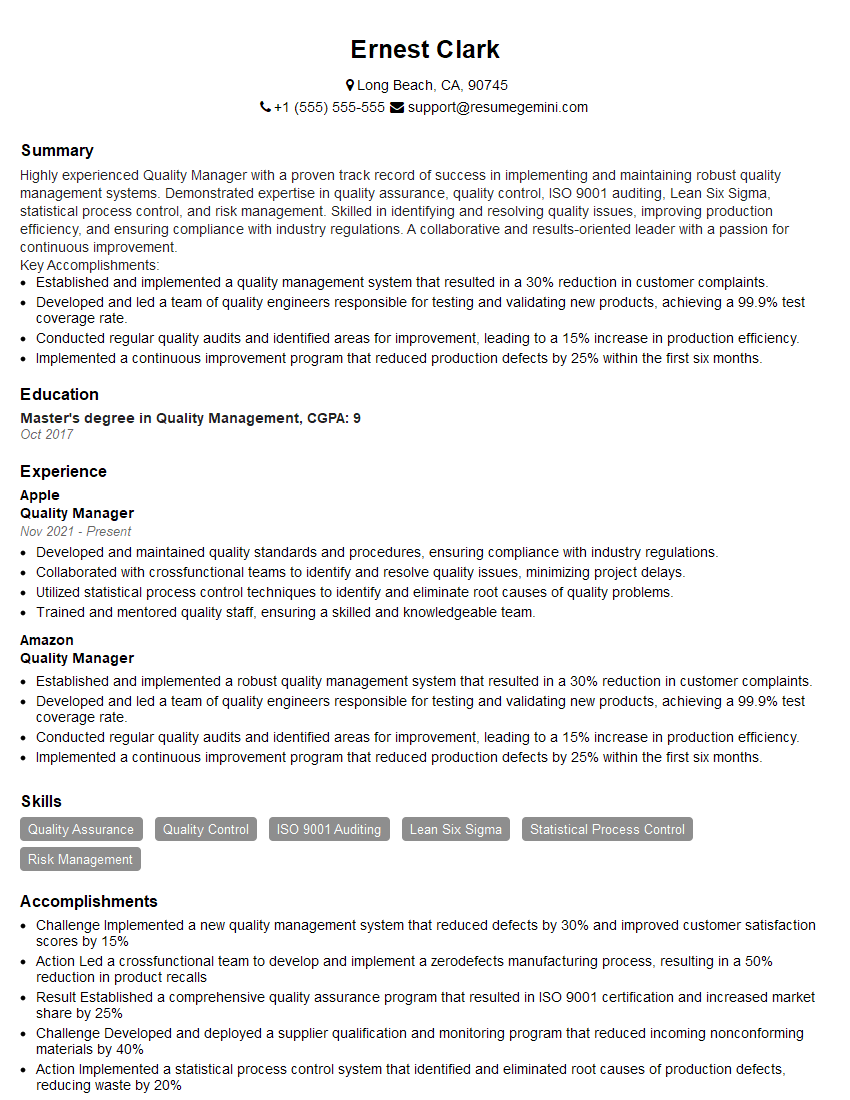
Quality Manager Resume Sample
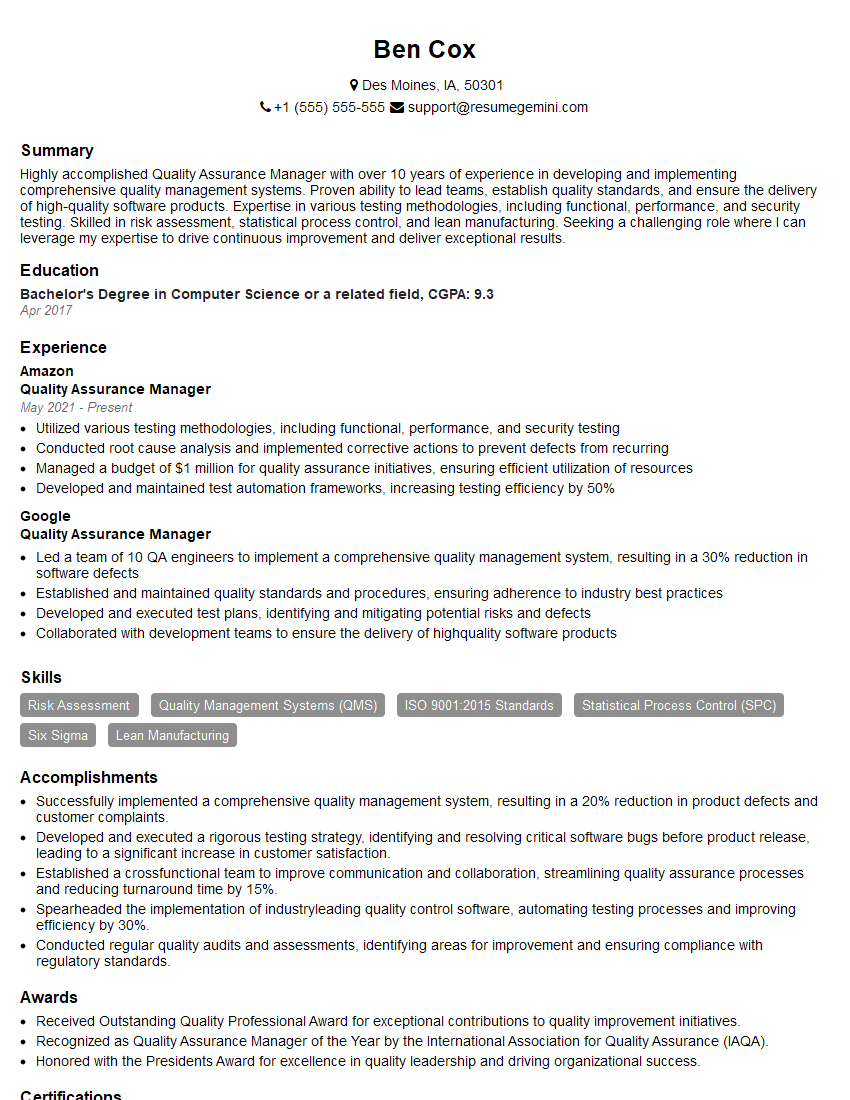
Quality Assurance Manager Resume Sample
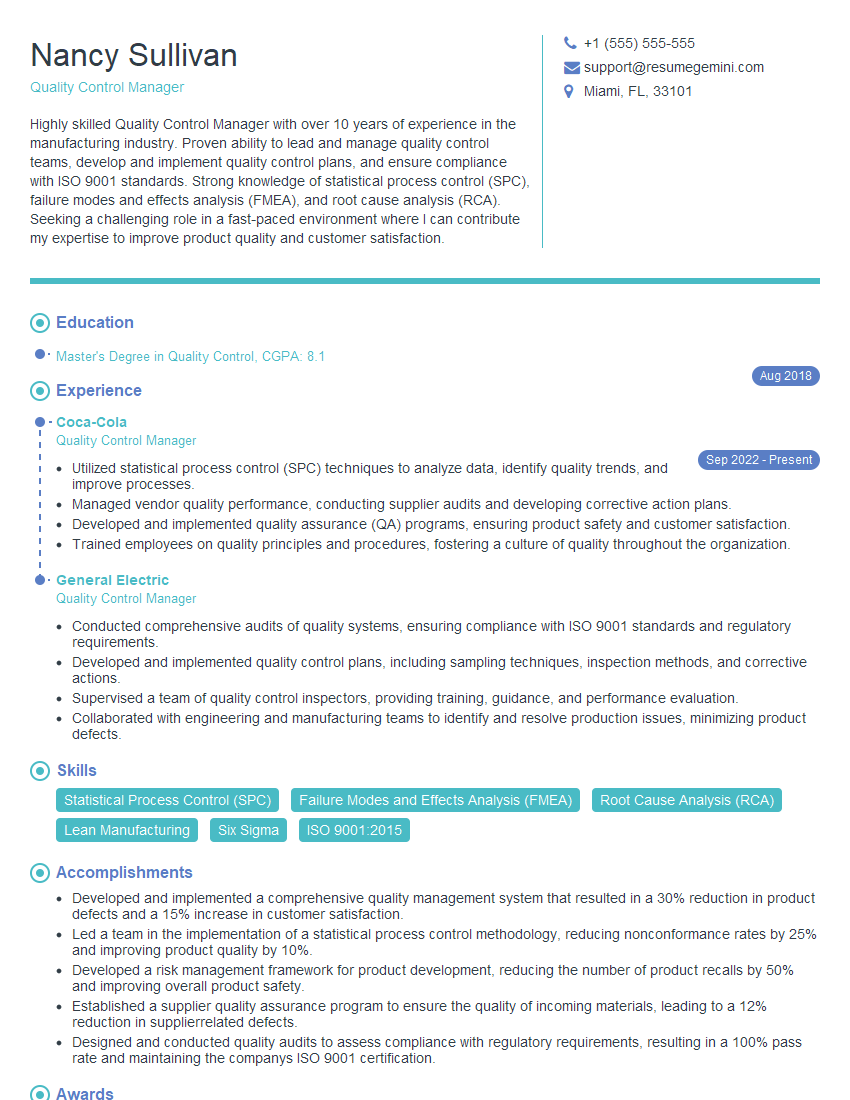
Quality Control Manager Resume Sample
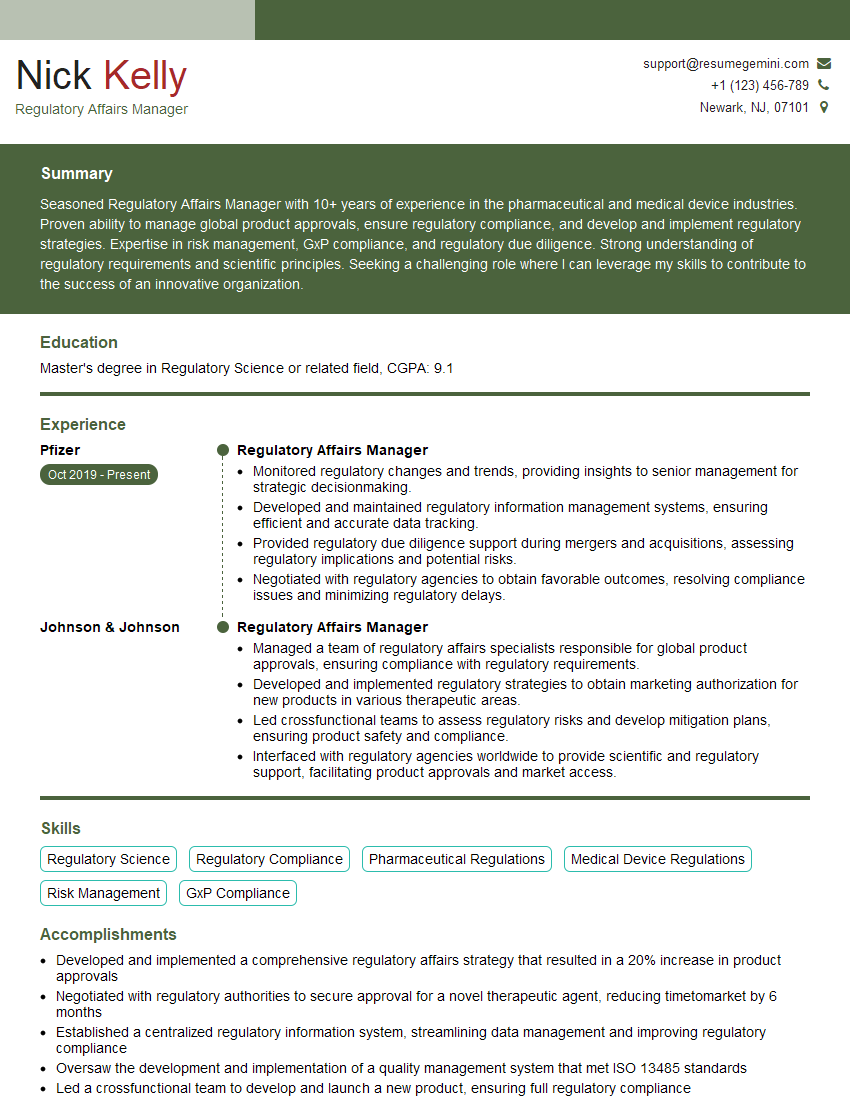
Regulatory Affairs Manager Resume Sample
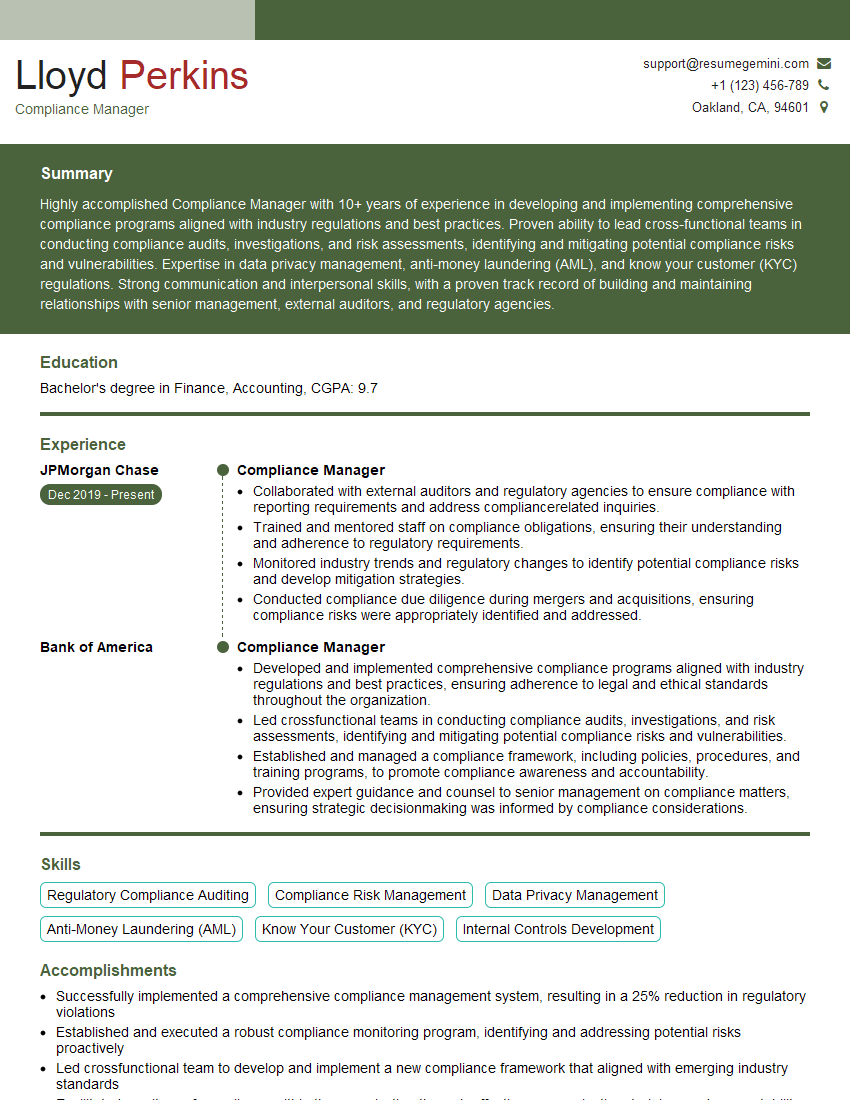
Compliance Manager Resume Sample

Compliance Officer Resume Sample
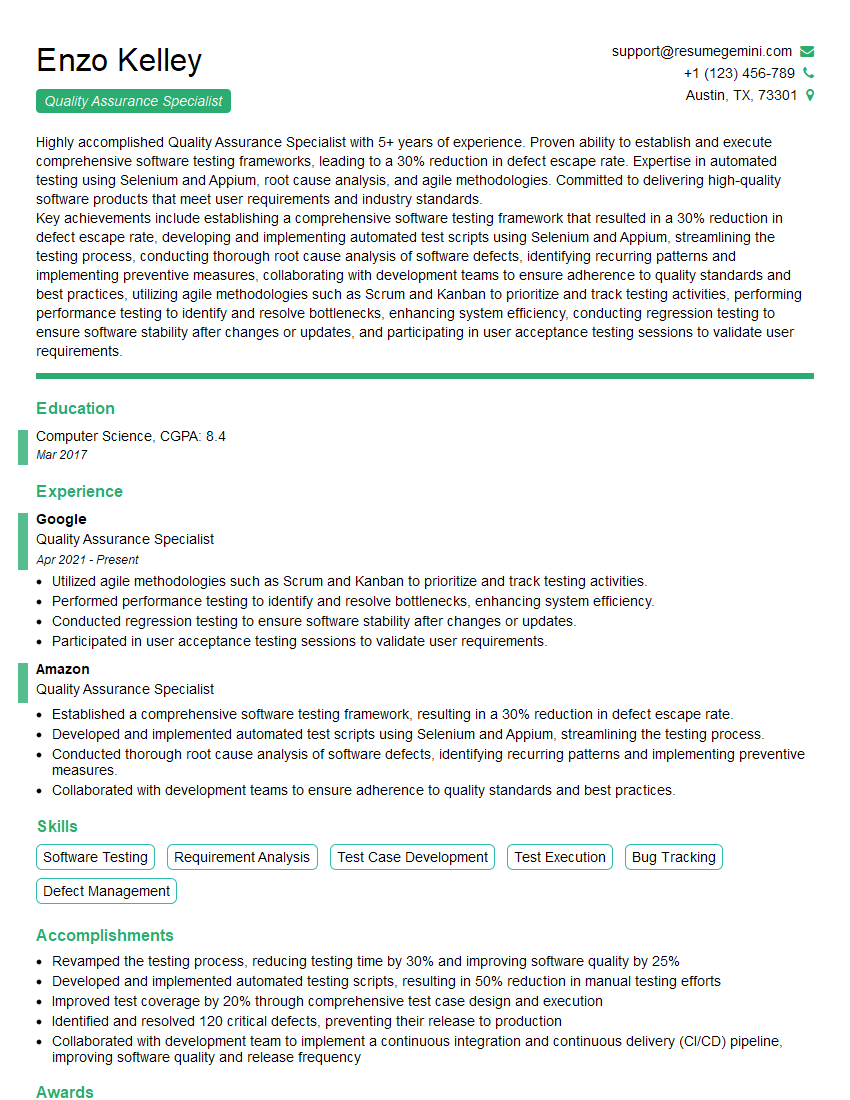
Quality Assurance Specialist Resume Sample
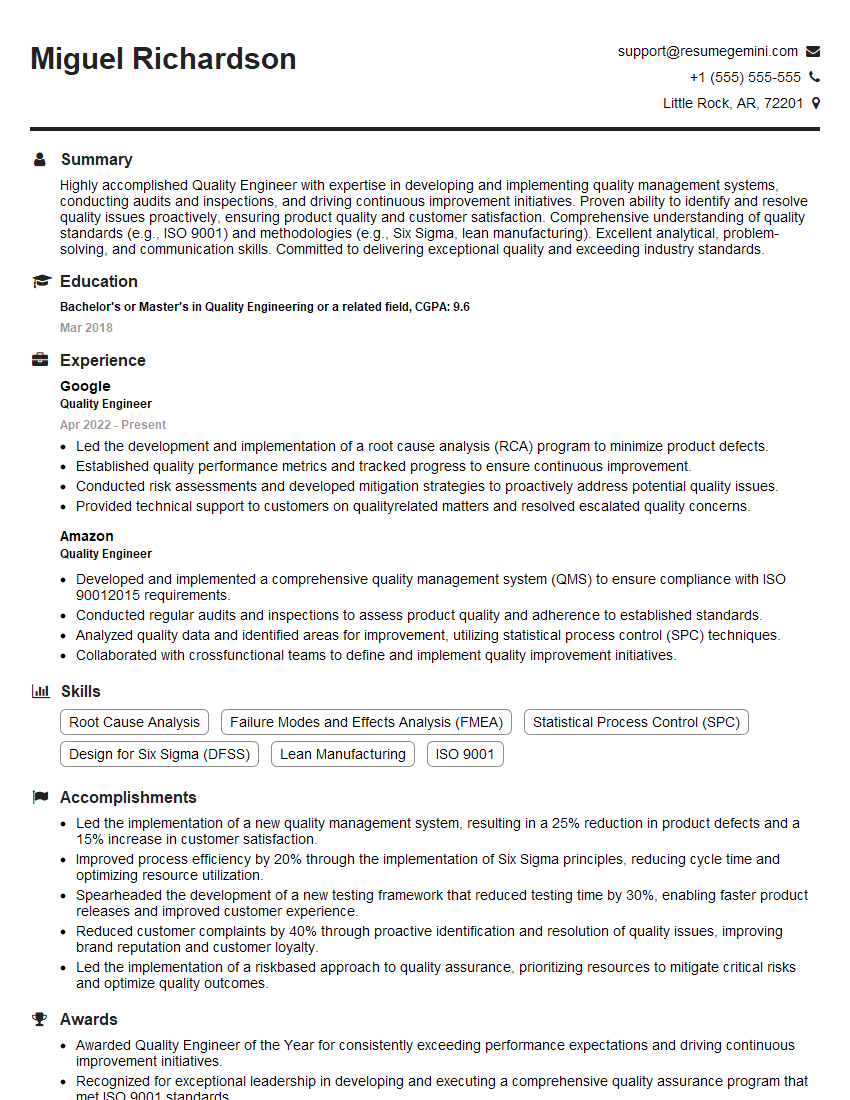
Quality Engineer Resume Sample
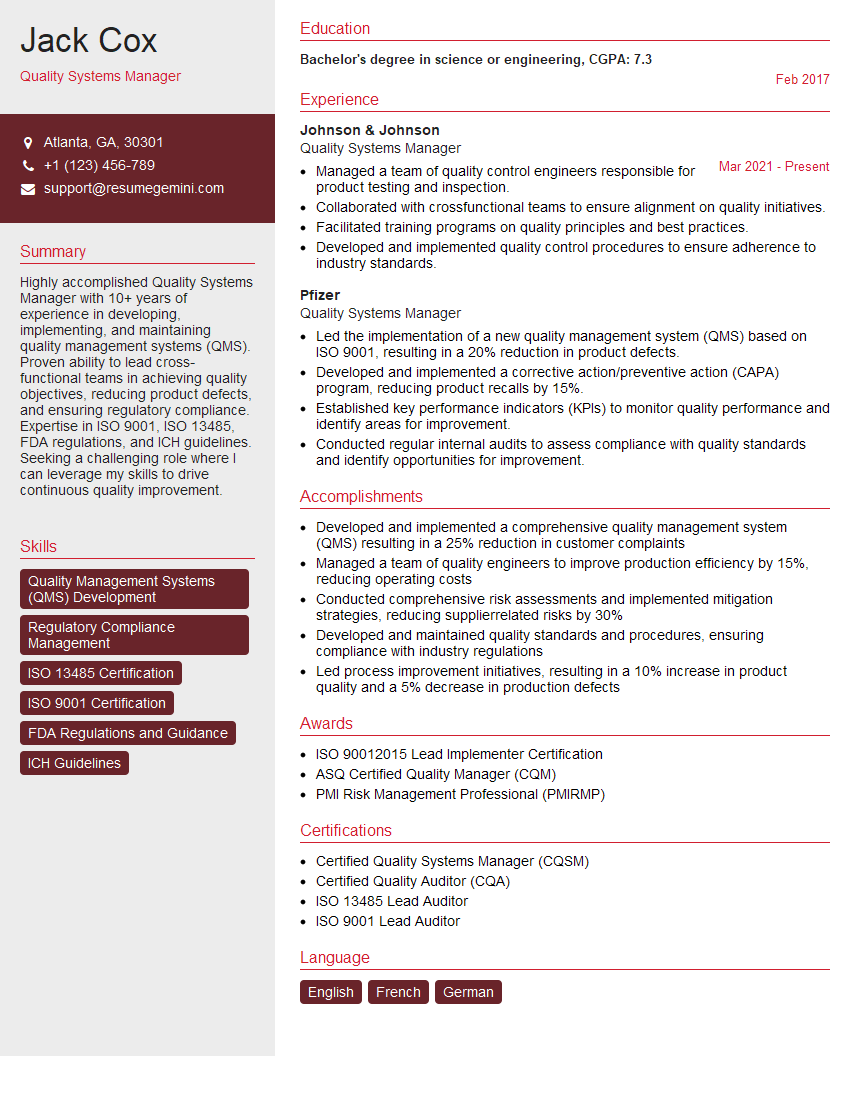
Quality Systems Manager Resume Sample
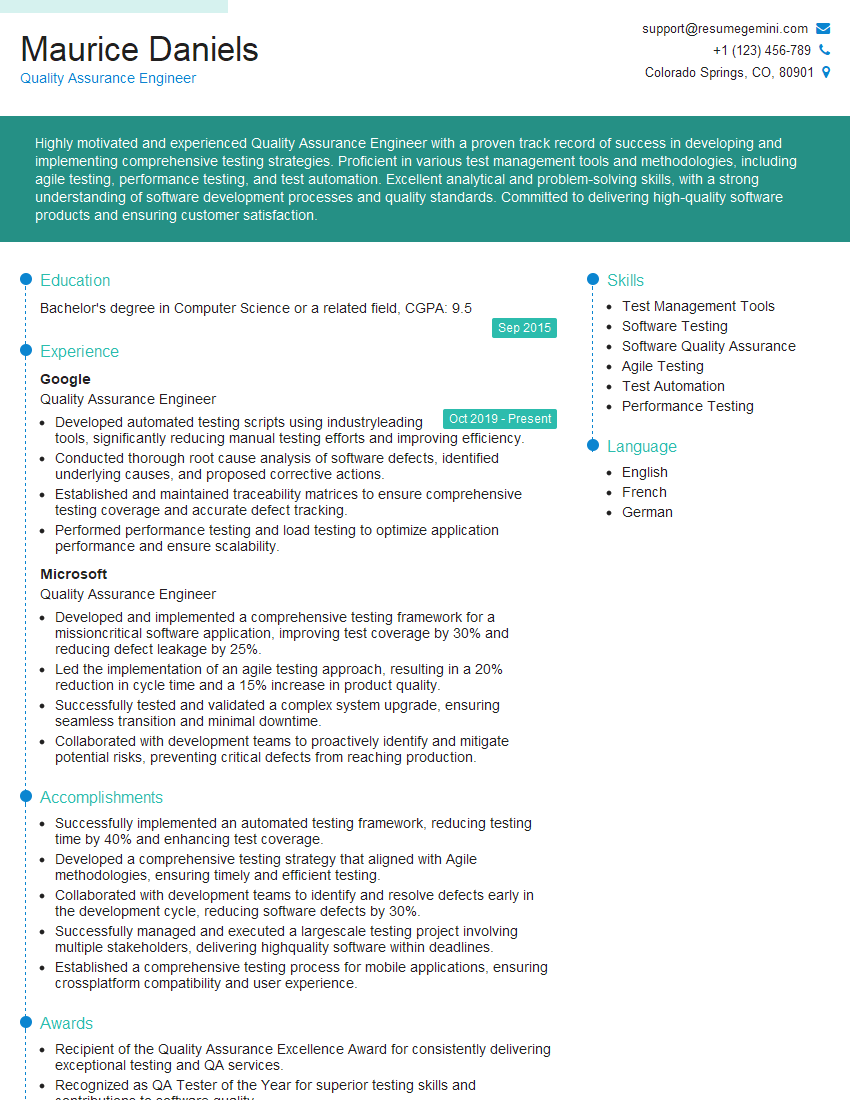
Quality Assurance Engineer Resume Sample
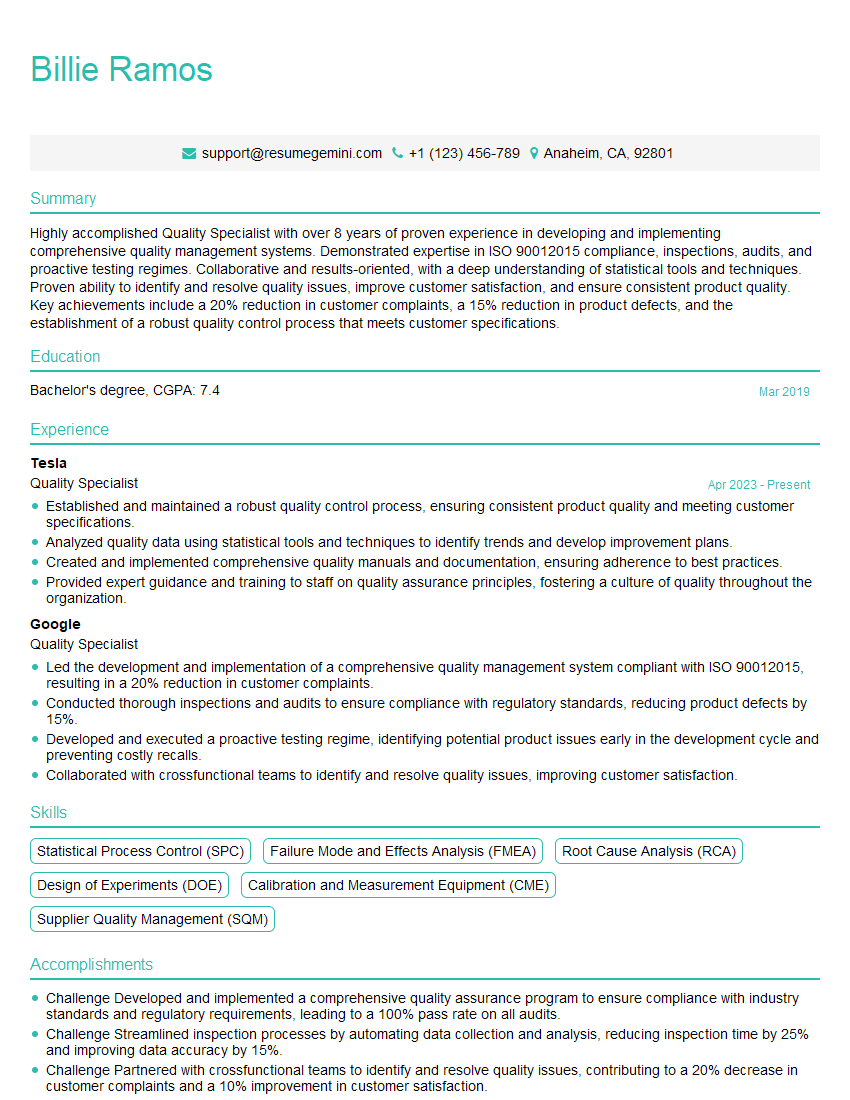
Quality Specialist Resume Sample
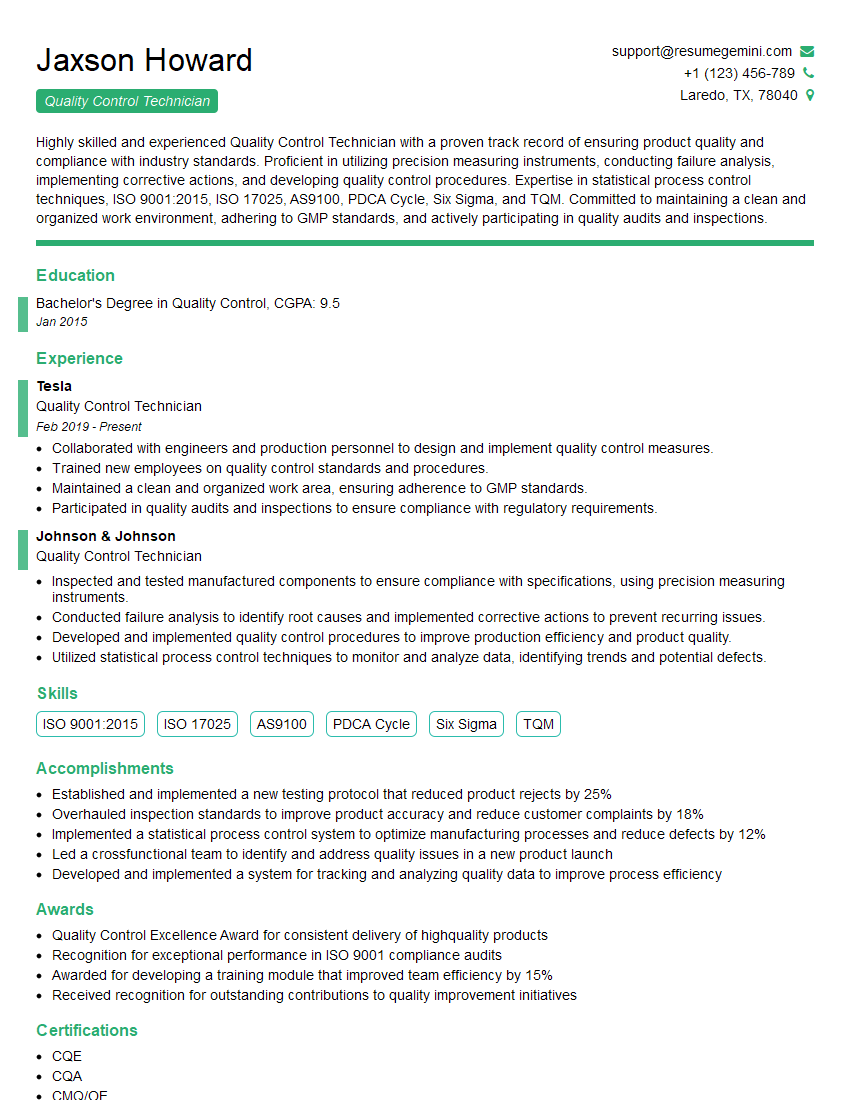
Quality Control Technician Resume Sample
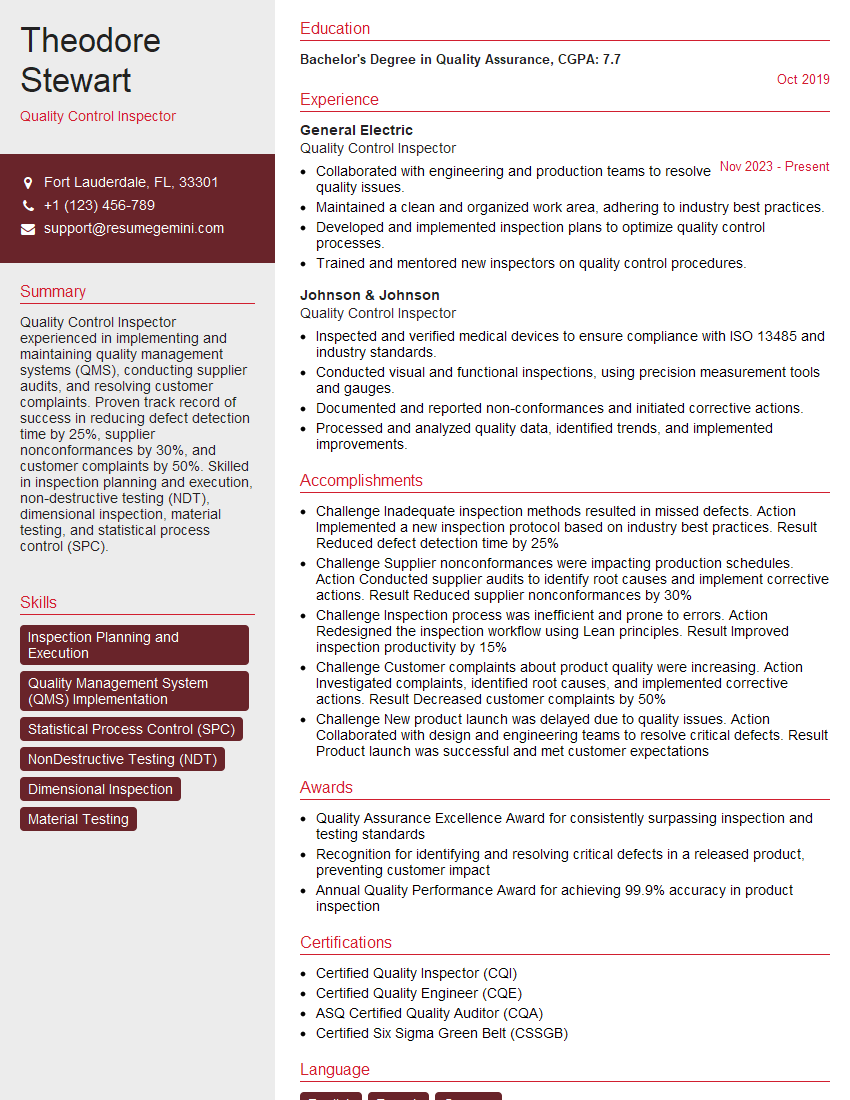
Quality Control Inspector Resume Sample
Explore more articles
Users Rating of Our Blogs
Share Your Experience
We value your feedback! Please rate our content and share your thoughts (optional).
What Readers Say About Our Blog
Very informative content, great job.
good