Every successful interview starts with knowing what to expect. In this blog, we’ll take you through the top ITIL Certified interview questions, breaking them down with expert tips to help you deliver impactful answers. Step into your next interview fully prepared and ready to succeed.
Questions Asked in ITIL Certified Interview
Q 1. Explain the four dimensions of service management in ITIL 4.
ITIL 4 introduces four dimensions of service management that provide a holistic view of how services are delivered and consumed. These dimensions are interconnected and influence each other, offering a broader perspective than previous ITIL versions.
- Organizations: This dimension focuses on the people, culture, and governance within the organization providing and consuming the services. It considers factors like organizational structure, communication styles, and the overall organizational strategy. For example, a highly siloed organization might struggle to deliver integrated services effectively, while a collaborative, cross-functional team excels.
- Information and Technology: This dimension encompasses the technology infrastructure, data, and applications that support the delivery of services. This includes the hardware, software, networks, and databases used. An example is the impact of a cloud migration on the IT infrastructure and its consequent effect on service availability.
- Partners and Suppliers: This dimension recognizes the importance of external relationships and collaborations in service management. It addresses the management of contracts, vendor relationships, and how different organizations collaborate to deliver a comprehensive service. For instance, a telecommunications provider relying on a cloud services provider for network infrastructure is an illustration of this dimension.
- Value Streams and Processes: This dimension focuses on the workflow and processes used to deliver value to customers. It links the other three dimensions and ensures alignment towards achieving business outcomes. An example is optimizing the incident management process to reduce resolution times, directly impacting customer satisfaction (organization) and leveraging IT tools (information and technology) while possibly collaborating with external support partners (partners and suppliers).
Q 2. Describe the key principles of ITIL 4.
ITIL 4’s guiding principles are crucial for effective service management. They provide a framework for decision-making and action. These principles are not rigid rules but rather flexible guidelines to adapt to specific contexts.
- Focus on Value: All activities should directly or indirectly contribute to creating and delivering value to customers.
- Start where you are: Implement changes incrementally, leveraging existing capabilities and processes, rather than trying to overhaul everything at once.
- Progress iteratively with feedback: Continuously improve services based on feedback and measurement.
- Collaborate and promote visibility: Foster strong relationships and communication across teams and organizations.
- Think and work holistically: Consider the interconnectedness of all aspects of service management.
- Keep it simple and practical: Avoid unnecessary complexity and prioritize practical solutions.
- Optimize and automate: Leverage automation to streamline processes and improve efficiency.
- Be data-driven: Use data to make informed decisions and track performance.
- Promote continual improvement: Embrace a culture of continuous learning and enhancement.
Q 3. What is the purpose of the Service Value System (SVS)?
The Service Value System (SVS) is the heart of ITIL 4. It’s a model that describes how all the components of service management work together to create value for customers. It’s not just a set of processes; it’s a holistic framework incorporating governance, practices, and continual improvement.
Its purpose is to guide organizations in designing, building, and delivering valuable services. The SVS helps ensure alignment between IT services and business objectives. It essentially answers the question: ‘How do we translate business needs into effective IT services that deliver value?’
Q 4. Define Value Streams and their importance in ITIL 4.
Value streams in ITIL 4 represent the end-to-end flow of activities required to deliver a specific service or product to a customer. They illustrate the journey from the initial request to the final delivery, encompassing all the steps and interactions involved.
Their importance lies in visualizing and optimizing the entire process of service delivery. By mapping value streams, organizations can identify bottlenecks, inefficiencies, and areas for improvement. For instance, mapping the value stream for onboarding a new employee might reveal delays in IT provisioning, leading to improvements in that specific area. This focus on the complete flow, rather than individual processes, allows for a more holistic and impactful approach to service improvement.
Q 5. Explain the relationship between the Service Value Chain and the SVS.
The Service Value Chain (SVC) and the Service Value System (SVS) are intimately linked within ITIL 4. The SVS is the overarching framework, while the SVC is a crucial component within it. Think of the SVS as the whole car and the SVC as the engine.
The SVC describes the six activities that create and deliver value: Plan, Do, Check, Act, Engage and Improve are the core steps of the SVC. The SVS provides the context and governance for the SVC to operate effectively. It provides the guiding principles, leadership, and resources for the SVC’s execution. In essence, the SVS provides the ‘why’ and the ‘how’ behind the SVC’s activities. The SVC, in turn, helps the SVS achieve its goal of delivering valuable services to customers.
Q 6. How does ITIL 4 address the concept of DevOps?
ITIL 4 explicitly acknowledges and integrates the principles of DevOps. It doesn’t replace DevOps but rather complements it. ITIL 4 emphasizes the importance of collaboration, automation, and continuous improvement, all core tenets of DevOps.
ITIL 4 guides organizations on how to leverage DevOps practices within a broader service management framework. This integration allows organizations to adopt DevOps methodologies while maintaining a robust, structured approach to service delivery. The focus shifts from siloed teams to collaborative teams, improving communication and speeding up the delivery of value.
For example, using ITIL practices for change management alongside DevOps CI/CD pipelines helps ensure that changes are thoroughly tested, approved, and implemented safely while maintaining speed and agility.
Q 7. What is the role of the Service Desk in incident management?
The Service Desk plays a critical role in incident management, acting as the first point of contact for users reporting incidents. They are responsible for logging, categorizing, prioritizing, and resolving or escalating incidents.
Their key responsibilities include:
- Incident logging and recording: Gathering all necessary details about the incident from the user.
- Initial diagnosis and troubleshooting: Attempting to resolve simple incidents using pre-defined solutions or knowledge bases.
- Prioritization and escalation: Determining the urgency and severity of the incident and escalating it to the appropriate technical teams if needed.
- Communication and updates: Keeping users informed about the progress of the incident resolution.
- Incident closure: Ensuring that the incident is properly closed once resolved and verified.
Effectively managing incidents through the Service Desk reduces downtime, improves user satisfaction, and maintains the stability of IT services.
Q 8. Describe the process of incident escalation.
Incident escalation is the process of moving an incident to a higher support level when the initial support team cannot resolve it within a defined timeframe or lacks the necessary expertise. Think of it like a relay race; if one runner can’t complete their leg, they pass the baton to a more experienced runner.
The process typically involves:
- Identification: The initial support team identifies that the incident requires escalation.
- Notification: The higher-level support team is notified of the incident, often through a ticketing system.
- Handover: Relevant information about the incident is transferred to the escalated team, ensuring continuity.
- Resolution: The escalated team works to resolve the incident.
- Communication: Updates are provided to the user and other stakeholders throughout the escalation process.
Example: Imagine a network outage affecting a company’s website. The first-level help desk may troubleshoot basic issues, but if they can’t resolve the problem, they escalate it to the network team, who possesses specialized knowledge to pinpoint and fix the root cause.
Q 9. Explain the difference between a problem and an incident.
While both incidents and problems disrupt services, they differ significantly in their scope and resolution. An incident is an unplanned interruption to an IT service or reduction in the quality of a service. Think of it as an immediate, urgent issue needing immediate attention. A problem, on the other hand, is the underlying cause of one or more incidents. It’s the ‘why’ behind the ‘what’ of an incident.
Incident Example: A server crashing, causing website downtime.
Problem Example: The server crashing repeatedly due to insufficient memory or a faulty power supply. The problem is the underlying root cause that needs to be addressed to prevent recurring incidents.
In essence: An incident is a symptom; a problem is the disease.
Q 10. How does problem management contribute to reducing incidents?
Problem management plays a crucial role in reducing incidents by proactively identifying and resolving the underlying causes of service disruptions. Instead of constantly putting out fires (incidents), problem management prevents the fires from starting in the first place.
This is achieved through:
- Root Cause Analysis (RCA): Investigating incidents to identify their root causes.
- Problem Identification and Recording: Documenting recurring incidents to identify potential problems.
- Workarounds and Preventative Actions: Implementing temporary fixes and permanent solutions to prevent future incidents.
- Knowledge Management: Sharing knowledge gained from problem resolution to prevent similar issues.
Example: If multiple users report slow application performance (incidents), problem management investigates, discovering a bottleneck in the database server (problem). Solving the database issue prevents further slowdowns (incidents).
Q 11. Describe the change management process, including its stages.
Change management is a structured approach to implementing changes within an IT environment to minimize disruptions and ensure stability. It’s like a carefully planned construction project, ensuring that all necessary steps are taken to build something reliable and functional.
The stages typically include:
- Identification: Identifying the need for a change.
- Proposal: Documenting the proposed change, including its impact and risks.
- Authorization: Obtaining approval from the Change Advisory Board (CAB).
- Planning: Developing a detailed plan for implementing the change.
- Implementation: Executing the change plan.
- Verification: Testing and validating the change.
- Closure: Formally documenting the change and its outcome.
Example: Implementing a new software update requires a change management process to ensure minimal disruption to users.
Q 12. What is the purpose of a Change Advisory Board (CAB)?
The Change Advisory Board (CAB) is a group of stakeholders responsible for reviewing and approving or rejecting proposed changes. They act as a gatekeeper, ensuring that only well-planned and low-risk changes are implemented.
The CAB’s purpose is to:
- Assess risk: Evaluating the potential impact of changes on the IT infrastructure and business operations.
- Prioritize changes: Deciding which changes are most important and should be implemented first.
- Ensure compliance: Making sure changes adhere to established policies and procedures.
- Reduce disruption: Minimizing the risk of unplanned outages or service disruptions.
Example: A CAB might reject a proposed change if it lacks a detailed rollback plan or poses a significant risk to production systems.
Q 13. Explain the importance of risk assessment in change management.
Risk assessment is a critical part of change management, helping to identify and mitigate potential negative impacts of a change. It’s like conducting a pre-flight check on an airplane before takeoff, ensuring everything is functioning properly and potential issues are addressed.
A thorough risk assessment considers factors like:
- Impact: The potential consequences of the change if it fails.
- Likelihood: The probability of the change failing.
- Mitigations: Steps to reduce the risk and its impact.
By identifying risks beforehand, organizations can develop mitigation plans to minimize disruptions and prevent costly downtime. This might involve testing thoroughly, creating rollback plans, and having backup systems in place.
Example: Implementing a major software upgrade carries a higher risk than a minor configuration change. A thorough risk assessment would identify potential issues like data loss and develop strategies to prevent them.
Q 14. What are the key components of a service level agreement (SLA)?
A Service Level Agreement (SLA) is a formal contract between a service provider and a customer defining the expected level of service. It’s a promise detailing what service the customer will receive and the provider’s obligations.
Key components include:
- Service Definition: Clearly specifying the services covered by the SLA.
- Service Level Targets: Defining measurable targets for service performance (e.g., uptime, response time).
- Metrics: How service performance will be measured (e.g., average resolution time, customer satisfaction).
- Reporting: How performance against the targets will be reported.
- Penalties: Consequences for failing to meet the agreed-upon targets (optional).
- Escalation Procedures: How issues will be escalated if targets aren’t met.
Example: An SLA might state that a help desk will respond to user calls within 15 minutes, 98% of website uptime, with monthly reports to the customer on performance.
Q 15. How do you measure service level performance?
Measuring service level performance involves tracking key metrics defined in Service Level Agreements (SLAs) to determine how well IT services meet agreed-upon targets. This isn’t just about ticking boxes; it’s about understanding if the services are truly meeting the needs of the business. We look at both quantitative and qualitative data.
Quantitative Metrics: These are measurable, numerical values. Examples include:
- Availability: The percentage of time a service is operational (e.g., 99.9% uptime).
- Mean Time To Resolution (MTTR): The average time it takes to resolve an incident.
- Mean Time Between Failures (MTBF): The average time between service disruptions.
- Customer Satisfaction (CSAT): Measured through surveys or feedback forms, quantifying user happiness.
Qualitative Metrics: These assess subjective aspects of service quality. Examples include:
- User Feedback: Gathering qualitative insights on user experience and service perception.
- Incident root cause analysis: Understanding why incidents occur to prevent recurrence.
Example: Imagine an SLA guaranteeing 99.9% uptime for email service. We’d monitor uptime, track outages, and calculate the percentage of time the service was available. If it consistently falls below 99.9%, it indicates a need for improvement and might require a deeper investigation into the root cause of downtime.
Career Expert Tips:
- Ace those interviews! Prepare effectively by reviewing the Top 50 Most Common Interview Questions on ResumeGemini.
- Navigate your job search with confidence! Explore a wide range of Career Tips on ResumeGemini. Learn about common challenges and recommendations to overcome them.
- Craft the perfect resume! Master the Art of Resume Writing with ResumeGemini’s guide. Showcase your unique qualifications and achievements effectively.
- Don’t miss out on holiday savings! Build your dream resume with ResumeGemini’s ATS optimized templates.
Q 16. Describe the process of capacity management.
Capacity management is the process of ensuring that IT infrastructure has sufficient resources (processing power, storage, bandwidth, etc.) to meet current and future business demands. It’s a proactive approach that avoids performance bottlenecks and service disruptions.
The process typically involves these key steps:
- Capacity Planning: Forecasting future resource needs based on business growth, new applications, and technological advancements.
- Capacity Modeling: Creating simulations to test different scenarios and optimize resource allocation.
- Performance Monitoring: Continuously tracking the performance of IT systems to identify potential bottlenecks or areas for improvement. Tools like Nagios or Zabbix are frequently used.
- Capacity Optimization: Identifying and implementing ways to improve resource utilization, such as upgrading hardware, optimizing software, or consolidating systems.
- Capacity Provisioning: Providing the necessary resources to meet the demands of IT services.
Example: A company anticipates a significant increase in website traffic during its holiday sales. Capacity management would involve forecasting the expected traffic, analyzing server performance, and ensuring enough server capacity is available to handle the peak load without impacting user experience. This might involve scaling up server resources temporarily or implementing load balancing techniques.
Q 17. What are the key performance indicators (KPIs) for capacity management?
Key Performance Indicators (KPIs) for capacity management provide a quantifiable measure of its effectiveness. These KPIs help identify areas needing attention and demonstrate the value of capacity management efforts.
- Resource Utilization: Percentage of resources (CPU, memory, disk space, network bandwidth) currently in use. High utilization suggests potential bottlenecks, while very low utilization might indicate over-provisioning.
- Number of capacity incidents: Track incidents related to capacity issues to identify trends and areas for improvement.
- Average response time: Measures the speed of application and system response to user requests.
- Mean Time To Repair (MTTR): The average time it takes to resolve capacity-related incidents.
- Storage utilization: Tracks the amount of storage used versus available storage.
- Application performance metrics: KPIs specific to applications, like transaction throughput or error rates.
Example: If the CPU utilization consistently exceeds 85%, it signals a potential capacity issue requiring attention. The capacity manager might then investigate the cause (e.g., a poorly performing application) and implement solutions (e.g., upgrading hardware, optimizing the application).
Q 18. Explain the importance of configuration management.
Configuration management (CMDB) is a crucial ITIL process that involves identifying, controlling, and managing all IT assets (hardware, software, network devices, etc.) and their relationships. Think of it as a comprehensive inventory and detailed blueprint of your IT infrastructure. A well-managed CMDB is the single source of truth for all IT assets.
Its importance stems from:
- Improved Service Delivery: Accurate configuration data ensures faster service deployments, updates, and changes.
- Reduced Risk: A complete inventory helps identify vulnerabilities and manage risk more effectively.
- Enhanced Incident Management: Rapid identification of affected components during incidents allows for quicker resolution.
- Better Change Management: CMDB aids in assessing the impact of changes before implementation.
- Cost Optimization: Identifying underutilized or redundant assets facilitates cost savings.
Example: Imagine a network outage. A properly maintained CMDB would quickly reveal which switches, routers, and other network devices are affected, enabling engineers to focus their troubleshooting efforts and minimize downtime.
Q 19. How does configuration management contribute to incident resolution?
Configuration management significantly contributes to faster and more effective incident resolution. By providing a clear picture of the IT infrastructure, it facilitates faster identification of the root cause of incidents and minimizes the time to resolution.
Here’s how:
- Rapid Identification of Affected Components: The CMDB quickly pinpoints the affected components, streamlining diagnostics.
- Faster Troubleshooting: Knowing the relationships between components helps isolate the problem more quickly.
- Reduced Downtime: Speedier identification and resolution translates to less downtime and improved service availability.
- Improved Root Cause Analysis: Understanding the configuration allows for more thorough root cause analysis, reducing the likelihood of recurrence.
- Better Communication: A shared CMDB ensures everyone involved in incident resolution has access to the same information.
Example: If a server crashes, the CMDB shows which applications run on that server, which databases it accesses, and the network connections it utilizes. This information significantly accelerates troubleshooting and reduces the time needed to restore service.
Q 20. Describe the process of continuous improvement in ITIL.
Continuous improvement in ITIL, often referred to as the Continual Service Improvement (CSI) process, is an iterative cycle aimed at constantly enhancing IT service quality, efficiency, and effectiveness. It’s about learning from experience and striving for better outcomes. This isn’t a one-time project; it’s an ongoing commitment.
The process typically involves these steps:
- Identify Opportunities for Improvement: Using various methods like service reviews, incident reports, and user feedback to identify areas needing improvement.
- Prioritize Improvement Areas: Focusing on the most critical and impactful areas based on business value and risk.
- Develop and Implement Solutions: Designing and implementing changes to address identified issues.
- Monitor and Measure Results: Tracking the effectiveness of implemented changes to ensure they achieve the desired outcomes.
- Review and Adapt: Regularly reviewing the improvement process itself to identify areas for optimization.
Example: A company notices a high number of incidents related to a specific application. Through CSI, they might analyze incident logs, gather user feedback, and implement solutions like application performance monitoring, improved training, or a software upgrade. The results are then measured to verify improvements in application stability and user satisfaction. The process then continues with ongoing monitoring and further refinements.
Q 21. What are the key benefits of adopting ITIL?
Adopting ITIL offers many benefits, contributing significantly to a more efficient and effective IT organization. These benefits span multiple areas:
- Improved Service Quality: ITIL provides a framework for delivering services that meet or exceed business expectations.
- Increased Efficiency: Standardized processes and best practices lead to streamlined workflows and reduced waste.
- Reduced Costs: Optimizing service delivery and resource allocation leads to significant cost savings.
- Enhanced Customer Satisfaction: Improved service quality and responsiveness result in happier customers.
- Better Risk Management: Proactive approaches to capacity management and change management mitigate risks and minimize disruptions.
- Improved Alignment with Business Goals: ITIL helps align IT services with business objectives, ensuring that IT supports the overall business strategy.
- Increased Transparency and Accountability: Clearly defined roles, responsibilities, and processes enhance transparency and accountability.
Example: A company experiencing frequent outages and frustrated users implemented ITIL best practices. This led to improved incident management, better proactive capacity planning, and more reliable services, resulting in increased customer satisfaction and reduced business disruption.
Q 22. What are some common challenges in implementing ITIL?
Implementing ITIL, while offering significant benefits, often faces hurdles. These challenges can be broadly categorized into organizational, technical, and cultural aspects.
- Resistance to Change: People are often comfortable with existing processes, even if inefficient. Introducing ITIL requires buy-in from all levels, necessitating clear communication and training to demonstrate the value proposition.
- Lack of Management Support: ITIL implementation requires significant resources – time, budget, and skilled personnel. Without strong leadership support, the initiative can easily stall or fail.
- Insufficient Training and Skill Gaps: ITIL requires specialized knowledge and skills across the organization. Inadequate training can lead to poor implementation and failure to realize the benefits.
- Integration Challenges: Integrating ITIL with existing tools, systems, and processes can be complex and time-consuming. Careful planning and phased implementation are crucial.
- Defining Clear Metrics: Measuring the success of an ITIL implementation requires establishing clear, measurable, achievable, relevant, and time-bound (SMART) goals and metrics from the outset. Without these, demonstrating ROI can be difficult.
- Tooling and Automation: Selecting and implementing the right tools to support ITIL processes is essential but can be a significant undertaking. Poor tool selection can create more problems than it solves.
For example, I once worked on an ITIL implementation where the lack of management buy-in led to insufficient resource allocation, delaying the project and ultimately impacting its effectiveness. We overcame this by demonstrating the potential cost savings and service improvements through a pilot project, gaining crucial support from senior management.
Q 23. How would you handle a high-priority incident?
Handling a high-priority incident requires immediate action and a structured approach. My process typically follows these steps:
- Acknowledgement and Impact Assessment: Immediately acknowledge the incident and quickly assess its impact on business operations. This includes understanding the affected users, systems, and services.
- Prioritization and Escalation: Based on the impact assessment, prioritize the incident and escalate it to the appropriate management level if necessary. Use established escalation procedures to ensure timely resolution.
- Incident Investigation and Diagnosis: Use available tools and information to diagnose the root cause of the incident quickly. This might involve reviewing logs, collaborating with other teams, or contacting vendors.
- Resolution and Recovery: Implement the appropriate solution to resolve the incident. This could involve temporary workarounds, configuration changes, or code fixes. Ensure comprehensive documentation of the resolution steps.
- Post-Incident Review: After the incident is resolved, conduct a thorough post-incident review to identify the root cause, analyze the response, and determine preventive measures to avoid similar incidents in the future. This often involves documenting lessons learned and implementing changes to processes or systems.
For instance, imagine a server outage affecting a critical online sales system. I would immediately acknowledge the incident, assess the financial impact of downtime, escalate it to management, and engage the necessary technical teams for diagnosis and resolution. Parallel communication to affected users and stakeholders would be critical to keep them informed.
Q 24. How do you prioritize multiple incidents?
Prioritizing multiple incidents requires a systematic approach. I typically use a combination of factors, often encapsulated within an incident prioritization matrix:
- Impact: The severity of the impact on business operations. A critical system failure impacting revenue will have higher priority than a minor issue affecting a less critical system.
- Urgency: How quickly the incident needs to be resolved. An incident that threatens business continuity requires immediate attention.
- Business Priority: The business value of the affected system or service. Critical applications supporting core business functions will be prioritized over less critical applications.
These factors are often assigned numerical weights, allowing for a quantitative assessment. For example, a system outage affecting a critical customer-facing application might score high on all three factors, warranting immediate attention. A minor issue with a reporting tool might score lower, allowing for delayed resolution. Tools and frameworks exist that can help automate and streamline this prioritization process.
Q 25. How do you resolve conflicts between different stakeholders?
Resolving stakeholder conflicts requires strong communication, negotiation, and diplomacy. My approach generally involves:
- Understanding the Perspectives: Actively listen to each stakeholder’s concerns and perspectives, seeking to understand their needs and priorities. Avoid interrupting and ensure everyone feels heard.
- Identifying Common Ground: Find areas of agreement among stakeholders. Highlight shared goals and objectives to build consensus.
- Facilitating Negotiation: Guide stakeholders through a negotiation process, helping them find mutually acceptable solutions. Employ conflict resolution techniques such as compromise and collaboration.
- Mediation and Escalation: If necessary, mediate the conflict or escalate it to a higher authority for resolution. Document all agreements and decisions.
- Follow-up and Communication: After reaching a resolution, follow up with stakeholders to ensure they are satisfied and to address any remaining concerns. Maintain open communication throughout the process.
In one instance, I facilitated a meeting between the development and operations teams who had conflicting priorities regarding a software release. By emphasizing the common goal of delivering high-quality software to customers, I helped them reach a compromise that satisfied both teams’ concerns.
Q 26. Describe your experience with ITIL frameworks.
My experience with ITIL frameworks spans several years, including roles in IT service management, incident management, and problem management. I’ve been involved in the full ITIL lifecycle, from service strategy to continual service improvement. I have practical experience in implementing and improving ITIL processes within diverse organizational settings, focusing on aligning IT services with business needs.
I have actively participated in various ITIL-based projects, including the implementation of incident and problem management systems, service level agreements (SLAs), and knowledge management systems. I’ve used ITIL to streamline processes, improve service quality, and reduce operational costs. My work has involved developing and implementing metrics to track and measure the effectiveness of IT services, leading to continuous improvement initiatives.
Q 27. What ITIL certifications do you hold?
I hold an ITIL 4 Foundation certification and an ITIL 4 Managing Professional certification. These certifications demonstrate my comprehensive understanding of the ITIL framework and its practical application in managing IT services.
Q 28. How would you measure the success of an ITIL implementation?
Measuring the success of an ITIL implementation requires a multi-faceted approach. Key metrics might include:
- Improved Service Availability: Track metrics like Mean Time To Resolution (MTTR) and Mean Time Between Failures (MTBF) to assess the reliability of IT services.
- Enhanced Service Quality: Measure customer satisfaction through surveys and feedback mechanisms. Track metrics like customer satisfaction (CSAT) and Net Promoter Score (NPS).
- Reduced Operational Costs: Analyze costs associated with IT service delivery, identifying areas for improvement and cost reduction.
- Improved Efficiency: Track metrics such as incident resolution time and first-call resolution rate to assess the efficiency of IT service delivery.
- Increased Business Agility: Assess the ability of IT to respond to changing business needs and demands. This could involve metrics around the speed of service provisioning and change implementation.
- Adherence to SLAs: Monitor the percentage of SLAs being met, identifying areas for improvement.
These metrics should be tracked and analyzed regularly, enabling continuous improvement of the ITIL implementation. It’s crucial to link these metrics back to the initial business goals established for the ITIL implementation to demonstrate a clear return on investment.
Key Topics to Learn for ITIL Certified Interview
- ITIL Service Lifecycle: Understand the five stages (Service Strategy, Service Design, Service Transition, Service Operation, and Continual Service Improvement) and their interdependencies. Be prepared to discuss practical examples of how each stage contributes to overall service management.
- Incident Management: Know the key processes involved in resolving incidents quickly and efficiently. This includes understanding incident prioritization, escalation, and the importance of root cause analysis. Be ready to discuss your experience (or hypothetical scenarios) with handling critical incidents.
- Problem Management: Explain the difference between incident and problem management and how they work together. Discuss the importance of proactive problem identification and prevention. Be prepared to explain your approach to root cause analysis and problem resolution.
- Change Management: Understand the process of managing changes to IT services to minimize disruption. Discuss the importance of risk assessment, authorization, and implementation. Be ready to explain your experience with different change management methodologies.
- Service Level Management: Explain how service level agreements (SLAs) are defined, monitored, and reported. Discuss the importance of aligning SLAs with business needs and measuring performance against those agreements. Be prepared to discuss metrics and reporting.
- Release and Deployment Management: Understand the processes involved in planning, building, testing, and releasing new services or updates to existing services. Discuss strategies for minimizing disruption during deployments.
- Continual Service Improvement (CSI): Explain the importance of ongoing improvement in IT service management. Discuss different improvement methodologies (e.g., Lean, Six Sigma) and their application within the ITIL framework. Be prepared to discuss how you would identify areas for improvement and implement changes.
Next Steps
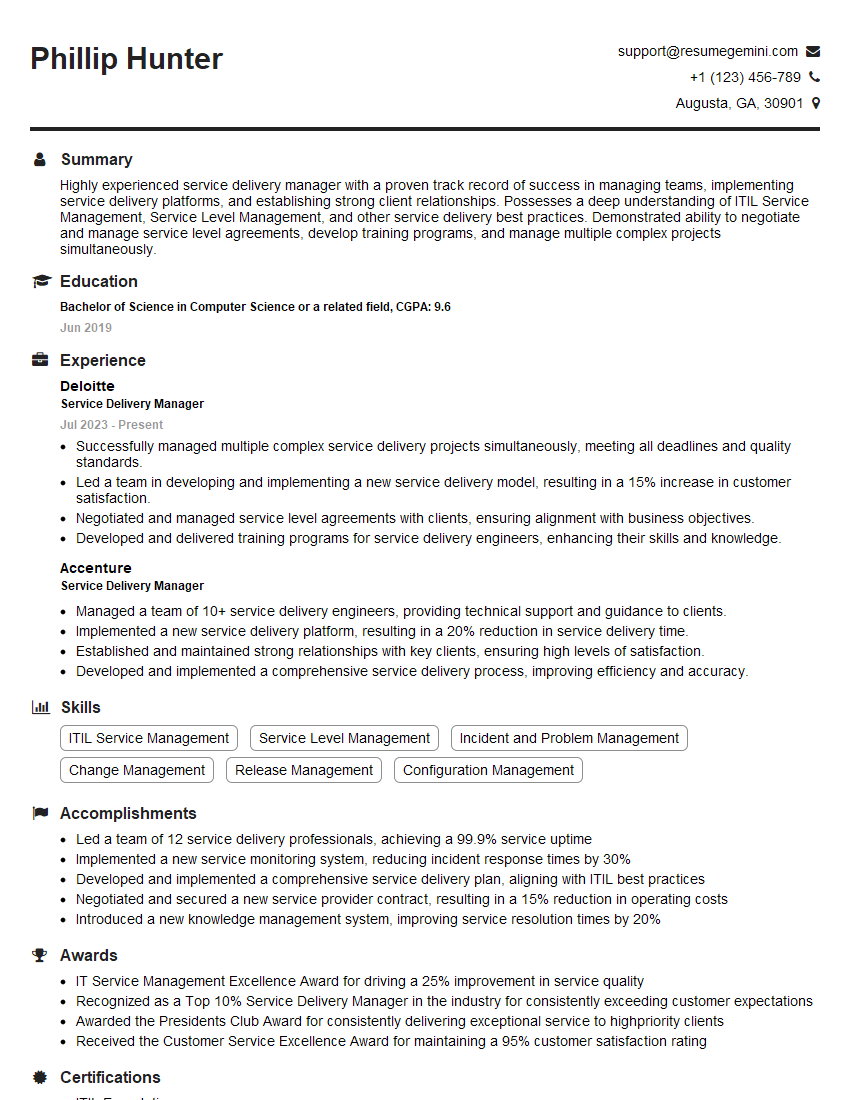
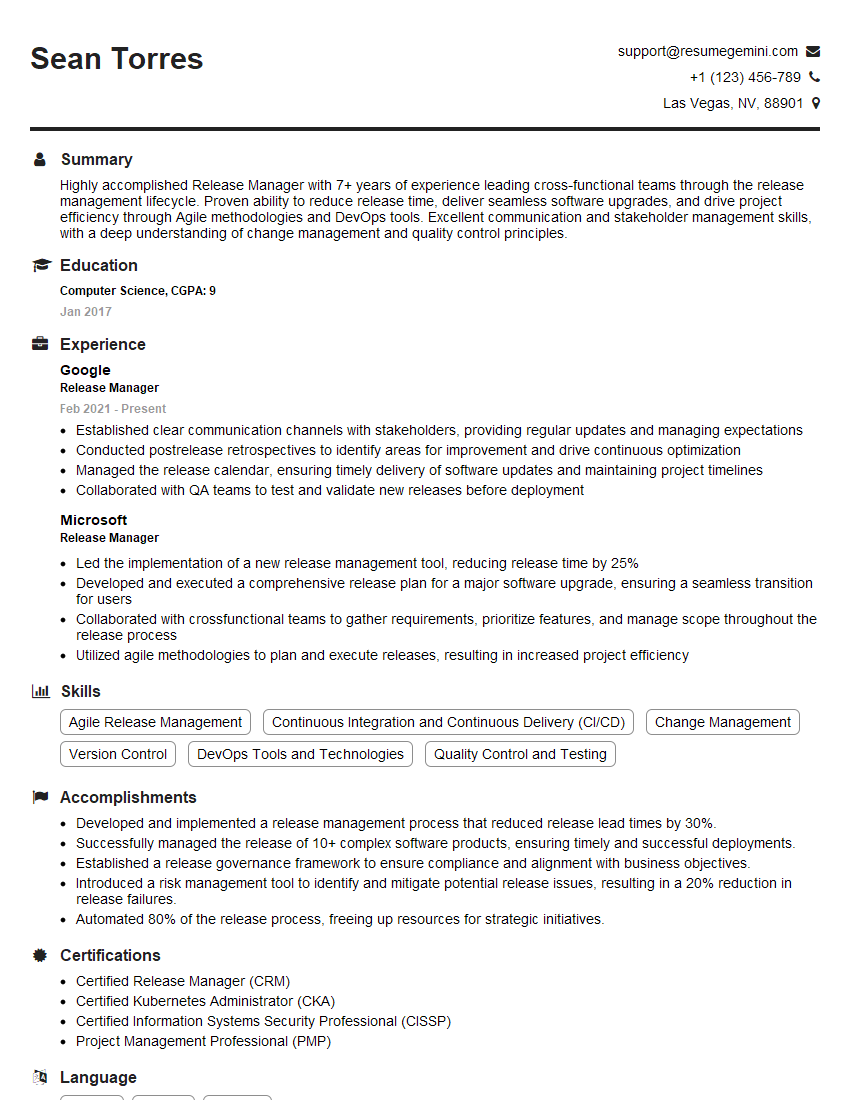
Mastering ITIL Certified significantly enhances your career prospects in IT service management, opening doors to more senior roles and higher earning potential. A well-crafted, ATS-friendly resume is crucial for getting your application noticed by recruiters. To maximize your chances, leverage the power of ResumeGemini to build a professional and impactful resume that highlights your ITIL knowledge and experience. ResumeGemini provides examples of resumes tailored to ITIL Certified professionals, giving you a head start in creating a compelling document that showcases your skills effectively.

Explore more articles
Users Rating of Our Blogs
Share Your Experience
We value your feedback! Please rate our content and share your thoughts (optional).
What Readers Say About Our Blog
Very informative content, great job.
good