Interviews are opportunities to demonstrate your expertise, and this guide is here to help you shine. Explore the essential Jewelry and Accessories Creation interview questions that employers frequently ask, paired with strategies for crafting responses that set you apart from the competition.
Questions Asked in Jewelry and Accessories Creation Interview
Q 1. Describe your experience with various jewelry-making techniques (e.g., casting, soldering, setting stones).
My experience in jewelry making encompasses a wide range of techniques, each crucial for creating different styles and effects. Casting, for example, allows me to create intricate designs that would be impossible to hand-forge. I’m proficient in both lost-wax casting, where a wax model is used to create a mold, and investment casting, offering greater precision and scalability. Soldering, a fundamental skill, is essential for joining different metal components, requiring a steady hand and precise control of heat to avoid damaging the piece. I’ve mastered various soldering techniques, from simple butt joints to more complex filigree work. Finally, stone setting is a delicate art that I’ve honed over years. I’m adept at various settings, including bezel setting, prong setting, channel setting, and pave setting, each requiring a unique approach to securely hold the gemstone while maximizing its brilliance.
For example, I recently completed a commission for a pair of earrings featuring intricate floral motifs. The design required lost-wax casting for the intricate details and then soldering to assemble the different components before carefully setting tiny, sparkling diamonds using pave setting for a dazzling effect. The entire process demanded precision and a deep understanding of all three techniques.
Q 2. What CAD software are you proficient in for jewelry design?
I’m highly proficient in several leading CAD software packages for jewelry design, including Rhino with the JewelSmith plugin, Matrix, and 3DMax. Rhino/JewelSmith is my go-to for its intuitive interface and powerful tools for creating organic and complex shapes. Matrix is excellent for its rendering capabilities and ease of use when dealing with intricate stone settings. My proficiency in these programs allows me to translate conceptual designs into highly detailed 3D models, which are then used to create precise molds for casting or to guide the fabrication process directly. I use them to explore design possibilities, refine details, and ensure structural integrity before any physical work begins.
For instance, when designing a custom engagement ring, I’ll initially sketch out the concept. Then I translate that sketch into a 3D model in Rhino, meticulously crafting each detail – from the band’s profile to the precise placement and size of the central gemstone. The software allows me to manipulate the model, adjust proportions, and view it from all angles before committing to the physical creation, saving time and resources.
Q 3. Explain your understanding of different metals used in jewelry making and their properties.
Understanding the properties of different metals is crucial for creating durable and aesthetically pleasing jewelry. Each metal possesses unique characteristics influencing its workability, durability, and final appearance. For example, gold, valued for its malleability, ductility and resistance to corrosion, comes in various karats (24k being pure gold, 18k, 14k, and 10k being alloys with other metals). Higher karat gold is softer and more expensive, while lower karat gold is harder and more affordable, offering a balance between durability and cost. Sterling silver (92.5% silver) is another popular choice, known for its brilliance and relatively low cost but requires careful handling to prevent tarnishing. Platinum, exceptionally durable and hypoallergenic, offers a lustrous white finish and is a popular choice for engagement rings, though it is significantly more expensive than gold or silver. Other metals like palladium, titanium, and tungsten carbide are increasingly used for their strength, hypoallergenic properties, and unique aesthetic qualities.
Choosing the right metal is crucial for the overall design and intended use of the jewelry. A delicate necklace might use 18k gold for its beauty and malleability, while a robust men’s ring might employ durable platinum or tungsten carbide for its strength and resistance to wear and tear.
Q 4. How do you ensure the quality and durability of your jewelry creations?
Quality and durability are paramount in my jewelry creation process. I utilize several strategies to ensure these qualities. Firstly, I meticulously source high-quality materials, from ethically sourced gemstones to refined precious metals. I then employ precise techniques during fabrication, ensuring that each joint is properly soldered, each stone is securely set, and the finish is impeccable. Regular quality checks are implemented at each stage of the process. Finally, I always consider the overall design for wearability and durability. For example, I avoid delicate structures in pieces intended for frequent wear. I also provide after-sales care instructions, advising customers on proper cleaning and storage methods to maintain the longevity of their jewelry.
A specific example is my approach to stone setting: I choose setting styles that best suit the hardness and fragility of the gem, using secure settings that minimize the risk of stone loss. This attention to detail ensures that the final piece not only looks exquisite but also stands the test of time.
Q 5. Describe your process for designing a new piece of jewelry from concept to completion.
My jewelry design process is an iterative journey, starting with the initial concept. I might begin with a sketch, a mood board, or a specific gemstone that inspires the design. This is followed by detailed sketching and refinement of the design, ensuring that the proportions and details are harmonious and aesthetically pleasing. Then I use CAD software to create a precise 3D model, allowing for virtual manipulation and refinement before physical creation. Once the digital model is finalized, I proceed to the fabrication stage, employing the appropriate techniques based on the design and chosen materials. Finally, the finished piece undergoes meticulous quality control and polishing before delivery.
Recently, I designed a pendant inspired by a seashell. Starting with a rough sketch, I refined it using CAD software, adding intricate details to mimic the shell’s organic textures. The 3D model helped me finalize the form, and then I used lost-wax casting in silver to create the pendant. The finished piece captured the delicate beauty of the shell, showcasing the effectiveness of my design process.
Q 6. How do you manage your time and prioritize tasks when working on multiple projects?
Managing multiple projects effectively requires a structured approach. I utilize project management tools to track deadlines, assign priorities, and monitor progress. I often break down larger projects into smaller, manageable tasks, which I schedule using a detailed calendar. Prioritization is key, focusing on deadlines and client requirements. Communication with clients is essential, proactively updating them on progress and addressing any concerns promptly. I also allocate specific time blocks for each project, minimizing interruptions and maintaining focus.
For instance, I might allocate Monday mornings to working on urgent commissions, Tuesdays to design work, and Wednesdays to more complex fabrication tasks. This structured approach ensures that I stay on track, delivering high-quality work within agreed-upon timelines.
Q 7. What are your preferred gemstones and why?
My preference for gemstones is dictated by their beauty, rarity, and ethical sourcing. I have a particular fondness for sapphires, appreciating their wide range of colors, from the classic deep blue to vibrant pink and yellow. Their durability also makes them ideal for everyday wear. Emeralds, with their captivating green hues, are another favorite, though their relative fragility requires careful consideration during design and setting. I also appreciate the unique properties of opals, fascinated by their play-of-color phenomenon. Ultimately, my choices often depend on the design’s inspiration and the desired aesthetic effect. Ethically sourced gemstones are a priority, ensuring that my work reflects a commitment to responsible practices.
For example, a recent client wanted a ring featuring a vibrant gemstone. We explored several options, ultimately choosing a sustainably sourced ethically sourced Mozambique ruby which was then hand-set into a custom platinum band. The final piece showcased both the gemstone’s stunning color and the client’s commitment to ethical purchasing.
Q 8. Explain your knowledge of different types of gemstones and their characteristics.
Understanding gemstones involves appreciating their diverse properties. Key characteristics include color, clarity, cut, and carat weight (the four Cs). Color refers to the hue, saturation, and tone of a gemstone. Clarity describes the absence of inclusions (internal flaws) and blemishes (external imperfections). Cut encompasses the proportions, symmetry, and polish of a gemstone, significantly influencing its brilliance. Carat weight measures the gemstone’s mass, with one carat equaling 200 milligrams.
- Diamonds: Renowned for their brilliance and hardness, diamonds are graded using the 4Cs. A flawless, perfectly cut diamond exhibits exceptional sparkle.
- Sapphires: Typically blue, sapphires can also be found in various colors like yellow (golden sapphire), pink, and green. Their hardness makes them durable for everyday wear.
- Emeralds: Known for their intense green color, emeralds often contain inclusions, which are considered part of their unique character. Their relatively lower hardness requires careful handling.
- Rubies: Valued for their deep red hue, rubies, like emeralds, can exhibit inclusions. Their hardness is comparable to sapphires.
- Opals: Famous for their play-of-color, opals show a spectrum of iridescent colors due to their internal structure. They are relatively softer than other gemstones mentioned.
Understanding these characteristics allows me to select the perfect gemstone for a specific design, considering its durability, aesthetic appeal, and the client’s budget.
Q 9. How do you source materials for your jewelry designs?
Sourcing materials is crucial for maintaining quality and ethical practices. I prioritize direct relationships with reputable suppliers whenever possible. This allows for better quality control and ensures I’m using ethically sourced materials.
- Direct Suppliers: I work with gemstone cutters and miners directly, visiting mines and workshops whenever feasible to verify sourcing and ethical practices. This allows me to select stones with specific characteristics for my designs.
- Reputable Wholesalers: For materials like metals and findings (clasps, jump rings, etc.), I work with established wholesalers known for their quality and ethical standards. Their certifications provide assurance of material purity and origin.
- Online Marketplaces (with caution): While online marketplaces can offer a wide selection, I carefully vet suppliers, checking for certifications and customer reviews to ensure quality and ethical sourcing. I usually prioritize direct relationships over online marketplaces.
My careful sourcing approach ensures I’m providing clients with high-quality jewelry that reflects my commitment to both artistry and ethical practices.
Q 10. Describe your experience with creating jewelry for different styles and aesthetics.
My experience spans various styles, from minimalist and modern to vintage-inspired and bohemian. I adapt my techniques and material choices to reflect the desired aesthetic.
- Modern Minimalist: I often use clean lines, geometric shapes, and high-polished metals with subtle gemstone accents for a contemporary look. A recent project involved creating a collection of delicate necklaces with ethically sourced diamonds set in platinum.
- Vintage-Inspired: This style involves incorporating antique techniques like filigree or using reclaimed materials and gemstones with a patina to evoke a sense of history and character. I recently recreated a Victorian-era brooch using antique silver and hand-faceted garnets.
- Bohemian Style: This approach embraces natural elements, incorporating raw gemstones, textured metals, and handcrafted details. A current project involves designing a collection of chunky bracelets using semi-precious stones and sterling silver.
Adaptability is key. Understanding the nuances of each style helps me transform client visions into reality.
Q 11. How do you handle customer feedback and revisions?
Customer feedback is invaluable. I encourage open communication throughout the design process.
- Initial Consultation: Thorough discussion at the beginning helps to avoid misunderstandings and sets clear expectations.
- Progress Updates: I provide regular updates with photos or videos, allowing clients to see the progress and offer feedback at different stages. This ensures they’re actively involved.
- Revisions: I’m flexible and willing to make revisions based on constructive feedback. Even small changes can significantly enhance the final piece.
- Post-Delivery Feedback: I follow up after delivery to gather feedback on the overall experience and address any concerns. This helps me continuously improve my process.
By actively listening and valuing customer input, I build trust and ensure the final product meets and exceeds expectations.
Q 12. What are your strengths and weaknesses as a jewelry designer?
My strengths lie in my creative vision, attention to detail, and ability to translate client ideas into tangible pieces. I’m also highly proficient in various jewelry-making techniques.
- Strengths: Creative vision, meticulous craftsmanship, strong communication skills, adaptability to diverse styles, efficient project management.
- Weaknesses: Sometimes I can be a perfectionist, leading to longer project timelines. I’m actively working on improving my time management skills by prioritizing tasks and setting realistic deadlines.
Recognizing my weaknesses allows me to proactively address them and improve my workflow efficiency.
Q 13. How familiar are you with industry-standard safety procedures in jewelry making?
Safety is paramount in jewelry making. I’m thoroughly familiar with and adhere to industry-standard safety procedures.
- Proper Ventilation: I use well-ventilated workspaces, especially when working with soldering torches and chemicals.
- Eye Protection: Safety glasses are always worn when working with tools, chemicals, or lasers.
- Hand Protection: I use appropriate gloves when handling chemicals or rough materials.
- Proper Tool Usage: I’m trained in the safe and efficient use of all my tools, from soldering irons to polishing wheels.
- Chemical Handling: I handle all chemicals with care, following manufacturer instructions and using proper storage and disposal methods.
My commitment to safety ensures a healthy and productive work environment and guarantees the safety of the jewelry produced.
Q 14. Describe your experience working with different clients or brands.
I’ve had the pleasure of working with a variety of clients, from individual customers commissioning bespoke pieces to larger brands requiring multiple designs for their collections.
- Individual Clients: I’ve collaborated with many individuals on unique, personalized designs, taking the time to understand their style, preferences, and stories to create truly meaningful pieces of jewelry.
- Boutique Brands: I’ve designed limited-edition collections for several emerging jewelry brands, helping them establish a unique brand identity and expand their product line.
- Larger Companies: I’ve collaborated on mass-production projects, overseeing the design and production of jewelry lines, ensuring quality control and consistency throughout the process.
Each experience has provided valuable insights and strengthened my ability to adapt my skills and processes to diverse projects and client needs. I value building strong relationships with all my clients, fostering a collaborative and transparent working environment.
Q 15. How do you stay up-to-date with the latest trends in jewelry design?
Staying current in jewelry design requires a multi-pronged approach. It’s not just about fleeting trends but understanding the underlying shifts in consumer preferences and technological advancements.
- Trade Publications and Shows: I religiously follow industry magazines like JCK and National Jeweler, and attend major trade shows like Couture and Baselworld. These offer invaluable insights into new materials, techniques, and design aesthetics.
- Online Resources: I actively monitor design blogs, websites, and social media platforms like Pinterest and Instagram. These platforms showcase emerging designers, innovative techniques, and evolving trends in real-time.
- Competitor Analysis: Studying the work of established and up-and-coming jewelry designers helps me understand market direction and identify areas for innovation. This involves analyzing their designs, materials, and marketing strategies.
- Networking: Attending workshops, conferences, and networking events allows me to connect with fellow designers, manufacturers, and industry experts, fostering knowledge sharing and collaboration.
For example, recently I noticed a growing interest in sustainable and ethically sourced materials, prompting me to explore lab-grown diamonds and recycled metals in my designs.
Career Expert Tips:
- Ace those interviews! Prepare effectively by reviewing the Top 50 Most Common Interview Questions on ResumeGemini.
- Navigate your job search with confidence! Explore a wide range of Career Tips on ResumeGemini. Learn about common challenges and recommendations to overcome them.
- Craft the perfect resume! Master the Art of Resume Writing with ResumeGemini’s guide. Showcase your unique qualifications and achievements effectively.
- Don’t miss out on holiday savings! Build your dream resume with ResumeGemini’s ATS optimized templates.
Q 16. How do you approach problem-solving when encountering technical challenges during the manufacturing process?
Problem-solving in jewelry manufacturing requires a systematic and creative approach. My strategy involves a combination of technical knowledge, resourcefulness, and collaboration.
- Identify the Root Cause: Thoroughly analyze the problem. Is it a material issue, a tooling problem, or a process flaw? For instance, if a gemstone keeps cracking during setting, the cause might be improper polishing or inadequate support during the setting process.
- Explore Solutions: Based on the root cause, I brainstorm potential solutions. This often involves consulting technical manuals, experimenting with different techniques, and seeking advice from experienced craftspeople.
- Test and Refine: I test the proposed solutions on prototypes or small batches to ensure effectiveness and identify any unforeseen issues. This iterative process allows for continuous improvement.
- Document Findings: I meticulously document the problem, the solutions implemented, and the results. This creates a valuable knowledge base for future projects and prevents recurrence.
- Collaborate: If needed, I collaborate with other specialists – gemologists, metalworkers, or CAD designers – to leverage their expertise and find optimal solutions.
For example, I once faced a challenge with a complex filigree design that kept breaking during the soldering process. By adjusting the soldering temperature, using a different flux, and modifying the design slightly to reinforce weak points, I successfully resolved the issue.
Q 17. What is your experience with budgeting and cost estimation for jewelry projects?
Accurate budgeting and cost estimation are critical for the success of any jewelry project. My approach involves a detailed breakdown of all costs involved.
- Material Costs: This includes the cost of precious metals, gemstones, and other materials, factoring in current market prices and potential fluctuations.
- Labor Costs: I estimate the time required for each stage of the process (design, prototyping, manufacturing, finishing) and multiply it by my hourly rate or the rates of my team.
- Overhead Costs: This encompasses studio rent, utilities, equipment maintenance, and other indirect expenses.
- Profit Margin: I include a reasonable profit margin to ensure financial viability.
I use spreadsheets and specialized software to track expenses and generate detailed cost estimates. I often create multiple budget scenarios to accommodate potential variations in material costs or production time. For example, for a custom engagement ring, I’ll create a detailed breakdown including the cost of the diamond (taking into account its carat, cut, clarity, and color), the type of metal, labor hours, and a markup for profit.
Q 18. Explain your understanding of intellectual property rights related to jewelry design.
Understanding intellectual property (IP) rights is vital for protecting original jewelry designs. This involves a combination of copyright, trademark, and design patent protection.
- Copyright: Protects the original artistic expression embodied in a jewelry design. This protection arises automatically upon creation, but registration provides additional benefits, including the ability to sue for infringement.
- Trademark: Protects brand names, logos, and other distinctive brand elements associated with a jewelry line. This is important for establishing brand recognition and preventing consumer confusion.
- Design Patent: Protects the ornamental design of a jewelry piece, including its shape, configuration, and pattern. This requires formal application and examination by the patent office.
I understand the importance of documenting my designs through sketches, CAD renderings, and photographic evidence to establish a clear record of ownership. I also advise clients on the best strategies for protecting their intellectual property, depending on their specific needs and the nature of their designs.
Q 19. What is your experience with jewelry repair and restoration?
I have extensive experience in jewelry repair and restoration, encompassing a wide range of techniques and materials.
- Metal Repair: This includes soldering broken parts, repairing dents and scratches, and resizing rings. I’m proficient in various soldering techniques, from laser soldering to traditional torch soldering, choosing the best method for each specific piece.
- Stone Setting: I can reset loose gemstones, replace damaged stones, and repair prong settings. This requires careful attention to detail and a precise hand.
- Cleaning and Polishing: I can effectively clean and polish jewelry to restore its original luster. This involves using appropriate cleaning solutions and polishing techniques to avoid damaging delicate pieces.
- Chain Repair: I can repair broken chains, replace clasps, and restore damaged links. I have experience working with various chain types and weaves.
One memorable restoration project involved repairing an antique brooch with a fractured clasp and several damaged prongs. Through careful examination and meticulous repair, I was able to restore the piece to its former glory while preserving its historical integrity.
Q 20. How do you ensure your designs are both aesthetically pleasing and structurally sound?
Balancing aesthetics and structural integrity is fundamental to creating high-quality, long-lasting jewelry. This requires a deep understanding of materials, design principles, and manufacturing techniques.
- Material Selection: Choosing the right materials is crucial. The strength and durability of the metal, the hardness and stability of the gemstones, and the compatibility of different materials all affect the overall structural integrity.
- Design Principles: The design itself must be structurally sound. This means avoiding overly delicate elements that are prone to damage and ensuring that the various components are properly secured.
- Construction Techniques: Employing appropriate manufacturing techniques is essential. This includes proper soldering, stone-setting, and finishing processes. For example, I might use reinforced settings for high-impact areas or select sturdier metals for pieces that are likely to be subjected to daily wear.
Imagine designing an intricate pendant with delicate filigree work. While the filigree adds visual interest, it’s crucial to reinforce it structurally to prevent breakage. I achieve this through careful design, using thicker gauge wire in key areas, and employing robust soldering techniques.
Q 21. Describe your experience working within specific design constraints (e.g., budget, time, materials).
Working within constraints is a regular part of jewelry design. My approach involves creative problem-solving and a willingness to adapt.
- Budget Constraints: I explore alternative materials, simplify designs, or optimize production processes to stay within budget. For example, using sterling silver instead of platinum, or opting for synthetic gemstones instead of natural ones.
- Time Constraints: I prioritize tasks, streamline workflows, and potentially delegate certain aspects of production to meet deadlines. Effective project management and time tracking are essential.
- Material Constraints: If a specific material is unavailable or too expensive, I explore suitable alternatives. This might involve researching new materials or adapting the design to work with readily available resources.
Recently, I worked on a commission with a tight budget. By using a less expensive metal and strategically employing smaller, more affordable gemstones, I created a beautiful and wearable piece while adhering to the client’s budget. This involved carefully managing the design to make it both visually appealing and cost-effective.
Q 22. How do you handle pressure and meet deadlines effectively?
Meeting deadlines in the fast-paced world of jewelry design requires a structured approach. I employ a project management methodology that combines detailed planning with agile adaptation. Firstly, I meticulously break down large projects into smaller, manageable tasks, assigning realistic timelines to each. This allows for better tracking of progress and early identification of potential delays. Secondly, I utilize digital tools like project management software to track tasks, deadlines, and resource allocation. This provides a clear overview of the workflow, highlighting any bottlenecks. Thirdly, I prioritize tasks based on urgency and importance, focusing on the most critical elements first. This ensures that essential aspects of the design and production are completed on time. Finally, I build in buffer time to account for unforeseen circumstances. Think of it like baking a cake – you wouldn’t start decorating until the cake is fully baked and cooled; similarly, I ensure crucial steps are complete before moving onto less critical elements.
For example, on a recent commission involving a complex diamond necklace, I divided the project into design sketches, CAD modeling, stone sourcing, setting, and finishing. Tracking each stage ensured the necklace was delivered on time and met the client’s expectations.
Q 23. What is your experience with quality control checks throughout the production process?
Quality control is paramount in jewelry making. My approach involves multiple checkpoints throughout the entire production process, starting from initial material selection to the final polishing. This multi-layered approach ensures consistent high quality. First, I meticulously inspect raw materials like gemstones and metals for any flaws or inconsistencies. Second, I conduct regular quality checks during the manufacturing process, ensuring that each step adheres to the design specifications and industry standards. This might include checking the accuracy of casting, the quality of soldering, and the precision of stone setting. Third, a final, rigorous inspection is conducted before packaging, encompassing a thorough evaluation of the piece’s overall aesthetic appeal, structural integrity, and adherence to the design’s specifications. Any imperfections are immediately addressed and rectified.
For instance, when working with delicate filigree, I use magnification tools to inspect each join for any minute flaws, ensuring structural integrity and a flawless finish. These rigorous quality checks have led to a consistently high standard of craftsmanship and client satisfaction across all my projects.
Q 24. Describe a time when you had to adapt to unexpected challenges in a jewelry design project.
During a bespoke ring commission featuring a rare opal, the supplier unexpectedly informed me the stone was slightly smaller than initially stated. This could have jeopardized the entire design, as the ring’s intricate setting was tailored to the opal’s original dimensions. Instead of panicking, I immediately brainstormed alternative solutions. I reworked the design, subtly adjusting the proportions of the setting to accommodate the smaller stone without compromising the overall aesthetic. This required quick thinking, technical expertise, and excellent communication with the client, who was incredibly understanding once I explained the situation and the proposed solution. The end result was still a stunning ring, showcasing my adaptability and problem-solving skills.
Q 25. What are your salary expectations?
My salary expectations are commensurate with my experience and expertise in the field of jewelry design and creation. Considering my extensive experience in bespoke jewelry, my proficiency in various jewelry-making techniques, and my consistent track record of delivering high-quality work, I am seeking a competitive salary that reflects my value. I am open to discussing a specific range based on the details of the role and the company’s compensation structure.
Q 26. What are your long-term career goals in the jewelry and accessories industry?
My long-term career goal is to establish myself as a leading figure in the luxury jewelry design industry. I envision creating my own signature line of high-end jewelry characterized by innovative designs and exceptional craftsmanship. This involves continually refining my technical skills, expanding my knowledge of materials and design trends, and cultivating strong relationships with suppliers and clients. I aspire to build a team of skilled artisans who share my commitment to quality and excellence. Furthermore, I aim to contribute to the industry’s growth by mentoring aspiring jewelry designers and promoting sustainable practices.
Q 27. Describe your understanding of various jewelry finishes and their applications.
Understanding jewelry finishes is crucial for achieving the desired look and feel of a piece. Different finishes offer distinct aesthetic qualities and levels of durability. For example, rhodium plating offers a bright, tarnish-resistant finish commonly used on white gold jewelry. High polish creates a smooth, highly reflective surface, perfect for showcasing gemstones. Satin finish produces a soft, matte look, ideal for more understated designs. Antiqued finishes, created through chemical treatments or texturing, provide a vintage or rustic appearance. The choice of finish depends heavily on the metal, the gemstones, and the desired style. A delicate necklace might benefit from a high polish, highlighting the brilliance of the gemstones, while a rugged bracelet might be better suited to an antiqued or brushed finish.
Q 28. How do you maintain a clean and organized workspace while creating jewelry?
Maintaining a clean and organized workspace is essential for efficiency and safety in jewelry making. My workspace is organized using a system of dedicated containers and trays for different tools and materials. This prevents confusion and allows for quick access to the necessary items. I clean my tools after each use to prevent the build-up of residues that can affect the quality of the work. A designated area is set aside for different stages of the production process, such as design, metalwork, and stone setting. Regularly clearing the workspace of debris not only aids efficiency but also minimizes the risk of accidents. It’s like keeping a chef’s kitchen spotless; a clean environment enhances both the quality of the work and the overall experience. Finally, I maintain detailed records of all projects and materials, so that I can easily track my progress and identify potential issues.
Key Topics to Learn for Jewelry and Accessories Creation Interview
- Materials & Techniques: Understanding various metals (precious & non-precious), stones (gemstones, semi-precious, synthetic), and other materials like beads, leather, and fabrics. Explore different crafting techniques like casting, soldering, wire wrapping, beading, and resin work. Be prepared to discuss your proficiency and experience with specific techniques.
- Design Principles & Aesthetics: Demonstrate knowledge of design elements (line, shape, color, texture) and principles (balance, harmony, contrast, rhythm) as they apply to jewelry and accessory design. Be able to discuss your design process, inspiration, and how you translate ideas into tangible creations.
- CAD/CAM Software (if applicable): If you’ve used any computer-aided design or manufacturing software (e.g., Rhino, SolidWorks, 3D printing software), be prepared to discuss your experience and proficiency. Highlight specific projects where you utilized these tools.
- Production & Manufacturing Processes: Understand the steps involved in bringing a design from concept to finished product, including prototyping, scaling production, quality control, and finishing techniques. Discuss your understanding of different manufacturing methods and their implications.
- Business Acumen: Demonstrate awareness of costing, pricing, market trends, and customer preferences within the jewelry and accessories industry. Show your understanding of how to create a successful product within a business context.
- Problem-Solving & Troubleshooting: Be prepared to discuss instances where you encountered challenges during the creation process and how you successfully resolved them. Showcase your resourcefulness and problem-solving abilities.
Next Steps
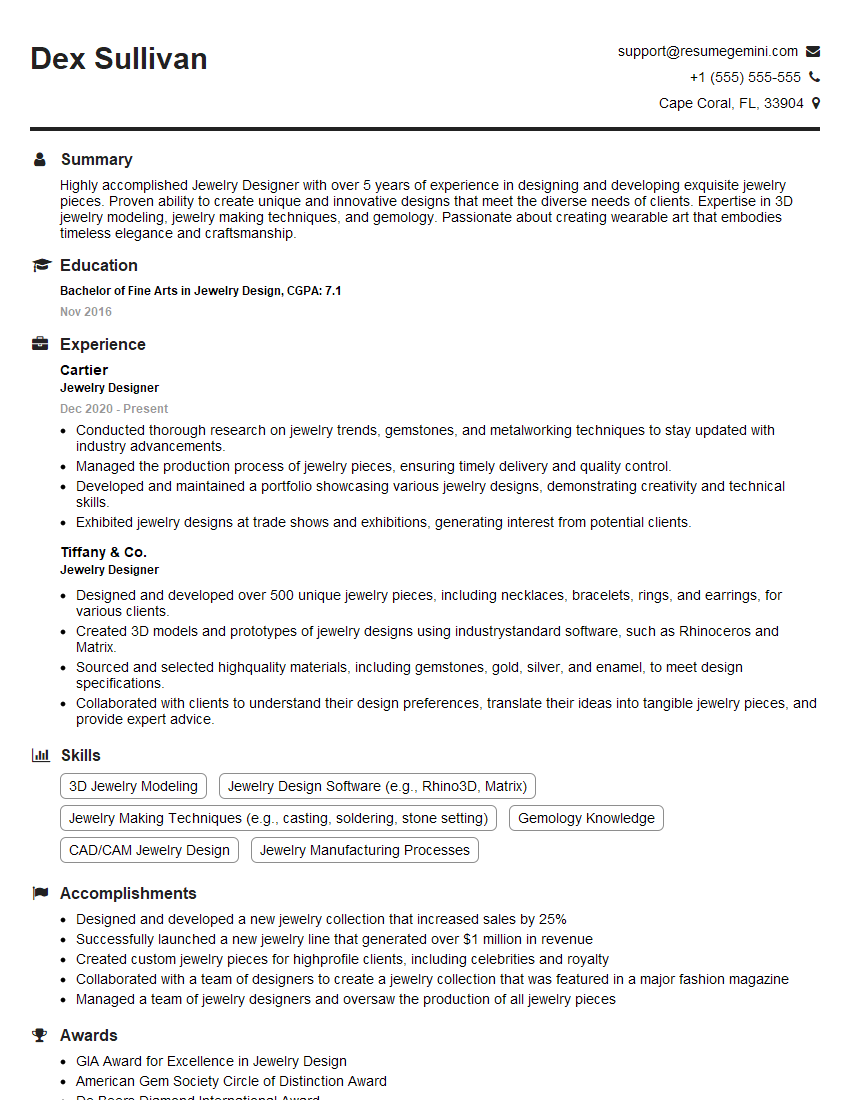
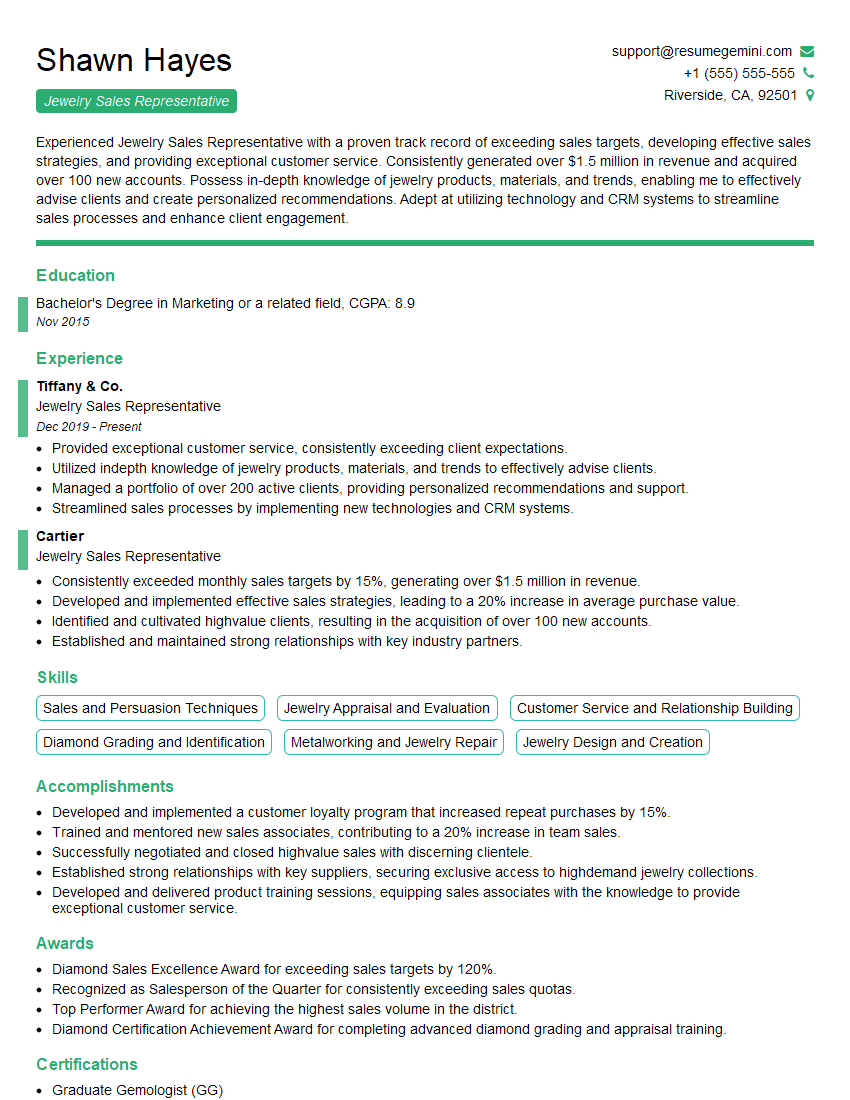
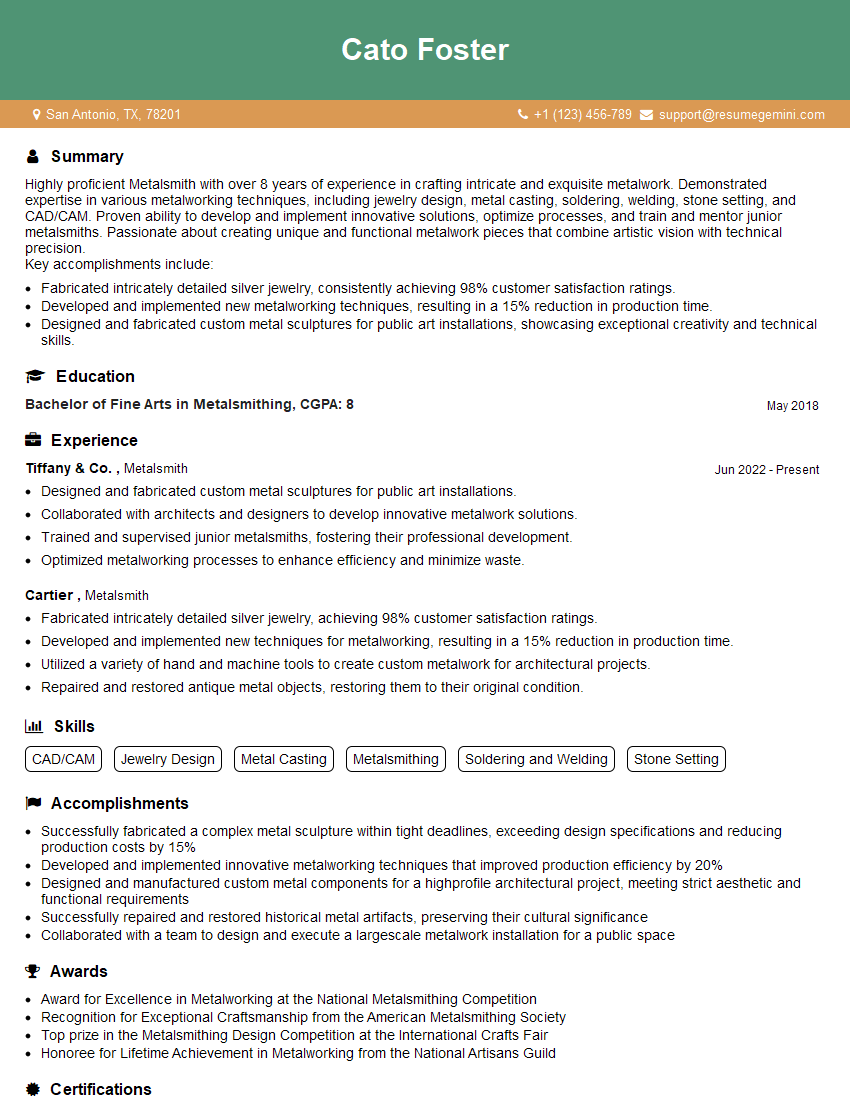
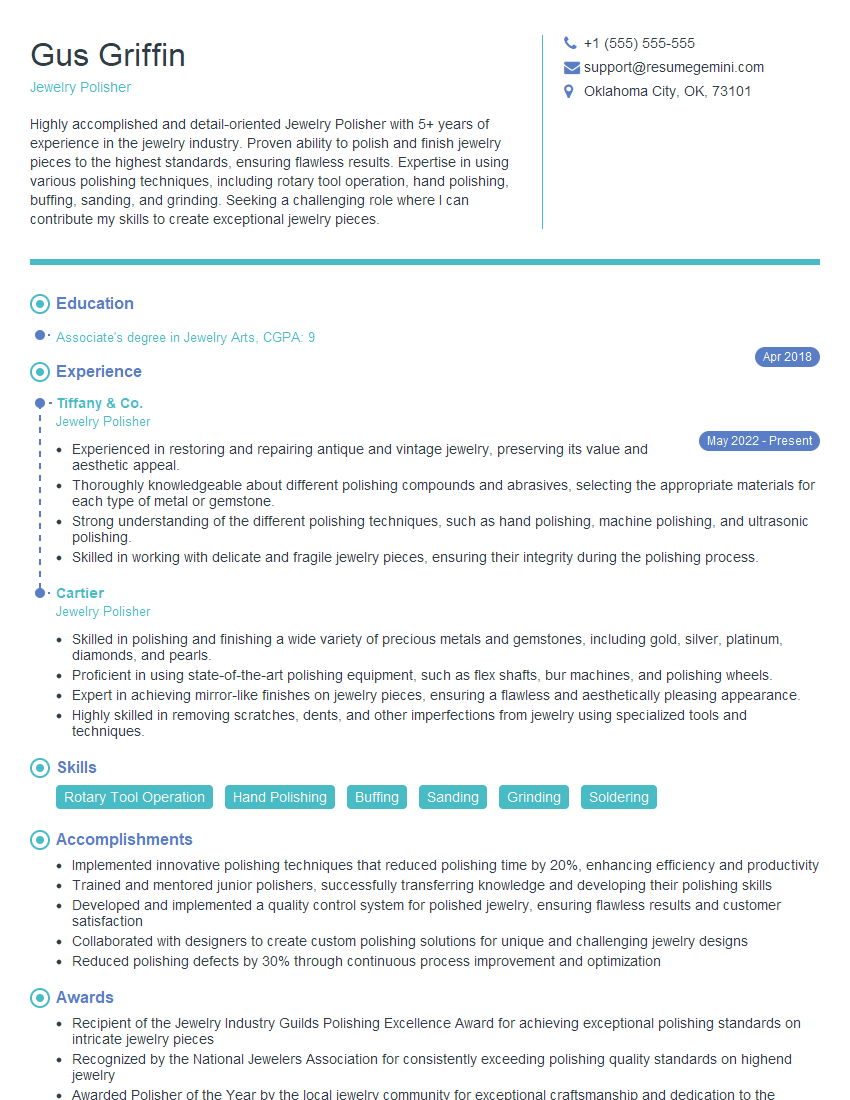
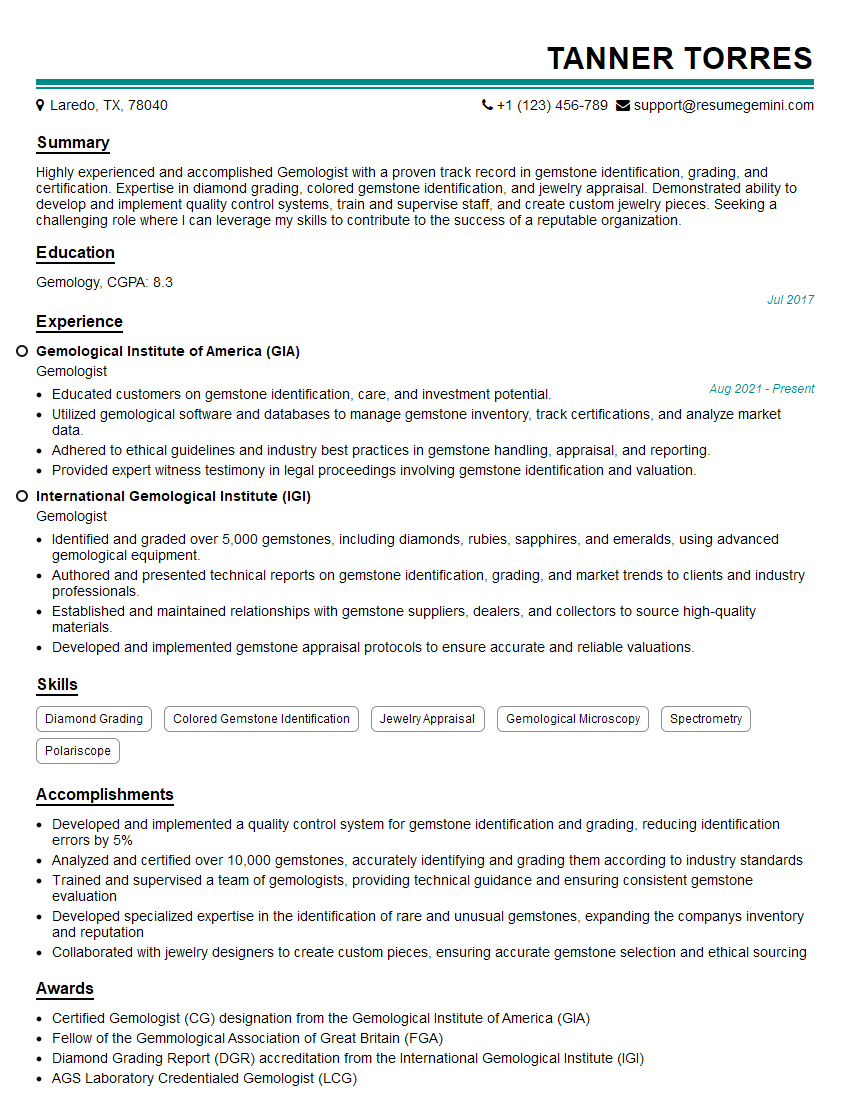
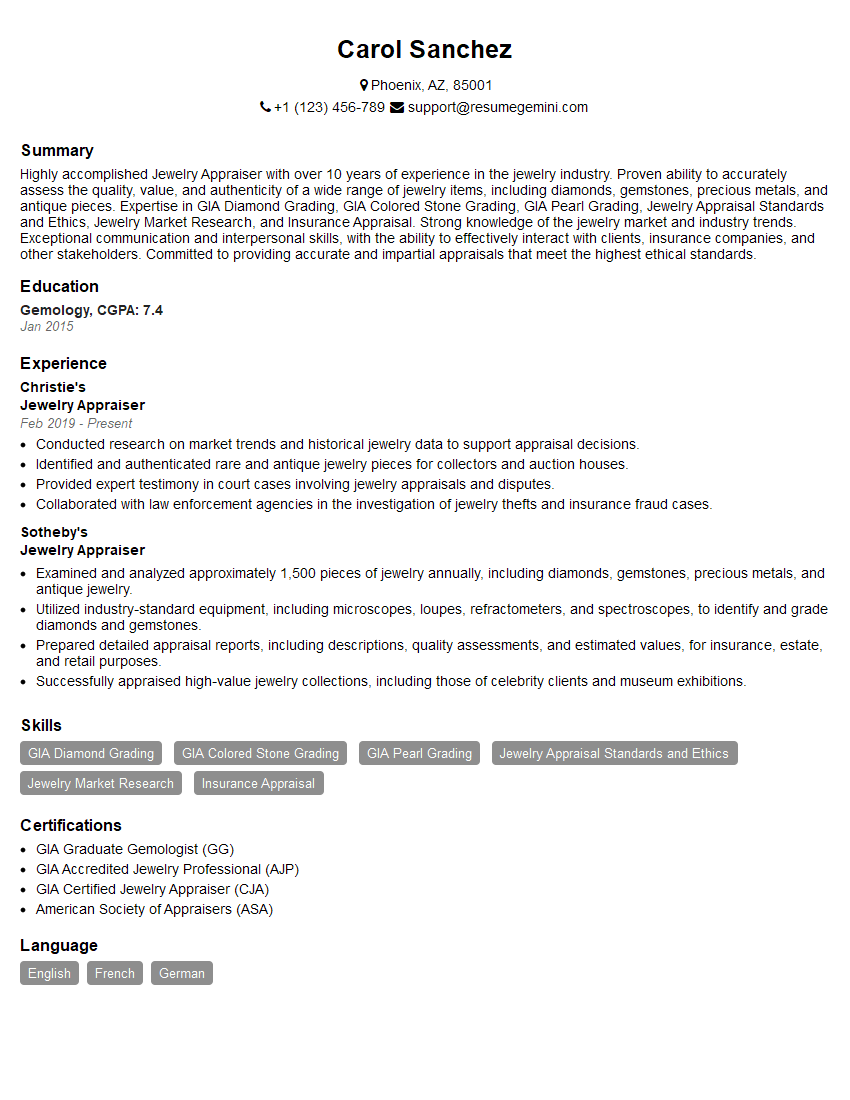
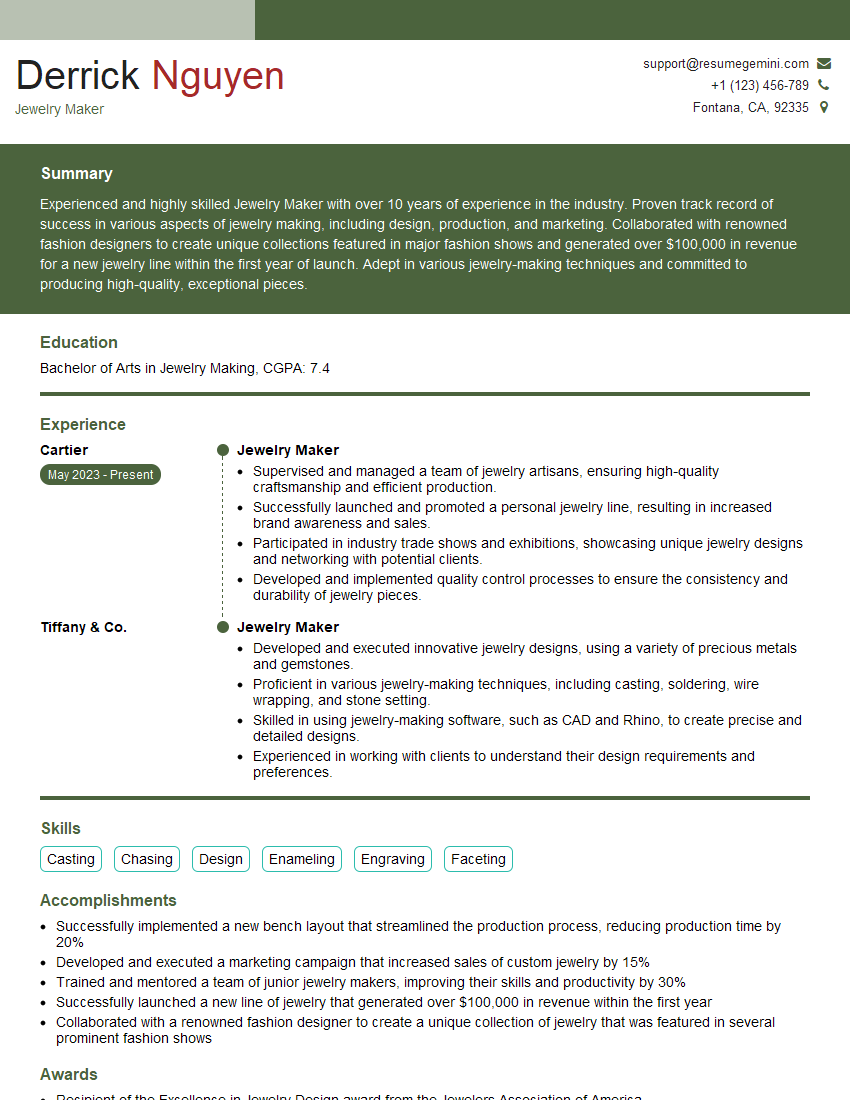
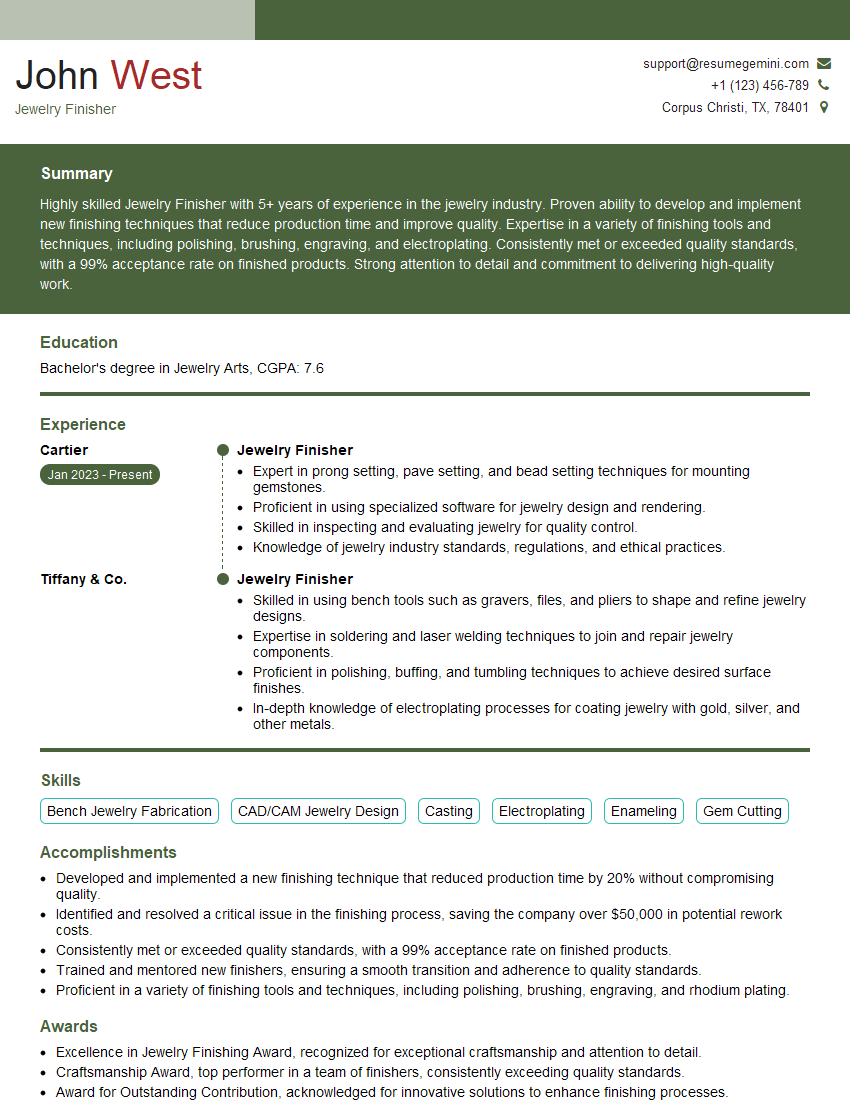
Mastering Jewelry and Accessories Creation opens doors to exciting career opportunities, from independent artisan to roles in high-end design houses and manufacturing companies. To maximize your job prospects, creating an ATS-friendly resume is crucial. An effectively crafted resume ensures your skills and experience are highlighted and easily identified by Applicant Tracking Systems. We recommend using ResumeGemini to build a professional and impactful resume. ResumeGemini provides tools and resources to help you create a compelling document, and we offer examples of resumes tailored to the Jewelry and Accessories Creation field.
Explore more articles
Users Rating of Our Blogs
Share Your Experience
We value your feedback! Please rate our content and share your thoughts (optional).
What Readers Say About Our Blog
Very informative content, great job.
good