The right preparation can turn an interview into an opportunity to showcase your expertise. This guide to Joint Fires Observer (JFO) Qualification interview questions is your ultimate resource, providing key insights and tips to help you ace your responses and stand out as a top candidate.
Questions Asked in Joint Fires Observer (JFO) Qualification Interview
Q 1. Describe the process of requesting and adjusting fire support.
Requesting and adjusting fire support follows a structured process to ensure accuracy and safety. It begins with identifying the target and its location using coordinates or a description. This information is then transmitted to the appropriate fire support coordination center (FSCC) via established communication channels, often using a standardized format like a 9-line call for fire. The JFO will provide details including target location, type, size, friendly forces location, and desired type of munition. The FSCC then tasks the appropriate fire support assets. Adjustment, if necessary, involves providing updates on the impact of the initial fire mission, usually based on observation. The JFO uses terms like ‘short,’ ‘over,’ ‘left,’ or ‘right’ to help correct the fire mission until it achieves the desired effect. This iterative process continues until the target is neutralized or the mission is terminated.
For example, during an operation in a mountainous area, we might use a laser rangefinder to obtain precise coordinates for a hidden enemy sniper nest. The 9-line would then transmit this location to the FSCC, requesting precision-guided munitions to minimize collateral damage. If the initial strike was slightly off target, I would provide the necessary adjustments, such as ’50 meters right’ to help correct the subsequent rounds until the nest was successfully neutralized.
Q 2. Explain the different types of fire support available to a JFO.
A JFO has access to a variety of fire support assets, each with unique capabilities. These include:
- Artillery: This encompasses various types of cannons and howitzers offering a wide range of effects, from high-explosive to smoke. They are crucial for suppressing enemy positions and providing indirect fire support.
- Mortars: Providing close-in fire support, mortars are exceptionally valuable in urban or confined environments where precision is not always achievable but suppressive fire is still effective.
- Close Air Support (CAS): Aircraft like fighter jets or attack helicopters can deliver precise strikes using bombs, rockets, or cannon fire. CAS is essential for engaging rapidly moving or heavily fortified targets.
- Naval Fire Support: In coastal operations, naval ships can offer substantial firepower with their main guns, extending the reach and power of fire support.
- Rocket and Missile Systems: These systems offer long-range precision strikes, valuable for targets outside the range of artillery.
The selection of the appropriate fire support asset depends heavily on the specific tactical situation, target characteristics, and the proximity of friendly forces.
Q 3. What are the key elements of a fire support plan?
A robust fire support plan is paramount to successful operations. It incorporates several key elements:
- Target Identification and Prioritization: Clearly identifying and prioritizing targets based on their threat level and impact on mission success.
- Fire Support Coordination Measures (FSCM): Defining areas where fire support is restricted to avoid fratricide, such as using no-fire zones or coordinating fire support with adjacent units.
- Target Acquisition Plan: Outlining the methods and resources used to locate and identify targets (e.g., aerial reconnaissance, ground observation).
- Engagement Priorities: Establishing the order of engagement for identified targets based on their threat level and impact on the overall mission.
- Communication Plan: Specifying the communication methods and procedures used to request and adjust fire support.
- Contingency Planning: Planning for potential issues or changes in the situation, including alternate firing positions or adjustments to the target priorities.
A well-defined plan minimizes confusion and risk while maximizing effectiveness.
Q 4. How do you ensure the safety of friendly forces during fire support operations?
Ensuring the safety of friendly forces is the absolute top priority during fire support operations. This requires a multi-layered approach:
- Detailed Target Location and Description: Precisely defining the target location and characteristics to minimize the risk of accidental engagement of friendly forces.
- Effective FSCM: Establishing and rigorously adhering to FSCM, such as no-fire zones and coordinate restrictions, to prevent fratricide.
- Constant Communication: Maintaining continuous communication with all involved parties to share updates, adjustments, and any potential changes in the situation.
- Careful Selection of Munitions: Using munitions appropriate to the target and environment to minimize collateral damage.
- Post-Strike Assessment: Conducting a thorough assessment after each fire mission to verify accuracy and identify any potential issues or risks.
In practice, this means continually checking for the presence of friendly forces near the target before requesting fire and verifying that the impact point is clear of friendly positions.
Q 5. Describe your experience with different types of targeting systems.
My experience encompasses a range of targeting systems, each with its strengths and weaknesses. I am proficient in using:
- Manual Targeting: Utilizing maps, compasses, and protractors for target location and aiming. This requires thorough training and a strong understanding of basic surveying principles.
- Digital Targeting Systems: I am skilled in using digital maps, GPS devices, and fire-control computers that automate many aspects of target location, aiming, and fire adjustment.
- Laser Rangefinders and Designators: These devices allow for accurate measurement of distances and designation of targets for laser-guided munitions, leading to improved precision.
- Unmanned Aerial Systems (UAS) Imagery: I have used UAS imagery for target identification, which provides valuable real-time intelligence on the battlefield.
The choice of targeting system depends on the specific circumstances, the available resources, and the level of precision needed.
Q 6. How do you communicate with air and ground assets during close air support operations?
Effective communication during CAS is critical. We typically use a combination of radio communication and pre-planned signals. The JFO uses standardized terminology and procedures to accurately communicate target location, type, and any potential hazards. For example, we utilize the Joint Tactical Air Controller (JTAC) terminology, ensuring clear communication with pilots about the precise location of the target and the presence of friendly forces in the vicinity. This includes constantly updating the pilot regarding the location of the engagement to allow them to dynamically adjust their flight path or target attack profiles.
In one instance, I used hand signals and radio communication to guide a helicopter gunship towards a rapidly advancing enemy position. Continuous updates about the enemy’s movement and the proximity of friendly troops prevented collateral damage.
Q 7. Explain the concept of Target Acquisition and its importance for JFOs.
Target acquisition is the process of locating, identifying, and assessing potential targets. For a JFO, it’s the foundation of effective fire support. Without accurate target acquisition, the risk of friendly fire or ineffective fire missions increases substantially. The JFO uses various methods for target acquisition, such as:
- Visual Observation: Direct observation through binoculars, spotting scopes, or other observation devices.
- Intelligence Reports: Using information from intelligence sources like HUMINT or SIGINT to locate enemy positions.
- Reconnaissance Assets: Employing drones, aircraft, or ground reconnaissance teams to locate and identify targets.
- Sensor Systems: Utilizing technology like radar, thermal imaging, and other sensors to detect and locate targets.
The accuracy and timeliness of target acquisition directly impact the success of fire support operations, minimizing civilian casualties and maximizing mission effectiveness. For instance, during an operation, confirming the target’s location through multiple means (visual observation and UAV imagery) prior to engaging it is critical to avoid causing fratricide.
Q 8. What are the limitations and potential risks associated with different types of munitions?
Different munitions possess unique limitations and risks. For instance, High-Explosive (HE) rounds, while effective against fortifications and personnel, have a relatively large blast radius, increasing the risk of collateral damage and fratricide. Their effectiveness against hardened targets is also limited. Precision-guided munitions (PGMs), such as laser-guided bombs or GPS-guided rockets, offer significantly improved accuracy, minimizing collateral damage. However, they are more expensive and their effectiveness is dependent on weather conditions and the availability of targeting data. White phosphorus (WP) munitions create a smoke screen or incendiary effect, but pose significant risks of burns and casualties if used improperly near friendly forces. Finally, cluster munitions, while effective against area targets, carry a high risk of unexploded ordnance (UXO) that can pose a long-term danger to civilians after the conflict. Each type of munition must be carefully selected based on the target, the surrounding environment, and the risk to friendly forces.
For example, during a mission in a densely populated area, using PGMs would be preferable to HE rounds to minimize civilian casualties. However, if the target is a deeply entrenched enemy position in a sparsely populated area, HE might be more effective and acceptable given the reduced risk to civilians.
Q 9. How do you handle communication failures during fire support missions?
Communication failures are a critical threat during fire support missions. My primary response is to immediately attempt to re-establish contact using alternate means. This might involve switching to a different frequency, using a backup radio, or employing a messenger if possible. Simultaneously, I’d update my higher headquarters on the situation and the attempts to restore communication. If the failure persists, I would implement contingency plans established beforehand, potentially involving visual signaling, or delaying the fire mission until communication is restored. Clear communication protocols and redundancies are vital for mitigating these risks. It is crucial to have pre-planned alternative methods and to continuously assess the communication environment.
Imagine a scenario where our primary radio fails during a critical fire mission. My immediate action would be to switch to the backup radio on a different frequency. If that fails, I would signal the fire support coordination center using pre-arranged hand signals. The key is to maintain situational awareness and employ multiple communication methods in the event of failure.
Q 10. Explain the process of conducting a post-mission debrief for a fire support mission.
A post-mission debrief is crucial for identifying lessons learned and improving future fire support operations. It involves a structured review of the entire mission, from planning and execution to results and assessment. The process typically begins with a description of the mission objectives and the actual execution. Then, we analyze the effectiveness of the fire support, considering factors like accuracy, timeliness, and the achievement of the objectives. We thoroughly examine any challenges encountered, such as communication issues, target acquisition difficulties, or unforeseen circumstances. We also evaluate the impact of our actions, focusing on collateral damage, friendly fire incidents, and the overall impact on the tactical situation. Finally, we identify actionable items to improve future missions, including modifying procedures, improving training, or refining communication protocols.
For example, if a mission fell short of its objectives, the debrief would analyze the root causes, such as inadequate target intel or poor coordination. This allows us to identify areas for improvement, such as better target acquisition methods or improved training in communication procedures.
Q 11. What are the different types of communication systems used by JFOs?
JFOs utilize a variety of communication systems, chosen based on the operational environment and mission requirements. These typically include secure and non-secure radios, such as the SINCGARS family of radios for secure communications and PRC-152 or similar radios for non-secure communications. Satellite communications (SATCOM) systems provide a broader range of communication, crucial in areas with limited terrestrial connectivity. We also use data links for transmitting precise target coordinates and other critical data rapidly and securely. Finally, we leverage blue force tracking systems to maintain situational awareness and coordinate actions with friendly forces.
The selection of a particular communication system would depend on the operational needs. For example, in a high-threat environment, secure radios would be preferred. If we are operating in a remote area with limited terrestrial connectivity, SATCOM would be essential.
Q 12. How do you coordinate fire support with other elements on the battlefield?
Coordinating fire support with other elements on the battlefield requires seamless communication and a thorough understanding of the overall operational plan. This involves close coordination with the maneuver elements, artillery units, air support assets, and other supporting arms. I would typically use the established fire support coordination mechanism to share the plan and receive situational awareness. Clear communication regarding the target location, engagement priorities, and the location of friendly forces is paramount. I would use the common operating picture (COP) to understand the overall battle space and ensure that fire support does not jeopardize friendly elements. Finally, constant communication and adjustments are critical to adapting to the dynamically changing battle space.
For example, before initiating a fire mission, I would confirm the location of friendly units with the maneuver commander to prevent fratricide. Throughout the mission, I’d maintain open communication to adjust fire support as needed to support the maneuver element’s advance.
Q 13. Describe your experience with Joint Tactical Air Controller (JTAC) procedures.
My experience with JTAC procedures includes extensive training and practical application in various operational environments. I am proficient in the Joint Terminal Attack Controller (JTAC) terminal control authority structure, understanding the roles and responsibilities within that structure. I am familiar with the use of JTAC terminology, call signs, and procedures for communicating with air assets. I am adept at using the standard JTAC procedures for target acquisition, marking, and engagement coordination, adhering to strict safety protocols and procedures to minimize the risk of collateral damage and friendly fire. I’m also experienced in using different types of marking methods, including laser designators, smoke, and other means to precisely identify targets for air assets.
One specific scenario involved coordinating a close air support mission with a JTAC. I worked directly with the JTAC to accurately mark and describe the target and surrounding environment, facilitating a precise airstrike minimizing risk to civilians. This successful coordination highlighted the importance of clear communication and a shared understanding of JTAC procedures.
Q 14. How do you manage the risks associated with fratricide in a complex fire support operation?
Fratricide mitigation is a paramount concern in any fire support operation. It requires a multi-layered approach. First, meticulous target confirmation and identification are essential. This involves using multiple sensors and verification methods to ensure that the target is accurately identified and that it is not a friendly element. Second, strict adherence to the rules of engagement and the established fire support coordination procedures is critical. Third, maintaining constant communication with friendly units is crucial, ensuring situational awareness of the positions of friendly forces. This is achieved through the use of advanced communication systems and close coordination with maneuver elements. Fourth, utilizing precision-guided munitions whenever feasible minimizes the risk of collateral damage and friendly fire. Finally, thorough post-mission analysis of near misses or close calls helps identify weaknesses in the system and implement corrective actions to prevent future incidents.
For example, before any fire mission, we meticulously check the target location against the locations of friendly forces using various sources of information and maps to confirm target coordinates are free of friendly units. Any doubt would lead to immediate mission suspension and further investigation.
Q 15. Explain the concept of ‘minimum essential information’ and its importance for JFOs.
Minimum Essential Information (MEI) for a JFO is the absolute bare minimum of data required to effectively request and coordinate fire support. It’s crucial because time is often of the essence in combat, and unnecessary details can delay or even prevent the timely delivery of fire. Think of it like ordering a pizza – you need the address, but you don’t need to explain the history of pizza making. The MEI focuses on the critical elements ensuring accuracy and speed.
- Target Location: Precise coordinates (preferably using a grid system like MGRS) are paramount. Even a small error can lead to the wrong target being engaged.
- Target Description: Brief but descriptive, focusing on size, shape, activity, and any unique identifying features. ‘Large, rectangular structure, emitting smoke’ is better than a lengthy description.
- Friendly Forces Location: To ensure no friendly fire casualties (FFC), the location of friendly troops needs to be clearly defined to avoid collateral damage.
- Method of Engagement: What type of fire support is needed (e.g., artillery, mortars, close air support)?
- Desired Effects: What needs to be accomplished? Suppression, neutralization, or destruction of the target? This clarifies the engagement objectives.
During a training exercise, I once observed a JFO spend several minutes providing irrelevant details about the enemy’s unit composition, delaying the delivery of much-needed suppressive fire. This highlighted the importance of MEI and focusing on the essentials.
Career Expert Tips:
- Ace those interviews! Prepare effectively by reviewing the Top 50 Most Common Interview Questions on ResumeGemini.
- Navigate your job search with confidence! Explore a wide range of Career Tips on ResumeGemini. Learn about common challenges and recommendations to overcome them.
- Craft the perfect resume! Master the Art of Resume Writing with ResumeGemini’s guide. Showcase your unique qualifications and achievements effectively.
- Don’t miss out on holiday savings! Build your dream resume with ResumeGemini’s ATS optimized templates.
Q 16. Describe your experience with using different maps and navigation tools for fire support planning.
My experience with maps and navigation tools is extensive. I’ve used various topographic maps, digital terrain elevation data (DTED) through systems like ArcGIS, and handheld GPS devices coupled with military mapping software. In particular, I’ve mastered the use of MGRS coordinates for pinpoint accuracy. One particularly challenging scenario involved using a paper map in a degraded communication environment during a field exercise. We had to rely on visual observation and compass bearings to refine target location, emphasizing the importance of basic navigation skills even in technologically advanced settings.
The ability to quickly switch between different map displays – satellite imagery, topographical maps, and even simple sketch maps – is essential. Understanding scale, contour lines, and symbols is fundamental to accurate fire support planning. I’ve also incorporated digital tools that allow for marking friendly and enemy positions, and predicting the effects of different munitions based on terrain.
Q 17. What are some common challenges JFOs face in real-world scenarios?
Real-world scenarios present JFOs with numerous challenges. Some of the most common include:
- Communication failures: Loss of communication with supporting elements or higher headquarters can severely hamper fire support coordination. This necessitates having backup communication plans and methods.
- Time constraints: Fast-moving situations demand rapid decision-making and efficient communication. Accurate and concise communication is essential to ensure timely fire support.
- Poor visibility and obscurants: Smoke, dust, and darkness can significantly impact observation and target location. This necessitates the use of alternative means to locate targets, such as sensors or intelligence.
- Enemy countermeasures: The enemy will actively attempt to disrupt fire support, including jamming communications and employing counter-battery fire.
- Collateral damage concerns: Protecting civilians and non-combatants is paramount. Careful target selection and consideration of potential collateral damage is crucial.
During a deployment, a sudden sandstorm significantly reduced visibility. We had to rely on a combination of forward observer reports and aerial reconnaissance to confirm target location before requesting fire support, illustrating the adaptive problem-solving demanded in the field.
Q 18. How do you assess the effectiveness of a fire support mission?
Assessing the effectiveness of a fire support mission requires a multi-faceted approach. It involves several key steps:
- Immediate Observation: Following the engagement, I would observe the effects of the fire support (e.g., target destruction, suppression of enemy fire).
- Post-Mission Reports: Gathering reports from participating units and analyzing any collected intelligence on target damage.
- After-Action Review (AAR): Conducting a thorough AAR with the team involved to identify lessons learned and areas for improvement in future missions.
- Damage Assessment: Analyzing imagery and reports to assess the actual damage inflicted on the target. This may involve comparing pre- and post-strike imagery.
A key measure is comparing the planned effects with the observed results. Was the target neutralized? Did the engagement achieve its objectives while minimizing collateral damage? This requires careful analysis of available data and feedback from all involved parties. For example, a successful mission might be confirmed by post-strike reports indicating enemy casualties and the destruction of key infrastructure.
Q 19. How do you maintain situational awareness during a fire support operation?
Maintaining situational awareness (SA) during a fire support operation is critical. This is achieved through continuous monitoring of multiple information sources. This includes:
- Communication with supporting units: Regular updates from artillery units, close air support aircraft, and other friendly elements contribute to a comprehensive understanding of the battlefield.
- Intelligence reports: Receiving and analyzing up-to-date intelligence helps identify enemy movements, capabilities, and potential threats.
- Visual observation: Direct observation of the battlefield using binoculars, optics, and other observation devices provides real-time information on the target and the surrounding area.
- Use of technology: Employing advanced sensor systems, UAV feeds, and other technology to enhance awareness and understanding of the situation.
I often use a combination of digital and analog tools to track multiple aspects of the situation simultaneously – for example, a digital map display to track friendly and enemy positions in real time, coupled with hand-drawn sketch maps for quick visualization and contingency planning.
Q 20. Explain your understanding of the laws of war related to fire support operations.
My understanding of the laws of war (LOWs), specifically as they pertain to fire support operations, is paramount. I am thoroughly familiar with the principles of distinction, proportionality, and precaution. This means ensuring that targets are legitimate military objectives (distinction), that the expected military advantage outweighs the potential civilian harm (proportionality), and taking all feasible precautions to minimize civilian harm (precaution). This includes verifying target location, assessing potential collateral damage, and employing appropriate munitions and engagement tactics.
Any violation of LOWs can have severe consequences. I’m trained to meticulously follow established procedures and protocols to ensure the legality and ethical conduct of every fire support mission. It requires constant vigilance, careful planning, and continuous self-assessment to ensure compliance.
Q 21. How do you integrate intelligence information into your fire support plan?
Integrating intelligence information into my fire support plan is crucial for mission success. I utilize intelligence to:
- Target identification and location: Intelligence reports pinpoint enemy locations, strengths, and weaknesses, enabling accurate targeting.
- Assessment of enemy capabilities: Understanding enemy capabilities (e.g., anti-battery radar, air defenses) informs decisions on engagement tactics and munitions selection.
- Prediction of enemy actions: Analyzing enemy patterns and behavior helps predict their movements and responses, facilitating preemptive fire support.
- Risk assessment: Intelligence helps assess potential risks and challenges, such as the presence of civilians or sensitive infrastructure near the target area.
For example, during a recent exercise, intelligence reports indicated a potential enemy ambush along a route of advance. By integrating this information, we adjusted our fire support plan to provide suppressive fire along that route, potentially preventing a disastrous encounter. Effective use of intelligence ensures a well-informed, legally compliant, and successful fire support plan.
Q 22. Describe your experience using laser range finders and other targeting equipment.
My experience with laser rangefinders and other targeting equipment is extensive. I’m proficient in operating various models, including the AN/PVS-7 and similar devices. This involves not only understanding how to accurately measure the distance to a target but also understanding the limitations of the technology – atmospheric conditions, target reflectivity, and the potential for errors. For example, I’ve had to compensate for atmospheric haze during a live-fire exercise to get an accurate range to a target. I’m also skilled in using other targeting aids such as digital maps, GPS devices, and compass, integrating them to create a precise grid reference to provide to the fire support coordination center (FSCC). This integrated approach ensures accuracy and speed in the process.
Beyond rangefinding, I’m skilled in employing other targeting tools, like advanced handheld computers which allow me to input target coordinates, adjust fire missions, and manage multiple fire support requests simultaneously. Accurate and efficient target location is paramount; the difference between a near miss and a successful strike often comes down to the precision and speed of the target location process.
Q 23. What are some effective methods for training and maintaining proficiency as a JFO?
Maintaining proficiency as a JFO requires continuous training and practical application. This involves a mix of classroom instruction, simulator training, and extensive field exercises. Classroom training keeps us updated on new technologies, procedures, and doctrinal changes, while simulator training allows for high-stakes, low-risk scenarios. We practice everything from basic target location and communication to handling complex, multi-target engagements under pressure. This helps us become proficient in different scenarios, such as coordinating artillery fire, air support or even mortar fire.
Crucially, field exercises are invaluable. They allow us to apply our knowledge in a realistic environment, working with different fire support elements and integrating with maneuver units. Regular practice ensures we maintain our skills in target acquisition, communication, and battle management. This is critical for ensuring we can quickly and accurately direct fire support to protect our forces.
- Regular refresher courses on JFO procedures and communication protocols.
- Participation in live-fire exercises to maintain practical skills.
- Consistent review of relevant doctrine and technological updates.
Q 24. How do you prioritize multiple fire support requests during a high-intensity operation?
Prioritizing fire support requests during a high-intensity operation is a critical skill that requires a systematic approach. I utilize a decision-making framework based on several key factors: the urgency of the request (immediate threat vs. future need), the lethality of the threat, the number of friendly forces at risk, and the capabilities of the available fire support assets. Essentially, I use a threat assessment and casualty risk assessment framework to make these decisions.
For instance, a request for immediate fire support to suppress an enemy machine gun emplacement actively engaging friendly troops would take precedence over a request to destroy a less immediate threat, such as an enemy supply route. I’d quickly assess the situation, coordinate with the FSCC, and prioritize accordingly. This also requires constant communication and updates with all parties involved. Clear and concise communication is critical.
To manage this effectively, I rely on clear communication protocols, constant situational awareness, and the ability to quickly assess risk and prioritize accordingly. It is a fast-paced, dynamic process that requires cool-headedness and decisive action under pressure.
Q 25. Explain your experience with Forward Air Controllers (FACs) and Close Air Support (CAS).
My experience with Forward Air Controllers (FACs) and Close Air Support (CAS) is extensive. I’ve worked closely with FACs from various branches, coordinating air strikes to support ground operations. This includes briefing the FAC on target details, coordinating the attack plan, and ensuring the safety of friendly troops. It’s a collaborative process that requires clear communication and mutual trust.
I understand the limitations of different aircraft and munitions, and I can adjust my requests accordingly. For example, when communicating with an aircraft with limited visibility, I’d ensure extremely precise coordinates to minimize the risk of fratricide. Similarly, I’d ensure to account for the blast radius of the munitions used when considering the safety of friendly units. Effective communication, precise target location, and constant awareness of friendly unit positions are paramount during CAS operations.
Q 26. Describe your understanding of different types of artillery and their capabilities.
My understanding of artillery and its capabilities encompasses various systems, including howitzers, mortars, and rocket artillery. I know the differences in range, accuracy, and effects of each weapon system. This is essential in requesting the correct support for specific targets and situations. For example, I understand that 155mm howitzers offer long-range precision, while mortars provide rapid, close-in support. Rocket artillery, on the other hand, is effective for area saturation fire against a larger target.
Beyond the weapon systems themselves, I also understand the impact of ammunition type (e.g., high-explosive, illumination, smoke) and the considerations needed for different target types (e.g., bunkers, vehicles, troops in the open). Knowing this allows me to make more effective requests tailored to the specific mission needs. The choice of weapon system is crucial; for example, engaging a point target at a significant range would require a howitzer, whereas quickly suppressing a close-range threat might call for mortars.
Q 27. How do you manage stress and maintain composure under pressure during fire support operations?
Managing stress and maintaining composure under pressure is a crucial aspect of being a JFO. It’s a high-stress job where rapid decision-making is essential. I use several techniques: proper physical fitness, constant training to build confidence, practiced mental discipline, and focusing on the task at hand. I also prioritize clear communication with my team, this helps reduce anxiety as we’re all in sync and understand the plan and roles.
In high-pressure situations, I focus on breaking the problem down into smaller, manageable tasks. This prevents being overwhelmed and allows for more effective decision-making. Regular briefings, including self-briefings, help to maintain situational awareness and reduce anxiety about the unknown. I believe that proactive stress management strategies are pivotal; a calm and focused JFO is more effective.
Q 28. What are your strengths and weaknesses as a Joint Fires Observer?
My strengths as a JFO include my excellent communication skills, proficiency with various targeting systems, and experience in high-pressure situations. I’m also adept at rapidly assessing situations and making timely, informed decisions. My situational awareness is extremely high, enabling me to anticipate potential issues and mitigate risks.
One area where I could improve is my experience with certain less frequently used weapon systems. While I have a theoretical understanding, more practical experience would enhance my efficiency. To mitigate this, I am actively pursuing opportunities for additional training and practice with these systems.
Key Topics to Learn for Joint Fires Observer (JFO) Qualification Interview
Mastering these key areas will significantly boost your confidence and preparedness for your JFO Qualification interview. Remember, practical application and problem-solving are just as crucial as theoretical understanding.
- Forward Observer Procedures: Understanding the entire process from target acquisition to engagement, including call for fire procedures, communication protocols, and safety considerations.
- Target Location and Designation: Mastering grid coordinates, aiming points, and accurate target description techniques. Practical application includes scenarios involving limited visibility or challenging terrain.
- Communication Systems and Procedures: Familiarity with various communication systems (e.g., radios, satellite phones) and the ability to effectively convey critical information under pressure.
- Joint Fires Coordination: Understanding the roles and responsibilities within a joint fires team, effective coordination with other branches of the military, and adherence to rules of engagement.
- Battlefield Management and Situational Awareness: Maintaining a clear understanding of the battlespace, utilizing available intelligence and resources to make informed decisions, and adapting to dynamic situations.
- Weapons Systems and Effects: Comprehensive knowledge of the capabilities and limitations of various weapons systems, including their effects on different target types and the environment.
- Safety Procedures and Risk Mitigation: Prioritizing safety throughout the entire fire support process, identifying and mitigating potential risks, and understanding the consequences of errors.
- Legal and Ethical Considerations: A thorough understanding of the laws of war and ethical considerations in employing joint fires.
Next Steps
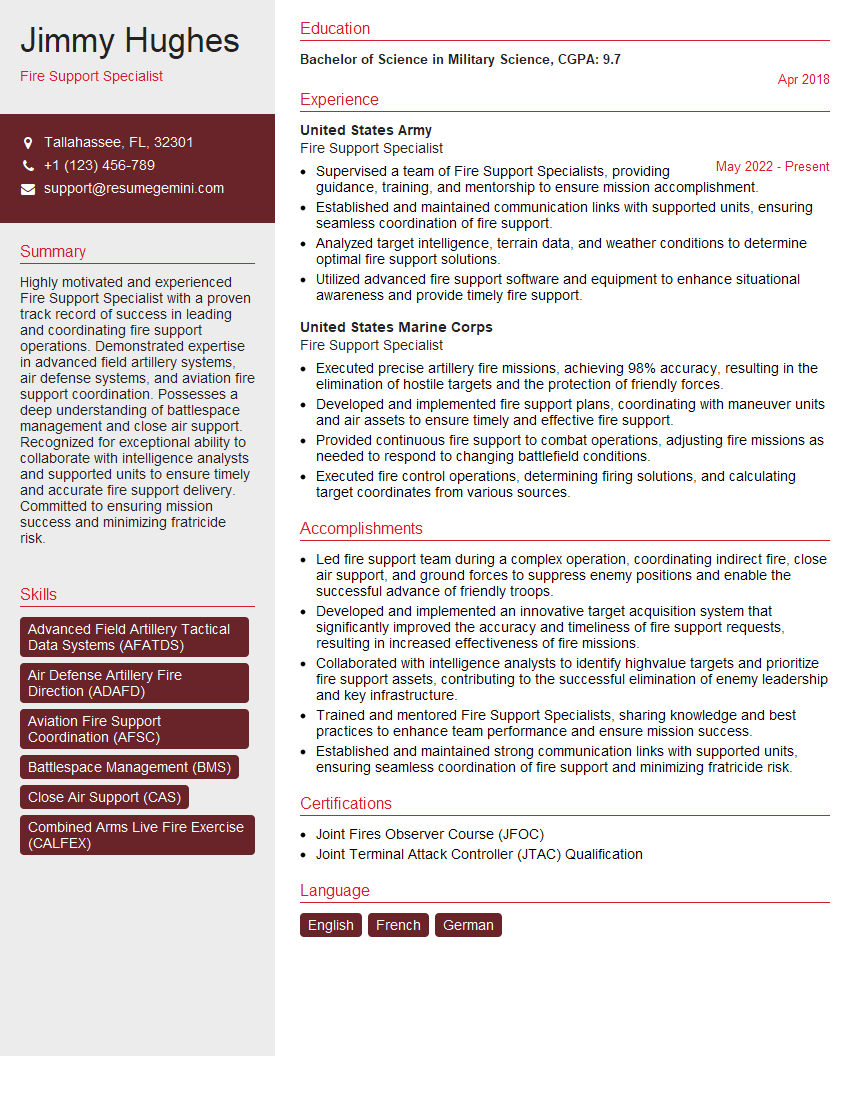
Securing your desired JFO role requires a strong understanding of the technical aspects and a compelling presentation of your skills. Mastering the JFO Qualification opens doors to exciting career advancements and leadership opportunities within the military. To maximize your job prospects, creating an ATS-friendly resume is crucial. This ensures your application is effectively screened by applicant tracking systems. We recommend using ResumeGemini to build a professional and impactful resume that highlights your qualifications. ResumeGemini provides examples of resumes tailored specifically to the Joint Fires Observer (JFO) Qualification to help guide you through the process.
Explore more articles
Users Rating of Our Blogs
Share Your Experience
We value your feedback! Please rate our content and share your thoughts (optional).
What Readers Say About Our Blog
Very informative content, great job.
good