Every successful interview starts with knowing what to expect. In this blog, we’ll take you through the top Kick-off Point and Target Calculations interview questions, breaking them down with expert tips to help you deliver impactful answers. Step into your next interview fully prepared and ready to succeed.
Questions Asked in Kick-off Point and Target Calculations Interview
Q 1. Define ‘Kick-off Point’ in the context of trajectory calculations.
The Kick-off Point (KOP) in trajectory calculations refers to the precise three-dimensional coordinates (latitude, longitude, and altitude) from where a projectile, such as a rocket, missile, or even a golf ball, begins its flight. It’s the starting point of the trajectory, marking the initiation of the projectile’s motion.
Think of it like the tee-off point in golf – you need to know exactly where you’re starting to accurately calculate where the ball will land.
Q 2. Explain the significance of accurate Kick-off Point determination.
Accurate KOP determination is paramount for successful trajectory prediction and mission accomplishment. Errors in the KOP can lead to significant deviations in the calculated trajectory, causing the projectile to miss its target. This is especially critical in applications like space launches, military operations, and even sporting events where precision is key. A slight error in the KOP for a satellite launch, for example, could result in the satellite ending up in the wrong orbit, rendering the mission ineffective or even dangerous.
Q 3. Describe different methods for calculating the Kick-off Point.
Several methods exist for calculating the KOP, each with varying degrees of accuracy and complexity:
- GPS (Global Positioning System): High-precision GPS receivers can provide accurate three-dimensional coordinates of the KOP. This is commonly used for many applications.
- Inertial Navigation Systems (INS): INS uses internal sensors to track position and orientation. While useful, INS measurements can drift over time, requiring calibration and potentially integration with other systems for high accuracy.
- Surveying Techniques: Traditional surveying methods, such as triangulation and total station measurements, can be used to determine the KOP, especially in scenarios where GPS signals are unreliable.
- Image Processing and Computer Vision: Analyzing video or image data of the launch or launch site can aid in determining the KOP, particularly useful for post-event analysis.
The choice of method depends heavily on the application, available resources, and the required level of accuracy.
Q 4. What factors influence the accuracy of Kick-off Point calculations?
The accuracy of KOP calculations is influenced by several factors:
- Sensor Accuracy: The precision of the measuring instruments (GPS receivers, INS, etc.) directly impacts the accuracy of the KOP.
- Environmental Conditions: Atmospheric conditions like temperature, pressure, and humidity can affect GPS signals and other sensor readings.
- Calibration and Maintenance: Regular calibration and maintenance of the measuring equipment are crucial for accurate readings.
- Data Processing Techniques: The algorithms and techniques used to process raw sensor data influence the final KOP calculation. Errors in the processing can lead to inaccurate results.
- Multipath Effects: GPS signals can be reflected or diffracted, leading to errors in the positioning.
Q 5. How do environmental factors (wind, gravity variations) affect Kick-off Point and Target calculations?
Environmental factors significantly affect both KOP and target calculations. Wind, for example, can cause a projectile to deviate from its intended path. Strong headwinds will reduce range, while tailwinds will increase it. Gravity variations across the Earth’s surface also influence the trajectory. Higher gravity means a slightly shorter range. These factors must be incorporated into trajectory models to achieve accurate predictions. Sophisticated trajectory prediction software usually include atmospheric and gravitational models to compensate for these effects.
Consider a long-distance artillery shell: A strong crosswind will significantly affect where the shell lands, necessitating adjustments to the launch angle and possibly even the KOP to hit the intended target. Similarly, launching a rocket near the equator, where gravity is slightly weaker, will require different calculations than a launch near the poles.
Q 6. Explain the relationship between Kick-off Point, Target Point, and trajectory.
The KOP, Target Point (TOP), and trajectory are inextricably linked. The KOP is the starting point, the TOP is the intended destination, and the trajectory is the path the projectile takes to travel from the KOP to the TOP. The trajectory is mathematically defined by the projectile’s initial velocity, launch angle, and the environmental factors mentioned earlier. The difference between the calculated TOP and the actual TOP is crucial for assessing the accuracy of the trajectory calculations, which, in turn, informs the accuracy of the KOP determination.
Imagine throwing a ball: The KOP is your hand, the TOP is where you want the ball to land, and the trajectory is the arc the ball follows. Changing your KOP (your hand position), or the force you throw with (initial velocity), will completely change the trajectory and thus the TOP.
Q 7. Describe the process of verifying the accuracy of calculated Kick-off and Target points.
Verifying the accuracy of calculated KOP and TOP requires a multi-faceted approach:
- Pre-launch Checks: Rigorous pre-launch checks of all equipment and data inputs ensure accuracy before the trajectory is initiated.
- Post-launch Data Analysis: After launch, tracking data from radar, telemetry, and other sources are compared to the predicted trajectory. Deviations are analyzed to identify sources of error.
- Simulation and Modeling: Computer simulations are used to model the projectile’s flight under various conditions, allowing for the testing of different scenarios and refinements to the KOP and TOP calculations.
- Redundancy and Cross-checking: Using multiple independent methods to calculate the KOP and comparing the results can help identify and mitigate errors.
- Statistical Analysis: Statistical methods are used to assess the uncertainty associated with the KOP and TOP calculations, providing a measure of confidence in the results.
Ultimately, verification is an iterative process. Through rigorous testing and refinement, we aim to continuously improve the accuracy of our calculations.
Q 8. How do you handle uncertainties and errors in input data for Kick-off Point calculations?
Uncertainties and errors in input data are inevitable in Kick-off Point calculations. We mitigate this through a robust approach that combines careful data acquisition with statistical methods and sensitivity analysis.
- Data Validation: Before any calculation, we rigorously validate the input data. This includes checking for inconsistencies, outliers, and plausibility. For example, if we’re calculating the launch of a rocket, we’d verify that the propellant mass is realistic and consistent with the rocket’s specifications.
- Error Propagation: We use error propagation techniques to quantify the uncertainty in the final Kick-off Point calculation based on the uncertainties in the input parameters (e.g., initial velocity, launch angle, wind speed). This gives us a range of possible Kick-off Points, rather than a single point, which is a much more realistic representation.
- Monte Carlo Simulation: For complex scenarios, a Monte Carlo simulation is invaluable. This involves running the Kick-off Point calculation many times with input parameters randomly sampled from their probability distributions. The resulting distribution of Kick-off Points provides a comprehensive understanding of the uncertainty.
- Sensitivity Analysis: We identify which input parameters have the most significant impact on the final Kick-off Point. This helps us focus our efforts on improving the accuracy of the most critical data.
Imagine designing a trajectory for a spacecraft. A small error in the initial velocity could dramatically affect the spacecraft’s arrival time and location, potentially causing mission failure. By carefully considering uncertainties, we develop contingency plans and increase the robustness of our calculations.
Q 9. What software or tools are you familiar with for performing these calculations?
I’m proficient in several software packages and tools for performing Kick-off Point and target calculations. My experience encompasses both specialized trajectory simulation software and general-purpose numerical computation tools.
- Specialized Trajectory Simulation Software: STK (Satellite Tool Kit), GMAT (General Mission Analysis Tool), and similar software packages are industry standards. They provide sophisticated tools for modelling various aspects of flight dynamics, including atmospheric drag, gravitational forces, and celestial body interactions. These are crucial for accurate, high-fidelity simulations.
- Numerical Computation Tools: MATLAB and Python (with libraries like SciPy and NumPy) offer excellent flexibility for developing custom algorithms and scripts tailored to specific needs. They’re particularly useful for prototyping or conducting more focused analyses. For instance, a quick analysis using Python can help compare the effectiveness of different trajectory optimization algorithms.
- Spreadsheets (Excel, Google Sheets): For simpler scenarios or initial estimations, spreadsheets can be used. However, their limitations in handling complex physics make them less suitable for intricate calculations.
The choice of software depends on the complexity of the problem, the required accuracy, and available resources. For simple scenarios a spreadsheet might suffice, but for highly accurate trajectories for space exploration, sophisticated tools like STK are needed.
Q 10. Explain the concept of iterative calculations in determining the optimal Kick-off Point.
Iterative calculations are essential for optimizing the Kick-off Point, especially in scenarios with complex constraints or interactions. The process involves repeatedly refining the Kick-off Point until a desired criterion is met.
For example, imagine launching a rocket to a specific target orbit. The initial Kick-off Point might be based on a simplified model. However, after running a trajectory simulation, we might find that the rocket misses the target orbit due to factors not initially considered (e.g., atmospheric drag). We then adjust the Kick-off Point, re-run the simulation, and repeat the process until the rocket consistently reaches the target. This process is iterative, and the improvement is usually based on the deviation from a target parameter like distance, angle, or time.
Common iterative methods include:
- Newton-Raphson method: A powerful technique for finding roots of equations, which can be used to refine the Kick-off Point.
- Gradient descent: An optimization algorithm that iteratively adjusts the Kick-off Point to minimize a cost function (e.g., the distance from the target).
The choice of iterative method depends on the specific problem and desired accuracy. Each iteration provides a better approximation of the optimal Kick-off Point, leading to a more precise trajectory.
Q 11. How would you approach calculating the Kick-off Point for a projectile launched at a high angle?
Calculating the Kick-off Point for a projectile launched at a high angle requires careful consideration of several factors that might be negligible at lower angles.
- Gravity’s Influence: At high angles, the projectile spends more time in the air, resulting in a more significant impact from gravity. Accurate modelling of the gravitational field, including variations in altitude, is crucial.
- Atmospheric Drag: Atmospheric drag becomes more substantial at higher altitudes and can significantly affect the trajectory. Sophisticated atmospheric models are necessary to account for its effects accurately.
- Coriolis Effect (Earth’s Rotation): While less significant than at very long ranges, the Coriolis effect can still influence the trajectory at high angles, particularly over longer distances and at higher latitudes. This is the apparent deflection of moving objects due to the Earth’s rotation.
- Computational Methods: Numerical integration techniques, such as Runge-Kutta methods, are commonly used to solve the equations of motion accurately. These methods can handle the complexities of high-angle trajectories much better than simpler analytical approximations.
For example, launching a weather balloon to a high altitude requires accounting for the changing atmospheric density and temperature with height, making this scenario a prime use-case for iterative calculation and sophisticated modelling.
Q 12. What are some common pitfalls to avoid when performing these calculations?
Several pitfalls can lead to inaccurate Kick-off Point calculations. Avoiding these is crucial for reliable results.
- Neglecting Environmental Factors: Ignoring factors such as wind, atmospheric drag, or the Earth’s rotation can lead to significant errors, especially for long-range trajectories. Always assess the influence of these factors.
- Using Simplified Models: While simpler models might suffice for preliminary estimates, they can be insufficient for accurate predictions. Use models appropriate to the problem’s complexity.
- Inaccurate Input Data: Errors in input parameters such as initial velocity, launch angle, and wind speed propagate through the calculation and dramatically affect the result.
- Ignoring Uncertainty: Failing to account for uncertainty in the input data can lead to overly confident but inaccurate results. Quantifying and incorporating uncertainty is key.
- Numerical Instability: Using inappropriate numerical methods can lead to unstable or inaccurate results, especially when dealing with complex trajectories.
For instance, a simple trigonometric calculation may give adequate initial results, but as altitude and distance increase, the lack of consideration of atmospheric drag will quickly result in inaccurate estimations. Always validate your approach and pay attention to limitations.
Q 13. How do you account for the Earth’s rotation in your calculations?
The Earth’s rotation is accounted for primarily through the Coriolis effect. This effect causes a deflection of moving objects due to the Earth’s rotation. The magnitude of the deflection depends on several factors.
- Latitude: The Coriolis effect is strongest at the poles and zero at the equator.
- Velocity: The higher the velocity of the projectile, the greater the deflection.
- Direction of Motion: The direction of deflection depends on the direction of motion (eastward vs. westward).
Incorporating the Coriolis effect involves adding Coriolis terms to the equations of motion that govern the projectile’s trajectory. These terms are derived from the rotation of the Earth, and are typically incorporated using a rotating coordinate system.
The impact of the Coriolis effect is usually negligible for short-range trajectories but becomes increasingly significant for longer ranges, like the flight paths of ballistic missiles or long-distance aircraft. Ignoring it in these scenarios can result in large errors.
For example, long-range artillery fire must account for the Coriolis effect to achieve accurate targeting. The calculations adjust the launch angle and velocity to compensate for this deflection.
Q 14. Describe the process of validating your calculations through simulation or testing.
Validation of Kick-off Point calculations is critical to ensure accuracy and reliability. We use several methods for validation.
- Comparison with Analytical Solutions: For simpler scenarios, we compare our results with analytical solutions to verify the accuracy of our numerical methods. This is a great initial check for accuracy.
- Simulation and Comparison: We use trajectory simulation software to model the projectile’s flight. The predicted trajectory from the simulation is then compared to our calculated Kick-off Point. Discrepancies between the simulation and calculated results highlight potential errors in the calculations or model parameters.
- Real-World Testing: Where feasible and safe, real-world testing provides the ultimate validation. The Kick-off Point is used in a real-world launch, and the actual trajectory is compared to the predicted trajectory. This is extremely important for safety-critical applications.
- Sensitivity Analysis: By varying input parameters and observing the change in the Kick-off Point, we can assess the sensitivity of our results to uncertainties in the input data. This helps identify potential sources of errors and strengthens the robustness of our calculations.
Imagine testing a new rocket design. Simulations based on our Kick-off Point calculations will be invaluable in planning for a successful test flight. Discrepancies between simulated and actual results will then lead to improvements in the model or the computational methods.
Q 15. How do you handle situations where the target is moving?
Calculating kick-off points and targets for moving targets requires incorporating the target’s velocity and predicted trajectory into the calculations. It’s not simply a matter of aiming at the target’s current position; you must lead the target. Think of shooting a moving duck – you don’t aim directly at it, but rather where it will be by the time your projectile arrives.
The process usually involves:
- Predicting Target Position: This requires knowing the target’s current velocity and any anticipated changes in velocity (acceleration). Sophisticated algorithms, often involving Kalman filters or similar techniques, are used for accurate prediction, especially in complex scenarios.
- Time of Flight Calculation: Determine how long it will take the projectile to reach the predicted target position. This depends on the projectile’s velocity and the distance.
- Adjusting the Aim Point: Based on the target’s velocity and time of flight, calculate the necessary lead angle or offset to compensate for the target’s movement. This involves vector addition of the projectile’s velocity and the target’s velocity vectors.
Example: Imagine a drone moving at a constant speed. We need to calculate the time the projectile will take to reach the drone. Based on this time and drone’s speed, we calculate the additional distance the drone will travel. This extra distance is added to the current drone position, giving us the ‘lead point’ we aim for.
Career Expert Tips:
- Ace those interviews! Prepare effectively by reviewing the Top 50 Most Common Interview Questions on ResumeGemini.
- Navigate your job search with confidence! Explore a wide range of Career Tips on ResumeGemini. Learn about common challenges and recommendations to overcome them.
- Craft the perfect resume! Master the Art of Resume Writing with ResumeGemini’s guide. Showcase your unique qualifications and achievements effectively.
- Don’t miss out on holiday savings! Build your dream resume with ResumeGemini’s ATS optimized templates.
Q 16. Explain the concept of a safety margin in Kick-off Point and Target calculations.
A safety margin in kick-off point and target calculations accounts for uncertainties and potential errors in the system. These uncertainties can stem from various sources such as inaccuracies in initial measurements (e.g., target position, projectile velocity), environmental factors (e.g., wind, gravity variations), and system limitations (e.g., sensor noise, actuator imperfections).
Including a safety margin ensures that even with these uncertainties, the projectile lands within an acceptable region near the target, avoiding misses. This margin can be expressed as a distance (e.g., a buffer zone around the target) or as a percentage (e.g., adding 10% to the calculated range). The size of the safety margin depends on the level of acceptable risk, and the magnitude of uncertainties involved. A high-risk scenario, such as a military operation, would demand a larger safety margin than a low-risk scenario, like a robotic arm placing an object.
Q 17. How do you determine the appropriate level of precision for your calculations?
Precision in kick-off point and target calculations depends on the application’s requirements and the level of uncertainty inherent in the system. Overly precise calculations may be computationally expensive and unnecessary when uncertainties are significant. Conversely, insufficient precision can lead to unacceptable errors.
The appropriate level of precision is determined by a careful analysis of:
- System Accuracy: The precision of the sensors and actuators used in the system limits the achievable accuracy of the calculations. There’s no point in calculating to 10 decimal places if your sensors only provide accuracy to two.
- Environmental Factors: Environmental effects like wind can introduce significant uncertainties. The precision should reflect the ability to predict and account for these effects.
- Acceptable Error: Define the maximum acceptable deviation between the calculated target and the actual impact point. This determines the required precision of the calculations.
Example: A highly precise robotic surgery system requires calculations with a very high level of precision, while aiming a cannon in a battlefield with high winds will necessitate a different (lower) level of precision.
Q 18. What are the limitations of the methods you use for Kick-off Point calculations?
Methods for kick-off point calculations have limitations, primarily stemming from simplifying assumptions and incomplete knowledge of the system. Some common limitations include:
- Idealized Models: Calculations often assume idealized conditions (e.g., no wind resistance, constant gravity), which rarely hold true in real-world scenarios. These simplifications can lead to inaccuracies.
- Uncertainty in Inputs: Inaccurate measurements of initial conditions (e.g., projectile velocity, target position) introduce errors that propagate through the calculations.
- Unmodeled Dynamics: Complex factors like wind gusts, projectile spin, or variations in gravity may not be fully incorporated in the calculations, leading to discrepancies.
- Computational Complexity: Highly accurate calculations can be computationally expensive, especially for complex systems or moving targets, potentially limiting real-time applications.
It is crucial to be aware of these limitations and incorporate safety margins to mitigate the impact of these uncertainties on the final outcome.
Q 19. How do you communicate your findings and calculations to others?
Communicating findings and calculations effectively requires clarity, precision, and consideration of the audience’s technical expertise. I typically use a combination of methods:
- Clear Visualizations: Graphs, charts, and diagrams help to convey complex information concisely. A visual representation of the trajectory, including safety margins and uncertainties, is crucial.
- Concise Reports: Written reports should clearly state the assumptions, methods, results, and limitations of the calculations. Technical details can be presented in appendices for those who require more in-depth analysis.
- Interactive Presentations: For less technical audiences, an interactive presentation helps explain the process and results in an easily understandable manner. Interactive elements allow for questions and clarification.
- Data Tables: Providing key data in a well-organized table helps in easy comprehension and verification of the results.
Regardless of the method, ensuring the communication is accessible to the intended audience is paramount. Using simple language and avoiding unnecessary jargon is important for broader comprehension.
Q 20. Describe a situation where you had to troubleshoot an error in Kick-off Point or Target calculations.
In one project involving a robotic arm placing components onto a moving conveyor belt, we encountered significant errors in the calculated kick-off point. The initial calculations, which assumed constant conveyor speed, resulted in consistent misses. After thorough investigation, we discovered that the conveyor belt’s speed wasn’t constant; it fluctuated slightly due to friction and load variations.
Troubleshooting Steps:
- Data Analysis: We analyzed the conveyor belt’s speed over time to identify the variations and their pattern.
- Model Refinement: We updated the model to incorporate the non-constant speed, using a time-varying velocity profile instead of a constant one.
- Algorithm Adjustment: The control algorithm was adapted to continuously adjust the kick-off point based on the real-time conveyor speed data from sensors.
- Testing and Validation: Extensive testing with the updated model and algorithm significantly reduced the error rates.
This experience highlighted the importance of considering real-world complexities and continuously validating assumptions when performing calculations.
Q 21. How do you adapt your calculations for different types of projectiles or launch systems?
Adapting calculations for different projectiles or launch systems requires modifying the underlying physical models to account for the specific characteristics of each system. Key factors to consider include:
- Projectile Aerodynamics: The shape and size of the projectile significantly affect its drag coefficient and trajectory. More aerodynamic projectiles will have different trajectories than less aerodynamic ones.
- Launch Velocity and Angle: The initial velocity and launch angle significantly influence the projectile’s range and trajectory. These parameters are highly specific to each launch system.
- Propellant Characteristics: The type of propellant and its burn rate affect the projectile’s velocity profile. Different propellants can exhibit different burn characteristics, which need to be incorporated into the model.
- Gravity and Wind Effects: Environmental factors like gravity and wind exert varying forces on projectiles depending on their shape, size, and velocity. These effects need careful consideration.
Example: Calculating the trajectory of a cannonball differs significantly from calculating the trajectory of a rocket. The cannonball’s trajectory is primarily governed by ballistic equations, whereas a rocket’s trajectory involves additional factors such as thrust, fuel consumption, and changing mass.
Q 22. Explain the importance of considering atmospheric drag in trajectory calculations.
Atmospheric drag is a crucial factor in accurate trajectory calculations, especially for longer ranges or projectiles traveling at high speeds. Ignoring drag leads to significant errors in predicting the projectile’s path and final destination. Drag is the resistance a projectile experiences as it moves through the air, caused by air molecules colliding with its surface. This resistance opposes the projectile’s motion, slowing it down and altering its trajectory.
Think of throwing a baseball – a fastball travels farther than a slow pitch because the faster ball overcomes air resistance more effectively. In trajectory calculations, we model drag using equations that account for the projectile’s shape, velocity, and the air’s density. Failing to incorporate this results in an overestimation of the projectile’s range and final impact point.
For instance, in long-range artillery calculations, neglecting atmospheric drag could lead to a miss of hundreds of meters, a critical issue in military operations. Sophisticated trajectory models use complex drag equations, often incorporating variations in air density with altitude.
Q 23. How do you incorporate wind speed and direction into your calculations?
Wind significantly affects projectile trajectories, causing deviations from the ideal path. We incorporate wind speed and direction into our calculations by adding a wind vector to the projectile’s velocity vector at each time step in the trajectory simulation. This vector represents the force exerted by the wind on the projectile, modifying its horizontal and potentially its vertical velocity.
For example, a headwind will slow down the projectile’s horizontal velocity, reducing its range, while a tailwind will increase its range. Crosswinds will deflect the projectile sideways. The strength of the effect depends on the wind’s speed and the projectile’s time of flight. We use weather data – usually obtained from weather stations, models, or sensors – to determine the wind profile along the projected trajectory. The data is often interpolated to create a continuous wind field representation.
The wind’s influence is usually added as a perturbation to the basic projectile equations. The calculation might appear as simple as adding the wind velocity to the projectile’s velocity, but advanced models account for the time-varying nature of the wind and variations in wind speed at different altitudes.
Q 24. Describe your experience with different coordinate systems used in trajectory calculations.
Proficiency with various coordinate systems is essential for trajectory calculations. I have extensive experience with Cartesian (x, y, z), spherical (r, θ, φ), and geodetic (latitude, longitude, altitude) coordinate systems. The choice depends on the specific application and the nature of the problem.
For instance, Cartesian coordinates are simple for calculations in a flat, inertial reference frame, but they become less suitable for long-range trajectories where the Earth’s curvature becomes significant. In such cases, geodetic coordinates, which are referenced to the Earth’s ellipsoid, are more appropriate. Spherical coordinates are useful when dealing with angles and distances from a central point, such as describing the launch angle and range of a projectile.
Furthermore, the transformation between these systems is crucial. I’m adept at performing coordinate transformations using appropriate mathematical formulas and software tools, ensuring that data is consistently represented and processed across different stages of the calculation. The accuracy of these transformations is particularly crucial for highly precise trajectories.
Q 25. How do you ensure the accuracy of your calculations when working with large datasets?
Accuracy when dealing with large datasets is paramount. I employ several strategies to ensure accuracy. First, rigorous data validation and cleaning is essential. This involves checking for inconsistencies, errors, and outliers before using the data in calculations. Second, I utilize efficient algorithms and data structures tailored to handle large datasets, optimizing for speed and memory usage.
Third, I leverage parallel processing techniques where possible, dividing the computational workload across multiple cores or machines to speed up calculations and reduce processing time. Fourth, I perform regular checks and comparisons against known results or simulations using smaller datasets to verify the accuracy and consistency of the results produced with larger datasets. Finally, I maintain meticulous records of the data processing steps and parameters used, facilitating reproducibility and error detection.
For instance, when processing meteorological data for long-range trajectory prediction, I use sophisticated interpolation and smoothing techniques to minimize errors arising from incomplete or noisy data. I also use robust statistical methods to identify and handle outliers that could significantly skew the results.
Q 26. What are some common assumptions made in simplified Kick-off Point and Target calculations?
Simplified Kick-off Point and Target calculations often rely on several key assumptions to reduce complexity. These assumptions, while simplifying the calculations, can introduce errors if not carefully considered. Common assumptions include:
- Flat Earth Approximation: Ignoring the Earth’s curvature, which is acceptable for short-range trajectories but leads to significant inaccuracies for longer distances.
- Constant Gravity: Assuming gravity remains constant, ignoring its variation with altitude. This is a reasonable assumption for relatively low-altitude trajectories.
- No Wind: Neglecting the effects of wind, which can significantly affect the trajectory, particularly for projectiles with longer flight times.
- No Air Resistance: Ignoring atmospheric drag, simplifying the equations but leading to overestimations of range and speed.
- Point Mass Projectile: Treating the projectile as a point mass, neglecting its physical dimensions and rotational effects.
The validity of these assumptions must be carefully assessed before using simplified models. In many real-world scenarios, more sophisticated models are necessary to achieve acceptable accuracy.
Q 27. How would you explain the concept of Kick-off Point and Target calculations to a non-technical audience?
Imagine throwing a ball. Kick-off Point and Target calculations are like figuring out where the ball will land, considering how hard you throw it, at what angle, and also accounting for things like wind and air resistance. The Kick-off Point is where you throw the ball from, and the Target is where you want it to land.
We use math and physics to predict the ball’s path. We take into account how gravity pulls the ball down and how air slows it down. If there’s wind, we even factor in how the wind pushes the ball. Accurate calculations help us predict the ball’s landing point accurately, even with these external influences.
This same principle applies to many things, from launching rockets to designing airplanes. Precise calculations are crucial to ensure objects reach their intended destinations safely and effectively. For example, accurately predicting the landing location of a spacecraft is crucial for a successful mission.
Q 28. How do you stay updated on the latest advancements in trajectory calculation methods?
Staying current in this rapidly evolving field is critical. I actively participate in professional organizations such as the [mention relevant professional organizations], attending conferences and workshops to learn about new methods and technologies. I regularly read peer-reviewed journals and publications focusing on trajectory calculations, computational fluid dynamics, and atmospheric science.
I also actively follow online resources, including reputable websites and blogs dedicated to aerospace engineering and ballistics. Furthermore, I engage in continuous self-learning through online courses and tutorials, focusing on advanced numerical methods and simulation techniques. This continuous learning ensures I remain at the forefront of advancements in trajectory calculation methods and can apply the most accurate and efficient techniques to my work.
For example, I recently completed a course on advanced numerical integration techniques, which has significantly improved the accuracy and efficiency of my trajectory simulations. Staying current ensures I can accurately address challenges posed by complex scenarios and provide the most accurate solutions.
Key Topics to Learn for Kick-off Point and Target Calculations Interview
- Defining Kick-off Point and Target: Understanding the fundamental concepts and their contextual differences across various industries and projects.
- Data Analysis & Interpretation: Exploring different data sources, identifying relevant information, and performing accurate calculations to determine the kick-off point and target.
- Scenario Planning & Risk Assessment: Developing strategies to anticipate potential challenges and adjust calculations accordingly. Understanding the impact of variables and uncertainties.
- Mathematical Modeling: Applying appropriate mathematical formulas and models to accurately calculate the kick-off point and target, including understanding the limitations of each model.
- Practical Application Examples: Analyzing real-world case studies to understand how kick-off point and target calculations are implemented in different contexts (e.g., sales forecasting, project management, marketing campaigns).
- Communication & Presentation: Clearly and concisely communicating your findings and rationale to stakeholders using appropriate visualizations and data storytelling techniques.
- Tools & Technologies: Familiarity with relevant software and tools used for data analysis and calculation (mentioning specific tools is optional, focus on the general concept).
Next Steps
Mastering Kick-off Point and Target Calculations demonstrates crucial analytical and problem-solving skills highly valued by employers across various sectors. This expertise can significantly boost your career prospects and open doors to exciting opportunities. To maximize your job search success, creating an ATS-friendly resume is essential. ResumeGemini is a trusted resource that can help you craft a professional resume that showcases your skills and experience effectively. We provide examples of resumes tailored specifically to highlight proficiency in Kick-off Point and Target Calculations to help you get started. Take the next step towards your dream career – build a compelling resume that gets noticed!

Project Engineer Resume Sample

Systems Engineer Resume Sample

Test Engineer Resume Sample

Integration Engineer Resume Sample
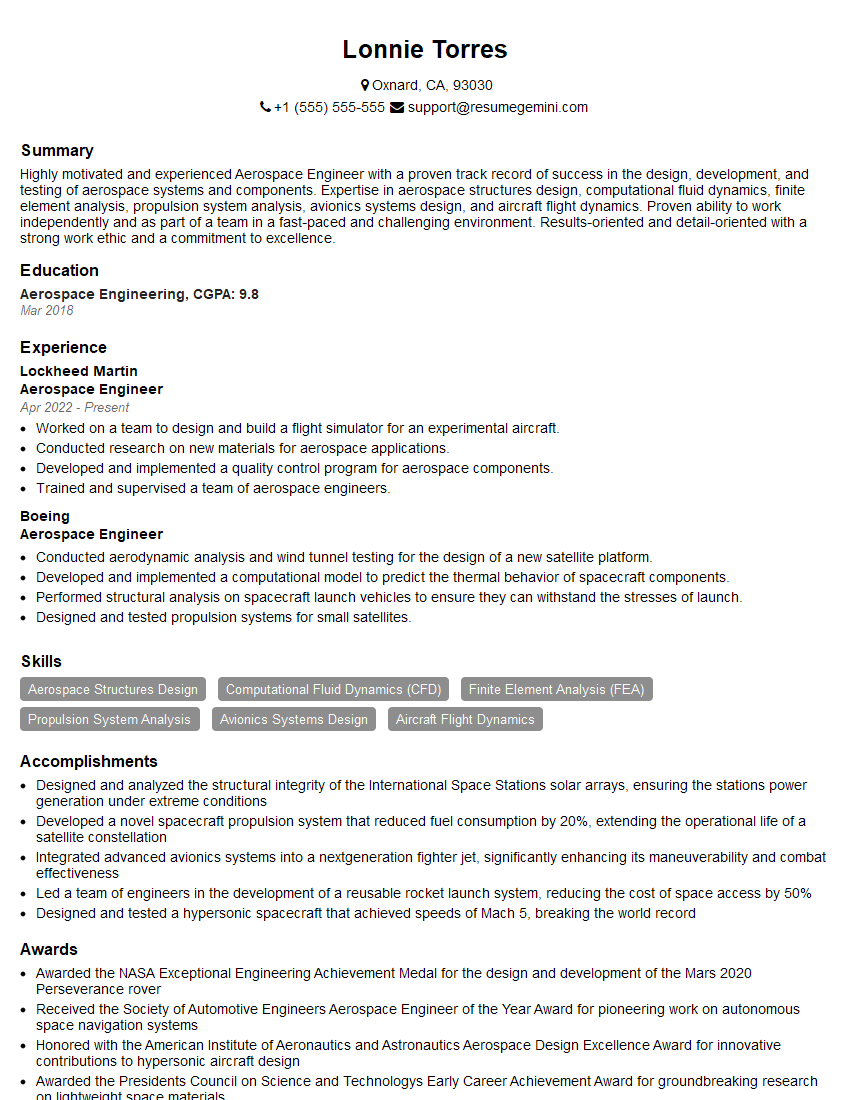
Aerospace Engineer Resume Sample

Validation Engineer Resume Sample

Control Systems Engineer Resume Sample
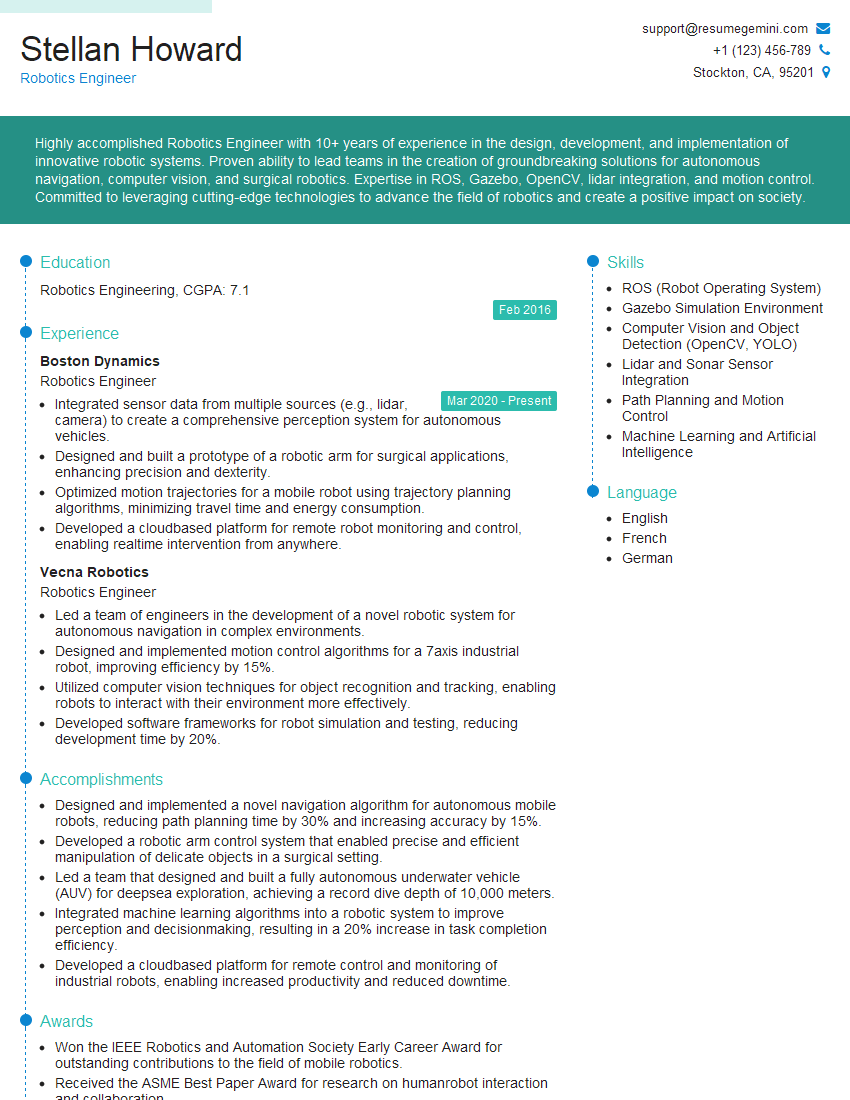
Robotics Engineer Resume Sample
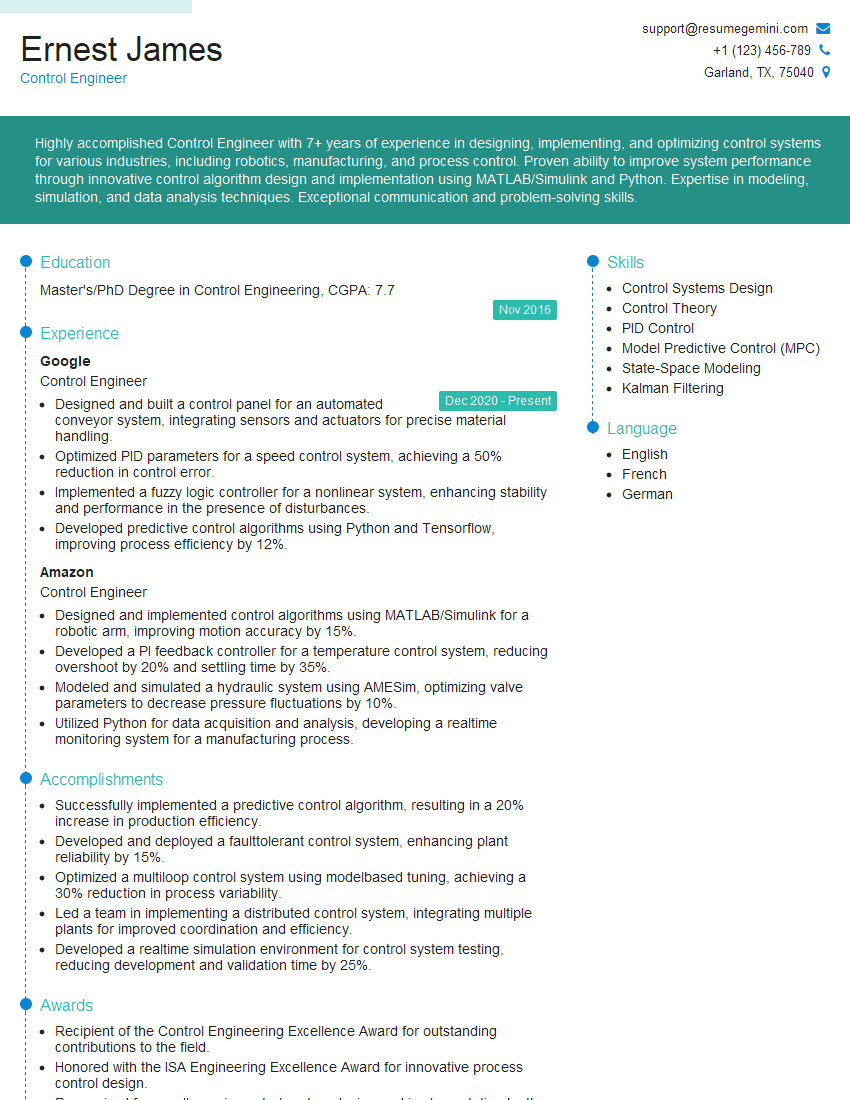
Control Engineer Resume Sample
Explore more articles
Users Rating of Our Blogs
Share Your Experience
We value your feedback! Please rate our content and share your thoughts (optional).
What Readers Say About Our Blog
Very informative content, great job.
good