Unlock your full potential by mastering the most common Knowledge of artificial intelligence interview questions. This blog offers a deep dive into the critical topics, ensuring you’re not only prepared to answer but to excel. With these insights, you’ll approach your interview with clarity and confidence.
Questions Asked in Knowledge of artificial intelligence Interview
Q 1. Explain the difference between supervised, unsupervised, and reinforcement learning.
The core difference between supervised, unsupervised, and reinforcement learning lies in how the algorithms learn from data. Think of it like teaching a dog:
- Supervised Learning: This is like explicitly showing your dog pictures of cats and dogs, telling them which is which. You provide labeled data – input data with corresponding correct outputs. The algorithm learns to map inputs to outputs. Examples include image classification (identifying cats vs. dogs) and spam detection (classifying emails as spam or not spam). The algorithm learns a function that maps inputs to the correct outputs.
- Unsupervised Learning: Here, you let your dog explore a room full of toys. You don’t tell it what each toy is; it has to figure things out on its own. You provide unlabeled data, and the algorithm finds patterns, structures, or relationships within the data. Examples include clustering (grouping similar data points together) and dimensionality reduction (reducing the number of variables while preserving important information). The goal is to discover underlying structure.
- Reinforcement Learning: This is like training your dog with treats and punishments. The algorithm learns through trial and error by interacting with an environment. It receives rewards for good actions and penalties for bad ones. The goal is to learn a policy – a strategy that maximizes cumulative reward over time. Examples include game playing (AlphaGo), robotics (teaching a robot to walk), and resource management (optimizing energy consumption in a smart grid).
In essence, supervised learning uses labeled data, unsupervised learning uses unlabeled data to find structure, and reinforcement learning learns through interaction and reward.
Q 2. What are the common challenges in implementing AI solutions?
Implementing AI solutions presents numerous challenges, often stemming from data, model limitations, and practical considerations:
- Data Quality and Quantity: AI models are data-hungry. Insufficient, noisy, or biased data can lead to inaccurate or unfair models. Imagine training a self-driving car on a dataset only containing sunny weather conditions; it will struggle in rain or snow.
- Model Complexity and Interpretability: Advanced models like deep neural networks are often ‘black boxes,’ making it difficult to understand why they make certain predictions. This lack of transparency can be a major hurdle in critical applications like medical diagnosis.
- Computational Resources: Training complex AI models requires significant computational power and time, which can be expensive and impractical for some organizations.
- Ethical Considerations: AI systems can perpetuate or amplify existing biases present in the data, leading to unfair or discriminatory outcomes. Ensuring fairness, accountability, and transparency is crucial.
- Integration and Deployment: Integrating AI models into existing systems and deploying them in a scalable and reliable manner can be challenging. This involves considerations like infrastructure, security, and maintenance.
Overcoming these challenges often requires careful planning, data preprocessing, model selection, thorough testing, and a multidisciplinary team with expertise in data science, engineering, and ethics.
Q 3. Describe different types of neural networks and their applications.
Neural networks come in various architectures, each suited for different tasks:
- Feedforward Neural Networks (FNNs): The simplest type, where information flows in one direction, from input to output, without loops. Used for classification and regression tasks. Example: Classifying images of handwritten digits.
- Convolutional Neural Networks (CNNs): Excellent for image and video processing, they use convolutional layers to extract features from spatial data. Example: Object detection in images, facial recognition.
- Recurrent Neural Networks (RNNs): Designed to process sequential data like text and time series. They have loops allowing information to persist over time. Example: Machine translation, natural language processing.
- Long Short-Term Memory (LSTM) networks: A specialized type of RNN designed to handle long-range dependencies in sequential data, addressing a limitation of basic RNNs. Example: Generating text, speech recognition.
- Autoencoders: Used for dimensionality reduction and feature extraction. They learn to encode data into a lower-dimensional representation and then decode it back, aiming to minimize information loss. Example: Anomaly detection, image compression.
- Generative Adversarial Networks (GANs): Consist of two networks, a generator and a discriminator, competing against each other. The generator creates synthetic data, and the discriminator tries to distinguish between real and fake data. Example: Creating realistic images, generating new music.
The choice of neural network depends heavily on the specific task and the nature of the data.
Q 4. Explain the bias-variance tradeoff.
The bias-variance tradeoff is a fundamental concept in machine learning. It describes the relationship between a model’s ability to fit the training data (variance) and its ability to generalize to unseen data (bias).
Bias refers to the error introduced by approximating a real-world problem, which might be complex, by a simplified model. A high-bias model makes strong assumptions about the data and may underfit, meaning it performs poorly on both training and testing data. Think of it as aiming for the wrong target.
Variance refers to the model’s sensitivity to fluctuations in the training data. A high-variance model fits the training data too closely, capturing noise and outliers. This leads to overfitting, where the model performs well on the training data but poorly on unseen data. Think of it as having excellent aim but shaky hands.
The goal is to find a balance. A model with low bias and low variance generalizes well. This is often achieved through techniques like cross-validation, regularization, and using appropriate model complexity.
Q 5. How do you handle imbalanced datasets?
Imbalanced datasets, where one class has significantly more samples than others, pose a challenge for many machine learning algorithms. They tend to favor the majority class, leading to poor performance on the minority class. Here are some ways to handle this:
- Resampling Techniques:
- Oversampling: Increase the number of samples in the minority class by duplicating existing samples or generating synthetic samples (e.g., SMOTE – Synthetic Minority Over-sampling Technique).
- Undersampling: Decrease the number of samples in the majority class by randomly removing samples.
- Cost-Sensitive Learning: Assign different misclassification costs to different classes, penalizing errors on the minority class more heavily.
- Ensemble Methods: Use ensemble methods like bagging or boosting, which can combine predictions from multiple models trained on different subsets of the data.
- Anomaly Detection Techniques: If the minority class represents anomalies or outliers, consider using anomaly detection methods instead of traditional classification.
The best approach depends on the specific dataset and the problem at hand. Experimentation and careful evaluation are crucial.
Q 6. What are some common evaluation metrics for machine learning models?
The choice of evaluation metrics depends on the specific machine learning task and the business goals. Some common metrics include:
- Accuracy: The percentage of correctly classified instances. Simple to understand but can be misleading with imbalanced datasets.
- Precision: Out of all the instances predicted as positive, what proportion was actually positive? Important when minimizing false positives.
- Recall (Sensitivity): Out of all the actual positive instances, what proportion was correctly predicted? Important when minimizing false negatives.
- F1-Score: The harmonic mean of precision and recall, providing a balanced measure. Useful when both precision and recall are important.
- AUC-ROC (Area Under the Receiver Operating Characteristic Curve): Measures the ability of a classifier to distinguish between classes across different thresholds. Useful for evaluating the overall performance of a binary classifier.
- Mean Squared Error (MSE) and Root Mean Squared Error (RMSE): Measure the average squared difference between predicted and actual values for regression tasks.
- R-squared: Represents the proportion of variance in the dependent variable explained by the model in regression tasks.
It’s often beneficial to use a combination of metrics to get a comprehensive understanding of a model’s performance.
Q 7. Explain the concept of overfitting and how to prevent it.
Overfitting occurs when a model learns the training data too well, including its noise and outliers, resulting in poor generalization to unseen data. Imagine memorizing the answers to a test instead of understanding the underlying concepts; you’ll do well on that specific test but poorly on a similar one.
Here are some ways to prevent overfitting:
- Cross-Validation: Evaluate the model’s performance on multiple subsets of the data to get a more reliable estimate of its generalization ability.
- Regularization: Add penalty terms to the model’s objective function to discourage overly complex models (e.g., L1 and L2 regularization). This shrinks the model’s parameters, making it less sensitive to noise.
- Data Augmentation: Increase the size and diversity of the training data by artificially creating new samples from existing ones (e.g., rotating images, adding noise to audio).
- Feature Selection/Engineering: Carefully choose the features used in the model, removing irrelevant or redundant ones. This simplifies the model and reduces overfitting.
- Dropout (for Neural Networks): Randomly ignore neurons during training to prevent the network from relying too heavily on any single neuron.
- Early Stopping: Monitor the model’s performance on a validation set during training and stop training when performance starts to decrease.
By employing these techniques, you can build models that are both accurate on the training data and generalize well to new, unseen data.
Q 8. Describe different regularization techniques.
Regularization techniques are crucial in machine learning to prevent overfitting, a scenario where a model learns the training data too well and performs poorly on unseen data. They work by adding a penalty to the model’s complexity, discouraging it from fitting the noise in the training set. Here are some common techniques:
- L1 Regularization (Lasso): Adds a penalty term proportional to the absolute value of the model’s weights. This encourages sparsity, meaning many weights become zero, effectively performing feature selection. Imagine it as a sculptor chipping away unnecessary details to reveal the essence of the statue.
loss = original_loss + λ * Σ|w|where λ is the regularization strength and w are the model weights. - L2 Regularization (Ridge): Adds a penalty term proportional to the square of the model’s weights. This shrinks the weights towards zero, but unlike L1, it doesn’t force them to be exactly zero. Think of it as gently smoothing the surface of the statue, reducing sharp features.
- Elastic Net: A combination of L1 and L2 regularization, offering the benefits of both sparsity and weight shrinkage. It’s a flexible approach that can be particularly useful when dealing with highly correlated features.
Choosing the right regularization technique often involves experimentation and validation. The optimal λ value is usually determined through techniques like cross-validation.
Q 9. What are hyperparameters and how do you tune them?
Hyperparameters are settings that control the learning process of a machine learning model, but are not learned directly from the data itself. Think of them as the knobs and dials you adjust on a machine to optimize its performance. Examples include the learning rate in gradient descent, the number of hidden layers in a neural network, or the C parameter in a Support Vector Machine.
Hyperparameter tuning involves finding the optimal set of hyperparameters that yield the best model performance. Common techniques include:
- Grid Search: Systematically tries all combinations of hyperparameters within a predefined range. It’s thorough but can be computationally expensive for many hyperparameters.
- Random Search: Randomly samples hyperparameter combinations from a specified distribution. Often more efficient than grid search, especially when the optimal hyperparameter settings are not uniformly distributed across the search space.
- Bayesian Optimization: A more sophisticated approach that uses a probabilistic model to guide the search, focusing on promising areas of the hyperparameter space. It’s computationally more intensive but can be more efficient for complex models.
Cross-validation is almost always used to evaluate the performance of different hyperparameter settings, ensuring the selected settings generalize well to unseen data. Tools like scikit-learn in Python simplify the process significantly.
Q 10. Explain the difference between precision and recall.
Precision and recall are metrics used to evaluate the performance of a classification model, particularly in scenarios with imbalanced classes. Imagine a spam filter:
- Precision answers: “Of all the emails the filter flagged as spam, what proportion was actually spam?” A high precision means the filter rarely mislabels legitimate emails as spam (few false positives).
- Recall answers: “Of all the spam emails, what proportion did the filter correctly identify?” A high recall means the filter rarely misses actual spam emails (few false negatives).
There’s often a trade-off between precision and recall. Improving one might worsen the other. For instance, increasing the sensitivity of the spam filter (higher recall) might lead to more legitimate emails being flagged as spam (lower precision).
The F1-score, the harmonic mean of precision and recall, provides a single metric to balance both.
Q 11. What are some common techniques for feature selection and engineering?
Feature selection and engineering are critical steps in building effective machine learning models. They deal with transforming raw data into a format suitable for model training.
Feature Selection aims to choose the most relevant features from the original dataset. Techniques include:
- Filter methods: Use statistical measures (e.g., correlation, chi-squared test) to rank features based on their relevance to the target variable. Simple and fast, but may miss interactions between features.
- Wrapper methods: Evaluate subsets of features using a model’s performance as a criterion. More computationally expensive but can capture feature interactions. Recursive feature elimination is a common example.
- Embedded methods: Integrate feature selection into the model training process itself. L1 regularization is an example, as it effectively performs feature selection by shrinking irrelevant feature weights to zero.
Feature Engineering involves creating new features from existing ones to improve model performance. This might involve:
- Combining features: Creating interaction terms or ratios of existing features.
- Transforming features: Applying mathematical functions (e.g., log transformation, standardization) to improve feature distribution.
- Encoding categorical features: Converting categorical variables into numerical representations using one-hot encoding or label encoding.
A good feature engineering strategy often involves domain expertise and creativity, drawing upon understanding of the data and problem.
Q 12. Explain the concept of a confusion matrix.
A confusion matrix is a table that visualizes the performance of a classification model by summarizing the counts of true positive (TP), true negative (TN), false positive (FP), and false negative (FN) predictions. Imagine it as a report card for your model.
Let’s say you’re building a model to detect fraudulent transactions. The confusion matrix would look like this:
| Predicted Fraudulent | Predicted Non-Fraudulent | |
|---|---|---|
| Actual Fraudulent | TP (Correctly identified fraudulent transactions) | FN (Missed fraudulent transactions) |
| Actual Non-Fraudulent | FP (Incorrectly flagged as fraudulent) | TN (Correctly identified non-fraudulent transactions) |
From this, you can calculate metrics like accuracy, precision, recall, and F1-score to get a comprehensive understanding of your model’s performance.
Q 13. How do you handle missing data?
Missing data is a common challenge in real-world datasets. Several strategies exist for handling it:
- Deletion: Simple but can lead to significant information loss, especially if data is missing systematically. Includes removing rows (listwise deletion) or columns (pairwise deletion) with missing values.
- Imputation: Replacing missing values with estimated ones. Common techniques include:
- Mean/Median/Mode imputation: Replacing missing values with the mean, median, or mode of the respective feature. Simple but can distort the distribution if there’s a lot of missing data.
- K-Nearest Neighbors (KNN) imputation: Imputes missing values based on the values of similar data points. More sophisticated than simple imputation.
- Multiple Imputation: Generates multiple plausible imputed datasets and combines the results. Reduces bias compared to single imputation.
- Model-based imputation: Using a predictive model (e.g., regression, decision tree) to predict missing values based on other features. Can be effective but requires careful model selection.
The best approach depends on the nature of the missing data (Missing Completely at Random (MCAR), Missing at Random (MAR), or Missing Not at Random (MNAR)) and the characteristics of the dataset. It’s often a good idea to experiment with different strategies and evaluate their impact on model performance.
Q 14. Describe different dimensionality reduction techniques.
Dimensionality reduction techniques aim to reduce the number of variables (features) in a dataset while preserving as much information as possible. This helps to improve model performance, reduce computational cost, and enhance interpretability. Here are some common methods:
- Principal Component Analysis (PCA): A linear transformation that projects the data onto a lower-dimensional subspace spanned by the principal components, which capture the most variance in the data. Think of it as finding the most important axes to represent your data.
- t-distributed Stochastic Neighbor Embedding (t-SNE): A non-linear technique particularly useful for visualization. It maps high-dimensional data to a lower-dimensional space while preserving local neighborhood relationships. Useful for exploring data structure but not suitable for model training directly.
- Linear Discriminant Analysis (LDA): A supervised technique that aims to find linear combinations of features that maximize the separation between classes. It’s particularly effective in classification tasks.
- Autoencoders: Neural networks trained to reconstruct their input. By restricting the size of the hidden layer, they learn a compressed representation of the data, achieving dimensionality reduction. This can capture more complex non-linear relationships compared to linear methods like PCA.
The choice of technique depends on the nature of the data, the dimensionality reduction goal (visualization, model training), and the computational resources available.
Q 15. What are the different types of clustering algorithms?
Clustering algorithms are unsupervised machine learning techniques used to group similar data points together. Think of it like sorting a pile of unsorted socks – you group them by color, type, etc., without knowing beforehand which socks belong together. There are many different types, each with its strengths and weaknesses:
- K-Means Clustering: This is arguably the most popular. It partitions data into k clusters, where k is a pre-defined number. The algorithm iteratively assigns points to the nearest centroid (mean) of a cluster and recalculates centroids until convergence. It’s simple and relatively fast, but sensitive to initial centroid placement and assumes spherical clusters.
- Hierarchical Clustering: This builds a hierarchy of clusters. Agglomerative clustering starts with each point as a separate cluster and merges the closest clusters iteratively. Divisive clustering does the opposite, starting with one cluster and recursively splitting it. It’s good for visualizing relationships between clusters but can be computationally expensive for large datasets.
- DBSCAN (Density-Based Spatial Clustering of Applications with Noise): This algorithm groups points based on density. It identifies core points (points with a minimum number of neighbors within a specified radius) and expands clusters around them. It’s robust to outliers and can identify clusters of arbitrary shapes, but choosing the right parameters (radius and minimum neighbors) is crucial.
- Gaussian Mixture Models (GMM): This probabilistic approach assumes data points are generated from a mixture of Gaussian distributions. Each Gaussian represents a cluster, and the algorithm estimates the parameters (mean and covariance) of each distribution. It’s flexible and handles overlapping clusters well but can be computationally intensive.
The choice of algorithm depends on the data and the desired outcome. For instance, K-Means is great for quickly finding a rough grouping, while DBSCAN is preferred for datasets with irregular clusters and noise.
Career Expert Tips:
- Ace those interviews! Prepare effectively by reviewing the Top 50 Most Common Interview Questions on ResumeGemini.
- Navigate your job search with confidence! Explore a wide range of Career Tips on ResumeGemini. Learn about common challenges and recommendations to overcome them.
- Craft the perfect resume! Master the Art of Resume Writing with ResumeGemini’s guide. Showcase your unique qualifications and achievements effectively.
- Don’t miss out on holiday savings! Build your dream resume with ResumeGemini’s ATS optimized templates.
Q 16. Explain the concept of cross-validation.
Cross-validation is a crucial technique in machine learning to evaluate a model’s performance and prevent overfitting. Overfitting happens when a model performs exceptionally well on the training data but poorly on unseen data. Cross-validation addresses this by systematically splitting the data into multiple subsets (folds).
Imagine you’re baking a cake. You wouldn’t just taste one tiny bit to determine if it’s good; you’d sample different parts to get a more accurate idea. Cross-validation is similar. The most common type is k-fold cross-validation:
- Split the data: Divide the dataset into k equal-sized folds.
- Train and test: Train the model on k-1 folds and test it on the remaining fold.
- Repeat: Repeat steps 1 and 2, using a different fold as the test set each time.
- Average: Average the performance metrics (e.g., accuracy, precision) across all k folds. This gives a more robust estimate of the model’s generalization ability.
Other variations include leave-one-out cross-validation (LOOCV) where each data point is treated as a test set and stratified k-fold cross-validation, ensuring each fold maintains the class proportions of the original dataset.
Q 17. What are some ethical considerations in AI development?
Ethical considerations in AI development are paramount. AI systems, if not developed responsibly, can perpetuate or amplify existing biases, lead to job displacement, and even pose safety risks. Key ethical considerations include:
- Bias and Fairness: AI models are trained on data, and if that data reflects societal biases (e.g., gender, race), the model will likely inherit and amplify those biases. Mitigation strategies involve careful data curation, algorithmic fairness techniques, and ongoing monitoring.
- Privacy and Security: AI systems often process sensitive personal data. Protecting this data through robust security measures and adhering to privacy regulations (like GDPR) is critical.
- Transparency and Explainability: Understanding how an AI system arrives at a decision is crucial, particularly in high-stakes applications (e.g., loan applications, medical diagnosis). Explainable AI (XAI) techniques aim to make AI decision-making more transparent.
- Accountability and Responsibility: Determining who is responsible when an AI system makes a mistake is a complex issue. Clear lines of accountability need to be established.
- Job Displacement: Automation driven by AI can lead to job losses. Strategies for reskilling and upskilling the workforce are crucial to mitigate this impact.
Ethical AI development requires a multidisciplinary approach, involving AI experts, ethicists, policymakers, and the wider public in ongoing dialogue and collaboration.
Q 18. Describe different types of deep learning architectures (e.g., CNN, RNN, LSTM).
Deep learning architectures are complex neural networks with multiple layers. Different architectures are suited to different types of data and tasks:
- Convolutional Neural Networks (CNNs): CNNs excel at processing grid-like data, such as images and videos. They use convolutional layers to detect features at different scales and pooling layers to reduce dimensionality. Imagine a CNN scanning an image, gradually recognizing edges, then shapes, and finally objects.
- Recurrent Neural Networks (RNNs): RNNs are designed for sequential data, like text and time series. They have loops that allow information to persist from one time step to the next. Think of an RNN reading a sentence word by word, remembering the context of previous words to understand the meaning of the whole sentence.
- Long Short-Term Memory (LSTMs): LSTMs are a specialized type of RNN designed to address the vanishing gradient problem, which hinders RNNs from learning long-range dependencies in sequences. They have a more sophisticated internal structure that helps them remember information over longer periods. This is crucial for tasks like machine translation, where understanding the entire sentence is essential.
Other notable architectures include Generative Adversarial Networks (GANs) for generating new data, Autoencoders for dimensionality reduction, and Transformers, which are highly effective for natural language processing tasks.
Q 19. Explain the backpropagation algorithm.
Backpropagation is the algorithm used to train neural networks. It’s the core of how neural networks learn from data. Imagine a network making a prediction, and comparing that prediction to the actual value. The difference is the error.
Backpropagation works by calculating the gradient of the error function with respect to the network’s weights. The gradient indicates the direction of steepest ascent of the error function. By moving the weights in the opposite direction (descent), we reduce the error. This is done iteratively, adjusting weights slightly with each step until the error is minimized.
The process involves three steps for each training example:
- Forward Pass: The input data propagates through the network, and the output is computed.
- Error Calculation: The difference between the network’s output and the actual target value is calculated.
- Backward Pass: The error is propagated backward through the network, and the gradients of the error with respect to the weights are calculated using the chain rule of calculus. These gradients are then used to update the weights, using an optimization algorithm like gradient descent.
This iterative process refines the network’s weights, gradually improving its accuracy. The chain rule enables efficient calculation of gradients, even for very deep networks.
Q 20. How do you choose the right algorithm for a given problem?
Choosing the right algorithm depends heavily on the nature of the problem and the data. There’s no one-size-fits-all answer. Here’s a structured approach:
- Understand the problem: Clearly define the goal (e.g., classification, regression, clustering). Is it a supervised or unsupervised learning task? What are the key characteristics of the data (e.g., size, dimensionality, noise level)?
- Explore data: Visualize and analyze your data to understand its distribution, identify outliers, and check for missing values. This step helps in making informed decisions about preprocessing and feature engineering.
- Consider algorithm properties: Each algorithm has its strengths and limitations. Consider factors like computational complexity, scalability, sensitivity to outliers, and the assumptions made about the data.
- Experiment and compare: Try out several algorithms and evaluate their performance using appropriate metrics. Cross-validation is essential for a robust evaluation.
- Iterate and refine: The best algorithm is often discovered through experimentation. Fine-tune hyperparameters, try different preprocessing techniques, and potentially explore ensemble methods to improve performance.
For example, if you have a large dataset with high dimensionality and you need to perform classification, you might start with a decision tree or a random forest. If you have sequential data, an RNN or LSTM might be more appropriate. If you have unlabeled data and want to discover patterns, a clustering algorithm like K-means or DBSCAN would be suitable.
Q 21. Explain the concept of gradient descent.
Gradient descent is an iterative optimization algorithm used to find the minimum of a function. Imagine you’re hiking down a mountain in dense fog; you can’t see the bottom, but you can feel the slope. You take small steps downhill, always following the steepest descent, eventually reaching the bottom (or a local minimum).
In machine learning, the function we want to minimize is the loss function (or error function), which measures the difference between the model’s predictions and the actual values. The gradient is a vector that points in the direction of the steepest ascent of the function. Gradient descent works by iteratively updating the model’s parameters (weights) in the opposite direction of the gradient, taking small steps towards the minimum.
Different variations of gradient descent exist:
- Batch Gradient Descent: Calculates the gradient using the entire dataset in each iteration. This is accurate but can be slow for large datasets.
- Stochastic Gradient Descent (SGD): Calculates the gradient using a single data point (or a small batch) in each iteration. This is faster but introduces more noise.
- Mini-batch Gradient Descent: A compromise between batch and stochastic gradient descent. It uses a small batch of data points to calculate the gradient.
The learning rate, which determines the size of the steps taken downhill, is a crucial hyperparameter. A learning rate that is too large can lead to oscillations and failure to converge, while a learning rate that is too small can result in slow convergence.
Q 22. What are some common techniques for model deployment?
Model deployment involves making your trained AI model accessible and usable in a real-world application. This isn’t a simple ‘copy-paste’ process; it requires careful consideration of several factors. Common techniques include:
- Cloud Deployment: Services like AWS SageMaker, Google Cloud AI Platform, and Azure Machine Learning provide managed infrastructure for deploying and scaling models. They handle resource allocation, monitoring, and versioning, simplifying the process significantly. For example, you might deploy a sentiment analysis model to a cloud platform to analyze customer feedback in real-time.
- On-Premise Deployment: Deploying directly onto a company’s own servers offers greater control and security but requires more hands-on management of infrastructure and resources. This is often preferred when data privacy or security regulations are stringent.
- Serverless Deployment: Using functions-as-a-service (FaaS) like AWS Lambda or Google Cloud Functions allows deploying individual model components as independent functions, triggered by events. This is cost-effective for infrequent or event-driven tasks.
- Edge Deployment: Deploying models directly onto edge devices like smartphones, IoT sensors, or embedded systems minimizes latency and bandwidth requirements. This is crucial for applications requiring real-time processing with limited connectivity, such as autonomous vehicle navigation.
- Containerization (Docker): Packaging your model and its dependencies within a Docker container ensures consistent execution across different environments, simplifying deployment and scaling across various platforms. This creates a portable and reproducible environment.
The best technique depends heavily on factors like the model’s size, the required latency, scalability needs, security considerations, and available infrastructure.
Q 23. How do you ensure the scalability and maintainability of your AI models?
Ensuring scalability and maintainability of AI models is paramount for long-term success. It requires a proactive approach throughout the entire lifecycle, starting with the design phase. Key strategies include:
- Modular Design: Break down complex models into smaller, independent modules. This allows for easier maintenance, updates, and scaling of individual components without impacting the entire system. Think of it like assembling a car – you can replace parts individually instead of rebuilding the whole thing.
- Microservices Architecture: Deploying individual model components as microservices enhances scalability and fault tolerance. If one service fails, the others can continue operating. This architecture is exceptionally resilient.
- Version Control (Git): Utilize Git to manage model code, data, and configurations, enabling easy tracking of changes, collaboration, and rollbacks to previous versions.
- Automated Testing and CI/CD: Implement continuous integration and continuous deployment (CI/CD) pipelines to automate model testing, deployment, and monitoring. This ensures consistent quality and efficient updates.
- Monitoring and Logging: Implement robust monitoring and logging mechanisms to track model performance, resource usage, and potential issues. This allows for proactive identification and resolution of problems.
- Scalable Infrastructure (Cloud): Leverage cloud platforms for their inherent scalability and elasticity. They allow you to adjust computing resources automatically based on demand, handling fluctuations in workload seamlessly.
By embracing these practices, you minimize downtime, improve efficiency, and ensure your models remain robust and adaptable to evolving requirements.
Q 24. What experience do you have with specific AI frameworks (e.g., TensorFlow, PyTorch)?
I possess extensive experience with both TensorFlow and PyTorch, two leading deep learning frameworks. My experience encompasses:
- TensorFlow: I’ve used TensorFlow extensively for building and deploying various models, including CNNs for image classification, RNNs for time-series analysis, and transformers for natural language processing. I’m comfortable using TensorFlow’s high-level APIs like Keras for rapid prototyping, as well as its lower-level APIs for more fine-grained control. I’ve also leveraged TensorFlow Serving for deploying models in production environments.
- PyTorch: PyTorch’s dynamic computation graph and intuitive API make it ideal for research and development. I’ve used it for building complex models, including generative adversarial networks (GANs) and graph neural networks (GNNs). I’m proficient in utilizing PyTorch Lightning for simplifying model training and deployment.
My expertise extends beyond simply using these frameworks. I understand their underlying mechanisms, strengths, and limitations, enabling me to make informed decisions about which framework is most suitable for a given task.
I am also familiar with other frameworks like scikit-learn for simpler machine learning tasks. The choice of framework always depends on the project’s specific needs and constraints.
Q 25. Explain your understanding of different AI model architectures (e.g., transformers, autoencoders).
AI model architectures are the blueprints of our AI systems. Different architectures are suited for different tasks. Let’s explore some key ones:
- Transformers: Transformers, particularly those based on the attention mechanism, revolutionized natural language processing. They excel at capturing long-range dependencies in sequential data. Examples include BERT, GPT, and their variants. They’re also finding applications beyond NLP, such as in computer vision.
- Autoencoders: Autoencoders are used for dimensionality reduction, feature extraction, and anomaly detection. They learn compressed representations of data by encoding the input into a lower-dimensional latent space and then decoding it back to the original dimension. Variational autoencoders (VAEs) and denoising autoencoders are popular variants.
- Convolutional Neural Networks (CNNs): CNNs are particularly effective for image processing and computer vision tasks. They utilize convolutional layers to extract features from images, making them adept at identifying patterns and objects.
- Recurrent Neural Networks (RNNs): RNNs are designed for sequential data like text and time series. LSTMs and GRUs are advanced RNN architectures that mitigate the vanishing gradient problem, making them better suited for longer sequences.
- Generative Adversarial Networks (GANs): GANs consist of two networks, a generator and a discriminator, that compete against each other. The generator creates synthetic data, while the discriminator tries to distinguish between real and synthetic data. This adversarial training process leads to the generation of highly realistic data.
The choice of architecture depends critically on the problem at hand. For instance, transformers are a natural choice for NLP tasks, while CNNs are well-suited for image recognition.
Q 26. Describe a time you encountered a challenging AI problem and how you solved it.
In a previous project, we faced a significant challenge in developing a fraud detection model for online transactions. The dataset was highly imbalanced, with fraudulent transactions representing a tiny fraction of the total transactions. This imbalance led to poor performance on the minority class (fraudulent transactions).
To address this, we employed several techniques:
- Resampling Techniques: We used oversampling techniques like SMOTE (Synthetic Minority Over-sampling Technique) to artificially increase the number of fraudulent transactions in the training data. This helped to balance the class distribution.
- Cost-Sensitive Learning: We adjusted the cost function to penalize misclassifications of fraudulent transactions more heavily. This encouraged the model to pay more attention to the minority class.
- Anomaly Detection Techniques: We explored anomaly detection techniques like Isolation Forest and One-Class SVM, which are specifically designed for imbalanced datasets. These methods focused on identifying unusual transactions that deviate from the norm.
- Ensemble Methods: We combined multiple models using techniques like bagging and boosting to improve overall accuracy and robustness. This approach leveraged the strengths of different models to handle the complexities of the imbalanced data.
By combining these techniques, we significantly improved the model’s ability to detect fraudulent transactions, resulting in a more effective fraud detection system. This experience highlighted the importance of carefully considering data characteristics and selecting appropriate techniques when dealing with challenging datasets.
Q 27. What are some current trends and future directions in AI?
The field of AI is rapidly evolving. Some key current trends and future directions include:
- Large Language Models (LLMs) and Generative AI: LLMs continue to push the boundaries of natural language processing, leading to advancements in text generation, translation, and question answering. Generative AI is expanding into various domains, including image, audio, and video generation.
- Explainable AI (XAI): The demand for transparency and interpretability in AI systems is growing. Research in XAI focuses on developing methods to make AI models more understandable and trustworthy.
- Federated Learning: This approach allows training models on decentralized data sources without directly sharing the data, addressing privacy concerns. It’s becoming increasingly important in healthcare and other sensitive domains.
- Reinforcement Learning (RL): RL is gaining traction in robotics, game playing, and other applications where an agent learns through interaction with an environment. Advancements in RL algorithms are enabling more complex and autonomous systems.
- AI for Science: AI is being increasingly applied to scientific discovery, accelerating research in areas like drug discovery, materials science, and climate modeling.
- Edge AI: The trend towards deploying AI models directly on edge devices is expanding, enabling faster processing and reduced reliance on cloud connectivity.
The future of AI promises even more transformative applications, but ethical considerations, bias mitigation, and responsible AI development remain critical areas of focus.
Q 28. Explain your understanding of explainable AI (XAI).
Explainable AI (XAI) focuses on making AI models and their decisions more transparent and understandable. It’s crucial for building trust, ensuring fairness, and debugging complex models. Without XAI, we might have highly accurate models, but we wouldn’t understand *why* they make specific predictions. This lack of understanding can lead to unintended biases, errors, or simply a lack of confidence in the system’s outputs.
Several approaches are used in XAI:
- Model-Agnostic Methods: These techniques don’t require modifying the underlying model. Examples include LIME (Local Interpretable Model-agnostic Explanations) and SHAP (SHapley Additive exPlanations), which explain individual predictions by approximating the model’s behavior locally.
- Model-Specific Methods: These methods are tailored to particular model architectures. For instance, decision trees are inherently interpretable due to their structure, while simpler linear models provide directly interpretable weights.
- Visualization Techniques: Visualizing model outputs, feature importance, and decision processes aids in understanding how the model works. Techniques such as saliency maps highlight the image regions contributing most to a classification.
The choice of XAI technique depends on the model’s complexity, the desired level of explanation, and the context of the application. It’s not a ‘one-size-fits-all’ solution; careful consideration is needed to select the most appropriate methods.
Key Topics to Learn for Your Artificial Intelligence Interview
Ace your next interview by mastering these fundamental AI concepts. We’ve structured this guide to help you build a strong foundation, combining theory with practical application.
- Machine Learning Fundamentals: Understand supervised, unsupervised, and reinforcement learning. Be prepared to discuss algorithms like linear regression, logistic regression, decision trees, and support vector machines. Consider practical applications such as fraud detection or image classification.
- Deep Learning Architectures: Familiarize yourself with neural networks, convolutional neural networks (CNNs) for image processing, and recurrent neural networks (RNNs) for sequential data. Discuss their applications in areas like natural language processing (NLP) and computer vision.
- Natural Language Processing (NLP): Explore techniques like tokenization, stemming, and lemmatization. Understand different NLP tasks such as sentiment analysis, text summarization, and machine translation. Be ready to discuss practical applications in chatbots or language models.
- Computer Vision: Gain a solid understanding of image recognition, object detection, and image segmentation. Discuss the role of CNNs in these applications and be prepared to discuss real-world examples such as self-driving cars or medical image analysis.
- Data Preprocessing and Feature Engineering: Master techniques for cleaning, transforming, and selecting relevant features from datasets. This is crucial for building effective AI models. Discuss the impact of data quality on model performance.
- Model Evaluation and Selection: Understand various metrics for evaluating model performance (e.g., precision, recall, F1-score, AUC). Be prepared to discuss different model selection strategies and techniques for avoiding overfitting and underfitting.
- Ethical Considerations in AI: Demonstrate awareness of the ethical implications of AI, such as bias in algorithms and the responsible use of AI technologies. This is increasingly important in interviews.
Next Steps: Unlock Your AI Career Potential
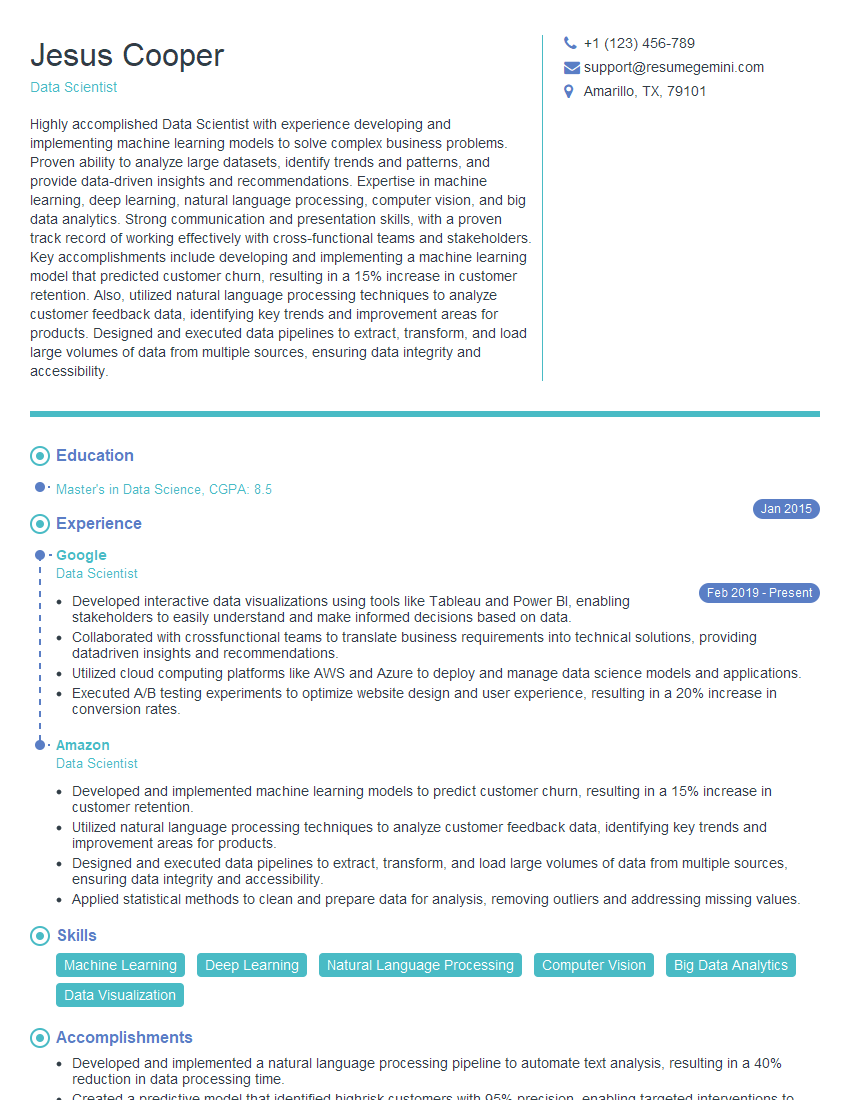
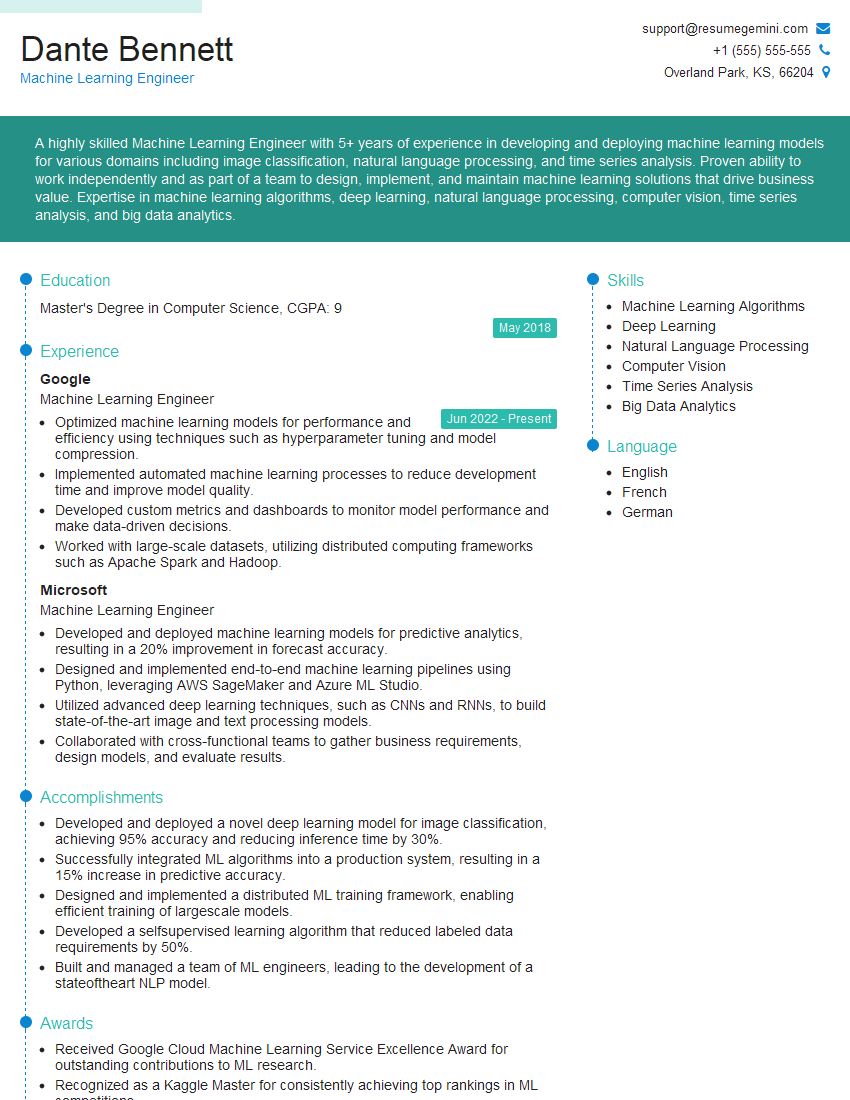
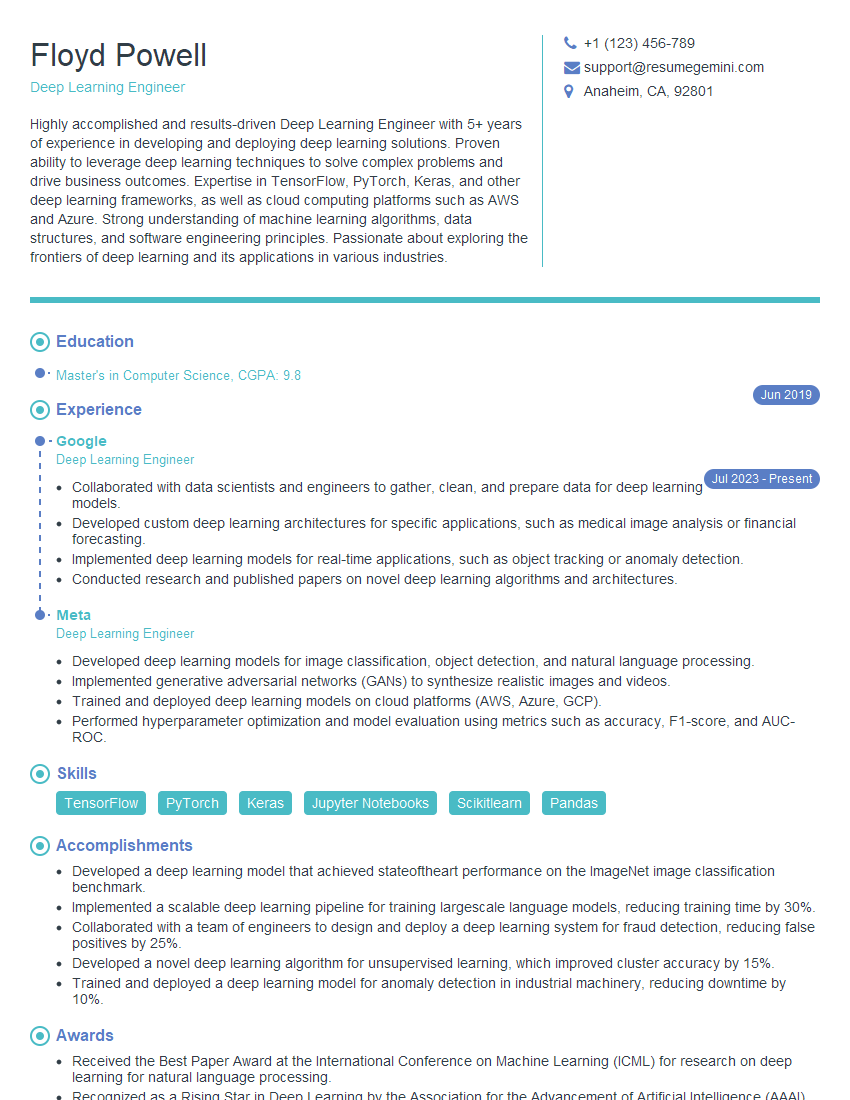
A strong understanding of artificial intelligence is paramount for career advancement in today’s tech landscape. To stand out, create an ATS-friendly resume that showcases your skills and experience effectively. ResumeGemini is a trusted resource that can help you build a professional and impactful resume tailored to the AI industry. We offer examples of resumes specifically designed for AI professionals, providing you with a template to craft your perfect application. Take the next step towards your dream AI career today!

Explore more articles
Users Rating of Our Blogs
Share Your Experience
We value your feedback! Please rate our content and share your thoughts (optional).
What Readers Say About Our Blog
Very informative content, great job.
good