The right preparation can turn an interview into an opportunity to showcase your expertise. This guide to Long Distance Shot Accuracy interview questions is your ultimate resource, providing key insights and tips to help you ace your responses and stand out as a top candidate.
Questions Asked in Long Distance Shot Accuracy Interview
Q 1. Explain the concept of bullet drop compensation.
Bullet drop compensation is the crucial adjustment made to account for the effect of gravity on a projectile’s trajectory over long distances. Unlike short-range shots where gravity’s influence is minimal, at longer ranges, gravity causes the bullet to arc downwards significantly. This drop needs to be accounted for by aiming higher than the target to compensate.
Imagine throwing a baseball. At short distances, you aim directly at your target. But at a long distance, you’d need to throw it upward at an angle to compensate for the ball’s downward trajectory. Bullet drop compensation is the equivalent of that angle adjustment for firearms.
Compensation is typically achieved by using a ballistic calculator, aiming higher on the target, or utilizing the adjustments on a riflescope’s turrets to adjust for the known bullet drop at a specific range. Different cartridges and bullets will have different drop characteristics; therefore, knowing your ammunition’s ballistic coefficients is crucial.
Q 2. Describe different methods for windage correction.
Windage correction is adjusting for the effect of wind on a bullet’s flight path. Wind pushes the bullet off course, requiring adjustments to counteract its effects and maintain accuracy. Several methods exist for windage correction:
Using a Wind Meter: This is the most accurate method. A handheld wind meter measures wind speed and direction, providing precise data for input into a ballistic calculator or for direct application to your scope’s windage turret.
Visual Wind Estimation: Experienced shooters can estimate wind speed by observing its effects on surrounding objects, like swaying vegetation or dust devils. This requires significant practice and experience to master. Mil-dots in scopes can provide a visual cue for estimating wind drift.
Using a Ballistic Calculator/Software: These tools take into account various factors, including wind speed, direction, bullet characteristics, and range to predict wind drift and give you a precise correction value in MOA or MILs.
It’s important to note that wind doesn’t blow consistently at the same speed and direction throughout the bullet’s flight path. Understanding wind speed and changes in wind speed over the distance to the target is critical.
Q 3. What factors influence bullet trajectory?
Many factors influence bullet trajectory. Understanding these factors is critical for achieving consistent long-range accuracy:
Gravity: As discussed previously, gravity causes the bullet to drop.
Air Density: This is affected by temperature, humidity, and barometric pressure. Denser air provides more resistance, causing the bullet to slow down faster and drop more.
Wind: Wind pushes the bullet off course.
Coriolis Effect: This is a subtle effect caused by the Earth’s rotation; it becomes more significant at extreme ranges.
Bullet Characteristics: The bullet’s weight, shape (ballistic coefficient), and muzzle velocity significantly affect its trajectory.
Rifle Characteristics: The rifle’s barrel length and twist rate influence the stability and velocity of the bullet.
Sight Height: The distance between the scope and the bore affects the trajectory.
Any change in one of these factors will significantly affect the bullet’s path. Precision long-range shooting demands careful consideration of all these factors.
Q 4. How do you account for environmental conditions (temperature, humidity, barometric pressure) in long-range shooting?
Environmental conditions drastically impact bullet trajectory. To account for them, advanced shooters utilize:
Weather Stations: These provide real-time data on temperature, humidity, barometric pressure, and wind speed. This data is then fed into a ballistic calculator for precise corrections.
Ballistic Calculators: Modern ballistic calculators/software allow you to input these environmental parameters alongside bullet characteristics, rifle information, and range to predict the bullet’s flight path with a high degree of accuracy.
Kestrel Meters: These combine wind meter and environmental sensors in a single device providing complete data for ballistic solutions.
Ignoring environmental conditions can lead to significant misses at longer ranges. A change of even a few degrees in temperature can alter the bullet’s trajectory considerably.
Q 5. What are the key components of a precision rifle system?
A precision rifle system requires several key components working harmoniously:
High-Quality Rifle: A stable, accurate rifle with a good barrel is essential. Features like a free-floating barrel and adjustable stock are often preferred.
Precision Ammunition: Consistent, high-quality ammunition is critical. Variations in bullet weight, powder charge, and seating depth will affect accuracy.
High-Power Scope: A scope with clear optics, adjustable magnification, and precise turrets is crucial for making accurate adjustments at long range. Features like mil-dots or MOA reticles aid in range estimation and windage/elevation adjustments.
Bipod/Rest: A stable shooting platform provides a consistent shooting position, minimizing shooter error.
Ballistic Calculator/Software: For calculating the required adjustments for bullet drop, windage, and other factors.
Rangefinder: Accurate rangefinding is crucial for inputting precise range data into the ballistic calculator.
These components work together as a system. The accuracy of one component heavily influences the overall accuracy of the system.
Q 6. Explain the principles of zeroing a rifle.
Zeroing a rifle is the process of adjusting the scope’s adjustments to ensure the point of impact matches the point of aim at a specific distance. This is usually done at two ranges, 100 yards and potentially another longer distance.
The process typically involves:
Setting up at a known range: Start at 100 yards with a stable shooting position.
Shooting a group: Fire three to five shots and observe their impact on the target.
Adjusting the scope: Using the scope’s elevation and windage turrets, adjust the point of aim to match the point of impact. The exact adjustment needed will depend on the scope’s adjustment values (MOA or MILs).
Repeating steps 2 and 3: Continue this process until the point of aim and point of impact are aligned at the first zeroing distance.
Repeating the Process at a Second Distance (Optional): This is done to establish a more consistent trajectory throughout the chosen range. This involves repeating the above steps at longer ranges to dial in the adjustments needed.
Accurate zeroing is the foundation of long-range shooting. A properly zeroed rifle ensures that your shots land consistently where you aim.
Q 7. Describe your experience with different types of scopes and their applications in long-range shooting.
I’ve extensive experience with various scopes, from entry-level to high-end models. The selection depends heavily on the intended use and shooting range:
Fixed Power Scopes: Excellent for situations where rapid target acquisition is paramount, often found in shorter-range applications. They’re typically robust and reliable, less prone to issues.
Variable Power Scopes: Ideal for long-range shooting, allowing for magnification adjustments based on the target distance and conditions. The versatility is invaluable, but you may sacrifice some precision in the adjustment compared to fixed magnification optics.
First Focal Plane (FFP) Scopes: The reticle scales with magnification, meaning range estimation remains accurate regardless of zoom. This advantage is crucial for long-range shooting but comes at a higher cost.
Second Focal Plane (SFP) Scopes: The reticle size remains constant across magnification levels. Simpler and less expensive than FFP scopes.
Scopes with Mil-Dot or MOA Reticles: These reticles aid in range estimation and hold-over adjustments for windage and elevation. My preference leans towards mil-dots for their intuitive metric-based system.
Choosing the right scope involves careful consideration of magnification range, reticle type, clarity, and durability. The scope is a critical component of the entire precision rifle system, and its selection impacts overall accuracy and usability significantly.
Q 8. How do you calculate the lead required for moving targets?
Calculating lead for moving targets involves predicting where the target will be by the time your projectile arrives. It’s not a simple calculation, but rather a combination of observation, experience, and estimation. The key is understanding the target’s speed and trajectory, as well as your projectile’s velocity and flight time.
A simplified approach involves estimating the target’s speed and the time of flight for your bullet. For example, imagine a target moving at 20 mph (approximately 30 ft/s) at 100 yards. If your bullet takes one second to travel that distance, you’d need to lead the target by approximately 30 feet. This is a gross simplification, however, because it doesn’t account for bullet drop, wind, or the angle of the target’s movement relative to your line of sight. In practice, experienced long-range shooters use a combination of holdover (aiming above the target) and lead, often practicing extensively to develop their instinctive judgment.
Advanced methods involve using rangefinders, ballistic calculators, and even specialized software to predict the trajectory of both the target and the bullet, factoring in all the relevant variables. This often necessitates significant data input, including atmospheric conditions such as temperature, humidity, and barometric pressure. The resulting lead is then translated into a point of aim adjustment.
Q 9. What are the safety procedures for handling long-range firearms?
Safety is paramount in long-range shooting. The procedures I adhere to always prioritize preventing accidents. This starts with thorough firearm familiarization, ensuring a complete understanding of the weapon’s operation and safety features. Always treat every firearm as if it were loaded.
- Firearm handling: Always keep the muzzle pointed in a safe direction, never pointing it at anything you don’t intend to shoot. Maintain positive control of the firearm at all times.
- Ammunition handling: Store ammunition separately from firearms, keeping it dry and in a secure location. Only load ammunition when ready to shoot.
- Range safety rules: Always follow the range’s specific rules and regulations. This includes maintaining a safe distance from others, avoiding distractions, and only shooting at authorized targets. Never shoot at ricochet hazards.
- Eye and ear protection: Always wear appropriate eye and hearing protection. Long-range shooting involves loud sounds and potentially dangerous flying debris.
- Weather conditions: Assess and understand the prevailing weather conditions, including wind speed and direction, before engaging in long-range shooting. High winds or other adverse conditions may significantly impact accuracy and present a safety hazard.
- Target setup: Ensure targets are placed in a safe backstop area where there’s minimal risk of ricochets or stray bullets. Consider the possibility of projectile overpenetration beyond the immediate target.
Regular safety checks and training are crucial. I actively participate in refresher courses to maintain my proficiency and stay up-to-date with best safety practices. Safety is not just a guideline; it’s a mindset.
Q 10. Describe your experience with different types of ammunition and their suitability for long-range shooting.
My experience encompasses a wide variety of ammunition, each with unique properties affecting long-range accuracy. The choice of ammunition is highly dependent on the firearm, the intended target, and environmental conditions.
- Match-grade ammunition: These cartridges are designed for superior accuracy, typically featuring higher-quality components and tighter tolerances. Their consistency is key for long-range shooting.
- Hunting ammunition: Hunting ammunition often prioritizes stopping power over pinpoint accuracy. While some hunting rounds may be suitable for long-range shooting, their consistency is generally lower than match-grade ammunition.
- Different calibers: Different calibers offer varying ballistic characteristics. Larger calibers generally have higher energy retention but can be more sensitive to wind. Smaller calibers are affected more by wind drift.
- Bullet construction: Bullet construction (full metal jacket, hollow point, etc.) significantly impacts ballistic performance and terminal effects. Match-grade ammunition often features boat-tail bullets designed for better aerodynamics and reduced drag.
For instance, I’ve extensively used .308 Winchester match-grade ammunition with excellent results out to 800 yards. However, I’ve also had experience with 6.5 Creedmoor which offers a flatter trajectory at long range, making it suitable for shots beyond 1000 yards. The key is thorough testing and data collection to find the best performing ammunition for the specific rifle and shooting conditions.
Q 11. What is your understanding of ballistic coefficient and its relevance to long-range shooting?
Ballistic coefficient (BC) is a measure of a projectile’s ability to overcome air resistance. A higher BC indicates that the bullet will retain its velocity better over longer distances, resulting in a flatter trajectory and reduced wind drift. It’s a crucial factor in long-range shooting because it directly impacts the accuracy and predictability of shots at extended ranges.
BC is calculated based on the bullet’s shape, weight, and diameter. A streamlined bullet design, such as a boat-tail, contributes to a higher BC. Heavier bullets of the same caliber generally have a higher BC than lighter bullets. Understanding the BC of your ammunition is crucial for accurate trajectory predictions. Ballistic calculators use BC as a key input to compute bullet drop, time of flight, and wind drift compensation. Without a reliable BC value, long-range shooting becomes significantly more difficult and prone to error.
For example, a bullet with a BC of 0.6 will retain its velocity significantly better than a bullet with a BC of 0.4, leading to a noticeable difference in accuracy at longer ranges. This difference becomes more pronounced as the distance increases.
Q 12. Explain the concept of mirage and its impact on accuracy.
Mirage is a visual distortion caused by the refraction of light as it passes through layers of air with varying temperatures and densities. In long-range shooting, this typically manifests as a shimmering or wavy appearance near the ground, making it difficult to accurately aim at the target. Hot air rising from the ground bends the light, making the target appear to move or shift.
The impact on accuracy can be significant, especially on calm, sunny days. Mirage can lead to misses if the shooter isn’t aware of the distortion or doesn’t account for it. Experienced long-range shooters often wait for periods of less intense mirage or adapt their aiming point based on their observations of the mirage effect. They might aim slightly higher or lower depending on the direction of the shimmering effect, compensating for the apparent movement of the target. They might also try to shoot during periods of less sunlight to reduce the impact of heat shimmer.
Strategies to mitigate the effects of mirage include shooting during cooler parts of the day (early morning or late evening) or on cloudy days when temperature gradients are less pronounced. Using a spotting scope to observe the target and mirage effects can be very helpful in refining aiming.
Q 13. How do you identify and correct for parallax error?
Parallax error occurs when there’s a mismatch between the eye’s position and the reticle’s alignment on the target, especially noticeable in scopes that don’t have a parallax adjustment. It results in an inaccurate point of aim, causing misses, even if your other adjustments are perfectly dialed in. Imagine looking through a straw: if your eye isn’t perfectly aligned with the straw, the object you’re looking at will appear off-center.
The solution is to use a scope with parallax adjustment. This adjustment mechanism allows you to eliminate parallax by aligning the reticle with the focal plane of the target at various distances. This is done by adjusting the scope’s objective lens until the reticle and the target are sharply focused together. The process usually involves focusing the reticle on the target at a known distance and then using the parallax adjustment knob to remove any apparent movement of the reticle relative to the target when moving your eye slightly.
If your scope lacks parallax adjustment, ensuring your eye is consistently positioned behind the scope during shooting will help to minimize errors, although completely eliminating them might be impossible.
Q 14. Describe your experience with different shooting positions and their advantages/disadvantages in long-range shooting.
Different shooting positions each present unique advantages and disadvantages in long-range shooting. The choice depends on factors such as range, terrain, wind conditions, and personal preference.
- Prone: This offers the most stable shooting platform, minimizing movement and providing the best potential for accuracy. However, it can be slow to set up and less adaptable to changing circumstances.
- Sitting: A compromise between prone and standing, sitting provides a relatively stable platform but offers less stability than prone. It’s relatively quick to establish.
- Kneeling: More stable than standing, but less so than prone or sitting. Can be quicker to set up than prone.
- Standing: The least stable position, susceptible to significant movement and reduced accuracy. Useful for quick shots when there’s no time to establish a more stable position.
My experience has shown that prone is generally preferred for maximum accuracy at long ranges, provided time allows for its setup. However, situational awareness is paramount. If rapid engagement is necessary or the terrain doesn’t permit a prone position, a kneeling or sitting position might be a more practical compromise.
For example, in a hunting scenario where rapid engagement might be crucial, a standing position could be preferable despite the reduced accuracy. However, in a precision shooting competition, a prone position would almost certainly be the most advantageous.
Q 15. How do you maintain and clean a precision rifle?
Maintaining a precision rifle is paramount for accuracy and longevity. It’s a meticulous process that goes beyond simple cleaning. Think of it like maintaining a high-performance engine – regular care prevents major issues.
- Cleaning the Barrel: I use a bore snake or a jag and patches with a suitable solvent, ensuring I push the patches from the breech to the muzzle to avoid damaging the crown. I pay close attention to removing all copper fouling, especially after firing a significant number of rounds. A clean barrel is crucial for consistent accuracy.
- Action Cleaning: I meticulously clean the bolt, receiver, and trigger group using a solvent and compressed air, removing any residue or debris. Lubrication with a high-quality gun oil is essential to prevent friction and ensure smooth operation.
- Stock Care: The rifle’s stock should be kept clean and protected from the elements. I use a suitable wood or polymer cleaner and protect it with a light coat of oil, depending on the material. A well-maintained stock ensures proper fit and stability.
- Scope Maintenance: Regularly check the scope for alignment, tightness, and cleanliness. I use lens cleaning solution and microfiber cloths to clean the lenses without scratching them. The quality of the optics directly impacts long-range accuracy.
- Storage: Proper storage is crucial. I store my rifles in a climate-controlled environment, unloaded, and away from moisture and extreme temperatures.
For example, I once spent hours cleaning my rifle after a particularly dusty competition; the extra care resulted in noticeably improved accuracy in the next match.
Career Expert Tips:
- Ace those interviews! Prepare effectively by reviewing the Top 50 Most Common Interview Questions on ResumeGemini.
- Navigate your job search with confidence! Explore a wide range of Career Tips on ResumeGemini. Learn about common challenges and recommendations to overcome them.
- Craft the perfect resume! Master the Art of Resume Writing with ResumeGemini’s guide. Showcase your unique qualifications and achievements effectively.
- Don’t miss out on holiday savings! Build your dream resume with ResumeGemini’s ATS optimized templates.
Q 16. What is your experience with range finding equipment and its use in long-range shooting?
Rangefinding is absolutely essential in long-range shooting. It’s the foundation upon which all ballistic calculations are made. In my experience, I’ve used a variety of rangefinders, from simple handheld units to advanced laser rangefinders with angle compensation.
Handheld rangefinders are easy to use, but they can be less accurate at extreme ranges. Laser rangefinders with angle compensation, on the other hand, are much more precise. They account for the angle to the target, which is crucial when shooting uphill or downhill, dramatically improving accuracy. Understanding the limitations of each device is vital. For instance, atmospheric conditions like fog or heavy rain can affect the accuracy of laser rangefinders. Proper zeroing of the rangefinder itself is also critical. I regularly check the zeroing of my rangefinder, especially before important competitions.
I’ve found that combining rangefinding with other data such as GPS coordinates and weather information offers the best accuracy in determining the correct ballistic solution. This becomes especially important in complex terrain where simple line-of-sight ranging is inadequate.
Q 17. Explain the principles of sight adjustment.
Sight adjustment is the process of aligning the rifle’s sights (or scope) with the point of impact (POI). Think of it as calibrating your targeting system. It involves making small adjustments to the windage (left/right) and elevation (up/down) controls on your scope to move the POI to where you want it to be.
The principles are straightforward: adjusting the windage knobs moves the POI horizontally, while adjusting the elevation knobs moves the POI vertically. Most scopes use a system of clicks or revolutions to make these adjustments. Each click corresponds to a specific amount of movement, typically measured in minutes of angle (MOA) or milliradians (mils).
The process usually starts with zeroing the rifle at a shorter range (e.g., 100 yards), followed by making finer adjustments at longer ranges. Using a target and documenting the shots is crucial. It is important to remember to avoid making adjustments rapidly and to be methodical to ensure you’re actually improving your shooting, not making the situation worse. I always maintain detailed records of all my zeroing sessions, including date, time, ammunition, environmental conditions, and adjustments made.
Q 18. How do you determine appropriate zeroing distances for various ranges?
Determining appropriate zeroing distances depends on several factors: the intended maximum range of engagement, the rifle’s trajectory, and the type of ammunition used. There’s no one-size-fits-all answer.
Many long-range shooters utilize a two-zeroing system, such as a 100-yard zero and a 300-yard zero (or similar values depending on the cartridge). This minimizes bullet drop at both ranges, creating a more forgiving trajectory and reducing the need for significant adjustments within the operational range. For instance, a common practice is to zero at 100 yards then make small adjustments on targets at 300, 500, and eventually 1000 yards to dial in for these longer ranges using ballistic compensation.
In practice, I often use ballistic software to model the bullet’s trajectory and determine the ideal zeroing distance to minimize bullet drop within my intended operational range. This approach allows for optimal performance across various distances without significant point of aim adjustments, improving accuracy and efficiency.
Q 19. What techniques do you employ for reading wind?
Reading wind is arguably the most challenging aspect of long-range shooting. It requires a combination of observation, experience, and understanding of how wind affects projectile trajectory. It’s not just about wind speed, but also wind direction and gusts.
- Observation: I carefully watch flags, dust, leaves, and other indicators to assess wind speed and direction at different heights. This can vary drastically depending on the landscape and surrounding features.
- Experience: Years of experience have taught me to identify subtle cues, like the way the wind bends grass or the movement of mirage, to gain a more precise understanding of wind conditions.
- Wind flags and devices: I often use wind flags placed at different distances to obtain a better understanding of wind speed, direction and drift. There are also many other devices available to help monitor wind conditions.
- Estimating wind speed and direction: I employ the commonly used estimation systems like the Beaufort scale or other simplified estimation systems. These offer good starting points, but I always refine them based on my observations.
For example, I once missed a shot at a long-range competition because I underestimated a sudden gust of wind. That experience reinforced the importance of constantly monitoring wind conditions and making real-time adjustments.
Q 20. Describe your experience with different types of spotting scopes and their use in long-range shooting.
Spotting scopes are indispensable for long-range shooting. They allow you to observe bullet impacts, assess wind conditions, and make necessary adjustments. I have experience with various spotting scopes, ranging from simple 20-60x magnification models to high-end scopes with advanced features like variable magnification and angled eyepieces.
Higher magnification scopes (e.g., 60x or more) are essential for identifying bullet impacts at extreme ranges, where even small deviations can be significant. However, higher magnification often means a smaller field of view and less light transmission, so selecting an appropriate magnification is crucial depending on the weather, range and application. Features like angled eyepieces provide greater comfort during extended observation periods. A quality spotting scope, properly set up, should be weather sealed to withstand challenging environmental conditions and have a high-quality lens to accurately interpret wind conditions and bullet impacts.
I typically prefer spotting scopes with adjustable focus and an integrated reticle to aid in range estimation. For example, at my last competition, my high-end spotting scope with a built-in reticle helped me quickly determine the necessary windage correction on my 1000-yard shot.
Q 21. How do you use data from a ballistic calculator?
Ballistic calculators are sophisticated tools that predict a bullet’s trajectory based on various factors such as bullet characteristics, environmental conditions (temperature, pressure, humidity, wind), and range to target.
I input data into the calculator, including the specific bullet being used (weight, ballistic coefficient), the rifle’s characteristics (barrel length, twist rate), and the environmental conditions. The calculator then generates data such as bullet drop, drift, and time of flight. This data helps me determine the aiming point necessary to compensate for the bullet’s trajectory. The results are not only used to make adjustments for aiming, but also to plan the shot, including assessing the range and trajectory to choose the most suitable shooting position.
Using a ballistic calculator isn’t simply plugging in numbers; I always cross-reference the output with my real-world observations. For example, if the wind conditions change significantly after I perform the calculations, I will adjust my aim based on my observation and refine the data from the calculator, to obtain the most accurate ballistic solution for the given conditions. It is important to use a reliable ballistic calculator with accurate data inputs, and understand the limitations of the technology.
Q 22. Explain your understanding of projectile stability and its relation to accuracy.
Projectile stability is crucial for long-distance shot accuracy. It refers to the bullet’s ability to maintain a consistent, predictable flight path. Instability leads to erratic movement, resulting in missed shots. This stability is primarily determined by the bullet’s design, specifically its shape and weight distribution. A perfectly symmetrical, aerodynamic bullet will experience less yaw (wobble) and drift than a poorly designed one. Factors like the rifling twist rate of the barrel also significantly impact stability. A faster twist rate stabilizes lighter, longer bullets more effectively, but a slower twist rate is needed for heavier, shorter bullets. Imagine throwing a perfectly balanced football versus a crumpled piece of paper – the football, analogous to a stable bullet, flies further and more accurately.
In practical terms, insufficient stability manifests as keyholing (the bullet impacting the target sideways), poor group size (widely scattered shots), and unpredictable wind drift. Understanding and optimizing projectile stability requires meticulous attention to bullet selection, barrel twist rate, and ammunition quality.
Q 23. Describe your troubleshooting techniques for malfunctions in a precision rifle.
Troubleshooting a precision rifle malfunction requires a systematic approach. Safety is paramount – always ensure the firearm is unloaded and pointed in a safe direction. My process starts with a visual inspection, checking for any obvious issues like obstructions in the barrel, loose screws, or damage to the stock. I then check the ammunition – ensuring it’s the correct caliber, in good condition, and properly seated. Next, I’ll cycle the action multiple times to see if there are any binding issues or unusual resistance.
If the issue persists, I might disassemble the rifle (if I’m comfortable doing so, otherwise a qualified gunsmith is necessary), cleaning and inspecting each component thoroughly. I pay close attention to the bolt, trigger mechanism, and firing pin. Common culprits include a dirty barrel, issues with the extractor or ejector, or problems with the firing pin striking the primer. I keep meticulous records of my troubleshooting steps and any changes made to the rifle, helping to isolate the problem effectively. Using a cleaning kit and lubrication suitable for precision rifles is critical. A malfunction might also be due to environmental factors like extreme cold or excessive moisture. In these cases, appropriate care and treatment before and after use is essential.
Q 24. What safety protocols do you follow during long-range shooting?
Safety is my absolute top priority in long-range shooting. My protocols begin with a thorough understanding of the environment and potential hazards. I always check for a safe backstop and ensure that no one is in the line of fire, not just directly downrange, but also considering ricochets. I always utilize ear and eye protection, and ensure my rifle is in safe condition before handling it and after each firing.
Before each shot, I always perform a visual and auditory safety check of the area around my firing position and ensure there are no distractions or obstacles. I maintain good communication with other shooters if they are present. I never point the rifle at anything I do not intend to shoot, and I always keep my finger off the trigger until ready to fire. After firing, I ensure the weapon is safe before moving, and I never leave the firing line until sure all shooters have cleared their weapons. Consistent adherence to these protocols is crucial for preventing accidents.
Q 25. How do you handle unexpected environmental changes during a long-range shooting engagement?
Unexpected environmental changes, like wind, temperature, and humidity, significantly affect long-range accuracy. I account for these by utilizing tools and techniques to predict and correct for them. For wind, I use a kestrel meter to measure wind speed and direction at different altitudes and use that data to adjust my aim point. Temperature significantly affects ballistic calculations – higher temperatures reduce bullet velocity and drop; lower temperatures increase it. I account for this by making adjustments to my DOPE (Data On Previous Engagements) accordingly. Humidity also slightly impacts drag. These data points, along with altitude and atmospheric pressure, are crucial to using a ballistic calculator or app to make accurate predictions, making environmental compensation a part of every shot.
Experience plays a vital role in anticipating these changes and judging their effect. I’ve learned to observe subtle cues in nature – the swaying of vegetation or dust movement – to gain a more qualitative sense of wind conditions that a meter might miss. Regular practice and data logging builds my proficiency in handling these environmental variables effectively.
Q 26. Describe a time you had to overcome a significant challenge in long-range shooting.
During a competition, I faced a significant challenge during a long-range precision rifle match. It was a particularly windy day, with gusts exceeding 30 mph. The wind was gusty and unpredictable, making it very difficult to predict bullet trajectory and accurately hold for the wind deflection. My initial shots were significantly off-target, putting me far behind the leaders.
To overcome this, I systematically shifted my approach. I spent more time observing the wind patterns, focusing less on individual gusts and more on the overall wind direction and strength. I used the Kestrel 5700, recording wind data at different levels, and carefully entered this data into my ballistic calculator. I made multiple small adjustments, and also made the decision to prioritize consistent shot placement over striving for maximum accuracy in each single shot. This allowed me to gather consistent data while accounting for wind drift. By focusing on smaller adjustments and patiently building my data set, I gradually improved my accuracy throughout the course of the match to finish with a much more respectable score.
Q 27. What are your preferred methods for target acquisition at long range?
Target acquisition at long range involves a combination of spotting and precision. My process involves using high-quality optics with sufficient magnification. First, I use a spotting scope to locate the target and assess the environmental conditions. Once I have a clear view, I use my rifle’s scope to refine my aim. I ensure my rifle is properly zeroed and make adjustments based on the data collected from my ballistic calculator and knowledge of current environmental factors. Proper body positioning and breathing techniques are essential for consistent results. I employ a method called ‘mil-dot’ ranging, using the reticle in my scope to estimate target distance. I double-check this with a rangefinder.
I often use a combination of techniques. For example, I may begin with a spotter to identify the target and confirm its range. This allows me to get a clear understanding of the shot before making my first shot and provides an accurate first point of reference. This approach allows for rapid target acquisition and accurate shot placement, even in challenging conditions.
Q 28. What is your understanding of different types of reticles and their applications in long-range shooting?
Different reticles serve specific purposes in long-range shooting. A simple crosshair reticle is suitable for shorter ranges, but for long-range work, more sophisticated reticles are necessary. Mil-dot reticles feature a series of dots spaced at precise intervals, allowing for ranging and windage adjustments. These dots provide a reference to make accurate calculations of distance, wind drift and bullet drop. They are particularly helpful in adjusting shots to account for environmental factors. MOA (Minute of Angle) reticles work similarly but are calibrated in MOA instead of mils. First Focal Plane (FFP) reticles maintain reticle size relative to magnification, while Second Focal Plane (SFP) reticles remain constant regardless of magnification. This means the measurements on FFP reticles will scale accurately with the magnification, while SFP reticles require a precise magnification to maintain proper measurement.
The choice of reticle depends on the shooter’s preference and shooting style. Some shooters prefer the consistent measurements of SFP reticles, while others value the scaling ability of FFP reticles. Understanding the strengths and weaknesses of each type is essential for selecting the most appropriate reticle for a given task. A well-chosen reticle significantly aids in target acquisition and shot placement in long-range shooting.
Key Topics to Learn for Long Distance Shot Accuracy Interview
- Ballistics and Trajectory: Understanding the factors influencing projectile flight, including gravity, wind, and projectile characteristics (e.g., bullet weight, velocity, spin).
- Environmental Factors: Analyzing the impact of temperature, humidity, altitude, and barometric pressure on long-range accuracy. Practical application includes adjusting aiming points based on these variables.
- Rifle Mechanics and Precision: Deep understanding of rifle components, their influence on accuracy, and proper maintenance procedures for optimal performance. This includes trigger control, proper breathing techniques, and stock adjustments.
- Zeroing and Calibration: Mastering the process of zeroing a rifle at various ranges and understanding the concept of adjustments for different ranges and ammunition types. Practical application includes calculating bullet drop compensation.
- Spotting and Range Estimation: Developing skills in accurately judging distance to targets and interpreting the impact of shots to make necessary adjustments for improved accuracy. Includes the application of rangefinders and other spotting tools.
- Advanced Techniques: Exploring advanced techniques like wind reading, using ballistic calculators, and implementing mil-dot or other ranging systems for precise shot placement. Problem-solving includes adapting to unpredictable conditions.
- Safety Procedures: Understanding and adhering to all safety protocols related to long-range shooting, emphasizing safe handling and responsible firearm use.
Next Steps
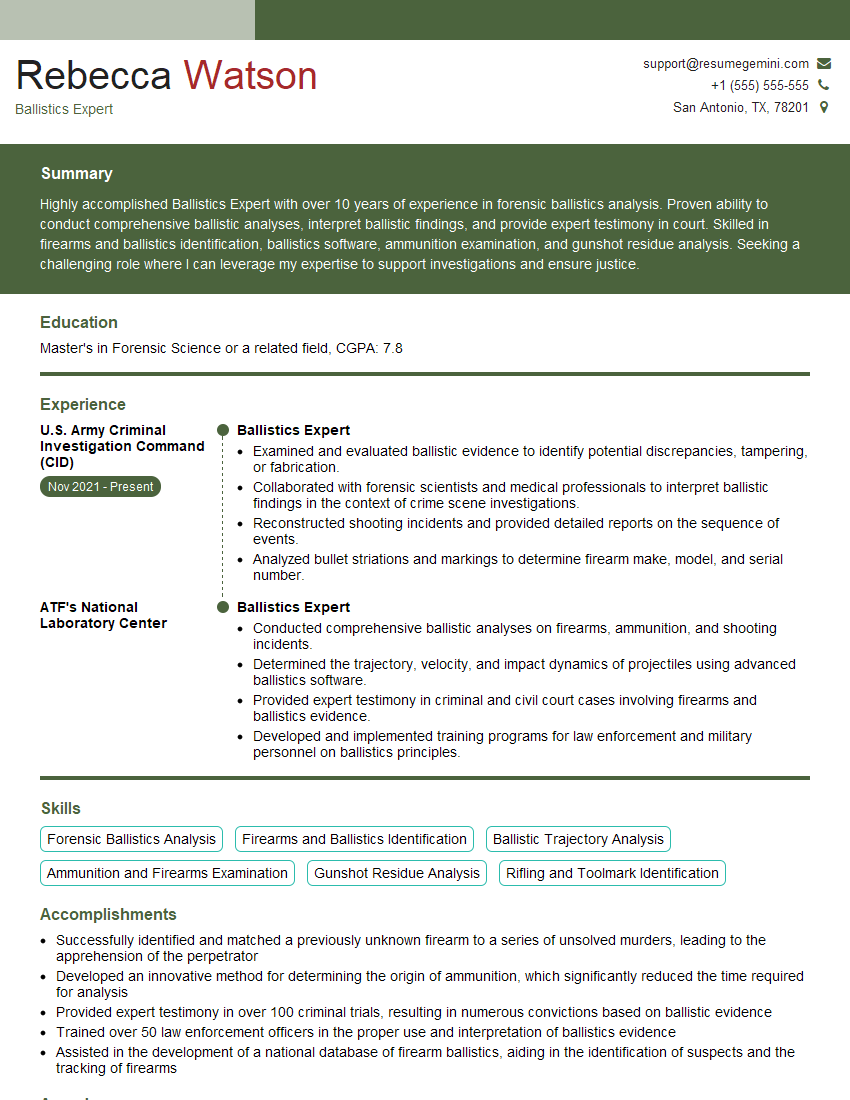
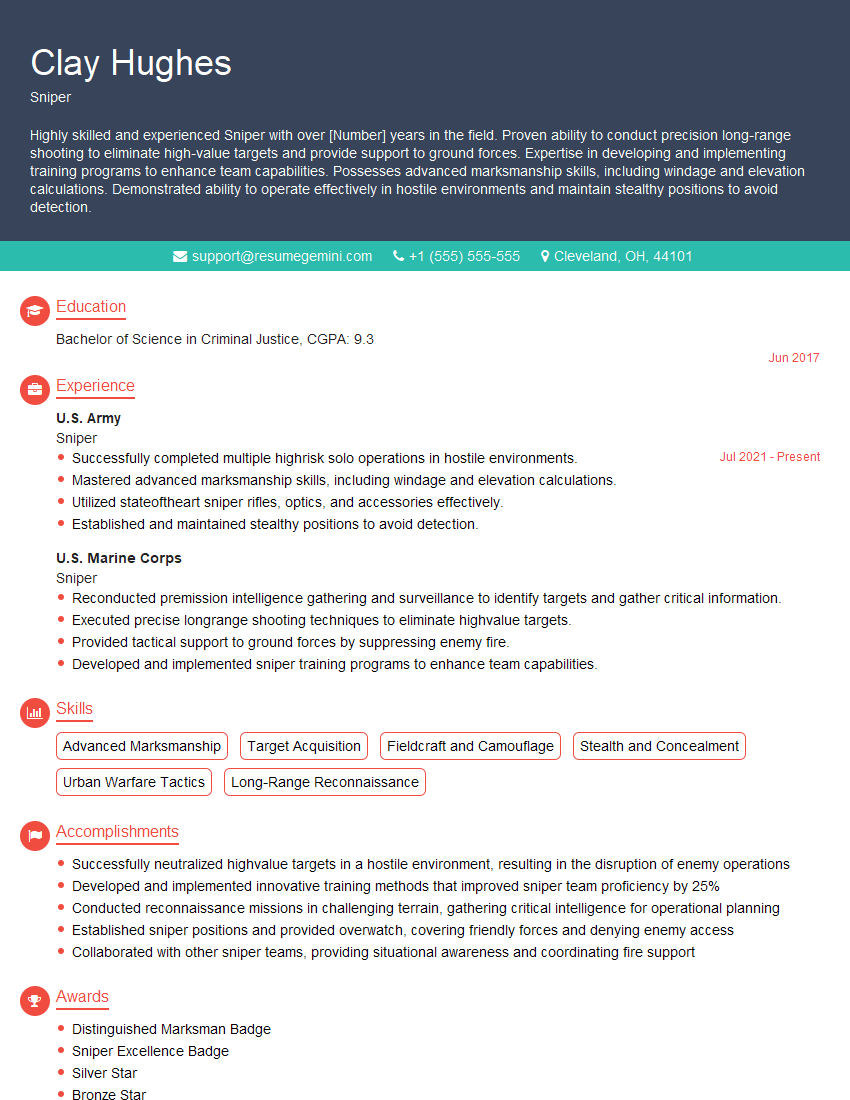
Mastering Long Distance Shot Accuracy opens doors to exciting career opportunities in fields demanding precision and expertise. A strong understanding of these principles significantly enhances your candidacy and sets you apart from the competition. To increase your chances of landing your dream role, focus on crafting an ATS-friendly resume that highlights your relevant skills and experience. ResumeGemini is a trusted resource to help you build a professional and impactful resume tailored to your specific skills. Examples of resumes tailored to Long Distance Shot Accuracy are provided to guide your resume building process.
Explore more articles
Users Rating of Our Blogs
Share Your Experience
We value your feedback! Please rate our content and share your thoughts (optional).
What Readers Say About Our Blog
Very informative content, great job.
good