Unlock your full potential by mastering the most common Knowledge of Color Matching and Profiling interview questions. This blog offers a deep dive into the critical topics, ensuring you’re not only prepared to answer but to excel. With these insights, you’ll approach your interview with clarity and confidence.
Questions Asked in Knowledge of Color Matching and Profiling Interview
Q 1. Explain the difference between additive and subtractive color mixing.
Additive and subtractive color mixing are two fundamental approaches to creating colors. Think of it like this: additive is like shining lights together, while subtractive is like mixing paints.
Additive color mixing starts with black (absence of light) and adds colors to create lighter shades. It’s how our screens and projectors work. The primary colors are red, green, and blue (RGB). Mixing red and green produces yellow; red and blue make magenta; green and blue make cyan. Combining all three at full intensity creates white light.
Subtractive color mixing begins with white (reflection of all light) and involves subtracting or absorbing certain wavelengths of light. This is how we mix paints, inks, and dyes. The primary colors are cyan, magenta, and yellow (CMY). Mixing cyan and magenta produces blue; magenta and yellow make red; cyan and yellow make green. Combining all three ideally results in black, though in practice, a pure black often requires a fourth color, black (K), hence CMYK.
In short: Additive is about light emission; subtractive is about light absorption. Understanding this difference is crucial for accurate color reproduction across different media.
Q 2. What are the primary color spaces (e.g., RGB, CMYK, Lab) and their applications?
Several color spaces are commonly used, each serving different purposes. The three you mentioned are key:
- RGB (Red, Green, Blue): This is an additive color space, ideal for devices that emit light like computer monitors, TVs, and projectors. Each color is represented by its intensity level on a scale of 0-255 (or 0-1 for normalized values). For example,
(255, 0, 0)represents pure red. - CMYK (Cyan, Magenta, Yellow, Key [Black]): This is a subtractive color space used in printing processes. It describes how inks absorb light to create colors on paper. Each color is defined by its percentage concentration.
- Lab (L*a*b*): This device-independent color space is designed to be perceptually uniform. This means that a small numerical change in Lab values corresponds to a small perceived color change by the human eye. ‘L’ represents lightness, ‘a’ represents the green-red axis, and ‘b’ represents the blue-yellow axis. Lab is often used as a reference point for color management and profile creation because it’s less device-dependent than RGB or CMYK.
The choice of color space depends heavily on the application. If you’re working on a digital display, RGB is the natural choice. For printed materials, CMYK is essential. Lab is a valuable tool for bridging the gap between different color spaces and devices.
Q 3. Describe the process of creating a color profile using a spectrophotometer.
Creating a color profile with a spectrophotometer involves measuring the color response of a device or medium. Here’s a breakdown of the process:
- Target Selection: Choose a set of color patches (usually a standardized color chart, like a ColorChecker chart) that cover a wide range of colors. These patches represent known color values.
- Measurement: Using the spectrophotometer, measure each color patch under controlled lighting conditions. The spectrophotometer will provide a spectral reflectance curve for each patch, indicating how much light is reflected at different wavelengths.
- Data Acquisition: The spectrophotometer outputs numerical data, typically in a spectral format, capturing the precise color characteristics of each patch as measured by the device. This is raw spectral data.
- Profile Creation Software: This data is then imported into color profile creation software (e.g., ColorMunki, i1Profiler). The software uses complex algorithms to mathematically map the measured values (from the spectrophotometer) to the color space of your device (e.g., RGB for a monitor, CMYK for a printer). This creates a mathematical relationship between the device’s actual color output and the intended color values.
- Profile Installation: Once created, the profile is saved in a standard format (e.g., ICC profile) and can be installed on the operating system, allowing applications to correctly interpret and translate colors based on the measurements.
This ensures that colors displayed or printed accurately represent the intended colors.
Q 4. How do you handle color inconsistencies between different devices?
Color inconsistencies across devices are a common challenge in color management. The core solution is color profiling and using a common color space for reference.
- Color Profiling: As discussed previously, create color profiles for each device (monitor, printer, scanner) to characterise their color response. This helps bridge the gaps in color reproduction.
- Color Management Software: Utilize color management software (CMS) like Adobe Color Management Modules (CMM) within applications. CMS works with ICC profiles to translate colors between different devices, trying to achieve visual consistency.
- Reference Color Space: Work in a device-independent color space such as Lab for creating or editing images. This makes it less likely that color shifts will occur when transitioning between devices.
- Soft Proofing: Before sending to print, use soft proofing functionality in applications such as Adobe Photoshop or Illustrator. Soft proofing simulates the output on the target device based on its color profile, allowing you to make adjustments to minimize discrepancies.
Remember that achieving perfect color consistency across all devices is often impossible due to inherent differences in technologies. The goal is to minimize discrepancies to an acceptable level.
Q 5. What is color gamut and how does it impact color reproduction?
Color gamut refers to the range of colors a particular device or medium can reproduce. Imagine a color wheel; the gamut represents the area within the wheel that a device can accurately display or print. Colors outside this area will be clipped or approximated.
The impact on color reproduction is significant. A device with a limited gamut will struggle to represent vibrant or saturated colors accurately. For example, a printer might produce a duller shade of blue than what is seen on a monitor, because the blue is outside the printer’s gamut. Conversely, a wider gamut means more colors can be reproduced accurately, leading to more faithful color reproduction. Understanding the color gamut of each device in your workflow is crucial for managing expectations and achieving optimal results.
Q 6. Explain the concept of color temperature and its relevance in color management.
Color temperature refers to the relative redness or blueness of a light source, measured in Kelvin (K). A lower color temperature (e.g., 2700K) produces a warmer light, with a yellowish or orange tint. Higher color temperatures (e.g., 6500K) produce cooler light, with a bluish tint.
In color management, color temperature is crucial because it significantly affects how colors are perceived. Inconsistent lighting conditions can lead to color mismatches. For instance, images viewed under incandescent lighting (warm light) will appear different under daylight (cooler light). Therefore, maintaining consistent color temperature during image capture, editing, and output is critical for accurate color reproduction. Calibration tools are used to ensure lighting conditions match the target color temperature.
Q 7. What are different types of color measurement instruments?
Several instruments are used for color measurement, each with its strengths and weaknesses:
- Spectrophotometers: These are the most precise instruments. They measure the spectral reflectance or transmittance of a sample across the entire visible spectrum, providing detailed information about the color’s composition. This allows for accurate color profile creation.
- Densitometers: These instruments measure the density of ink on printed materials. They are less precise than spectrophotometers but are simpler and more affordable. Primarily used in print quality control.
- Colorimeters: These instruments measure color in terms of tristimulus values (XYZ or RGB) but don’t provide spectral information. While less precise than spectrophotometers, they are more portable and cost-effective. Useful for basic color checks.
- Spectro-radiometers: These measure the spectral power distribution of light sources (illuminants). Essential in determining the color temperature of the light impacting color perception.
The choice of instrument depends on the specific application and the required level of accuracy. For professional color management, spectrophotometers are often preferred.
Q 8. What is Delta E and how is it used in color quality control?
Delta E, or ΔE, is a numerical representation of the perceived difference between two colors. It’s essentially a metric that quantifies how ‘far apart’ two colors appear to the human eye. In color quality control, Delta E is crucial because it allows us to objectively measure the discrepancy between a target color and the actual color produced. A smaller Delta E value indicates a closer match, with a Delta E of 0 representing a perfect match. Different Delta E formulas exist (e.g., Delta E 2000, Delta E 76), each with varying complexities in accounting for perceptual uniformity across the color space. For example, a Delta E of 1 might be acceptable for a wall paint, but totally unacceptable for a high-end fashion fabric. Acceptable Delta E values are determined by industry standards and client specifications. In quality control, we’d set a maximum acceptable Delta E, and any batch exceeding this threshold would require adjustments in the printing process or raw materials.
Q 9. How do you interpret a color profile report?
Interpreting a color profile report involves understanding the profile’s components and assessing their accuracy relative to the intended application. A typical report includes information about the color space (e.g., sRGB, Adobe RGB), gamut coverage (the range of colors the device can reproduce), and various colorimetric parameters. I would look for potential issues like color casts (unwanted tints or shades), gamut clipping (colors outside the device’s range), and inconsistencies between the profile and the actual device’s output. For example, a large gamut clipping value might suggest a need for a different printing method or a software adjustment to avoid color loss. The report also often provides Delta E values comparing the profiled device’s colors to a standard. Analyzing these Delta E values against industry tolerances helps determine the overall accuracy and consistency of the profile and the device itself. It’s crucial to compare the profile report with visual inspection of test prints to ensure the numerical data accurately reflects the perceived color differences.
Q 10. Explain the importance of color calibration and profiling in digital printing.
Color calibration and profiling are paramount in digital printing to ensure color accuracy and consistency across different devices and throughout the printing process. Calibration involves adjusting the device’s hardware to meet a known standard. For example, a monitor calibration adjusts its color output to match a standardized color profile, leading to a more accurate on-screen representation of colors. Profiling creates a unique profile for each device to describe its color characteristics. This profile compensates for the device’s specific color biases, enabling the accurate conversion of colors between different devices and color spaces, like between a digital design and a printing press. Without proper calibration and profiling, you risk encountering significant color shifts between the digital design and the final print output, leading to costly reprints and dissatisfied customers. For instance, a brand needing consistent color reproduction across brochures, websites, and packaging relies heavily on standardized color management workflows using calibration and profiling.
Q 11. What are common color management workflow challenges?
Common color management workflow challenges include inconsistencies between different devices (monitors, printers, scanners), inaccurate color profiles, improper color space conversions, and metamerism. Inadequate communication between designers, pre-press operators, and printers can also lead to errors. For example, a designer working in a wide-gamut color space might unknowingly create colors that are not reproducible by the client’s printer, leading to significant color discrepancies. Another common problem is the lack of proper quality control measures during production, such as not checking print proofs against the digital design. Addressing these challenges requires robust color management software, calibrated hardware, effective communication, and a well-defined color workflow with clearly specified tolerances. Regular training for staff on color management principles is also essential to ensure successful color reproduction.
Q 12. Describe your experience with ICC profiles.
I have extensive experience working with ICC (International Color Consortium) profiles. I understand how to create, edit, and utilize ICC profiles for various devices (printers, monitors, scanners). My experience includes embedding ICC profiles in image files for consistent color representation across different software and hardware, performing profile transformations to ensure color accuracy in various workflows, and troubleshooting issues that arise from profile mismatches or inconsistencies. I have even used advanced techniques, such as creating custom profiles for unique substrates or inks. For instance, I once helped a client resolve a color-matching issue by creating a dedicated profile for their unusual metallic ink, leading to perfect color reproduction on their packaging.
Q 13. How do you troubleshoot color matching problems in a print production environment?
Troubleshooting color matching problems starts with a systematic approach. First, I’d isolate the source of the problem: Is it the monitor calibration, the printer profile, the ink formulation, the substrate, or a combination of factors? I then perform a series of tests: checking the monitor and printer calibrations, testing different profiles, examining ink consistency, and assessing the substrate’s impact on color. Print test strips with different color patches and carefully measure Delta E values against the target colors. I also carefully analyze the print environment, such as lighting conditions. If the issue lies with the profile, I may need to create or modify it. If it’s an ink issue, collaboration with the ink supplier might be necessary. Documenting every step is critical for effective troubleshooting. A methodical process, utilizing Delta E measurements and thorough analysis, enables quick resolution and minimizes production downtime. Often, resolving issues involves combining technical problem-solving with strong communication skills to ensure all stakeholders are aligned.
Q 14. How do metamerism affect color matching?
Metamerism is a phenomenon where two colors appear identical under one light source but different under another. This poses a significant challenge in color matching because a perfect match achieved under one lighting condition may not be a match under different lighting. For example, two fabrics might appear the same color under the fluorescent lights in a store but look different under natural sunlight. To mitigate metamerism issues, color matching should be performed under standardized lighting conditions that closely simulate the target viewing environment. Using spectral color measurement devices is also very important, as they provide a more detailed understanding of the color components and can predict how a color might appear under various lighting conditions. Specifying the light source (e.g., D50, D65) is crucial during the color management process to achieve consistent and reliable color reproduction regardless of viewing conditions.
Q 15. Explain the differences between various color measurement modes (e.g., spectral, tristimulus).
Color measurement modes are crucial for quantifying color, each offering a unique approach. Spectral measurement is the most comprehensive, capturing the entire reflectance or transmittance curve of a sample across the visible spectrum (approximately 400-700nm). Think of it like a detailed fingerprint of the color – it reveals precisely how much light is reflected or transmitted at each wavelength. This allows for the most accurate color reproduction, but requires specialized and expensive spectrophotometers.
Tristimulus measurement, on the other hand, simplifies this by using three specific wavelengths (typically red, green, and blue) to approximate the color perception of the human eye. It provides three numerical values (XYZ or other similar color spaces like L*a*b*) representing the amounts of these primary colors needed to match the sample color. This is faster and cheaper than spectral measurement, but less precise as some color nuances might be missed. Imagine trying to describe a sunset using just three paint colors – you can get close but you won’t capture the full complexity.
In short: Spectral data is the gold standard for accuracy, while tristimulus is a practical compromise offering sufficient precision for many applications. The choice depends on the specific needs and budget of the project. For example, high-end print reproduction might necessitate spectral measurement, whereas quality control in a textile factory could suffice with tristimulus measurements.
Career Expert Tips:
- Ace those interviews! Prepare effectively by reviewing the Top 50 Most Common Interview Questions on ResumeGemini.
- Navigate your job search with confidence! Explore a wide range of Career Tips on ResumeGemini. Learn about common challenges and recommendations to overcome them.
- Craft the perfect resume! Master the Art of Resume Writing with ResumeGemini’s guide. Showcase your unique qualifications and achievements effectively.
- Don’t miss out on holiday savings! Build your dream resume with ResumeGemini’s ATS optimized templates.
Q 16. What software are you proficient in for color management?
My proficiency in color management software spans several leading platforms. I’m highly experienced with X-Rite i1Profiler, Color iMatch, and Datacolor Spectraflash. I’m also familiar with Adobe Photoshop’s color management tools and the color profiles embedded within Adobe Creative Suite applications. My expertise includes creating and editing ICC profiles, performing color transformations, and troubleshooting color discrepancies using these tools. I have extensively used these programs to profile various devices such as printers, monitors, and scanners, ensuring accurate color reproduction across different media. For example, in a recent project involving packaging design, I used i1Profiler to create custom ICC profiles for the specific printing press, guaranteeing the colors on the final product matched the client’s approved digital design flawlessly.
Q 17. Describe your experience with colorimetric quality control procedures.
My experience with colorimetric quality control involves implementing rigorous procedures at various stages of the production process. This starts with initial device profiling to create accurate color representations. Then, throughout the production run, I utilize spectrophotometers to measure samples and compare them against established color targets. I rely on tolerance values defined within color difference formulas such as Delta E (ΔE), ensuring the final product stays within acceptable deviation limits. I have a strong background in implementing Statistical Process Control (SPC) techniques to monitor the color consistency and identify any potential drifts in the process. For instance, I’ve developed and implemented a control chart system for a large-scale print operation, significantly reducing color variation and improving overall product quality.
Furthermore, I’m experienced in analyzing the root causes of color inconsistencies. This may involve investigating factors like ink variations, substrate changes, or environmental conditions within the printing process. My process uses a combination of data analysis, visual assessment and close collaboration with the production team to resolve these issues and maintain consistent color reproduction.
Q 18. How do you ensure color consistency across different printing techniques?
Maintaining color consistency across different printing techniques, like offset, digital, and screen printing, requires a multifaceted approach. The key is in understanding the unique characteristics of each process and using appropriate color management strategies. This begins with creating device-specific ICC profiles for each printer to accurately map colors to their capabilities. Next, we need to standardize the color space – using a common color space like L*a*b* ensures consistency across different devices.
Furthermore, using a digital workflow with color-managed files is critical. This involves defining a color reference point, such as a Pantone or other approved color standard, early in the process. This reference ensures the colors remain consistent throughout the design and production process, regardless of which printing method is used. To address variations inherent to different processes, we often utilize proofing techniques, either soft proofs (digital) or hard proofs (printed), to simulate the final output and resolve any discrepancies beforehand.
Q 19. Explain the significance of color standards (e.g., Pantone, RAL).
Color standards, like Pantone and RAL, play a vital role in ensuring consistent color communication and reproduction across different locations, manufacturers, and production methods. They provide a shared language for color. Pantone, for example, is widely used in graphic design and printing, offering a standardized set of colors with specific formulations. Each color has a unique Pantone number, which eliminates ambiguity and allows designers and printers to precisely communicate color specifications.
RAL, on the other hand, is predominantly used in the coatings and paint industries, providing a system of numbered color standards. These systems offer a common reference for consistent color reproduction, even across diverse materials and printing technologies. Without such standards, achieving consistent color across different mediums and locations would be extremely difficult, often leading to costly errors and rework. For example, in a global manufacturing operation, referencing a Pantone color ensures that the product’s color in China matches the sample produced in the USA.
Q 20. How do you manage and resolve color differences in cross-media projects?
Managing color differences in cross-media projects requires a proactive and methodical approach. The starting point is a clearly defined color target, often expressed using a specific color standard (like Pantone or a L*a*b* value). This target should be consistently referenced across all media – print, web, and screen displays. Different media have varied color gamuts and reproduction capabilities, so it is important to manage expectations appropriately. This involves a close collaboration with all stakeholders, and careful communication about achievable color results.
When color differences do arise, a systematic approach to troubleshooting is crucial. We carefully measure the color differences using appropriate color difference metrics (such as ΔE), analyzing the root cause. The troubleshooting may involve adjustments to the color profile, reviewing the printing process, or re-evaluating the target color. Using color management software, we perform color transformations to bridge the gap between the various media. Often, minor color adjustments might be acceptable to maintain visual consistency across all media.
Q 21. Describe your approach to communicating color specifications to clients or colleagues.
Communicating color specifications effectively involves a blend of technical precision and clear visual representation. I typically avoid using abstract terms and instead rely on precise data. For clients, I would use easily understandable color names alongside numerical data, like Pantone numbers or L*a*b* values. I often supplement this with visual aids, such as color swatches or simulated proofs. For colleagues, more technical language, such as specific color difference metrics or ICC profile details, might be appropriate.
Regardless of the audience, I ensure transparency throughout the process. This includes discussing limitations of color reproduction, highlighting potential variations between different media, and managing expectations concerning color accuracy. Clear and open communication avoids misunderstandings and helps in ensuring the final outcome matches the client’s vision and meets the project’s technical requirements.
Q 22. What is your experience with color communication methods like color language or digital color proofing?
Effective color communication is crucial for consistent results across the entire production pipeline. My experience encompasses a wide range of methods, including verbal descriptions, Pantone color guides, and digital color proofing systems. I’m proficient in using color language, precisely describing colors using terms like hue, saturation, and lightness, or using standardized systems like Pantone Matching System (PMS). Digital color proofing, using software like Adobe Acrobat Pro with embedded ICC profiles and X-Rite i1Profiler, allows for virtual verification of color accuracy before printing or manufacturing. I have extensively used these methods in projects involving packaging design, textile production, and print media. For instance, in a recent packaging project, I utilized Pantone colors and digital color proofs to ensure the client’s brand colors were consistently replicated across various printing techniques and substrates.
- Pantone Matching System (PMS): Using pre-defined color formulas for consistent color reproduction.
- Digital Color Proofing: Utilizing software to simulate the final printed output, minimizing costly reprint errors.
- ICC Profiles: Incorporating these profiles to ensure accurate color translation across different devices and print processes.
Q 23. How do you handle unexpected color variations during production?
Unexpected color variations are an inevitable challenge in production. My approach involves a systematic process of investigation and correction. First, I’d identify the source of the variation – this could involve analyzing the printing process, examining the raw materials, or evaluating the lighting conditions. Then, I would systematically assess the delta-E values between the expected and actual colors to quantify the difference. This helps prioritize and focus the corrective action. Depending on the nature of the problem, solutions might include recalibrating printing equipment, adjusting ink formulations, re-evaluating substrate properties, or even adjusting lighting in the viewing environment. For example, I once encountered a significant color shift during large-format printing. After investigation, I realized it stemmed from variations in the substrate’s absorbency. We addressed this by implementing stricter quality control measures on the substrate and adjusting the printing profiles to compensate. Documentation at each stage is crucial; this creates an auditable trail for future reference and facilitates improved processes.
Q 24. Describe your experience with color correction techniques.
My experience with color correction techniques is extensive, encompassing both hardware and software solutions. I’m proficient in using color management software like Adobe Photoshop and Lightroom, employing tools such as curves, levels, selective color, and hue/saturation adjustments. These tools enable precise control over color, allowing for correction of issues such as color casts, uneven tones, and inaccurate color reproduction. I understand the intricacies of color channels and how to effectively manipulate them to achieve desired results. Furthermore, I have experience with spectrophotometers and densitometers, using them for objective color measurement and profiling. This allows for data-driven color correction, ensuring accuracy and consistency. For instance, in a photography project, I used Photoshop’s curves tool to expertly correct a color cast resulting from inconsistent lighting during the shoot. This involved careful manipulation of the red, green, and blue channels to restore the natural tones.
Q 25. How do you stay updated with the latest advancements in color science and technology?
Staying current in color science and technology is paramount. I achieve this through multiple avenues. I regularly attend industry conferences and webinars, such as those hosted by organizations like the Inter-Society Color Council (ISCC). I actively read industry publications and peer-reviewed journals focusing on color management and reproduction. Membership in professional organizations provides access to cutting-edge research and networking opportunities. Moreover, I actively participate in online communities and forums dedicated to color science. This allows me to exchange ideas, learn from others’ experiences, and stay abreast of the newest technological advancements. Following key players in the industry, such as X-Rite and Pantone, through their websites and publications, also keeps me up to date with the latest software, hardware, and color standards.
Q 26. What is your experience with different types of color spaces (e.g., CIE XYZ, L*a*b*)?
I possess a strong understanding of various color spaces and their applications. The CIE XYZ color space serves as a foundation, providing a device-independent representation of color. However, its non-linearity makes it less intuitive for human perception. The L*a*b* color space addresses this, with L* representing lightness, a* representing the green-red axis, and b* representing the blue-yellow axis. This perceptually uniform space is excellent for evaluating color differences and making adjustments. I’ve used both extensively in various projects, selecting the most appropriate space based on the specific needs of the task. For instance, in a project analyzing color differences in printed fabrics, the L*a*b* space proved invaluable in quantifying and comparing color variations accurately. The advantages of each space, alongside their limitations, are crucial when choosing the right method for color analysis, reproduction, and quality control.
Q 27. Explain the impact of lighting conditions on color perception and measurement.
Lighting conditions significantly influence color perception and measurement. Different light sources emit varying spectral power distributions, impacting how colors appear. Metamerism, where two colors appear identical under one light source but different under another, highlights this complexity. Accurate color measurement necessitates controlled lighting conditions. Standard illuminants, like D65 (simulating daylight), are used to standardize color measurements and minimize variations due to lighting. In professional settings, light booths with calibrated light sources ensure consistent viewing conditions. Ignoring this can lead to inaccurate color evaluations and inconsistencies in color reproduction across various settings. For instance, a fabric sample might look perfect under a tungsten light but appear quite different under fluorescent lighting. Understanding and controlling lighting is key to consistent and reliable color assessment.
Q 28. How would you approach a scenario where color accuracy is critical, such as in medical imaging or food packaging?
When color accuracy is critical, such as in medical imaging or food packaging (where color can indicate freshness or safety), a rigorous and multi-faceted approach is required. This starts with utilizing high-precision equipment, including spectrophotometers capable of accurate measurements across a wide spectrum. Furthermore, implementing robust color management systems, including ICC profiles, is crucial to ensure color consistency throughout the workflow. Regular calibration and validation of all equipment, including monitors, printers, and scanners, are indispensable. In medical imaging, strict adherence to established standards and guidelines is essential to prevent misinterpretations. For food packaging, color standards must align with regulatory requirements to ensure accurate representation of the product’s characteristics. Collaboration with specialists in the relevant field is crucial to address specific industry needs and requirements, ensuring reliable and accurate color reproduction for these critical applications. This might include working with medical imaging experts or food scientists to set acceptable color tolerances and ensure regulatory compliance.
Key Topics to Learn for Knowledge of Color Matching and Profiling Interview
- Color Spaces and Models: Understanding RGB, CMYK, LAB, and other color spaces; their strengths and weaknesses in different applications; and how to convert between them. Practical application: Explaining why a color looks different on screen versus in print.
- Colorimetry and Spectrophotometry: The science behind color measurement; understanding the principles of spectrophotometers and colorimeters; interpreting spectral data. Practical application: Troubleshooting discrepancies between target and measured color values.
- Color Management Systems (CMS): How profiles (ICC profiles) work; the role of a CMS in ensuring color consistency across different devices and workflows; practical aspects of profile creation and embedding. Practical application: Diagnosing and resolving color inconsistencies in a print workflow.
- Color Difference Formulas (Delta E): Understanding various color difference metrics (e.g., Delta E 2000, Delta E 76); interpreting their numerical values to assess the perceptibility of color differences. Practical application: Determining whether a color difference is visually acceptable within a given tolerance.
- Color Appearance Models: Understanding how factors like lighting and surrounding colors affect perceived color. Practical application: Explaining how to compensate for metamerism in color matching.
- Color Matching Techniques: Familiarize yourself with various color matching methods, both manual and automated, including spectral matching and iterative adjustments. Practical application: Describing the steps in a typical color matching process for a specific application.
- Industry-Specific Applications: Depending on the job, explore color management in specific fields like printing, textiles, paints, or digital media. Practical application: Explain how your understanding of color management applies to a specific industry challenge.
Next Steps
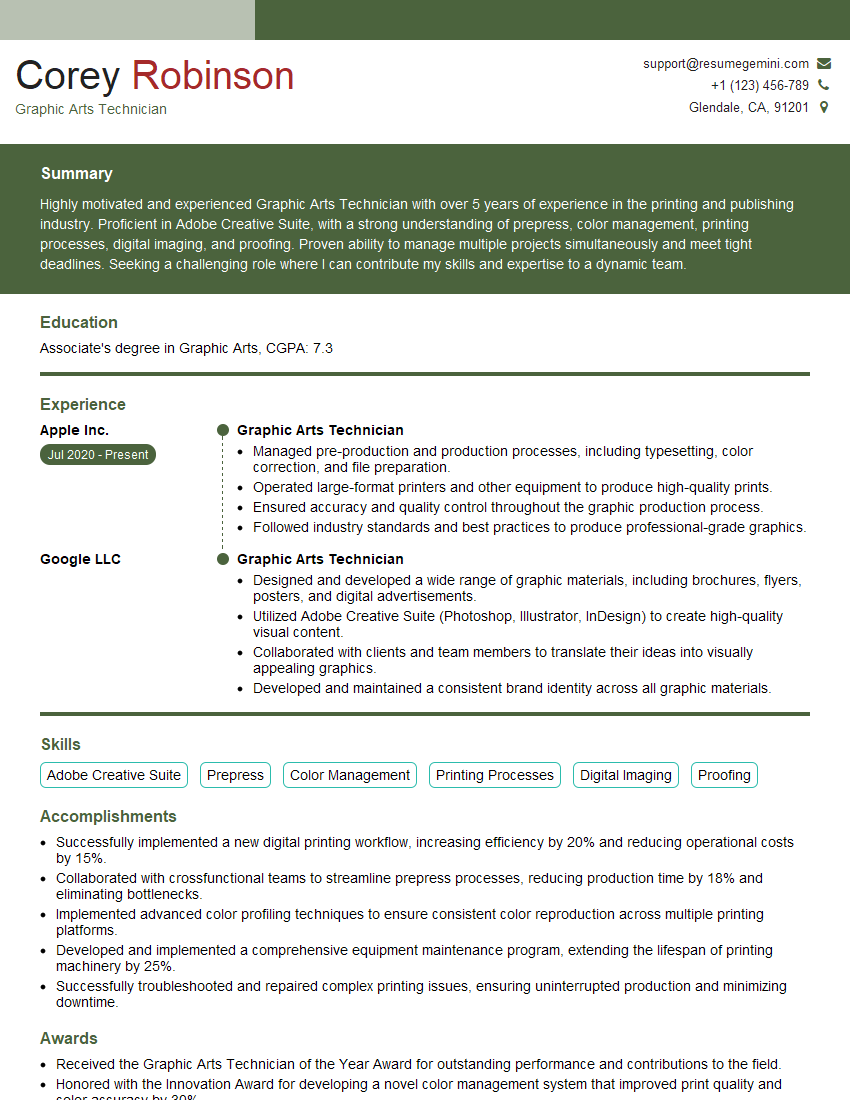
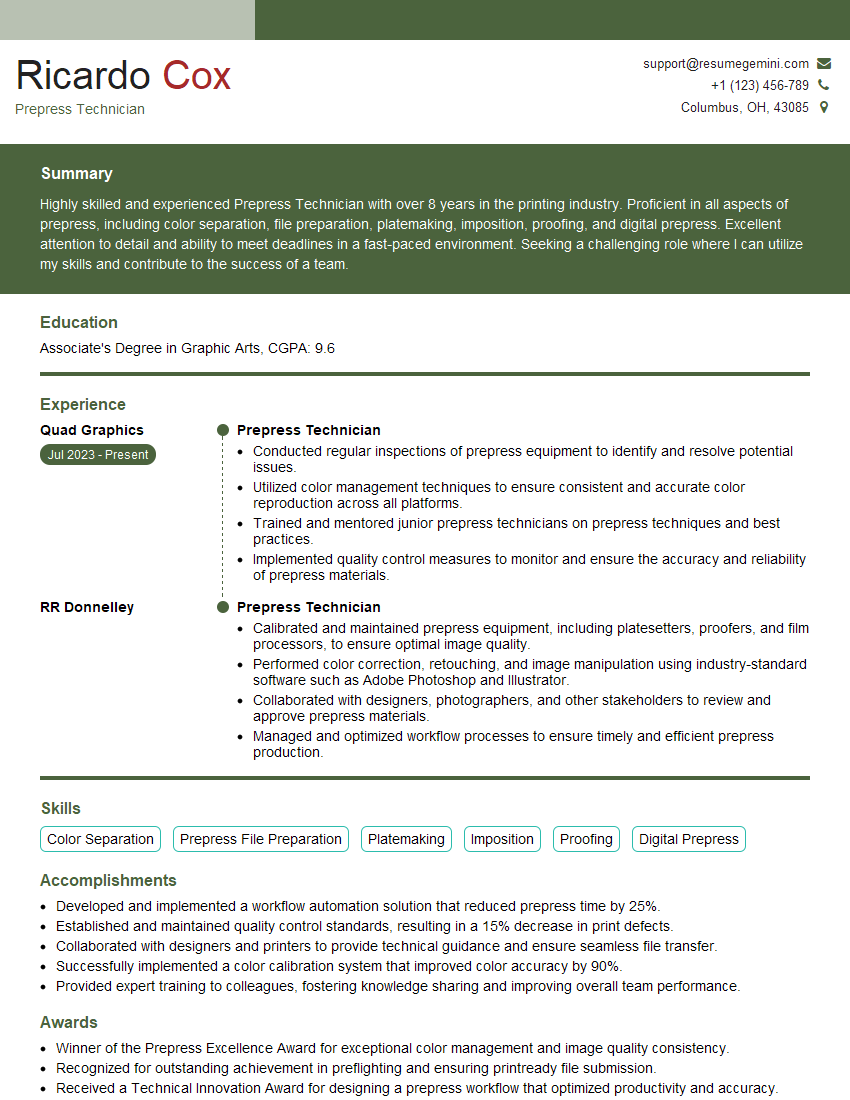
Mastering knowledge of color matching and profiling significantly enhances your career prospects in design, printing, imaging, and related fields. It demonstrates a crucial technical skillset highly valued by employers. To maximize your job search success, creating a strong, ATS-friendly resume is paramount. ResumeGemini can help you build a professional and effective resume tailored to highlight your expertise. We provide examples of resumes specifically designed for candidates with expertise in Knowledge of Color Matching and Profiling, helping you showcase your skills and experience to potential employers.
Explore more articles
Users Rating of Our Blogs
Share Your Experience
We value your feedback! Please rate our content and share your thoughts (optional).
What Readers Say About Our Blog
Very informative content, great job.
good