Are you ready to stand out in your next interview? Understanding and preparing for Knowledge of Crystallography and Diffraction interview questions is a game-changer. In this blog, we’ve compiled key questions and expert advice to help you showcase your skills with confidence and precision. Let’s get started on your journey to acing the interview.
Questions Asked in Knowledge of Crystallography and Diffraction Interview
Q 1. Explain Bragg’s Law and its significance in X-ray diffraction.
Bragg’s Law is the fundamental principle governing X-ray diffraction. It describes the condition for constructive interference of X-rays scattered by atoms in a crystal lattice. Imagine throwing pebbles into a pond – the ripples (waves) interfere with each other. Similarly, X-rays scattered from different lattice planes interfere, either constructively (reinforcing each other, leading to a diffraction peak) or destructively (canceling each other out).
The law states: nλ = 2d sinθ where:
nis an integer (order of reflection), representing the number of wavelengths fitting into the path difference.λis the wavelength of the X-rays.dis the interplanar spacing (distance between parallel planes of atoms in the crystal lattice).θis the angle of incidence (and reflection) of the X-rays with respect to the lattice plane.
Its significance lies in its ability to relate the observed diffraction angles (θ) to the crystal lattice spacing (d). By measuring the angles at which diffraction peaks occur, we can deduce the crystal structure’s atomic arrangement. This is crucial for materials science, chemistry, and biology, enabling the determination of the structure of materials at the atomic level.
Q 2. Describe the differences between single-crystal and powder diffraction techniques.
Single-crystal and powder diffraction are two main X-ray diffraction techniques, differing primarily in the sample’s nature and the resulting diffraction pattern.
- Single-crystal diffraction: Uses a single, well-ordered crystal. The diffraction pattern consists of sharp, discrete spots, each corresponding to a specific set of lattice planes. This provides the most detailed structural information, allowing for precise determination of the unit cell parameters and atomic positions. Think of it like looking at a perfectly arranged LEGO structure from many angles – you get a complete picture.
- Powder diffraction: Employs a powdered sample containing numerous randomly oriented crystallites. The diffraction pattern displays concentric rings instead of spots. Each ring represents a particular interplanar spacing (d-spacing). While less detailed than single-crystal diffraction, it’s useful for identifying phases and determining crystal structures in materials where obtaining a large single crystal is difficult. Imagine many tiny LEGO structures randomly scattered – you still get an idea of what the LEGO bricks look like, but less detail than a single, complete structure.
Q 3. What are the advantages and disadvantages of using X-rays, neutrons, and electrons for diffraction studies?
X-rays, neutrons, and electrons all interact differently with matter, making them suitable for different types of diffraction studies.
- X-rays: Interact primarily with electrons. They are excellent for locating light atoms like hydrogen and oxygen, but their scattering power is proportional to Z2 (where Z is the atomic number), making it difficult to locate light atoms in the presence of heavy atoms. They are widely used due to their availability and ease of use.
- Neutrons: Interact with the nucleus of atoms. They are particularly useful for determining hydrogen positions and distinguishing between isotopes. They are less sensitive to the atomic number and useful for magnetic structure determination. However, neutron sources are less readily available, making them more expensive.
- Electrons: Interact with both the nucleus and electron cloud, offering high sensitivity to surface features and atomic arrangements in thin films. They can also yield high-resolution structural information but are more susceptible to damage in beam-sensitive samples. Electron diffraction is extensively used in transmission electron microscopy (TEM).
The choice of radiation depends on the specific scientific question and the nature of the sample. For example, if hydrogen positions are crucial, neutron diffraction is preferred. If high surface sensitivity is needed, electron diffraction is best suited.
Q 4. How is the unit cell determined from diffraction data?
Determining the unit cell from diffraction data involves several steps. The unit cell is the smallest repeating unit of a crystal lattice. The diffraction pattern’s symmetry and peak positions reveal the unit cell’s parameters:
- Indexing Reflections: Assigning Miller indices (hkl) to each diffraction spot or ring. This involves relating the positions of the peaks to the angles of incidence.
- Determining Unit Cell Parameters: Using Bragg’s Law (
nλ = 2d sinθ) and the indexed reflections, we can calculate the interplanar spacings (d) for different sets of planes. We then utilize mathematical relationships derived from crystallography (like the relationship between the d-spacing and the unit cell parameters, a, b, c, α, β, γ) to deduce the unit cell dimensions and angles (a, b, c, α, β, γ). - Symmetry Analysis: The symmetry observed in the diffraction pattern provides information about the crystal system (cubic, tetragonal, orthorhombic, etc.), which further constrains the unit cell parameters.
Software packages like SHELX and GSAS-II are commonly used for data analysis and unit cell determination. These tools incorporate sophisticated algorithms to refine the unit cell parameters based on the diffraction data, minimizing discrepancies between the observed and calculated diffraction patterns.
Q 5. Explain the concept of reciprocal space and its relationship to real space.
Reciprocal space is a mathematical construct that simplifies the analysis of diffraction patterns. It’s a way of representing crystallographic information in a different coordinate system compared to the ‘real space’ we are familiar with.
Real space describes the actual three-dimensional arrangement of atoms in a crystal. It uses coordinates (x, y, z) to locate atoms.
Reciprocal space is a representation of the Fourier transform of the crystal lattice. Each point in reciprocal space corresponds to a set of parallel lattice planes in real space. The distance of a point from the origin in reciprocal space is inversely proportional to the interplanar spacing (d) in real space. Specifically, the distance is 1/d.
The relationship between real and reciprocal space is crucial for understanding diffraction. The diffraction pattern is directly related to the reciprocal lattice; the spots or rings in the diffraction pattern represent the points in reciprocal space. The strength of each spot is related to the scattering power of the atoms forming the respective lattice planes.
Think of it as a map: real space is the geographical map showing the location of houses, while reciprocal space is a map of ripples created by dropping pebbles into a pond, each ripple representing a set of parallel rows of houses.
Q 6. Describe different methods for solving crystal structures (e.g., direct methods, Patterson methods).
Solving a crystal structure involves determining the three-dimensional arrangement of atoms within the unit cell. Several methods exist, including:
- Direct Methods: These techniques exploit statistical relationships between the phases of the diffraction intensities. By using probability methods, they estimate the phases, which are not directly measured from diffraction experiments, allowing the calculation of an electron density map that reveals the atomic positions. This approach is often successful for small molecules and those with lighter atoms.
- Patterson Methods: This technique uses the intensities of the diffraction pattern to create a Patterson map. This map represents a vector map that shows the interatomic distances in the crystal structure. By carefully analyzing the peaks in this map, it is sometimes possible to deduce the atomic positions, especially when heavy atoms are present.
- Charge Flipping: A powerful method that uses iterative procedures to refine the phases of the structure factors. It is especially useful for complex structures or when the direct methods fail.
- Molecular Replacement: When a similar structure is already known, this method can be used. The known structure (or a model) is placed into the unit cell and refined to match the diffraction data. This is particularly helpful for biological macromolecules like proteins.
In practice, a combination of these methods may be required to solve complex crystal structures. Software packages like SHELX, Phaser, and CRYSTAL are widely used for structure solution and refinement.
Q 7. What is the Laue condition, and what are its implications?
The Laue condition is another fundamental condition for diffraction, related to the constructive interference of waves scattered from a crystal lattice. It is particularly relevant to Laue diffraction, which uses a continuous spectrum of X-rays (as opposed to monochromatic X-rays used in Bragg’s law experiments).
The Laue condition can be stated as: k - k0 = g where:
k0is the wave vector of the incident X-ray.kis the wave vector of the scattered X-ray.gis a reciprocal lattice vector.
This condition implies that the difference in wave vectors between the incident and scattered X-rays must equal a reciprocal lattice vector for constructive interference to occur. In simpler terms, the scattering vector connects two reciprocal lattice points.
Its implication is that Laue diffraction allows the study of crystalline materials using a broad spectrum of radiation. This is beneficial because it requires only a single exposure to obtain the diffraction pattern.
Q 8. How does the symmetry of a crystal affect its diffraction pattern?
The symmetry of a crystal dictates the arrangement of its atoms, and this directly impacts its diffraction pattern. Imagine throwing pebbles into a perfectly symmetrical pond; the ripples will exhibit a corresponding symmetry. Similarly, the symmetry operations present in a crystal (like rotations, reflections, and inversions) create systematic absences and intensities in the diffraction pattern. For example, a crystal with a center of symmetry will only show diffraction peaks with even Miller indices (hkl), while those without a center of symmetry may exhibit both even and odd indices. This relationship is fundamental to determining the space group of a crystal.
A crystal with high symmetry will produce a diffraction pattern with many systematic absences and fewer unique reflections. Conversely, a crystal with low symmetry will display a more complex pattern with fewer absences and a larger number of unique reflections. This difference is crucial in determining the crystal’s symmetry and solving its structure.
Q 9. Explain the concept of space groups and their importance in crystallography.
Space groups describe the symmetry of a crystal lattice, combining translational symmetry (the repeating unit cell) with point group symmetry (rotations, reflections, inversions at a single point). They are crucial because they tell us everything about the possible symmetry operations that can exist in a three-dimensional crystal structure. There are 230 possible space groups. Knowing the space group significantly restricts the possible positions of atoms within the unit cell, streamlining the structure determination process. Imagine building with LEGO bricks; the space group defines the rules for how those bricks can be arranged to form a stable and repeating structure.
For example, if we determine a crystal’s space group is P212121, we instantly know it has three 2-fold screw axes and a primitive unit cell. This information is paramount in correctly assigning atomic positions during structure refinement. Misidentifying the space group can lead to completely incorrect structural models.
Q 10. What are systematic absences in diffraction data, and what information do they provide?
Systematic absences are the systematic absence of certain reflections in the diffraction pattern that are not due to experimental limitations or crystal imperfections. They are directly caused by the presence of symmetry elements within the crystal lattice, such as screw axes or glide planes. These symmetry operations lead to destructive interference of scattered waves for specific reflections.
For example, a 21 screw axis will cause systematic absences for reflections where h+k is odd, while a c-glide plane will lead to absences for reflections where l is odd. Analyzing these absences is critical for determining the space group. Imagine a musical chord where some notes are systematically missing; the missing notes provide clues to the underlying harmonic structure. Similarly, systematic absences are key clues to uncovering the underlying symmetry of the crystal.
The information they provide is invaluable in the unambiguous determination of the space group. By identifying the specific systematic absences, we can eliminate many possibilities from the 230 space groups, drastically simplifying the structural solution.
Q 11. How is the intensity of diffracted beams related to the structure of the crystal?
The intensity of a diffracted beam is directly related to the arrangement of atoms within the crystal unit cell. Specifically, it’s proportional to the square of the structure factor (Fhkl), which is a complex number representing the amplitude and phase of the wave scattered from a single unit cell for a particular reflection (hkl). The structure factor is calculated as the sum of the scattering amplitudes from all atoms in the unit cell, considering their positions and scattering factors (related to atomic number).
Fhkl = Σ fj exp[2πi(hxj + kyj + lzj)]
where fj is the scattering factor of atom j, and (xj, yj, zj) are its fractional coordinates. The intensity, Ihkl, is proportional to |Fhkl|2. Therefore, atoms arranged in ways that produce constructive interference for a particular reflection will yield strong intensity peaks, whereas destructive interference will lead to weak or absent peaks. In essence, the intensity pattern is a fingerprint of the atomic arrangement.
Q 12. Describe the process of data reduction in crystallography.
Data reduction in crystallography is the process of converting raw diffraction data (typically a series of images from a detector) into a set of intensities (Ihkl) for each unique reflection. This involves several steps:
- Integration: Assigning measured intensity values to individual Bragg reflections. This often involves sophisticated algorithms to identify and separate overlapping reflections.
- Background correction: Subtracting background noise from the measured intensities.
- Lorentz and polarization corrections: Accounting for geometrical factors related to the experimental setup, including the path length of X-rays and the polarization effects of the crystal and instrument.
- Absorption correction: Correcting for the attenuation of X-rays as they pass through the crystal. This is particularly important for larger crystals.
- Scaling: Ensuring that the intensities are consistently measured throughout the dataset by scaling them to a common scale.
Accurate data reduction is critical as it forms the foundation for all subsequent structural analysis. Errors at this stage will propagate through the entire structure determination process, leading to an inaccurate or unreliable model. Think of it as preparing the ingredients meticulously before baking a cake; if the ingredients aren’t properly measured and prepared, the cake will not turn out well.
Q 13. What is refinement, and what are the different refinement methods used in crystallography?
Refinement is the iterative process of adjusting the atomic positions and other parameters (like temperature factors, occupancy) of a proposed structural model to optimize the fit between the observed diffraction intensities and those calculated from the model. It’s essentially a process of iterative minimization of the difference between the observed and calculated data. This process is crucial because the intensities only provide the amplitude of the scattered waves, not their phase. Refinement algorithms use various techniques to estimate these phases and then iteratively refine the model to improve the agreement.
Common refinement methods include:
- Least-squares refinement: The most widely used method. It minimizes the difference between observed and calculated intensities by adjusting the model parameters.
- Maximum likelihood refinement: Takes into account the statistical properties of the measured intensities.
- Restrained and constrained refinement: Uses geometric constraints and restraints (e.g., bond lengths and angles) to stabilize the refinement and account for potential model biases.
Refinement is a critical step ensuring the accuracy and reliability of the final crystal structure. An improperly refined structure will not accurately represent the actual atomic arrangement.
Q 14. How are R-factors used to assess the quality of a crystal structure?
R-factors are indicators of the goodness-of-fit between the observed and calculated structure factors. They are used to assess the quality of a crystal structure solution. Several R-factors exist, but the most commonly used are Rwork and Rfree.
Rwork (or R) is calculated using the data included in the refinement process. A lower Rwork generally indicates better agreement between the observed and calculated data. However, it’s not solely indicative of a good structure, as it can be artificially lowered by over-refinement. Rfree is calculated using a small subset of data (typically 5-10%) that was excluded from refinement. It provides an unbiased estimate of the model accuracy and assesses the model’s ability to predict data not used in its creation. A low Rfree value indicates a reliable and accurate structure.
Ideally, both Rwork and Rfree should be low (typically below 0.05 for high-quality structures), and their difference should be small (less than 0.02). Large discrepancies suggest overfitting or potential problems with the model. The R-factors provide a quantitative measure to evaluate the quality and reliability of a determined crystal structure. They’re essential for judging the validity of the structural solution and reporting its quality in publications.
Q 15. Explain the concept of electron density maps.
Electron density maps are three-dimensional representations of the electron density within a crystal. Imagine a crystal as a complex arrangement of atoms; the electron density map shows where the electrons are most concentrated, essentially revealing the positions of atoms within the crystal lattice. These maps are generated from X-ray diffraction data. The brighter regions on the map correspond to higher electron density, indicating the location of atoms (heavier atoms show brighter spots). The process involves Fourier transformation of the diffraction data, which converts the diffraction pattern (a representation of how X-rays scatter off the crystal) into a real-space map showing electron density.
Think of it like a topographic map, but instead of showing elevation, it shows the concentration of electrons. Peaks in the map represent the positions of atoms, and the height of the peak is proportional to the atomic number (number of protons) of the atom. This information is crucial for determining the structure of the molecule or material.
For example, if you’re studying a new protein, the electron density map will reveal the arrangement of its atoms in three dimensions, enabling you to understand its shape and function.
Career Expert Tips:
- Ace those interviews! Prepare effectively by reviewing the Top 50 Most Common Interview Questions on ResumeGemini.
- Navigate your job search with confidence! Explore a wide range of Career Tips on ResumeGemini. Learn about common challenges and recommendations to overcome them.
- Craft the perfect resume! Master the Art of Resume Writing with ResumeGemini’s guide. Showcase your unique qualifications and achievements effectively.
- Don’t miss out on holiday savings! Build your dream resume with ResumeGemini’s ATS optimized templates.
Q 16. What are some common problems encountered during crystal growth, and how can they be addressed?
Crystal growth is a delicate process, and several problems can hinder the formation of high-quality crystals suitable for diffraction studies. Common issues include:
- Nucleation problems: Too many or too few nucleation sites can lead to many small, poorly formed crystals or a single large, imperfect one. This can be addressed by carefully controlling factors like supersaturation, temperature, and the presence of impurities.
- Impurities: Impurities in the solution can disrupt the crystal lattice, resulting in defects and poor diffraction quality. Techniques like recrystallization and solvent purification can minimize impurities.
- Twinning: Crystals can grow in intergrown orientations (twinned), which complicates data analysis. Careful control over growth conditions can sometimes reduce twinning.
- Crystal habit: The shape of the crystal (its habit) can be needle-like or plate-like, making them difficult to handle and mount. Optimizing growth conditions, including the use of additives, can sometimes improve habit.
- Growth rate: Very fast or very slow crystal growth can both lead to defects. Finding the optimal growth rate is crucial for producing high-quality crystals.
Addressing these problems requires a systematic approach, often involving experimentation with different growth parameters and techniques. For instance, the use of seeding techniques can promote controlled crystal growth.
Q 17. Describe different techniques used for crystal mounting and data collection.
Crystal mounting and data collection are critical steps in crystallography. The goal is to securely mount the crystal in a way that minimizes damage and allows for optimal diffraction data acquisition.
- Mounting: Crystals are typically mounted using a variety of methods such as using tiny loops of thin glass fibers, or mounting pins with a small amount of adhesive. The choice of method depends on the crystal size and shape. The crystal is then secured onto the goniometer head of the diffractometer.
- Data Collection: X-ray diffraction data is typically collected using automated diffractometers. The crystal is rotated while being exposed to a monochromatic X-ray beam, and the diffracted X-rays are detected by a detector. Different methods for data collection exist, including omega scans, phi scans and kappa scans, each designed to efficiently record all diffracted beams. The diffractometer software controls these processes and collects the diffraction intensities from which the electron density map is ultimately generated.
Precise mounting is crucial for successful data collection. A poorly mounted crystal may result in poor data quality or even damage to the crystal during data collection. Different diffractometers (single-crystal and powder) have different sample preparation and mounting methods.
Q 18. How do you identify and interpret twinning in crystallography?
Twinning occurs when two or more crystal lattices intergrow in a specific symmetrical relationship. This means parts of the crystal have different orientations, which leads to overlapping diffraction patterns and complicates structure determination. Identifying twinning involves careful examination of the diffraction data.
- Inspection of Diffraction Patterns: Twinning often manifests as extra reflections or systematic absences in the diffraction data that are not consistent with a single crystal lattice. The symmetry of the diffraction pattern might appear higher than expected.
- Analysis of Unit Cell Parameters: Unusual or inconsistent unit cell parameters can be indicative of twinning.
- Software Tools: Specialized crystallographic software packages can help identify twinning by analyzing the diffraction data and fitting different twin laws to the observed data.
- Interpretation: Once twinning is identified, the next step is to determine the twin law, describing the symmetrical relationship between the different lattice orientations. Some types of twinning, such as merohedral twinning, can be resolved relatively easily, while others are more complex.
Twinning is a common problem in crystallography; not all twinned crystals are unusable. Software can often correct for effects of twinning by determining the relative contributions of the twin components, allowing for accurate structure determination.
Q 19. What are some common software packages used for crystallographic data analysis?
Many software packages are used for crystallographic data analysis, each with its strengths and weaknesses. Some commonly used packages include:
- SHELXL: A powerful suite of programs for structure solution and refinement, widely used for small molecule crystallography.
- PHENIX: A comprehensive crystallographic software package providing tools for data reduction, structure solution, refinement, and model building, commonly used for macromolecular crystallography.
- CCP4: A suite of programs for macromolecular crystallography, encompassing a wide range of functionalities.
- MOSFLM and XDS: Programs used for the processing of diffraction images, vital in reducing raw diffraction data into a format suitable for further analysis.
- Olex2: A graphical user interface (GUI) that integrates several crystallographic programs, providing a user-friendly environment for data processing and analysis.
The choice of software depends on the type of crystallographic problem being addressed (e.g., small molecule vs. macromolecule) and the researcher’s preferences. Many packages are open-source, fostering community collaboration and development.
Q 20. Explain the principles of Rietveld refinement.
Rietveld refinement is a powerful technique used to analyze powder diffraction data. Unlike single-crystal diffraction, powder diffraction produces diffraction patterns from many tiny crystallites oriented randomly. The Rietveld method involves fitting a calculated diffraction pattern to the experimentally observed powder diffraction pattern. This involves refining the crystal structure parameters, including atomic positions, unit cell parameters, and crystallite size and shape.
The process iteratively adjusts the model parameters until the best possible fit between the calculated and observed patterns is achieved. The goodness of fit is evaluated using various parameters, such as the R-factors (e.g., Rwp, Rp). The refined parameters reveal information about the crystal structure, phase composition, and other material properties.
Imagine you have a mixture of different phases in your powder sample. Rietveld refinement will help you determine the proportion of each phase, the crystal structure of each phase, and even the crystallite size of each. It’s like a puzzle where you’re fitting different pieces together to match the observed pattern.
Q 21. How is crystallographic information used in material science?
Crystallographic information plays a vital role in materials science. Determining the crystal structure and understanding the relationships between structure and properties are fundamental to material design and development.
- Phase Identification: Crystallography helps identify different phases present in materials, particularly in alloys and composites.
- Property Prediction: The crystal structure directly influences properties like mechanical strength, electrical conductivity, magnetism, and optical behavior. Understanding the atomic arrangement allows for the prediction of these properties.
- Material Design: Crystallography guides the design of new materials with tailored properties. For example, by modifying the composition and crystal structure of a ceramic material, one can enhance its strength or thermal conductivity.
- Defect Analysis: Crystallographic techniques can identify and characterize various defects (e.g., vacancies, interstitials, dislocations) within materials that affect their properties.
- Catalysis: The structure of catalytic materials is crucial to their activity. Crystallography helps understand active sites and mechanisms in heterogeneous catalysis.
In essence, crystallography provides the atomic-scale blueprint for materials. This information is crucial for understanding and improving existing materials and designing new ones with enhanced performance.
Q 22. Describe the role of crystallography in drug discovery.
Crystallography plays a crucial role in drug discovery by providing the three-dimensional structure of drug molecules and their targets. Understanding this structure is paramount for designing effective and safe medications. We use X-ray crystallography, primarily, to determine the atomic arrangement within a crystal of the drug or its biological target (e.g., a protein or enzyme). This detailed structural information allows researchers to:
- Identify binding sites: Pinpoint precisely where the drug interacts with its target.
- Optimize drug design: Modify the drug’s structure to improve its binding affinity, selectivity, and efficacy.
- Predict drug interactions: Understand how the drug might interact with other molecules in the body.
- Study drug resistance mechanisms: Analyze structural changes in the target that contribute to resistance.
For example, the structure of HIV protease determined via crystallography was instrumental in the development of protease inhibitor drugs, significantly impacting the treatment of HIV/AIDS. Knowing the precise shape and charge distribution of the active site allowed scientists to design molecules that fit perfectly and inhibit the enzyme’s function.
Q 23. What are the limitations of crystallographic methods?
While immensely powerful, crystallographic methods have limitations. A major one is the need for crystals. Many molecules, especially large biological macromolecules, are difficult or impossible to crystallize. The crystallization process itself can introduce artifacts or alter the molecule’s conformation. Furthermore:
- Resolution limitations: The resolution of a crystal structure is limited by the quality of the crystals and the experimental setup. Lower resolution structures might lack detail, obscuring important features.
- Phase problem: Determining the phases of the diffracted X-rays is a challenging aspect of crystallography, requiring sophisticated computational techniques.
- Dynamic information: Crystallography primarily provides a static snapshot of the molecule. It doesn’t readily capture dynamic processes, such as conformational changes, which are crucial for understanding protein function.
- Radiation damage: The intense X-ray beams used can damage the sample, particularly sensitive biological molecules.
For example, membrane proteins are notoriously difficult to crystallize due to their hydrophobic nature and the need for a stable lipid environment. Overcoming these challenges requires specialized techniques and expertise.
Q 24. Explain the concept of polymorphism and its implications.
Polymorphism refers to the ability of a solid substance to exist in more than one crystalline form. These different forms, called polymorphs, have the same chemical composition but different arrangements of atoms or molecules in the crystal lattice. This results in variations in physical properties such as melting point, solubility, density, and mechanical strength.
The implications of polymorphism are significant, particularly in the pharmaceutical industry. Different polymorphs of a drug can exhibit different bioavailability, dissolution rates, and stability. A less soluble polymorph might lead to lower drug efficacy, while an unstable polymorph could degrade over time, affecting the drug’s potency and shelf-life.
For example, ritonavir, an antiretroviral drug, experienced a serious setback when a less soluble polymorph appeared during manufacturing, rendering the drug less effective. This highlighted the critical importance of understanding and controlling polymorphism during drug development and manufacturing.
Q 25. How can diffraction techniques be used to study amorphous materials?
Amorphous materials lack the long-range order characteristic of crystalline solids. While traditional crystallography relies on the periodic arrangement of atoms to interpret diffraction patterns, studying amorphous materials requires different approaches. Techniques like wide-angle X-ray scattering (WAXS) and small-angle X-ray scattering (SAXS) are used.
WAXS provides information about the short-range atomic order, revealing details about the local atomic environment and interatomic distances. SAXS probes larger-scale structures, revealing information on porosity, particle size distribution, and other features. By analyzing the scattered intensity as a function of scattering angle, we can obtain information on the structure and properties of amorphous materials. This is often complemented by other techniques such as differential scanning calorimetry (DSC) to fully characterize the material.
For example, WAXS is used to study the structure of glasses and polymers. The resulting diffraction patterns lack the sharp Bragg peaks seen in crystalline materials, reflecting the lack of long-range order. Analyzing the diffuse scattering provides insights into the local structural arrangements.
Q 26. Discuss the applications of electron diffraction in materials science.
Electron diffraction is a powerful technique that uses a beam of electrons to probe the structure of materials. It is particularly useful for studying materials that are difficult to analyze using X-ray diffraction, such as nanomaterials and thin films. The much shorter wavelength of electrons compared to X-rays allows for the investigation of finer structural details. Applications include:
- Nanomaterial characterization: Determining the crystal structure and orientation of nanoparticles and nanocrystals.
- Thin film analysis: Studying the crystallinity, orientation, and layer structure of thin films.
- Surface studies: Investigating the structure of surfaces and interfaces.
- Phase identification: Determining the crystal structure and phase composition of unknown materials.
Electron diffraction is often combined with transmission electron microscopy (TEM), providing both structural and morphological information. For instance, the crystal structure and orientation of individual nanoparticles can be studied by acquiring diffraction patterns from selected areas using selected area electron diffraction (SAED).
Q 27. What are the advantages of using synchrotron radiation for diffraction experiments?
Synchrotron radiation provides several advantages over conventional X-ray sources for diffraction experiments. The highly intense, collimated, and tunable X-ray beams enable high-resolution data acquisition, significantly improving the quality and detail of the resulting structures. Specifically:
- Higher intensity: Allows for faster data collection and studies of smaller or weakly diffracting samples.
- Tunable wavelength: Enables optimization of the experiment for specific elements or scattering properties.
- High brilliance: Leads to higher signal-to-noise ratios and improved data quality.
- Polarization control: Offers possibilities for more detailed studies of anisotropic properties.
These benefits make synchrotron radiation particularly valuable for studying complex biological macromolecules, materials under extreme conditions (high pressure, low temperature), and time-resolved studies where rapid data acquisition is crucial.
Q 28. Describe your experience with a specific crystallographic software package (e.g., SHELX, GSAS-II).
I have extensive experience using GSAS-II, a powerful and versatile open-source software package for the analysis of powder diffraction data. GSAS-II is particularly useful for Rietveld refinement, a technique used to model and refine crystal structures from powder diffraction patterns.
My work involves using GSAS-II to refine crystal structures of various materials, including metal oxides and pharmaceuticals. The software’s user-friendly graphical interface and comprehensive functionalities enable detailed analysis of diffraction data. I frequently utilize its features for peak fitting, background subtraction, structural refinement, and visualization of results. For instance, in a recent project analyzing a novel metal oxide, I used GSAS-II to determine the crystal structure, lattice parameters, and atomic positions, which was crucial for understanding the material’s properties. I’m also proficient in scripting using Python within GSAS-II, allowing for automation of repetitive tasks and custom data analysis workflows. The ability to refine multiple phases simultaneously within the same model is a significant advantage in studying complex mixtures or materials with varying crystallographic phases.
Key Topics to Learn for Knowledge of Crystallography and Diffraction Interview
- Crystal Systems and Bravais Lattices: Understanding the seven crystal systems and 14 Bravais lattices, including their symmetry properties and relationships.
- X-ray Diffraction: Comprehending Bragg’s Law and its application in determining crystal structures. Familiarize yourself with different diffraction techniques (powder, single-crystal).
- Structure Factor Calculations: Knowing how to calculate structure factors and understanding their relationship to diffraction intensities. This includes considering the effects of scattering factors and thermal vibrations.
- Miller Indices and Crystal Planes: Mastering the use of Miller indices to describe crystallographic planes and directions, and their relation to diffraction patterns.
- Space Groups and Symmetry Operations: Understanding the concept of space groups and the various symmetry operations that define them. Be prepared to discuss the implications for crystal structure determination.
- Practical Applications: Be ready to discuss the applications of crystallography and diffraction in materials science, chemistry, biology (protein crystallography), and other relevant fields. Examples include identifying phases, determining molecular structures, and characterizing defects.
- Data Analysis and Refinement: Familiarize yourself with the process of analyzing diffraction data, including techniques for indexing, peak fitting, and structure refinement. Understand the concepts of R-factors and their significance.
- Diffractometer Operation (if applicable): If your experience involves using diffractometers, be prepared to discuss your experience with instrument operation, data collection strategies, and troubleshooting.
Next Steps
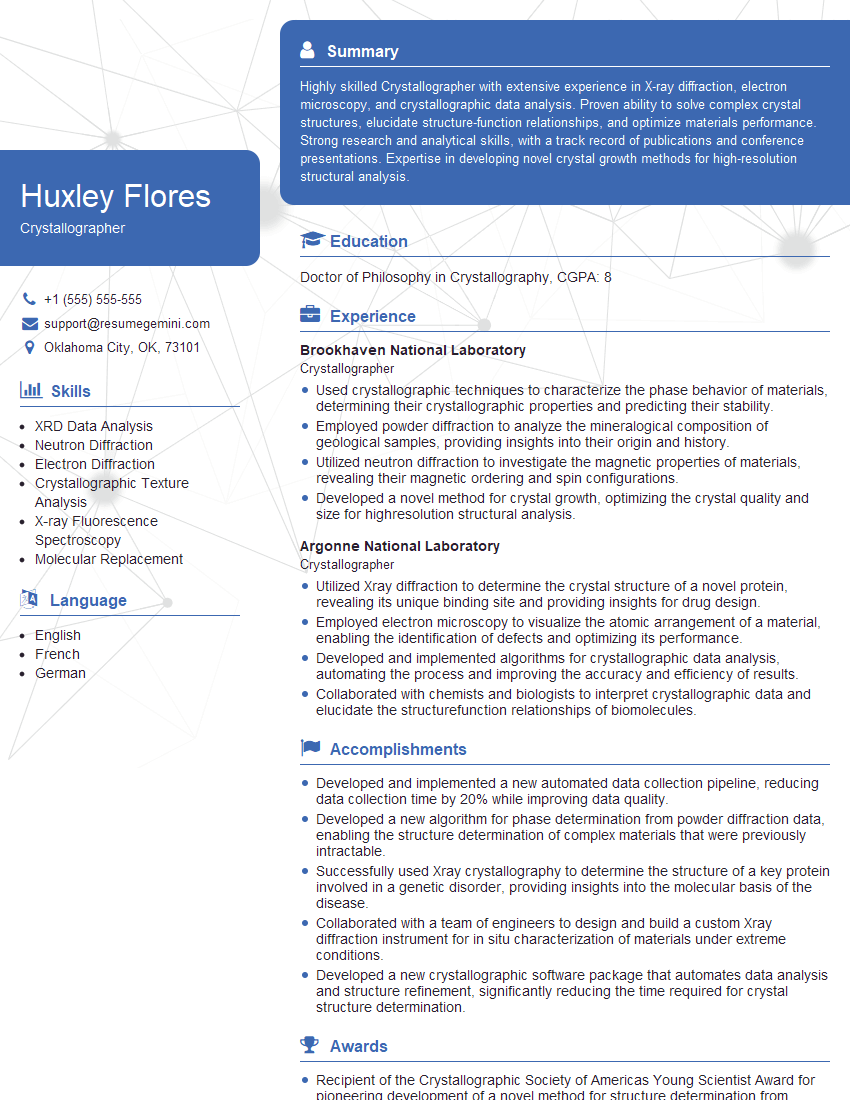
Mastering crystallography and diffraction is crucial for advancement in numerous scientific and engineering fields. A strong understanding of these concepts opens doors to exciting research opportunities and impactful career paths. To maximize your chances of landing your dream role, presenting your skills effectively is paramount. Creating an ATS-friendly resume is essential to ensure your application gets noticed by recruiters. We highly recommend using ResumeGemini to build a professional and compelling resume that highlights your expertise in crystallography and diffraction. ResumeGemini provides examples of resumes tailored to this specific field, helping you showcase your accomplishments and qualifications in the best possible light.



Explore more articles
Users Rating of Our Blogs
Share Your Experience
We value your feedback! Please rate our content and share your thoughts (optional).
What Readers Say About Our Blog
Very informative content, great job.
good