Preparation is the key to success in any interview. In this post, we’ll explore crucial Knowledge of Electrical Engineering Principles interview questions and equip you with strategies to craft impactful answers. Whether you’re a beginner or a pro, these tips will elevate your preparation.
Questions Asked in Knowledge of Electrical Engineering Principles Interview
Q 1. Explain Ohm’s Law and its applications.
Ohm’s Law is a fundamental principle in electrical engineering that describes the relationship between voltage, current, and resistance in a simple electrical circuit. It states that the current (I) flowing through a conductor is directly proportional to the voltage (V) applied across it and inversely proportional to its resistance (R). Mathematically, it’s represented as: V = IR
Applications: Ohm’s Law is incredibly versatile. Imagine designing a simple circuit with a 12V battery and a 6-ohm resistor. Using Ohm’s Law, we can easily calculate the current: I = V/R = 12V / 6Ω = 2A. This is crucial for selecting appropriate components (resistors, wires, etc.) that can handle the expected current without overheating or failing. It’s used extensively in circuit design, troubleshooting, and power calculations in countless electronic devices, from smartphones to power grids.
Another example: If you’re testing a device and measure a voltage and current, you can easily calculate the resistance (impedance in AC circuits, discussed later) of that component. This is a fundamental diagnostic technique in electrical troubleshooting.
Q 2. Describe Kirchhoff’s Laws and their significance in circuit analysis.
Kirchhoff’s Laws are two fundamental rules that govern the behavior of current and voltage in electrical circuits. They are invaluable for analyzing complex circuits that can’t be easily simplified using Ohm’s Law alone.
- Kirchhoff’s Current Law (KCL): The sum of currents entering a node (junction) in a circuit is equal to the sum of currents leaving that node. Think of it like a water pipe junction – the total water flowing in must equal the total water flowing out. This law reflects the conservation of charge.
- Kirchhoff’s Voltage Law (KVL): The sum of voltage drops around any closed loop in a circuit is equal to zero. Imagine walking around a closed loop in a circuit: the voltage gains (e.g., from batteries) will exactly offset the voltage drops (e.g., across resistors). This is a consequence of the conservation of energy.
Significance: These laws allow us to solve for unknown currents and voltages in complex circuits by setting up a system of equations. For example, consider a circuit with multiple resistors and voltage sources. By applying KCL and KVL, we can create a set of simultaneous equations to solve for the unknown currents in each branch. Software tools use these principles to automate circuit analysis.
Q 3. What are the different types of AC and DC motors, and their applications?
AC and DC motors are the workhorses of countless applications. The key difference is the type of power they use: Direct Current (DC) or Alternating Current (AC).
DC Motors:
- Brushed DC Motors: These are simpler, more economical motors with brushes that mechanically switch the current direction in the armature windings. They are commonly found in toys, tools, and some automotive applications. However, the brushes eventually wear out, limiting their lifespan.
- Brushless DC Motors (BLDC): These motors use electronic commutation instead of mechanical brushes, resulting in higher efficiency, longer life, and quieter operation. They are used in computer fans, electric vehicles, and high-precision robotics.
AC Motors:
- Induction Motors: These are the most common type of AC motor, robust and relatively inexpensive. They operate on the principle of electromagnetic induction – a rotating magnetic field induces current in the rotor, causing it to turn. Used extensively in industrial applications, appliances (fans, pumps), and HVAC systems.
- Synchronous Motors: These motors run at a speed directly proportional to the frequency of the AC power supply. They require a separate excitation source, often making them more complex but offering better speed regulation and power factor correction capabilities. Used in applications requiring precise speed control, such as clocks and high-precision machinery.
- Stepper Motors: These motors rotate in discrete steps, making them ideal for precise positioning control. They are commonly used in printers, CNC machines, and robotics.
The choice of motor depends heavily on the specific application requirements such as speed, torque, efficiency, cost, and maintenance needs.
Q 4. Explain the concept of impedance and its role in AC circuits.
In AC circuits, impedance (Z) is the overall opposition to the flow of current. Unlike resistance in DC circuits, impedance includes not only the resistance (R) but also the reactance (X), which accounts for the effects of capacitance (Xc) and inductance (XL). Reactance arises from the energy storage in capacitors and inductors. Capacitors oppose changes in voltage, while inductors oppose changes in current.
The impedance is calculated using the following formula (for a series RLC circuit): Z = √(R² + (XL - XC)²), where:
Ris resistance in ohms (Ω)XLis inductive reactance (XL = 2πfL, where f is frequency and L is inductance)XCis capacitive reactance (XC = 1/(2πfC), where f is frequency and C is capacitance)
Role in AC Circuits: Impedance is critical in determining the current flow in AC circuits, voltage drops across components, and power calculations. It is analogous to resistance in DC circuits, but it is frequency-dependent. For instance, a capacitor will have high impedance at low frequencies and low impedance at high frequencies.
Q 5. How do you calculate the power factor in an AC circuit?
The power factor (PF) in an AC circuit represents the ratio of true power (P) to apparent power (S). It indicates how effectively the power is being used. A power factor of 1 means the power is being used efficiently, while a lower power factor indicates reactive power (due to inductors and capacitors) is causing inefficiency. The formula is:
Power Factor (PF) = True Power (P) / Apparent Power (S) = cos(θ)
where θ is the phase angle between the voltage and current waveforms. Apparent power is calculated as S = VI (voltage times current), while true power is calculated as P = VI cos(θ). The angle θ can be determined using a phasor diagram or from the impedance calculation of the circuit.
Calculation Example: Let’s say you have a circuit with a voltage of 120V, a current of 5A, and a phase angle of 30 degrees. The apparent power is S = 120V * 5A = 600 VA. The true power is P = 600 VA * cos(30°) ≈ 519.6 W. The power factor is then PF = 519.6W / 600VA ≈ 0.866.
Low power factors can lead to higher energy bills and increased stress on electrical equipment. Power factor correction techniques, using capacitors or synchronous motors, are often employed to improve the power factor closer to 1.
Q 6. What are the different types of transformers and their uses?
Transformers are crucial components in electrical systems used to change the voltage of AC power. They operate based on the principle of electromagnetic induction.
- Step-Up Transformers: These increase the voltage from the primary winding to the secondary winding. They are used in power transmission lines to reduce power loss over long distances. The ratio of secondary voltage to primary voltage is greater than 1.
- Step-Down Transformers: These decrease the voltage from the primary to the secondary. They are used in homes and appliances to convert high-voltage transmission lines to safer lower voltages for use. The ratio of secondary voltage to primary voltage is less than 1.
- Isolation Transformers: These provide electrical isolation between the primary and secondary windings, creating a barrier that prevents current flow between them. This is crucial for safety reasons in some applications.
- Autotransformers: These have a single winding tapped at various points, providing different voltage ratios without complete electrical isolation. They are often smaller and lighter than two-winding transformers but do not provide the same level of isolation.
The choice of transformer type depends on the specific voltage requirements, safety considerations, and the application’s overall design. The turns ratio of a transformer determines the voltage transformation, and the power rating determines how much power it can handle.
Q 7. Describe the working principle of a three-phase induction motor.
A three-phase induction motor is a type of AC motor that operates on the principle of electromagnetic induction. It has a stator (stationary part) with three sets of windings, each carrying AC current at a different phase. This creates a rotating magnetic field within the stator.
Working Principle:
- Rotating Magnetic Field: The three-phase currents create a rotating magnetic field that sweeps around the stator. The speed of this rotating field depends on the frequency of the AC power supply.
- Induced Current in Rotor: This rotating magnetic field induces currents in the rotor conductors (usually copper bars or aluminum). These currents create their own magnetic field.
- Interaction of Magnetic Fields: The interaction between the rotating stator magnetic field and the induced rotor magnetic field produces a torque that causes the rotor to rotate.
- Slip: The rotor never quite reaches the speed of the rotating magnetic field; a small difference called “slip” is necessary to maintain the induced current and torque. This slip is typically only a few percent of synchronous speed.
Three-phase induction motors are widely used in industrial applications due to their robustness, reliability, and high efficiency. They require less maintenance than other motor types, making them a cost-effective solution for many power applications.
Q 8. Explain the concept of resonance in electrical circuits.
Resonance in electrical circuits occurs when the inductive and capacitive reactances cancel each other out at a specific frequency, resulting in a maximum current flow. Imagine a child on a swing; pushing at just the right frequency (resonance) maximizes the swing’s amplitude. Similarly, in an RLC circuit (containing resistance, inductance, and capacitance), at the resonant frequency, the impedance is at its minimum, allowing maximum current to flow. This resonant frequency (fr) is determined by the inductance (L) and capacitance (C) of the circuit and is calculated using the formula: fr = 1/(2π√(LC)). At frequencies above or below this resonant frequency, the impedance increases, and the current decreases.
Real-world applications of resonance are abundant. Radio receivers, for example, use tuned circuits (LC circuits) to select specific radio frequencies. By adjusting the capacitance or inductance, the resonant frequency of the circuit is changed, allowing you to ‘tune’ to different radio stations. Another example is in power supplies where resonant converters operate at a specific frequency for efficient energy transfer.
Q 9. What are different types of filters and their applications?
Electrical filters are circuits designed to allow specific frequencies to pass through while attenuating (reducing) others. Think of them as sieves for electrical signals.
- Low-pass filters: These allow low-frequency signals to pass while blocking high-frequency signals. Imagine a filter allowing only bass sounds to pass through your speakers.
- High-pass filters: These allow high-frequency signals to pass and block low-frequency signals. Think of a filter that removes the rumble (low frequencies) from your audio.
- Band-pass filters: These allow a specific range of frequencies to pass while attenuating frequencies both below and above that range. Imagine a radio receiver only allowing signals within the frequency of a specific radio station.
- Band-stop (notch) filters: These attenuate signals within a specific frequency range while allowing frequencies outside that range to pass. Think of removing a specific, unwanted tone from an audio signal.
Applications are widespread, including audio processing (equalizers), radio communication (selective tuning), power supply filtering (removing unwanted harmonics), and signal processing in various electronic systems.
Q 10. Explain the operation of a simple transistor amplifier.
A simple transistor amplifier uses a bipolar junction transistor (BJT) to amplify a weak input signal into a stronger output signal. Imagine a lever; a small force on one end results in a larger force on the other. The transistor acts similarly, using a small current to control a larger current.
In a common-emitter configuration, a small base current (IB) controls a much larger collector current (IC). The input signal is applied to the base, and the amplified output signal is taken from the collector. The transistor acts as a current-controlled switch, changing the collector current proportionally to the input signal. A resistor and capacitor network usually provide the necessary biasing and coupling to the input and output signals. The amplification is determined by the transistor’s current gain (β).
A practical example is an audio amplifier in a sound system. The weak signal from a microphone or instrument is amplified by a transistor circuit to drive the speakers.
Q 11. Describe different types of semiconductor devices and their characteristics.
Semiconductor devices are made from materials with electrical conductivity between that of conductors (like copper) and insulators (like rubber). Their properties can be manipulated through doping (adding impurities). Key types include:
- Diodes: These allow current to flow in only one direction. Think of a one-way valve for electricity, essential for rectification (converting AC to DC).
- Transistors (Bipolar Junction Transistors (BJTs) and Field-Effect Transistors (FETs)): These act as electronic switches and amplifiers, crucial components in almost all electronic circuits.
- Integrated Circuits (ICs): These contain numerous transistors and other components on a single chip, forming complex circuits like microprocessors and memory.
- Thyristors: These are high-power switching devices used in applications like motor control and power electronics.
Their characteristics are defined by parameters such as current and voltage ratings, switching speed, gain (for transistors), and operating temperature range.
Q 12. Explain the concept of Boolean algebra and its application in digital logic design.
Boolean algebra is a mathematical system dealing with binary variables (0 and 1, representing true and false). It’s the foundation of digital logic design. Think of it as a simplified algebra for ones and zeros.
It utilizes logic operations like AND, OR, and NOT to manipulate these variables. For example, the AND operation results in 1 only when both inputs are 1; the OR operation results in 1 if at least one input is 1; and the NOT operation inverts the input (0 becomes 1, and 1 becomes 0). These operations are combined to create complex logic functions. This allows us to represent and design digital circuits using simple algebraic equations.
Applications include designing digital circuits, simplifying logic expressions, and developing algorithms for computer systems. A simple example is a security system: only if the door is closed (0) AND the alarm is set (1) is the system secure (1).
Q 13. What are different types of logic gates and their truth tables?
Logic gates are fundamental building blocks of digital circuits, implementing Boolean operations. Each gate performs a specific Boolean function on its inputs.
- AND gate: Output is 1 only if all inputs are 1. Truth table:
Input A | Input B | Output
------- | -------- | --------
0       | 0        | 0
0       | 1        | 0
1       | 0        | 0
1 | 1 | 1 - OR gate: Output is 1 if at least one input is 1. Truth table:
Input A | Input B | Output
------- | -------- | --------
0       | 0        | 0
0       | 1        | 1
1       | 0        | 1
1 | 1 | 1 - NOT gate (inverter): Output is the inverse of the input. Truth table:
Input   | Output
------- | --------
0       | 1
1 | 0 - XOR gate (exclusive OR): Output is 1 if only one input is 1. Truth table:
Input A | Input B | Output
------- | -------- | --------
0       | 0        | 0
0       | 1        | 1
1       | 0        | 1
1 | 1 | 0 - NAND gate (NOT AND): Output is the inverse of the AND gate.
- NOR gate (NOT OR): Output is the inverse of the OR gate.
These gates are combined to create more complex circuits like adders, multiplexers, and memory elements.
Q 14. Explain the working principle of a microcontroller.
A microcontroller is a small, programmable computer on a single integrated circuit (IC). Imagine a tiny, specialized computer embedded in a device to control its functions.
It contains a central processing unit (CPU), memory (both RAM and ROM), input/output (I/O) ports, and timers, all integrated onto one chip. The CPU executes instructions stored in the program memory (ROM), processes input from sensors and other peripherals through the I/O ports, and controls output devices such as motors and LEDs. The microcontroller’s actions are defined by the program written and uploaded into its memory.
Microcontrollers are found in countless embedded systems, such as washing machines, automobiles, medical devices, industrial control systems, and many consumer electronics. They provide the intelligence and control capabilities needed to perform specific tasks within a device.
Q 15. Describe different types of sensors and their applications.
Sensors are transducers that convert physical phenomena into electrical signals. There’s a vast array of sensor types, each suited to specific applications. Let’s look at a few key categories:
- Temperature Sensors: These measure temperature. Thermocouples (based on the Seebeck effect), thermistors (resistance changes with temperature), and RTDs (Resistance Temperature Detectors) are common examples. Applications include industrial process control, automotive engine management, and weather monitoring.
- Pressure Sensors: These convert pressure into an electrical signal. Strain gauge-based pressure sensors, capacitive pressure sensors, and piezoelectric sensors are frequently used. Applications include tire pressure monitoring systems, weather forecasting, and industrial process control.
- Light Sensors: Photoresistors (resistance changes with light intensity), photodiodes (generate current proportional to light), and phototransistors (amplified photodiode) are examples. They find use in cameras, automatic lighting systems, and robotics.
- Position Sensors: These measure the position or displacement of an object. Potentiometers, encoders (rotary and linear), and LVDTs (Linear Variable Differential Transformers) are some common types. Applications range from robotic arms to automotive throttle position sensing.
- Accelerometers: These measure acceleration. Piezoelectric accelerometers and MEMS (Microelectromechanical Systems) accelerometers are widely used. Applications include airbag deployment systems, inertial navigation, and motion detection in smartphones.
The choice of sensor depends heavily on factors like required accuracy, operating environment, cost, and power consumption. For instance, while thermocouples are robust and can measure high temperatures, they might not be as accurate as RTDs.
Career Expert Tips:
- Ace those interviews! Prepare effectively by reviewing the Top 50 Most Common Interview Questions on ResumeGemini.
- Navigate your job search with confidence! Explore a wide range of Career Tips on ResumeGemini. Learn about common challenges and recommendations to overcome them.
- Craft the perfect resume! Master the Art of Resume Writing with ResumeGemini’s guide. Showcase your unique qualifications and achievements effectively.
- Don’t miss out on holiday savings! Build your dream resume with ResumeGemini’s ATS optimized templates.
Q 16. What are different types of communication protocols used in embedded systems?
Embedded systems utilize various communication protocols for data exchange. The choice depends on factors like data rate, distance, power consumption, and cost. Here are some prominent examples:
- I2C (Inter-Integrated Circuit): A two-wire serial bus commonly used for short-distance communication between microcontrollers and peripherals. It’s simple, low-cost, and power-efficient.
- SPI (Serial Peripheral Interface): Another popular serial bus characterized by its high speed and full-duplex communication (simultaneous sending and receiving). It’s often used for high-speed data transfer between microcontrollers and peripherals like sensors and displays.
- UART (Universal Asynchronous Receiver/Transmitter): A simple serial communication protocol often used for debugging and low-speed data transmission. It’s prevalent in older systems and simpler embedded applications.
- CAN (Controller Area Network): A robust and reliable protocol designed for real-time control applications, commonly found in automotive systems. It features message prioritization and error detection.
- Ethernet: A widely used network protocol offering high bandwidth and long-distance communication. Embedded systems often use Ethernet for networking and data acquisition over larger distances.
- USB (Universal Serial Bus): A versatile standard supporting various data rates and power delivery. It is used extensively for connecting peripherals to embedded systems, particularly for data storage and human-machine interfaces.
- Bluetooth: A short-range wireless communication technology commonly employed for connecting peripherals wirelessly. It’s ideal for low-power applications.
- Wi-Fi: A wireless networking technology used for connecting embedded systems to the internet or local area networks. It enables remote monitoring and control.
Selecting the appropriate protocol requires a careful consideration of the application’s specific requirements.
Q 17. Explain the concept of grounding and its importance in electrical systems.
Grounding is the process of connecting a point in an electrical system to the earth. It serves several crucial functions:
- Safety: Grounding provides a low-impedance path for fault currents to flow to the earth, preventing dangerous voltage buildup on exposed metal parts. This minimizes the risk of electric shock.
- Noise Reduction: Grounding helps reduce electromagnetic interference (EMI) by providing a common reference potential for different parts of the system. This is critical in sensitive electronic circuits.
- Lightning Protection: Grounding protects equipment from damage caused by lightning strikes by diverting the surge current to the earth.
- System Stability: Grounding aids in stabilizing the system voltage and preventing voltage surges or imbalances.
Imagine a scenario where a live wire comes into contact with a metal chassis of an appliance. If the appliance is properly grounded, the fault current will flow to earth through the grounding wire, tripping a circuit breaker or fuse, preventing electric shock. Without grounding, the chassis could become energized, posing a severe hazard.
Q 18. Describe different types of protection devices used in electrical systems.
Protection devices safeguard electrical systems from overloads, short circuits, and other faults. Here are some key examples:
- Fuses: These are simple and inexpensive devices containing a thin wire that melts and breaks the circuit when excessive current flows. They are typically one-time use.
- Circuit Breakers: These are electromechanical switches that automatically trip and interrupt the circuit when an overload or short circuit is detected. They can be reset and reused.
- Relays: Electromagnetic switches that open or close a circuit in response to a control signal. They’re used in various protection schemes, often as part of more sophisticated protection systems.
- Ground Fault Circuit Interrupters (GFCIs): These detect small leakage currents to ground, rapidly tripping the circuit to prevent electric shock. They are essential in wet locations.
- Surge Arresters: These divert high-voltage surges caused by lightning or switching transients away from sensitive equipment, protecting it from damage.
- Overcurrent Relays: These are more sophisticated devices that monitor current and trip the circuit breaker when excessive current persists for a specified time. They can provide more precise protection than simple fuses or circuit breakers.
The type of protection device used depends on the application and the level of protection required. For example, GFCIs are mandated in bathrooms and kitchens to minimize the risk of electric shock.
Q 19. How to analyze faults in an electrical circuit?
Fault analysis in electrical circuits involves systematically identifying the cause of a malfunction. The process generally involves:
- Visual Inspection: Start with a visual inspection of the circuit, looking for obvious signs of damage like burnt components, loose connections, or physical damage.
- Schematic Diagram Review: Carefully examine the circuit schematic to understand the intended functionality and identify potential weak points or vulnerable components.
- Measurement Techniques: Use multimeters to measure voltages, currents, and resistances at various points in the circuit. This helps pinpoint the location and type of fault (open circuit, short circuit, etc.).
- Systematic Isolation: Isolate sections of the circuit to narrow down the area where the fault resides. This can involve disconnecting components or using a process of elimination.
- Logic Analysis (for complex systems): For complex circuits, logic analyzers or oscilloscopes might be used to monitor signals and identify timing issues or logic errors.
- Component Testing: Once a faulty component is identified, test it individually to confirm that it’s the source of the problem.
Consider a scenario where a circuit doesn’t work. A multimeter can reveal if there’s a short circuit (low resistance), an open circuit (infinite resistance), or a faulty component showing incorrect voltage or current levels. Tracing the problem systematically is key.
Q 20. Explain the difference between short circuit and open circuit.
A short circuit and an open circuit represent opposite types of faults in electrical circuits:
- Short Circuit: A short circuit occurs when there’s an unintended low-resistance path between two points in a circuit that are supposed to be at different potentials. This causes an excessive current flow, often leading to overheating and damage to components or even a fire. Think of it as creating a direct connection between the positive and negative terminals of a battery.
- Open Circuit: An open circuit occurs when the intended path for current flow is broken, creating an infinite resistance. No current can flow through the affected part of the circuit. This is like a broken wire or a failed component.
A short circuit is like a flood – excessive current flows where it shouldn’t. An open circuit is like a blocked pipe – no current can flow at all. Understanding the difference is critical for troubleshooting electrical circuits effectively.
Q 21. What are the safety precautions to be followed while working with high voltage systems?
Working with high-voltage systems presents significant safety risks, necessitating strict adherence to precautions:
- Lockout/Tagout Procedures: Always use lockout/tagout procedures to de-energize the system completely before working on it. This ensures that power cannot be accidentally restored.
- Personal Protective Equipment (PPE): Wear appropriate PPE, including insulated gloves, safety glasses, and arc-flash protective clothing to protect against electric shock and arc flashes.
- Proper Training and Supervision: Only qualified and trained personnel should work with high-voltage systems, and adequate supervision should be provided.
- Insulated Tools: Use insulated tools and equipment to prevent electric shock.
- Grounding and Bonding: Ensure proper grounding and bonding to protect against voltage surges and electrical hazards.
- Emergency Procedures: Familiarize yourself with emergency procedures and have a readily available emergency response plan.
- Voltage Testing: Verify that the system is indeed de-energized using a reliable voltage tester before commencing any work.
- Awareness of Surroundings: Be aware of your surroundings and avoid working in wet or damp conditions.
High-voltage work is inherently dangerous. Neglecting safety precautions can lead to severe injury or even death. Thorough training and a meticulous approach are paramount.
Q 22. Explain the concept of electromagnetic interference (EMI) and how to mitigate it.
Electromagnetic Interference (EMI) is the disruption of the operation of an electronic device caused by an external electromagnetic field. Imagine it like a radio station’s signal being interrupted by static – that static is EMI. It arises from unwanted electromagnetic radiation or conducted interference, affecting electronic circuits by inducing unwanted currents or voltages.
Mitigating EMI involves a multi-pronged approach. Shielding is crucial – using conductive enclosures to block electromagnetic waves. Filtering, employing capacitors and inductors to block specific frequency ranges of interference, is another key technique. Proper grounding minimizes conducted interference by providing a low-impedance path for stray currents. Careful circuit design, including techniques like using twisted-pair wiring to reduce radiated emissions, is equally important. Consideration of cable routing and the placement of components also minimizes unintended coupling. For instance, keeping high-frequency circuits away from sensitive analog circuits can significantly reduce interference.
In a real-world scenario, think about a hospital’s sensitive medical equipment. EMI from nearby power lines or other devices could be fatal. Shielding and filtering are critical in ensuring the reliable operation of life-saving equipment.
Q 23. Describe the different types of power generation systems.
Power generation systems can be broadly classified into several types based on their primary energy source:
- Thermal Power Plants: These utilize heat from burning fossil fuels (coal, natural gas, oil) or nuclear fission to generate steam, which drives turbines connected to generators. They are relatively mature technologies but contribute significantly to greenhouse gas emissions.
- Hydroelectric Power Plants: These harness the energy of flowing water to drive turbines. They are environmentally friendly but require suitable geographical locations with sufficient water flow.
- Wind Power Plants: Wind turbines convert the kinetic energy of wind into electricity. They are clean and renewable, but their output is intermittent and depends on wind conditions.
- Solar Power Plants: Photovoltaic (PV) cells directly convert sunlight into electricity, while concentrated solar power (CSP) systems use mirrors to focus sunlight to heat a fluid, which drives a turbine. These are renewable but their efficiency is affected by weather conditions and require large land areas.
- Geothermal Power Plants: These utilize heat from the Earth’s interior to generate steam or hot water. They are renewable but their geographical limitations restrict their widespread application.
- Nuclear Power Plants: Nuclear fission is used to produce heat, similar to thermal power plants, but without the greenhouse gas emissions. However, concerns about nuclear waste disposal and safety remain.
The choice of power generation system depends on factors like environmental impact, cost, availability of resources, and geographical location.
Q 24. What are the advantages and disadvantages of different types of power transmission lines?
Different power transmission lines have various advantages and disadvantages:
- Overhead Transmission Lines: These are the most common type, using high-voltage conductors suspended on towers. They are relatively inexpensive to build, but susceptible to weather damage, visual pollution, and right-of-way issues. They are efficient for long-distance transmission due to the lower resistance of the conductors.
- Underground Transmission Lines: These use cables buried underground. They have a lower visual impact and are less susceptible to weather damage. However, they are significantly more expensive to install and maintain, and their thermal capacity is often limited. Fault location and repair are more complex.
The selection between overhead and underground transmission lines involves a trade-off between cost, environmental impact, reliability, and maintenance considerations. For example, in densely populated urban areas, underground lines are often preferred despite their higher cost, while long-distance power transmission favors overhead lines for their efficiency and lower cost.
Q 25. Explain the concept of power system stability.
Power system stability refers to the ability of a power system to maintain its synchronism under normal operating conditions and following disturbances. Think of it like a group of dancers maintaining their synchronized movements – even when something unexpected happens, they need to quickly adjust and regain their coordination. In a power system, this means maintaining the correct voltage and frequency throughout the grid, even when facing load changes, equipment failures, or other disruptions.
Loss of synchronism can lead to cascading failures, widespread blackouts, and significant economic damage. Power system stability is addressed through various measures including proper generator control, adequate transmission capacity, and sophisticated protection and control systems that quickly respond to disturbances.
Q 26. Describe different types of control systems and their applications.
Control systems are broadly classified into several types:
- Open-loop Control Systems: These systems do not use feedback to correct errors. The output is solely determined by the input. Think of a simple toaster – you set the time, and it operates without monitoring the bread’s browning level.
- Closed-loop Control Systems (Feedback Control Systems): These systems use feedback to compare the actual output with the desired output and adjust the input accordingly. A thermostat is a good example; it measures the temperature and adjusts the heating accordingly.
- Linear Control Systems: These systems exhibit a linear relationship between input and output. Mathematical tools like Laplace transforms are readily applicable for analysis and design.
- Nonlinear Control Systems: These systems have a nonlinear relationship between input and output. They are often more complex to analyze and design.
- Digital Control Systems: These systems use digital computers to implement control algorithms. They offer flexibility and precision.
- Analog Control Systems: These systems use analog circuits to implement control algorithms.
Applications span diverse fields, from industrial automation (robotics, process control) and aerospace (flight control, satellite navigation) to biomedical engineering (prosthetic limbs, drug delivery systems) and consumer electronics.
Q 27. Explain the concept of feedback control and its importance.
Feedback control is a fundamental concept in control systems engineering. It involves continuously measuring the output of a system, comparing it to the desired output (the setpoint), and using the difference (the error) to adjust the system’s input. This closed-loop system ensures that the system’s output remains close to the desired value, even in the presence of disturbances. It’s like a self-correcting mechanism.
Its importance is paramount. Feedback control enhances system accuracy, stability, and robustness. Without feedback, even minor disturbances can cause significant deviations from the desired output. Feedback control makes systems less sensitive to variations in the environment and to uncertainties in the system’s parameters. For instance, in a temperature control system, feedback ensures that the temperature remains stable despite external factors influencing the room’s heat loss.
Q 28. How to design a simple control system?
Designing a simple control system involves several steps:
- Define the system: Clearly specify the system to be controlled, its inputs, outputs, and desired behavior.
- Develop a model: Create a mathematical model to represent the system’s dynamics. This could involve transfer functions or state-space representations.
- Choose a control strategy: Select an appropriate control algorithm based on the system requirements. For example, a proportional-integral-derivative (PID) controller is a common choice for its simplicity and effectiveness.
- Design the controller: Tune the controller parameters to achieve the desired performance. This often involves experimentation and iterative refinement.
- Implement and test: Implement the control system using hardware or software and thoroughly test its performance under various operating conditions.
A simple example would be designing a temperature controller for a small room. You’d need a temperature sensor, a heater, and a microcontroller to implement a PID control algorithm. The controller would compare the measured temperature to the setpoint and adjust the heater accordingly. Testing would involve checking the controller’s response to changes in the setpoint, external temperature fluctuations, and potential heater malfunctions.
Key Topics to Learn for Knowledge of Electrical Engineering Principles Interview
Ace your Electrical Engineering interview by mastering these fundamental concepts. Remember, understanding the “why” behind the theory is just as important as knowing the “how”.
- Circuit Analysis: Understand DC and AC circuit analysis techniques, including Kirchhoff’s laws, Thevenin and Norton theorems, and mesh/nodal analysis. Practical Application: Designing efficient power distribution systems or analyzing the performance of electronic circuits.
- Electromagnetism: Grasp fundamental principles like Faraday’s law, Lenz’s law, and Ampere’s law. Practical Application: Designing transformers, motors, and generators; understanding electromagnetic interference (EMI).
- Power Systems: Familiarize yourself with power generation, transmission, and distribution systems, including different types of power plants and transmission lines. Practical Application: Working on renewable energy projects, grid management, or power system optimization.
- Control Systems: Understand feedback control systems, transfer functions, and stability analysis. Practical Application: Designing automated systems for industrial processes, robotics, or aerospace applications.
- Digital Logic and Electronics: Be comfortable with Boolean algebra, logic gates, flip-flops, and digital circuit design. Practical Application: Designing embedded systems, microcontrollers, and digital signal processing (DSP) systems.
- Signals and Systems: Understand signal processing techniques, Fourier transforms, and Laplace transforms. Practical Application: Working with communication systems, image processing, or audio processing.
Next Steps
A strong understanding of Electrical Engineering principles is crucial for career advancement, opening doors to exciting opportunities in various sectors. To maximize your job prospects, it’s vital to present your skills effectively. Crafting an ATS-friendly resume is key – it ensures your application gets noticed by recruiters and hiring managers. ResumeGemini is a trusted resource to help you build a professional and impactful resume that highlights your expertise. We provide examples of resumes tailored specifically to showcase Knowledge of Electrical Engineering Principles, helping you stand out from the competition.

Telecommunications Engineer Resume Sample
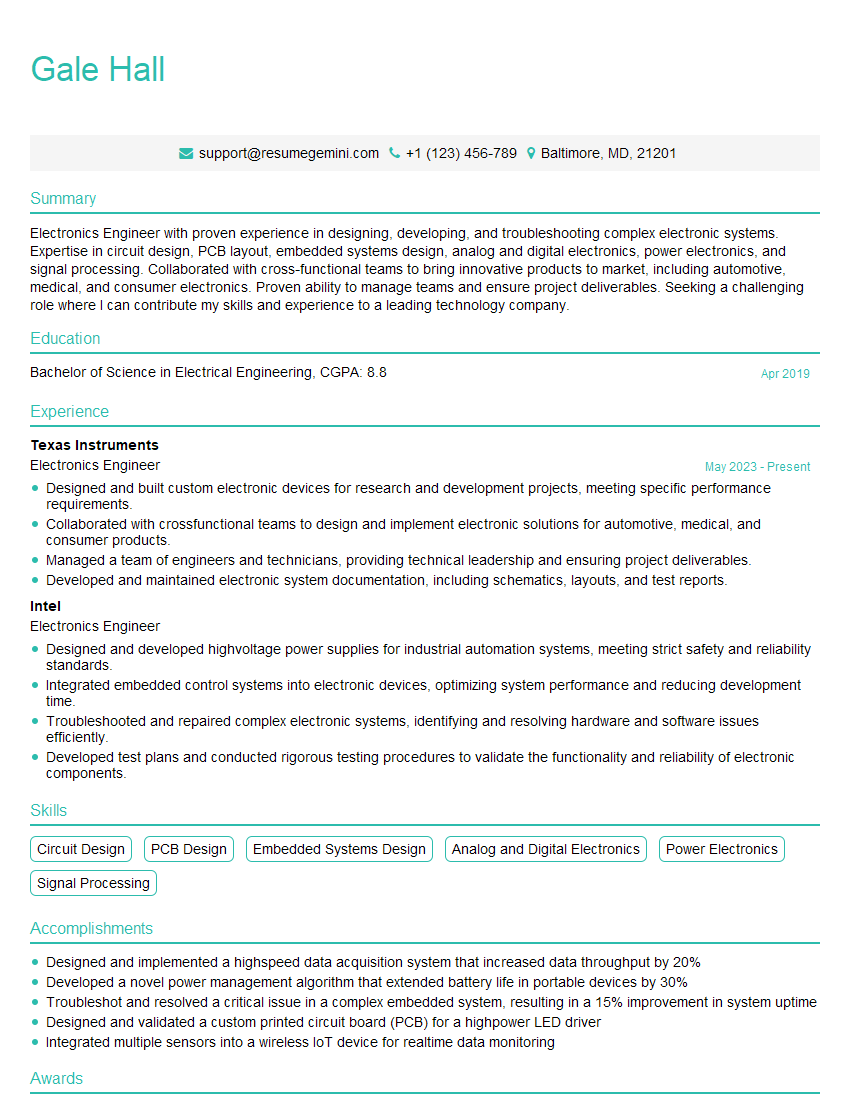
Electronics Engineer Resume Sample

Hardware Engineer Resume Sample
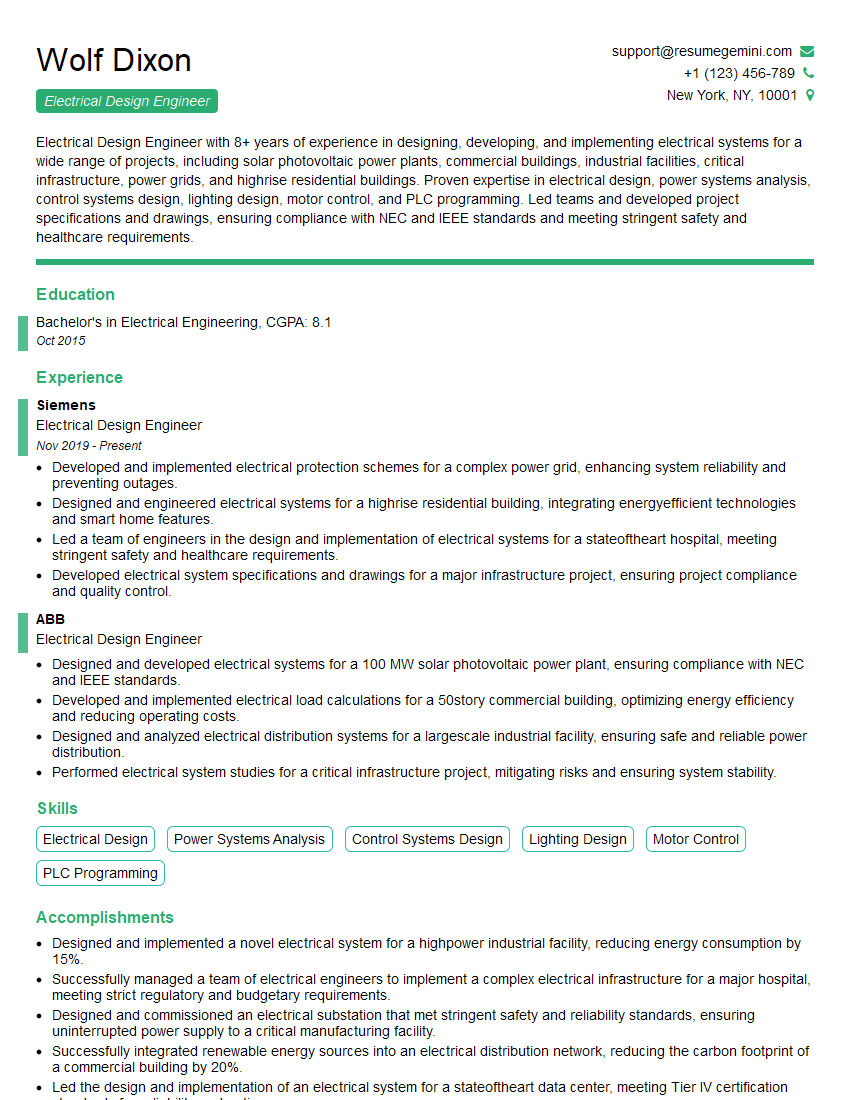
Electrical Design Engineer Resume Sample
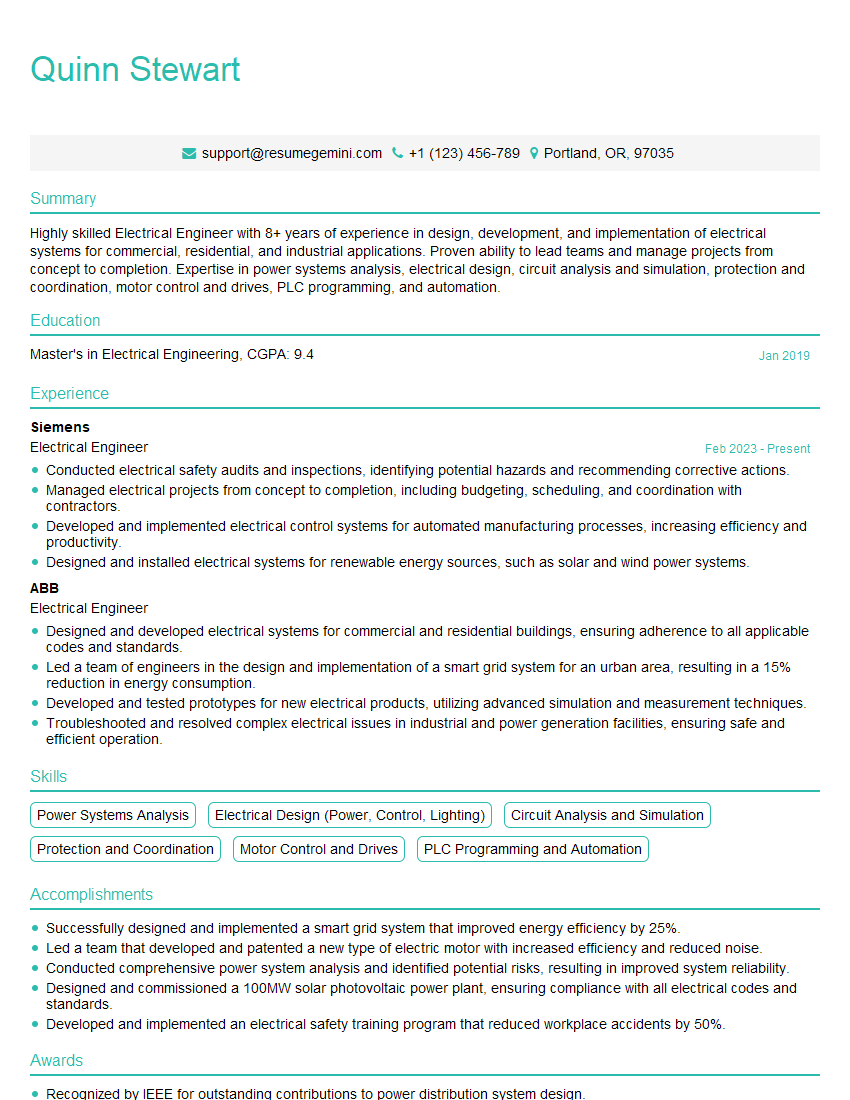
Electrical Engineer Resume Sample
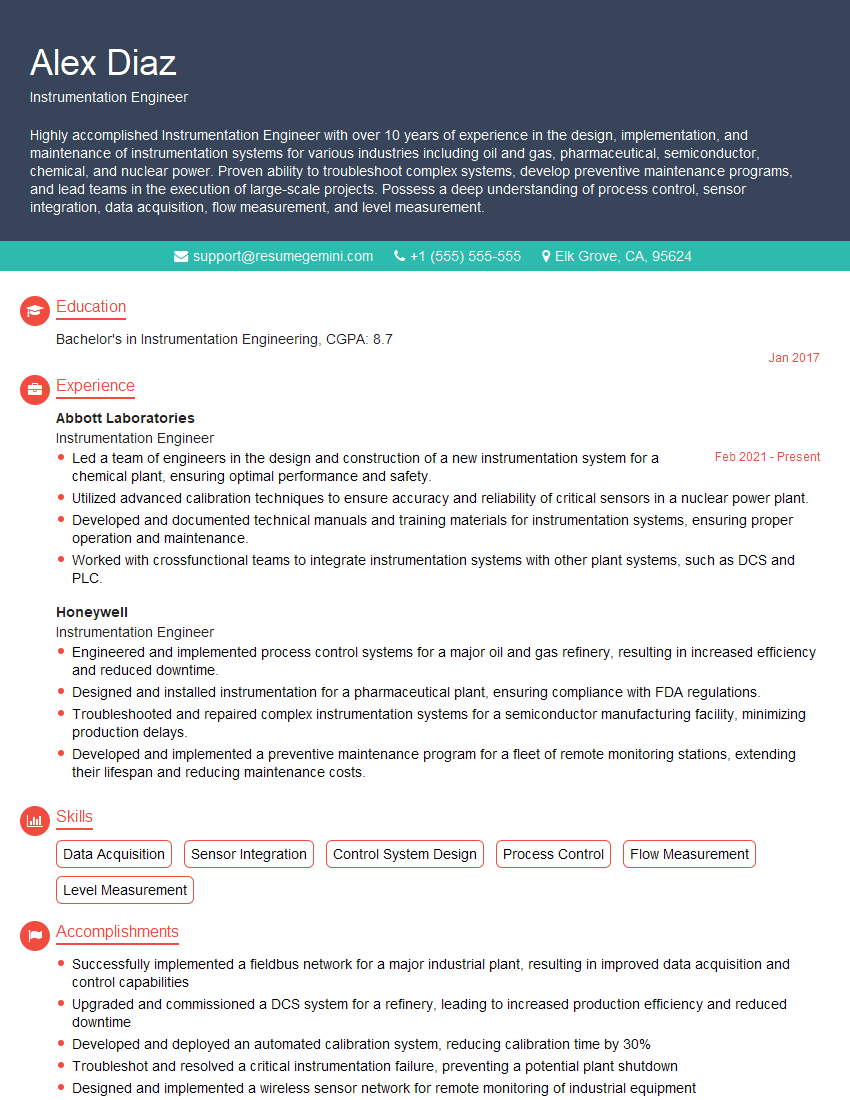
Instrumentation Engineer Resume Sample
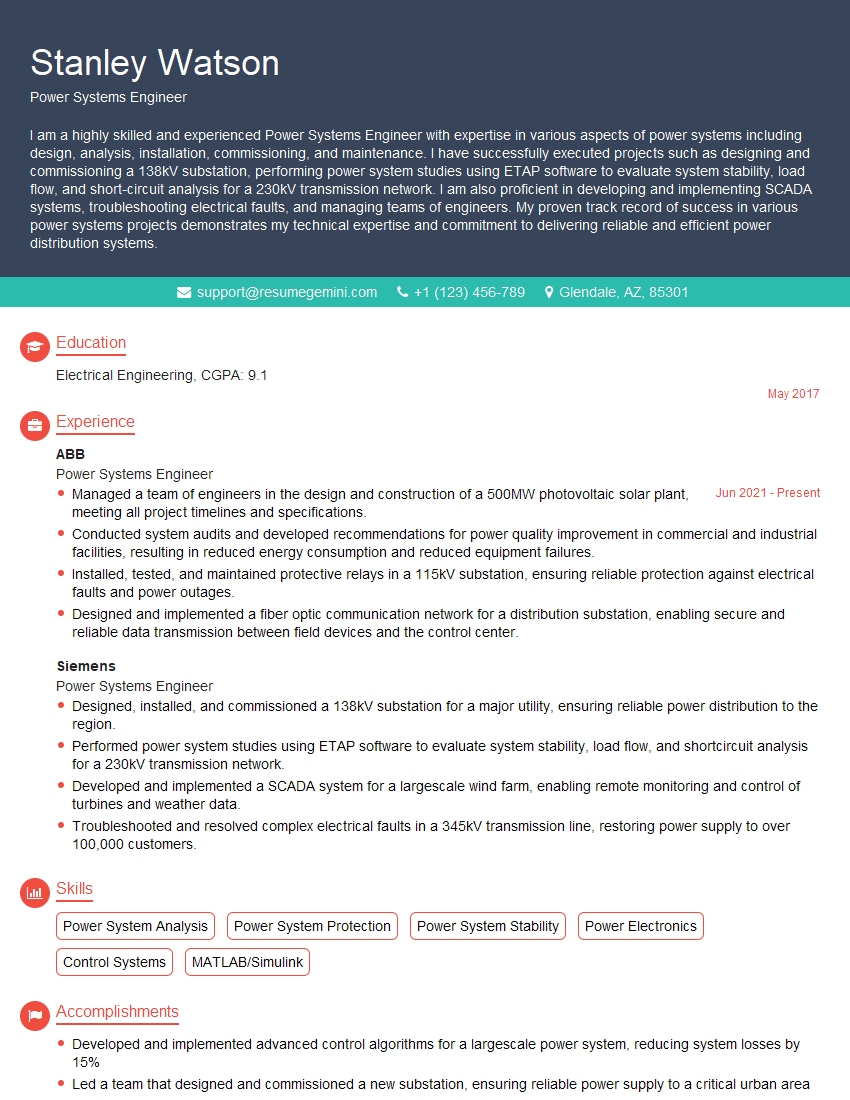
Power Systems Engineer Resume Sample

Circuit Design Engineer Resume Sample
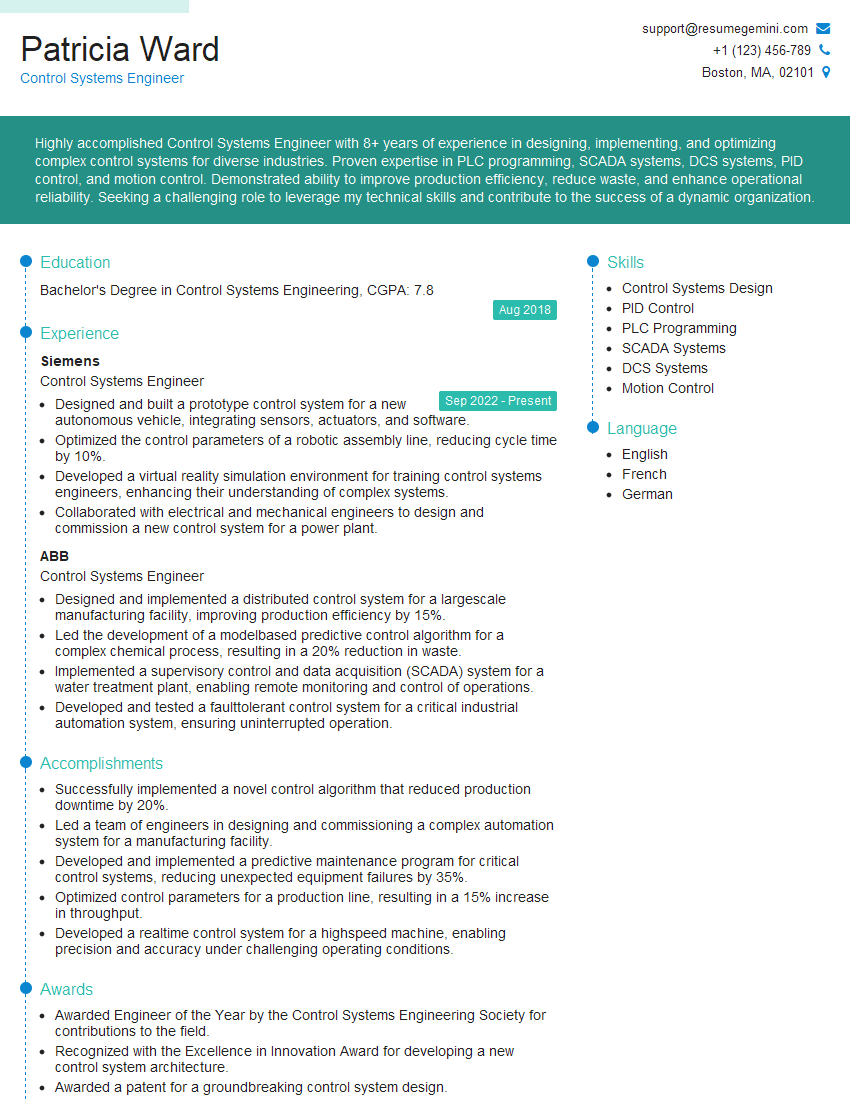
Control Systems Engineer Resume Sample

Robotics Engineer Resume Sample
Explore more articles
Users Rating of Our Blogs
Share Your Experience
We value your feedback! Please rate our content and share your thoughts (optional).
What Readers Say About Our Blog
Very informative content, great job.
good